Judges 2:21

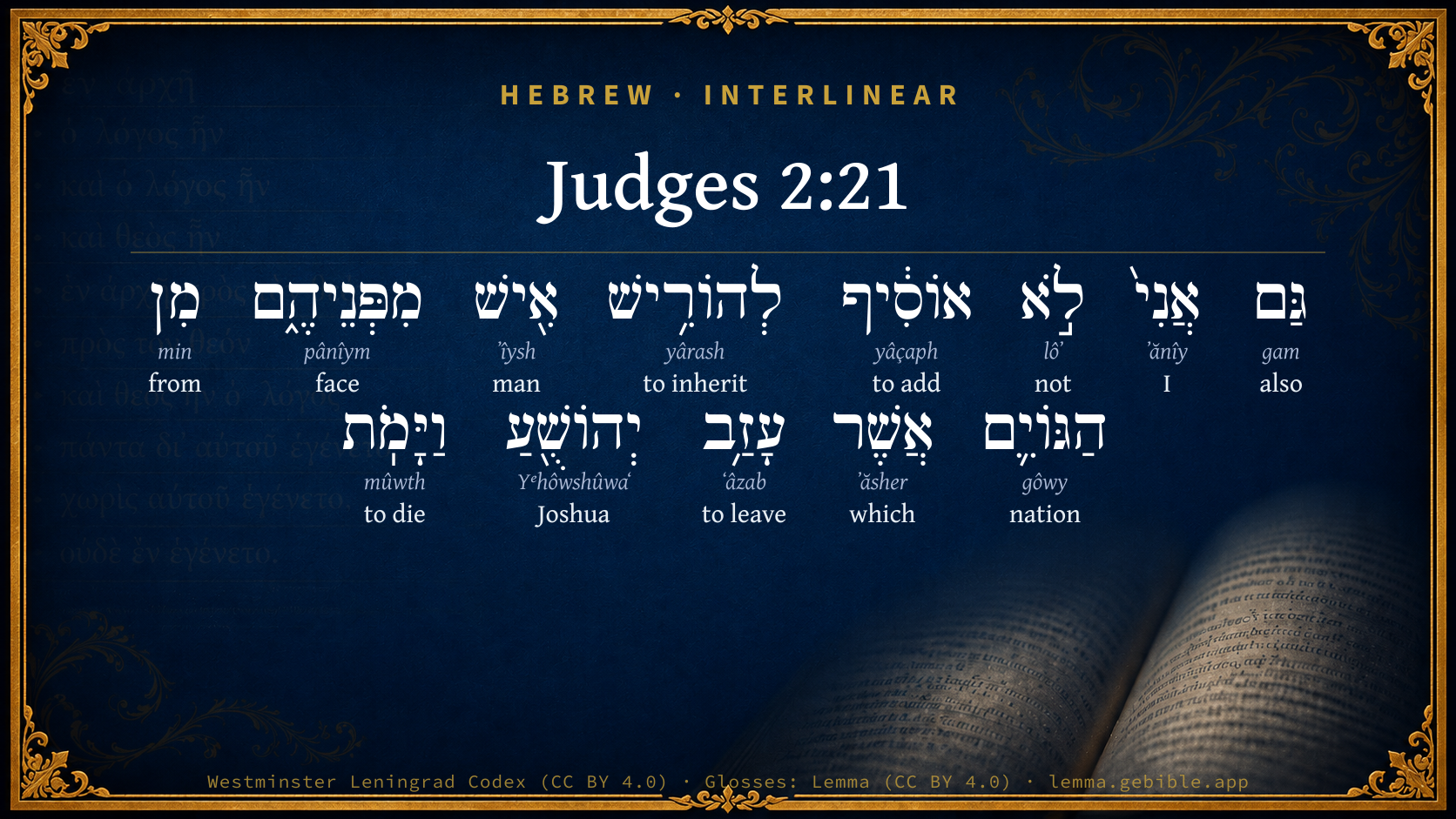
Hebrew (Westminster Leningrad Codex) Judges 2:21 appears in the Hebrew Old Testament. The text above is from the Westminster Leningrad Codex. Each word links to its Strong’s number, a concise gloss, and parsing drawn from the Open Scriptures Hebrew Bible morphology. Click any word for its full Brown-Driver-Briggs (BDB) entry.
Download image
Cite this verse

Judges 2:21 (World English Bible). Public Domain. Lemma interlinear Bible study tool, https://lemma.gebible.app/v/judges/2/21.

Show BibTeX & RIS
BibTeX
RIS
English Translation
I also will not henceforth drive out any from before them of the nations that Joshua left when he died;
World English Bible · Public Domain
Download a study sheet

One document with this verse’s original text, its word-by-word gloss line, the meaning frame, cross-references with their text, attributed commentary, and full source and license credits — printable, and it pastes into notes with its structure intact.

This verse Autodidact and up

Study sheet (.html) Plain text (.txt)

A passage Seminary Student

Up to 50 verses in one chapter. A passage sheet keeps up to 6 commentary sources and 12 cross-references per verse, in the order this page ranks them, and says so on the sheet whenever that leaves anything out. Ask for a single verse and you get the Autodidact verse sheet above.

Everything on this page stays free to read, with no account — the sheet is a download of what is already on screen, not access to it.

Want to remove ads? Support Godless Engineer
Compare translations 3

The same verse in 3 English versions, stacked beneath the original-language interlinear above. Click any original word for its lexicon entry.

Each is an independent rendering of the whole verse — the interlinear is not word-aligned to these translations.

Highlighted words mark where these versions differ — a whole-verse word diff, not a word-by-word alignment.

  • World English Bible Public Domain
    I also will not henceforth drive out any from before them of the nations that Joshua left when he died;
  • King James Version Public Domain
    I also will not henceforth drive out any from before them of the nations which Joshua left when he died:
  • unfoldingWord Literal Text CC BY-SA 4.0
    I also will not continue to dispossess from the face of them any of the nations that Joshua left when he died,

unfoldingWord Literal Text — © unfoldingWord, licensed CC BY-SA 4.0. Word-aligned USFM3 via Door43 (git.door43.org/unfoldingWord/en_ult).

Versions to compare (up to 4)

3 of 4 selected

Show all 18 translations

Every available English version of this verse, each an independent rendering of the whole verse.

  • World English Bible Public Domain
    I also will not henceforth drive out any from before them of the nations that Joshua left when he died;
  • Berean Standard Bible Public Domain
    I will no longer drive out before them any of the nations Joshua left when he died.
  • Majority Standard Bible Public Domain
    I will no longer drive out before them any of the nations Joshua left when he died.
  • King James Version Public Domain
    I also will not henceforth drive out any from before them of the nations which Joshua left when he died:
  • American Standard Version (1901) Public Domain
    I also will not henceforth drive out any from before them of the nations that Joshua left when he died;
  • Revised Version (1885) Public Domain
    I also will not henceforth drive out any from before them of the nations which Joshua left when he died:
  • Geneva Bible (1599) Public Domain
    Therefore will I no more cast out before them any of the nations, which Ioshua left when he dyed,
  • Douay-Rheims (1899) Public Domain
    I also will not destroy the nations which Josue left, when he died:
  • Young's Literal Translation Public Domain
    I also continue not to dispossess any from before them of the nations which Joshua hath left when he dieth,
  • Literal Standard Version CC BY-SA 4.0
    I also do not continue to dispossess any from before them of the nations which Joshua has left when he dies,
  • Unlocked Literal Bible CC BY-SA 4.0
    I will not, from now on, drive out from before them any of the nations that Joshua left when he died.
  • unfoldingWord Literal Text CC BY-SA 4.0
    I also will not continue to dispossess from the face of them any of the nations that Joshua left when he died,
  • Darby Bible Public Domain
    I will not henceforth drive out before them any of the nations that Joshua left when he died,
  • World Messianic Bible Public Domain
    I also will no longer drive out any of the nations that Joshua left when he died from before them;
  • Webster's Bible Public Domain
    I also will not henceforth drive out from before them any of the nations which Joshua left when he died:
  • Free Bible Version CC BY-SA 4.0
    from now on I won't drive out before them any of the nations Joshua left when he died.
  • Bible in Basic English Public Domain
    From now on I will not go on driving out from before them any of the nations which at the death of Joshua were still living in this land;
  • JPS Tanakh (1917) Public Domain
    I also will not henceforth drive out any from before them of the nations that Joshua left when he died;

Literal Standard Version (2020), Covenant Press — licensed CC BY-SA 4.0. Text via the HelloAO Bible API (eBible.org). Unlocked Literal Bible (unfoldingWord) — licensed CC BY-SA 4.0. Text via the HelloAO Bible API (eBible.org). unfoldingWord Literal Text — © unfoldingWord, licensed CC BY-SA 4.0. Word-aligned USFM3 via Door43 (git.door43.org/unfoldingWord/en_ult). Free Bible Version, Dr. Jonathan Gallagher — licensed CC BY-SA 4.0. Text via the HelloAO Bible API (eBible.org).

Word by word

More ways to search: Search by grammar → Find every occurrence → Compare this word →

Practice this passage: Drill this verse → Learn its vocabulary →

אוֹסִ֔יף
yâçaph
H3254
“to add”
Verb, Hiphil, Imperfect, 1st Person, Common, Singular
Part of Speech
Verb
Stem
Hiphil
Form
Imperfect
Person
1st Person
Gender
Common
Number
Singular
Full BDB Definition

Origin: a primitive root

TWOT: 876

to add, increase, do again - (Qal) to add, increase, do again - (Niphal) - to join, join oneself to - to be joined, be added to - (Hiphil) - to cause to add, increase - to do more, do again
  1. גַּם gam H1571 “also” Particle, Accusative
  2. אֲנִי֙ ʼănîy H589 “I” Pronoun, Personal, 1st Person, Common, Singular
  3. לֹ֣א lôʼ H3808 “not” Particle, Negative
  4. לְהוֹרִ֥ישׁ yârash H3423 “to inherit” Preposition + Verb, Hiphil, Infinitive Construct
  5. אִ֖ישׁ ʼîysh H376 “man” Noun, Common, Masculine, Singular, Absolute
  6. מִפְּנֵיהֶ֑ם pânîym H6440 “from · face(s) · their” Preposition + Noun, Common, Both, Plural, Construct + Suffix, Personal, 3rd Person, Masculine, Plural
  7. מִן min H4480 “from” Preposition
  8. הַגּוֹיִ֛ם gôwy H1471 “the · nations” Particle, Definite Article + Noun, Common, Masculine, Plural, Absolute
  9. אֲשֶׁר ʼăsher H834 “which” Particle, Relative
  10. עָזַ֥ב ʻâzab H5800 “to leave” Verb, Qal, Perfect, 3rd Person, Masculine, Singular
  11. יְהוֹשֻׁ֖עַ Yᵉhôwshûwaʻ H3091 “Joshua” Noun, Proper
  12. וַיָּמֹֽת mûwth H4191 “and · to die” Conjunction + Verb, Qal, Sequential Imperfect, 3rd Person, Masculine, Singular

About this verse

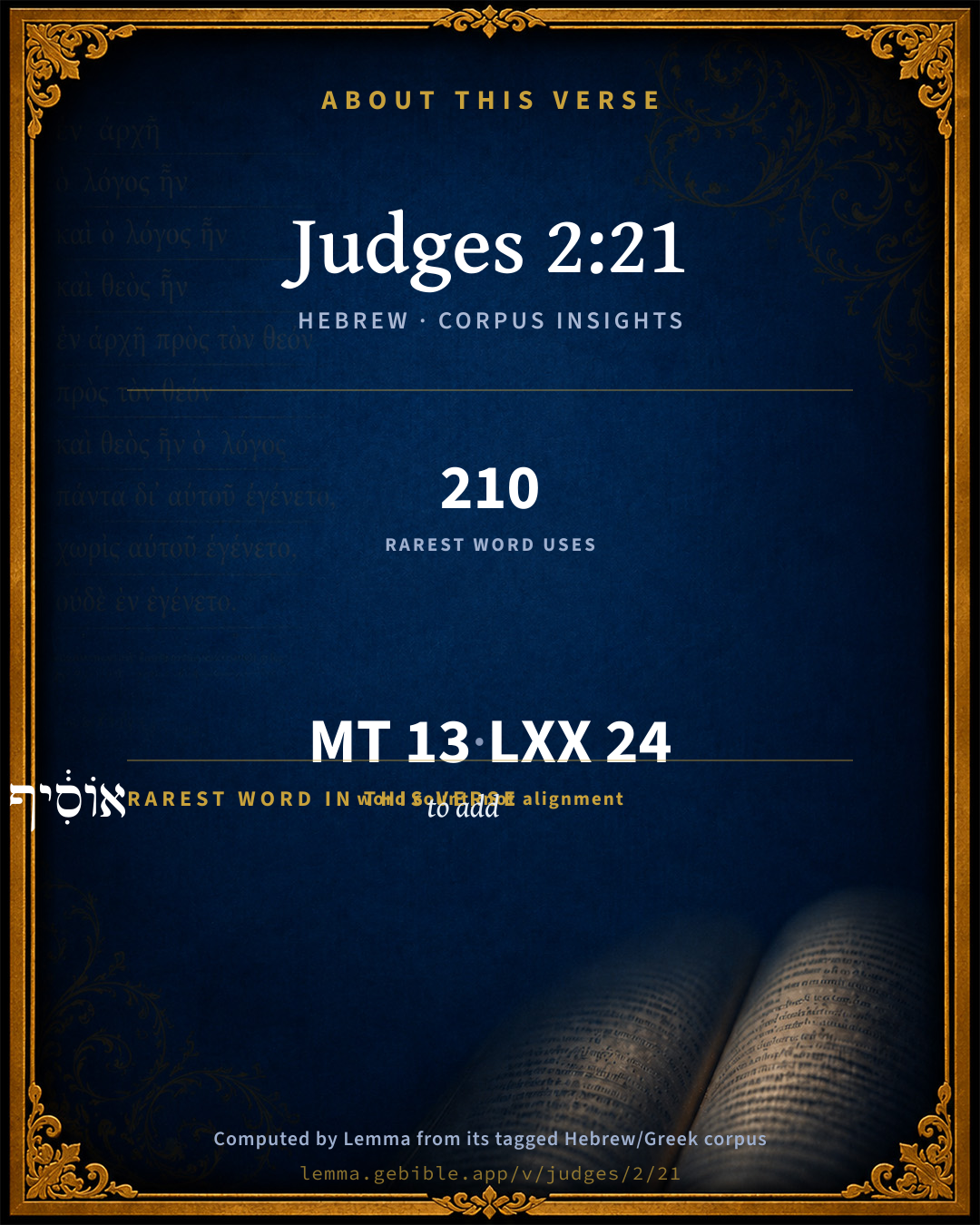
These counts appear in no published source. They are computed here, from the morphology-tagged text and Lemma’s own curated glosses. What Lemma adds →

13
words
13
distinct lemmas
Historical
section

Grammatical profile

  • 4 verbs
  • 4 nouns
  • 1 pronoun
  • 1 preposition
  • 3 particles

Verb forms

  • אוֹסִ֔יף Hiphil · Imperfect
  • לְהוֹרִ֥ישׁ Hiphil · Infinitive Construct
  • עָזַ֥ב Qal · Perfect
  • וַיָּמֹֽת Qal · Sequential Imperfect

Hebrew & Septuagint length

In English translation the verse runs 20 words from the Hebrew and 31 from the Septuagint (LXX English) — the Septuagint runs noticeably longer here. See the side-by-side →

A rough comparison of the two English renderings, which tokenize alike — not a word-level alignment.

Word counts can differ between the Hebrew and the Greek without any difference in meaning — e.g. the Hebrew direct-object marker אֵת has no separate Greek word, and Greek often adds the article ὁ.

In the original languages it is 13 Hebrew tokens and 24 Greek tokens — but the two are counted differently (Hebrew bundles its prefixes and suffixes into one token; the Greek is in lemma form), so that isn’t a like-for-like length.

Cross-references

4

Topical passages linked to Judges 2:21 in the Treasury of Scripture Knowledge — connected by theme and wording, ordered by reader-vote popularity; previews shown in the World English Bible.

  • Joshua 23:13 know for a certainty that Yahweh your God will no more drive these nations from out of your sight; but they shall be a snare and a trap to you, and a scourge in your sides, and thorns in your eyes, until you perish from off this good land which Yahweh your God has given you.
  • Judges 2:3 Therefore I also said, I will not drive them out from before you; but they shall be [as thorns] in your sides, and their gods shall be a snare to you.
  • Ezekiel 20:24 because they had not executed my ordinances, but had rejected my statutes, and had profaned my Sabbaths, and their eyes were after their fathers' idols.
  • Judges 3:3 [namely], the five lords of the Philistines, and all the Canaanites, and the Sidonians, and the Hivites who lived on Mount Lebanon, from Mount Baal Hermon to the entrance of Hamath.

Cross-references courtesy of OpenBible.info (CC BY 4.0).

Hebrew and Greek witnesses Masoretic Hebrew ↔ Greek Septuagint

The same verse in the two great witnesses to the Old Testament, shown verse-for-verse.

Here the Septuagint runs noticeably longer than the Hebrew — LXX2012 (modern English Septuagint) 31 words vs World English Bible 20. A rough length comparison of the two English translations, not a word-level alignment — read both below.

These are two independent witnesses, not word-aligned to each other, and the Septuagint is shown in lemma (dictionary) form.

Hebrew Judges 2:21 Masoretic · Westminster Leningrad Codex

גַּם אֲנִי֙ לֹ֣א אוֹסִ֔יף לְהוֹרִ֥ישׁ אִ֖ישׁ מִפְּנֵיהֶ֑ם מִן הַגּוֹיִ֛ם אֲשֶׁר עָזַ֥ב יְהוֹשֻׁ֖עַ וַיָּמֹֽת

I also will not henceforth drive out any from before them of the nations that Joshua left when he died;

World English Bible · Public Domain

Greek LXX Judges 2:21 Septuagint · lemma form

καί γέ ἐγώ οὐ προςτίθημι ὁ ἐκαἴρω ἀνήρ ἐκ πρόσωπον αὐτός ἀπό ὁ ἔθνος ὅς καταλείπω ἰησοῦς υἱός ναυη ἐν ὁ γῆ καί ἀποἵημι

therefore I will not any more cast out a man of the nations before their face, which Joshua the son of Naue left in the land. And the Lord left them,

LXX2012 (modern English Septuagint) · Public Domain

On this verse, The Cambridge Bible for Schools and Colleges discusses the Septuagint’s reading. Read the note in Commentary ↓

Hebrew: Westminster Leningrad Codex (CC BY 4.0). Greek: Septuagint (public domain); English from LXX2012 (modern English Septuagint) (Public Domain). How the Septuagint differs from the Hebrew →

Targum (Aramaic paraphrase)

1

The Targum is the ancient Jewish Aramaic paraphrase of the Hebrew Scriptures — an interpretive translation, not the Hebrew text itself. Onkelos (literal) and Pseudo-Jonathan (expansive) render the Torah, and Jonathan the Prophets. Coverage is partial: where no permissively-licensed English translation exists for a verse, only the Aramaic is shown. This is verse-level text, not a word-by-word alignment to the Hebrew.

  1. Targum Jonathan Prophets (Joshua–Malachi)
    אַף אֲנָא לָא אוֹסִיף לְתָרָכָא אֱנָשׁ מִן קֳדָמֵיהוֹן מִן עַמְמַיָא דִי שְׁבַק יְהוֹשֻׁעַ וּמִית:

    (no public-domain English translation for this verse)

    Targum Jonathan — Aramaic: “Mikraot Gedolot” (public domain). English: “Sefaria Community Translation” (CC0 1.0 (public-domain dedication)); “London "Chaldee Paraphrase," 1871” (public domain). Text via Sefaria.

Commentary

Notes on Judges 2:21 from classic Christian and Jewish commentators (each source and its license shown beneath its notes). The classic Christian expositions comment on the surrounding passage and are grouped to its opening verse, so a note may address several verses; the Jewish commentaries on the Tanakh (Rashi and others) are per-verse, so they appear only where the commentator wrote on this verse.

Lemma curates 59 commentaries, every one of them public domain or Creative Commons licensed, each selected and text-cleaned for this edition rather than reprinted as found. About our sources →

Trapp's Complete Commentary

John Trapp

Jdg 2:21 I also will not henceforth drive out any from before them of the nations which Joshua left when he died:

Ver. 21. I also will not,] sc., Unless they repent: for, Ideo minatur Deus ut non puniat; Repentance disarmeth God’s indignation. Let him but see that rainbow appearing in our hearts, and he will take up immediately.

John Trapp, A Commentary or Exposition upon All the Books of the Old and New Testament (1647–1656) — public domain. Text from a community e-Sword module.

Geneva Bible (1599)

Geneva Bible translators

As the Hivites, Jebusites, Amorites, etc.

Geneva Bible (1599) marginal notes — public domain. Text via Bolls.life.

Adam Clarke's Commentary

Verse 21. I will not henceforth drive out] As a people, they never had personal courage, discipline, or hardihood, sufficient to stand before their enemies: the advantages they gained were by the peculiar interference of God. This they had while obedient; when they ceased to obey, his strong arm was no longer stretched out in their behalf; therefore their enemies continued to possess the land which God purposed to give them as their inheritance for ever.

Adam Clarke's Commentary on the Bible (1810–1826) — public domain. Text from a community e-Sword/MySword module.

The Cambridge Bible for Schools and Colleges

gen. ed. J. J. S. Perowne

21. I also will not … drive out] By worshipping other gods Israel had broken the terms of the covenant, Exo_23:24 f., Exo_23:32 f., Exo_34:12-16; therefore Jehovah would not fulfil His promise to drive out the nations of Canaan, Exo_23:27 f., Exo_23:31; Exo_34:11; Exo_34:24.

which Joshua left when he died] Josh, Jos_23:12 f.; when he died is not a translation, but a tacit correction of the original and died; LXX and he (i.e. Jehovah) left, as in Jdg_2:23.

The Cambridge Bible for Schools and Colleges (gen. ed. J. J. S. Perowne; Cambridge University Press, 1878–1918) — public domain. Text from a community e-Sword module.

John Gill's Exposition

I also henceforth will not drive out and from before them,.... At least not as yet, not very soon nor hastily, as in Jdg 2:23,

of the nations which Joshua left when he died; that is, unsubdued; which was owing either to the infirmities of old age coming upon him, which made him incapable of engaging further in war with the Canaanites; or to the sloth and indolence of the people, being weary of war, and not caring to prosecute it; or to want of men to cultivate any more land, and people other cities, than what they were possessed of; and chiefly this was owing to the providence of God, who had an end to answer hereby, as follows.

John Gill's Exposition of the Whole Bible (1746–1763) — public domain (CC PDM 1.0). Text via the HelloAO Bible API.

Haydock's Catholic Bible Commentary

Nations. Hebrew, "any." Septuagint, "a man of those nations," which must be understood, unless the Israelites return to a proper sense of their duty. For then he destroyed not only individuals, but whole armies, by the hand of the judges. Yet we do not find that such havoc was made among the infidels afterwards, as had been made in the days of Josue. They frequently rose up and harassed the Israelites; and God suffered them to do so, that the latter might learn to know themselves, and might perceive how dreadful a thing it is not to comply, at first, with his injunctions. (Haydock)

George Leo Haydock (1774–1849), Haydock's Catholic Family Bible and Commentary, 1859 edition — public domain. Excludes Psalms (Douay-Rheims chapter numbering differs from Protestant) and Deuterocanonical books (Catholic canon only).

The Pulpit Commentary

HOMILIES BY W.F. ADENEY Vers. 21, 22. Tested by temptation.

The pagan nations of Canaan were a.constant source of temptation to idolatry and immorality. If they were left in the land, the fidelity of Israel would be tried by the way in which this temptation was met.

I TEMPTATION IS NOT IMMEDIATELY SENT BY GOD, Israel had been commanded to expel the Canaanites; it was owing to the indolence and weakness of the invaders that their work was not completed. Having failed on their side, they now find that God will no longer secure them victory over their enemies. The temptation which thus resulted from the presence of the heathen in their midst grew out of their own conduct. God never tempts us. (Jam_1:13) Temptation often arises out of negligence, indolence, needless pleasure, wilful presumption. It is vain to pray, "Lead us not into temptation," while we are creating temptations for ourselves.

II TEMPTATION MUST OFTEN BE REGARDED IN THE LIGHT OF A PUNISHMENT.

1. It frequently comes as the consequence of former sin. The memory of sin, the contracted habit of sin, the associations of sin, and the weakness resulting from sin are all sources of new temptation.

2. Temptation is one of the most painful consequences of sin. If we have any love for goodness, one of the saddest results of our sin must be the consciousness of new temptations to which it renders us liable. For a good man to suffer temptation is to suffer pain.

3. We must therefore con-elude that all the temptations we meet with are not unavoidable and necessary. We bring them on ourselves; we might have escaped them; they are dangerous calamities which we must deplore. We need not wish to be tried. If temptation is often a punishment, it is better to rest humbly ignorant of our own weakness than to court trial which will reveal the extent of it.

III TEMPTATION IS USED BY GOD AS A TEST OF FIDELITY. The people of Israel would be proved by the temptation arising out of the presence of immoral idolaters in the midst of them.

1. Fidelity consists

(1) in care and firmness, keep the way of the Lord, and

(2) in diligence and progressive activity "to walk therein.

2. This fidelity is tested by the attractions of evil ways. We cannot be said to keep the way simply because we are found in it. But when the way is contested, or a more pleasing path opens out near to it, the strength of our fidelity will be put to the test. Some men need the test of temptation more than others. If they have already shown weakness, the punishment which comes in the form of a temptation may be a useful means of self-revelation. This need of proof, however, is a humiliation. It is better to be so clearly true as neither to invoke the punishment of temptation nor require the test it affords. A.

The Pulpit Commentary (1880–1919), ed. H.D.M. Spence-Jones & Joseph S. Exell — public domain. Text from a community e-Sword module.

Lesson kit

Teaching starters — assembled from the data on this page, not authored interpretation. Every prompt links to the verse data it draws on. Edit before teaching.

Judges, in the Historical, opens this verse with 13 words (13 distinct Hebrew lemmas). Its most distinctive word is yâçaph (“to add”). The Greek Septuagint runs longer here. A historical commentator’s framing appears above. Read the whole chapter for the surrounding context.

Discussion questions

  1. How does “to add” (yâçaph) shape what this verse is saying?
  2. How does Joshua 23:13, which shares this passage’s theme, read alongside this verse?
  3. The Septuagint runs longer here than the Hebrew. What might account for the difference?
  4. These translations render this verse differently. What is at stake in choosing one wording over another?
  5. «אוֹסִ֔יף» is a Hiphil Imperfect verb. How does that grammatical form shape the action described?
  6. Compare how Trapp's Complete Commentary and Geneva Bible (1599) read this verse. Where do they agree or differ?

Things to notice

Reading settings

Reading text

Shown beneath each verse's original-language words.

Old Testament
Old Testament edition

Read the OT as the Masoretic Hebrew (MT) or the Greek Septuagint (LXX).

English shown for the Greek Septuagint (in the Hebrew ↔ Greek comparison).

Comparing translations? Open the Compare panel on any verse page to stack up to four side by side.