
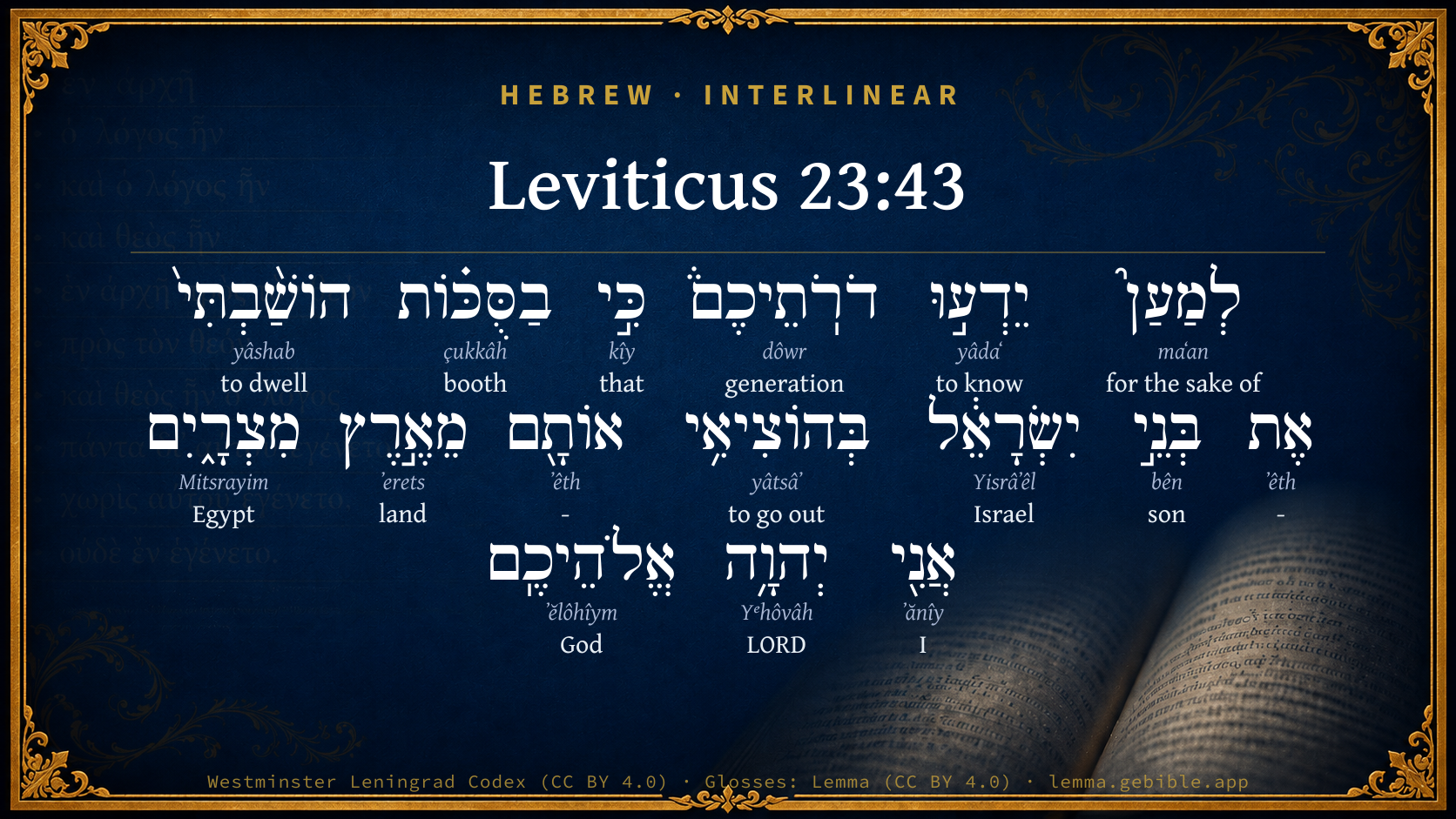
Leviticus 23:43

Hebrew (Westminster Leningrad Codex) Leviticus 23:43 appears in the Hebrew Old Testament. The text above is from the Westminster Leningrad Codex. Each word links to its Strong’s number, a concise gloss, and parsing drawn from the Open Scriptures Hebrew Bible morphology. Click any word for its full Brown-Driver-Briggs (BDB) entry.
Download image
Cite this verse

Leviticus 23:43 (World English Bible). Public Domain. Lemma interlinear Bible study tool, https://lemma.gebible.app/v/leviticus/23/43.

Show BibTeX & RIS
BibTeX
RIS
English Translation
that your generations may know that I made the children of Israel to dwell in booths, when I brought them out of the land of Egypt. I am Yahweh your God.'"
World English Bible · Public Domain
Download a study sheet

One document with this verse’s original text, its word-by-word gloss line, the meaning frame, cross-references with their text, attributed commentary, and full source and license credits — printable, and it pastes into notes with its structure intact.

This verse Autodidact and up

Study sheet (.html) Plain text (.txt)

A passage Seminary Student

Up to 50 verses in one chapter. A passage sheet keeps up to 6 commentary sources and 12 cross-references per verse, in the order this page ranks them, and says so on the sheet whenever that leaves anything out. Ask for a single verse and you get the Autodidact verse sheet above.

Everything on this page stays free to read, with no account — the sheet is a download of what is already on screen, not access to it.

Want to remove ads? Support Godless Engineer
Compare translations 3

The same verse in 3 English versions, stacked beneath the original-language interlinear above. Click any original word for its lexicon entry.

Each is an independent rendering of the whole verse — the interlinear is not word-aligned to these translations.

Highlighted words mark where these versions differ — a whole-verse word diff, not a word-by-word alignment.

  • World English Bible Public Domain
    that your generations may know that I made the children of Israel to dwell in booths, when I brought them out of the land of Egypt. I am Yahweh your God.'"
  • King James Version Public Domain
    That your generations may know that I made the children of Israel to dwell in booths, when I brought them out of the land of Egypt: I am the LORD your God.
  • unfoldingWord Literal Text CC BY-SA 4.0
    so that your generations may know that I made the sons of Israel dwell in booths when I brought them out from the land of Egypt. I Yahweh your God.’”

unfoldingWord Literal Text — © unfoldingWord, licensed CC BY-SA 4.0. Word-aligned USFM3 via Door43 (git.door43.org/unfoldingWord/en_ult).

Versions to compare (up to 4)

3 of 4 selected

Show all 18 translations

Every available English version of this verse, each an independent rendering of the whole verse.

  • World English Bible Public Domain
    that your generations may know that I made the children of Israel to dwell in booths, when I brought them out of the land of Egypt. I am Yahweh your God.'"
  • Berean Standard Bible Public Domain
    so that your descendants may know that I made the Israelites dwell in booths when I brought them out of the land of Egypt. I am the LORD your God.’”
  • Majority Standard Bible Public Domain
    so that your descendants may know that I made the Israelites dwell in booths when I brought them out of the land of Egypt. I am the LORD your God.’”
  • King James Version Public Domain
    That your generations may know that I made the children of Israel to dwell in booths, when I brought them out of the land of Egypt: I am the LORD your God.
  • American Standard Version (1901) Public Domain
    that your generations may know that I made the children of Israel to dwell in booths, when I brought them out of the land of Egypt: I am Jehovah your God.
  • Revised Version (1885) Public Domain
    that your generations may know that I made the children of Israel to dwell in booths, when I brought them out of the land of Egypt: I am the LORD your God.
  • Geneva Bible (1599) Public Domain
    That your posterity may know that I haue made the children of Israel to dwell in boothes, when I brought them out of the lande of Egypt: I am the Lord your God.
  • Douay-Rheims (1899) Public Domain
    That your posterity may know, that I made the children of Israel to dwell in tabernacles, when I brought them out of the land of Egypt. I am the Lord your God.
  • Young's Literal Translation Public Domain
    so that your generations do know that in booths I caused the sons of Israel to dwell; in my bringing them out of the land of Egypt; I, Jehovah, `am' your God.'
  • Literal Standard Version CC BY-SA 4.0
    so that your generations know that I caused the sons of Israel to dwell in shelters in My bringing them out of the land of Egypt; I [am] your God YHWH.”
  • Unlocked Literal Bible CC BY-SA 4.0
    so that your descendants, generation after generation, may learn how I made the people of Israel live in such shelters when I led them out of the land of Egypt. I am Yahweh your God.'”
  • unfoldingWord Literal Text CC BY-SA 4.0
    so that your generations may know that I made the sons of Israel dwell in booths when I brought them out from the land of Egypt. I Yahweh your God.’”
  • Darby Bible Public Domain
    that your generations may know that I caused the children of Israel to dwell in booths, when I brought them out of the land of Egypt: I am Jehovah your God.
  • World Messianic Bible Public Domain
    that your generations may know that I made the children of Israel to dwell in temporary shelters when I brought them out of the land of Egypt. I am the LORD your God.’”
  • Webster's Bible Public Domain
    That your generations may know that I made the children of Israel to dwell in booths, when I brought them out of the land of Egypt: I am the LORD your God.
  • Free Bible Version CC BY-SA 4.0
    so that your descendants will remember that I made the Israelites live in shelters when I led them out of Egypt. I am the Lord your God.”
  • Bible in Basic English Public Domain
    So that future generations may keep in mind how I gave the children of Israel tents as their living-places when I took them out of the land of Egypt: I am the Lord your God.
  • JPS Tanakh (1917) Public Domain
    that your generations may know that I made the children of Israel to dwell in booths, when I brought them out of the land of Egypt: I am the LORD your God.

Literal Standard Version (2020), Covenant Press — licensed CC BY-SA 4.0. Text via the HelloAO Bible API (eBible.org). Unlocked Literal Bible (unfoldingWord) — licensed CC BY-SA 4.0. Text via the HelloAO Bible API (eBible.org). unfoldingWord Literal Text — © unfoldingWord, licensed CC BY-SA 4.0. Word-aligned USFM3 via Door43 (git.door43.org/unfoldingWord/en_ult). Free Bible Version, Dr. Jonathan Gallagher — licensed CC BY-SA 4.0. Text via the HelloAO Bible API (eBible.org).

Word by word

More ways to search: Search by grammar → Find every occurrence → Compare this word →

Practice this passage: Drill this verse → Learn its vocabulary →

בַסֻּכּ֗וֹת
çukkâh
H5521
“in/at the · booths”
Preposition, Determined + Noun, Common, Feminine, Plural, Absolute
Part of Speech
Preposition + Noun
Type
Common
Gender
Feminine
Number
Plural
State
Absolute
Full BDB Definition

Origin: from H5520

TWOT: 1492d

thicket, covert, booth - thicket - booth (rude or temporary shelter)
  1. לְמַעַן֮ maʻan H4616 “for the sake of” Preposition
  2. יֵדְע֣וּ yâdaʻ H3045 “to know” Verb, Qal, Imperfect, 3rd Person, Masculine, Plural
  3. דֹרֹֽתֵיכֶם֒ dôwr H1755 “generations · your” Noun, Common, Masculine, Plural, Construct + Suffix, Personal, 2nd Person, Masculine, Plural
  4. כִּ֣י kîy H3588 “that” Conjunction
  5. הוֹשַׁ֨בְתִּי֙ yâshab H3427 “to dwell” Verb, Hiphil, Perfect, 1st Person, Common, Singular
  6. אֶת ʼêth H853 “-” Particle, Direct Object
  7. בְּנֵ֣י bên H1121 “sons of” Noun, Common, Masculine, Plural, Construct
  8. יִשְׂרָאֵ֔ל Yisrâʼêl H3478 “Israel” Noun, Proper
  9. בְּהוֹצִיאִ֥י yâtsâʼ H3318 “in/at · to go out · me” Preposition + Verb, Hiphil, Infinitive Construct + Suffix, Personal, 1st Person, Common, Singular
  10. אוֹתָ֖ם ʼêth H853 “- · them” Particle, Direct Object + Suffix, Personal, 3rd Person, Masculine, Plural
  11. מֵאֶ֣רֶץ ʼerets H776 “from · land of” Preposition + Noun, Common, Both, Singular, Construct
  12. מִצְרָ֑יִם Mitsrayim H4714 “Egypt” Noun, Proper
  13. אֲנִ֖י ʼănîy H589 “I” Pronoun, Personal, 1st Person, Common, Singular
  14. יְהוָ֥ה Yᵉhôvâh H3068 “LORD” Noun, Proper
  15. אֱלֹהֵיכֶֽם ʼĕlôhîym H430 “God(s) · your” Noun, Common, Masculine, Plural, Construct + Suffix, Personal, 2nd Person, Masculine, Plural

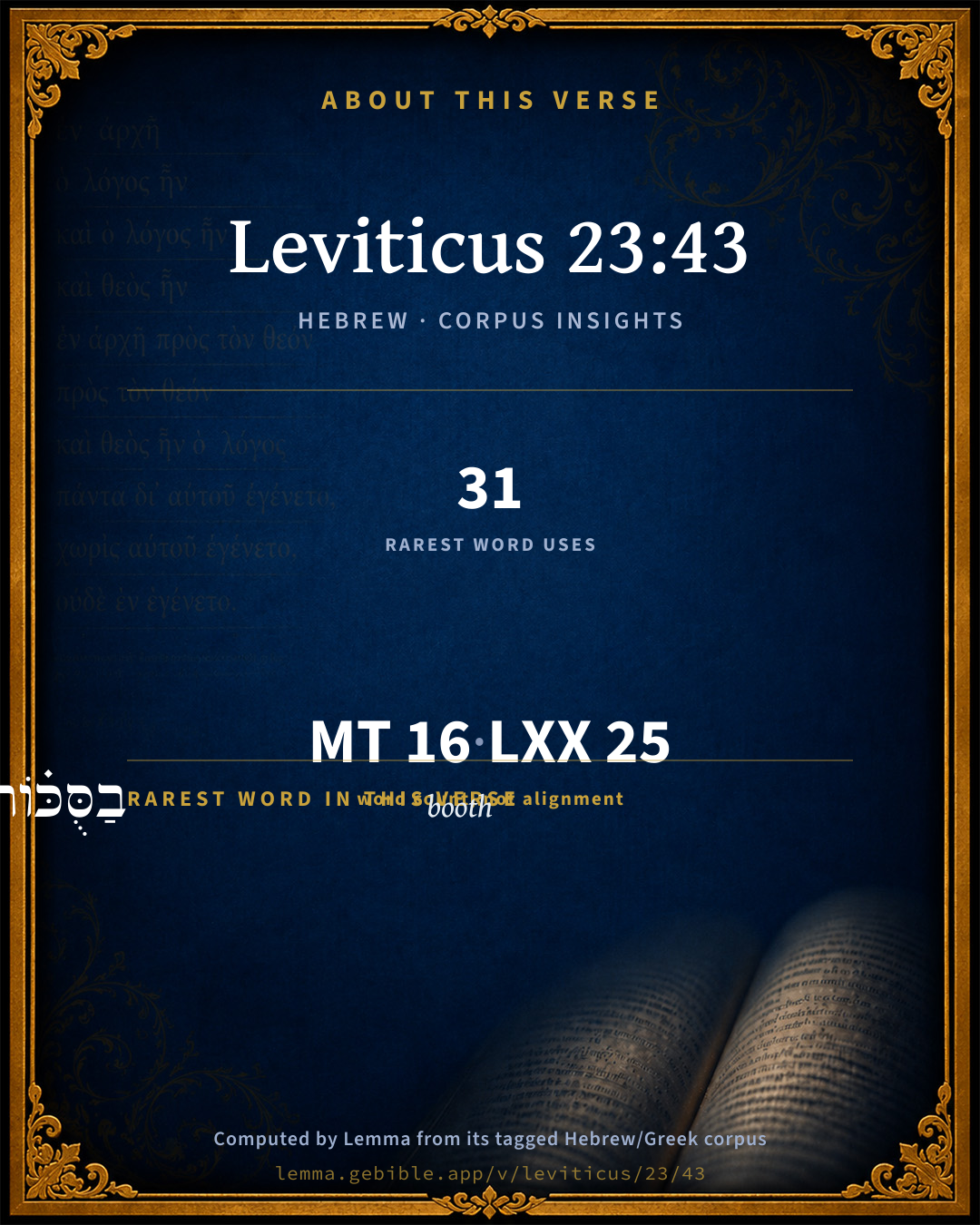
About this verse

These counts appear in no published source. They are computed here, from the morphology-tagged text and Lemma’s own curated glosses. What Lemma adds →

16
words
15
distinct lemmas
Pentateuch
section

Shared distinctive vocabulary

בַסֻּכּ֗וֹת booth H5521 occurs in 29 verses of the Hebrew Bible. Also found in:

Grammatical profile

  • 3 verbs
  • 8 nouns
  • 1 pronoun
  • 1 preposition
  • 1 conjunction
  • 2 particles

Verb forms

  • יֵדְע֣וּ Qal · Imperfect
  • הוֹשַׁ֨בְתִּי֙ Hiphil · Perfect
  • בְּהוֹצִיאִ֥י Hiphil · Infinitive Construct

Hebrew & Septuagint length

In English translation the verse runs 31 words from the Hebrew and 32 from the Septuagint (LXX English) — closely comparable.

A rough comparison of the two English renderings, which tokenize alike — not a word-level alignment.

Word counts can differ between the Hebrew and the Greek without any difference in meaning — e.g. the Hebrew direct-object marker אֵת has no separate Greek word, and Greek often adds the article ὁ.

In the original languages it is 16 Hebrew tokens and 25 Greek tokens — but the two are counted differently (Hebrew bundles its prefixes and suffixes into one token; the Greek is in lemma form), so that isn’t a like-for-like length.

Cross-references

3

Topical passages linked to Leviticus 23:43 in the Treasury of Scripture Knowledge — connected by theme and wording, ordered by reader-vote popularity; previews shown in the World English Bible.

  • Deuteronomy 31:10–13 Moses commanded them, saying, At the end of [every] seven years, in the set time of the year of release, in the feast of tents,
  • Exodus 13:14 It shall be, when your son asks you in time to come, saying, 'What is this?' that you shall tell him, 'By strength of hand Yahweh brought us out from Egypt, from the house of bondage;
  • Psalms 78:5–6 For he established a testimony in Jacob, And appointed a law in Israel, Which he commanded our fathers, That they should make them known to their children;

Cross-references courtesy of OpenBible.info (CC BY 4.0).

Hebrew and Greek witnesses Masoretic Hebrew ↔ Greek Septuagint

The same verse in the two great witnesses to the Old Testament, shown verse-for-verse.

These are two independent witnesses, not word-aligned to each other, and the Septuagint is shown in lemma (dictionary) form.

Hebrew Leviticus 23:43 Masoretic · Westminster Leningrad Codex

לְמַעַן֮ יֵדְע֣וּ דֹרֹֽתֵיכֶם֒ כִּ֣י בַסֻּכּ֗וֹת הוֹשַׁ֨בְתִּי֙ אֶת בְּנֵ֣י יִשְׂרָאֵ֔ל בְּהוֹצִיאִ֥י אוֹתָ֖ם מֵאֶ֣רֶץ מִצְרָ֑יִם אֲנִ֖י יְהוָ֥ה אֱלֹהֵיכֶֽם

that your generations may know that I made the children of Israel to dwell in booths, when I brought them out of the land of Egypt. I am Yahweh your God.'"

World English Bible · Public Domain

Greek LXX Leviticus 23:43 Septuagint · lemma form

ὅπως ὁράω ὁ γενεά σύ ὅτι ἐν σκηνή καταοἰκίζω ὁ υἱός ἰσραήλ ἐν ὁ ἐκἄγω ἐγώ αὐτός ἐκ γῆ αἴγυπτος ἐγώ κύριος ὁ θεός σύ

that your posterity may see, that I made the children of Israel to dwell in tents, when I brought them out of the land of Egypt: I am the Lord your God.

LXX2012 (modern English Septuagint) · Public Domain

Hebrew: Westminster Leningrad Codex (CC BY 4.0). Greek: Septuagint (public domain); English from LXX2012 (modern English Septuagint) (Public Domain). How the Septuagint differs from the Hebrew →

Targum (Aramaic paraphrase)

2

The Targum is the ancient Jewish Aramaic paraphrase of the Hebrew Scriptures — an interpretive translation, not the Hebrew text itself. Onkelos (literal) and Pseudo-Jonathan (expansive) render the Torah, and Jonathan the Prophets. Coverage is partial: where no permissively-licensed English translation exists for a verse, only the Aramaic is shown. This is verse-level text, not a word-by-word alignment to the Hebrew.

  1. Targum Onkelos Torah (Genesis–Deuteronomy)
    בְּדִיל דְיִדְעוּן דָרֵיכוֹן אֲרֵי בִמְטַלָיוּת עֲנָנֵי אוֹתֵבִית יָת בְּנֵי יִשְׂרָאֵל בְּאַפָּקוּתִי יָתְהוֹן מֵאַרְעָא דְמִצְרַיִם אֲנָא יְיָ אֱלָהֲכוֹן

    (no public-domain English translation for this verse)

    Targum Onkelos — Aramaic: “Onkelos Genesis” (public domain); “Onkelos Exodus” (public domain); “Onkelos Leviticus” (public domain); “Onkelos Numbers” (public domain); “Onkelos Deuteronomy” (public domain). English: “Sefaria Community Translation” (CC0 1.0 (public-domain dedication)); “J.W. Etheridge. The Targums of Onkelos and Jonathan Ben Uzziel on the Pentateuch. London: Longmans, Green, 1862” (public domain). Text via Sefaria.

  2. Targum Pseudo-Jonathan Torah (Genesis–Deuteronomy)
    מִן בִּגְלַל דְיֵדְעוּן דָרֵיכוֹן אֲרוּם בְּמַטְלַת עֲנָנֵי יְקָרָא אוֹתֵיבִית יַת בְּנֵי יִשְרָאֵל בִּזְמַן דְהַנְפֵּיקִית יַתְהוֹן פְּרִיקִין מֵאַרְעָא דְמִצְרָיִם אֲנָא הוּא יְיָ אֳלָהָכוֹן

    That your generations may know how, under the shadow of the cloud of glory, I made the sons of Israel to dwell at the time that I brought them out redeemed from the land of Mizraim.

    Targum Pseudo-Jonathan — Aramaic: “Targum Jonathan on Genesis” (public domain); “Targum Jonathan on Exodus” (public domain); “Targum Jonathan on Leviticus” (public domain); “Targum Jonathan on Numbers” (public domain); “Targum Jonathan on Deuteronomy” (public domain). English: “The Targum of Jonathan ben Uzziel, trans. J. W. Etheridge, London, 1862” (public domain). Text via Sefaria.

Commentary

Notes on Leviticus 23:43 from classic Christian and Jewish commentators (each source and its license shown beneath its notes). The classic Christian expositions comment on the surrounding passage and are grouped to its opening verse, so a note may address several verses; the Jewish commentaries on the Tanakh (Rashi and others) are per-verse, so they appear only where the commentator wrote on this verse.

Lemma curates 59 commentaries, every one of them public domain or Creative Commons licensed, each selected and text-cleaned for this edition rather than reprinted as found. About our sources →

Trapp's Complete Commentary

John Trapp

Lev 23:43 That your generations may know that I made the children of Israel to dwell in booths, when I brought them out of the land of Egypt: I [am] the LORD your God.

Ver. 43. That your generations may know.] For which purpose also they had at this feast the law read unto them. {Neh 8:18 Deu 31:10; Deu 31:13}

John Trapp, A Commentary or Exposition upon All the Books of the Old and New Testament (1647–1656) — public domain. Text from a community e-Sword module.

Tyndale Open Study Notes

Tyndale Open Resources

23:43 The Israelites were never to forget God’s great acts of redemption on their behalf, but were to remind each new generation of what God had done (Deut 4:9; 11:19). Their understanding of who they were and of who God was revolved around their knowledge of those things. See Deut 6:20-24; 26:5-9; Josh 24:2-13; Ps 136.

Tyndale Open Study Notes — © Tyndale Open Resources, licensed CC BY-SA 4.0. Text via the HelloAO Bible API.

Geneva Bible (1599)

Geneva Bible translators

In the wilderness, forasmuch as they would not credit Joshua and Caleb, when they returned from spying the land of Canaan.

Geneva Bible (1599) marginal notes — public domain. Text via Bolls.life.

Adam Clarke's Commentary

Verse 43. That your generations may know, &c.] By the institution of this feast God had two great objects in view:

1. To perpetuate the wonderful display of his providence and grace in bringing them out of Egypt, and in preserving them in the wilderness.

2. To excite and maintain in them a spirit of gratitude and obedience, by leading them to consider deeply the greatness of the favours which they had received from his most merciful hands.

SIGNAL displays of the mercy, kindness, and providential care of God should be particularly remembered. When we recollect that we deserve nothing at his hands, and that the debt of gratitude is all the debt we can pay, in it we should be cheerful, fervent, and frequent. An ungrateful heart is an unfeeling, unloving, unbelieving, and disobedient heart. Reader, pray to God that he may deliver thee from its influence and its curse.

Adam Clarke's Commentary on the Bible (1810–1826) — public domain. Text from a community e-Sword/MySword module.

Ellicott's Commentary for English Readers

(43) That your generations may know.—When their posterity are securely occupying the land of Canaan, the temporary dwelling in booths once a year may remind them of the goodness of God vouchsafed to their fathers in delivering them from the land of bondage, and sheltering them in booths in the wilderness.

A Bible Commentary for English Readers, edited by Charles John Ellicott (1878–1897) — public domain. Text from a community e-Sword module.

John Gill's Exposition

That your generations may know that I made the children of Israel to dwell in booths,.... Which by the providence of God the Israelites were obliged to make for themselves to dwell in:

when I brought them out of the land of Egypt; for the very first place they came to, when they departed from thence, was called Succoth, from the booths they there built:

I am the Lord your God; who brought them out of Egypt, made them to dwell in booths in the wilderness, and enjoined them the observance of the feast of tabernacles in memory of it, in which he expected to be obeyed.

John Gill's Exposition of the Whole Bible (1746–1763) — public domain (CC PDM 1.0). Text via the HelloAO Bible API.

Rashi

Rabbi Shlomo Yitzchaki (Rashi)

כי בסכות הושבתי THAT I MADE [THE CHILDREN OF ISRAEL] ABIDE IN BOOTHS — This does not mean literally “booths” but, “the clouds of Glory" by which they were sheltered (cf. Onkelos; Sifra, Emor, Chapter 17 11; Mekhilta; Sukkah 11b).

Rashi on the Tanakh — English translations: “The Judaica Press complete Tanach with Rashi, translated by A. J. Rosenberg” (CC BY 4.0); “Pentateuch with Rashi's commentary by M. Rosenbaum and A.M. Silbermann, 1929-1934” (public domain); “The Metsudah Tanach series, Lakewood, N.J” (CC BY 4.0); and “The Book of Joshua, Metsudah Publications, 1997” (CC BY 4.0). Text via Sefaria.

Ramban (Nachmanides)

Rabbi Moshe ben Nachman (Ramban / Nachmanides)

THAT I MADE THE CHILDREN OF ISRAEL TO ABIDE IN BOOTHS. “This means the clouds of Glory” [which surrounded the camp of the Israelites during their stay in the wilderness]. This is Rashi’s language. And in my opinion this is the correct interpretation [even] according to the literal sense of Scripture, for He commanded that the generations should know all the great deeds of the Eternal which He did wondrously with them, that He made them dwell in the clouds of His Glory like in a booth, similar to what is said, And the Eternal will create over the whole habitation of Mount Zion, and over her assemblies, a cloud and smoke by day, and the shining of a flaming fire by night; for over all the glory shall be a canopy. And there shall be a ‘succah’ (pavilion) for a shadow in the day-time from the heat etc. And since Scripture has already explained that the cloud of the Eternal was upon them by day and the pillar of fire by night, 13:22. He just says here, that I made the children of Israel to abide in booths, [without explaining what kind of booths, but meaning] “I made them booths out of the clouds of My Glory to protect them.” Thus He commanded that at the beginning of the summer season we are to remember the exodus from Egypt by [calling] its month [the first of the months], and by observing its festival [of Passover], and He further commanded the remembrance of the continuous miracle which was done for them throughout the days of their stay in the wilderness, at the beginning of the winter season. And according to the opinion of the Sage who says were “clouds of Glory” [mentioned above] is the opinion of Rabbi Eliezer (ibid.). that they made themselves booths in the literal sense, [we must explain that the reason why this commandment is to be observed at the onset of the winter season], is because they began to make them at the beginning of the winter, on account of the cold, as is customary in camps, and therefore He commanded [that we also make] them at that time. The sense of the remembrance is that they should know and remember that they were in the wilderness, and did not live in homes, and they found no city of habitation for forty years, but G-d was with them and they lacked nothing.

Ramban (Nachmanides) on the Tanakh — English translation: “Commentary on the Torah by Ramban (Nachmanides). Translated and annotated by Charles B. Chavel. New York, Shilo Pub. House, 1971-1976” (CC BY 4.0). Text via Sefaria.

Lesson kit

Teaching starters — assembled from the data on this page, not authored interpretation. Every prompt links to the verse data it draws on. Edit before teaching.

Leviticus, in the Pentateuch, opens this verse with 16 words (15 distinct Hebrew lemmas). Its most distinctive word is çukkâh (“booth”). A historical commentator’s framing appears above. Read the whole chapter for the surrounding context.

Discussion questions

  1. How does “booth” (çukkâh) shape what this verse is saying?
  2. Genesis 33:17 shares the word «booth» with this verse. How do the two illuminate each other?
  3. The translations on this page render this verse differently — a whole-verse word diff, not a word-by-word alignment. What might account for the different wordings?
  4. The verb «יֵדְע֣וּ» is Qal Imperfect. How does its form color the action?
  5. Reading how Trapp's Complete Commentary and Tyndale Open Study Notes read this verse, where do the two commentators agree and where do they part?

Things to notice

Reading settings

Reading text

Shown beneath each verse's original-language words.

Old Testament
Old Testament edition

Read the OT as the Masoretic Hebrew (MT) or the Greek Septuagint (LXX).

English shown for the Greek Septuagint (in the Hebrew ↔ Greek comparison).

Comparing translations? Open the Compare panel on any verse page to stack up to four side by side.