
Exodus 13:15

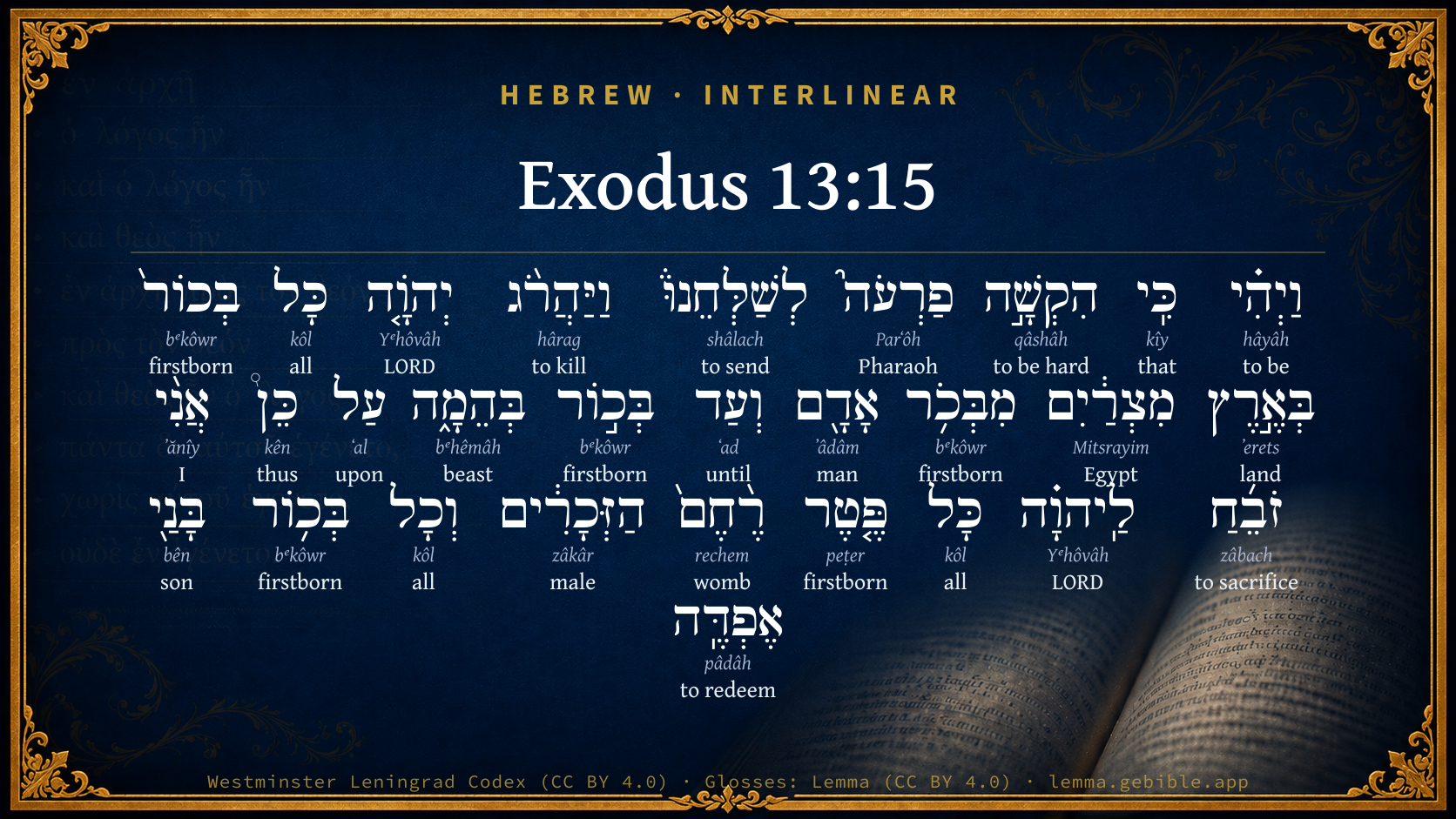
Hebrew (Westminster Leningrad Codex) Exodus 13:15 appears in the Hebrew Old Testament. The text above is from the Westminster Leningrad Codex. Each word links to its Strong’s number, a concise gloss, and parsing drawn from the Open Scriptures Hebrew Bible morphology. Click any word for its full Brown-Driver-Briggs (BDB) entry.
Download image
Cite this verse

Exodus 13:15 (World English Bible). Public Domain. Lemma interlinear Bible study tool, https://lemma.gebible.app/v/exodus/13/15.

Show BibTeX & RIS
BibTeX
RIS
English Translation
and it happened, when Pharaoh would hardly let us go, that Yahweh killed all the firstborn in the land of Egypt, both the firstborn of man, and the firstborn of animal. Therefore I sacrifice to Yahweh all that opens the womb, being males; but all the firstborn of my sons I redeem.'
World English Bible · Public Domain
Download a study sheet

One document with this verse’s original text, its word-by-word gloss line, the meaning frame, cross-references with their text, attributed commentary, and full source and license credits — printable, and it pastes into notes with its structure intact.

This verse Autodidact and up

Study sheet (.html) Plain text (.txt)

A passage Seminary Student

Up to 50 verses in one chapter. A passage sheet keeps up to 6 commentary sources and 12 cross-references per verse, in the order this page ranks them, and says so on the sheet whenever that leaves anything out. Ask for a single verse and you get the Autodidact verse sheet above.

Everything on this page stays free to read, with no account — the sheet is a download of what is already on screen, not access to it.

Want to remove ads? Support Godless Engineer
Compare translations 3

The same verse in 3 English versions, stacked beneath the original-language interlinear above. Click any original word for its lexicon entry.

Each is an independent rendering of the whole verse — the interlinear is not word-aligned to these translations.

Highlighted words mark where these versions differ — a whole-verse word diff, not a word-by-word alignment.

  • World English Bible Public Domain
    and it happened, when Pharaoh would hardly let us go, that Yahweh killed all the firstborn in the land of Egypt, both the firstborn of man, and the firstborn of animal. Therefore I sacrifice to Yahweh all that opens the womb, being males; but all the firstborn of my sons I redeem.'
  • King James Version Public Domain
    And it came to pass, when Pharaoh would hardly let us go, that the LORD slew all the firstborn in the land of Egypt, both the firstborn of man, and the firstborn of beast: therefore I sacrifice to the LORD all that openeth the matrix, being males; but all the firstborn of my children I redeem.
  • unfoldingWord Literal Text CC BY-SA 4.0
    And so it was, that when Pharaoh was hard to let us go, then Yahweh struck all of the firstborn in the land of Egypt, from the firstborn of man and to the firstborn of beast. That is why I sacrifice to Yahweh all the openers of the womb—the males—and I ransom all of the firstborn of my sons.’

unfoldingWord Literal Text — © unfoldingWord, licensed CC BY-SA 4.0. Word-aligned USFM3 via Door43 (git.door43.org/unfoldingWord/en_ult).

Versions to compare (up to 4)

3 of 4 selected

Show all 18 translations

Every available English version of this verse, each an independent rendering of the whole verse.

  • World English Bible Public Domain
    and it happened, when Pharaoh would hardly let us go, that Yahweh killed all the firstborn in the land of Egypt, both the firstborn of man, and the firstborn of animal. Therefore I sacrifice to Yahweh all that opens the womb, being males; but all the firstborn of my sons I redeem.'
  • Berean Standard Bible Public Domain
    And when Pharaoh stubbornly refused to let us go, the LORD killed every firstborn in the land of Egypt, both of man and beast. This is why I sacrifice to the LORD the firstborn male of every womb, but I redeem all the firstborn of my sons.’
  • Majority Standard Bible Public Domain
    And when Pharaoh stubbornly refused to let us go, the LORD killed every firstborn in the land of Egypt, both of man and beast. This is why I sacrifice to the LORD the firstborn male of every womb, but I redeem all the firstborn of my sons.’
  • King James Version Public Domain
    And it came to pass, when Pharaoh would hardly let us go, that the LORD slew all the firstborn in the land of Egypt, both the firstborn of man, and the firstborn of beast: therefore I sacrifice to the LORD all that openeth the matrix, being males; but all the firstborn of my children I redeem.
  • American Standard Version (1901) Public Domain
    and it came to pass, when Pharaoh would hardly let us go, that Jehovah slew all the first-born in the land of Egypt, both the first-born of man, and the first-born of beast: therefore I sacrifice to Jehovah all that openeth the womb, being males; but all the first-born of my sons I redeem.
  • Revised Version (1885) Public Domain
    and it came to pass, when Pharaoh would hardly let us go, that the LORD slew all the firstborn in the land of Egypt, both the firstborn of man, and the firstborn of beast: therefore I sacrifice to the LORD all that openeth the womb, being males; but all the firstborn of my sons I redeem.
  • Geneva Bible (1599) Public Domain
    For when Pharaoh was harde hearted against our departing, the Lord then slewe all the first borne in the lande of Egypt: from the first borne of man euen to the first borne of beast: therefore I sacrifice vnto the Lord all the males that first open the wombe, but all the first borne of my sonnes I redeeme.
  • Douay-Rheims (1899) Public Domain
    For when Pharao was hardened, and would not let us go, the Lord slew every firstborn in the land of Egypt, from the firstborn of man to the firstborn of beasts: therefore I sacrifice to the Lord all that openeth the womb of the male sex, and all the firstborn of my sons I redeem.
  • Young's Literal Translation Public Domain
    yea, it cometh to pass, when Pharaoh hath been pained to send us away, that Jehovah doth slay every first-born in the land of Egypt, from the first-born of man even unto the first-born of beast; therefore I am sacrificing to Jehovah all opening a womb who `are' males, and every first-born of my sons I ransom;
  • Literal Standard Version CC BY-SA 4.0
    indeed, it comes to pass, when Pharaoh has been pained to send us away, that YHWH slays every firstborn in the land of Egypt, from the firstborn of man even to the firstborn of beast; therefore I am sacrificing to YHWH all opening a womb who [are] males, and I ransom every firstborn of my sons;
  • Unlocked Literal Bible CC BY-SA 4.0
    When Pharaoh stubbornly refused to let us go, Yahweh killed all the firstborn in the land of Egypt, both the firstborn of people and the firstborn of animals. That is why I sacrifice to Yahweh the firstborn male of every animal, and why I buy back the firstborn of my sons.'
  • unfoldingWord Literal Text CC BY-SA 4.0
    And so it was, that when Pharaoh was hard to let us go, then Yahweh struck all of the firstborn in the land of Egypt, from the firstborn of man and to the firstborn of beast. That is why I sacrifice to Yahweh all the openers of the womb—the males—and I ransom all of the firstborn of my sons.’
  • Darby Bible Public Domain
    And it came to pass, when Pharaoh stubbornly refused to let us go, that Jehovah slew all the firstborn in the land of Egypt, both the firstborn of men and the firstborn of cattle: therefore I sacrifice to Jehovah all that breaketh open the womb -- being males; and every firstborn of my children I ransom.
  • World Messianic Bible Public Domain
    When Pharaoh stubbornly refused to let us go, the LORD killed all the firstborn in the land of Egypt, both the firstborn of man, and the firstborn of livestock. Therefore I sacrifice to the LORD all that opens the womb, being males; but all the firstborn of my sons I redeem.’
  • Webster's Bible Public Domain
    And it came to pass, when Pharaoh would hardly let us go, that the LORD slew all the first-born in the land of Egypt, both the first-born of man, and the first-born of beasts: therefore I sacrifice to the LORD all that openeth the matrix, being males; but all the first-born of my children I redeem.
  • Free Bible Version CC BY-SA 4.0
    Pharaoh stubbornly refused to let us leave, so the Lord killed every firstborn in the land of Egypt, both human and animal. That's the reason why I sacrifice to the Lord the firstborn male of every animal, and I buy back all the firstborn of my sons.’
  • Bible in Basic English Public Domain
    And when Pharaoh made his heart hard and would not let us go, the Lord sent death on all the first sons in Egypt, of man and of beast: and so every first male who comes to birth is offered to the Lord; but for all the first of my sons I give a price.
  • JPS Tanakh (1917) Public Domain
    and it came to pass, when Pharaoh would hardly let us go that the LORD slew all the firstborn in the land of Egypt, both the first-born of man, and the first-born of beast; therefore I sacrifice to the LORD all that openeth the womb, being males; but all the first-born of my sons I redeem.

Literal Standard Version (2020), Covenant Press — licensed CC BY-SA 4.0. Text via the HelloAO Bible API (eBible.org). Unlocked Literal Bible (unfoldingWord) — licensed CC BY-SA 4.0. Text via the HelloAO Bible API (eBible.org). unfoldingWord Literal Text — © unfoldingWord, licensed CC BY-SA 4.0. Word-aligned USFM3 via Door43 (git.door43.org/unfoldingWord/en_ult). Free Bible Version, Dr. Jonathan Gallagher — licensed CC BY-SA 4.0. Text via the HelloAO Bible API (eBible.org).

Word by word

More ways to search: Search by grammar → Find every occurrence → Compare this word →

Practice this passage: Drill this verse → Learn its vocabulary →

פֶּ֤טֶר
peṭer
H6363
“firstborn of”
Noun, Common, Masculine, Singular, Construct
Part of Speech
Noun
Type
Common
Gender
Masculine
Number
Singular
State
Construct
Full BDB Definition

Origin: from H6362

TWOT: 1764a , 1764b

firstborn, firstling, that which separates or first opens
  1. וַיְהִ֗י hâyâh H1961 “and · to be” Conjunction + Verb, Qal, Sequential Imperfect, 3rd Person, Masculine, Singular
  2. כִּֽי kîy H3588 “that” Conjunction
  3. הִקְשָׁ֣ה qâshâh H7185 “to be hard” Verb, Hiphil, Perfect, 3rd Person, Masculine, Singular
  4. פַרְעֹה֮ Parʻôh H6547 “Pharaoh” Noun, Proper
  5. לְשַׁלְּחֵנוּ֒ shâlach H7971 “to send · us” Preposition + Verb, Piel, Infinitive Construct + Suffix, Personal, 1st Person, Common, Plural
  6. וַיַּהֲרֹ֨ג hârag H2026 “and · to kill” Conjunction + Verb, Qal, Sequential Imperfect, 3rd Person, Masculine, Singular
  7. יְהֹוָ֤ה Yᵉhôvâh H3068 “LORD” Noun, Proper
  8. כָּל kôl H3605 “all of” Noun, Common, Masculine, Singular, Construct
  9. בְּכוֹר֙ bᵉkôwr H1060 “firstborn” Noun, Common, Masculine, Singular, Absolute
  10. בְּאֶ֣רֶץ ʼerets H776 “in/at · land of” Preposition + Noun, Common, Both, Singular, Construct
  11. מִצְרַ֔יִם Mitsrayim H4714 “Egypt” Noun, Proper
  12. מִבְּכֹ֥ר bᵉkôwr H1060 “from · firstborn of” Preposition + Noun, Common, Masculine, Singular, Construct
  13. אָדָ֖ם ʼâdâm H120 “man” Noun, Common, Masculine, Singular, Absolute
  14. וְעַד ʻad H5704 “and · until” Conjunction + Preposition
  15. בְּכ֣וֹר bᵉkôwr H1060 “firstborn of” Noun, Common, Masculine, Singular, Construct
  16. בְּהֵמָ֑ה bᵉhêmâh H929 “beast” Noun, Common, Feminine, Singular, Absolute
  17. עַל ʻal H5921 “upon” Preposition
  18. כֵּן֩ kên H3651 “thus” Particle, Demonstrative
  19. אֲנִ֨י ʼănîy H589 “I” Pronoun, Personal, 1st Person, Common, Singular
  20. זֹבֵ֜חַ zâbach H2076 “sacrificing” Verb, Qal, Participle Active, Masculine, Singular, Absolute
  21. לַֽיהוָ֗ה Yᵉhôvâh H3068 “to/for · LORD” Preposition + Noun, Proper
  22. כָּל kôl H3605 “all of” Noun, Common, Masculine, Singular, Construct
  23. רֶ֨חֶם֙ rechem H7358 “womb” Noun, Common, Masculine, Singular, Absolute
  24. הַזְּכָרִ֔ים zâkâr H2145 “the · males” Particle, Definite Article + Noun, Common, Masculine, Plural, Absolute
  25. וְכָל kôl H3605 “and · all of” Conjunction + Noun, Common, Masculine, Singular, Construct
  26. בְּכ֥וֹר bᵉkôwr H1060 “firstborn of” Noun, Common, Masculine, Singular, Construct
  27. בָּנַ֖י bên H1121 “sons · my” Noun, Common, Masculine, Plural, Construct + Suffix, Personal, 1st Person, Common, Singular
  28. אֶפְדֶּֽה pâdâh H6299 “to redeem” Verb, Qal, Imperfect, 1st Person, Common, Singular

About this verse

These counts appear in no published source. They are computed here, from the morphology-tagged text and Lemma’s own curated glosses. What Lemma adds →

29
words
23
distinct lemmas
Pentateuch
section

Notable vocabulary

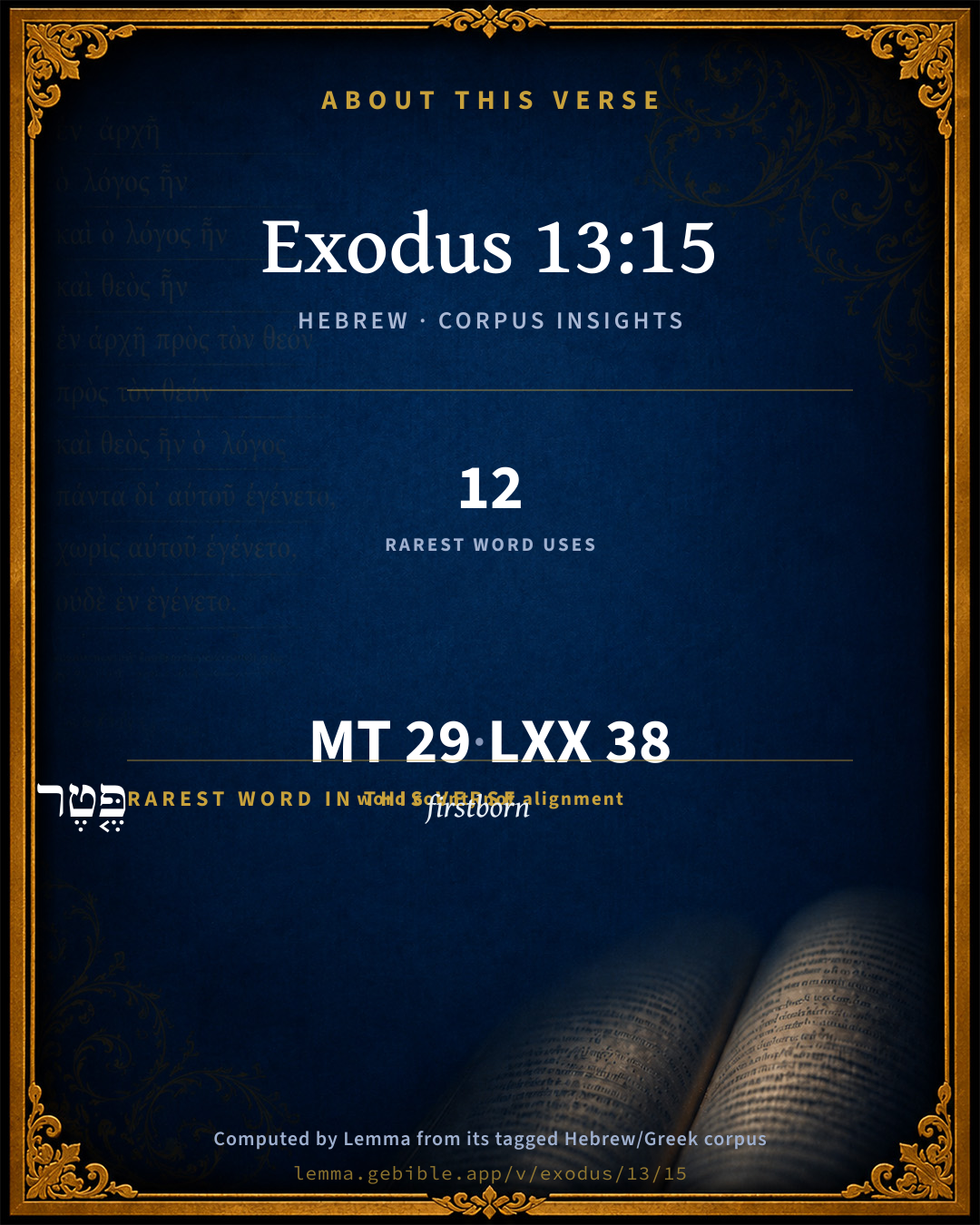
The rarest word here is פֶּ֤טֶר firstborn H6363 — appearing just 12 times in the whole Hebrew Bible.

Shared distinctive vocabulary

פֶּ֤טֶר firstborn H6363 occurs in 10 verses of the Hebrew Bible. Also found in:

Grammatical profile

  • 6 verbs
  • 18 nouns
  • 1 pronoun
  • 2 prepositions
  • 1 conjunction
  • 1 particle

Verb forms

  • וַיְהִ֗י Qal · Sequential Imperfect
  • הִקְשָׁ֣ה Hiphil · Perfect
  • לְשַׁלְּחֵנוּ֒ Piel · Infinitive Construct
  • וַיַּהֲרֹ֨ג Qal · Sequential Imperfect
  • זֹבֵ֜חַ Qal · Participle Active
  • אֶפְדֶּֽה Qal · Imperfect

Repetition

Words recur within this verse — often emphatic in Hebrew:

  • בְּכוֹר֙ firstborn H1060 ×4
  • כָּל all H3605 ×3
  • יְהֹוָ֤ה LORD H3068 ×2

Hebrew & Septuagint length

In English translation the verse runs 52 words from the Hebrew and 56 from the Septuagint (LXX English) — closely comparable.

A rough comparison of the two English renderings, which tokenize alike — not a word-level alignment.

Word counts can differ between the Hebrew and the Greek without any difference in meaning — e.g. the Hebrew direct-object marker אֵת has no separate Greek word, and Greek often adds the article ὁ.

In the original languages it is 29 Hebrew tokens and 38 Greek tokens — but the two are counted differently (Hebrew bundles its prefixes and suffixes into one token; the Greek is in lemma form), so that isn’t a like-for-like length.

Cross-references

1

Topical passages linked to Exodus 13:15 in the Treasury of Scripture Knowledge — connected by theme and wording, ordered by reader-vote popularity; previews shown in the World English Bible.

  • Exodus 12:29 It happened at midnight, that Yahweh struck all the firstborn in the land of Egypt, from the firstborn of Pharaoh who sat on his throne to the firstborn of the captive who was in the dungeon; and all the firstborn of cattle.

Cross-references courtesy of OpenBible.info (CC BY 4.0).

Hebrew and Greek witnesses Masoretic Hebrew ↔ Greek Septuagint

The same verse in the two great witnesses to the Old Testament, shown verse-for-verse.

These are two independent witnesses, not word-aligned to each other, and the Septuagint is shown in lemma (dictionary) form.

Hebrew Exodus 13:15 Masoretic · Westminster Leningrad Codex

וַיְהִ֗י כִּֽי הִקְשָׁ֣ה פַרְעֹה֮ לְשַׁלְּחֵנוּ֒ וַיַּהֲרֹ֨ג יְהֹוָ֤ה כָּל בְּכוֹר֙ בְּאֶ֣רֶץ מִצְרַ֔יִם מִבְּכֹ֥ר אָדָ֖ם וְעַד בְּכ֣וֹר בְּהֵמָ֑ה עַל כֵּן֩ אֲנִ֨י זֹבֵ֜חַ לַֽיהוָ֗ה כָּל פֶּ֤טֶר רֶ֨חֶם֙ הַזְּכָרִ֔ים וְכָל בְּכ֥וֹר בָּנַ֖י אֶפְדֶּֽה

and it happened, when Pharaoh would hardly let us go, that Yahweh killed all the firstborn in the land of Egypt, both the firstborn of man, and the firstborn of animal. Therefore I sacrifice to Yahweh all that opens the womb, being males; but all the firstborn of my sons I redeem.'

World English Bible · Public Domain

Greek LXX Exodus 13:15 Septuagint · lemma form

ἡνίκα δέ σκληρύνω φαραώ ἐκ ἀποστέλλω ἐγώ ἀποκτείνω πᾶς πρωτότοκος ἐν γῆ αἴγυπτος ἀπό πρωτότοκος ἄνθρωπος ἕως πρωτότοκος κτῆνος διά οὗτος ἐγώ θύω ὁ κύριος πᾶς δια ἀναοἴγω μήτρα ὁ ἀρσενικός καί πᾶς πρωτότοκος ὁ υἱός ἐγώ λυτρόω

And when Pharao hardened his heart so as not to send us away, he killed every firstborn in the land of Egypt, both the firstborn of man and the firstborn of beast; therefore do I sacrifice every offspring that opens the womb, the males to the Lord, and every firstborn of my sons I will redeem.

LXX2012 (modern English Septuagint) · Public Domain

Hebrew: Westminster Leningrad Codex (CC BY 4.0). Greek: Septuagint (public domain); English from LXX2012 (modern English Septuagint) (Public Domain). How the Septuagint differs from the Hebrew →

Targum (Aramaic paraphrase)

2

The Targum is the ancient Jewish Aramaic paraphrase of the Hebrew Scriptures — an interpretive translation, not the Hebrew text itself. Onkelos (literal) and Pseudo-Jonathan (expansive) render the Torah, and Jonathan the Prophets. Coverage is partial: where no permissively-licensed English translation exists for a verse, only the Aramaic is shown. This is verse-level text, not a word-by-word alignment to the Hebrew.

  1. Targum Onkelos Torah (Genesis–Deuteronomy)
    וַהֲוָה אֲרֵי אַקְשֵׁי פַרְעֹה לְשַׁלָחוּתָנָא וּקְטַל יְיָ כָּל בּוּכְרָא בְּאַרְעָא דְמִצְרַיִם מִבּוּכְרָא דַאֲנָשָׁא וְעַד בּוּכְרָא דִבְעִירָא עַל כֵּן אֲנָא דָבַח קֳדָם יְיָ כָּל פָּתַח וַלְדָא דִכְרִין וְכָל בּוּכְרָא דִבְנַי אֶפְרוֹק:

    (no public-domain English translation for this verse)

    Targum Onkelos — Aramaic: “Onkelos Genesis” (public domain); “Onkelos Exodus” (public domain); “Onkelos Leviticus” (public domain); “Onkelos Numbers” (public domain); “Onkelos Deuteronomy” (public domain). English: “Sefaria Community Translation” (CC0 1.0 (public-domain dedication)); “J.W. Etheridge. The Targums of Onkelos and Jonathan Ben Uzziel on the Pentateuch. London: Longmans, Green, 1862” (public domain). Text via Sefaria.

  2. Targum Pseudo-Jonathan Torah (Genesis–Deuteronomy)
    וַהֲוָה כַּד אַקְשֵׁי מֵימְרָא דַיְיָ יַת לִבָּא דְפַרְעה לְמִפְטְרָנָא וְקָטַל יְיָ כָּל בּוּכְרָא בְּאַרְעָא דְמִצְרַיִם מִן בּוּכְרָא דְּאֵינָשָׁא וְעַד בּוּכְרָא דִבְעִירָא בְּגִין כֵּן אֲנָא דַבַּח קֳדָם יְיָ כָּל פְּתַח וַולְדָא דוּכְרַיָיא וְכָל בּוּכְרָא דִבְרַיי אֶפְרוֹק בְּכַסְפָּא

    And when the Word of the Lord had hardened the heart of Pharoh (that be would) not deliver us, he killed all the firstborn in the land of Mizraim, from the firstborn of man to the firstborn of cattle; therefore do I sacrifice before the Lord every male that openeth the womb, and every firstborn of my sons I redeem with silver.

    Targum Pseudo-Jonathan — Aramaic: “Targum Jonathan on Genesis” (public domain); “Targum Jonathan on Exodus” (public domain); “Targum Jonathan on Leviticus” (public domain); “Targum Jonathan on Numbers” (public domain); “Targum Jonathan on Deuteronomy” (public domain). English: “The Targum of Jonathan ben Uzziel, trans. J. W. Etheridge, London, 1862” (public domain). Text via Sefaria.

Commentary

Notes on Exodus 13:15 from classic Christian and Jewish commentators (each source and its license shown beneath its notes). The classic Christian expositions comment on the surrounding passage and are grouped to its opening verse, so a note may address several verses; the Jewish commentaries on the Tanakh (Rashi and others) are per-verse, so they appear only where the commentator wrote on this verse.

Lemma curates 59 commentaries, every one of them public domain or Creative Commons licensed, each selected and text-cleaned for this edition rather than reprinted as found. About our sources →

Trapp's Complete Commentary

John Trapp

Exo 13:15 And it came to pass, when Pharaoh would hardly let us go, that the LORD slew all the firstborn in the land of Egypt, both the firstborn of man, and the firstborn of beast: therefore I sacrifice to the LORD all that openeth the matrix, being males; but all the firstborn of my children I redeem.

Ver. 15. Would hardly let us go.] Heb., Was hard to send us away, He had as leave have been knocked on the head almost as have done it. It was morely extorted, as sour juice is wrung out of a crab apple. It was an honest prayer of an ancient, Domine duc me quo non volo.

John Trapp, A Commentary or Exposition upon All the Books of the Old and New Testament (1647–1656) — public domain. Text from a community e-Sword module.

The Cambridge Bible for Schools and Colleges

gen. ed. J. J. S. Perowne

15. would hardly, &c.] Heb. dealt hardly in letting us go (or made it hard to let us go), i.e. made difficulties in letting us go: cf., for the Heb., Gen_35:16.

that Jehovah slew, &c.] cf. Num_3:13; Num_8:17 (P).

The Cambridge Bible for Schools and Colleges (gen. ed. J. J. S. Perowne; Cambridge University Press, 1878–1918) — public domain. Text from a community e-Sword module.

John Gill's Exposition

And it came to pass, when Pharaoh would hardly let us go,.... Showed great reluctance to it, and with difficulty was prevailed upon to dismiss them:

that the Lord slew all the firstborn in the land of Egypt, both the firstborn of men, and the firstborn of beast: which he did in one night, making use of a destroying angel or angels for that purpose:

therefore I sacrifice to the Lord all that openeth thee matrix, being males; that is, the firstborn of all clean creatures, as oxen, sheep, and goats:

but all the firstborn of my children I redeem; by paying five shekels apiece to the priest for them, as before observed; and this law continues to be observed with the Jews; the manner of which, as related by Leo Modena (i), is as follows,"Thirty days being expired after the birth of the child, they call a priest to them; that is to say, one that is descended of the stock of Aaron, whom the father of the child pleaseth; and so, many people being gathered together at the time appointed, the father of the child bringeth before the priest, in a bowl or basin, a good quantity of gold and silver, and then they give him the child into his arms; the priest then calling the mother of it before him, saith unto her, mistress, is this your son? she answereth, yes; then, replies he, have you never had any child before, either male or female, or have miscarried anyone? she saith unto him, no; then doth the priest say, this child is mine, as being the firstborn; then turning himself toward the father, he asketh him, whether he will redeem it or not? who answereth him, saying, see, here is gold and silver, take your own price; then saith the priest unto him, you will redeem it then? the father answereth, I will redeem it; it shall be so then, saith the priest, this child is mine as being the firstborn, as it is written, Num 18:16. I therefore take this in exchange, &c. and so he takes the sum of two French crowns, or thereabout, as he thinks good, and then delivers the child to his father and mother, and this day they make a feasting day.''This custom was used in Christ's time, and was observed with respect to him, Luk 2:27.

(i) History of the Jews, par. 4. c. 9. sect. 2.

John Gill's Exposition of the Whole Bible (1746–1763) — public domain (CC PDM 1.0). Text via the HelloAO Bible API.

Haydock's Catholic Bible Commentary

Hardened. Hebrew, "by himself," or by his own malice. (Worthington)

George Leo Haydock (1774–1849), Haydock's Catholic Family Bible and Commentary, 1859 edition — public domain. Excludes Psalms (Douay-Rheims chapter numbering differs from Protestant) and Deuterocanonical books (Catholic canon only).

The Pulpit Commentary

When Pharaoh would hardly let us go. Bather, "when Pharaoh hardened himself against letting us go." At his last interview with Moses, Pharaoh had absolutely refused to let them go with their cattle, (Exo_10:24-27) and Moses had absolutely refused to go without them. I sacrifice all that openeth the womb, being males. And being clean animals. The common sense of the reader or hearer, is expected to supply the restriction. Of my children. Rather, as in verse 13, "of my sons."

The Pulpit Commentary (1880–1919), ed. H.D.M. Spence-Jones & Joseph S. Exell — public domain. Text from a community e-Sword module.

Lesson kit

Teaching starters — assembled from the data on this page, not authored interpretation. Every prompt links to the verse data it draws on. Edit before teaching.

Exodus, in the Pentateuch, opens this verse with 29 words (23 distinct Hebrew lemmas). Its most distinctive word is peṭer (“firstborn”). A historical commentator’s framing appears above. Read the whole chapter for the surrounding context.

Discussion questions

  1. The word peṭer carries the sense “firstborn.” How does it shape the verse?
  2. Exodus 13:2 shares the word «firstborn» with this verse. How do the two illuminate each other?
  3. “firstborn” occurs 4× in this one verse. What is the effect of the repetition?
  4. These translations render this verse differently; the difference is in the English rendering, not the original. What questions does that raise?
  5. The verb «וַיְהִ֗י» is Qal Sequential Imperfect. How does its form color the action?
  6. Reading how Trapp's Complete Commentary and The Cambridge Bible for Schools and Colleges read this verse, where do the two commentators agree and where do they part?

Things to notice

Reading settings

Reading text

Shown beneath each verse's original-language words.

Old Testament
Old Testament edition

Read the OT as the Masoretic Hebrew (MT) or the Greek Septuagint (LXX).

English shown for the Greek Septuagint (in the Hebrew ↔ Greek comparison).

Comparing translations? Open the Compare panel on any verse page to stack up to four side by side.