
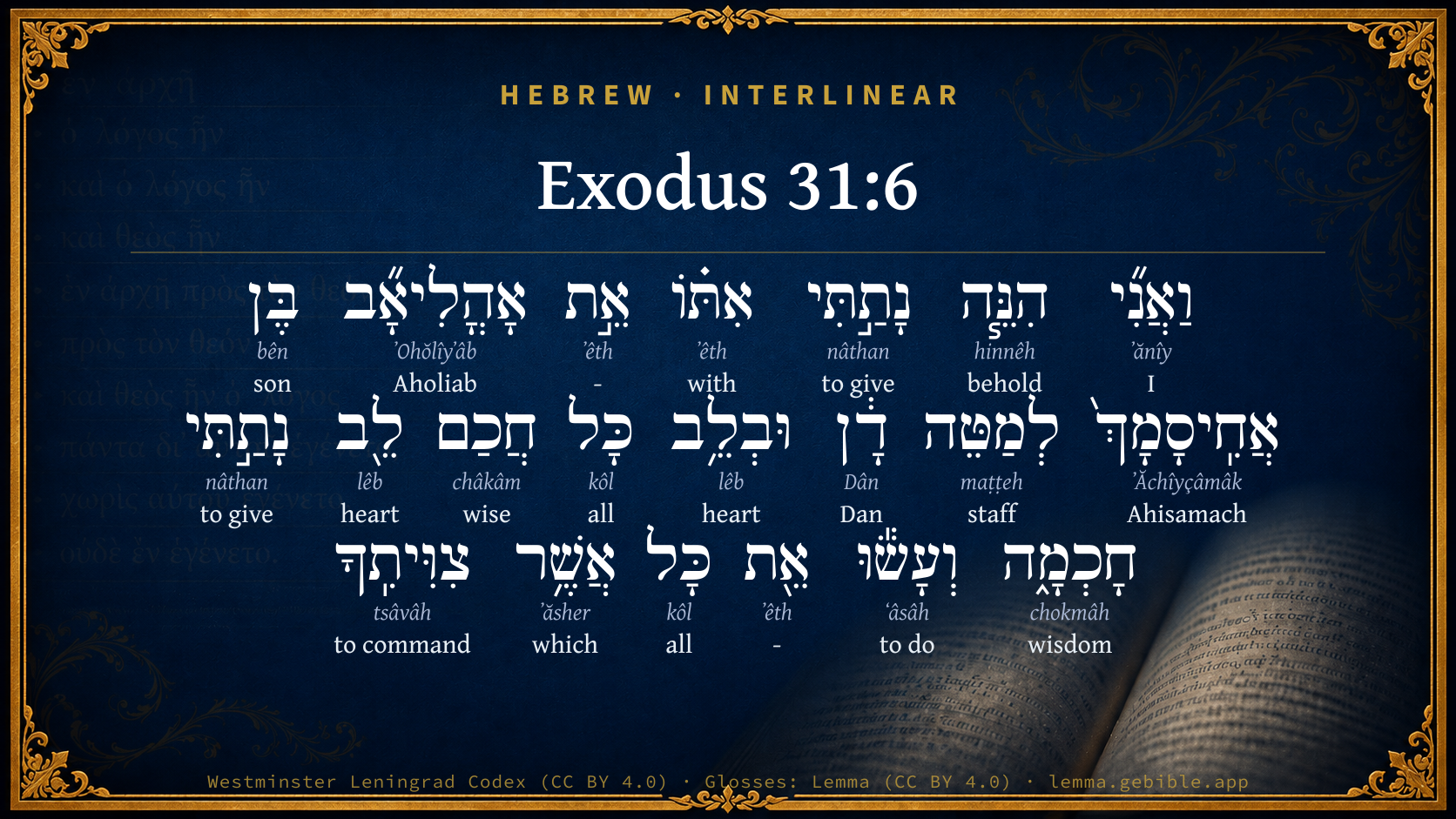
Exodus 31:6

Hebrew (Westminster Leningrad Codex) Exodus 31:6 appears in the Hebrew Old Testament. The text above is from the Westminster Leningrad Codex. Each word links to its Strong’s number, a concise gloss, and parsing drawn from the Open Scriptures Hebrew Bible morphology. Click any word for its full Brown-Driver-Briggs (BDB) entry.
Download image
Cite this verse

Exodus 31:6 (World English Bible). Public Domain. Lemma interlinear Bible study tool, https://lemma.gebible.app/v/exodus/31/6.

Show BibTeX & RIS
BibTeX
RIS
English Translation
I, behold, I have appointed with him Oholiab, the son of Ahisamach, of the tribe of Dan; and in the heart of all who are wise-hearted I have put wisdom, that they may make all that I have commanded you:
World English Bible · Public Domain
Highlights
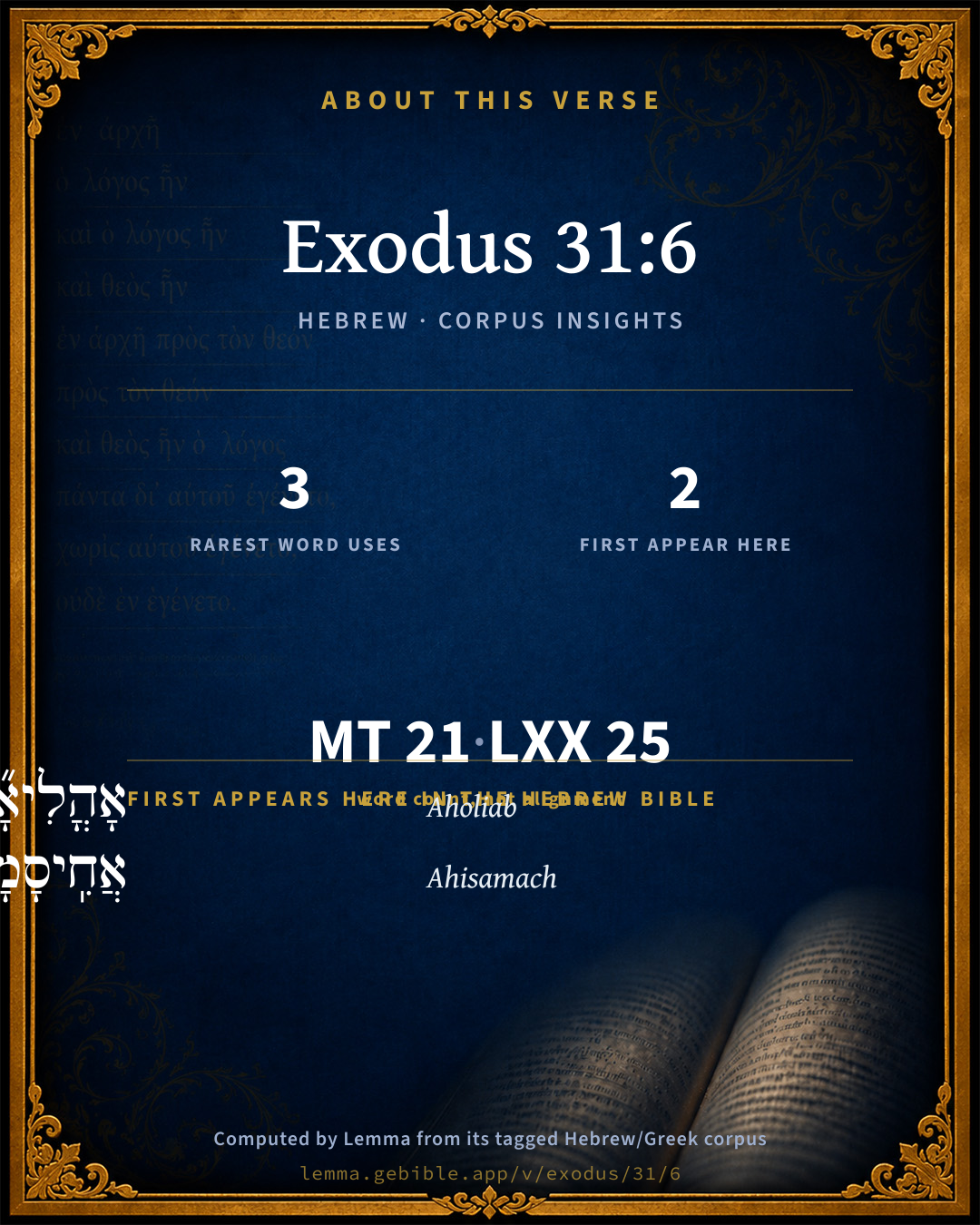
  • 2 first appearances in the Hebrew Bible
Full analysis ↓
Download a study sheet

One document with this verse’s original text, its word-by-word gloss line, the meaning frame, cross-references with their text, attributed commentary, and full source and license credits — printable, and it pastes into notes with its structure intact.

This verse Autodidact and up

Study sheet (.html) Plain text (.txt)

A passage Seminary Student

Up to 50 verses in one chapter. A passage sheet keeps up to 6 commentary sources and 12 cross-references per verse, in the order this page ranks them, and says so on the sheet whenever that leaves anything out. Ask for a single verse and you get the Autodidact verse sheet above.

Everything on this page stays free to read, with no account — the sheet is a download of what is already on screen, not access to it.

Want to remove ads? Support Godless Engineer
Compare translations 3

The same verse in 3 English versions, stacked beneath the original-language interlinear above. Click any original word for its lexicon entry.

Each is an independent rendering of the whole verse — the interlinear is not word-aligned to these translations.

Highlighted words mark where these versions differ — a whole-verse word diff, not a word-by-word alignment.

  • World English Bible Public Domain
    I, behold, I have appointed with him Oholiab, the son of Ahisamach, of the tribe of Dan; and in the heart of all who are wise-hearted I have put wisdom, that they may make all that I have commanded you:
  • King James Version Public Domain
    And I, behold, I have given with him Aholiab, the son of Ahisamach, of the tribe of Dan: and in the hearts of all that are wise hearted I have put wisdom, that they may make all that I have commanded thee;
  • unfoldingWord Literal Text CC BY-SA 4.0
    And behold, I have given with him Oholiab son of Ahisamak, from the tribe of Dan. And I have put skill into the hearts of all of the skilled of heart, and they shall make all that I have commanded you:

unfoldingWord Literal Text — © unfoldingWord, licensed CC BY-SA 4.0. Word-aligned USFM3 via Door43 (git.door43.org/unfoldingWord/en_ult).

Versions to compare (up to 4)

3 of 4 selected

Show all 18 translations

Every available English version of this verse, each an independent rendering of the whole verse.

  • World English Bible Public Domain
    I, behold, I have appointed with him Oholiab, the son of Ahisamach, of the tribe of Dan; and in the heart of all who are wise-hearted I have put wisdom, that they may make all that I have commanded you:
  • Berean Standard Bible Public Domain
    Moreover, I have selected Oholiab son of Ahisamach, of the tribe of Dan, as his assistant. I have also given skill to all the craftsmen, that they may fashion all that I have commanded you:
  • Majority Standard Bible Public Domain
    Moreover, I have selected Oholiab son of Ahisamach, of the tribe of Dan, as his assistant. I have also given skill to all the craftsmen, that they may fashion all that I have commanded you:
  • King James Version Public Domain
    And I, behold, I have given with him Aholiab, the son of Ahisamach, of the tribe of Dan: and in the hearts of all that are wise hearted I have put wisdom, that they may make all that I have commanded thee;
  • American Standard Version (1901) Public Domain
    And I, behold, I have appointed with him Oholiab, the son of Ahisamach, of the tribe of Dan; and in the heart of all that are wise-hearted I have put wisdom, that they may make all that I have commanded thee:
  • Revised Version (1885) Public Domain
    And I, behold, I have appointed with him Oholiab, the son of Ahisamach, of the tribe of Dan; and in the hearts of all that are wise hearted I have put wisdom, that they may make all that I have commanded thee:
  • Geneva Bible (1599) Public Domain
    And behold, I haue ioyned with him Aholiab the sonne of Ahisamach of the tribe of Dan, and in the hearts of all that are wise hearted, haue I put wisdome to make all that I haue commanded thee:
  • Douay-Rheims (1899) Public Domain
    And I have given him for his companion Ooliab the son of Achisamech of the tribe of Dan. And I have put wisdom in the heart of every skilful man, that they may make all things which I have commanded thee,
  • Young's Literal Translation Public Domain
    `And I, lo, I have given with him Aholiab, son of Ahisamach, of the tribe of Dan, and in the heart of every wise-hearted one I have given wisdom, and they have made all that which I have commanded thee.
  • Literal Standard Version CC BY-SA 4.0
    And I, behold, have given with him Aholiab, son of Ahisamach, of the tribe of Dan, and I have given wisdom in the heart of every wise-hearted one, and they have made all that which I have commanded you.
  • Unlocked Literal Bible CC BY-SA 4.0
    In addition to him, I have appointed Oholiab son of Ahisamak, from the tribe of Dan. I have put skill into the hearts of all who are wise so that they may make all that I have commanded you. This includes
  • unfoldingWord Literal Text CC BY-SA 4.0
    And behold, I have given with him Oholiab son of Ahisamak, from the tribe of Dan. And I have put skill into the hearts of all of the skilled of heart, and they shall make all that I have commanded you:
  • Darby Bible Public Domain
    And I, behold, I have given with him Aholiab the son of Ahisamach, of the tribe of Dan; and in the heart of every one that is wise-hearted have I given wisdom, that they may make all that I have commanded thee --
  • World Messianic Bible Public Domain
    Behold, I myself have appointed with him Oholiab, the son of Ahisamach, of the tribe of Dan; and in the heart of all who are wise-hearted I have put wisdom, that they may make all that I have commanded you:
  • Webster's Bible Public Domain
    And I, behold, I have given with him Aholiab the son of Ahisamach of the tribe of Dan; and in the hearts of all that are wise-hearted I have put wisdom; that they may make all that I have commanded thee:
  • Free Bible Version CC BY-SA 4.0
    I have also chosen Oholiab, son of Ahisamach, from the tribe of Dan, to help him. I have also given all the craftsmen the skills needed to make everything that I have ordered you to make:
  • Bible in Basic English Public Domain
    And I have made selection of Oholiab with him, the son of Ahisamach, of the tribe of Dan; and in the hearts of all who are wise I have put the knowledge to make whatever I have given you orders to have made;
  • JPS Tanakh (1917) Public Domain
    And I, behold, I have appointed with him Oholiab, the son of Ahisamach, of the tribe of Dan; and in the hearts of all that are wise-hearted I have put wisdom, that they may make all that I have commanded thee:

Literal Standard Version (2020), Covenant Press — licensed CC BY-SA 4.0. Text via the HelloAO Bible API (eBible.org). Unlocked Literal Bible (unfoldingWord) — licensed CC BY-SA 4.0. Text via the HelloAO Bible API (eBible.org). unfoldingWord Literal Text — © unfoldingWord, licensed CC BY-SA 4.0. Word-aligned USFM3 via Door43 (git.door43.org/unfoldingWord/en_ult). Free Bible Version, Dr. Jonathan Gallagher — licensed CC BY-SA 4.0. Text via the HelloAO Bible API (eBible.org).

Word by word

More ways to search: Search by grammar → Find every occurrence → Compare this word →

Practice this passage: Drill this verse → Learn its vocabulary →

אֲחִֽיסָמָךְ֙
ʼĂchîyçâmâk
H294
“Ahisamach”
Noun, Proper
Part of Speech
Noun
Type
Proper
Full BDB Definition

Origin: from H251 and H5564

TWOT: None

Ahisamach = "my brother is support (has supported)" - a Danite, father of Aholiab, a workman on the tabernacle
  1. וַאֲנִ֞י ʼănîy H589 “and · I” Conjunction + Pronoun, Personal, 1st Person, Common, Singular
  2. הִנֵּ֧ה hinnêh H2009 “behold” Particle, Demonstrative
  3. נָתַ֣תִּי nâthan H5414 “to give” Verb, Qal, Perfect, 1st Person, Common, Singular
  4. אִתּ֗וֹ ʼêth H854 “with · him” Preposition + Suffix, Personal, 3rd Person, Masculine, Singular
  5. אֵ֣ת ʼêth H853 “-” Particle, Direct Object
  6. אָהֳלִיאָ֞ב ʼOhŏlîyʼâb H171 “Aholiab” Noun, Proper
  7. בֶּן bên H1121 “son of” Noun, Common, Masculine, Singular, Construct
  8. לְמַטֵּה maṭṭeh H4294 “to/for · staff of” Preposition + Noun, Common, Masculine, Singular, Construct
  9. דָ֔ן Dân H1835 “Dan” Noun, Proper
  10. וּבְלֵ֥ב lêb H3820 “and · in/at · heart of” Conjunction + Preposition + Noun, Common, Masculine, Singular, Construct
  11. כָּל kôl H3605 “all of” Noun, Common, Masculine, Singular, Construct
  12. חֲכַם châkâm H2450 “wise of” Adjective, Adjective, Masculine, Singular, Construct
  13. לֵ֖ב lêb H3820 “heart” Noun, Common, Masculine, Singular, Absolute
  14. נָתַ֣תִּי nâthan H5414 “to give” Verb, Qal, Perfect, 1st Person, Common, Singular
  15. חָכְמָ֑ה chokmâh H2451 “wisdom” Noun, Common, Feminine, Singular, Absolute
  16. וְעָשׂ֕וּ ʻâsâh H6213 “and · to do” Conjunction + Verb, Qal, Sequential Perfect, 3rd Person, Common, Plural
  17. אֵ֖ת ʼêth H853 “-” Particle, Direct Object
  18. כָּל kôl H3605 “all of” Noun, Common, Masculine, Singular, Construct
  19. אֲשֶׁ֥ר ʼăsher H834 “which” Particle, Relative
  20. צִוִּיתִֽךָ tsâvâh H6680 “to command · you” Verb, Piel, Perfect, 1st Person, Common, Singular + Suffix, Personal, 2nd Person, Masculine, Singular

About this verse

These counts appear in no published source. They are computed here, from the morphology-tagged text and Lemma’s own curated glosses. What Lemma adds →

21
words
17
distinct lemmas
Pentateuch
section

Notable vocabulary

The rarest word here is אֲחִֽיסָמָךְ֙ Ahisamach H294 — appearing just 3 times in the whole Hebrew Bible.

First appearance in Scripture

These words make their first canonical appearance in the Hebrew Bible here:

  • אָהֳלִיאָ֞ב Aholiab H171
  • אֲחִֽיסָמָךְ֙ Ahisamach H294

Shared distinctive vocabulary

אֲחִֽיסָמָךְ֙ Ahisamach H294 occurs in 3 verses of the Hebrew Bible. Also found in:

Grammatical profile

  • 4 verbs
  • 10 nouns
  • 1 adjective
  • 1 pronoun
  • 1 preposition
  • 4 particles

Verb forms

  • נָתַ֣תִּי Qal · Perfect
  • נָתַ֣תִּי Qal · Perfect
  • וְעָשׂ֕וּ Qal · Sequential Perfect
  • צִוִּיתִֽךָ Piel · Perfect

Repetition

Words recur within this verse — often emphatic in Hebrew:

  • נָתַ֣תִּי to give H5414 ×2
  • וּבְלֵ֥ב heart H3820 ×2
  • כָּל all H3605 ×2

Hebrew & Septuagint length

In English translation the verse runs 40 words from the Hebrew and 41 from the Septuagint (LXX English) — closely comparable.

A rough comparison of the two English renderings, which tokenize alike — not a word-level alignment.

Word counts can differ between the Hebrew and the Greek without any difference in meaning — e.g. the Hebrew direct-object marker אֵת has no separate Greek word, and Greek often adds the article ὁ.

In the original languages it is 21 Hebrew tokens and 25 Greek tokens — but the two are counted differently (Hebrew bundles its prefixes and suffixes into one token; the Greek is in lemma form), so that isn’t a like-for-like length.

Cross-references

22

Topical passages linked to Exodus 31:6 in the Treasury of Scripture Knowledge — connected by theme and wording, ordered by reader-vote popularity; previews shown in the World English Bible.

  • Exodus 28:3 You shall speak to all who are wise-hearted, whom I have filled with the spirit of wisdom, that they make Aaron's garments to sanctify him, that he may minister to me in the priest's office.
  • Exodus 35:10 "Let every wise-hearted man among you come, and make all that Yahweh has commanded:
  • Exodus 35:34–36:1 He has put in his heart that he may teach, both he, and Oholiab, the son of Ahisamach, of the tribe of Dan.
  • Luke 10:1 Now after these things, the Lord also appointed seventy others, and sent them two by two ahead of him into every city and place, where he was about to come.
  • Acts 13:2 As they served the Lord and fasted, the Holy Spirit said, "Separate Barnabas and Saul for me, for the work to which I have called them."
  • James 1:16–17 Don't be deceived, my beloved brothers.
  • Exodus 4:14–15 The anger of Yahweh was kindled against Moses, and he said, "What about Aaron, your brother, the Levite? I know that he can speak well. Also, behold, he comes forth to meet you. When he sees you, he will be glad in his heart.
  • Exodus 35:25–26 All the women who were wise-hearted spun with their hands, and brought that which they had spun, the blue, the purple, the scarlet, and the fine linen.
  • Exodus 37:1–29 Bezalel made the ark of acacia wood. Its length was two and a half cubits, and its breadth a cubit and a half, and a cubit and a half its height.
  • 1 Kings 3:12 behold, I have done according to your word: behold, I have given you a wise and an understanding heart; so that there has been none like you before you, neither after you shall any arise like you.
  • Ezra 5:1–2 Now the prophets, Haggai the prophet, and Zechariah the son of Iddo, prophesied to the Jews who were in Judah and Jerusalem; in the name of the God of Israel [prophesied they] to them.
  • Ecclesiastes 4:9–12 Two are better than one, because they have a good reward for their labor.
  • Exodus 6:26 These are that Aaron and Moses, to whom Yahweh said, "Bring out the children of Israel from the land of Egypt according to their hosts."
  • Exodus 36:8 All the wise-hearted men among those who did the work made the tent with ten curtains; of fine twined linen, blue, purple, and scarlet, with cherubim, the work of the skillful workman, they made them.
  • 2 Chronicles 3:1–4 Then Solomon began to build the house of Yahweh at Jerusalem on Mount Moriah, where [Yahweh] appeared to David his father, which he made ready in the place that David had appointed, in the threshing floor of Ornan the Jebusite.
  • Proverbs 2:6–7 For Yahweh gives wisdom. Out of his mouth comes knowledge and understanding.
  • Matthew 10:2–4 Now the names of the twelve apostles are these. The first, Simon, who is called Peter; Andrew, his brother; James the son of Zebedee; John, his brother;
  • Acts 15:39–40 Then the contention grew so sharp that they separated from each other. Barnabas took Mark with him, and sailed away to Cyprus,
  • James 1:5 But if any of you lacks wisdom, let him ask of God, who gives to all liberally and without reproach; and it will be given to him.
  • Numbers 4:1–49 Yahweh spoke to Moses and to Aaron, saying,
  • 1 Kings 6:1–8 It happened in the four hundred and eightieth year after the children of Israel were come out of the land of Egypt, in the fourth year of Solomon's reign over Israel, in the month Ziv, which is the second month, that he began to build the house of Yahweh.
  • Ezekiel 43:1–27 Afterward he brought me to the gate, even the gate that looks toward the east.

Cross-references courtesy of OpenBible.info (CC BY 4.0).

Hebrew and Greek witnesses Masoretic Hebrew ↔ Greek Septuagint

The same verse in the two great witnesses to the Old Testament, shown verse-for-verse.

These are two independent witnesses, not word-aligned to each other, and the Septuagint is shown in lemma (dictionary) form.

Hebrew Exodus 31:6 Masoretic · Westminster Leningrad Codex

וַאֲנִ֞י הִנֵּ֧ה נָתַ֣תִּי אִתּ֗וֹ אֵ֣ת אָהֳלִיאָ֞ב בֶּן אֲחִֽיסָמָךְ֙ לְמַטֵּה דָ֔ן וּבְלֵ֥ב כָּל חֲכַם לֵ֖ב נָתַ֣תִּי חָכְמָ֑ה וְעָשׂ֕וּ אֵ֖ת כָּל אֲשֶׁ֥ר צִוִּיתִֽךָ

I, behold, I have appointed with him Oholiab, the son of Ahisamach, of the tribe of Dan; and in the heart of all who are wise-hearted I have put wisdom, that they may make all that I have commanded you:

World English Bible · Public Domain

Greek LXX Exodus 31:6 Septuagint · lemma form

καί ἐγώ δίδωμι αὐτός καί ὁ ελιαβ ὁ ὁ αχισαμαχ ἐκ φυλή δαν καί πᾶς συνετός καρδία δίδωμι σύνεσις καί ποιέω πᾶς ὅσος σύ συντάσσω

And I have appointed him and Eliab the son of Achisamach of the tribe of Dan, and to every one understanding in heart I have given understanding; and they shall make all things as many as I have appointed you, —

LXX2012 (modern English Septuagint) · Public Domain

On this verse, Keil & Delitzsch discusses the Septuagint’s reading. Read the note in Commentary ↓

Hebrew: Westminster Leningrad Codex (CC BY 4.0). Greek: Septuagint (public domain); English from LXX2012 (modern English Septuagint) (Public Domain). How the Septuagint differs from the Hebrew →

Targum (Aramaic paraphrase)

2

The Targum is the ancient Jewish Aramaic paraphrase of the Hebrew Scriptures — an interpretive translation, not the Hebrew text itself. Onkelos (literal) and Pseudo-Jonathan (expansive) render the Torah, and Jonathan the Prophets. Coverage is partial: where no permissively-licensed English translation exists for a verse, only the Aramaic is shown. This is verse-level text, not a word-by-word alignment to the Hebrew.

  1. Targum Onkelos Torah (Genesis–Deuteronomy)
    וַאֲנָא הָא יְהָבִית עִמֵהּ יָת אָהֳלִיאָב בַּר אֲחִיסָמָךְ לְשִׁבְטָא דְדָן וּבְלִבָּא כָל חַכִּימֵי לִבָּא יְהָבִית חָכִמְתָא וְיַעְבִּדוּן יָת כָּל דִי פַקֵדִתָּךְ:

    (no public-domain English translation for this verse)

    Targum Onkelos — Aramaic: “Onkelos Genesis” (public domain); “Onkelos Exodus” (public domain); “Onkelos Leviticus” (public domain); “Onkelos Numbers” (public domain); “Onkelos Deuteronomy” (public domain). English: “Sefaria Community Translation” (CC0 1.0 (public-domain dedication)); “J.W. Etheridge. The Targums of Onkelos and Jonathan Ben Uzziel on the Pentateuch. London: Longmans, Green, 1862” (public domain). Text via Sefaria.

  2. Targum Pseudo-Jonathan Torah (Genesis–Deuteronomy)
    וַאֲנָא הָא מַנְיַית עִמֵּיהּ יַת אָהֳלִיאָב בַר אֲחִיסָמָךְ לְשִׁבְטָא דְדָן וּבְלִבָּא דְּכָל חַכִּימֵי לִיבָּא אוֹסִיפִית רוּחַ חוּכְמָתָא וְיַעַבְדוּן יַת כָּל מַה דְּאַפְקֵדִיתָךְ

    And, behold, I have appointed with him Ahaliab bar Achisamah, of the tribe of Dan; and in the heart of every one wise hearted I have added the Spirit of wisdom, that they may perform all whatever I have commanded thee.

    Targum Pseudo-Jonathan — Aramaic: “Targum Jonathan on Genesis” (public domain); “Targum Jonathan on Exodus” (public domain); “Targum Jonathan on Leviticus” (public domain); “Targum Jonathan on Numbers” (public domain); “Targum Jonathan on Deuteronomy” (public domain). English: “The Targum of Jonathan ben Uzziel, trans. J. W. Etheridge, London, 1862” (public domain). Text via Sefaria.

Commentary

Notes on Exodus 31:6 from classic Christian and Jewish commentators (each source and its license shown beneath its notes). The classic Christian expositions comment on the surrounding passage and are grouped to its opening verse, so a note may address several verses; the Jewish commentaries on the Tanakh (Rashi and others) are per-verse, so they appear only where the commentator wrote on this verse.

Lemma curates 59 commentaries, every one of them public domain or Creative Commons licensed, each selected and text-cleaned for this edition rather than reprinted as found. About our sources →

Trapp's Complete Commentary

John Trapp

Exo 31:6 And I, behold, I have given with him Aholiab, the son of Ahisamach, of the tribe of Dan: and in the hearts of all that are wise hearted I have put wisdom, that they may make all that I have commanded thee;

Ver. 6. I have given with him.] Two is better than one; four eyes see more than two: God usually therefore coupleth his agents. {See Trapp on "Mat 10:2"} {See Trapp on "Mat 10:3"} {See Trapp on "Luk 10:1"}

John Trapp, A Commentary or Exposition upon All the Books of the Old and New Testament (1647–1656) — public domain. Text from a community e-Sword module.

The Biblical Illustrator

Joseph S. Exell

Exo_31:6

In the hearts of all that are wise hearted I have put wisdom.

The danger of accomplishments

There are persons who doubt whether what are called accomplishments, whether in literature or in the fine arts, can be consistent with deep and practical seriousness of mind. I am not speaking of human learning; this also many men think inconsistent with simple uncorrupted faith. They suppose that learning must make a man proud. This is of course a great mistake; but of it I am not speaking, but of an over-jealousy of accomplishments, the elegant arts and studies, such as poetry, literary composition, painting, music, and the like; which are considered, not indeed to make a man proud, but to make him trifling. Of this opinion, how far it is true and how far not true, I am going to speak. Now, that the accomplishments I speak of have a tendency to make us trifling and unmanly, and therefore are to be viewed by each of us with suspicion as far as regards himself, I am ready to admit, and shall presently make clear. I allow that in matter of fact, refinement and luxury, elegance and effeminacy, go together. Antioch, the most polished, was the most voluptuous city of Asia. But the abuse of good things is no argument against the things themselves; mental cultivation may be a Divine gift, though it is abused. An acquaintance with the elegant arts may he a gift and a good, and intended to be an instrument of Gods glory, though numbers who have it are rendered thereby indolent, luxurious, and feeble-minded. But the account of the building of the Tabernacle in the wilderness, from which the text is taken, is decisive on this point. How, then, is it that what in itself is of so excellent, and, I may say, Divine a nature, is yet so commonly perverted? Now the danger of an elegant and polite education is that it separates feeling and acting; it teaches us to think, speak, and be affected aright, without forcing us to practise what is right. I will take an illustration of this from the effect produced upon the mind by reading what is commonly called a romance or novel. Such works contain many good sentiments (I am taking the better sort of them); characters, too, are introduced, virtuous, noble, patient under suffering, and triumphing at length over misfortune. But it is all fiction; it does not exist out of a book which contains the beginning and end of it. We have nothing to do; we read, are affected, softened, or roused, and that is all; we cool again--nothing comes of it. Now observe the effect of this. God has made us feel in order that we may go on to act in consequence of feeling; if, then, we allow our feelings to be excited without acting upon them, we do mischief to the moral system within us, just as we might spoil a watch, or other piece of mechanism, by playing with the wheels of it. We weaken its springs, and they cease to act truly. For instance, we will say we have read again and again of the heroism of facing danger, and we have glowed with the thought of its nobleness. Now, suppose at length we actually come into trial, and, let us say, our feelings become roused, as often before, at the thought of boldly resisting temptations to cowardice, shall we therefore do our duty, quitting ourselves like men? rather, we are likely to talk loudly, and then run from the danger. And what is here instanced of fortitude is true in all cases of duty. The refinement which literature gives is that of thinking, feeling, knowing and speaking right, not of acting right; and thus, while it makes the manners amiable, and the conversation decorous and agreeable, it has no tendency to make the conduct, the practice of the man virtuous. The case is the same with the arts last alluded to--poetry and music. These are especially likely to make us unmanly, if we are not on our guard, as exciting emotions without insuring correspondent practice, and so destroying the connection between feeling and acting; for I here mean by unmanliness the inability to do with ourselves what we wish--the saying fine things and yet lying slothfully on our couch, as if we could not get up, though we ever so much wished it. And here I must notice something besides in elegant accomplishments, which goes to make us over-refined and fastidious, and falsely delicate. In books everything is made beautiful in its way. Pictures are drawn of complete virtue; little is said about failures, and little or nothing of the drudgery of ordinary, every-day obedience, which is neither poetical nor interesting. True faith teaches us to do numberless disagreeable things for Christs sake, to bear petty annoyances, which we find written down in no book. And further still, it must be observed, that the art of composing, which is a chief accomplishment, has in itself a tendency to make us artificial and insincere. For to be ever attending to the fitness and propriety of our words, is (or at least there is the risk of its being) a kind of acting; and knowing what can be said on both sides of a subject is a main step towards thinking the one side as good as the other. With these thoughts before us, it is necessary to look back to the Scripture instances which I began by adducing, to avoid the conclusion that accomplishments are positively dangerous and unworthy a Christian. But St. Luke and St. Paul show us that we may be sturdy workers in the Lords service, and bear our cross manfully, though we be adorned with all the learning of the Egyptians; or, rather, that the resources of literature and the graces of a cultivated mind may be made both a lawful source of enjoyment to the possessor, and a means of introducing and recommending the truth to others; while the history of the Tabernacle shows that all the cunning arts and precious possessions of this world may be consecrated to a religious service, and be made to speak of the world to come. I conclude, then, with the following cautions, to which the foregoing remarks lead. First, we must avoid giving too much time to lighter occupations; and next, we must never allow ourselves to read works of fiction or poetry, or to interest ourselves in the fine arts for the mere sake of the things themselves; but keep in mind all along that we are Christians and accountable beings, who have fixed principles of right and wrong, by which all things must be tried, and have religious habits to be matured within them, towards which all things are to be made subservient. If we are in earnest we shall let nothing lightly pass by which may do us good, nor shall we dare to trifle with such sacred subjects as morality and religious duty. We shall apply all we read to ourselves; and this almost without intending to do so, from the mere sincerity and honesty of our desire to please God. We shall be suspicious of all such good thoughts and wishes, and we shall shrink from all such exhibitions of our principles as fall short of action. Of all such as abuse the decencies and elegancies of moral truth into a means of luxurious enjoyment, what would a prophet of God say? (Eze_33:30-32; 2Ti_4:2-4; 1Co_16:13). (J. H. Newman, D. D.)

The wise hearted ones

Who are the wise hearted ones?

1. They are those who prove themselves as having ability to do useful work. Work done, and well done, though it be in itself of trifling value, is the determination of wisdom.

2. The wise hearted are they who reach beyond present ability to perform. No true workman is satisfied to simply repeat his last job.

3. The wise hearted are they who, at Christs call, enter His kingdom, there to labour under the influence of the purest, strongest motives. (C. R. Seymour.)

Grace and genius

I. Natural gifts are often discovered by grace.

II. Natural gifts are directed by grace.

III. Natural gifts are heightened by grace.

IV. Natural gifts are sanctified by grace. (J. S. Exell, M. A.)

The method of Providence

God would have everything built beautifully. What an image of beauty have we seen this Tabernacle to be through and through, flushed with colours we have never seen, and bright with lights that could not show themselves fully in the murkiness of this air! He would make us more beautiful than our dwelling-place. He would not have the house more valuable than the tenant. He did not mean the worshipper to be less than the Tabernacle which He set up for worship. Are we living the beautiful life--the life solemn with sweet harmonies, broad in its generous purpose, noble in the sublimity of its prayer, like God in the perpetual sacrifice of its life? Not only will God build everything beautifully; His purpose is to have everything built for religious uses. His meaning is that the form shall help the thought, that images appealing to the eye shall also touch the imagination and graciously affect the whole spirit, and subdue into tender obedience and worship the soul and heart of man. What is the Tabernacle for? For worship. What is the meaning of it? It is a gate opening upon heaven. Why was it set up? To lift us nearer God. If we fail to seize these purposes, if we fail of magnifying and glorifying them so as to ennoble our own life in the process, we have never seen the Tabernacle. Herein is it for ever true that we may have a Bible but no revelation; a sermon but no Gospel; we may be in the church, yet not in the sanctuary; we may admire beauty, and yet live the life of the drunkard and the debauchee. In all His building--and God is always building--He qualifies every man for a particular work in connection with the edifice. The one man wants the other man. The work stands still till that other man comes in. (J. Parker, D. D.)

Various kinds of inspiration

Who can read these words as they ought to be read? How it makes ministers of God by the thousand! We have thought that Aaron was a religious man because of his clothing and because of many peculiarities which separated him from other men; but the Lord distinctly claims the artificer as another kind of Aaron. Who divides life into sacred and profane? Who introduces the element of meanness into human occupation and service? God claims all things for Himself. Who will say that the preacher is a religious man, but the artificer is a secular worker? But let us claim all true workers as inspired men. We know that there is an inspired art. The world knows it; instinctively, unconsciously, the world uncovers before it. There is an inspired poetry, make it of what measure you will. The great common heart knows it, says, That is the true verse; how it rises, falls, plashes like a fountain, flows like a stream, breathes like a summer wind, speaks the thoughts we have long understood, but could never articulate! The great human heart says, That is the voice Divine; that is the appeal of heaven. Why should we say that inspiration is not given to all true workers, whether in gold or in thought, whether in song or in prayer, whether in the type or in the magic eloquence of the burning tongue? Let us enlarge life, and enlarge Providence, rather than contract it, and not, whilst praying to a God in the heavens, have no God in the heart. You would work better if you realized that God is the Teacher of the fingers, and the Guide of the hand. Labour is churched and glorified. Art turns its chiselled and flushed features towards its native heaven. (J. Parker, D. D.)

Gifts from God as well as graces

God gave the plan clearly, graphically, distinctly, to Moses; but it needed men raised up specially by the Spirit of God to execute the plan, and to give it practical development. And we learn from this fact that a gifted intellect is as much the creation of the Spirit of God as a regenerate heart. Gifts are from God as truly as graces; it needs the guidance of Gods good Spirit to enable a man to work in gold, and in silver, and in brass, and in cutting of stones, to set them; and in carving of timber, to work in all manner of workmanship; just as it does to do justly, and to love mercy, and to walk humbly with God. We thus see that God gives light to the intellect as well as grace to the heart; and we may, perhaps, from this learn a very humbling, but a very blessed truth--that the man with a gifted intellect is as much summoned to bow the knee, and to thank the Fountain and the Author of it, as the man that has a sanctified heart feels it his privilege to bow his knee, and to bless the Holy Spirit that gave it, for this his distinguishing grace and mercy. (J. Cumming, D. D.)

Spiritual gifts

1. Prize them inestimably.

2. Covet them earnestly.

3. Seek for them diligently.

4. Ponder them frequently.

5. Wait for them patiently.

6. Expect them hopefully.

7. Receive them joyfully.

8. Enjoy them thankfully.

9. Improve them carefully.

10. Retain them watchfully.

11. Plead for them manfully.

12. Hold them dependently.

13. Grasp them eternally. (Biblical Museum.)

Genius and industry

A friend of Charles Dickens, a man who had given promise of a noble career as an author, but who, through indolence, had failed in doing any permanent work, called upon him one morning, and, after bewailing his ill-success, ended by sighing, Ah, if I only were gifted with your genius! Dickens, who had listened patiently to the complaint, exclaimed at once in answer, Genius, sir! I do not know what you mean. I had no genius save the genius for hard work! However his enthusiastic admirers may dispute this, certain it is that Dickens trusted to no such uncertain light as the fire of genius. Day in and day out, by hard work, he elaborated the plot, characters, and dialogue of his imperishable stories. Whole days he would spend to discover suitable localities, and then be able to give vividness to his description of them, while, sentence by sentence, his work, after apparent completion, was retouched and revised. The great law of labour makes no exception of the gifted or ignorant. Whatever the work may be, there can be no success in it without diligent, unceasing, persevering labour.

The Biblical Illustrator, edited by Joseph S. Exell (c. 1880s–1900s) — public domain. Text from a community e-Sword module.

Tyndale Open Study Notes

Tyndale Open Resources

31:6 God commanded remarkable things, but he also provided gifted craftsmen who would be able to carry out all those instructions—much as Augustine prayed, “Give what you command, and command what you will” (Augustine, Confessions 10.29).

Tyndale Open Study Notes — © Tyndale Open Resources, licensed CC BY-SA 4.0. Text via the HelloAO Bible API.

Geneva Bible (1599)

Geneva Bible translators

I have instructed them, and increased their knowledge.

Geneva Bible (1599) marginal notes — public domain. Text via Bolls.life.

Jamieson, Fausset & Brown

Robert Jamieson, A. R. Fausset & David Brown

I have given with him Aholiab--He belonged to the tribe of Dan, one of the least influential and honorable in Israel; and here, too, we can trace the evidence of wise and paternal design, in choosing the colleague or assistant of Bezaleel from an inferior tribe (compare Co1 12:14-25; also Mar 6:7).

all that are wise-hearted I have put wisdom--At that period, when one spirit pervaded all Israel, it was not the man full of heavenly genius who presided over the work; but all who contributed their skill, experience, and labor, in rendering the smallest assistance, showed their piety and devotedness to the divine service. In like manner, it was at the commencement of the Christian Church (Act 6:5; Act 18:2).

Jamieson, Fausset & Brown — Commentary Critical and Explanatory on the Whole Bible (1871) — public domain (CC PDM 1.0). Text via the HelloAO Bible API.

Adam Clarke's Commentary

Verse 6. In the hearts of all that are wisehearted I have put wisdom] So every man that had a natural genius, as we term it, had an increase of wisdom by immediate inspiration from God, so that he knew how to execute the different works which Divine wisdom designed for the tabernacle and its furniture. Dark as were the heathens, yet they acknowledged that all talents, and the seeds of all arts, came from God. Hence Seneca: Insita nobis omnium artium semina, magisterque ex occulto Deus producit ingenia.

In the same way Homer attributes such curious arts to Minerva, the goddess of wisdom, and Vulcan, the god of handicrafts.

Ὡς δ' ὁτε τις χρυσον περιχευεται αργυρῳ ανηρ

Ιδρις, ὁν Ἡφαιστος δεδαεν και Παλλας Αθηνη

Τεχνην παντοιην, χαριεντα δε εργα τελειει.

Odyss., l. vi., ver. 232.

As by some artist, to whom VULCAN gives

His skill divine, a breathing statue lives;

By PALLAS taught, he frames the wondrous mould,

And o'er the silver pours the fusile gold. - POPE.

And all this the wisest of men long before them declared; when speaking of the wisdom of God he says, I, Wisdom, dwell with Prudence, and find out knowledge of witty inventions; Pr 8:12. See Clarke on Ex 28:3, to which the reader is particularly desired to refer. There is something remarkable in the name of this second superintendent, אהליאב Aholiab, the tabernacle of the father, or, the father is my tabernacle; a name nearly similar in its meaning to that of Bezaleel, See Clarke on Ex 31:2.

Adam Clarke's Commentary on the Bible (1810–1826) — public domain. Text from a community e-Sword/MySword module.

Ellicott's Commentary for English Readers

(6) Aholiab, the son of Ahisamach.—It has been observed above (see the first Note on the chapter) that Bezaleel’s work was general, Aholiab’s, special. Our version, indeed, styles the latter “an engraver, and a cunning workman, and an embroiderer” (Exo_38:23), from which it might be supposed that, like Bezaleel, he cultivated various branches of art. In the original, however, nothing is said of engraving, and the true meaning seems to be that Aholiab had the charge of the textile fabrics needed for the sanctuary, and directed both the weaving and the embroidery, but did not intermeddle in other matters. (See Note on Exo_38:23).

Of the tribe of Dan.—The tribe of Dan is among the most undistinguished; but it produced two great artists—Aholiab, the skilful maker of the textile fabrics of the tabernacle, and Hiram, the master workman employed in the ornamentation of Solomon’s temple (2Ch_2:14).

All that are wise hearted.—On the expression “wise hearted,” see Note 1 on Exo_28:3.

A Bible Commentary for English Readers, edited by Charles John Ellicott (1878–1897) — public domain. Text from a community e-Sword module.

The Cambridge Bible for Schools and Colleges

gen. ed. J. J. S. Perowne

6. Oholiab to be Bĕẓal’çl’s associate. The name ‘Oholiab’ is peculiar, and perhaps not genuinely Hebrew (Gray, Heb. Pr. Names, p. 246): it means apparently The father (God) is my tent; cf. Phoen. אהלבעל, אהלמלך, Baal, or the King, is a tent; Sabaean אהלעתתר, אהלאל, ‘Athtar is a tent, God is a tent; and the Edomitish Oholibamah (‘My tent is the high place’?), Gen_36:2; Gen_36:41.

and in the hearts, &c.] i.e. those who are already wise-hearted, i.e. (cf. on Exo_28:3) possess artistic aptitudes, are to be further endowed by God with wisdom, i.e. with the requisite skill to assist Bĕẓal’çl and Oholiab in their work.

The Cambridge Bible for Schools and Colleges (gen. ed. J. J. S. Perowne; Cambridge University Press, 1878–1918) — public domain. Text from a community e-Sword module.

John Gill's Exposition

And I, behold, I have given with him Aholiab, the son of Ahisamach, of the tribe of Dan,.... To be a partner with him, and to assist in the direction and oversight of the work of the tabernacle; which was done that there might appear to be a sufficiency in the direction, and that too much honour might not be given to one tribe; and it is observable, that as Solomon of the tribe of Judah was the builder of the temple, one of the tribe of Dan also was a principal artificer in it, Ch2 2:14 and it is no unusual thing for two persons to be joined together in matters of moment and importance, as Moses and Aaron, who were sent to Pharaoh for Israel's dismission out of the land of Egypt; the apostles of Christ, and seventy disciples, who were sent out two by two; the two witnesses prophesying in sackcloth, the two anointed ones standing before the Lord of the whole earth; and Joshua and Zerubbabel in the rebuilding of the temple: nor is it unusual for both such persons to be types of Christ, as Moses and Aaron, Joshua and Zerubbabel, were; and here Bezaleel, as before, and now Aholiab, whose name signifies "the Father's tent" or "tabernacle"; he being concerned in the oversight of the tabernacle of God and the building of it, and his father's name Ahisamach, according to Hillerus (p), signifies, "one supports", i.e. God; and may be a figure of Christ, whose human nature is the true tabernacle God pitched, and not man, and who, as Mediator, is Jehovah's servant, whom he upholds:

and in the hearts of all that are wise hearted; men of ingenuity, that had good natural parts and abilities, and minds disposed to curious works, and able to perform them, under the guidance and direction of others:

I have put wisdom, that they may make all that I have commanded thee; in the preceding chapters; these persons were to work under Bezaleel and Aholiab, and to do as they were ordered and directed by them; and having good natural abilities, mechanical heads and hearts, and divine wisdom in a large measure communicated to them, they were greatly qualified for the service of the tabernacle, and making all things appertaining to it: thus Christ, the architect and master builder of his church, has wise builders under him, that work in his house, being qualified with the gifts and graces of his Spirit from him, see Zac 6:12.

(p) Onomast. Sacr. p. 735.

John Gill's Exposition of the Whole Bible (1746–1763) — public domain (CC PDM 1.0). Text via the HelloAO Bible API.

Haydock's Catholic Bible Commentary

Wisdom. Good artists deserve this title, provided they make things of real use. (Origen, hom. 22. Num.)

George Leo Haydock (1774–1849), Haydock's Catholic Family Bible and Commentary, 1859 edition — public domain. Excludes Psalms (Douay-Rheims chapter numbering differs from Protestant) and Deuterocanonical books (Catholic canon only).

Matthew Poole's English Annotations

All that are wise-hearted; that have wisdom and skill sufficient to do these things, under the inspection and direction of Bezaleel and Aholiab, the principal workmen.

Matthew Poole's English Annotations on the Holy Bible (1683–1685) — public domain. Text from a community e-Sword/MySword module.

Whedon's Commentary on the Bible

Daniel D. Whedon

6. Aholiab — The grandson of Hur was not to be alone in this responsible work of the sanctuary. A representative of the tribe of Dan was to be associated with him in the labour and responsibility. From Exo_35:35, and Exo_38:23, we infer that Aholiab had more particular charge of the textile fabrics, and the weaving and embroidering, but Bezaleel had superintendency of all. With these were associated also others who were wise hearted, that is, skilled to perform similar artistic work; for many workmen would be needed for the preparation of all that was shown to Moses in the mount. With this account of the call and qualifications of the workmen is joined a brief recapitulation (Exo_31:7-11) of the several articles which have been described in the foregoing chapters.

Daniel D. Whedon (gen. ed.), Commentary on the Old and New Testaments (1874–1909) — public domain. Text from a community e-Sword module.

The Pulpit Commentary

Aholiab appears to have had the entire charge of the textile fabrics, both woven and embroidered. (Exo_38:23) Of the tribe of Ban. It is remarkable that Hiram, the chief artist employed by Solomon for the ornamental work of the temple, was also a descendant of Dan. (2Ch_2:14) Yet the Danites were in general rather warlike and rude than artistic. (Gen_49:17; Deu_33:22; Jud_1:13:2 18:11, 27) In the hearts of all that are wise hearted have I put wisdom. "Unto him that hath shall be given. Those who were already "wise hearted possessed, that is, of artistic power were selected by God to receive extraordinary gifts of the same kind.

The Pulpit Commentary (1880–1919), ed. H.D.M. Spence-Jones & Joseph S. Exell — public domain. Text from a community e-Sword module.

Keil & Delitzsch

C. F. Keil & F. Delitzsch

There were associated with Bezaleel as assistants, Oholiab, the son of Achisamach, of the tribe of Dan, and other men endowed with understanding, whom God had filled with wisdom for the execution of His work. According to Exo 38:23, Oholiab was both faber, a master in metal, stone, and wood work, and also an artistic weaver of colours. In Exo 38:7-11, the words to be executed, which have been minutely described in ch. 24-30, are mentioned singly once more; and, in addition to these, we find in Exo 31:10 השּׂרד בּגדי mentioned, along with, or rather before, the holy dress of Aaron. This is the case also in Exo 35:19 and Exo 39:41, where there is also the additional clause, "to serve (שׁרת ministrare) in the sanctuary." They were composed, according to Exo 39:1, of blue and red purple, and crimson. The meaning of the word serad, which only occurs in these passages, is quite uncertain. The Rabbins understand by the bigde hasserad the wrappers in which the vessels of the sanctuary were enclosed when the camp was broken up, as these are called begadim of blue and red purple, and crimson, in Num 4:6. But this rendering is opposed to the words which follow, and which indicate their use in the holy service, i.e., in the performance of worship, and therefore are quite inapplicable to the wrappers referred to. There is even less ground for referring them, as Gesenius and others do, to the inner curtains of the tabernacle, or the inner hangings of the dwelling-place. For, apart from the uncertainty of the rendering given to serad, viz., netted cloth, filet, it is overthrown by the fact that these curtains of the dwelling-place were not of net-work; and still more decisively by the order in which the bigde hasserad occur in Exo 39:41, viz., not till the dwelling-place and tent, and everything belonging to them, have been mentioned, even down to the hangings of the court and the pegs of the tent, and all that remains to be noticed is the clothing of the priests. From the definition "to serve in the sanctuary," it is obvious that the bigde serad were clothes used in the worship, στολαὶ λειτουργικαί, as the lxx have rendered it in agreement with the rest of the ancient versions-that they were, in fact, the rich robes which constituted the official dress of the high priest, whilst "the holy garments for Aaron" were the holy clothes which were worn by him in common with the priests.

Keil & Delitzsch — Biblical Commentary on the Old Testament (1861–1891) — public domain (CC PDM 1.0). Text via the HelloAO Bible API. (Old Testament only.)

unfoldingWord translationNotes

Door43 World Missions Community

General Information:

Yahweh continues speaking to Moses.

Oholiab ... Ahisamak

These are names of men. (See: How to Translate Names)

I have put skill into the hearts of all who are wise

God speaks of making people able to make things as if he were putting the ability into their hearts. AT: "I have given skill to all who are wise" or "I have made all who are wise able to make things well"

tent of meeting

This is another name for the tabernacle. See how you translated this in Exodus 27:21.

ark of the testimony

The ark is the chest that contains the commandments. This can be stated clearly in the translation. See how you translated this in Exodus 26:33. AT: "the chest containing the commandments" (See: Assumed Knowledge and Implicit Information)

atonement lid

This is the lid that sits on top of the ark where the atonement offering was made. See how you translated this in Exodus 25:17.

incense altar

"altar to burn incense." See how you translated this in Exodus 30:03.

altar for burnt offerings

"altar on which offering were burnt." See how you translated this in Exodus 30:28.

translationWords

appoint

Dan

heart

wise

command

tent of meeting

ark of the covenant

atonement

tent

pure

altar of incense

altar

burnt offering

unfoldingWord translationNotes — © Distant Shores Media and the Door43 World Missions Community, licensed CC BY-SA 4.0. Source: git.door43.org/Door43/en_tn.

Rashi

Rabbi Shlomo Yitzchaki (Rashi)

ובלב כל חכם לב וגו׳ AND IN THE HEARTS OF ALL THAT ARE WISE HEARTED [I HAVE GIVEN WISDOM] — and there are still other wise-hearted men among you (beside Bezalel and Oholiab) and all these in whom I have given wisdom shall make all that I have commanded thee.

Rashi on the Tanakh — English translations: “The Judaica Press complete Tanach with Rashi, translated by A. J. Rosenberg” (CC BY 4.0); “Pentateuch with Rashi's commentary by M. Rosenbaum and A.M. Silbermann, 1929-1934” (public domain); “The Metsudah Tanach series, Lakewood, N.J” (CC BY 4.0); and “The Book of Joshua, Metsudah Publications, 1997” (CC BY 4.0). Text via Sefaria.

Lesson kit

Teaching starters — assembled from the data on this page, not authored interpretation. Every prompt links to the verse data it draws on. Edit before teaching.

Exodus, in the Pentateuch, opens this verse with 21 words (17 distinct Hebrew lemmas). Its most distinctive word is ʼĂchîyçâmâk (“Ahisamach”). A historical commentator’s framing appears above. Read the whole chapter for the surrounding context.

Discussion questions

  1. What does “Ahisamach” (ʼĂchîyçâmâk) contribute to the verse as a whole?
  2. 2 words here appear for the first time in Scripture. What is being introduced at this debut?
  3. Exodus 35:34 shares the word «Ahisamach» with this verse. How do the two illuminate each other?
  4. “to give” occurs 2× in this one verse. What is the effect of the repetition?
  5. These translations render this verse differently. What is at stake in choosing one wording over another?
  6. The verb «נָתַ֣תִּי» is Qal Perfect. How does its form color the action?
  7. Reading how Trapp's Complete Commentary and The Biblical Illustrator read this verse, where do the two commentators agree and where do they part?

Things to notice

Reading settings

Reading text

Shown beneath each verse's original-language words.

Old Testament
Old Testament edition

Read the OT as the Masoretic Hebrew (MT) or the Greek Septuagint (LXX).

English shown for the Greek Septuagint (in the Hebrew ↔ Greek comparison).

Comparing translations? Open the Compare panel on any verse page to stack up to four side by side.