
Numbers 3:45

Hebrew (Westminster Leningrad Codex) Numbers 3:45 appears in the Hebrew Old Testament. The text above is from the Westminster Leningrad Codex. Each word links to its Strong’s number, a concise gloss, and parsing drawn from the Open Scriptures Hebrew Bible morphology. Click any word for its full Brown-Driver-Briggs (BDB) entry.
Download image
Cite this verse

Numbers 3:45 (World English Bible). Public Domain. Lemma interlinear Bible study tool, https://lemma.gebible.app/v/numbers/3/45.

Show BibTeX & RIS
BibTeX
RIS
English Translation
"Take the Levites instead of all the firstborn among the children of Israel, and the cattle of the Levites instead of their cattle; and the Levites shall be mine. I am Yahweh.
World English Bible · Public Domain
Download a study sheet

One document with this verse’s original text, its word-by-word gloss line, the meaning frame, cross-references with their text, attributed commentary, and full source and license credits — printable, and it pastes into notes with its structure intact.

This verse Autodidact and up

Study sheet (.html) Plain text (.txt)

A passage Seminary Student

Up to 50 verses in one chapter. A passage sheet keeps up to 6 commentary sources and 12 cross-references per verse, in the order this page ranks them, and says so on the sheet whenever that leaves anything out. Ask for a single verse and you get the Autodidact verse sheet above.

Everything on this page stays free to read, with no account — the sheet is a download of what is already on screen, not access to it.

Want to remove ads? Support Godless Engineer
Compare translations 3

The same verse in 3 English versions, stacked beneath the original-language interlinear above. Click any original word for its lexicon entry.

Each is an independent rendering of the whole verse — the interlinear is not word-aligned to these translations.

Highlighted words mark where these versions differ — a whole-verse word diff, not a word-by-word alignment.

  • World English Bible Public Domain
    "Take the Levites instead of all the firstborn among the children of Israel, and the cattle of the Levites instead of their cattle; and the Levites shall be mine. I am Yahweh.
  • King James Version Public Domain
    Take the Levites instead of all the firstborn among the children of Israel, and the cattle of the Levites instead of their cattle; and the Levites shall be mine: I am the LORD.
  • unfoldingWord Literal Text CC BY-SA 4.0
    “Take the Levites instead of every firstborn among the sons of Israel, and the animal of the Levites instead of their animal. And the Levites shall be for me—I Yahweh.

unfoldingWord Literal Text — © unfoldingWord, licensed CC BY-SA 4.0. Word-aligned USFM3 via Door43 (git.door43.org/unfoldingWord/en_ult).

Versions to compare (up to 4)

3 of 4 selected

Show all 18 translations

Every available English version of this verse, each an independent rendering of the whole verse.

  • World English Bible Public Domain
    "Take the Levites instead of all the firstborn among the children of Israel, and the cattle of the Levites instead of their cattle; and the Levites shall be mine. I am Yahweh.
  • Berean Standard Bible Public Domain
    “Take the Levites in place of all the firstborn of Israel, and the livestock of the Levites in place of their livestock. The Levites belong to Me; I am the LORD.
  • Majority Standard Bible Public Domain
    “Take the Levites in place of all the firstborn of Israel, and the livestock of the Levites in place of their livestock. The Levites belong to Me; I am the LORD.
  • King James Version Public Domain
    Take the Levites instead of all the firstborn among the children of Israel, and the cattle of the Levites instead of their cattle; and the Levites shall be mine: I am the LORD.
  • American Standard Version (1901) Public Domain
    Take the Levites instead of all the first-born among the children of Israel, and the cattle of the Levites instead of their cattle; and the Levites shall be mine: I am Jehovah.
  • Revised Version (1885) Public Domain
    Take the Levites instead of all the firstborn among the children of Israel, and the cattle of the Levites instead of their cattle: and the Levites shall be mine; I am the LORD.
  • Geneva Bible (1599) Public Domain
    Take the Leuites for all the first borne of the children of Israel, and the cattell of the Leuites for their cattel, and the Leuites shalbe mine, (I am the Lord)
  • Douay-Rheims (1899) Public Domain
    Take the Levites for the firstborn of the children of Israel, and the cattle of the Levites for their cattle, and the Levites shall be mine. I am the Lord.
  • Young's Literal Translation Public Domain
    `Take the Levites instead of every first-born among the sons of Israel, and the cattle of the Levites instead of their cattle; and the Levites have been Mine; I `am' Jehovah.
  • Literal Standard Version CC BY-SA 4.0
    “Take the Levites instead of every firstborn among the sons of Israel, and the livestock of the Levites instead of their livestock; and the Levites have been Mine; I [am] YHWH.
  • Unlocked Literal Bible CC BY-SA 4.0
    “Take the Levites instead of all the firstborn among the people of Israel, and take the Levites' livestock instead of the people's livestock. The Levites belong to me—I am Yahweh.
  • unfoldingWord Literal Text CC BY-SA 4.0
    “Take the Levites instead of every firstborn among the sons of Israel, and the animal of the Levites instead of their animal. And the Levites shall be for me—I Yahweh.
  • Darby Bible Public Domain
    Take the Levites instead of all the firstborn among the children of Israel, and the cattle of the Levites instead of their cattle; and the Levites shall be mine: I am Jehovah.
  • World Messianic Bible Public Domain
    “Take the Levites instead of all the firstborn among the children of Israel, and the livestock of the Levites instead of their livestock; and the Levites shall be mine. I am the LORD.
  • Webster's Bible Public Domain
    Take the Levites instead of all the first-born among the children of Israel, and the cattle of the Levites instead of their cattle; and the Levites shall be mine: I am the LORD.
  • Free Bible Version CC BY-SA 4.0
    “You are to take the Levites in place of all the firstborn children of Israel, and the livestock of the Levites in place of their livestock, because the Levites belong to me. I am the Lord.
  • Bible in Basic English Public Domain
    Take the Levites in place of all the first sons of the children of Israel, and the cattle of the Levites in place of their cattle; the Levites are to be mine; I am the Lord.
  • JPS Tanakh (1917) Public Domain
    'Take the Levites instead of all the first-born among the children of Israel, and the cattle of the Levites instead of their cattle; and the Levites shall be Mine, even the LORD'S.

Literal Standard Version (2020), Covenant Press — licensed CC BY-SA 4.0. Text via the HelloAO Bible API (eBible.org). Unlocked Literal Bible (unfoldingWord) — licensed CC BY-SA 4.0. Text via the HelloAO Bible API (eBible.org). unfoldingWord Literal Text — © unfoldingWord, licensed CC BY-SA 4.0. Word-aligned USFM3 via Door43 (git.door43.org/unfoldingWord/en_ult). Free Bible Version, Dr. Jonathan Gallagher — licensed CC BY-SA 4.0. Text via the HelloAO Bible API (eBible.org).

Word by word

More ways to search: Search by grammar → Find every occurrence → Compare this word →

Practice this passage: Drill this verse → Learn its vocabulary →

בְּכוֹר֙
bᵉkôwr
H1060
“firstborn”
Noun, Common, Masculine, Singular, Absolute
Part of Speech
Noun
Type
Common
Gender
Masculine
Number
Singular
State
Absolute
Full BDB Definition

Origin: from H1069

TWOT: 244a

firstborn, firstling - of men and women - of animals - noun of relation (figuratively)
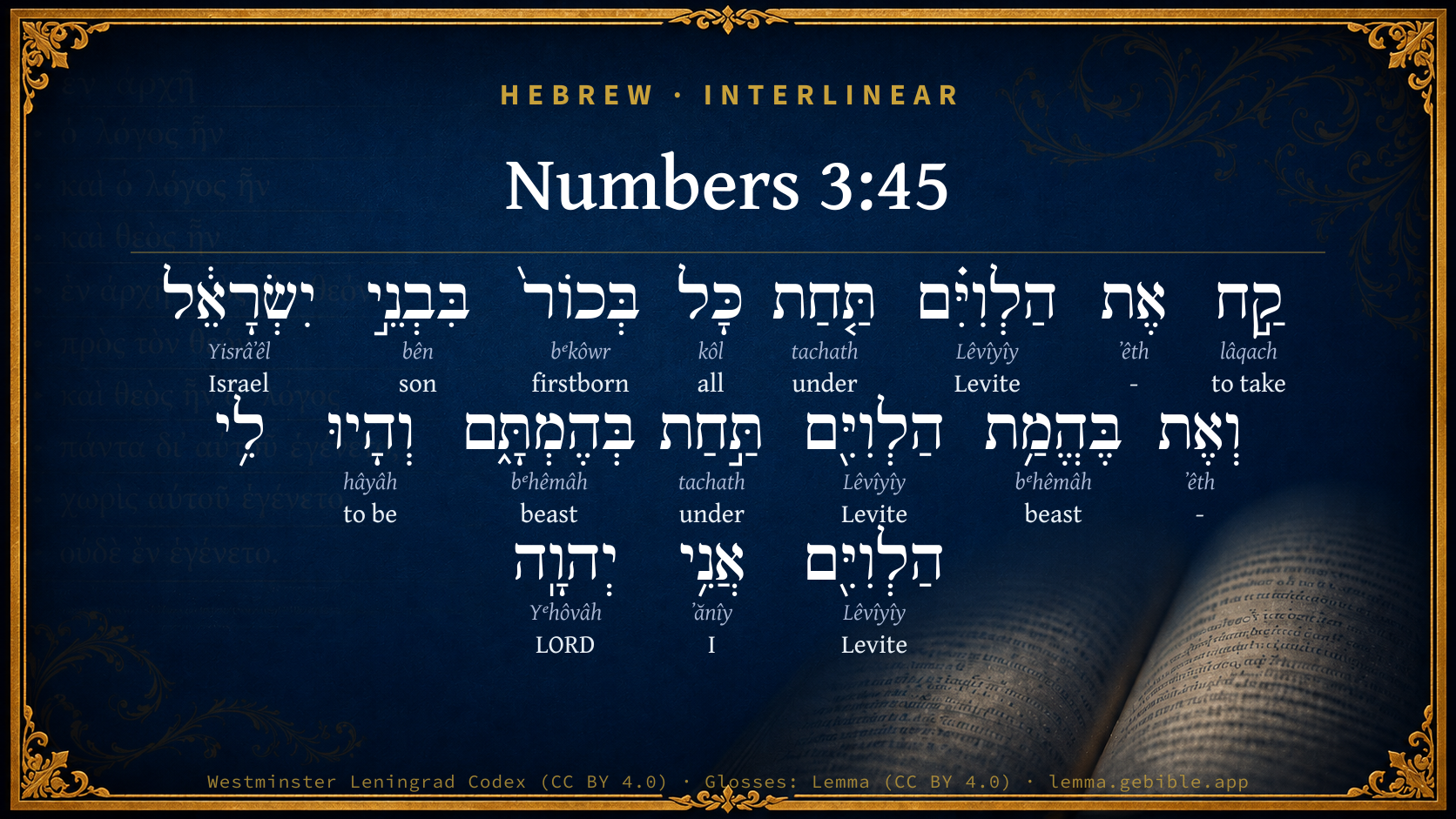
  1. קַ֣ח lâqach H3947 “take” Verb, Qal, Imperative, 2nd Person, Masculine, Singular
  2. אֶת ʼêth H853 “-” Particle, Direct Object
  3. הַלְוִיִּ֗ם Lêvîyîy H3881 “the · Levites” Particle, Definite Article + Noun, Gentilic, Masculine, Plural, Absolute
  4. תַּ֤חַת tachath H8478 “under” Preposition
  5. כָּל kôl H3605 “all of” Noun, Common, Masculine, Singular, Construct
  6. בִּבְנֵ֣י bên H1121 “in/at · sons of” Preposition + Noun, Common, Masculine, Plural, Construct
  7. יִשְׂרָאֵ֔ל Yisrâʼêl H3478 “Israel” Noun, Proper
  8. וְאֶת ʼêth H853 “and · -” Conjunction + Particle, Direct Object
  9. בֶּהֱמַ֥ת bᵉhêmâh H929 “beast of” Noun, Common, Feminine, Singular, Construct
  10. הַלְוִיִּ֖ם Lêvîyîy H3881 “the · Levites” Particle, Definite Article + Noun, Gentilic, Masculine, Plural, Absolute
  11. תַּ֣חַת tachath H8478 “under” Preposition
  12. בְּהֶמְתָּ֑ם bᵉhêmâh H929 “beast · their” Noun, Common, Feminine, Singular, Construct + Suffix, Personal, 3rd Person, Masculine, Plural
  13. וְהָיוּ hâyâh H1961 “and · to be” Conjunction + Verb, Qal, Sequential Perfect, 3rd Person, Common, Plural
  14. הַלְוִיִּ֖ם Lêvîyîy H3881 “the · Levites” Particle, Definite Article + Noun, Gentilic, Masculine, Plural, Absolute
  15. אֲנִ֥י ʼănîy H589 “I” Pronoun, Personal, 1st Person, Common, Singular
  16. יְהוָֽה Yᵉhôvâh H3068 “LORD” Noun, Proper

About this verse

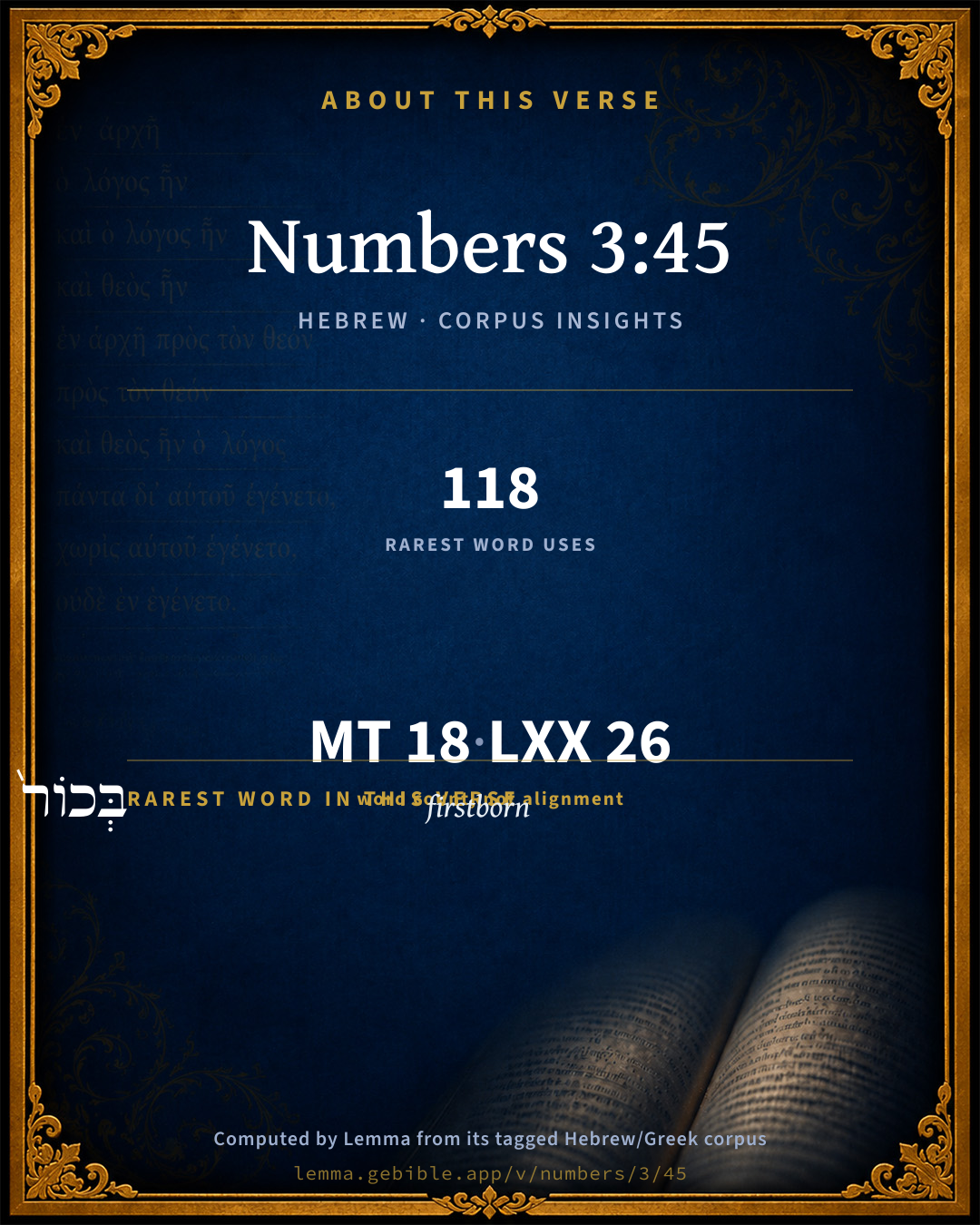
These counts appear in no published source. They are computed here, from the morphology-tagged text and Lemma’s own curated glosses. What Lemma adds →

18
words
12
distinct lemmas
Pentateuch
section

Grammatical profile

  • 2 verbs
  • 10 nouns
  • 1 pronoun
  • 3 prepositions
  • 2 particles

Verb forms

  • קַ֣ח Qal · Imperative
  • וְהָיוּ Qal · Sequential Perfect

Repetition

Words recur within this verse — often emphatic in Hebrew:

  • הַלְוִיִּ֗ם Levite H3881 ×3
  • תַּ֤חַת under H8478 ×2
  • בֶּהֱמַ֥ת beast H929 ×2

Hebrew & Septuagint length

In English translation the verse runs 32 words from the Hebrew and 33 from the Septuagint (LXX English) — closely comparable.

A rough comparison of the two English renderings, which tokenize alike — not a word-level alignment.

Word counts can differ between the Hebrew and the Greek without any difference in meaning — e.g. the Hebrew direct-object marker אֵת has no separate Greek word, and Greek often adds the article ὁ.

In the original languages it is 18 Hebrew tokens and 26 Greek tokens — but the two are counted differently (Hebrew bundles its prefixes and suffixes into one token; the Greek is in lemma form), so that isn’t a like-for-like length.

Cross-references

2

Topical passages linked to Numbers 3:45 in the Treasury of Scripture Knowledge — connected by theme and wording, ordered by reader-vote popularity; previews shown in the World English Bible.

  • Numbers 3:12 "Behold, I have taken the Levites from among the children of Israel instead of all the firstborn who open the womb among the children of Israel; and the Levites shall be mine:
  • Numbers 3:40–41 Yahweh said to Moses, "Number all the firstborn males of the children of Israel from a month old and upward, and take the number of their names.

Cross-references courtesy of OpenBible.info (CC BY 4.0).

Hebrew and Greek witnesses Masoretic Hebrew ↔ Greek Septuagint

The same verse in the two great witnesses to the Old Testament, shown verse-for-verse.

These are two independent witnesses, not word-aligned to each other, and the Septuagint is shown in lemma (dictionary) form.

Hebrew Numbers 3:45 Masoretic · Westminster Leningrad Codex

קַ֣ח אֶת הַלְוִיִּ֗ם תַּ֤חַת כָּל בְּכוֹר֙ בִּבְנֵ֣י יִשְׂרָאֵ֔ל וְאֶת בֶּהֱמַ֥ת הַלְוִיִּ֖ם תַּ֣חַת בְּהֶמְתָּ֑ם וְהָיוּ לִ֥י הַלְוִיִּ֖ם אֲנִ֥י יְהוָֽה

"Take the Levites instead of all the firstborn among the children of Israel, and the cattle of the Levites instead of their cattle; and the Levites shall be mine. I am Yahweh.

World English Bible · Public Domain

Greek LXX Numbers 3:45 Septuagint · lemma form

λαμβάνω ὁ λευίτης ἀντί πᾶς ὁ πρωτότοκος ὁ υἱός ἰσραήλ καί ὁ κτῆνος ὁ λευίτης ἀντί ὁ κτῆνος αὐτός καί εἰμί ἐγώ ὁ λευίτης ἐγώ κύριος

Take the Levites instead of all the firstborn of the sons of Israel, and the cattle of the Levites instead of their cattle, and the Levites shall be mine; I am the Lord.

LXX2012 (modern English Septuagint) · Public Domain

Hebrew: Westminster Leningrad Codex (CC BY 4.0). Greek: Septuagint (public domain); English from LXX2012 (modern English Septuagint) (Public Domain). How the Septuagint differs from the Hebrew →

Targum (Aramaic paraphrase)

2

The Targum is the ancient Jewish Aramaic paraphrase of the Hebrew Scriptures — an interpretive translation, not the Hebrew text itself. Onkelos (literal) and Pseudo-Jonathan (expansive) render the Torah, and Jonathan the Prophets. Coverage is partial: where no permissively-licensed English translation exists for a verse, only the Aramaic is shown. This is verse-level text, not a word-by-word alignment to the Hebrew.

  1. Targum Onkelos Torah (Genesis–Deuteronomy)
    קָרֵב יָת לֵוָאֵי חֲלַף כָּל בּוּכְרָא בִּבְנֵי יִשְׂרָאֵל וְיָת בְּעִירָא דְלֵוָאֵי חֲלַף בְּעִירְהוֹן וִיהוֹן מְשַּׁמְשִׁין קֳדָמַי לֵוָאֵי אֲנָא יְיָ

    (no public-domain English translation for this verse)

    Targum Onkelos — Aramaic: “Onkelos Genesis” (public domain); “Onkelos Exodus” (public domain); “Onkelos Leviticus” (public domain); “Onkelos Numbers” (public domain); “Onkelos Deuteronomy” (public domain). English: “Sefaria Community Translation” (CC0 1.0 (public-domain dedication)); “J.W. Etheridge. The Targums of Onkelos and Jonathan Ben Uzziel on the Pentateuch. London: Longmans, Green, 1862” (public domain). Text via Sefaria.

  2. Targum Pseudo-Jonathan Torah (Genesis–Deuteronomy)
    קָרֵיב יַת לֵיוָאֵי חֲלַף כָּל בּוּכְרָא בִּבְנֵי יִשְרָאֵל וְיַת בְּעִירָא לֵיוָאֵי חֲלַף בְּעִירֵיהוֹן וִיהוֹן מְשַׁמְשִׁין קֳדָמָי לֵיוָאֵי אֲנָא יְיָ

    Bring near the Levites instead of every first-born among Israel, and the cattle of the Levites instead of their cattle, that the Levites may minister before me: I am the Lord.

    Targum Pseudo-Jonathan — Aramaic: “Targum Jonathan on Genesis” (public domain); “Targum Jonathan on Exodus” (public domain); “Targum Jonathan on Leviticus” (public domain); “Targum Jonathan on Numbers” (public domain); “Targum Jonathan on Deuteronomy” (public domain). English: “The Targum of Jonathan ben Uzziel, trans. J. W. Etheridge, London, 1862” (public domain). Text via Sefaria.

Commentary

Notes on Numbers 3:45 from classic Christian and Jewish commentators (each source and its license shown beneath its notes). The classic Christian expositions comment on the surrounding passage and are grouped to its opening verse, so a note may address several verses; the Jewish commentaries on the Tanakh (Rashi and others) are per-verse, so they appear only where the commentator wrote on this verse.

Lemma curates 59 commentaries, every one of them public domain or Creative Commons licensed, each selected and text-cleaned for this edition rather than reprinted as found. About our sources →

Ellicott's Commentary for English Readers

(45) And the cattle of the Levites instead of their cattle.—There appears to have been no numbering of the cattle. Had it been otherwise, an argument might have been used in support of the prospective reference of the command to number the firstborn, derived from the fact that it would have been impossible to ascertain the number of firstborn among the cattle. It appears, however, that the whole of the cattle of the Levites was given in redemption of the firstborn of all the cattle of the other tribes.

A Bible Commentary for English Readers, edited by Charles John Ellicott (1878–1897) — public domain. Text from a community e-Sword module.

John Gill's Exposition

And for those that are to be redeemed, &c. With money, there being not Levites enough to answer to them, and exchange for them:

of the two hundred and threescore and thirteen of the firstborn of the children of Israel, which are more than the Levites; for the sum total of the Levites, as given, was but 22,000, Num 3:39, whereas the sum total of the firstborn of Israel were 22,273, Num 3:43, so that there were, two hundred seventy three more of the latter than of the former; and what was to be done with these next follows.

John Gill's Exposition of the Whole Bible (1746–1763) — public domain (CC PDM 1.0). Text via the HelloAO Bible API.

Matthew Poole's English Annotations

Take the Levites, to wit, the 22,000 reckoned up Num 3:39, See Poole "Num 3:39"

Matthew Poole's English Annotations on the Holy Bible (1683–1685) — public domain. Text from a community e-Sword/MySword module.

Rashi

Rabbi Shlomo Yitzchaki (Rashi)

ואת בהמת הלוים וגו׳ AND [THOU SHALT TAKE] THE BEASTS OF THE LEVITES [INSTEAD OF ALL THE FIRSTBORN AMONG THE BEASTS OF THE CHILDREN OF ISRAEL] — The beasts of the Levites did not redeem the firstborn of the clean beasts belonging to the Israelites, but only the first offsprings of their asses (cf. Bekhorot 4a). One lamb of the Levites (it must be remembered that for the redemption of פטר חמור a lamb is prescribed; cf. Exodus 13:13) could, however, release several first offsprings of asses belonging to Israelites. You may know that this is so, for it (Scripture) mentions the number of firstborn Israelites in excess of the number of Levites in the case of human beings, but mentions no number of firstborn animals belonging to the Israelites as being in excess over the lambs of the Levites, [although there were undoubtedly many more firstborn asses of the Israelites than ordinary lambs of the Levites] (cf. Bekhorot 4b).

Rashi on the Tanakh — English translations: “The Judaica Press complete Tanach with Rashi, translated by A. J. Rosenberg” (CC BY 4.0); “Pentateuch with Rashi's commentary by M. Rosenbaum and A.M. Silbermann, 1929-1934” (public domain); “The Metsudah Tanach series, Lakewood, N.J” (CC BY 4.0); and “The Book of Joshua, Metsudah Publications, 1997” (CC BY 4.0). Text via Sefaria.

Ramban (Nachmanides)

Rabbi Moshe ben Nachman (Ramban / Nachmanides)

TAKE THE LEVITES INSTEAD OF ALL THE FIRSTBORN AMONG THE CHILDREN OF ISRAEL. The firstborns had become sanctified to G-d from the time that He commanded Sanctify unto Me all the firstborn … among the children of Israel etc. There were thus many firstborns in Israel who had not been redeemed until now, since it had not yet been said who would “redeem” them, for it was only now that the priests became sanctified, and [Israel] had not yet been commanded about the gifts of the priesthood. Thus they [the firstborns] continued without restriction in their sanctity, and it is possible that they performed the Service of the offerings, as our Rabbis have said. The correct opinion appears to me to be that not all these firstborns were born in the desert in one year, for the people did not increase there so rapidly [that there should have been twenty-two thousand firstborns in one year, corresponding to the twenty-two thousand Levites, with an excess over the Levites of two hundred and seventy-three]. Rather, all firstborns of Israel [alive at that time, even those born many years previously] were counted, for they were all sanctified, as I have explained there. Now, He exchanged them for the Levites, and this was their “redemption,” and He commanded to redeem those that exceeded [the number of the Levites by means of each one giving five shekels]. And He gave the redemption-money to Aaron and his sons, as is the commandment for all generations [that a firstborn son be redeemed by giving five shekels to a priest].

Ramban (Nachmanides) on the Tanakh — English translation: “Commentary on the Torah by Ramban (Nachmanides). Translated and annotated by Charles B. Chavel. New York, Shilo Pub. House, 1971-1976” (CC BY 4.0). Text via Sefaria.

Lesson kit

Teaching starters — assembled from the data on this page, not authored interpretation. Every prompt links to the verse data it draws on. Edit before teaching.

Numbers, in the Pentateuch, opens this verse with 18 words (12 distinct Hebrew lemmas). Its most distinctive word is bᵉkôwr (“firstborn”). A historical commentator’s framing appears above. Read the whole chapter for the surrounding context.

Discussion questions

  1. How does “firstborn” (bᵉkôwr) shape what this verse is saying?
  2. Numbers 3:12 shares this passage’s theme. How do the two illuminate each other?
  3. “Levite” occurs 3× in this one verse. What is the effect of the repetition?
  4. These translations render this verse differently. What is at stake in choosing one wording over another?
  5. The verb «קַ֣ח» is Qal Imperative. How does its form color the action?
  6. Reading how Ellicott's Commentary for English Readers and John Gill's Exposition read this verse, where do the two commentators agree and where do they part?

Things to notice

Reading settings

Reading text

Shown beneath each verse's original-language words.

Old Testament
Old Testament edition

Read the OT as the Masoretic Hebrew (MT) or the Greek Septuagint (LXX).

English shown for the Greek Septuagint (in the Hebrew ↔ Greek comparison).

Comparing translations? Open the Compare panel on any verse page to stack up to four side by side.