
Leviticus 21:23

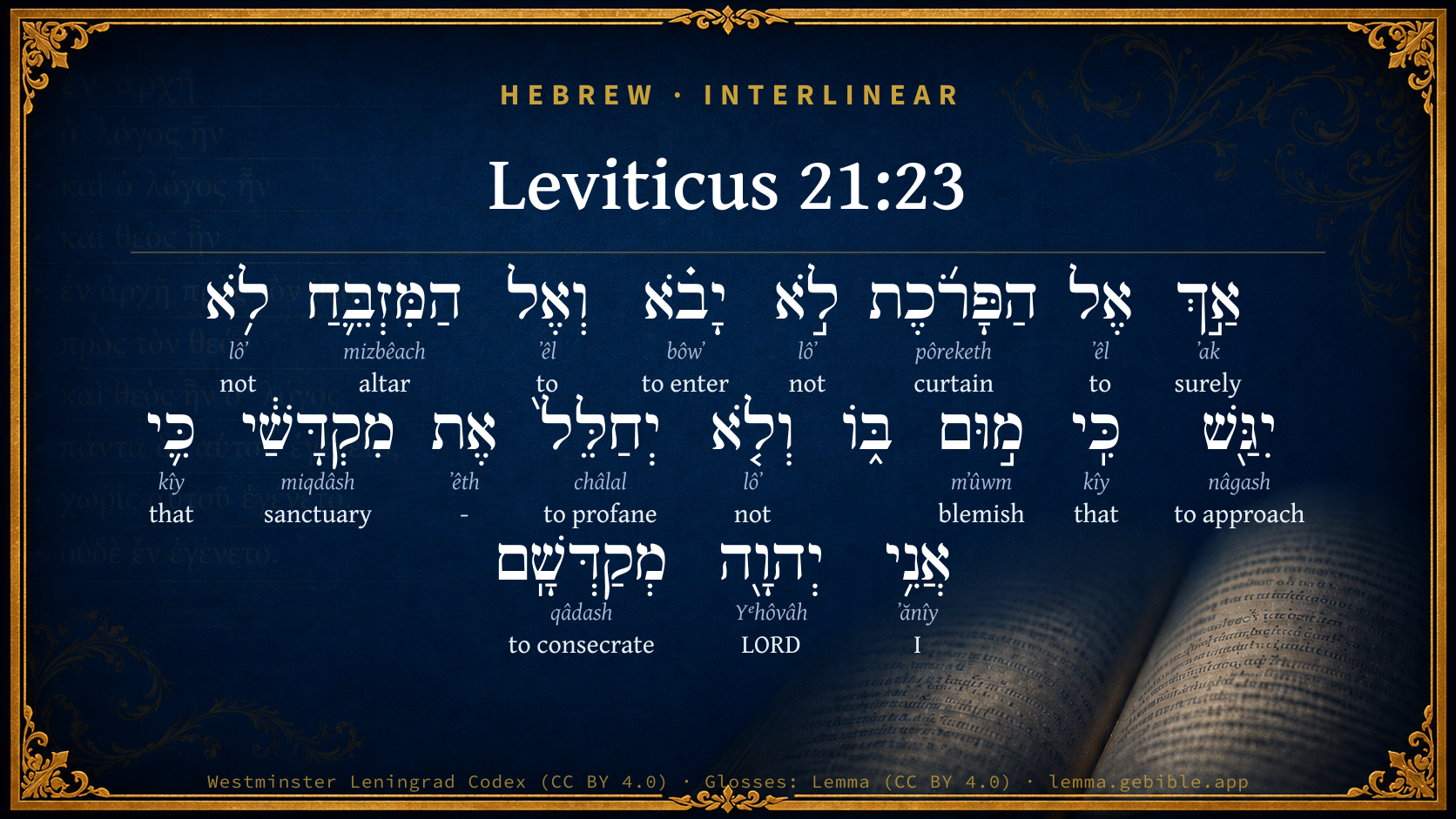
Hebrew (Westminster Leningrad Codex) Leviticus 21:23 appears in the Hebrew Old Testament. The text above is from the Westminster Leningrad Codex. Each word links to its Strong’s number, a concise gloss, and parsing drawn from the Open Scriptures Hebrew Bible morphology. Click any word for its full Brown-Driver-Briggs (BDB) entry.
Download image
Cite this verse

Leviticus 21:23 (World English Bible). Public Domain. Lemma interlinear Bible study tool, https://lemma.gebible.app/v/leviticus/21/23.

Show BibTeX & RIS
BibTeX
RIS
English Translation
He shall not come near to the veil, nor come near to the altar, because he has a blemish; that he may not profane my sanctuaries, for I am Yahweh who sanctifies them.'"
World English Bible · Public Domain
Download a study sheet

One document with this verse’s original text, its word-by-word gloss line, the meaning frame, cross-references with their text, attributed commentary, and full source and license credits — printable, and it pastes into notes with its structure intact.

This verse Autodidact and up

Study sheet (.html) Plain text (.txt)

A passage Seminary Student

Up to 50 verses in one chapter. A passage sheet keeps up to 6 commentary sources and 12 cross-references per verse, in the order this page ranks them, and says so on the sheet whenever that leaves anything out. Ask for a single verse and you get the Autodidact verse sheet above.

Everything on this page stays free to read, with no account — the sheet is a download of what is already on screen, not access to it.

Want to remove ads? Support Godless Engineer
Compare translations 3

The same verse in 3 English versions, stacked beneath the original-language interlinear above. Click any original word for its lexicon entry.

Each is an independent rendering of the whole verse — the interlinear is not word-aligned to these translations.

Highlighted words mark where these versions differ — a whole-verse word diff, not a word-by-word alignment.

  • World English Bible Public Domain
    He shall not come near to the veil, nor come near to the altar, because he has a blemish; that he may not profane my sanctuaries, for I am Yahweh who sanctifies them.'"
  • King James Version Public Domain
    Only he shall not go in unto the vail, nor come nigh unto the altar, because he hath a blemish; that he profane not my sanctuaries: for I the LORD do sanctify them.
  • unfoldingWord Literal Text CC BY-SA 4.0
    However, he shall not enter into the curtain, and he shall not draw near to the altar, for a blemish on him. And he shall not profane my Holy Place, for I Yahweh, the one making them holy.’”

unfoldingWord Literal Text — © unfoldingWord, licensed CC BY-SA 4.0. Word-aligned USFM3 via Door43 (git.door43.org/unfoldingWord/en_ult).

Versions to compare (up to 4)

3 of 4 selected

Show all 18 translations

Every available English version of this verse, each an independent rendering of the whole verse.

  • World English Bible Public Domain
    He shall not come near to the veil, nor come near to the altar, because he has a blemish; that he may not profane my sanctuaries, for I am Yahweh who sanctifies them.'"
  • Berean Standard Bible Public Domain
    but because he has a defect, he must not go near the veil or approach the altar, so as not to desecrate My sanctuaries. For I am the LORD who sanctifies them.’”
  • Majority Standard Bible Public Domain
    but because he has a defect, he must not go near the veil or approach the altar, so as not to desecrate My sanctuaries. For I am the LORD who sanctifies them.’”
  • King James Version Public Domain
    Only he shall not go in unto the vail, nor come nigh unto the altar, because he hath a blemish; that he profane not my sanctuaries: for I the LORD do sanctify them.
  • American Standard Version (1901) Public Domain
    only he shall not go in unto the veil, nor come nigh unto the altar, because he hath a blemish; that he profane not my sanctuaries: for I am Jehovah who sanctifieth them.
  • Revised Version (1885) Public Domain
    Only he shall not go in unto the veil, nor come nigh unto the altar, because he hath a blemish; that he profane not my sanctuaries: for I am the LORD which sanctify them.
  • Geneva Bible (1599) Public Domain
    But he shall not goe in vnto the vaile, nor come neere the altar, because hee hath a blemish, least he pollute my Sanctuaries: for I am the Lord that sanctifie them.
  • Douay-Rheims (1899) Public Domain
    Yet so that he enter not within the veil, nor approach to the altar, because he hath a blemish, and he must not defile my sanctuary. I am the Lord who sanctify them.
  • Young's Literal Translation Public Domain
    only, unto the vail he doth not enter, and unto the altar he doth not draw nigh; for blemish `is' in him; and he doth not pollute My sanctuaries; for I `am' Jehovah, sanctifying them.'
  • Literal Standard Version CC BY-SA 4.0
    only, he does not come toward the veil, and he does not draw near to the altar; for blemish [is] in him; and he does not defile My sanctuaries; for I [am] YHWH, sanctifying them.”
  • Unlocked Literal Bible CC BY-SA 4.0
    However, he must not enter inside the curtain or come near the altar, because he has a bodily defect, so that he does not defile my holy place, for I am Yahweh, who makes them holy.'”
  • unfoldingWord Literal Text CC BY-SA 4.0
    However, he shall not enter into the curtain, and he shall not draw near to the altar, for a blemish on him. And he shall not profane my Holy Place, for I Yahweh, the one making them holy.’”
  • Darby Bible Public Domain
    only he shall not come in unto the veil, nor shall he draw near unto the altar; for he hath a defect: that he profane not my sanctuaries; for I am Jehovah who do hallow them.
  • World Messianic Bible Public Domain
    He shall not come near to the veil, nor come near to the altar, because he has a defect; that he may not profane my sanctuaries, for I am the LORD who sanctifies them.’”
  • Webster's Bible Public Domain
    Only he shall not go in to the vail, nor come nigh to the altar, because he hath a blemish; that he may not profane my sanctuaries: for I the LORD do sanctify them.
  • Free Bible Version CC BY-SA 4.0
    but because he has a defect, he is not allowed to go near the curtain or the altar, so that my sanctuary and everything in it are not made unclean, because I am the Lord who makes them holy.”
  • Bible in Basic English Public Domain
    But he may not go inside the veil or come near the altar, because he is damaged; and he may not make my holy places common; for I the Lord have made them holy.
  • JPS Tanakh (1917) Public Domain
    Only he shall not go in unto the veil, nor come nigh unto the altar, because he hath a blemish; that he profane not My holy places; for I am the LORD who sanctify them.

Literal Standard Version (2020), Covenant Press — licensed CC BY-SA 4.0. Text via the HelloAO Bible API (eBible.org). Unlocked Literal Bible (unfoldingWord) — licensed CC BY-SA 4.0. Text via the HelloAO Bible API (eBible.org). unfoldingWord Literal Text — © unfoldingWord, licensed CC BY-SA 4.0. Word-aligned USFM3 via Door43 (git.door43.org/unfoldingWord/en_ult). Free Bible Version, Dr. Jonathan Gallagher — licensed CC BY-SA 4.0. Text via the HelloAO Bible API (eBible.org).

Word by word

More ways to search: Search by grammar → Find every occurrence → Compare this word →

Practice this passage: Drill this verse → Learn its vocabulary →

מ֣וּם
mʼûwm
H3971
“blemish”
Noun, Common, Masculine, Singular, Absolute
Part of Speech
Noun
Type
Common
Gender
Masculine
Number
Singular
State
Absolute
Full BDB Definition

Origin: as if passive participle from an unused root

TWOT: 1137a

blemish, spot, defect - of physical defect - of moral stain
  1. אַ֣ךְ ʼak H389 “surely” Particle, Accusative
  2. אֶל ʼêl H413 “to” Preposition
  3. הַפָּרֹ֜כֶת pôreketh H6532 “the · curtain” Particle, Definite Article + Noun, Common, Feminine, Singular, Absolute
  4. לֹ֣א lôʼ H3808 “not” Particle, Negative
  5. יָבֹ֗א bôwʼ H935 “to enter” Verb, Qal, Imperfect, 3rd Person, Masculine, Singular
  6. וְאֶל ʼêl H413 “and · to” Conjunction + Preposition
  7. הַמִּזְבֵּ֛חַ mizbêach H4196 “the · altar” Particle, Definite Article + Noun, Common, Masculine, Singular, Absolute
  8. לֹ֥א lôʼ H3808 “not” Particle, Negative
  9. יִגַּ֖שׁ nâgash H5066 “to approach” Verb, Qal, Imperfect, 3rd Person, Masculine, Singular
  10. כִּֽי kîy H3588 “that” Conjunction
  11. וְלֹ֤א lôʼ H3808 “and · not” Conjunction + Particle, Negative
  12. יְחַלֵּל֙ châlal H2490 “to profane” Verb, Piel, Imperfect, 3rd Person, Masculine, Singular
  13. אֶת ʼêth H853 “-” Particle, Direct Object
  14. מִקְדָּשַׁ֔י miqdâsh H4720 “sanctuaries · my” Noun, Common, Masculine, Plural, Construct + Suffix, Personal, 1st Person, Common, Singular
  15. כִּ֛י kîy H3588 “that” Conjunction
  16. אֲנִ֥י ʼănîy H589 “I” Pronoun, Personal, 1st Person, Common, Singular
  17. יְהוָ֖ה Yᵉhôvâh H3068 “LORD” Noun, Proper
  18. מְקַדְּשָֽׁם qâdash H6942 “consecrating · them” Verb, Piel, Participle Active, Masculine, Singular, Construct + Suffix, Personal, 3rd Person, Masculine, Plural

About this verse

These counts appear in no published source. They are computed here, from the morphology-tagged text and Lemma’s own curated glosses. What Lemma adds →

20
words
15
distinct lemmas
Pentateuch
section

Notable vocabulary

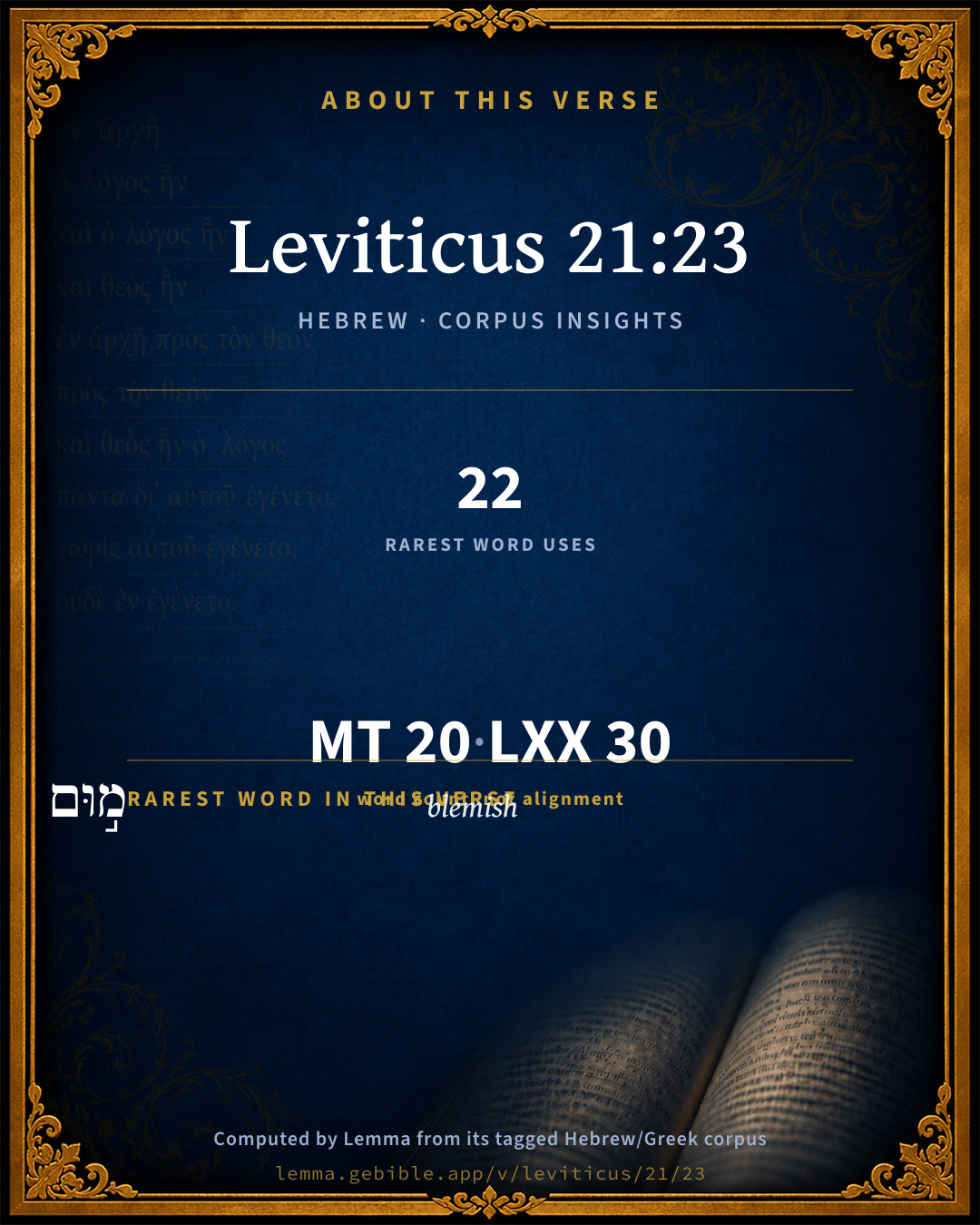
The rarest word here is מ֣וּם blemish H3971 — appearing just 22 times in the whole Hebrew Bible.

Shared distinctive vocabulary

מ֣וּם blemish H3971 occurs in 19 verses of the Hebrew Bible. Also found in:

Grammatical profile

  • 4 verbs
  • 5 nouns
  • 1 pronoun
  • 3 prepositions
  • 2 conjunctions
  • 5 particles

Verb forms

  • יָבֹ֗א Qal · Imperfect
  • יִגַּ֖שׁ Qal · Imperfect
  • יְחַלֵּל֙ Piel · Imperfect
  • מְקַדְּשָֽׁם Piel · Participle Active

Repetition

Words recur within this verse — often emphatic in Hebrew:

Hebrew & Septuagint length

In English translation the verse runs 33 words from the Hebrew and 39 from the Septuagint (LXX English) — closely comparable.

A rough comparison of the two English renderings, which tokenize alike — not a word-level alignment.

Word counts can differ between the Hebrew and the Greek without any difference in meaning — e.g. the Hebrew direct-object marker אֵת has no separate Greek word, and Greek often adds the article ὁ.

In the original languages it is 20 Hebrew tokens and 30 Greek tokens — but the two are counted differently (Hebrew bundles its prefixes and suffixes into one token; the Greek is in lemma form), so that isn’t a like-for-like length.

Cross-references

5

Topical passages linked to Leviticus 21:23 in the Treasury of Scripture Knowledge — connected by theme and wording, ordered by reader-vote popularity; previews shown in the World English Bible.

  • Leviticus 21:12 neither shall he go out of the sanctuary, nor profane the sanctuary of his God; for the crown of the anointing oil of his God is upon him. I am Yahweh.
  • Exodus 30:6–8 You shall put it before the veil that is by the ark of the testimony, before the mercy seat that is over the testimony, where I will meet with you.
  • Exodus 40:26–27 He put the golden altar in the tent of meeting before the veil;
  • Leviticus 15:31 "'Thus you shall separate the children of Israel from their uncleanness, so they will not die in their uncleanness, when they defile my tabernacle that is in their midst.'"
  • Ezekiel 44:9–14 Thus says the Lord Yahweh, No foreigner, uncircumcised in heart and uncircumcised in flesh, shall enter into my sanctuary, of any foreigners who are among the children of Israel.

Cross-references courtesy of OpenBible.info (CC BY 4.0).

Hebrew and Greek witnesses Masoretic Hebrew ↔ Greek Septuagint

The same verse in the two great witnesses to the Old Testament, shown verse-for-verse.

These are two independent witnesses, not word-aligned to each other, and the Septuagint is shown in lemma (dictionary) form.

Hebrew Leviticus 21:23 Masoretic · Westminster Leningrad Codex

אַ֣ךְ אֶל הַפָּרֹ֜כֶת לֹ֣א יָבֹ֗א וְאֶל הַמִּזְבֵּ֛חַ לֹ֥א יִגַּ֖שׁ כִּֽי מ֣וּם בּ֑וֹ וְלֹ֤א יְחַלֵּל֙ אֶת מִקְדָּשַׁ֔י כִּ֛י אֲנִ֥י יְהוָ֖ה מְקַדְּשָֽׁם

He shall not come near to the veil, nor come near to the altar, because he has a blemish; that he may not profane my sanctuaries, for I am Yahweh who sanctifies them.'"

World English Bible · Public Domain

Greek LXX Leviticus 21:23 Septuagint · lemma form

πλήν πρός ὁ καταπέτασμα οὐ προςἔρχομαι καί πρός ὁ θυσιαστήριον οὐ ἐγγίζω ὅτι μῶμος ἔχω καί οὐ βεβηλόω ὁ ἅγιος ὁ θεός αὐτός ὅτι ἐγώ εἰμί κύριος ὁ ἁγιάζω αὐτός

Only he shall not approach the veil, and he shall not draw near to the altar, because he has a blemish; and he shall not profane the sanctuary of his God, for I am the Lord that sanctifies them.

LXX2012 (modern English Septuagint) · Public Domain

Hebrew: Westminster Leningrad Codex (CC BY 4.0). Greek: Septuagint (public domain); English from LXX2012 (modern English Septuagint) (Public Domain). How the Septuagint differs from the Hebrew →

Targum (Aramaic paraphrase)

2

The Targum is the ancient Jewish Aramaic paraphrase of the Hebrew Scriptures — an interpretive translation, not the Hebrew text itself. Onkelos (literal) and Pseudo-Jonathan (expansive) render the Torah, and Jonathan the Prophets. Coverage is partial: where no permissively-licensed English translation exists for a verse, only the Aramaic is shown. This is verse-level text, not a word-by-word alignment to the Hebrew.

  1. Targum Onkelos Torah (Genesis–Deuteronomy)
    בְּרַם לְפָרֻכְתָּא לָא יֵיעוֹל וּלְמַדְבְּחָא לָא יִקְרַב אֲרֵי מוּמָא בֵהּ וְלָא יַחֵל יָת מַקְדְשַׁי אֲרֵי אֲנָא יְיָ מְקַדִשְׁהוֹן

    (no public-domain English translation for this verse)

    Targum Onkelos — Aramaic: “Onkelos Genesis” (public domain); “Onkelos Exodus” (public domain); “Onkelos Leviticus” (public domain); “Onkelos Numbers” (public domain); “Onkelos Deuteronomy” (public domain). English: “Sefaria Community Translation” (CC0 1.0 (public-domain dedication)); “J.W. Etheridge. The Targums of Onkelos and Jonathan Ben Uzziel on the Pentateuch. London: Longmans, Green, 1862” (public domain). Text via Sefaria.

  2. Targum Pseudo-Jonathan Torah (Genesis–Deuteronomy)
    לְחוֹד לְפַרְגוֹדָא לָא יֵיעוֹל וּלְמַדְבְּחָא לָא יִקְרַב אֲרוּם מוּמָא בֵּיהּ וְלָא יָפִיס יַת מִקְדָשַׁי אֲרוּם אֲנָא יְיָ מְקַדִשְׁהוֹן

    only he must not enter within the veil, nor approach the altar; for a blemish is in him, and he shall not profane My sanctuary; for I the Lord do sanctify them.

    Targum Pseudo-Jonathan — Aramaic: “Targum Jonathan on Genesis” (public domain); “Targum Jonathan on Exodus” (public domain); “Targum Jonathan on Leviticus” (public domain); “Targum Jonathan on Numbers” (public domain); “Targum Jonathan on Deuteronomy” (public domain). English: “The Targum of Jonathan ben Uzziel, trans. J. W. Etheridge, London, 1862” (public domain). Text via Sefaria.

Commentary

Notes on Leviticus 21:23 from classic Christian and Jewish commentators (each source and its license shown beneath its notes). The classic Christian expositions comment on the surrounding passage and are grouped to its opening verse, so a note may address several verses; the Jewish commentaries on the Tanakh (Rashi and others) are per-verse, so they appear only where the commentator wrote on this verse.

Lemma curates 59 commentaries, every one of them public domain or Creative Commons licensed, each selected and text-cleaned for this edition rather than reprinted as found. About our sources →

Trapp's Complete Commentary

John Trapp

Lev 21:23 Only he shall not go in unto the vail, nor come nigh unto the altar, because he hath a blemish; that he profane not my sanctuaries: for I the LORD do sanctify them.

Ver. 23. For I the Lord do sanctify them.] By my presence, and services there performed.

John Trapp, A Commentary or Exposition upon All the Books of the Old and New Testament (1647–1656) — public domain. Text from a community e-Sword module.

Joseph Benson's Commentary

Lev 21:23. To the veil — To the second veil, which was between the holy and the most holy place, to burn incense, to order the show-bread, and to dress the lamps, which were nigh unto that veil, though without. My altar — The altar of burnt-offering, which was without the sanctuary. The sense is, he shall not execute the priest’s office, which was to be done in those two places.

Joseph Benson's Commentary on the Old and New Testaments (1811–1818) — public domain. Text from a community e-Sword module.

Geneva Bible (1599)

Geneva Bible translators

Into the Sanctuary.

Geneva Bible (1599) marginal notes — public domain. Text via Bolls.life.

Adam Clarke's Commentary

Verse 23. He shall not go in unto the veil] The priest with a blemish was not permitted to enter into the holy of holies, nor to burn incense, nor to offer the shew-bread, nor to light the golden candlestick, c. In short, he was not permitted to perform any essential function of the priesthood.

1. THE great perfection required in the Jewish high priest was intended principally to point out the perfection of that priesthood of which the Jewish was only the type. And yet, as the apostle assures us, that law made nothing perfect, but pointed out that most perfect priesthood and sacrifice by which we draw near to God.

2. As none who had a blemish could enter into the holy of holies, and this holy of holies was a type of the kingdom of God, so nothing that is defiled can enter into heaven for he gave himself for his Church that he might purify it to himself, and present it at last before the presence of the Divine glory having neither spot nor wrinkle, nor any such thing, Eph 5:27; a passage which evidently refers to the directions in the preceding verse. Reader, art thou become a king and priest unto God and the Lamb? and hast thou obtained, or art thou earnestly seeking, that holiness without which thou canst not see the kingdom of heaven?

Adam Clarke's Commentary on the Bible (1810–1826) — public domain. Text from a community e-Sword/MySword module.

Ellicott's Commentary for English Readers

(23) Only he shall not go in unto the vail.—That is, into the holy place which was before the vail.

A Bible Commentary for English Readers, edited by Charles John Ellicott (1878–1897) — public domain. Text from a community e-Sword module.

The Cambridge Bible for Schools and Colleges

gen. ed. J. J. S. Perowne

23. my sanctuaries] The plural may have reference to the sacred building and its surroundings, as in Jer_51:51.

The Cambridge Bible for Schools and Colleges (gen. ed. J. J. S. Perowne; Cambridge University Press, 1878–1918) — public domain. Text from a community e-Sword module.

John Gill's Exposition

And Moses told it to Aaron, and to his sons,.... What God had said to him concerning the priests defiling themselves for the dead, both common priests and high priest, and concerning their marriages and their blemishes; that they might be careful not to transgress the laws and rules given them concerning those things:

and to all the children of Israel; to the heads of the tribes and elders of the people, and by them to the whole, that they might know who were fit, and who not, to put their sacrifice into their hands, to offer for them: Jarchi thinks this was to warn the sanhedrim concerning the priests, whose business it was to examine and judge who were fit for service and who not; for so we are told (k), that in the chamber Gazith, or of hewn stone, the great sanhedrim of Israel sat and judged the priests, and rejected some and received others.

(k) Misn. Middot, c. 5. sect. 3.

Next: Leviticus Chapter 22

John Gill's Exposition of the Whole Bible (1746–1763) — public domain (CC PDM 1.0). Text via the HelloAO Bible API.

Haydock's Catholic Bible Commentary

Veil, which separates the sanctuary from the court. The Athenians chose the most handsome man ot be the king of ceremonies; and the people of Eli appointed such only to carry the sacred vessels, &c. (Atheneus xiii. 2.) (Calmet)

George Leo Haydock (1774–1849), Haydock's Catholic Family Bible and Commentary, 1859 edition — public domain. Excludes Psalms (Douay-Rheims chapter numbering differs from Protestant) and Deuterocanonical books (Catholic canon only).

Matthew Poole's English Annotations

In unto the veil i.e. to the second veil, which was between the holy and the most holy place, Exo 26:13,36, to burn incense, to order the shew-bread, and to dress the lamps, which were nigh unto that veil, though without.

Nor come nigh unto the altar, i.e. the altar of burnt-offering, which was without the sanctuary. The sense is, He shall not execute the priest’s office, which was to be done in those two places. My sanctuary, Heb. my sanctuaries, in the plural number, as it is also Lev 26:31; Jer 51:51; Eze 28:18; for though the sanctuary was but one, yet there were divers parts, to wit, the court, the holy place, and the most holy, each of which was in a large sense a sanctuary, or a holy place set apart for God’s worship.

I the Lord do sanctify them, i.e. do set them apart for high and holy uses, to manifest my presence and grace, and to receive my worship and service in them. And therefore I will not have them polluted or disparaged by the admission of defiled or deformed priests to minister therein.

Matthew Poole's English Annotations on the Holy Bible (1683–1685) — public domain. Text from a community e-Sword/MySword module.

John Wesley's Explanatory Notes

To the veil - To the second veil which was between the holy and the most holy place, to burn incense, to order the shew-bread, and to dress the lamps, which were nigh unto that veil though without. My altar - The altar of burnt-offering, which was without the sanctuary. The sense is, he shall not execute the priest's office, which was to be done in those two places.

John Wesley, Explanatory Notes Upon the Whole Bible (1754–1765) — public domain. Text via the GEBible commentary corpus.

Rashi

Rabbi Shlomo Yitzchaki (Rashi)

אך אל הפרכת ONLY [HE SHALL NOT GO IN] UNTO THE PARTITION VEIL for the purpose of applying the seven sprinklings which are to be made upon the partition vail (cf. Leviticus 16:17).

ואל המזבח [NOR SHALL HE COME NIGH] UNTO THE ALTAR — i. e. the outer altar. Both (פרכת and מזבח) must be mentioned here and the reason is explained in Torath Cohanim (Sifra, Emor, Chapter 3 10).

ולא יחלל את מקדשי THAT HE PROFANE NOT WHAT IS HOLY TO ME — Consequently, if he performs the service it is profaned and thus becomes invalid (Sifra, Emor, Chapter 3 11).

Rashi on the Tanakh — English translations: “The Judaica Press complete Tanach with Rashi, translated by A. J. Rosenberg” (CC BY 4.0); “Pentateuch with Rashi's commentary by M. Rosenbaum and A.M. Silbermann, 1929-1934” (public domain); “The Metsudah Tanach series, Lakewood, N.J” (CC BY 4.0); and “The Book of Joshua, Metsudah Publications, 1997” (CC BY 4.0). Text via Sefaria.

Lesson kit

Teaching starters — assembled from the data on this page, not authored interpretation. Every prompt links to the verse data it draws on. Edit before teaching.

Leviticus, in the Pentateuch, opens this verse with 20 words (15 distinct Hebrew lemmas). Its most distinctive word is mʼûwm (“blemish”). A historical commentator’s framing appears above. Read the whole chapter for the surrounding context.

Discussion questions

  1. What does “blemish” (mʼûwm) contribute to the verse as a whole?
  2. Leviticus 21:17 shares the word «blemish» with this verse. How do the two illuminate each other?
  3. “not” occurs 3× in this one verse. What is the effect of the repetition?
  4. These translations render this verse differently. What is at stake in choosing one wording over another?
  5. The verb «יָבֹ֗א» is Qal Imperfect. How does its form color the action?
  6. Reading how Trapp's Complete Commentary and Joseph Benson's Commentary read this verse, where do the two commentators agree and where do they part?

Things to notice

Reading settings

Reading text

Shown beneath each verse's original-language words.

Old Testament
Old Testament edition

Read the OT as the Masoretic Hebrew (MT) or the Greek Septuagint (LXX).

English shown for the Greek Septuagint (in the Hebrew ↔ Greek comparison).

Comparing translations? Open the Compare panel on any verse page to stack up to four side by side.