
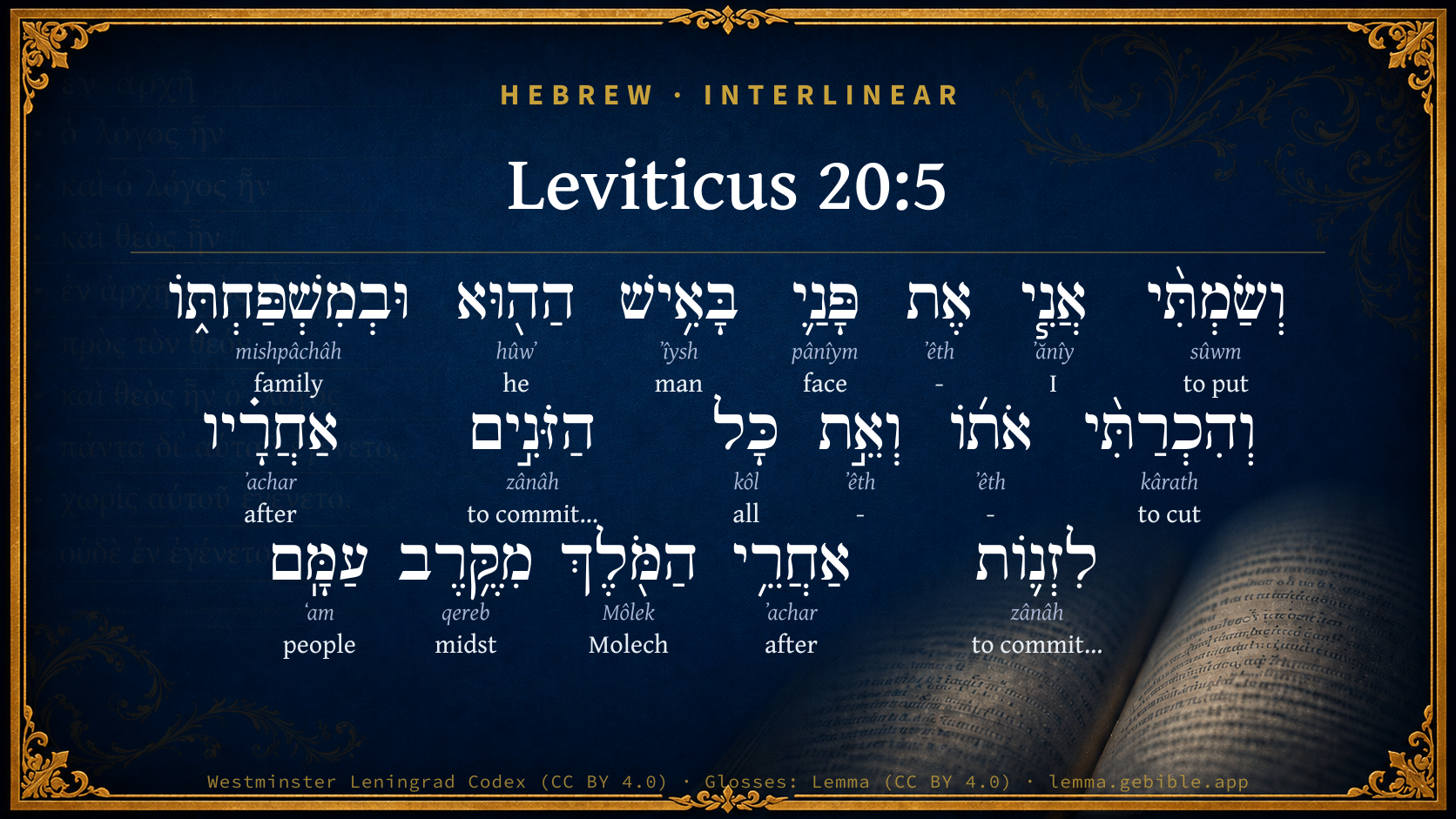
Leviticus 20:5

Hebrew (Westminster Leningrad Codex) Leviticus 20:5 appears in the Hebrew Old Testament. The text above is from the Westminster Leningrad Codex. Each word links to its Strong’s number, a concise gloss, and parsing drawn from the Open Scriptures Hebrew Bible morphology. Click any word for its full Brown-Driver-Briggs (BDB) entry.
Download image
Cite this verse

Leviticus 20:5 (World English Bible). Public Domain. Lemma interlinear Bible study tool, https://lemma.gebible.app/v/leviticus/20/5.

Show BibTeX & RIS
BibTeX
RIS
English Translation
then I will set my face against that man, and against his family, and will cut him off, and all who play the prostitute after him, to play the prostitute with Molech, from among their people.
World English Bible · Public Domain
Download a study sheet

One document with this verse’s original text, its word-by-word gloss line, the meaning frame, cross-references with their text, attributed commentary, and full source and license credits — printable, and it pastes into notes with its structure intact.

This verse Autodidact and up

Study sheet (.html) Plain text (.txt)

A passage Seminary Student

Up to 50 verses in one chapter. A passage sheet keeps up to 6 commentary sources and 12 cross-references per verse, in the order this page ranks them, and says so on the sheet whenever that leaves anything out. Ask for a single verse and you get the Autodidact verse sheet above.

Everything on this page stays free to read, with no account — the sheet is a download of what is already on screen, not access to it.

Want to remove ads? Support Godless Engineer
Compare translations 3

The same verse in 3 English versions, stacked beneath the original-language interlinear above. Click any original word for its lexicon entry.

Each is an independent rendering of the whole verse — the interlinear is not word-aligned to these translations.

Highlighted words mark where these versions differ — a whole-verse word diff, not a word-by-word alignment.

  • World English Bible Public Domain
    then I will set my face against that man, and against his family, and will cut him off, and all who play the prostitute after him, to play the prostitute with Molech, from among their people.
  • King James Version Public Domain
    Then I will set my face against that man, and against his family, and will cut him off, and all that go a whoring after him, to commit whoredom with Molech, from among their people.
  • unfoldingWord Literal Text CC BY-SA 4.0
    then I myself will set my face against that man and his clan. And I will cut him off and all the people who practice prostitution after him, by prostituting after Molech, from the midst of their people.

unfoldingWord Literal Text — © unfoldingWord, licensed CC BY-SA 4.0. Word-aligned USFM3 via Door43 (git.door43.org/unfoldingWord/en_ult).

Versions to compare (up to 4)

3 of 4 selected

Show all 18 translations

Every available English version of this verse, each an independent rendering of the whole verse.

  • World English Bible Public Domain
    then I will set my face against that man, and against his family, and will cut him off, and all who play the prostitute after him, to play the prostitute with Molech, from among their people.
  • Berean Standard Bible Public Domain
    then I will set My face against that man and his family and cut off from among their people both him and all who follow him in prostituting themselves with Molech.
  • Majority Standard Bible Public Domain
    then I will set My face against that man and his family and cut off from among their people both him and all who follow him in prostituting themselves with Molech.
  • King James Version Public Domain
    Then I will set my face against that man, and against his family, and will cut him off, and all that go a whoring after him, to commit whoredom with Molech, from among their people.
  • American Standard Version (1901) Public Domain
    then I will set my face against that man, and against his family, and will cut him off, and all that play the harlot after him, to play the harlot with Molech, from among their people.
  • Revised Version (1885) Public Domain
    then I will set my face against that man, and against his family, and will cut him off, and all that go a whoring after him, to commit whoredom with Molech, from among their people.
  • Geneva Bible (1599) Public Domain
    Then will I set my face against that man, and against his familie, and will cut him off, and all that go a whoring after him to comit whoredome with Molech, from among their people.
  • Douay-Rheims (1899) Public Domain
    I will set my face against that man, and his kindred, and will cut off both him and all that consented with him, to commit fornication with Moloch, out of the midst of their people.
  • Young's Literal Translation Public Domain
    then I have set My face against that man, and against his family, and have cut him off, and all who are going a-whoring after him, even going a-whoring after the Molech, from the midst of their people.
  • Literal Standard Version CC BY-SA 4.0
    then I have set My face against that man and against his family, and have cut him off, and all who are going whoring after him, even going whoring after the Molech, from the midst of their people.
  • Unlocked Literal Bible CC BY-SA 4.0
    then I myself will set my face against that man and his clan, and I will cut him off and everyone else who prostitutes himself in order to play the harlot with Molech.
  • unfoldingWord Literal Text CC BY-SA 4.0
    then I myself will set my face against that man and his clan. And I will cut him off and all the people who practice prostitution after him, by prostituting after Molech, from the midst of their people.
  • Darby Bible Public Domain
    then I will set my face against that man, and against his family, and will cut him off, and all that go a whoring after him, to commit whoredom with Molech, from among their people.
  • World Messianic Bible Public Domain
    then I will set my face against that man and against his family, and will cut him off, and all who play the prostitute after him to play the prostitute with Molech, from among their people.
  • Webster's Bible Public Domain
    Then I will set my face against that man, and against his family, and will cut him off, and all that go astray after him, to commit lewdness with Molech from among their people.
  • Free Bible Version CC BY-SA 4.0
    I will disown them and their family, and expel them from their people—and not just them, but everyone who follows them in spiritually prostituting themselves with Molech.
  • Bible in Basic English Public Domain
    Then my face will be turned against him and his family, and he and all those who do evil with him will be cut off from among their people.
  • JPS Tanakh (1917) Public Domain
    then I will set My face against that man, and against his family, and will cut him off, and all that go astray after him, to go astray after Molech, from among their people.

Literal Standard Version (2020), Covenant Press — licensed CC BY-SA 4.0. Text via the HelloAO Bible API (eBible.org). Unlocked Literal Bible (unfoldingWord) — licensed CC BY-SA 4.0. Text via the HelloAO Bible API (eBible.org). unfoldingWord Literal Text — © unfoldingWord, licensed CC BY-SA 4.0. Word-aligned USFM3 via Door43 (git.door43.org/unfoldingWord/en_ult). Free Bible Version, Dr. Jonathan Gallagher — licensed CC BY-SA 4.0. Text via the HelloAO Bible API (eBible.org).

Word by word

More ways to search: Search by grammar → Find every occurrence → Compare this word →

Practice this passage: Drill this verse → Learn its vocabulary →

הַמֹּ֖לֶךְ
Môlek
H4432
“the · Molech”
Particle, Definite Article + Noun, Proper
Part of Speech
Particle + Noun
Type
Proper
Full BDB Definition

Origin: from H4427

TWOT: 1199h

Molech = "king" - the god of the Ammonites and Phoenicians to whom some Israelites sacrificed their infants in the valley of Hinnom
  1. וְשַׂמְתִּ֨י sûwm H7760 “and · to put” Conjunction + Verb, Qal, Sequential Perfect, 1st Person, Common, Singular
  2. אֲנִ֧י ʼănîy H589 “I” Pronoun, Personal, 1st Person, Common, Singular
  3. אֶת ʼêth H853 “-” Particle, Direct Object
  4. פָּנַ֛י pânîym H6440 “face(s) · my” Noun, Common, Both, Plural, Construct + Suffix, Personal, 1st Person, Common, Singular
  5. בָּאִ֥ישׁ ʼîysh H376 “in/at the · man” Preposition, Determined + Noun, Common, Masculine, Singular, Absolute
  6. הַה֖וּא hûwʼ H1931 “the · he” Particle, Definite Article + Pronoun, Personal, 3rd Person, Masculine, Singular
  7. וּבְמִשְׁפַּחְתּ֑וֹ mishpâchâh H4940 “and · in/at · family · his” Conjunction + Preposition + Noun, Common, Feminine, Singular, Construct + Suffix, Personal, 3rd Person, Masculine, Singular
  8. וְהִכְרַתִּ֨י kârath H3772 “and · to cut” Conjunction + Verb, Hiphil, Sequential Perfect, 1st Person, Common, Singular
  9. אֹת֜וֹ ʼêth H853 “- · him” Particle, Direct Object + Suffix, Personal, 3rd Person, Masculine, Singular
  10. וְאֵ֣ת ʼêth H853 “and · -” Conjunction + Particle, Direct Object
  11. כָּל kôl H3605 “all of” Noun, Common, Masculine, Singular, Construct
  12. הַזֹּנִ֣ים zânâh H2181 “the · committing fornication” Particle, Definite Article + Verb, Qal, Participle Active, Masculine, Plural, Absolute
  13. אַחֲרָ֗יו ʼachar H310 “after · him” Preposition + Suffix, Personal, 3rd Person, Masculine, Singular
  14. לִזְנ֛וֹת zânâh H2181 “to commit fornication” Preposition + Verb, Qal, Infinitive Construct
  15. אַחֲרֵ֥י ʼachar H310 “after” Preposition
  16. מִקֶּ֥רֶב qereb H7130 “from · midst of” Preposition + Noun, Common, Masculine, Singular, Construct
  17. עַמָּֽם ʻam H5971 “people · their” Noun, Common, Masculine, Singular, Construct + Suffix, Personal, 3rd Person, Masculine, Plural

About this verse

These counts appear in no published source. They are computed here, from the morphology-tagged text and Lemma’s own curated glosses. What Lemma adds →

18
words
14
distinct lemmas
Pentateuch
section

Notable vocabulary

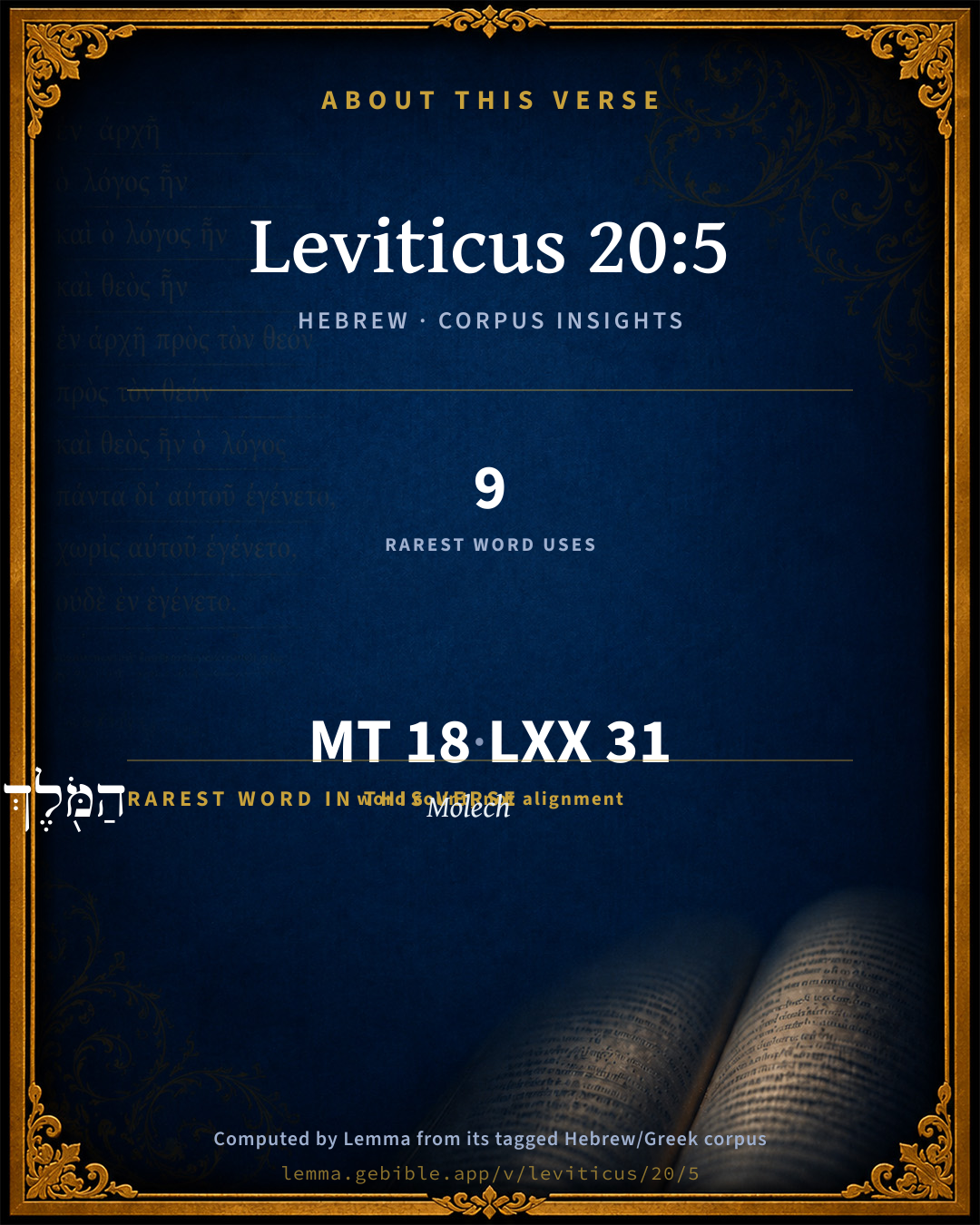
The rarest word here is הַמֹּ֖לֶךְ Molech H4432 — appearing just 9 times in the whole Hebrew Bible.

Shared distinctive vocabulary

הַמֹּ֖לֶךְ Molech H4432 occurs in 9 verses of the Hebrew Bible. Also found in:

Grammatical profile

  • 4 verbs
  • 7 nouns
  • 2 pronouns
  • 2 prepositions
  • 3 particles

Verb forms

  • וְשַׂמְתִּ֨י Qal · Sequential Perfect
  • וְהִכְרַתִּ֨י Hiphil · Sequential Perfect
  • הַזֹּנִ֣ים Qal · Participle Active
  • לִזְנ֛וֹת Qal · Infinitive Construct

Repetition

Words recur within this verse — often emphatic in Hebrew:

  • הַזֹּנִ֣ים to commit fornication H2181 ×2
  • אַחֲרָ֗יו after H310 ×2

Hebrew & Septuagint length

In English translation the verse runs 36 words from the Hebrew and 40 from the Septuagint (LXX English) — closely comparable.

A rough comparison of the two English renderings, which tokenize alike — not a word-level alignment.

Word counts can differ between the Hebrew and the Greek without any difference in meaning — e.g. the Hebrew direct-object marker אֵת has no separate Greek word, and Greek often adds the article ὁ.

In the original languages it is 18 Hebrew tokens and 31 Greek tokens — but the two are counted differently (Hebrew bundles its prefixes and suffixes into one token; the Greek is in lemma form), so that isn’t a like-for-like length.

Cross-references

9

Topical passages linked to Leviticus 20:5 in the Treasury of Scripture Knowledge — connected by theme and wording, ordered by reader-vote popularity; previews shown in the World English Bible.

  • Psalms 106:39 Thus were they defiled with their works, And prostituted themselves in their deeds.
  • Exodus 20:5 you shall not bow yourself down to them, nor serve them, for I, Yahweh your God, am a jealous God, visiting the iniquity of the fathers on the children, on the third and on the fourth generation of those who hate me,
  • Leviticus 17:7 They shall no more sacrifice their sacrifices to the goat idols, after which they play the prostitute. This shall be a statute forever to them throughout their generations.'
  • Leviticus 17:10 "'Any man of the house of Israel, or of the strangers who live as foreigners among them, who eats any kind of blood, I will set my face against that soul who eats blood, and will cut him off from among his people.
  • Jeremiah 3:2 Lift up your eyes to the bare heights, and see; where have you not been lain with? By the ways have you sat for them, as an Arabian in the wilderness; and you have polluted the land with your prostitution and with your wickedness.
  • Jeremiah 32:39 and I will give them one heart and one way, that they may fear me forever, for the good of them, and of their children after them:
  • Hosea 2:5 For their mother has played the prostitute. She who conceived them has done shamefully; For she said, 'I will go after my lovers, Who give me my bread and my water, My wool and my flax, My oil and my drink.'
  • Hosea 2:13 I will visit on her the days of the Baals, To which she burned incense, When she decked herself with her earrings and her jewels, And went after her lovers, And forgot me," says Yahweh.
  • Jeremiah 32:28–35 Therefore thus says Yahweh: Behold, I will give this city into the hand of the Chaldeans, and into the hand of Nebuchadrezzar king of Babylon, and he shall take it:

Cross-references courtesy of OpenBible.info (CC BY 4.0).

Hebrew and Greek witnesses Masoretic Hebrew ↔ Greek Septuagint

The same verse in the two great witnesses to the Old Testament, shown verse-for-verse.

These are two independent witnesses, not word-aligned to each other, and the Septuagint is shown in lemma (dictionary) form.

Hebrew Leviticus 20:5 Masoretic · Westminster Leningrad Codex

וְשַׂמְתִּ֨י אֲנִ֧י אֶת פָּנַ֛י בָּאִ֥ישׁ הַה֖וּא וּבְמִשְׁפַּחְתּ֑וֹ וְהִכְרַתִּ֨י אֹת֜וֹ וְאֵ֣ת כָּל הַזֹּנִ֣ים אַחֲרָ֗יו לִזְנ֛וֹת אַחֲרֵ֥י הַמֹּ֖לֶךְ מִקֶּ֥רֶב עַמָּֽם

then I will set my face against that man, and against his family, and will cut him off, and all who play the prostitute after him, to play the prostitute with Molech, from among their people.

World English Bible · Public Domain

Greek LXX Leviticus 20:5 Septuagint · lemma form

καί ἐπιἵστημι ὁ πρόσωπον ἐγώ ἐπί ὁ ἄνθρωπος ἐκεῖνος καί ὁ συγγένεια αὐτός καί ἀποὀλλύω αὐτός καί πᾶς ὁ ὁμονοέω αὐτός ὥστε ἐκπορνεύω αὐτός εἰς ὁ ἄρχων ἐκ ὁ λαός αὐτός

then will I set my face against that man and his family, and I will destroy him, and all who have been of one mind with him, so that he should go a whoring to the princes, from their people.

LXX2012 (modern English Septuagint) · Public Domain

Hebrew: Westminster Leningrad Codex (CC BY 4.0). Greek: Septuagint (public domain); English from LXX2012 (modern English Septuagint) (Public Domain). How the Septuagint differs from the Hebrew →

Targum (Aramaic paraphrase)

2

The Targum is the ancient Jewish Aramaic paraphrase of the Hebrew Scriptures — an interpretive translation, not the Hebrew text itself. Onkelos (literal) and Pseudo-Jonathan (expansive) render the Torah, and Jonathan the Prophets. Coverage is partial: where no permissively-licensed English translation exists for a verse, only the Aramaic is shown. This is verse-level text, not a word-by-word alignment to the Hebrew.

  1. Targum Onkelos Torah (Genesis–Deuteronomy)
    וֶאֱשַׁוֵי אֲנָא יָת רוּגְזִי בְגַבְרָא הַהוּא וּבִסְעָדוֹהִי וֶאֱשֵׁיצֵי יָתֵהּ וְיָת כָּל דְטָעָן בַּתְרוֹהִי לְמִטְעֵי בָּתַר מוֹלֶךְ מִגוֹ עַמְהוֹן

    (no public-domain English translation for this verse)

    Targum Onkelos — Aramaic: “Onkelos Genesis” (public domain); “Onkelos Exodus” (public domain); “Onkelos Leviticus” (public domain); “Onkelos Numbers” (public domain); “Onkelos Deuteronomy” (public domain). English: “Sefaria Community Translation” (CC0 1.0 (public-domain dedication)); “J.W. Etheridge. The Targums of Onkelos and Jonathan Ben Uzziel on the Pentateuch. London: Longmans, Green, 1862” (public domain). Text via Sefaria.

  2. Targum Pseudo-Jonathan Torah (Genesis–Deuteronomy)
    וְאֶשַׁוֵי אֲנָא פְנוּיַיְתָא לְמֶעֱסוֹק בְּגַבְרָא הַהוּא וּבִגְנִיסָתֵיהּ דִמְחַפְיַין עֲלוֹי לְאִתְרְדָאָה בְּיִסוּרֵי וְיָתֵיהּ אֵישֵׁיצֵי וְיַת כָּל דְטָעַן בַּתְרוֹי לְמִטְעֵי בָּתַר פּוּלְחָנָא אוֹחֲרָא מִגוֹ עַמֵיהּ

    then will I appoint a reverse, to make a controversy against that man, and against his family who protect (cover) him, to chastise (them) with afflictions; and him will I destroy, and all who follow him to wander after strange worship, from among their people.

    Targum Pseudo-Jonathan — Aramaic: “Targum Jonathan on Genesis” (public domain); “Targum Jonathan on Exodus” (public domain); “Targum Jonathan on Leviticus” (public domain); “Targum Jonathan on Numbers” (public domain); “Targum Jonathan on Deuteronomy” (public domain). English: “The Targum of Jonathan ben Uzziel, trans. J. W. Etheridge, London, 1862” (public domain). Text via Sefaria.

Commentary

Notes on Leviticus 20:5 from classic Christian and Jewish commentators (each source and its license shown beneath its notes). The classic Christian expositions comment on the surrounding passage and are grouped to its opening verse, so a note may address several verses; the Jewish commentaries on the Tanakh (Rashi and others) are per-verse, so they appear only where the commentator wrote on this verse.

Lemma curates 59 commentaries, every one of them public domain or Creative Commons licensed, each selected and text-cleaned for this edition rather than reprinted as found. About our sources →

Trapp's Complete Commentary

John Trapp

Lev 20:5 Then I will set my face against that man, and against his family, and will cut him off, and all that go a whoring after him, to commit whoredom with Molech, from among their people.

Ver. 5. I will set my face against that man.] See the reason in Eze 16:20-21, "Is this of thy whoredoms a small matter, that thou hast slain my children, and delivered them to pass through the fire for them?" This was an enraging sin; such as God is absolute in threatening, and will be as resolute in punishing.

John Trapp, A Commentary or Exposition upon All the Books of the Old and New Testament (1647–1656) — public domain. Text from a community e-Sword module.

Ellicott's Commentary for English Readers

(5) Then I will set my face.—In that case God himself will show His anger. (See Lev_20:3, and Lev_17:10.) He will interpose to execute just judgment.

And against his family.—Because they would naturally be privy to it, and aid and abet the father in this crime, they, as well as all those who joined in this idolatrous worship, will be cut off by God himself.

A Bible Commentary for English Readers, edited by Charles John Ellicott (1878–1897) — public domain. Text from a community e-Sword module.

John Gill's Exposition

Then I will set my face against that man,.... That man that sees him do the fact, and winks at it, or the judge that connives at him, and will not condemn him, as well as the man that has committed the iniquity:

and against his family; either the family of the witness, who could and should have testified against him, or of the judge negligent of his office, or of the man himself, whose family must be privy to so shocking an action, and were abettors of it, and aiders and assisters in it; and so Onkelos renders it, "and his helpers":

and will cut him off: the head of the family, whether judge, witness, or the criminal himself:

and all that go a whoring after him: that commit the like idolatry after his example, and encouraged to it by the connivance of others at it:

to commit whoredom with Molech; that is, idolatry, which is spiritual whoredom, and often so called in Scripture, and with great propriety; for since God had espoused these people to himself, and was their husband, as he was from the time of his bringing them out of Egypt, and making a covenant with them, Jer 31:32; and their sacrificing to and serving other gods being a breach of their matrimonial covenant with him, it was no other than whoredom in a spiritual sense, for which he threatens to cut them off:

from among their people; by an immature death, even all that were guilty of such abominable actions, or made themselves accessory to them, by any ways conniving at them, either as judges or witnesses.

John Gill's Exposition of the Whole Bible (1746–1763) — public domain (CC PDM 1.0). Text via the HelloAO Bible API.

Matthew Poole's English Annotations

Against his family, i.e. either,

1. His posterity, whom God threatened to punish for their father’s idolatry, Exo 20. Or,

2. His people, as that word is used, Jer 8:3; Mic 2:3, to wit, the people of that land, who by their connivance make themselves guilty of his sin, Lev 20:4. Or,

3. His disciples and followers, who are oft called the sons or children of their masters. And so it may seem to be explained in the following words,

all that go a whoring after him, as the first clause, which concerns the head or chief person himself, I will set my face against that man, is explained by these words, I will cut him off.

Matthew Poole's English Annotations on the Holy Bible (1683–1685) — public domain. Text from a community e-Sword/MySword module.

Rashi

Rabbi Shlomo Yitzchaki (Rashi)

ובמשפחתו [THEN I WILL SET MY EYES AGAINST THAT MAN], AND AGAINST HIS FAMILY — R. Simeon asked, "But how did his family sin that it should be punished?" But the family is mentioned to teach you that you may take it as a rule that there is no family in which there is one tax-collector (a calling held in great reprobation by Jews) which may not be regarded as consisting entirely of tax-collectors, for they all try to protect him (Sifra, Kedoshim, Section 4 13; Shevuot 39a).

והכרתי אתו AND I WILL CUT HIM OFF — Why is this stated (it appears to be a mere repetition of the statement in v. 3)? Because since Scripture says here for the reason stated above, “[I will set My face…] against his family", I might think that the whole family is also doomed to excision; Scripture therefore states “[I will cut] him [off]"— he alone is subject to excision, but the whole family is not subject to excision but to bodily sufferings (Sifra, Kedoshim, Section 4 14; Shevuot 39a).

לזנות אחרי המלך TO COMMIT WHOREDOM WITH MOLECH — This is intended to include the worship also of any other idol which he worshipped in this way (by letting his children pass through the fire in honor of it) even though this is not the manner of worship peculiar to it (Sifra, Kedoshim, Section 4 15; Sanhedrin 64a).

Rashi on the Tanakh — English translations: “The Judaica Press complete Tanach with Rashi, translated by A. J. Rosenberg” (CC BY 4.0); “Pentateuch with Rashi's commentary by M. Rosenbaum and A.M. Silbermann, 1929-1934” (public domain); “The Metsudah Tanach series, Lakewood, N.J” (CC BY 4.0); and “The Book of Joshua, Metsudah Publications, 1997” (CC BY 4.0). Text via Sefaria.

Ramban (Nachmanides)

Rabbi Moshe ben Nachman (Ramban / Nachmanides)

TO GO ASTRAY AFTER THE MOLECH. “This is intended to include any other idol that was worshipped in that way [i.e., by a person passing his children through the fire], even if that particular idol is ordinarily not worshipped that way.” This is Rashi’s language. Now Rashi has already written in the section of Acharei Moth that the Molech is “an idol the name of which is ‘Molech,’ and this was the way in which it was worshipped: he would hand over his child to the priests etc.” But all this does not conform and agree properly with the Gemara’s conclusion as it appears after deliberation. For according to the opinion of the Sage who says that Molech is an idol [and not a name for a form of witchcraft], the worship thereof was not by passing children through the fire, for if so there was no need at all for Scripture to mention this, [i.e., the passing through fire] since it would be included in the admonition against worshipping the idols [in the manner in which they are usually worshipped], of which there are many general prohibitions in the Torah, and it is also included in the punishment stated in the section If there be found in the midst of thee … man or woman, that doeth that which is evil in the sight of the Eternal thy G-d, in transgressing His covenant, and hath gone and served other gods, and worshipped them. Rather, we must perforce interpret [if Molech is the name of a particular idol] that the essential purpose of Scripture in mentioning [this particular form of worship], was only to make one liable for passing one’s children [through fire] even if that particular idol is not ordinarily worshipped in that manner. And thus the Rabbis have said in the Gemara: “And according to the Sage who is of the opinion that Molech is an idol, why did Scripture state [the punishment of] excision in the case of Molech [when it is already included in the general punishment for all idol-worship]? It is to apply it in the case of one who passes his son [through the fire in honor of any idol, even if that idol is] not ordinarily worshipped in that manner.” And the same reasoning applies to the punishment and the admonition which Scripture mentioned with reference to it [this particular form of worship], that they were only necessary [if we hold that Molech is an idol] for the case of one who passed his son [through fire] to an idol which is not normally worshipped in that manner.It would appear that according to this opinion [that the Molech was idol-worship, and that the main reason why Scripture mentioned this particular form of worship was to prohibit and punish the practice thereof even as an abnormal manner of worship of all other idols], that the term “Molech” is not a name for a particular graven image or statute, but is a general name for anything that is worshipped, “anything which you accept as your king and take upon you as your god.” In accordance with this opinion, the children of Ammon called their abhorrence Molech, because he was their king, the term Molech thus being a general name for all things honored [as deities], for it is derived from the term malchuth (royalty). It is thus not like the Rabbi [Rashi] said [in the preceding section of Acharei Moth], that Molech is “an idol the name of which is ‘Molech,’ and the manner of its worship” was as mentioned. Similarly, that which Rashi wrote here that the phrase to go astray after the Molech “is necessary to include any other idol that was worshipped in that way, even if that particular idol is ordinarily not worshipped in that way” — this interpretation too, is impossible [to accept] for the reason that we have mentioned, namely, that the essential basis for the punishment of excision mentioned specifically in the case of the Molech, is to make one liable for practicing before an idol even if the idol is not ordinarily worshipped in that manner, and this includes all idols! [Hence it is not necessary to include them on the basis of the phrase before us in Verse 5 — to go astray after the Molech — when this point is already established the overall statement of excision mentioned in Verse 3 which essentially prohibits that kind of worship to any idol, even if it is not normally worshipped in that way]! It is also impossible to say that Scripture made one liable to excision in the case of that idol the name of which is “Molech,” although passing a child through the fire before it was not its usual mode of worship, and that then it reverts [in the verse before us, stating to go astray after Molech, in order, as Rashi said] to include in the punishment of excision he [who passes through the fire of his seed] to Peor or Merkulis [which was also an abnormal mode of worshipping them]. For why was it necessary for Scripture to mention it [i.e., Molech] altogether? Why was that idol [called “Molech” or “Peor” or “Merkulis”] different from all other idols [since the Torah has already prohibited passing one’s children through fire before any idol, under punishment of excision even if that particular idol is ordinarily not worshipped that way]? Moreover, if so you would need a special verse to include one who passes his child through the fire to Peor or Merkulis in the punishment of stoning [if there were witnesses to his act and he was given the proper warning], just as Scripture [according to Rashi] included him in the punishment of excision [when there were no witnesses]!Rather, [we must conclude] that Scripture only mentioned the admonition, and the punishments of excision and stoning, in the case of Molech, with reference to one who passes his child through the fire to any idol whatsoever, even if that is not its usual mode of worship. Thus whether you say that the term Molech is a name for all idols [since the name is derived from the word malchuth, (royalty)] as we have explained, or whether you say [as Rashi does] that Molech is the name of a particular idol that was so called, [we must say, as explained above] that Scripture mentioned it [in order to prohibit this practice even] if it be an abnormal mode of worship [of that idol, i.e., Molech]; the same law applying to all idols, for this stringency is on account of the frightfulness of this mode of worship. All this is made clear in the Gemara of Tractate Sanhedrin according to this opinion which the Rabbi [Rashi] wrote, that the Molech was an idol. But our Mishnah [which mentions first “the idolator” and then “he that offers of his seed to Molech,” thus indicating that Molech is not an idol, for otherwise this would have been included under the law of “the idolator”], is taught in accordance with the opinion of the Sage who says that Molech was not an idol, meaning to say, it was not worshipped in a manner of being accepted as a god, but instead it was like a practice of witchcraft, to seek on behalf of the living unto the dead, unto this dead dog. According to this opinion, one who passed his seed through the fire to Peor or Merkulis, is not liable [since that form of witchcraft was performed only before Molech, and the Torah specifically mentioned that this practice of witchcraft was done before Molech]. (royalty), as the act of idol worship meant that the idolator accepted the idol as his god. But if Molech is held to have been a form of witchcraft [and not a mode of idol worship], then if one is to perform that practice before Peor or Merkulis, it would not come under that specific prohibition which the Torah singled out, and hence he would be free from the punishment of death, although — needless to state — he has committed a heinous sin. Rashi’s words in his commentaries to Tractate Sanhedrin are also as we have written. And the Beraitha taught in the Torath Kohanim 10:15. [which was the source for Rashi’s comment mentioned at the beginning of this verse]: “And I will cut him off, and all that go astray after him, to go astray after Molech. This is intended to include the case of any other idol [which was worshipped in that way, that the worshipper is liable to the punishment of] excision” — the interpretation of this Beraitha is not based upon the redundant expression to go astray after Molech, as appears from the words of the Rabbi [Rashi]. Rather, the Beraitha is stating that this whole [Scriptural passage laying down the law of] excision is redundant, and therefore we are to apply it to any other idol that was worshipped in that way. It is this which the Rabbis have stated in the Gemara: “Why is excision mentioned thrice [as the punishment] for idolatry? It is prescribed once for [worshipping an idol in] the customary manner; once for worshipping it in a non-customary manner,” that is, if he sacrifices, or burns incense, or pours a libation, or bows down before an idol, which have been included under the punishment of death. And see “The Commandments,” Vol. II, p. 6. even if the idol is not ordinarily worshipped in that manner, and here [in the verse before us] they are made liable to excision [in the absence of witnesses]. “And once excision is mentioned for [the worship of] Molech” [for Molech is not an idol, but a form of witchcraft which the Torah prohibited by means of this strong form of punishment]. And according to the Sage who says that Molech is an idol [we must perforce say that the reason why the Torah singled out the Molech is in order to prohibit and punish] passing a child through the fire before any idol whatever, even if the idol is not ordinarily worshipped in that manner, as we have mentioned.

Ramban (Nachmanides) on the Tanakh — English translation: “Commentary on the Torah by Ramban (Nachmanides). Translated and annotated by Charles B. Chavel. New York, Shilo Pub. House, 1971-1976” (CC BY 4.0). Text via Sefaria.

Lesson kit

Teaching starters — assembled from the data on this page, not authored interpretation. Every prompt links to the verse data it draws on. Edit before teaching.

Leviticus, in the Pentateuch, opens this verse with 18 words (14 distinct Hebrew lemmas). Its most distinctive word is Môlek (“Molech”). A historical commentator’s framing appears above. Read the whole chapter for the surrounding context.

Discussion questions

  1. How does “Molech” (Môlek) shape what this verse is saying?
  2. How does Leviticus 18:21, which shares the word «Molech», read alongside this verse?
  3. What does the repetition of “to commit fornication” (2× in this one verse) do in this verse?
  4. These translations render this verse differently. What is at stake in choosing one wording over another?
  5. «וְשַׂמְתִּ֨י» is a Qal Sequential Perfect verb. How does that grammatical form shape the action described?
  6. Compare how Trapp's Complete Commentary and Ellicott's Commentary for English Readers read this verse. Where do they agree or differ?

Things to notice

Reading settings

Reading text

Shown beneath each verse's original-language words.

Old Testament
Old Testament edition

Read the OT as the Masoretic Hebrew (MT) or the Greek Septuagint (LXX).

English shown for the Greek Septuagint (in the Hebrew ↔ Greek comparison).

Comparing translations? Open the Compare panel on any verse page to stack up to four side by side.