Exodus 7:5

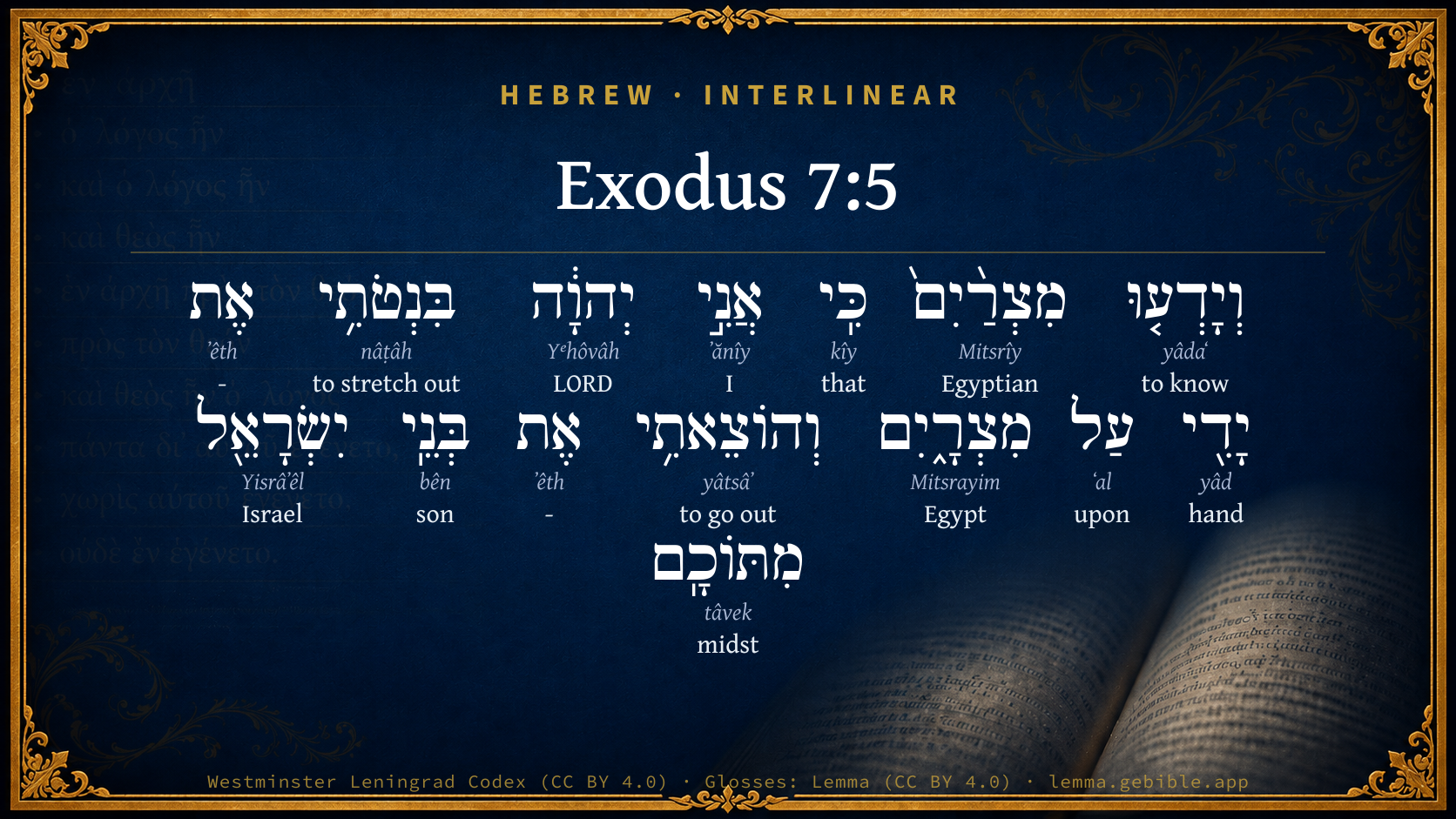
Hebrew (Westminster Leningrad Codex) Exodus 7:5 appears in the Hebrew Old Testament. The text above is from the Westminster Leningrad Codex. Each word links to its Strong’s number, a concise gloss, and parsing drawn from the Open Scriptures Hebrew Bible morphology. Click any word for its full Brown-Driver-Briggs (BDB) entry.
Download image
Cite this verse

Exodus 7:5 (World English Bible). Public Domain. Lemma interlinear Bible study tool, https://lemma.gebible.app/v/exodus/7/5.

Show BibTeX & RIS
BibTeX
RIS
English Translation
The Egyptians shall know that I am Yahweh, when I stretch forth my hand on Egypt, and bring out the children of Israel from among them."
World English Bible · Public Domain
Download a study sheet

One document with this verse’s original text, its word-by-word gloss line, the meaning frame, cross-references with their text, attributed commentary, and full source and license credits — printable, and it pastes into notes with its structure intact.

This verse Autodidact and up

Study sheet (.html) Plain text (.txt)

A passage Seminary Student

Up to 50 verses in one chapter. A passage sheet keeps up to 6 commentary sources and 12 cross-references per verse, in the order this page ranks them, and says so on the sheet whenever that leaves anything out. Ask for a single verse and you get the Autodidact verse sheet above.

Everything on this page stays free to read, with no account — the sheet is a download of what is already on screen, not access to it.

Want to remove ads? Support Godless Engineer
Compare translations 3

The same verse in 3 English versions, stacked beneath the original-language interlinear above. Click any original word for its lexicon entry.

Each is an independent rendering of the whole verse — the interlinear is not word-aligned to these translations.

Highlighted words mark where these versions differ — a whole-verse word diff, not a word-by-word alignment.

  • World English Bible Public Domain
    The Egyptians shall know that I am Yahweh, when I stretch forth my hand on Egypt, and bring out the children of Israel from among them."
  • King James Version Public Domain
    And the Egyptians shall know that I am the LORD, when I stretch forth mine hand upon Egypt, and bring out the children of Israel from among them.
  • unfoldingWord Literal Text CC BY-SA 4.0
    And the Egyptians will know that I am Yahweh when I stretch out my hand over Egypt to bring the sons of Israel out from their midst.”

unfoldingWord Literal Text — © unfoldingWord, licensed CC BY-SA 4.0. Word-aligned USFM3 via Door43 (git.door43.org/unfoldingWord/en_ult).

Versions to compare (up to 4)

3 of 4 selected

Show all 18 translations

Every available English version of this verse, each an independent rendering of the whole verse.

  • World English Bible Public Domain
    The Egyptians shall know that I am Yahweh, when I stretch forth my hand on Egypt, and bring out the children of Israel from among them."
  • Berean Standard Bible Public Domain
    And the Egyptians will know that I am the LORD, when I stretch out My hand against Egypt and bring the Israelites out from among them.”
  • Majority Standard Bible Public Domain
    And the Egyptians will know that I am the LORD, when I stretch out My hand against Egypt and bring the Israelites out from among them.”
  • King James Version Public Domain
    And the Egyptians shall know that I am the LORD, when I stretch forth mine hand upon Egypt, and bring out the children of Israel from among them.
  • American Standard Version (1901) Public Domain
    And the Egyptians shall know that I am Jehovah, when I stretch forth my hand upon Egypt, and bring out the children of Israel from among them.
  • Revised Version (1885) Public Domain
    And the Egyptians shall know that I am the LORD, when I stretch forth mine hand upon Egypt, and bring out the children of Israel from among them.
  • Geneva Bible (1599) Public Domain
    Then the Egyptians shall knowe that I am the Lord, when I stretch foorth mine hand vpon Egypt, and bring out the children of Israel from among them.
  • Douay-Rheims (1899) Public Domain
    And the Egyptians shall know that I am the Lord, who have stretched forth my hand upon Egypt, and have brought forth the children of Israel out of the midst of them.
  • Young's Literal Translation Public Domain
    and the Egyptians have known that I `am' Jehovah, in My stretching out My hand against Egypt; and I have brought out the sons of Israel from their midst.'
  • Literal Standard Version CC BY-SA 4.0
    and the Egyptians have known that I [am] YHWH, in My stretching out My hand against Egypt; and I have brought out the sons of Israel from their midst.”
  • Unlocked Literal Bible CC BY-SA 4.0
    The Egyptians will know that I am Yahweh when I reach out with my hand on Egypt and bring out the Israelites from among them.”
  • unfoldingWord Literal Text CC BY-SA 4.0
    And the Egyptians will know that I am Yahweh when I stretch out my hand over Egypt to bring the sons of Israel out from their midst.”
  • Darby Bible Public Domain
    And the Egyptians shall know that I am Jehovah, when I stretch forth my hand on Egypt, and bring out the children of Israel from among them.
  • World Messianic Bible Public Domain
    The Egyptians shall know that I am the LORD when I stretch out my hand on Egypt, and bring the children of Israel out from among them.”
  • Webster's Bible Public Domain
    And the Egyptians shall know that I am the LORD, when I stretch forth my hand upon Egypt, and bring out the children of Israel from among them.
  • Free Bible Version CC BY-SA 4.0
    In this way the Egyptians will know that I am the Lord—when I take action against Egypt and lead the Israelites out of the country.”
  • Bible in Basic English Public Domain
    And the Egyptians will see that I am the Lord, when my hand is stretched out over Egypt, and I take the children of Israel out from among them.
  • JPS Tanakh (1917) Public Domain
    And the Egyptians shall know that I am the LORD, when I stretch forth My hand upon Egypt, and bring out the children of Israel from among them.'

Literal Standard Version (2020), Covenant Press — licensed CC BY-SA 4.0. Text via the HelloAO Bible API (eBible.org). Unlocked Literal Bible (unfoldingWord) — licensed CC BY-SA 4.0. Text via the HelloAO Bible API (eBible.org). unfoldingWord Literal Text — © unfoldingWord, licensed CC BY-SA 4.0. Word-aligned USFM3 via Door43 (git.door43.org/unfoldingWord/en_ult). Free Bible Version, Dr. Jonathan Gallagher — licensed CC BY-SA 4.0. Text via the HelloAO Bible API (eBible.org).

Word by word

More ways to search: Search by grammar → Find every occurrence → Compare this word →

Practice this passage: Drill this verse → Learn its vocabulary →

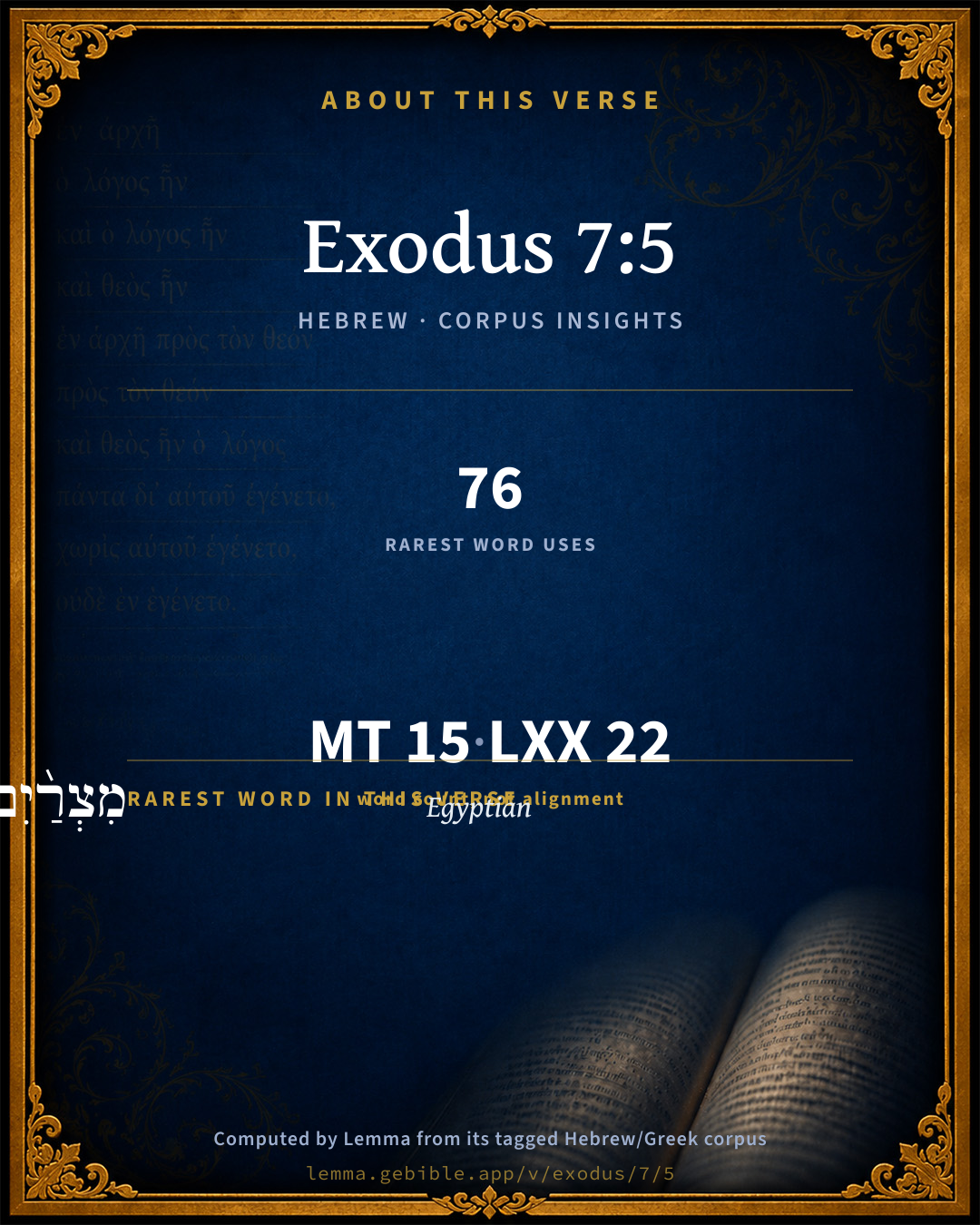
מִצְרַ֨יִם֙
Mitsrîy
H4713
“Egyptian”
Noun, Proper
Part of Speech
Noun
Type
Proper
Full BDB Definition

Origin: from H4714

TWOT: None

Egyptian = see Egypte " double straits" - Egyptian - an inhabitant or citizen of Egypt - an Egyptian - the Egyptian
  1. וְיָדְע֤וּ yâdaʻ H3045 “and · to know” Conjunction + Verb, Qal, Sequential Perfect, 3rd Person, Common, Plural
  2. כִּֽי kîy H3588 “that” Conjunction
  3. אֲנִ֣י ʼănîy H589 “I” Pronoun, Personal, 1st Person, Common, Singular
  4. יְהוָ֔ה Yᵉhôvâh H3068 “LORD” Noun, Proper
  5. בִּנְטֹתִ֥י nâṭâh H5186 “in/at · to stretch out · me” Preposition + Verb, Qal, Infinitive Construct + Suffix, Personal, 1st Person, Common, Singular
  6. אֶת ʼêth H853 “-” Particle, Direct Object
  7. יָדִ֖י yâd H3027 “hand · my” Noun, Common, Both, Singular, Construct + Suffix, Personal, 1st Person, Common, Singular
  8. עַל ʻal H5921 “upon” Preposition
  9. מִצְרָ֑יִם Mitsrayim H4714 “Egypt” Noun, Proper
  10. וְהוֹצֵאתִ֥י yâtsâʼ H3318 “and · to go out” Conjunction + Verb, Hiphil, Sequential Perfect, 1st Person, Common, Singular
  11. אֶת ʼêth H853 “-” Particle, Direct Object
  12. בְּנֵֽי bên H1121 “sons of” Noun, Common, Masculine, Plural, Construct
  13. יִשְׂרָאֵ֖ל Yisrâʼêl H3478 “Israel” Noun, Proper
  14. מִתּוֹכָֽם tâvek H8432 “from · midst · their” Preposition + Noun, Common, Masculine, Singular, Construct + Suffix, Personal, 3rd Person, Masculine, Plural

About this verse

These counts appear in no published source. They are computed here, from the morphology-tagged text and Lemma’s own curated glosses. What Lemma adds →

15
words
14
distinct lemmas
Pentateuch
section

Grammatical profile

  • 3 verbs
  • 7 nouns
  • 1 pronoun
  • 1 preposition
  • 1 conjunction
  • 2 particles

Verb forms

  • וְיָדְע֤וּ Qal · Sequential Perfect
  • בִּנְטֹתִ֥י Qal · Infinitive Construct
  • וְהוֹצֵאתִ֥י Hiphil · Sequential Perfect

Hebrew & Septuagint length

In English translation the verse runs 26 words from the Hebrew and 32 from the Septuagint (LXX English) — closely comparable.

A rough comparison of the two English renderings, which tokenize alike — not a word-level alignment.

Word counts can differ between the Hebrew and the Greek without any difference in meaning — e.g. the Hebrew direct-object marker אֵת has no separate Greek word, and Greek often adds the article ὁ.

In the original languages it is 15 Hebrew tokens and 22 Greek tokens — but the two are counted differently (Hebrew bundles its prefixes and suffixes into one token; the Greek is in lemma form), so that isn’t a like-for-like length.

Cross-references

13

Topical passages linked to Exodus 7:5 in the Treasury of Scripture Knowledge — connected by theme and wording, ordered by reader-vote popularity; previews shown in the World English Bible.

  • Exodus 14:18 The Egyptians shall know that I am Yahweh, when I have gotten myself honor over Pharaoh, over his chariots, and over his horsemen."
  • Exodus 7:17 Thus says Yahweh, "In this you shall know that I am Yahweh. Behold, I will strike with the rod that is in my hand on the waters which are in the river, and they shall be turned to blood.
  • Exodus 8:22 I will set apart in that day the land of Goshen, in which my people dwell, that no swarms of flies shall be there; to the end you may know that I am Yahweh in the midst of the earth.
  • Exodus 14:4 I will harden Pharaoh's heart, and he will follow after them; and I will get honor over Pharaoh, and over all his host; and the Egyptians shall know that I am Yahweh." They did so.
  • Exodus 3:20 I will put forth my hand and strike Egypt with all my wonders which I will do in the midst of it, and after that he will let you go.
  • Exodus 8:10 He said, "Tomorrow." He said, "Be it according to your word, that you may know that there is none like Yahweh our God.
  • Ezekiel 25:17 I will execute great vengeance on them with wrathful rebukes; and they shall know that I am Yahweh, when I shall lay my vengeance on them.
  • Ezekiel 28:22 and say, Thus says the Lord Yahweh: Behold, I am against you, Sidon; and I will be glorified in the midst of you; and they shall know that I am Yahweh, when I shall have executed judgments in her, and shall be sanctified in her.
  • Ezekiel 36:23 I will sanctify my great name, which has been profaned among the nations, which you have profaned in the midst of them; and the nations shall know that I am Yahweh, says the Lord Yahweh, when I shall be sanctified in you before their eyes.
  • Ezekiel 39:7 My holy name will I make known in the midst of my people Israel; neither will I allow my holy name to be profaned any more: and the nations shall know that I am Yahweh, the Holy One in Israel.
  • Ezekiel 39:22 So the house of Israel shall know that I am Yahweh their God, from that day and forward.
  • Exodus 8:19 Then the magicians said to Pharaoh, "This is the finger of God:" and Pharaoh's heart was hardened, and he didn't listen to them; as Yahweh had spoken.
  • Psalms 9:16 Yahweh has made himself known. He has executed judgment. The wicked is snared by the work of his own hands. Meditation. Selah.

Cross-references courtesy of OpenBible.info (CC BY 4.0).

Hebrew and Greek witnesses Masoretic Hebrew ↔ Greek Septuagint

The same verse in the two great witnesses to the Old Testament, shown verse-for-verse.

These are two independent witnesses, not word-aligned to each other, and the Septuagint is shown in lemma (dictionary) form.

Hebrew Exodus 7:5 Masoretic · Westminster Leningrad Codex

וְיָדְע֤וּ מִצְרַ֨יִם֙ כִּֽי אֲנִ֣י יְהוָ֔ה בִּנְטֹתִ֥י אֶת יָדִ֖י עַל מִצְרָ֑יִם וְהוֹצֵאתִ֥י אֶת בְּנֵֽי יִשְׂרָאֵ֖ל מִתּוֹכָֽם

The Egyptians shall know that I am Yahweh, when I stretch forth my hand on Egypt, and bring out the children of Israel from among them."

World English Bible · Public Domain

Greek LXX Exodus 7:5 Septuagint · lemma form

καί γιγνώσκω πᾶς ὁ αἰγύπτιος ὅτι ἐγώ εἰμί κύριος ἐκτείνω ὁ χείρ ἐπί αἴγυπτος καί ἐκἄγω ὁ υἱός ἰσραήλ ἐκ μέσος αὐτός

And all the Egyptians shall know that I am the Lord, stretching out my hand upon Egypt, and I will bring out the children of Israel out of the midst of them.

LXX2012 (modern English Septuagint) · Public Domain

Hebrew: Westminster Leningrad Codex (CC BY 4.0). Greek: Septuagint (public domain); English from LXX2012 (modern English Septuagint) (Public Domain). How the Septuagint differs from the Hebrew →

Targum (Aramaic paraphrase)

2

The Targum is the ancient Jewish Aramaic paraphrase of the Hebrew Scriptures — an interpretive translation, not the Hebrew text itself. Onkelos (literal) and Pseudo-Jonathan (expansive) render the Torah, and Jonathan the Prophets. Coverage is partial: where no permissively-licensed English translation exists for a verse, only the Aramaic is shown. This is verse-level text, not a word-by-word alignment to the Hebrew.

  1. Targum Onkelos Torah (Genesis–Deuteronomy)
    וְיִדְעוּן מִצְרַיִם אֲרֵי אֲנָא יְיָ כַּד אָרֵים יָת מָחַת גְבֻרְתִּי עַל מִצְרָיִם וְאַפֵּיק יָת בְּנֵי יִשְׂרָאֵל מִבֵּינֵיהוֹן:

    (no public-domain English translation for this verse)

    Targum Onkelos — Aramaic: “Onkelos Genesis” (public domain); “Onkelos Exodus” (public domain); “Onkelos Leviticus” (public domain); “Onkelos Numbers” (public domain); “Onkelos Deuteronomy” (public domain). English: “Sefaria Community Translation” (CC0 1.0 (public-domain dedication)); “J.W. Etheridge. The Targums of Onkelos and Jonathan Ben Uzziel on the Pentateuch. London: Longmans, Green, 1862” (public domain). Text via Sefaria.

  2. Targum Pseudo-Jonathan Torah (Genesis–Deuteronomy)
    וְיִנְדְעוּן מִצְרָאֵי אֲרוּם אֲנָא הוּא יְיָ כַּד אָרִים יַת מְחַת גְבוּרְתִּי עַל מִצְרָיִם וְאַנְפֵּיק יַת בְּנֵי יִשְרָאֵל פְּרִיקִין מִבֵּינֵיהוֹן

    (no public-domain English translation for this verse)

    Targum Pseudo-Jonathan — Aramaic: “Targum Jonathan on Genesis” (public domain); “Targum Jonathan on Exodus” (public domain); “Targum Jonathan on Leviticus” (public domain); “Targum Jonathan on Numbers” (public domain); “Targum Jonathan on Deuteronomy” (public domain). English: “The Targum of Jonathan ben Uzziel, trans. J. W. Etheridge, London, 1862” (public domain). Text via Sefaria.

Commentary

Notes on Exodus 7:5 from classic Christian and Jewish commentators (each source and its license shown beneath its notes). The classic Christian expositions comment on the surrounding passage and are grouped to its opening verse, so a note may address several verses; the Jewish commentaries on the Tanakh (Rashi and others) are per-verse, so they appear only where the commentator wrote on this verse.

Lemma curates 59 commentaries, every one of them public domain or Creative Commons licensed, each selected and text-cleaned for this edition rather than reprinted as found. About our sources →

Trapp's Complete Commentary

John Trapp

Exo 7:5 And the Egyptians shall know that I [am] the LORD, when I stretch forth mine hand upon Egypt, and bring out the children of Israel from among them.

Ver. 5. And the Egyptians shall know.] To their cost, when the Lord’s hand, that is lifted up in threatening, shall fall down in punishing. "Lord," saith the prophet, "when thy hand is lifted up, they will not see, but they shall see," &c. {Isa 26:11} God will unseal their heavy eyes with scorching plagues, and rouse them with horror enough.

John Trapp, A Commentary or Exposition upon All the Books of the Old and New Testament (1647–1656) — public domain. Text from a community e-Sword module.

The Biblical Illustrator

Joseph S. Exell

Exo_7:5

The Egyptians shall know that I am the Lord.

A knowledge of God

I. That the worst of men will one day have to recognize the reality of the Divine existence. And the Egyptians shall know, etc.

1. Men of bad moral character shall know this.

2. Men of sceptical dispositions shall know this.

II. That they will be brought to a recognition of the Divine existence by severe judgments.

1. Some men will listen to the voice of reason. The Egyptians would not.

2. Such will learn the existence of God by judgment.

III. That the existence of God is a guarantee for the safety of the good. And bring out, etc., from moral and temporal bondage into Canaan, of peace and quiet. (J. S. Exell, M. A.)

The plagues

1. These plagues are arranged in regular order, and gradually advance from the external to the internal, and from the mediate to the immediate hand of God. They are in number ten, which is one of the numbers denoting perfection. They are divided first into nine and one, the last one standing clearly apart from all the others in the awful shriek of woe which it draws forth from every Egyptian home. The nine are arranged in threes. In the first of each three the warning is given to Pharaoh in the morning (Exo_7:15; Exo_8:20; Exo_9:13). In the first and second of each three the plague is announced beforehand (Exo_8:1; Exo_9:1; Exo_10:1); in the third not (Exo_8:16; Exo_9:8; Exo_10:21). At the third the magicians of Pharaoh acknowledge the finger of God (Exo_8:19), at the sixth they cannot stand before Moses (Exo_9:11), and at the ninth Pharaoh refuses to see the face of Moses any more (Exo_10:28). In the first three Aaron uses the rod, in the second three it is not mentioned, in the third three Moses uses it, though in the last of them only his hand is mentioned. All these marks of order lie on the face of the narrative, and point to a deeper order of nature and reason out of which they spring.

2. The plagues were characterized by increasing severity, a method of procedure to which we see an analogy in the warnings which the providential government of the world often puts before the sinner.

3. These plagues were of a miraculous character. As such the historian obviously intends us to regard them, and they are elsewhere spoken of as the wonders which God wrought in the land of Ham (Psa_105:27), as His miracles in Egypt (Psa_106:7), and as His signs and prodigies which He sent into the midst of Egypt (Psa_135:9). It is only under this aspect that we can accept the narrative as historical.

4. That the immediate design of these inflictions was the delivering of the Israelites from their cruel bondage lies on the surface of the narrative, but with this other ends were contemplated. The manifestation of Gods own glory was here, as in all His works, the highest object in view, and this required that the powers of Egyptian idolatry, with which the interest of Satan was at that time peculiarly identified, should be brought into the conflict and manifestly confounded. For this reason it was that nearly every miracle performed by Moses had relation to some object of idolatrous worship among the Egyptians (see Exo_12:12). For this reason, also, it was that the first wonders wrought had such distinct reference to the exploits of the magicians, who were the wonder-workers connected with that gigantic system of idolatry, and the main instruments of its support and credit in the world. They were thus naturally drawn, as well as Pharaoh, into the contest, and became, along with him, the visible heads and representatives of the spiritual wickedness of Egypt. And since they refused to own the supremacy and accede to the demands of Jehovah, or witnessing that first, and as it may be called harmless, triumph of His power over theirs--since they resolved, as the adversaries of Gods and the instruments of Satans interest in the world, to prolong the contest, there remained no alternative but to visit the land with a series of judgments, such as might clearly prove the utter impotence of its fancied deities to protect their votaries from the might and vengeance of the living God. (A. Nevin, D. D.)

The variety of the plagues

The diversity and various sorts of those plagues--each sorer than other. The first and second were upon the water, the third and fourth were upon the earth, the five next were upon the air, and the tenth falls upon the firstborn of men, insomuch that their punishment was absolute, not only as to the number of the plagues, which was a number of perfection, but more especially in respect of their nature, matter, and manner, all various and exquisite. For--

I. They were plagued by all kind of creatures.

1. By all the elements; as water, earth, air and fire.

2. By sundry animals; as frogs, lice, caterpillars, flies, and locusts.

3. By men; as Moses and Aaron were instruments in Gods hand.

4. By the angels who ministered those plagues, both the evil angels (Psa_78:44), whom He sent among them, and the good that were employed in destroying their firstborn (Exo_12:3, etc.), yea, by the very stars, who all combined against them--with the sun and moon--in suspending their light from that land--during the three days darkness--as all ashamed to look upon such sinful inhabitants thereof, etc.

II. They were plagued in all things wherein they most delighted.

1. In all manner of their luscious and delicious fruit, by its being universally blasted or devoured, etc.

2. In their goodliest cattle--some of which they worshipped--all destroyed by murrain, etc.

3. In their River Nilus, which they adored, and for which end, it is supposed, Pharaoh was going down to pay his homage to that idol, when God bade Moses go meet him in the morning (Exo_7:15). This is intimated in Eze_29:3; Eze_29:9, where they are twitted twice for idolizing it, but God made it loathsome to them (verse 18).

4. In the fish, which was their daily and delicate diet (Num_11:5), for the flesh of many beasts they, out of superstition, would not eat of, as abominable (Exo_8:26). All the fish died when their water was turned into blood (verse 21).

5. In their bodies, wherein they greatly prided themselves, but the boils God smote them which spoiled all their beauties in their wellbuilt bodies.

6. In their children, when in every house there was a dead corpse, and that not of a slave or servant, but of their firstborn. All these were the idols of Egypt (Exo_12:12; Zep_2:11).

III. They were plagued in all their senses.

1. In their seeing; for they lost all sight when the plague of darkness took away their light for three days, unless it were horrible sights mentioned in Apocrypha (Wis_17:6-7). However, their comfort of seeing they lost.

2. In their hearing. Oh, what a consternation! Dread and terror seized upon them when God uttered His terrible voice in those frightful thunders in the plague of hail, when fire ran along upon the ground, yet did not melt the hailstones (Exo_9:23). This must be supernatural, and therefore the more dreadful, which might make them think that God was come to rain hell-fire out of heaven upon them as He had done, before this, upon wicked Sodom (Gen_19:1-38.). How did this voice of the Lord break the cedars, etc. (Psa_29:5-6, etc.), yea, every tree of the field (Exo_9:25).

3. In their smelling, both by the stench of the frogs (Exo_8:14), which might mind them of their sin that made them stink before God, and likewise by the stinking rotten matter that ran out of those ulcers wherewith they were smitten (Exo_9:9-11). As they had oppressed Gods people with furnace work in making brick, so the ashes of that furnace became burning boils that break forth into putrid running sores, etc.

4. In their tasting, both by the waters turned into blood, because in them they had shed the blood of the male Hebrew children. These bloody men had blood to drink, for they were worthy (Rev_16:6). Their River Nilus they used to boast of to the Grecians, saying, in mockery to them, If God should forget to rain, they might chance to perish for it. The rain, they thought, was of God, but not their river (Eze_29:3; Eze_29:9), therefore, to confute them in their confidence, as God threatens to dry it up (Isa_19:5-6), so here to bereave them of all the comfortable use of it; they now loathed to drink of it (verses 18-20). God cursed their blessings (Mal_2:2), and also by their thirst thereby procured. Drinking such bloody water did rather torture their taste than please their palate, or quench their thirst.

5. In their touching or feeling, by their dolorous shooting pangs in their body, when the sin of their souls broke forth into sores of their bodies, which pained them so, that, as they could not now sleep in a whole skin, so they gnawed their own tongues for pain. This was superadded to the bitings of flies, wasps, flying-serpents, etc., whereby some might be stung to death (Psa_78:45), and the magicians themselves, who had so insolently imitated Moses, the devil being Gods ape, were branded with those boils to detect their contumacy. Besides, also, the frogs ravaging upon their bodies so irresistibly, etc., must needs be very offensive to their sense of touching.

IV. Lastly, as if all this had been too little to fill up the measure of their plagues and punishments, Pharaoh and all his forces, that hitherto had escaped, were all drawn blindfold into the noose, by fair way, weather, etc., and then were drowned in the Red Sea (Exo_14:8-9; Exo_14:21; Exo_14:24; Exo_14:28). (C. Ness.)

The Biblical Illustrator, edited by Joseph S. Exell (c. 1880s–1900s) — public domain. Text from a community e-Sword module.

Tyndale Open Study Notes

Tyndale Open Resources

7:5 my powerful hand: A further revelation of God would take place in the exodus of the Israelites from Egypt, revealing God’s incomparable power.

Tyndale Open Study Notes — © Tyndale Open Resources, licensed CC BY-SA 4.0. Text via the HelloAO Bible API.

Adam Clarke's Commentary

Verse 5. And bring out the children of Israel] Pharaoh's obstinacy was either caused or permitted in mercy to the Egyptians, that he and his magicians being suffered to oppose Moses and Aaron to the uttermost of their power, the Israelites might be brought out of Egypt in so signal a manner, in spite of all the opposition of the Egyptians, their king, and their gods, that Jehovah might appear to be All-mighty and All-sufficient.

Adam Clarke's Commentary on the Bible (1810–1826) — public domain. Text from a community e-Sword/MySword module.

Ellicott's Commentary for English Readers

(5) The Egyptians shall know that I am the Lord.—Heb., that I am Jehovah: i.e., that I answer to my name—that I am the only really existing God, their so-called gods being “vapour, smoke, nothingness.” No doubt this was one of the main lessons intended to be taught by the whole series of miraculous events connected with the Exodus. Egypt was the greatest monarchy in the whole world. She was now at the height of her glory. Among existent polytheisms, hers was the most famous; and her gods must have seemed, not only to herself, but to all the surrounding nations, the most powerful. To discredit them was to throw discredit upon polytheism generally, and to exalt the name of Jehovah above that of all the deities of the nations. (Comp. Exo_14:11-16.)

A Bible Commentary for English Readers, edited by Charles John Ellicott (1878–1897) — public domain. Text from a community e-Sword module.

The Cambridge Bible for Schools and Colleges

gen. ed. J. J. S. Perowne

5. And the Egyptians shall know, &c.] These great judgement, and Israel’s triumphant exodus, will teach the Egyptians Jehovah’s might, and (cf. Exo_12:12) His superiority to their own gods. Cf. Exo_14:4; Exo_14:18; and similarly Eze_25:7; Eze_25:11; Eze_Exo_25:17; Eze_28:24, &c. On the expression, see on Exo Exo_6:7.

The Cambridge Bible for Schools and Colleges (gen. ed. J. J. S. Perowne; Cambridge University Press, 1878–1918) — public domain. Text from a community e-Sword module.

John Gill's Exposition

And the Egyptians shall know that I am the Lord,.... Jehovah, the one only true and living God; this they should know by the judgments executed upon them, and be obliged to acknowledge it:

when I stretch forth mine hand upon Egypt: especially the last time, to destroy the firstborn:

and bring out the children of Israel from among them; by which it would appear that he was mightier than they, and obtained the end for which the plagues were inflicted on them.

John Gill's Exposition of the Whole Bible (1746–1763) — public domain (CC PDM 1.0). Text via the HelloAO Bible API.

The Pulpit Commentary

The Egyptians shall know that I am the Lord. Rather, "that I am Jehovahi.e. that I answer to my Name that I am the only God who is truly existent, other so-called gods being nonentities. They will know this and feel this when I stretch forth mine hand upon Egypt, as I am about to stretch it forth.

The Pulpit Commentary (1880–1919), ed. H.D.M. Spence-Jones & Joseph S. Exell — public domain. Text from a community e-Sword module.

Scofield Reference Notes

C. I. Scofield

when

A prophetic sign also. The nations shall know Jehovah when He restores and blesses Israel in the kingdom. (Isa 2:1-3); (Isa 11:10-16); (Isa 11:1); (Isa 60:4-5); (Eze 37:28).

The Scofield Reference Bible (1917 edition), notes by C. I. Scofield — public domain. Text from a community e-Sword module.

Lesson kit

Teaching starters — assembled from the data on this page, not authored interpretation. Every prompt links to the verse data it draws on. Edit before teaching.

Exodus, in the Pentateuch, opens this verse with 15 words (14 distinct Hebrew lemmas). Its most distinctive word is Mitsrîy (“Egyptian”). A historical commentator’s framing appears above. Read the whole chapter for the surrounding context.

Discussion questions

  1. What does “Egyptian” (Mitsrîy) contribute to the verse as a whole?
  2. Exodus 14:18 shares this passage’s theme. How do the two illuminate each other?
  3. These translations render this verse differently. What is at stake in choosing one wording over another?
  4. The verb «וְיָדְע֤וּ» is Qal Sequential Perfect. How does its form color the action?
  5. Reading how Trapp's Complete Commentary and The Biblical Illustrator read this verse, where do the two commentators agree and where do they part?

Things to notice

Reading settings

Reading text

Shown beneath each verse's original-language words.

Old Testament
Old Testament edition

Read the OT as the Masoretic Hebrew (MT) or the Greek Septuagint (LXX).

English shown for the Greek Septuagint (in the Hebrew ↔ Greek comparison).

Comparing translations? Open the Compare panel on any verse page to stack up to four side by side.