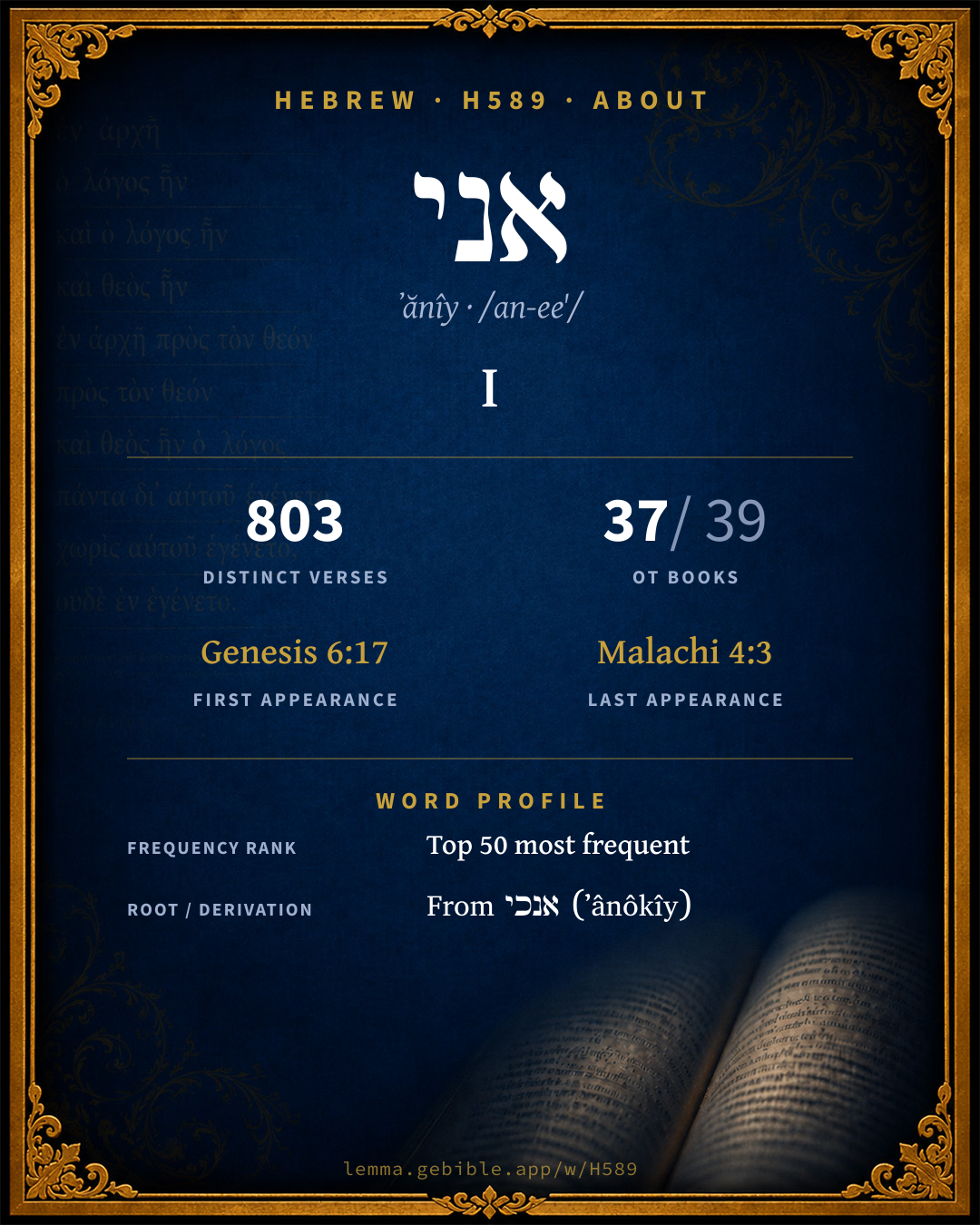
אֲנִי
I
Full lexicon entry — Brown-Driver-Briggs (BDB)
From Brown-Driver-Briggs (BDB)
Where this word appears
Grammar key — what these labels mean
Part of speech
- Pronoun
- A word standing in for a noun (“he,” “this,” “who”).
Person
- 1st Person
- The speaker (“I / we”).
Gender
- Common
- Either gender — not distinguished for this form.
Number
- Singular
- One.
Every verse where H589 appears in the Book of 2 Samuel — 26 distinct verses. Click any verse to open its interlinear word-by-word view. Verse text shown in the World English Bible for context — . Each verse’s Hebrew form is shown with its reference; the English is not keyword-highlighted, since the data carries no word-level English alignment. Use “Compare translations” on any verse to read it across multiple English versions. This concordance covers the Hebrew Bible; Septuagint (Greek Old Testament) occurrences are not indexed here.
2 Samuel
- 2 Samuel 3:13 אֲנִ֕י pron pers 1cs He said, Well; I will make a league with you; but one thing I require of you: that is, you shall not see my face, except you first bring Michal, Saul's daughter, when you come to see my face.
- 2 Samuel 7:8 אֲנִ֤י pron pers 1cs Now therefore thus shall you tell my servant David, Thus says Yahweh of Hosts, I took you from the sheep pen, from following the sheep, that you should be prince over my people, over Israel;
- 2 Samuel 7:14 אֲנִי֙ pron pers 1cs I will be his father, and he shall be my son: if he commit iniquity, I will chasten him with the rod of men, and with the stripes of the children of men;
- 2 Samuel 11:11 וַ/אֲנִ֞י conj + pron pers 1cs Uriah said to David, The ark, and Israel, and Judah, abide in booths; and my lord Joab, and the servants of my lord, are encamped in the open field; shall I then go into my house, to eat and to drink, and to lie with my wife? as you live, and as your soul lives, I will not do this thing.
- 2 Samuel 12:12 וַ/אֲנִ֗י conj + pron pers 1cs For you did it secretly, but I will do this thing before all Israel, and before the sun.'"
- 2 Samuel 12:23 אֲנִ֣י אֲנִי֙ pron pers 1cs pron pers 1cs But now he is dead, why should I fast? can I bring him back again? I shall go to him, but he will not return to me.
- 2 Samuel 12:28 אֲנִי֙ pron pers 1cs Now therefore gather the rest of the people together, and encamp against the city, and take it; lest I take the city, and it be called after my name.
- 2 Samuel 13:4 אֲנִ֥י pron pers 1cs He said to him, Why, son of the king, are you thus lean from day to day? Won't you tell me? Amnon said to him, I love Tamar, my brother Absalom's sister.
- 2 Samuel 13:13 וַ/אֲנִ֗י conj + pron pers 1cs I, where shall I carry my shame? and as for you, you will be as one of the fools in Israel. Now therefore, please speak to the king; for he will not withhold me from you.
- 2 Samuel 14:5 אָ֖נִי pron pers 1cs The king said to her, What ails you? She answered, Of a truth I am a widow, and my husband is dead.
- 2 Samuel 14:8 וַ/אֲנִ֖י conj + pron pers 1cs The king said to the woman, Go to your house, and I will give charge concerning you.
- 2 Samuel 14:32 אֲנִי pron pers 1cs Absalom answered Joab, Behold, I sent to you, saying, Come here, that I may send you to the king, to say, Why am I come from Geshur? it were better for me to be there still. Now therefore let me see the king's face; and if there be iniquity in me, let him kill me.
- 2 Samuel 15:20 וַ/אֲנִ֣י אֲנִ֖י conj + pron pers 1cs pron pers 1cs Whereas you came but yesterday, should I this day make you go up and down with us, seeing I go where I may? return you, and take back your brothers; mercy and truth be with you.
- 2 Samuel 15:34 אֲנִ֤י וַֽ/אֲנִי֙ וַ/אֲנִ֣י pron pers 1cs conj + pron pers 1cs conj + pron pers 1cs but if you return to the city, and tell Absalom, I will be your servant, O king; as I have been your father's servant in time past, so will I now be your servant; then will you defeat for me the counsel of Ahithophel.
- 2 Samuel 16:19 אֲנִ֣י pron pers 1cs Again, whom should I serve? Shouldn't I serve in the presence of his son? as I have served in your father's presence, so will I be in your presence.
- 2 Samuel 17:15 אָֽנִי pron pers 1cs Then said Hushai to Zadok and to Abiathar the priests, Thus and thus did Ahithophel counsel Absalom and the elders of Israel; and thus and thus have I counseled.
- 2 Samuel 18:2 אֲנִ֖י pron pers 1cs David sent forth the people, a third part under the hand of Joab, and a third part under the hand of Abishai the son of Zeruiah, Joab's brother, and a third part under the hand of Ittai the Gittite. The king said to the people, I will surely go forth with you myself also.
- 2 Samuel 18:22 אָ֖נִי pron pers 1cs Then said Ahimaaz the son of Zadok yet again to Joab, But come what may, Please let me also run after the Cushite. Joab said, Why will you run, my son, seeing that you will have no reward for the news?
- 2 Samuel 18:27 אֲנִ֤י pron pers 1cs The watchman said, I think the running of the foremost is like the running of Ahimaaz the son of Zadok. The king said, He is a good man, and comes with good news.
- 2 Samuel 18:33 אֲנִ֣י pron pers 1cs The king was much moved, and went up to the chamber over the gate, and wept: and as he went, thus he said, my son Absalom, my son, my son Absalom! would I had died for you, Absalom, my son, my son!
- 2 Samuel 19:20 אֲנִ֣י pron pers 1cs For your servant does know that I have sinned: therefore, behold, I am come this day the first of all the house of Joseph to go down to meet my lord the king.
- 2 Samuel 19:22 אֲנִי pron pers 1cs David said, What have I to do with you, you sons of Zeruiah, that you should this day be adversaries to me? shall there any man be put to death this day in Israel? for don't I know that I am this day king over Israel?
- 2 Samuel 19:38 וַ/אֲנִי֙ conj + pron pers 1cs The king answered, Chimham shall go over with me, and I will do to him that which shall seem good to you: and whatever you shall require of me, that will I do for you.
- 2 Samuel 19:43 אֲנִ֣י pron pers 1cs The men of Israel answered the men of Judah, and said, We have ten parts in the king, and we have also more [right] in David than you: why then did you despise us, that our advice should not be first had in bringing back our king? The words of the men of Judah were fiercer than the words of the men of Israel.
- 2 Samuel 20:17 אָ֑נִי pron pers 1cs He came near to her; and the woman said, Are you Joab? He answered, I am. Then she said to him, Hear the words of your handmaid. He answered, I do hear.
- 2 Samuel 21:6 אֲנִ֥י pron pers 1cs let seven men of his sons be delivered to us, and we will hang them up to Yahweh in Gibeah of Saul, the chosen of Yahweh. The king said, I will give them.
About this entry
At a glance — auto-summarized from this page’s data, not written by a person. Every figure links to its source below. This summary describes the numbers; it doesn’t interpret them.
אני (ʼănîy) is a Hebrew name most often rendered “I.” It first appears in Genesis 6:17. The Hebrew Bible uses it across 803 verses — among the most common. For the data behind this summary, explore 803-verse concordance and the renderings breakdown below.
Gloss history
Strong's 1890 vs modern scholarship
About this word
Strong's H589 catalogs a Hebrew word from the Hebrew Old Testament.
These counts are not copied from any lexicon or concordance. They are computed here, from the morphology-tagged Hebrew Old Testament. What Lemma adds →
- 803
- distinct verses
- The word appears in 803 distinct verses.
- 37 / 39
- OT books
- The word appears in 37 of 39 Old Testament books.
- #50
- by frequency
- Top 50 most frequent Hebrew words (rank 50 of 8,640 Hebrew words by occurrence).
View all 803 occurrences in the concordance →
By section of the Old Testament
By traditional corpus
Conventional, traditional groupings — biblical authorship is debated, so this is a traditional corpus grouping, not an authorship claim. Each share is this word’s portion of its verses in that division of the Hebrew canon. Each figure is a share of the word’s 803 distinct verses.
- Prophets (Nevi'im) 420 verses · 52%
- Writings (Ketuvim) 217 verses · 27%
- Torah (Pentateuch) 166 verses · 21%
How translations render this word
Counts come from each version’s own published word-to-Strong’s tagging or interlinear alignment — an approximate guide to how each version renders this word, not a word-level alignment the data otherwise carries. Because each total is that version’s own tagged count, the per-version totals vary from one another and need not match the appearance or distinct-verse counts above. These counts may also differ from a printed concordance because Lemma counts each distinctly tagged rendering and does not collapse phrase taggings into a single head-word total. This is a fixed set of word-tagged versions (KJV, ASV, BSB, ULT) and does not change with the reading translation you choose elsewhere. Each version’s license is shown beside its name below (and on Sources).
- King James Version: I 2×, Me 2×, Shall i 2×
- American Standard Version: I 3×, Me 2×, Shall i 2×
- Berean Standard Bible: I 722×, Surely as i 13×, I am 11×
- unfoldingWord Literal Text: I 654×, Am 96×, I am 56×
King James Version Public Domain
Renders H589 across 13 tagged occurrences — most commonly:
Plus 7 renderings that appear only once — usually multi-word phrases or single function words the recovered tagging swept in, not distinct renderings.
American Standard Version Public Domain
Renders H589 across 14 tagged occurrences — most commonly:
Plus 7 renderings that appear only once — usually multi-word phrases or single function words the recovered tagging swept in, not distinct renderings.
Berean Standard Bible Public Domain
Renders H589 across 854 tagged occurrences — most commonly:
Plus other, less common renderings. Plus 34 renderings that appear only once — usually multi-word phrases or single function words the recovered tagging swept in, not distinct renderings. Not rendered by a distinct English word in 16 further occurrences.
unfoldingWord Literal Text CC BY-SA 4.0
Renders H589 across 975 tagged occurrences — most commonly:
Plus other, less common renderings. Plus 23 renderings that appear only once — usually multi-word phrases or single function words the recovered tagging swept in, not distinct renderings.
Senses in BDB
The 1 sense BDB distinguishes for this word, in lexicon order (not ranked by frequency or importance). The full entry — with sub-senses — is in the Lexicon Entry tab.
- I (first person singular - usually used for emphasis)
Word origin
pron. 1 s. comm. I (أَنَا, אֲנָא, ܐܶܢܳܐ:, አነ ) Gn 6:17; 9:9, 12 + oft. Following a ptcp. as its subj. (to express mostly either a true present or the fut. instans) Gn 18:17 הַמְכַסֶּה אֲנִי Am I hiding from Abraham that which, etc., Ju 15:3 1 S 3:13 Je 1:12; 38:14; 44:29 (v. Dr§ 135, 4). Appended to a verb, it expresses, in early Hebrew, a real emphasis, as Ju 8:23 לֹא אֶמְשֹׁל אֲנִי בָּכֶם I will not rule over you, 2 S 12:28 lest I take the city, 2 S 17:15 thus and thus did Ahitophel counsel, and thus and thus יָעַצְתִּי אָ֑נִי did I counsel; but in later Heb. it is sometimes pleonastic, Ec 2:11–15, 18–20 +. In response to a question, אָ֑נִי alone = I am, It is I, Gn 27:24 Ju 13:11 1 K 18:8 +. With הֲ, הַאֲנִי †Is 66:9. (Syn. אָנֹכִי, q.v.)
— Brown-Driver-Briggs (Oxford 1906, public domain), digitized via Sefaria, supplemented by the OpenScriptures HebrewLexicon (CC BY 4.0). See Sources.
Derived from אנכי (ʼânôkîy) (H595) — I.
Jastrow Dictionary
A second Hebrew/Aramaic lexicon for comparison, covering Aramaic and post-biblical (Talmudic, Targumic, Midrashic) usage that the biblical-Hebrew BDB does not. Matched by lemma rather than by Strong’s number, so a lemma may carry more than one Jastrow headword (shown separately below), and the entries cover usage well beyond the Bible.
אני
- (= b. h. ינה, sec. r. of און, cmp. אָנַן a. b. h. ענה); Pi. (אִנָּה) אִינָּה to press, wrong, oppress; to impose, overreach in dealing, v. אוֹנָאָה. B. Mets. 59ᵇ המְאַנֶּה את הגר he who wounds a stranger’s (proselyte’s) feeling. Ib. 49ᵇ תן לי מה שאִינִּיתָנִי return to me the amount with which thou hast overreached me. Ib. 50ᵃ top מה שאניתני (Ms. R. 1 שנִתְאוֹנַנְתִּי, v. infra). Ib. 51ᵃ שאניתני (Ms. M. שאֲנַנְתָּנִי, fr. אָנַן; Mish. ib. IV, 2 שאוֹנִיתָנִי, v. אוֹנָאָה, Ms. R. 1 שהוֹנִיתָנִי, v. הוֹנָאָה, Ms. R. 2 שאונתני, v. Rabb. D. S. a. l. note).
- to be overreached. Ib. 49ᵇ מי נ׳ which of them has been overreached? Ib. 50ᵇ מי שנ׳ (Ms. M. מִתְאוֹנֶה); a. fr. [Nithpol. of אנן, נִתְאוֹנֵן, v. supra.] [In. Y. אוֹנָה, v. אוֹנָאָה.]
אֲנִי
- , v. אָנֹכִי) I. Succ. 53ᵃ; a. v. fr.—[Ib. IV, 5 אני והו (Y. והוא), reverential transcription of אנא יהוה, to avoid the utterance of the Tetragrammaton.]—Pl. אָנוּ. Keth. I, 6; a. fr.
A Dictionary of the Targumim, the Talmud Babli and Yerushalmi, and the Midrashic Literature (Marcus Jastrow; London, Luzac, 1903) — Public Domain. Digitized via Sefaria. Digitized via Sefaria. Full attribution on Sources.
Forms in the corpus
The 60 distinct written forms H589 takes in the Hebrew Bible, most frequent first — each parse links to that state’s occurrences in the concordance. Hebrew forms include their vowel points and cantillation, so a single lemma takes many written forms.
| Form | Parsing | Example | Uses |
|---|---|---|---|
| אֲנִ֥י | Pronoun, Personal, 1st Person, Common, Singular | Daniel 8:15 | 145 |
| אֲנִ֣י | Pronoun, Personal, 1st Person, Common, Singular | Daniel 8:1 | 126 |
| אֲנִ֖י | Pronoun, Personal, 1st Person, Common, Singular | Ecclesiastes 2:15 | 76 |
| אֲנִי֙ | Pronoun, Personal, 1st Person, Common, Singular | Daniel 1:10 | 57 |
| אֲנִ֤י | Pronoun, Personal, 1st Person, Common, Singular | Daniel 9:20 | 45 |
| וַ/אֲנִ֣י | Pronoun, Personal, 1st Person, Common, Singular | Daniel 8:5 | 33 |
| אֲנִ֛י | Pronoun, Personal, 1st Person, Common, Singular | Ecclesiastes 4:2 | 32 |
| אָֽנִי | Pronoun, Personal, 1st Person, Common, Singular | Deuteronomy 12:30 | 24 |
| אָ֔נִי | Pronoun, Personal, 1st Person, Common, Singular | Ecclesiastes 2:13 | 20 |
| וַ/אֲנִ֖י | Pronoun, Personal, 1st Person, Common, Singular | Exodus 2:9 | 20 |
| וַ/אֲנִ֗י | Pronoun, Personal, 1st Person, Common, Singular | Daniel 10:4 | 19 |
| וַ/אֲנִי֙ | Pronoun, Personal, 1st Person, Common, Singular | Daniel 8:2 | 17 |
| אֲנִ֨י | Pronoun, Personal, 1st Person, Common, Singular | Daniel 10:7 | 16 |
| אָ֑נִי | Pronoun, Personal, 1st Person, Common, Singular | Ezekiel 5:8 | 16 |
| וַ/אֲנִ֥י | Pronoun, Personal, 1st Person, Common, Singular | Daniel 8:2 | 16 |
| וַ/אֲנִ֤י | Pronoun, Personal, 1st Person, Common, Singular | Daniel 10:17 | 15 |
| אָ֗נִי | Pronoun, Personal, 1st Person, Common, Singular | Ecclesiastes 5:18 | 14 |
| אֲנִ֗י | Pronoun, Personal, 1st Person, Common, Singular | Ecclesiastes 1:16 | 13 |
| אֲנִ֧י | Pronoun, Personal, 1st Person, Common, Singular | Deuteronomy 32:39 | 12 |
| וַ/אֲנִ֕י | Pronoun, Personal, 1st Person, Common, Singular | Ezekiel 11:20 | 12 |
| וַ/אֲנִ֞י | Pronoun, Personal, 1st Person, Common, Singular | Exodus 31:6 | 11 |
| אֲ֭נִי | Pronoun, Personal, 1st Person, Common, Singular | Job 5:8 | 10 |
| אֲנִ֞י | Pronoun, Personal, 1st Person, Common, Singular | Exodus 10:1 | 10 |
| אֲנִ֜י | Pronoun, Personal, 1st Person, Common, Singular | Ecclesiastes 2:15 | 9 |
| אֲנִי | Pronoun, Personal, 1st Person, Common, Singular | Genesis 17:1 | 8 |
| אֲ֝נִ֗י | Pronoun, Personal, 1st Person, Common, Singular | Psalms 2:7 | 7 |
| וַֽ/אֲנִי֙ | Pronoun, Personal, 1st Person, Common, Singular | Ezekiel 14:11 | 7 |
| אֲֽנִי | Pronoun, Personal, 1st Person, Common, Singular | Job 5:3 | 6 |
| וַ֭/אֲנִי | Pronoun, Personal, 1st Person, Common, Singular | Psalms 2:6 | 6 |
| אָ֖נִי | Pronoun, Personal, 1st Person, Common, Singular | Genesis 27:34 | 5 |
| אָ֭נִי | Pronoun, Personal, 1st Person, Common, Singular | Job 7:12 | 5 |
| וַ/אֲנִי | Pronoun, Personal, 1st Person, Common, Singular | Daniel 10:12 | 5 |
| וַ֝/אֲנִ֗י | Pronoun, Personal, 1st Person, Common, Singular | Psalms 31:6 | 5 |
| אֲנִֽי | Pronoun, Personal, 1st Person, Common, Singular | Ezekiel 36:32 | 4 |
| אָ֕נִי | Pronoun, Personal, 1st Person, Common, Singular | Ezekiel 18:3 | 4 |
| אָ֨נִי֙ | Pronoun, Personal, 1st Person, Common, Singular | Ezekiel 20:3 | 4 |
| וַ/אֲנִ֛י | Pronoun, Personal, 1st Person, Common, Singular | Ezekiel 20:31 | 4 |
| אֲנִ֕י | Pronoun, Personal, 1st Person, Common, Singular | Genesis 17:4 | 3 |
| אֲנִי֩ | Pronoun, Personal, 1st Person, Common, Singular | Amos 4:6 | 3 |
| אָ֣נִי | Pronoun, Personal, 1st Person, Common, Singular | Ezekiel 33:11 | 3 |
| אָ֥נִי | Pronoun, Personal, 1st Person, Common, Singular | Psalms 6:2 | 3 |
| אֲנִ֔י | Pronoun, Personal, 1st Person, Common, Singular | Ezekiel 9:10 | 2 |
| אֲנִי֮ | Pronoun, Personal, 1st Person, Common, Singular | Job 7:11 | 2 |
| אָנִי֒ | Pronoun, Personal, 1st Person, Common, Singular | Ezekiel 17:19 | 2 |
| וַ/אֲנִ֨י | Pronoun, Personal, 1st Person, Common, Singular | 1 Samuel 19:3 | 2 |
| וַֽ/אֲנִי֙ | Pronoun, Personal, 1st Person, Common, Singular | 1 Kings 18:24 | 2 |
| אֲנִ֪י | Pronoun, Personal, 1st Person, Common, Singular | Psalms 116:16 | 1 |
| אָ֜נִי | Pronoun, Personal, 1st Person, Common, Singular | Ezekiel 34:8 | 1 |
| אָ֝֗נִי | Pronoun, Personal, 1st Person, Common, Singular | Job 9:20 | 1 |
| אָ֡נִי | Pronoun, Personal, 1st Person, Common, Singular | Zephaniah 2:9 | 1 |
| אָנִֽי | Pronoun, Personal, 1st Person, Common, Singular | Judges 9:2 | 1 |
| אָנִי֩ | Pronoun, Personal, 1st Person, Common, Singular | Malachi 1:6 | 1 |
| אָנִי֮ | Pronoun, Personal, 1st Person, Common, Singular | Jeremiah 22:24 | 1 |
| הַ/אֲנִ֥י | Pronoun, Personal, 1st Person, Common, Singular | Isaiah 66:9 | 1 |
| וַ֠/אֲנִי | Pronoun, Personal, 1st Person, Common, Singular | 1 Kings 5:9 | 1 |
| וַֽ/אֲנִ֛י | Pronoun, Personal, 1st Person, Common, Singular | 2 Chronicles 6:2 | 1 |
| וַֽ/אֲנִי | Pronoun, Personal, 1st Person, Common, Singular | Isaiah 43:12 | 1 |
| וַֽ/אֲנִ֣י | Pronoun, Personal, 1st Person, Common, Singular | Joshua 17:14 | 1 |
| שֶׁ/אֲנִ֣י | Pronoun, Personal, 1st Person, Common, Singular | Song of Solomon 1:6 | 1 |
| שֶׁ/אֲנִ֥י | Pronoun, Personal, 1st Person, Common, Singular | Ecclesiastes 2:18 | 1 |
Same root — word family
Other BDB entries built from the same root as H589, grouped by Strong’s listed origin. These share a root / origin per the lexicon — not necessarily a shared meaning. Each links to that word’s own entry.
Derives from
Shares the same root
Proper names from this root
People and places named from this root — a name, not an additional meaning of the word.
Compare all same-root words → 2 of the same-root words are proper names (people or places). They share a root, not necessarily a meaning.
Septuagint verse parallels
This word appears in 744 verses that also exist in the Greek Old Testament (Septuagint), out of the 803 Hebrew verses it occurs in. You can read those verses in Greek by switching the Old Testament edition to the Septuagint.
Read these verses in the Septuagint
- Genesis 6:17
- Exodus 2:9
- Leviticus 11:44
- Numbers 3:12
- Deuteronomy 12:30
- Joshua 5:14
- Judges 1:3
- Ruth 1:21
- 1 Samuel 1:26
- 2 Samuel 3:13
- 1 Kings 1:5
- 2 Kings 1:10
This is a verse-level parallel only — the same verses exist in both the Hebrew and Greek Old Testaments. No word-level Hebrew↔Greek correspondence is claimed: the data carries no such alignment, so no Greek word is shown as this Hebrew word’s translation. Coverage is not total — the Septuagint omits the deuterocanon and renumbers the Psalms, so some Hebrew verses have no direct Greek parallel.