
Ecclesiastes 2:15

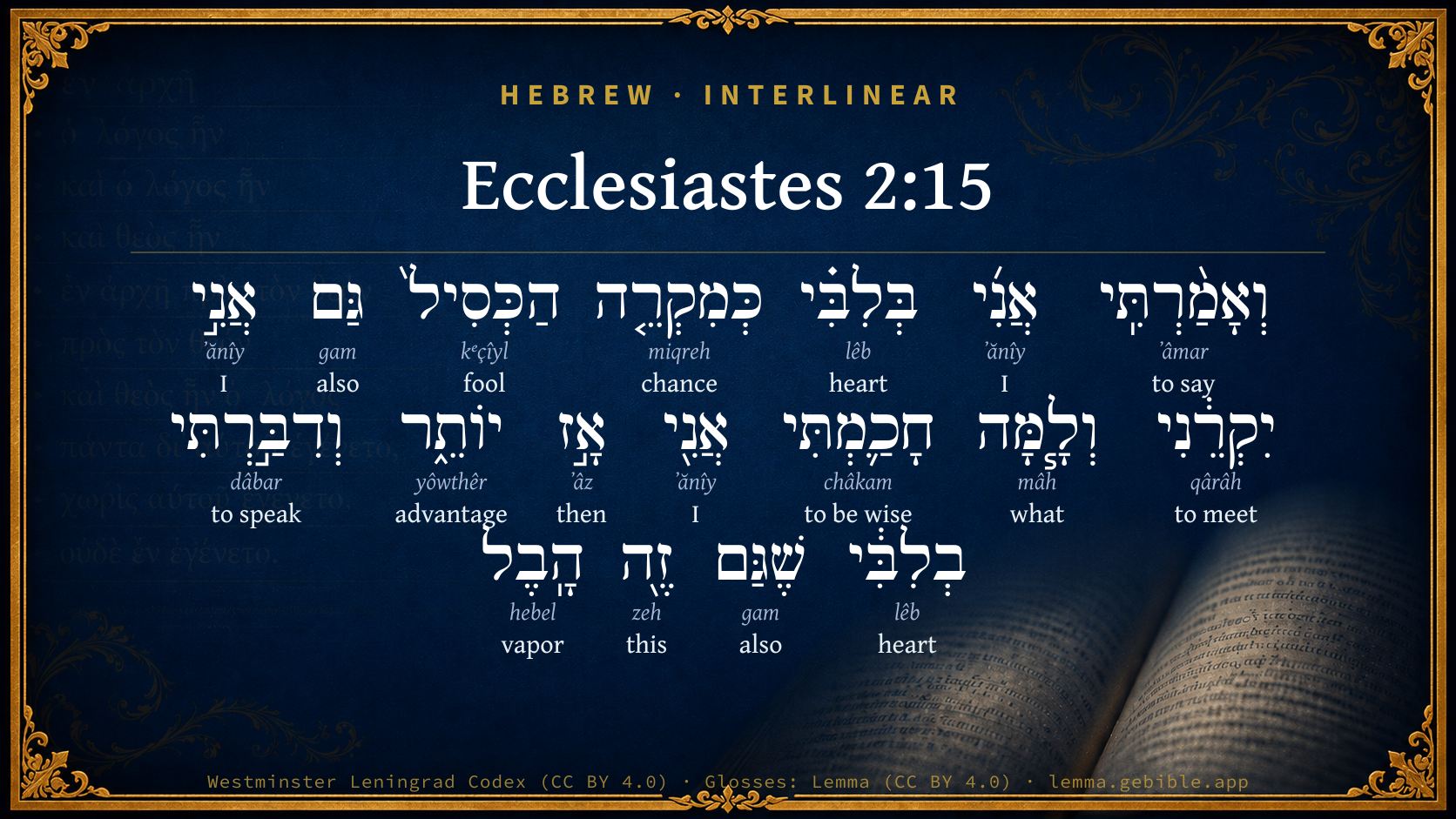
Hebrew (Westminster Leningrad Codex) Ecclesiastes 2:15 appears in the Hebrew Old Testament. The text above is from the Westminster Leningrad Codex. Each word links to its Strong’s number, a concise gloss, and parsing drawn from the Open Scriptures Hebrew Bible morphology. Click any word for its full Brown-Driver-Briggs (BDB) entry.
Download image
Cite this verse

Ecclesiastes 2:15 (World English Bible). Public Domain. Lemma interlinear Bible study tool, https://lemma.gebible.app/v/ecclesiastes/2/15.

Show BibTeX & RIS
BibTeX
RIS
English Translation
Then said I in my heart, "As it happens to the fool, so will it happen even to me; and why was I then more wise?" Then said I in my heart that this also is vanity.
World English Bible · Public Domain
Download a study sheet

One document with this verse’s original text, its word-by-word gloss line, the meaning frame, cross-references with their text, attributed commentary, and full source and license credits — printable, and it pastes into notes with its structure intact.

This verse Autodidact and up

Study sheet (.html) Plain text (.txt)

A passage Seminary Student

Up to 50 verses in one chapter. A passage sheet keeps up to 6 commentary sources and 12 cross-references per verse, in the order this page ranks them, and says so on the sheet whenever that leaves anything out. Ask for a single verse and you get the Autodidact verse sheet above.

Everything on this page stays free to read, with no account — the sheet is a download of what is already on screen, not access to it.

Want to remove ads? Support Godless Engineer
Compare translations 3

The same verse in 3 English versions, stacked beneath the original-language interlinear above. Click any original word for its lexicon entry.

Each is an independent rendering of the whole verse — the interlinear is not word-aligned to these translations.

Highlighted words mark where these versions differ — a whole-verse word diff, not a word-by-word alignment.

  • World English Bible Public Domain
    Then said I in my heart, "As it happens to the fool, so will it happen even to me; and why was I then more wise?" Then said I in my heart that this also is vanity.
  • King James Version Public Domain
    Then said I in my heart, As it happeneth to the fool, so it happeneth even to me; and why was I then more wise? Then I said in my heart, that this also is vanity.
  • unfoldingWord Literal Text CC BY-SA 4.0
    And I spoke, I with my heart, “As happening of the fool, even me—it will happen me! And why was I, I, wise then, abundantly?” And I said to my heart that also this vapor.

unfoldingWord Literal Text — © unfoldingWord, licensed CC BY-SA 4.0. Word-aligned USFM3 via Door43 (git.door43.org/unfoldingWord/en_ult).

Versions to compare (up to 4)

3 of 4 selected

Show all 18 translations

Every available English version of this verse, each an independent rendering of the whole verse.

  • World English Bible Public Domain
    Then said I in my heart, "As it happens to the fool, so will it happen even to me; and why was I then more wise?" Then said I in my heart that this also is vanity.
  • Berean Standard Bible Public Domain
    So I said to myself, “The fate of the fool will also befall me. What then have I gained by being wise?” And I said to myself that this too is futile.
  • Majority Standard Bible Public Domain
    So I said to myself, “The fate of the fool will also befall me. What then have I gained by being wise?” And I said to myself that this too is futile.
  • King James Version Public Domain
    Then said I in my heart, As it happeneth to the fool, so it happeneth even to me; and why was I then more wise? Then I said in my heart, that this also is vanity.
  • American Standard Version (1901) Public Domain
    Then said I in my heart, As it happeneth to the fool, so will it happen even to me; and why was I then more wise? Then said I in my heart, that this also is vanity.
  • Revised Version (1885) Public Domain
    Then said I in my heart, As it happeneth to the fool, so will it happen even to me; and why was I then more wise? Then I said in my heart, that this also was vanity.
  • Geneva Bible (1599) Public Domain
    Then I thought in mine heart, It befalleth vnto me, as it befalleth to ye foole. Why therefore doe I then labour to be more wise? And I sayd in mine heart, that this also is vanitie.
  • Douay-Rheims (1899) Public Domain
    And I said in my heart: If the death of the fool and mine shall be one, what doth it avail me, that I have applied myself more to the study of wisdom? And speaking with my own mind, I perceived that this also was vanity.
  • Young's Literal Translation Public Domain
    and I said in my heart, `As it happeneth with the fool, it happeneth also with me, and why am I then more wise?' And I spake in my heart, that also this `is' vanity:
  • Literal Standard Version CC BY-SA 4.0
    and I said in my heart, “As it happens with the fool, it happens also with me, and why am I then more wise?” And I spoke in my heart, that also this [is] vanity:
  • Unlocked Literal Bible CC BY-SA 4.0
    Then I said in my heart, “What happens to the fool, will also happen to me. So what difference does it make if I am very wise?” I concluded in my heart, “This too is only vapor.”
  • unfoldingWord Literal Text CC BY-SA 4.0
    And I spoke, I with my heart, “As happening of the fool, even me—it will happen me! And why was I, I, wise then, abundantly?” And I said to my heart that also this vapor.
  • Darby Bible Public Domain
    And I said in my heart, As it happeneth to the fool so will it happen even to me; and why was I then so wise? Then I said in my heart that this also is vanity.
  • World Messianic Bible Public Domain
    Then I said in my heart, “As it happens to the fool, so will it happen even to me; and why was I then more wise?” Then I said in my heart that this also is vanity.
  • Webster's Bible Public Domain
    Then said I in my heart, As it happeneth to the fool, so it happeneth even to me; and why was I then more wise? Then I said in my heart, that this also is vanity.
  • Free Bible Version CC BY-SA 4.0
    Then I thought to myself, “If I'm going to end up the same as a fool, what's the point of being so wise?” So I thought to myself, “This is also hard to understand!”
  • Bible in Basic English Public Domain
    Then said I in my heart: As it comes to the foolish man, so will it come to me; so why have I been wise overmuch? Then I said in my heart: This again is to no purpose.
  • JPS Tanakh (1917) Public Domain
    Then said I in my heart: 'As it happeneth to the fool, so will it happen even to me; and why was I then more wise?' Then I said in my heart, that this also is vanity.

Literal Standard Version (2020), Covenant Press — licensed CC BY-SA 4.0. Text via the HelloAO Bible API (eBible.org). Unlocked Literal Bible (unfoldingWord) — licensed CC BY-SA 4.0. Text via the HelloAO Bible API (eBible.org). unfoldingWord Literal Text — © unfoldingWord, licensed CC BY-SA 4.0. Word-aligned USFM3 via Door43 (git.door43.org/unfoldingWord/en_ult). Free Bible Version, Dr. Jonathan Gallagher — licensed CC BY-SA 4.0. Text via the HelloAO Bible API (eBible.org).

Word by word

More ways to search: Search by grammar → Find every occurrence → Compare this word →

Practice this passage: Drill this verse → Learn its vocabulary →

יוֹתֵ֑ר
yôwthêr
H3148
“advantage”
Noun, Common, Masculine, Singular, Absolute
Part of Speech
Noun
Type
Common
Gender
Masculine
Number
Singular
State
Absolute
Full BDB Definition

Origin: active participle of H3498

TWOT: 936d

superiority, advantage, excess (noun masculine) - excess, better (adverb) - besides, moreover, more (conjuntion)
  1. וְאָמַ֨רְתִּֽי ʼâmar H559 “and · to say” Conjunction + Verb, Qal, Perfect, 1st Person, Common, Singular
  2. אֲנִ֜י ʼănîy H589 “I” Pronoun, Personal, 1st Person, Common, Singular
  3. בְּלִבִּ֗י lêb H3820 “in/at · heart · my” Preposition + Noun, Common, Masculine, Singular, Construct + Suffix, Personal, 1st Person, Common, Singular
  4. כְּמִקְרֵ֤ה miqreh H4745 “like/as · chance of” Preposition + Noun, Common, Masculine, Singular, Construct
  5. הַכְּסִיל֙ kᵉçîyl H3684 “the · fool” Particle, Definite Article + Adjective, Adjective, Masculine, Singular, Absolute
  6. גַּם gam H1571 “also” Particle, Accusative
  7. אֲנִ֣י ʼănîy H589 “I” Pronoun, Personal, 1st Person, Common, Singular
  8. יִקְרֵ֔נִי qârâh H7136 “to meet · me” Verb, Qal, Imperfect, 3rd Person, Masculine, Singular + Suffix, Personal, 1st Person, Common, Singular
  9. וְלָ֧מָּה mâh H4100 “and · to/for · what” Conjunction + Preposition + Particle, Interrogative
  10. חָכַ֛מְתִּי châkam H2449 “to be wise” Verb, Qal, Perfect, 1st Person, Common, Singular
  11. אֲנִ֖י ʼănîy H589 “I” Pronoun, Personal, 1st Person, Common, Singular
  12. אָ֣ז ʼâz H227 “then” Adverb
  13. וְדִבַּ֣רְתִּי dâbar H1696 “and · to speak” Conjunction + Verb, Piel, Perfect, 1st Person, Common, Singular
  14. בְלִבִּ֔י lêb H3820 “in/at · heart · my” Preposition + Noun, Common, Masculine, Singular, Construct + Suffix, Personal, 1st Person, Common, Singular
  15. שֶׁגַּם gam H1571 “who/which · also” Particle, Relative + Adverb
  16. זֶ֖ה zeh H2088 “this” Pronoun, Demonstrative, Masculine, Singular
  17. הָֽבֶל hebel H1892 “vapor” Noun, Common, Masculine, Singular, Absolute

About this verse

These counts appear in no published source. They are computed here, from the morphology-tagged text and Lemma’s own curated glosses. What Lemma adds →

18
words
14
distinct lemmas
Wisdom
section

Notable vocabulary

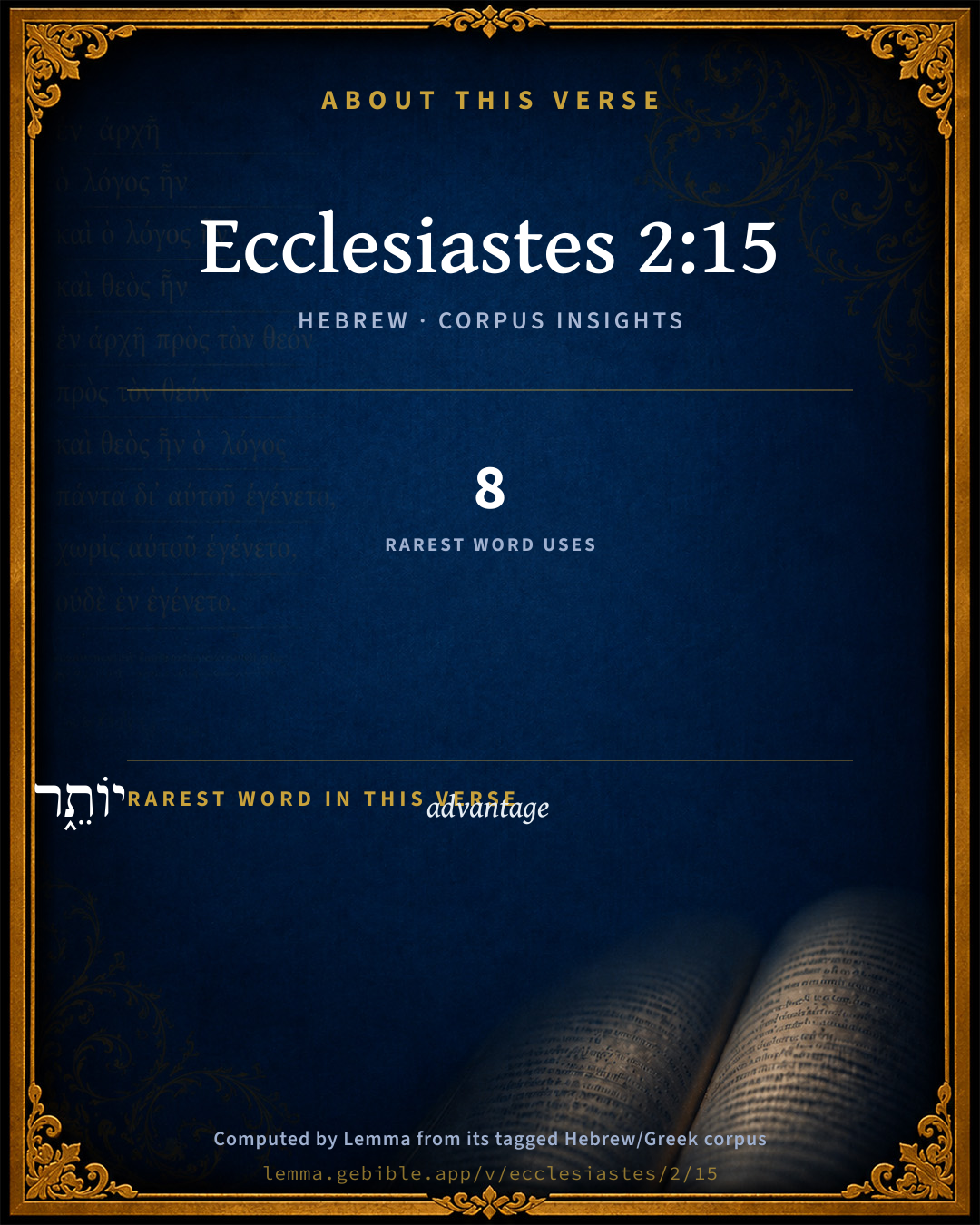
The rarest word here is יוֹתֵ֑ר advantage H3148 — appearing just 8 times in the whole Hebrew Bible.

Shared distinctive vocabulary

יוֹתֵ֑ר advantage H3148 occurs in 8 verses of the Hebrew Bible. Also found in:

Grammatical profile

  • 4 verbs
  • 5 nouns
  • 1 adjective
  • 4 pronouns
  • 2 adverbs
  • 2 particles

Verb forms

  • וְאָמַ֨רְתִּֽי Qal · Perfect
  • יִקְרֵ֔נִי Qal · Imperfect
  • חָכַ֛מְתִּי Qal · Perfect
  • וְדִבַּ֣רְתִּי Piel · Perfect

Repetition

Words recur within this verse — often emphatic in Hebrew:

  • בְּלִבִּ֗י heart H3820 ×2
  • גַּם also H1571 ×2
  • אֲנִ֜י I H589 ×3

Hebrew & Septuagint length

In English translation the verse runs 37 words from the Hebrew and 47 from the Septuagint (LXX English) — closely comparable.

A rough comparison of the two English renderings, which tokenize alike — not a word-level alignment.

Word counts can differ between the Hebrew and the Greek without any difference in meaning — e.g. the Hebrew direct-object marker אֵת has no separate Greek word, and Greek often adds the article ὁ.

Cross-references

7

Topical passages linked to Ecclesiastes 2:15 in the Treasury of Scripture Knowledge — connected by theme and wording, ordered by reader-vote popularity; previews shown in the World English Bible.

  • Ecclesiastes 6:8 For what advantage has the wise more than the fool? What has the poor man, that knows how to walk before the living?
  • Ecclesiastes 1:14 I have seen all the works that are done under the sun; and, behold, all is vanity and a chasing after wind.
  • 1 Kings 3:12 behold, I have done according to your word: behold, I have given you a wise and an understanding heart; so that there has been none like you before you, neither after you shall any arise like you.
  • Ecclesiastes 1:2 "Vanity of vanities," says the Preacher; "Vanity of vanities, all is vanity."
  • Ecclesiastes 1:16 I said to myself, "Behold, I have obtained for myself great wisdom above all who were before me in Jerusalem. Yes, my heart has had great experience of wisdom and knowledge."
  • Ecclesiastes 1:18–2:1 For in much wisdom is much grief; and he who increases knowledge increases sorrow.
  • Ecclesiastes 2:16 For of the wise man, even as of the fool, there is no memory for ever, seeing that in the days to come all will have been long forgotten. Indeed, the wise man must die just like the fool!

Cross-references courtesy of OpenBible.info (CC BY 4.0).

Hebrew and Greek witnesses Masoretic Hebrew ↔ Greek Septuagint

The same verse in the two great witnesses to the Old Testament, shown verse-for-verse.

These are two independent witnesses, not word-aligned to each other, and the Septuagint is shown in lemma (dictionary) form.

Hebrew Ecclesiastes 2:15 Masoretic · Westminster Leningrad Codex

וְאָמַ֨רְתִּֽי אֲנִ֜י בְּלִבִּ֗י כְּמִקְרֵ֤ה הַכְּסִיל֙ גַּם אֲנִ֣י יִקְרֵ֔נִי וְלָ֧מָּה חָכַ֛מְתִּי אֲנִ֖י אָ֣ז יוֹתֵ֑ר וְדִבַּ֣רְתִּי בְלִבִּ֔י שֶׁגַּם זֶ֖ה הָֽבֶל

Then said I in my heart, "As it happens to the fool, so will it happen even to me; and why was I then more wise?" Then said I in my heart that this also is vanity.

World English Bible · Public Domain

Greek LXX Ecclesiastes 2:15 Septuagint · lemma form

καί εἶπον ἐγώ ἐν καρδία ἐγώ ὡς συνάντημα ὁ ἄφρων καί γέ ἐγώ συνἀντάω ἐγώ καί ἵνα τίς σοφίζω ἐγώ τότε περισσός λαλέω ἐν καρδία ἐγώ διότι ἄφρων ἐκ περίσσευμα λαλέω ὅτι καί γέ οὗτος ματαιότης

And I said in my heart, As the event of the fool is, so shall it be to me, even to me: and to what purpose have I gained wisdom? I said moreover in my heart, This is also vanity, because the fool speaks of his abundance.

LXX2012 (modern English Septuagint) · Public Domain

On this verse, Haydock's Catholic Bible Commentary discusses the Septuagint’s reading. Read the note in Commentary ↓

Hebrew: Westminster Leningrad Codex (CC BY 4.0). Greek: Septuagint (public domain); English from LXX2012 (modern English Septuagint) (Public Domain). How the Septuagint differs from the Hebrew →

Commentary

Notes on Ecclesiastes 2:15 from classic Christian and Jewish commentators (each source and its license shown beneath its notes). The classic Christian expositions comment on the surrounding passage and are grouped to its opening verse, so a note may address several verses; the Jewish commentaries on the Tanakh (Rashi and others) are per-verse, so they appear only where the commentator wrote on this verse.

Lemma curates 59 commentaries, every one of them public domain or Creative Commons licensed, each selected and text-cleaned for this edition rather than reprinted as found. About our sources →

Trapp's Complete Commentary

John Trapp

Ecc 2:15 Then said I in my heart, As it happeneth to the fool, so it happeneth even to me; and why was I then more wise? Then I said in my heart, that this also [is] vanity.

Ver 15. As it happeneth to the fool, so it happeneth.] It is with men as with counters, though in the account one stand for a penny, another for a pound, yet in the bag there is no difference; so here in the event all our wisdom is soon refuted with one black Theta, which understanding us not, snappeth us unrespectively without distinction, and putteth at once a period to our reading and to our being.

And why was I then more wise?] This is a piece of peevishness, a childish folly we are all prone to - viz., to repent us of our best pains if not presently paid for it; so short spirited are we, that unless we may sow and reap all in a day, unless all things may go with us as well as we could wish, we repent us of our repentance with David, {Psa 73:13} hit God in the teeth with our obedience, as those hypocrites in Isa 58:2-3, and as that elder brother in the parable, that told his father he had never been worth a kid to him for all his good service. But, what! is God like to break or to die in our debts that we are so hasty with him? This was good Baruch’s fault, and he is soundly chidden for it. {Jer 45:1-5; Jer 36:32} Good men oft find it more easy to bear evil than to wait till the promised good be enjoyed. It was so with those Christian Hebrews, {Heb 10:34; Heb 10:36} whom therefore the apostle there tells they had need of patience, υπομονη, or tarriance, to tarry God’s time. It needs not repent the wise of this world, much less the children of light, of any good they have done or gotten, however it prove with them, since some degree of comfort follows every good action, as heat accompanies fire, as beams and influences issue from the sun. And this is so true, that very heathens, upon the discharge of a good conscience, have found comfort and peace answerable.

John Trapp, A Commentary or Exposition upon All the Books of the Old and New Testament (1647–1656) — public domain. Text from a community e-Sword module.

Joseph Benson's Commentary

Ecc 2:15-16. Then I said — why was I more wise — What benefit have I by my wisdom? or, to what purpose did I take so much pains to get wisdom. For there is no remembrance of the wise — Their memory, though it may flourish for a season, yet will, in a little time, be worn out; as we see in most of the wise men of former ages, whose very names, together with all their monuments, are utterly lost. As the fool — He must die as certainly as the fool.

Joseph Benson's Commentary on the Old and New Testaments (1811–1818) — public domain. Text from a community e-Sword module.

Tyndale Open Study Notes

Tyndale Open Resources

2:15-16 If both the wise and the foolish will die, what advantage is there in being wise? Since the lives of both wise and foolish people are fleeting, the conclusion is that all is meaningless. • both will be forgotten: Those who follow us will not remember us or our accomplishments, so our efforts will come to nothing (cp. 1:11; 9:13-16).

Tyndale Open Study Notes — © Tyndale Open Resources, licensed CC BY-SA 4.0. Text via the HelloAO Bible API.

Jamieson, Fausset & Brown

Robert Jamieson, A. R. Fausset & David Brown

why was I--so anxious to become, &c. (Ch2 1:10).

Then--Since such is the case.

this--namely, pursuit of (worldly) wisdom; it can never fill the place of the true wisdom (Job 28:28; Jer 8:9).

Jamieson, Fausset & Brown — Commentary Critical and Explanatory on the Whole Bible (1871) — public domain (CC PDM 1.0). Text via the HelloAO Bible API.

Adam Clarke's Commentary

Verse 15. As it happeneth to the fool] Literally, "According as the event is to the fool, it happens to me, even me." There is a peculiar beauty and emphasis in the repetition of me. Having pointed out the advantages that wisdom has over folly, he takes this opportunity of reminding us of the danger of trusting too much to it, by showing that it is equally subject to the common accidents of life; and, therefore, incapable of making us completely happy. Having given his sentiments on this point in general terms, he proceeds to those particular instances wherein human prudence chiefly exerts itself; and shows how egregiously it is mistaken in every one of them.-C.

Adam Clarke's Commentary on the Bible (1810–1826) — public domain. Text from a community e-Sword/MySword module.

The Cambridge Bible for Schools and Colleges

gen. ed. J. J. S. Perowne

15. why was I then more wise?] Better, Why have I been wise now overmuch? The very wisdom of the seeker might lead him to see that he has not only been wiser than others, but wiser than it was wise to be. The last word is almost identical with the “profit” which occurs so frequently. He found that he had a surplus of wisdom, and that it was but surplusage. We seem to hear an echo of the Μηδὲ νἀγὰν, the Ne quid nimis (“Nothing in excess”) of Greek and Roman sages. So, with the same Hebrew word, we have in chap. Ecc_7:16, “Be not righteous over much.” So it was that the sentence of ‘Vanity’ was once more written on wisdom as well as folly. It is not without significance that the man feels the bitterness of the sentence, because, even in his wisdom, he, like the Stoics, had been egoistic. That he and the fool, the man of large discourse, and the man to whom culture was an unknown word, should die the same death, this made him curse his destiny.

The Cambridge Bible for Schools and Colleges (gen. ed. J. J. S. Perowne; Cambridge University Press, 1878–1918) — public domain. Text from a community e-Sword module.

John Gill's Exposition

Then said I in my heart, as it happeneth to the fool, so it happeneth even to me,.... The wisest of kings, and the wisest of men; that is, he looked over things in his mind, and considered what had befallen him, or what were his present circumstances, or what would be his case, especially at death; and said within himself, the same things happen to me, who have attained to the highest pitch of wisdom, as to the most errant fool; and therefore no true happiness can be in this sort of wisdom. The Targum paraphrases it thus,

"as it happened to Saul the son of Kish, the king who turned aside perversely, and kept not the commandment he received concerning Amalek, and his kingdom was taken from him; so shall it happen to me;''

and why was I then more wise? the Targum adds, than he, or than any other man, or even than a fool; why have I took so much pains to get wisdom? what am I the better for it? what happiness is there in it, seeing it gives me no advantage, preference, and excellency to a fool; or secures me from the events that befall me?

Then I said in my heart, that this also is vanity; this worldly wisdom has nothing solid and substantial in it, as well as pleasure; and it is a vain thing to seek happiness in it, since this is the case, that the events are the same to men that have it, as to one that has it not.

John Gill's Exposition of the Whole Bible (1746–1763) — public domain (CC PDM 1.0). Text via the HelloAO Bible API.

Haydock's Catholic Bible Commentary

Vanity. This inference was false, (ver. 16.) or my labouring for wisdom was to no purpose. (Calmet) --- Septuagint, "I then spoke more in my heart, (for the fool speaks out of his abundance) since this also is vanity." (Haydock)

George Leo Haydock (1774–1849), Haydock's Catholic Family Bible and Commentary, 1859 edition — public domain. Excludes Psalms (Douay-Rheims chapter numbering differs from Protestant) and Deuterocanonical books (Catholic canon only).

Matthew Poole's English Annotations

Why was I then more wise? what benefit have I by my wisdom? or, to what purpose did I desire and take so much pains for wisdom?

Matthew Poole's English Annotations on the Holy Bible (1683–1685) — public domain. Text from a community e-Sword/MySword module.

Whedon's Commentary on the Bible

Daniel D. Whedon

15. As it happeneth — The “it” before the “happeneth” refers to fate.

To me — The Hebrew is very emphatic.

Why was I… more wise — Better, Why am I then wise in any profit? The wise man feels more keenly than the fool, the griefs and disappointments of life.

Daniel D. Whedon (gen. ed.), Commentary on the Old and New Testaments (1874–1909) — public domain. Text from a community e-Sword module.

The Pulpit Commentary

Then (and) said I in my heart, (Ecc_1:16) As it happeneth to the fool, so it happeneth even to me. He applies the general statement of ver. 14 to his own case. The end that overtakes the fool will ere long overtake him; and he proceeds, Why was I then more wise? "Then" (za), may be understood either logically, i.e. in this ease, since such is the fate of wise and foolish; or temporally, at the hour of death regarded as past. He puts the question To what end, with what design, has he been so excessively wise, or, as it may be, wise overmuch? (Ecc_7:16) His wisdom has, as it were, recoiled upon himself it taught him much, but not content; it made him keen-sighted in seeingthe emptiness of human things, but it satisfied not his cravings. Then I said in my heart, that this also is vanity. This similarity of fate for philosopher and fool makes life vain and worthless; or rather, the meaning may be, if the superiority of wisdom over folly conduces to no other end than this, that superiority is a vanity. The LXX has glossed the passage, followed herein by the Syriac, "Moreover, I spake in my heart that indeed this is also vanity, because the fool speaks out of his abundance ver. 16 giving the substance of the fool"s thoughts. Vulgate, Locutusque cum mente mea, animadverti quod hoc quoque esset vanitas. Our Hebrew text does not confirm this interpretation or addition.

The Pulpit Commentary (1880–1919), ed. H.D.M. Spence-Jones & Joseph S. Exell — public domain. Text from a community e-Sword module.

John Wesley's Explanatory Notes

Why - What benefit have I by my wisdom?

John Wesley, Explanatory Notes Upon the Whole Bible (1754–1765) — public domain. Text via the GEBible commentary corpus.

unfoldingWord translationNotes

Door43 World Missions Community

I said in my heart

Here the author refers to himself by his "heart" to emphasize his feelings. AT: "I said to myself" (See: Synecdoche)

So what difference does it make if I am very wise?

The author uses this rhetorical question to emphasize that there is no benefit to being wise. This question can be written as a statement. AT: "So it makes no difference if I am very wise." (See: Rhetorical Question)

I concluded in my heart

Here the author refers to himself by his "heart" to emphasize his feelings. AT: "I concluded" (See: Synecdoche)

is only vapor

"is only mist." The author speaks of useless and meaningless things as if they were "vapor." See how you translated this in Ecclesiastes 1:14. AT: "is as useless as vapor" or "is meaningless" (See: Metaphor)

For the wise man, like the fool, is not remembered for very long

This can be stated in active form. AT: "People do not remember the wise man for very long, just as they do not remember the fool for very long" (See: Active or Passive)

everything will have been long forgotten

This can be stated in active form. AT: "people will have long forgotten everything" (See: Active or Passive)

translationWords

heart

die

unfoldingWord translationNotes — © Distant Shores Media and the Door43 World Missions Community, licensed CC BY-SA 4.0. Source: git.door43.org/Door43/en_tn.

Rashi

Rabbi Shlomo Yitzchaki (Rashi)

And I said to myself, etc. i.e., since they will both die, perhaps I will think in my heart from now on that as it happens to the wicked man, so will it happen to me. So why should I be more righteous?

And I said to myself that if I think so, that is vanity, for the remembrances of the wise man and the fool are not equal. After their deaths, both of them will not be remembered together, for this one will be remembered for good, and this one will be remembered for evil.

Rashi on the Tanakh — English translations: “The Judaica Press complete Tanach with Rashi, translated by A. J. Rosenberg” (CC BY 4.0); “Pentateuch with Rashi's commentary by M. Rosenbaum and A.M. Silbermann, 1929-1934” (public domain); “The Metsudah Tanach series, Lakewood, N.J” (CC BY 4.0); and “The Book of Joshua, Metsudah Publications, 1997” (CC BY 4.0). Text via Sefaria.

Lesson kit

Teaching starters — assembled from the data on this page, not authored interpretation. Every prompt links to the verse data it draws on. Edit before teaching.

Ecclesiastes, in the Wisdom, opens this verse with 18 words (14 distinct Hebrew lemmas). Its most distinctive word is yôwthêr (“advantage”). A historical commentator’s framing appears above. Read the whole chapter for the surrounding context.

Discussion questions

  1. How does “advantage” (yôwthêr) shape what this verse is saying?
  2. Esther 6:6 shares the word «advantage» with this verse. How do the two illuminate each other?
  3. “heart” occurs 2× in this one verse. What is the effect of the repetition?
  4. The translations on this page render this verse differently — a whole-verse word diff, not a word-by-word alignment. What might account for the different wordings?
  5. The verb «וְאָמַ֨רְתִּֽי» is Qal Perfect. How does its form color the action?
  6. Reading how Trapp's Complete Commentary and Joseph Benson's Commentary read this verse, where do the two commentators agree and where do they part?

Things to notice

Reading settings

Reading text

Shown beneath each verse's original-language words.

Old Testament
Old Testament edition

Read the OT as the Masoretic Hebrew (MT) or the Greek Septuagint (LXX).

English shown for the Greek Septuagint (in the Hebrew ↔ Greek comparison).

Comparing translations? Open the Compare panel on any verse page to stack up to four side by side.