Exodus 29:46

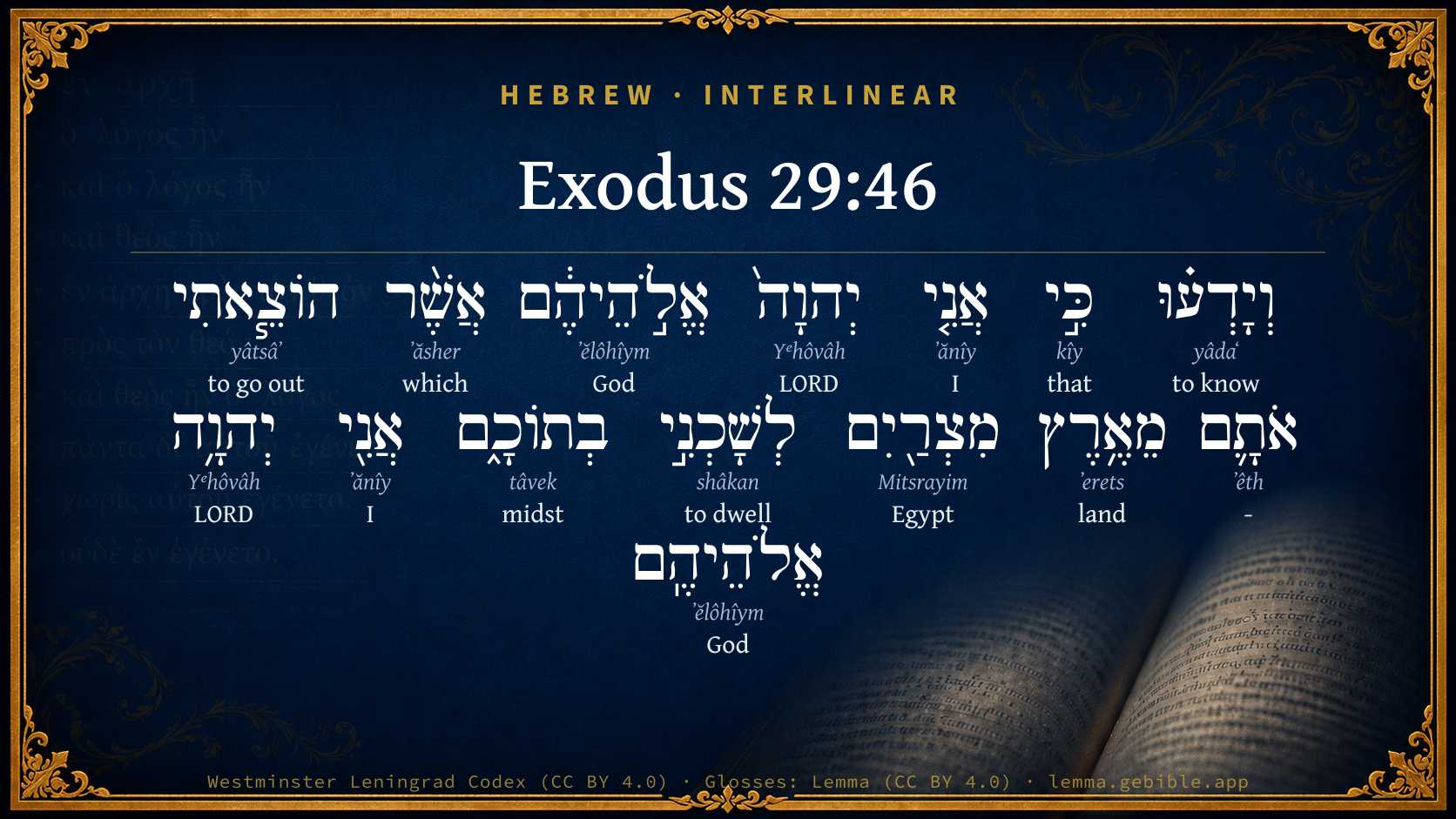
Hebrew (Westminster Leningrad Codex) Exodus 29:46 appears in the Hebrew Old Testament. The text above is from the Westminster Leningrad Codex. Each word links to its Strong’s number, a concise gloss, and parsing drawn from the Open Scriptures Hebrew Bible morphology. Click any word for its full Brown-Driver-Briggs (BDB) entry.
Download image
Cite this verse

Exodus 29:46 (World English Bible). Public Domain. Lemma interlinear Bible study tool, https://lemma.gebible.app/v/exodus/29/46.

Show BibTeX & RIS
BibTeX
RIS
English Translation
They shall know that I am Yahweh their God, who brought them forth out of the land of Egypt, that I might dwell among them: I am Yahweh their God.
World English Bible · Public Domain
Download a study sheet

One document with this verse’s original text, its word-by-word gloss line, the meaning frame, cross-references with their text, attributed commentary, and full source and license credits — printable, and it pastes into notes with its structure intact.

This verse Autodidact and up

Study sheet (.html) Plain text (.txt)

A passage Seminary Student

Up to 50 verses in one chapter. A passage sheet keeps up to 6 commentary sources and 12 cross-references per verse, in the order this page ranks them, and says so on the sheet whenever that leaves anything out. Ask for a single verse and you get the Autodidact verse sheet above.

Everything on this page stays free to read, with no account — the sheet is a download of what is already on screen, not access to it.

Want to remove ads? Support Godless Engineer
Compare translations 3

The same verse in 3 English versions, stacked beneath the original-language interlinear above. Click any original word for its lexicon entry.

Each is an independent rendering of the whole verse — the interlinear is not word-aligned to these translations.

Highlighted words mark where these versions differ — a whole-verse word diff, not a word-by-word alignment.

  • World English Bible Public Domain
    They shall know that I am Yahweh their God, who brought them forth out of the land of Egypt, that I might dwell among them: I am Yahweh their God.
  • King James Version Public Domain
    And they shall know that I am the LORD their God, that brought them forth out of the land of Egypt, that I may dwell among them: I am the LORD their God.
  • unfoldingWord Literal Text CC BY-SA 4.0
    And they will know that I am Yahweh their God, who brought them out from the land of Egypt to live among them. I am Yahweh their God.

unfoldingWord Literal Text — © unfoldingWord, licensed CC BY-SA 4.0. Word-aligned USFM3 via Door43 (git.door43.org/unfoldingWord/en_ult).

Versions to compare (up to 4)

3 of 4 selected

Show all 18 translations

Every available English version of this verse, each an independent rendering of the whole verse.

  • World English Bible Public Domain
    They shall know that I am Yahweh their God, who brought them forth out of the land of Egypt, that I might dwell among them: I am Yahweh their God.
  • Berean Standard Bible Public Domain
    And they will know that I am the LORD their God, who brought them out of the land of Egypt so that I might dwell among them. I am the LORD their God.
  • Majority Standard Bible Public Domain
    And they will know that I am the LORD their God, who brought them out of the land of Egypt so that I might dwell among them. I am the LORD their God.
  • King James Version Public Domain
    And they shall know that I am the LORD their God, that brought them forth out of the land of Egypt, that I may dwell among them: I am the LORD their God.
  • American Standard Version (1901) Public Domain
    And they shall know that I am Jehovah their God, that brought them forth out of the land of Egypt, that I might dwell among them: I am Jehovah their God.
  • Revised Version (1885) Public Domain
    And they shall know that I am the LORD their God, that brought them forth out of the land of Egypt, that I may dwell among them: I am the LORD their God.
  • Geneva Bible (1599) Public Domain
    Then shall they knowe that I am ye Lord their God, that brought them out of the lande of Egypt, that I might dwell among them: I am the Lord their God.
  • Douay-Rheims (1899) Public Domain
    And they shall know that I am the Lord their God, who have brought them out of the land of Egypt, that I might abide among them, I the Lord their God.
  • Young's Literal Translation Public Domain
    and they have known that I `am' Jehovah their God, who hath brought them out of the land of Egypt, that I may tabernacle in their midst; I `am' Jehovah their God.
  • Literal Standard Version CC BY-SA 4.0
    and they have known that I [am] their God YHWH, who has brought them out of the land of Egypt, that I may dwell in their midst; I [am] their God YHWH.”
  • Unlocked Literal Bible CC BY-SA 4.0
    They will know that I am Yahweh, their God, who brought them out from the land of Egypt so that I might live among them. I am Yahweh, their God.
  • unfoldingWord Literal Text CC BY-SA 4.0
    And they will know that I am Yahweh their God, who brought them out from the land of Egypt to live among them. I am Yahweh their God.
  • Darby Bible Public Domain
    And they shall know that I am Jehovah their God, who have brought them forth out of the land of Egypt, to dwell in their midst: I am Jehovah their God.
  • World Messianic Bible Public Domain
    They shall know that I am the LORD their God, who brought them out of the land of Egypt, that I might dwell among them: I am the LORD their God.
  • Webster's Bible Public Domain
    And they shall know that I am the LORD their God, that brought them forth out of the land of Egypt, that I may dwell among them: I am the LORD their God.
  • Free Bible Version CC BY-SA 4.0
    They will know that I am the Lord their God, who led them out of Egypt, so that I could live with them. I am the Lord their God.
  • Bible in Basic English Public Domain
    And they will see that I am the Lord their God, who took them out of the land of Egypt, so that I might be ever with them: I am the Lord their God.
  • JPS Tanakh (1917) Public Domain
    And they shall know that I am the LORD their God, that brought them forth out of the land of Egypt, that I may dwell among them. I am the LORD their God.

Literal Standard Version (2020), Covenant Press — licensed CC BY-SA 4.0. Text via the HelloAO Bible API (eBible.org). Unlocked Literal Bible (unfoldingWord) — licensed CC BY-SA 4.0. Text via the HelloAO Bible API (eBible.org). unfoldingWord Literal Text — © unfoldingWord, licensed CC BY-SA 4.0. Word-aligned USFM3 via Door43 (git.door43.org/unfoldingWord/en_ult). Free Bible Version, Dr. Jonathan Gallagher — licensed CC BY-SA 4.0. Text via the HelloAO Bible API (eBible.org).

Word by word

More ways to search: Search by grammar → Find every occurrence → Compare this word →

Practice this passage: Drill this verse → Learn its vocabulary →

לְשָׁכְנִ֣י
shâkan
H7931
“to dwell · me”
Preposition + Verb, Qal, Infinitive Construct + Suffix, Personal, 1st Person, Common, Singular
Part of Speech
Preposition + Verb
Stem
Qal
Form
Infinitive Construct
Full BDB Definition

Origin: a primitive root [apparently akin (by transmission) to H7901 through the idea of lodging]

TWOT: 2387

to settle down, abide, dwell, tabernacle, reside - (Qal) - to settle down to abide - to abide, dwell, reside - (Piel) - to make settle down, establish - to make or cause to dwell - (Hiphil) - to lay, place, set, establish, settle, fix - to cause to dwell or abide
  1. וְיָדְע֗וּ yâdaʻ H3045 “and · to know” Conjunction + Verb, Qal, Sequential Perfect, 3rd Person, Common, Plural
  2. כִּ֣י kîy H3588 “that” Conjunction
  3. אֲנִ֤י ʼănîy H589 “I” Pronoun, Personal, 1st Person, Common, Singular
  4. יְהוָה֙ Yᵉhôvâh H3068 “LORD” Noun, Proper
  5. אֱלֹ֣הֵיהֶ֔ם ʼĕlôhîym H430 “God(s) · their” Noun, Common, Masculine, Plural, Construct + Suffix, Personal, 3rd Person, Masculine, Plural
  6. אֲשֶׁ֨ר ʼăsher H834 “which” Particle, Relative
  7. הוֹצֵ֧אתִי yâtsâʼ H3318 “to go out” Verb, Hiphil, Perfect, 1st Person, Common, Singular
  8. אֹתָ֛ם ʼêth H853 “- · them” Particle, Direct Object + Suffix, Personal, 3rd Person, Masculine, Plural
  9. מֵאֶ֥רֶץ ʼerets H776 “from · land of” Preposition + Noun, Common, Both, Singular, Construct
  10. מִצְרַ֖יִם Mitsrayim H4714 “Egypt” Noun, Proper
  11. בְתוֹכָ֑ם tâvek H8432 “in/at · midst · their” Preposition + Noun, Common, Masculine, Singular, Construct + Suffix, Personal, 3rd Person, Masculine, Plural
  12. אֲנִ֖י ʼănîy H589 “I” Pronoun, Personal, 1st Person, Common, Singular
  13. יְהוָ֥ה Yᵉhôvâh H3068 “LORD” Noun, Proper
  14. אֱלֹהֵיהֶֽם ʼĕlôhîym H430 “God(s) · their” Noun, Common, Masculine, Plural, Construct + Suffix, Personal, 3rd Person, Masculine, Plural

About this verse

These counts appear in no published source. They are computed here, from the morphology-tagged text and Lemma’s own curated glosses. What Lemma adds →

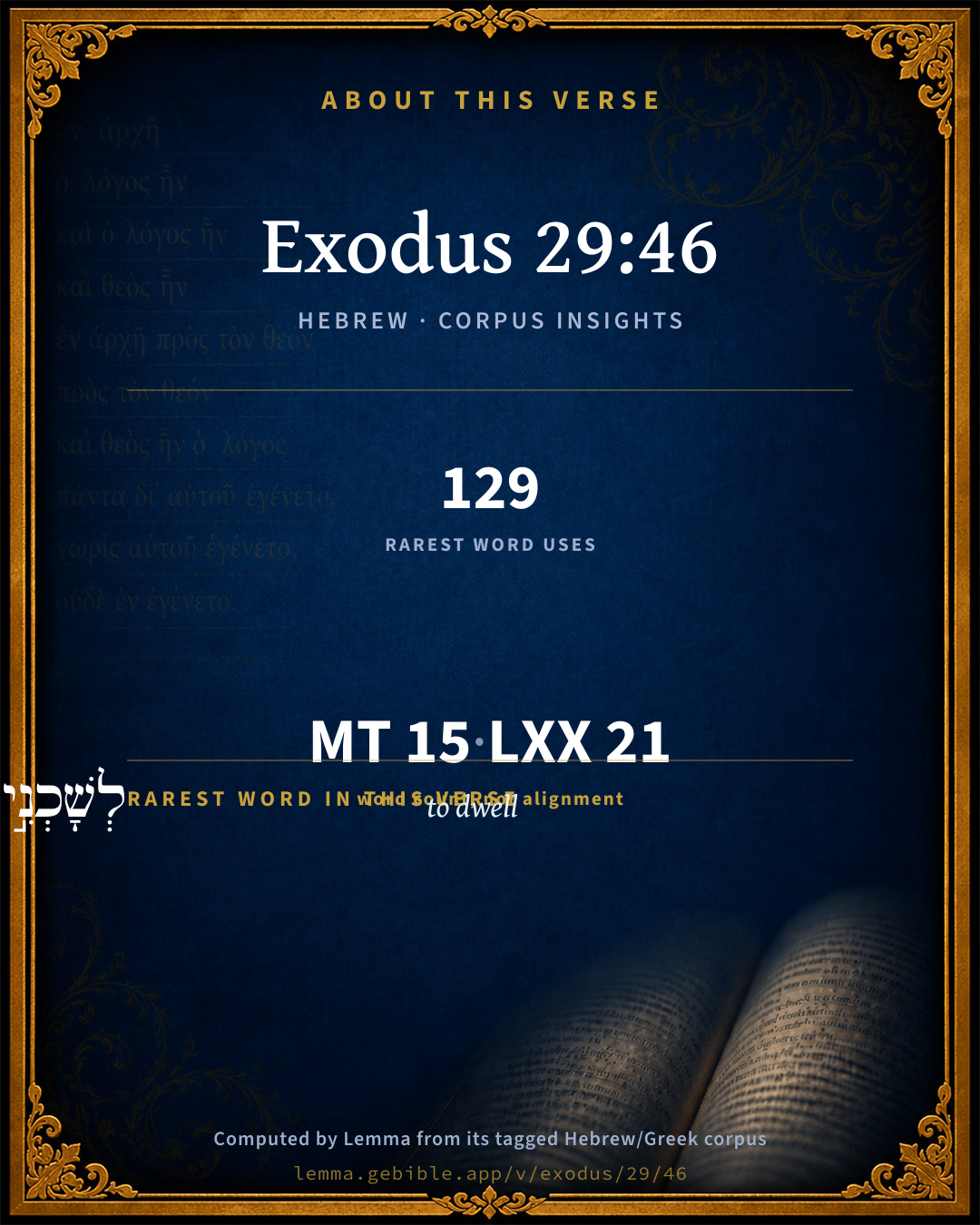
15
words
12
distinct lemmas
Pentateuch
section

Grammatical profile

  • 3 verbs
  • 7 nouns
  • 2 pronouns
  • 1 conjunction
  • 2 particles

Verb forms

  • וְיָדְע֗וּ Qal · Sequential Perfect
  • הוֹצֵ֧אתִי Hiphil · Perfect
  • לְשָׁכְנִ֣י Qal · Infinitive Construct

Repetition

Words recur within this verse — often emphatic in Hebrew:

  • יְהוָה֙ LORD H3068 ×2
  • אֱלֹ֣הֵיהֶ֔ם God H430 ×2
  • אֲנִ֤י I H589 ×2

Hebrew & Septuagint length

In English translation the verse runs 30 words from the Hebrew and 32 from the Septuagint (LXX English) — closely comparable.

A rough comparison of the two English renderings, which tokenize alike — not a word-level alignment.

Word counts can differ between the Hebrew and the Greek without any difference in meaning — e.g. the Hebrew direct-object marker אֵת has no separate Greek word, and Greek often adds the article ὁ.

In the original languages it is 15 Hebrew tokens and 21 Greek tokens — but the two are counted differently (Hebrew bundles its prefixes and suffixes into one token; the Greek is in lemma form), so that isn’t a like-for-like length.

Cross-references

6

Topical passages linked to Exodus 29:46 in the Treasury of Scripture Knowledge — connected by theme and wording, ordered by reader-vote popularity; previews shown in the World English Bible.

  • Exodus 20:2 "I am Yahweh your God, who brought you out of the land of Egypt, out of the house of bondage.
  • Jeremiah 31:33 But this is the covenant that I will make with the house of Israel after those days, says Yahweh: I will put my law in their inward parts, and in their heart will I write it; and I will be their God, and they shall be my people:
  • Leviticus 11:44 For I am Yahweh your God. Sanctify yourselves therefore, and be holy; for I am holy: neither shall you defile yourselves with any kind of creeping thing that moves on the earth.
  • Leviticus 18:30 Therefore you shall keep my charge, that you do not practice any of these abominable customs, which were practiced before you, and that you do not defile yourselves with them: I am Yahweh your God.'"
  • Leviticus 19:2 "Speak to all the congregation of the children of Israel, and tell them, 'You shall be holy; for I Yahweh your God am holy.
  • Ezekiel 20:5 and tell them, Thus says the Lord Yahweh: In the day when I chose Israel, and swore to the seed of the house of Jacob, and made myself known to them in the land of Egypt, when I swore to them, saying, I am Yahweh your God;

Cross-references courtesy of OpenBible.info (CC BY 4.0).

Hebrew and Greek witnesses Masoretic Hebrew ↔ Greek Septuagint

The same verse in the two great witnesses to the Old Testament, shown verse-for-verse.

These are two independent witnesses, not word-aligned to each other, and the Septuagint is shown in lemma (dictionary) form.

Hebrew Exodus 29:46 Masoretic · Westminster Leningrad Codex

וְיָדְע֗וּ כִּ֣י אֲנִ֤י יְהוָה֙ אֱלֹ֣הֵיהֶ֔ם אֲשֶׁ֨ר הוֹצֵ֧אתִי אֹתָ֛ם מֵאֶ֥רֶץ מִצְרַ֖יִם לְשָׁכְנִ֣י בְתוֹכָ֑ם אֲנִ֖י יְהוָ֥ה אֱלֹהֵיהֶֽם

They shall know that I am Yahweh their God, who brought them forth out of the land of Egypt, that I might dwell among them: I am Yahweh their God.

World English Bible · Public Domain

Greek LXX Exodus 29:46 Septuagint · lemma form

καί γιγνώσκω ὅτι ἐγώ εἰμί κύριος ὁ θεός αὐτός ὁ ἐκἄγω αὐτός ἐκ γῆ αἴγυπτος ἐπικαλέω αὐτός καί θεός εἰμί αὐτός

And they shall know that I am the Lord their God, who brought them forth out of the land of Egypt, to be called upon by them, and to be their God.

LXX2012 (modern English Septuagint) · Public Domain

Hebrew: Westminster Leningrad Codex (CC BY 4.0). Greek: Septuagint (public domain); English from LXX2012 (modern English Septuagint) (Public Domain). How the Septuagint differs from the Hebrew →

Targum (Aramaic paraphrase)

2

The Targum is the ancient Jewish Aramaic paraphrase of the Hebrew Scriptures — an interpretive translation, not the Hebrew text itself. Onkelos (literal) and Pseudo-Jonathan (expansive) render the Torah, and Jonathan the Prophets. Coverage is partial: where no permissively-licensed English translation exists for a verse, only the Aramaic is shown. This is verse-level text, not a word-by-word alignment to the Hebrew.

  1. Targum Onkelos Torah (Genesis–Deuteronomy)
    וְיִדְעוּן אֲרֵי אֲנָא יְיָ אֱלָהֲהוֹן דִי אַפֵּקִית יָתְהוֹן מֵאַרְעָא דְמִצְרַיִם לְאַשְׁרָאָה שְׁכִנְתִּי בֵּינֵיהוֹן אֲנָא יְיָ אֱלָהֲהוֹן:

    (no public-domain English translation for this verse)

    Targum Onkelos — Aramaic: “Onkelos Genesis” (public domain); “Onkelos Exodus” (public domain); “Onkelos Leviticus” (public domain); “Onkelos Numbers” (public domain); “Onkelos Deuteronomy” (public domain). English: “Sefaria Community Translation” (CC0 1.0 (public-domain dedication)); “J.W. Etheridge. The Targums of Onkelos and Jonathan Ben Uzziel on the Pentateuch. London: Longmans, Green, 1862” (public domain). Text via Sefaria.

  2. Targum Pseudo-Jonathan Torah (Genesis–Deuteronomy)
    וְיֵדְעוּן בְּנֵי יִשְרָאֵל אֲרוּם אֲנָא יְיָ אֱלָהָהוֹן דִּי הַנְפֵיקִית יַתְהוֹן פְּרִיקִין מֵאַרְעָא דְמִצְרַיִם לְאַשְׁרָאָה שְׁכִינְתִּי בֵּינֵיהוֹן אֲנָא הוּא יְיָ אֱלָהָהוֹן

    And the sons of Israel shall know that I am their God, who led them out free from the land of Mizraim to make My Shekinah dwell among them. I am the Lord their God.

    Targum Pseudo-Jonathan — Aramaic: “Targum Jonathan on Genesis” (public domain); “Targum Jonathan on Exodus” (public domain); “Targum Jonathan on Leviticus” (public domain); “Targum Jonathan on Numbers” (public domain); “Targum Jonathan on Deuteronomy” (public domain). English: “The Targum of Jonathan ben Uzziel, trans. J. W. Etheridge, London, 1862” (public domain). Text via Sefaria.

Commentary

Notes on Exodus 29:46 from classic Christian and Jewish commentators (each source and its license shown beneath its notes). The classic Christian expositions comment on the surrounding passage and are grouped to its opening verse, so a note may address several verses; the Jewish commentaries on the Tanakh (Rashi and others) are per-verse, so they appear only where the commentator wrote on this verse.

Lemma curates 59 commentaries, every one of them public domain or Creative Commons licensed, each selected and text-cleaned for this edition rather than reprinted as found. About our sources →

Tyndale Open Study Notes

Tyndale Open Resources

29:46 The purpose of the Exodus was to reveal the grace, power, and holiness of God and to enable humans to experience God’s presence in their lives.

Tyndale Open Study Notes — © Tyndale Open Resources, licensed CC BY-SA 4.0. Text via the HelloAO Bible API.

Geneva Bible (1599)

Geneva Bible translators

It is I the Lord, that am their God.

Geneva Bible (1599) marginal notes — public domain. Text via Bolls.life.

Adam Clarke's Commentary

Verse 46. And they shall know that I am the Lord their God] That is, They shall acknowledge God, and their infinite obligations to him. In a multitude of places in Scripture the word know should be thus understood.

That I may dwell among them] For without this acknowledgment and consequent dependence on and gratitude and obedience to God, they could not expect him to dwell among them.

BY dwelling among the people God shows that he would be a continual resident in their houses and in their hearts; that he would be their God - the sole object of their religious worship, to whom they should turn and on whom they should trust in all difficulties and distresses; and that he would be to them all that the Creator could be to his creatures. That in consequence they should have a full conviction of his presence and blessing, and a consciousness that HE was their God, and that they were his people. Thus then God dwells among men that they may know him; and they must know him that he may continue to dwell among them. He who does not experimentally know God, cannot have him as an indwelling Saviour; and he who does not continue to know - to acknowledge, love, and obey him, cannot retain him as his Preserver and Sanctifier. From the beginning of the world, the salvation of the souls of men necessarily implied the indwelling influences of God. Reader, hast thou this salvation? This alone will support thee in all thy travels in this wilderness, comfort thee in death, and give thee boldness in the day of judgment. "He," says an old writer, "who has pardon may look his judge in the face."

Adam Clarke's Commentary on the Bible (1810–1826) — public domain. Text from a community e-Sword/MySword module.

Ellicott's Commentary for English Readers

(46) They shall know . . . —i.e., My after care of them will prove me the same loving and all-powerful God whose help effected their deliverance from the bondage of Egypt.

A Bible Commentary for English Readers, edited by Charles John Ellicott (1878–1897) — public domain. Text from a community e-Sword module.

The Cambridge Bible for Schools and Colleges

gen. ed. J. J. S. Perowne

46. And they shall know] viz. by the evidences of His presence in their midst (cf. Exo_16:6; Exo_16:12). For other instances of the expression, see on Exo_6:7.

I am Jehovah their God] a closing asseverative formula: see on Exo_6:8

The Cambridge Bible for Schools and Colleges (gen. ed. J. J. S. Perowne; Cambridge University Press, 1878–1918) — public domain. Text from a community e-Sword module.

John Gill's Exposition

And they shall know that I am the Lord their God,.... By his presence with them, by the blessings bestowed upon them, by his care of them, and kindness to them:

that brought them forth out of the land of Egypt, that I may dwell amongst them; not only did he bring them from thence, that they might dwell in the land of Canaan, but that he might dwell among them, which was by far the greatest mercy; and not only that they might be delivered from the bondage and affliction with which they were sorely pressed, but that they might be a free people, under the protection of their King and their God, in the midst of them; all which was a great encouragement to them, and an obligation on them to attend the service of the sanctuary, and to obey the Lord in whatsoever he had enjoined or should command them:

I am the Lord their God; of which he had given full proof and evidence by what he had done for them, and would yet give more; and to have the Lord our God is the greatest happiness that can be enjoyed, see Psa 33:12.

Next: Exodus Chapter 30

John Gill's Exposition of the Whole Bible (1746–1763) — public domain (CC PDM 1.0). Text via the HelloAO Bible API.

The Pulpit Commentary

And they shall know, etc. When they experience my protection, bounty, love, tenderness, pardon, they shall truly feel and know in their inmost hearts, that I am the same God who delivered them out of the bondage of Egypt, and brought them forth, for the very purpose of "dwelling among them." I am Jehovah, their God. No other God could deliver after this sort. No other God could be so long-suffering to a "stiffnecked people."

The Pulpit Commentary (1880–1919), ed. H.D.M. Spence-Jones & Joseph S. Exell — public domain. Text from a community e-Sword module.

Rashi

Rabbi Shlomo Yitzchaki (Rashi)

לשכני בתכם means under the condition that I may dwell in the midst of them.

Rashi on the Tanakh — English translations: “The Judaica Press complete Tanach with Rashi, translated by A. J. Rosenberg” (CC BY 4.0); “Pentateuch with Rashi's commentary by M. Rosenbaum and A.M. Silbermann, 1929-1934” (public domain); “The Metsudah Tanach series, Lakewood, N.J” (CC BY 4.0); and “The Book of Joshua, Metsudah Publications, 1997” (CC BY 4.0). Text via Sefaria.

Ramban (Nachmanides)

Rabbi Moshe ben Nachman (Ramban / Nachmanides)

L’SHOCHNI B’THOCHAM’ — “on condition that I dwell in the midst of them.” This is Rashi’s language. But the usage of the letter lamed [l’shochni] for a condition of this kind is not found [elsewhere in Scripture]! It is possible that He is stating: “and they shall know ‘when’ I dwell among them that I am the Eternal their G-d that brought them forth out of the land of Egypt, for they will [then] know My Glory and believe that I brought them forth from the land of Egypt.” It is similar in usage to the verses: And David had great success ‘l’chol drachav’ all his ways.” [which is like b’chol drachav — “in all his ways”]; that thou hast chosen ‘l’ben Yishai’, 20:30. Literally: “to the son of Jesse.” [which means b’ben Yishai — “the son of Jesse”]; because ye rebelled against My word ‘l’mei Meribah’ the waters of Meribah.” [which means b’mei Meribah — “in (or ‘at’) the waters of Meribah”], and similar cases.But Rabbi Abraham ibn Ezra explained [the verse to mean that] the purpose of My bringing them forth from the land of Egypt was only that I might dwell in their midst, and that this was the fulfilment of [the promise to Moses], you shall serve G-d upon this mountain. He explained it well, and if it is so, there is in this matter a great secret. For in the plain sense of things it would appear that [the dwelling of] the Divine Glory in Israel was to fulfill a want below, but it is not so. It fulfilled a want above, being rather similar in thought to that which Scripture states, Israel, in whom I will be glorified. And Joshua said, [For when the Canaanites… hear of it… and cut off our name from the earth,] and what wilt Thou do for Thy Great Name? There are many verses which express this thought: He hath desired it [i.e., Zion] for His habitation; Here I dwell; for I have desired it., Verse 14. And it is further written, and I will remember the land. is of the root The Eternal hath been mindful of us” (Psalms 115:12) (Ricanti).

Ramban (Nachmanides) on the Tanakh — English translation: “Commentary on the Torah by Ramban (Nachmanides). Translated and annotated by Charles B. Chavel. New York, Shilo Pub. House, 1971-1976” (CC BY 4.0). Text via Sefaria.

Ibn Ezra

Rabbi Abraham ibn Ezra

They will know … to dwell among them. They will know that God brought them out of Egypt solely in order to in the Sanctuary that they would build for Him.

Ibn Ezra on the Tanakh — English translations: “Sefaria Community Translation” (CC0 1.0 (public-domain dedication)); “Yalkut, Sifsei Chachomim Chumash, Metsudah Publications, 2009” (CC BY 4.0); and “Commentary of Ibn Ezra on Isaiah - trans. by M. Friedlander, 1873” (public domain). Text via Sefaria.

Lesson kit

Teaching starters — assembled from the data on this page, not authored interpretation. Every prompt links to the verse data it draws on. Edit before teaching.

Exodus, in the Pentateuch, opens this verse with 15 words (12 distinct Hebrew lemmas). Its most distinctive word is shâkan (“to dwell”). A historical commentator’s framing appears above. Read the whole chapter for the surrounding context.

Discussion questions

  1. The word shâkan carries the sense “to dwell.” How does it shape the verse?
  2. How does Exodus 20:2, which shares this passage’s theme, read alongside this verse?
  3. What does the repetition of “LORD” (2× in this one verse) do in this verse?
  4. These translations render this verse differently; the difference is in the English rendering, not the original. What questions does that raise?
  5. «וְיָדְע֗וּ» is a Qal Sequential Perfect verb. How does that grammatical form shape the action described?
  6. Compare how Tyndale Open Study Notes and Geneva Bible (1599) read this verse. Where do they agree or differ?

Things to notice

Reading settings

Reading text

Shown beneath each verse's original-language words.

Old Testament
Old Testament edition

Read the OT as the Masoretic Hebrew (MT) or the Greek Septuagint (LXX).

English shown for the Greek Septuagint (in the Hebrew ↔ Greek comparison).

Comparing translations? Open the Compare panel on any verse page to stack up to four side by side.