
Ezekiel 20:31

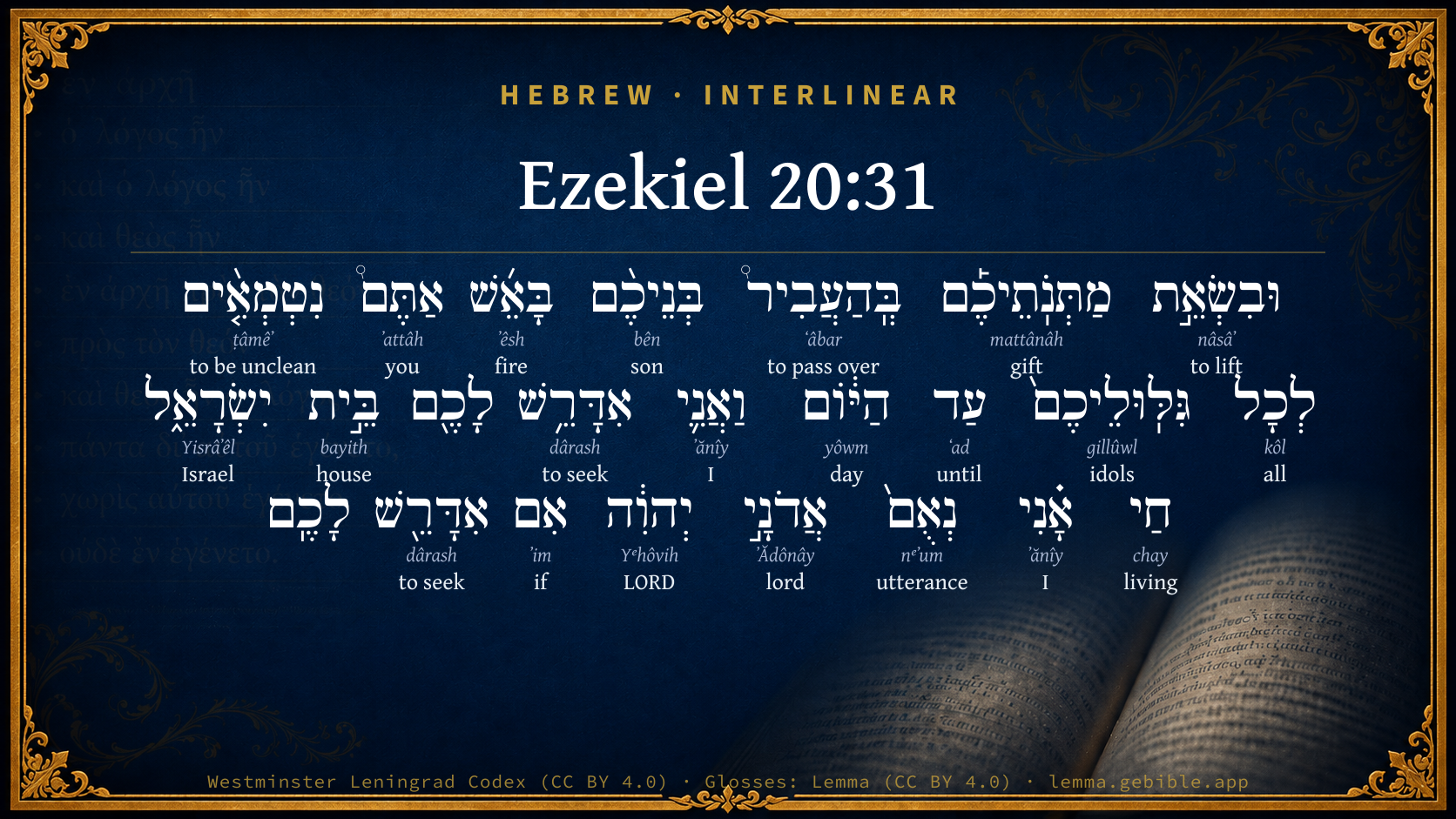
Hebrew (Westminster Leningrad Codex) Ezekiel 20:31 appears in the Hebrew Old Testament. The text above is from the Westminster Leningrad Codex. Each word links to its Strong’s number, a concise gloss, and parsing drawn from the Open Scriptures Hebrew Bible morphology. Click any word for its full Brown-Driver-Briggs (BDB) entry.
Download image
Cite this verse

Ezekiel 20:31 (World English Bible). Public Domain. Lemma interlinear Bible study tool, https://lemma.gebible.app/v/ezekiel/20/31.

Show BibTeX & RIS
BibTeX
RIS
English Translation
and when you offer your gifts, when you make your sons to pass through the fire, do you pollute yourselves with all your idols to this day? and shall I be inquired of by you, house of Israel? As I live, says the Lord Yahweh, I will not be inquired of by you;
World English Bible · Public Domain
Download a study sheet

One document with this verse’s original text, its word-by-word gloss line, the meaning frame, cross-references with their text, attributed commentary, and full source and license credits — printable, and it pastes into notes with its structure intact.

This verse Autodidact and up

Study sheet (.html) Plain text (.txt)

A passage Seminary Student

Up to 50 verses in one chapter. A passage sheet keeps up to 6 commentary sources and 12 cross-references per verse, in the order this page ranks them, and says so on the sheet whenever that leaves anything out. Ask for a single verse and you get the Autodidact verse sheet above.

Everything on this page stays free to read, with no account — the sheet is a download of what is already on screen, not access to it.

Want to remove ads? Support Godless Engineer
Compare translations 3

The same verse in 3 English versions, stacked beneath the original-language interlinear above. Click any original word for its lexicon entry.

Each is an independent rendering of the whole verse — the interlinear is not word-aligned to these translations.

Highlighted words mark where these versions differ — a whole-verse word diff, not a word-by-word alignment.

  • World English Bible Public Domain
    and when you offer your gifts, when you make your sons to pass through the fire, do you pollute yourselves with all your idols to this day? and shall I be inquired of by you, house of Israel? As I live, says the Lord Yahweh, I will not be inquired of by you;
  • King James Version Public Domain
    For when ye offer your gifts, when ye make your sons to pass through the fire, ye pollute yourselves with all your idols, even unto this day: and shall I be enquired of by you, O house of Israel? As I live, saith the Lord GOD, I will not be enquired of by you.
  • unfoldingWord Literal Text CC BY-SA 4.0
    When you offer up your gifts—when you cause your sons to pass through the fire—to this day you defile yourselves with all your idols. So why should I let you seek me, house of Israel? As I live—this is the Lord Yahweh’s declaration—I will not allow you to seek me.

unfoldingWord Literal Text — © unfoldingWord, licensed CC BY-SA 4.0. Word-aligned USFM3 via Door43 (git.door43.org/unfoldingWord/en_ult).

Versions to compare (up to 4)

3 of 4 selected

Show all 18 translations

Every available English version of this verse, each an independent rendering of the whole verse.

  • World English Bible Public Domain
    and when you offer your gifts, when you make your sons to pass through the fire, do you pollute yourselves with all your idols to this day? and shall I be inquired of by you, house of Israel? As I live, says the Lord Yahweh, I will not be inquired of by you;
  • Berean Standard Bible Public Domain
    When you offer your gifts, sacrificing your sons in the fire, you continue to defile yourselves with all your idols to this day. So should I be consulted by you, O house of Israel? As surely as I live, declares the Lord GOD, I will not be consulted by you!
  • Majority Standard Bible Public Domain
    When you offer your gifts, sacrificing your sons in the fire, you continue to defile yourselves with all your idols to this day. So should I be consulted by you, O house of Israel? As surely as I live, declares the Lord GOD, I will not be consulted by you!
  • King James Version Public Domain
    For when ye offer your gifts, when ye make your sons to pass through the fire, ye pollute yourselves with all your idols, even unto this day: and shall I be enquired of by you, O house of Israel? As I live, saith the Lord GOD, I will not be enquired of by you.
  • American Standard Version (1901) Public Domain
    and when ye offer your gifts, when ye make your sons to pass through the fire, do ye pollute yourselves with all your idols unto this day? and shall I be inquired of by you, O house of Israel? As I live, saith the Lord Jehovah, I will not be inquired of by you;
  • Revised Version (1885) Public Domain
    and when ye offer your gifts, when ye make your sons to pass through the fire, do ye pollute yourselves with all your idols, unto this day? and shall I be inquired of by you, O house of Israel? As I live, saith the Lord GOD, I will not be inquired of by you:
  • Geneva Bible (1599) Public Domain
    For when you offer your giftes, and make your sonnes to passe through the fire, you pollute your selues with all your idoles vnto this day: shall I answere you when I am asked, O house of Israel? As I liue, saith the Lord God, I wil not answere you when I am asked.
  • Douay-Rheims (1899) Public Domain
    And you defile yourselves with all your: idols unto this day, in the offering of your gifts, when you make your children pass through the fire: and shall I answer you, O house of Israel? As I live, saith the Lord God, I will not answer you.
  • Young's Literal Translation Public Domain
    And in the offering of your gifts, In causing your sons to pass through fire, Ye are defiled by all your idols to this day, And I am sought by you, O house of Israel! I live -- an affirmation of the Lord Jehovah, I am not sought by you.
  • Literal Standard Version CC BY-SA 4.0
    And in the offering of your gifts, || In causing your sons to pass through fire, || You are defiled by all your idols to this day, || And I am sought by you, O house of Israel? [As] I live—a declaration of Lord YHWH, I am not sought by you.
  • Unlocked Literal Bible CC BY-SA 4.0
    When you offer up your gifts—when you cause your sons to pass through the fire—to this day you defile yourselves with all your idols. So why should I let you seek me, house of Israel? As I live—this is the Lord Yahweh's declaration—I will not allow you to seek me.
  • unfoldingWord Literal Text CC BY-SA 4.0
    When you offer up your gifts—when you cause your sons to pass through the fire—to this day you defile yourselves with all your idols. So why should I let you seek me, house of Israel? As I live—this is the Lord Yahweh’s declaration—I will not allow you to seek me.
  • Darby Bible Public Domain
    And when ye offer your gifts, making your sons to pass through the fire, ye defile yourselves with all your idols, even unto this day; and shall I be inquired of by you, O house of Israel? [As] I live, saith the Lord Jehovah, I will not be inquired of by you.
  • World Messianic Bible Public Domain
    When you offer your gifts, when you make your sons pass through the fire, do you pollute yourselves with all your idols to this day? Should I be inquired of by you, house of Israel? As I live, says the Lord GOD, I will not be inquired of by you!
  • Webster's Bible Public Domain
    For when ye offer your gifts, when ye make your sons to pass through the fire, ye pollute yourselves with all your idols, even to this day: and shall I be inquired of by you, O house of Israel? As I live, saith the Lord GOD, I will not be inquired of by you.
  • Free Bible Version CC BY-SA 4.0
    When you present your offerings to idols and sacrifice your children in the fire, you continue to make yourselves unclean with all your idols right up until now. So should I give you advice when you ask me, people of Israel? As I live, declares the Lord God, I'm not going to answer you!
  • Bible in Basic English Public Domain
    And when you give your offerings, causing your sons to go through the fire, you make yourselves unclean with all your images to this day; and will you come to me for directions, O children of Israel? By my life, says the Lord, you will get no direction from me.
  • JPS Tanakh (1917) Public Domain
    and when, in offering your gifts, in making your sons to pass through the fire, ye pollute yourselves with all your idols, unto this day; shall I then be inquired of by you, O house of Israel? As I live, saith the Lord GOD, I will not be inquired of by you;

Literal Standard Version (2020), Covenant Press — licensed CC BY-SA 4.0. Text via the HelloAO Bible API (eBible.org). Unlocked Literal Bible (unfoldingWord) — licensed CC BY-SA 4.0. Text via the HelloAO Bible API (eBible.org). unfoldingWord Literal Text — © unfoldingWord, licensed CC BY-SA 4.0. Word-aligned USFM3 via Door43 (git.door43.org/unfoldingWord/en_ult). Free Bible Version, Dr. Jonathan Gallagher — licensed CC BY-SA 4.0. Text via the HelloAO Bible API (eBible.org).

Word by word

More ways to search: Search by grammar → Find every occurrence → Compare this word →

Practice this passage: Drill this verse → Learn its vocabulary →

מַתְּנֹֽתֵיכֶ֡ם
mattânâh
H4979
“gifts · your”
Noun, Common, Feminine, Plural, Construct + Suffix, Personal, 2nd Person, Masculine, Plural
Part of Speech
Noun
Type
Common
Gender
Feminine
Number
Plural
State
Construct
Full BDB Definition

Origin: from H4976

TWOT: 1443c

gift
  1. וּבִשְׂאֵ֣ת nâsâʼ H5375 “and · in/at · to lift” Conjunction + Preposition + Verb, Qal, Infinitive Construct
  2. בְּֽהַעֲבִיר֩ ʻâbar H5674 “in/at · to pass over” Preposition + Verb, Hiphil, Infinitive Construct
  3. בְּנֵיכֶ֨ם bên H1121 “sons · your” Noun, Common, Masculine, Plural, Construct + Suffix, Personal, 2nd Person, Masculine, Plural
  4. בָּאֵ֜שׁ ʼêsh H784 “in/at the · fire” Preposition, Determined + Noun, Common, Both, Singular, Absolute
  5. אַתֶּם֩ ʼattâh H859 “you” Pronoun, Personal, 2nd Person, Masculine, Plural
  6. נִטְמְאִ֤֨ים ṭâmêʼ H2930 “unclean” Verb, Niphal, Participle Passive, Masculine, Plural, Absolute
  7. לְכָל kôl H3605 “to/for · all of” Preposition + Noun, Common, Masculine, Singular, Construct
  8. גִּלּֽוּלֵיכֶם֙ gillûwl H1544 “idols · your” Noun, Common, Masculine, Plural, Construct + Suffix, Personal, 2nd Person, Masculine, Plural
  9. עַד ʻad H5704 “until” Preposition
  10. הַיּ֔וֹם yôwm H3117 “the · day” Particle, Definite Article + Noun, Common, Masculine, Singular, Absolute
  11. וַאֲנִ֛י ʼănîy H589 “and · I” Conjunction + Pronoun, Personal, 1st Person, Common, Singular
  12. אִדָּרֵ֥שׁ dârash H1875 “to seek” Verb, Niphal, Imperfect, 1st Person, Common, Singular
  13. בֵּ֣ית bayith H1004 “house of” Noun, Common, Masculine, Singular, Construct
  14. יִשְׂרָאֵ֑ל Yisrâʼêl H3478 “Israel” Noun, Proper
  15. חַי chay H2416 “living” Adjective, Adjective, Masculine, Singular, Absolute
  16. אָ֗נִי ʼănîy H589 “I” Pronoun, Personal, 1st Person, Common, Singular
  17. נְאֻם֙ nᵉʼum H5002 “utterance of” Noun, Common, Masculine, Singular, Construct
  18. אֲדֹנָ֣י ʼĂdônây H136 “Lord · my” Noun, Common, Masculine, Plural, Construct + Suffix, Personal, 1st Person, Common, Singular
  19. יְהוִ֔ה Yᵉhôvih H3069 “LORD” Noun, Proper
  20. אִם ʼim H518 “if” Conjunction
  21. אִדָּרֵ֖שׁ dârash H1875 “to seek” Verb, Niphal, Imperfect, 1st Person, Common, Singular

About this verse

These counts appear in no published source. They are computed here, from the morphology-tagged text and Lemma’s own curated glosses. What Lemma adds →

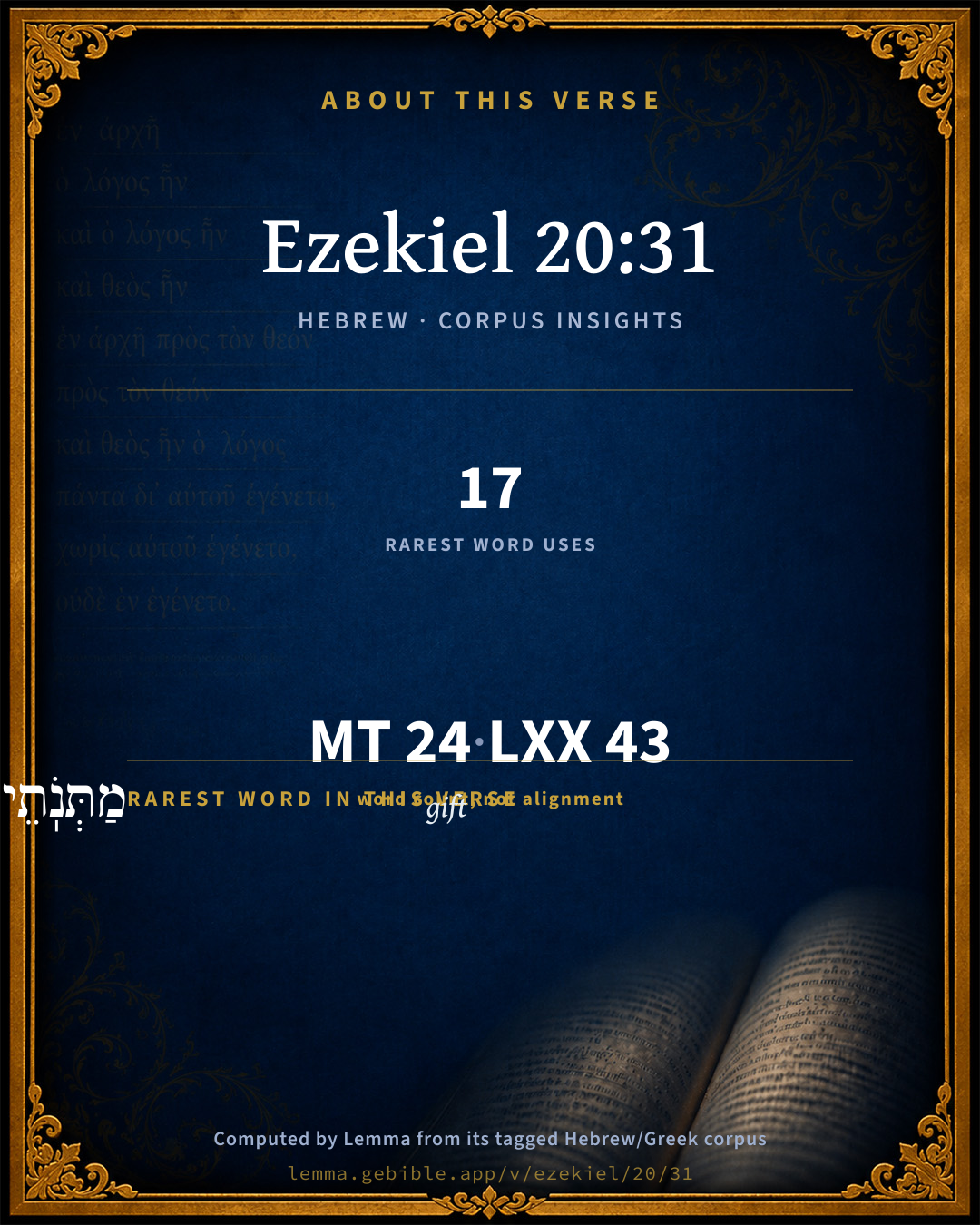
24
words
20
distinct lemmas
Prophets
section

Notable vocabulary

The rarest word here is מַתְּנֹֽתֵיכֶ֡ם gift H4979 — appearing just 17 times in the whole Hebrew Bible.

Shared distinctive vocabulary

מַתְּנֹֽתֵיכֶ֡ם gift H4979 occurs in 17 verses of the Hebrew Bible. Also found in:

Grammatical profile

  • 5 verbs
  • 11 nouns
  • 1 adjective
  • 3 pronouns
  • 3 prepositions
  • 1 conjunction

Verb forms

  • וּבִשְׂאֵ֣ת Qal · Infinitive Construct
  • בְּֽהַעֲבִיר֩ Hiphil · Infinitive Construct
  • נִטְמְאִ֤֨ים Niphal · Participle Passive
  • אִדָּרֵ֥שׁ Niphal · Imperfect
  • אִדָּרֵ֖שׁ Niphal · Imperfect

Repetition

Words recur within this verse — often emphatic in Hebrew:

  • אִדָּרֵ֥שׁ to seek H1875 ×2
  • וַאֲנִ֛י I H589 ×2

Hebrew & Septuagint length

In English translation the verse runs 53 words from the Hebrew and 54 from the Septuagint (LXX English) — closely comparable.

A rough comparison of the two English renderings, which tokenize alike — not a word-level alignment.

Word counts can differ between the Hebrew and the Greek without any difference in meaning — e.g. the Hebrew direct-object marker אֵת has no separate Greek word, and Greek often adds the article ὁ.

In the original languages it is 24 Hebrew tokens and 43 Greek tokens — but the two are counted differently (Hebrew bundles its prefixes and suffixes into one token; the Greek is in lemma form), so that isn’t a like-for-like length.

Cross-references

20

Topical passages linked to Ezekiel 20:31 in the Treasury of Scripture Knowledge — connected by theme and wording, ordered by reader-vote popularity; previews shown in the World English Bible.

  • Psalms 106:37–39 Yes, they sacrificed their sons and their daughters to demons.
  • Jeremiah 7:31 They have built the high places of Topheth, which is in the valley of the son of Hinnom, to burn their sons and their daughters in the fire; which I didn't command, neither came it into my mind.
  • Ezekiel 20:26 and I polluted them in their own gifts, in that they caused to pass through [the fire] all that opens the womb, that I might make them desolate, to the end that they might know that I am Yahweh.
  • Deuteronomy 18:10–12 There shall not be found with you anyone who makes his son or his daughter to pass through the fire, one who uses divination, one who practices sorcery, or an enchanter, or a sorcerer,
  • 1 Samuel 28:5–6 When Saul saw the host of the Philistines, he was afraid, and his heart trembled greatly.
  • 2 Kings 3:13–14 Elisha said to the king of Israel, What have I to do with you? get you to the prophets of your father, and to the prophets of your mother. The king of Israel said to him, No; for Yahweh has called these three kings together to deliver them into the hand of Moab.
  • Job 27:8 For what is the hope of the godless, when he is cut off, When God takes away his life?
  • Job 27:10 Will he delight himself in the Almighty, And call on God at all times?
  • Psalms 66:18 If I cherished sin in my heart, The Lord wouldn't have listened.
  • Proverbs 1:27–28 When calamity overtakes you like a storm, When your disaster comes on like a whirlwind; When distress and anguish come on you.
  • Proverbs 28:9 He who turns away his ear from hearing the law, Even his prayer is an abomination.
  • Isaiah 1:15 When you spread forth your hands, I will hide my eyes from you; Yes, when you make many prayers, I will not hear. Your hands are full of blood.
  • Jeremiah 14:12 When they fast, I will not hear their cry; and when they offer burnt offering and meal-offering, I will not accept them; but I will consume them by the sword, and by the famine, and by the pestilence.
  • Jeremiah 19:5 and have built the high places of Baal, to burn their sons in the fire for burnt offerings to Baal; which I didn't command, nor spoke it, neither came it into my mind:
  • Ezekiel 14:3–4 Son of man, these men have taken their idols into their heart, and put the stumbling block of their iniquity before their face: should I be inquired of at all by them?
  • Ezekiel 16:20 Moreover you have taken your sons and your daughters, whom you have borne to me, and these have you sacrificed to them to be devoured. Were your prostitution a small matter,
  • Ezekiel 20:3 Son of man, speak to the elders of Israel, and tell them, Thus says the Lord Yahweh: Is it to inquire of me that you have come? As I live, says the Lord Yahweh, I will not be inquired of by you.
  • Zechariah 7:13 It has come to pass that, as he called, and they refused to listen, so they will call, and I will not listen," said Yahweh of Hosts;
  • Matthew 25:11–12 Afterward the other virgins also came, saying, 'Lord, Lord, open to us.'
  • James 4:1–3 Where do wars and fightings among you come from? Don't they come from your pleasures that war in your members?

Cross-references courtesy of OpenBible.info (CC BY 4.0).

Hebrew and Greek witnesses Masoretic Hebrew ↔ Greek Septuagint

The same verse in the two great witnesses to the Old Testament, shown verse-for-verse.

These are two independent witnesses, not word-aligned to each other, and the Septuagint is shown in lemma (dictionary) form.

Hebrew Ezekiel 20:31 Masoretic · Westminster Leningrad Codex

וּבִשְׂאֵ֣ת מַתְּנֹֽתֵיכֶ֡ם בְּֽהַעֲבִיר֩ בְּנֵיכֶ֨ם בָּאֵ֜שׁ אַתֶּם֩ נִטְמְאִ֤֨ים לְכָל גִּלּֽוּלֵיכֶם֙ עַד הַיּ֔וֹם וַאֲנִ֛י אִדָּרֵ֥שׁ לָכֶ֖ם בֵּ֣ית יִשְׂרָאֵ֑ל חַי אָ֗נִי נְאֻם֙ אֲדֹנָ֣י יְהוִ֔ה אִם אִדָּרֵ֖שׁ לָכֶֽם

and when you offer your gifts, when you make your sons to pass through the fire, do you pollute yourselves with all your idols to this day? and shall I be inquired of by you, house of Israel? As I live, says the Lord Yahweh, I will not be inquired of by you;

World English Bible · Public Domain

Greek LXX Ezekiel 20:31 Septuagint · lemma form

καί ἐν ὁ ἀπαρχή ὁ δόμα σύ ἐν ὁ ἀφορισμός σύ μιαίνω ἐν πᾶς ὁ ἐνθύμημα σύ ἕως ὁ σήμερον ἡμέρα καί ἐγώ ἀποκρίνω σύ οἶκος ὁ ἰσραήλ ζάω ἐγώ λέγω κύριος εἰ ἀποκρίνω σύ καί εἰ ἀναβαίνω ἐπί ὁ πνεῦμα σύ οὗτος

and do you⌃ pollute yourselves with the first fruits of your gifts, in the offerings wherewith you⌃ pollute yourselves in all your imaginations, until this day; and shall I answer you, O house of Israel? As I live, says the Lord, I will not answer you, neither shall this thing come upon your spirit.

LXX2012 (modern English Septuagint) · Public Domain

On this verse, John Gill's Exposition discusses the Septuagint’s reading. Read the note in Commentary ↓

Hebrew: Westminster Leningrad Codex (CC BY 4.0). Greek: Septuagint (public domain); English from LXX2012 (modern English Septuagint) (Public Domain). How the Septuagint differs from the Hebrew →

Targum (Aramaic paraphrase)

1

The Targum is the ancient Jewish Aramaic paraphrase of the Hebrew Scriptures — an interpretive translation, not the Hebrew text itself. Onkelos (literal) and Pseudo-Jonathan (expansive) render the Torah, and Jonathan the Prophets. Coverage is partial: where no permissively-licensed English translation exists for a verse, only the Aramaic is shown. This is verse-level text, not a word-by-word alignment to the Hebrew.

  1. Targum Jonathan Prophets (Joshua–Malachi)
    וּבְמַטַל מַתְּנָתֵיכוֹן בְּאַעֲבָרָא בְּנֵיכוֹן בְּנוּרָא אַתּוּן מִסְתַּאֲבִין לְכָל פּוּלְחַן טַעֲוָתְכוֹן עַד יוֹמָא דֵין וַאֲנָא אֶשְׁתָּאֵיל לְכוֹן בְּמֵימְרִי בֵּית יִשְׂרָאֵל קַיָם אֲנָא אֲמַר יְיָ אֱלֹהִים אִם אֶשְׁתְּאֵין לְכוֹן בְּמֵימְרִי:

    (no public-domain English translation for this verse)

    Targum Jonathan — Aramaic: “Mikraot Gedolot” (public domain). English: “Sefaria Community Translation” (CC0 1.0 (public-domain dedication)); “London "Chaldee Paraphrase," 1871” (public domain). Text via Sefaria.

Commentary

Notes on Ezekiel 20:31 from classic Christian and Jewish commentators (each source and its license shown beneath its notes). The classic Christian expositions comment on the surrounding passage and are grouped to its opening verse, so a note may address several verses; the Jewish commentaries on the Tanakh (Rashi and others) are per-verse, so they appear only where the commentator wrote on this verse.

Lemma curates 59 commentaries, every one of them public domain or Creative Commons licensed, each selected and text-cleaned for this edition rather than reprinted as found. About our sources →

Trapp's Complete Commentary

John Trapp

Eze 20:31 For when ye offer your gifts, when ye make your sons to pass through the fire, ye pollute yourselves with all your idols, even unto this day: and shall I be enquired of by you, O house of Israel? [As] I live, saith the Lord GOD, I will not be enquired of by you.

Ver. 31. And shall I be inquired of by you?] Is it ever likely to do well, think you? Of witches’ good prayers, as some call them, one saith well: Si magicae, Deus non vult tales: si piae, non per tales. See Jer 7:9-10. {See Trapp on "Jer 7:9"} {See Trapp on "Jer 7:10"}

John Trapp, A Commentary or Exposition upon All the Books of the Old and New Testament (1647–1656) — public domain. Text from a community e-Sword module.

Geneva Bible (1599)

Geneva Bible translators

He showeth that the ingratitude of the people deserveth that God should cut them off, and that they should not have the comfort of his word.

Geneva Bible (1599) marginal notes — public domain. Text via Bolls.life.

Jamieson, Fausset & Brown

Robert Jamieson, A. R. Fausset & David Brown

through the fire--As "the fire" is omitted in Eze 20:26, FAIRBAIRN represents the generation here referred to (namely, that of Ezekiel's day) as attaining the climax of guilt (see on Eze 20:26), in making their children pass through the fire, which that former generation did not. The reason, however, for the omission of "the fire" in Eze 20:26 is, perhaps, that there it is implied the children only "passed through the fire" for purification, whereas here they are actually burnt to death before the idol; and therefore "the fire" is specified in the latter, not in the former case (compare Kg2 3:27).

Jamieson, Fausset & Brown — Commentary Critical and Explanatory on the Whole Bible (1871) — public domain (CC PDM 1.0). Text via the HelloAO Bible API.

Adam Clarke's Commentary

Verse 31. Ye pollute yourselves] This shows the sense in which God says, Eze 20:26, "I polluted them in their own gifts." They chose to pollute themselves, and I permitted them to do so. See on Eze 20:25-26.

Adam Clarke's Commentary on the Bible (1810–1826) — public domain. Text from a community e-Sword/MySword module.

John Calvin's Commentaries

He follows up the same sentiment, that it was a monstrous sin that they so perniciously remained fixed in the perverse imitation of their fathers: for they had been drawn off from their lusts by God’s numerous chastisements, and then they pretended to be afterwards disposed to obedience: God therefore here says, why, then, by offering your gifts, do you make your sons pass through the fire, and pollute yourselves with all your idols even to this day? For this question concerns what is quite incredible and worthy of the greatest surprise, since there was no way of reconciling the sufferings of the Israelites in exile with their remaining obstinate in their wickedness. But the Prophet here again deprives them of that vain pretense with which they covered themselves in offering their gifts: he concedes to them what was true, yet, at the same time, he objects, that they passed their sons through the fire, and were polluted in all their idols. He adds, at length, shall I be inquired of by you? I have elsewhere explained that clause, which is now for the third time repeated. Many take it in a different sense, that God will not deign to answer them any more: but, in my opinion, he simply reproaches their perfidy, because, when they approached the Prophet, they wished to blind his eyes. Shall I, says he, be inquired of you? For דרש, deresh, means to seek, and to attain the end of our search, when the person asked answers, and the person sought presents himself. But here God simply shows that they do not come in a right mind, and that nothing else was imposed on them except seeking him. But because that was almost incredible, hence he swears that they were merely hypocritical in pretending to true piety in suppliantly applying to the Prophet for an answer in God’s name, and then wantonly deriding it, and impiously and wickedly using his name, and thus profaning it.

John Calvin's Commentaries (1540-1563) — public domain. Text from the Calvin Translation Society English edition (1840s-50s) via the Christian Classics Ethereal Library (ccel.org). Calvin's coverage is partial (roughly two-thirds of the Bible); uncommented books and verses are honest gaps, never fabricated. The 19th-century editor's footnotes and remarks are omitted so the notes are faithfully Calvin's own voice.

Ellicott's Commentary for English Readers

(31) I will not be enquired of by you.—This takes up the refrain of Eze_20:3, and with the following verse fitly closes this portion of the prophecy which was introduced by the coming of the elders to enquire.

A Bible Commentary for English Readers, edited by Charles John Ellicott (1878–1897) — public domain. Text from a community e-Sword module.

The Cambridge Bible for Schools and Colleges

gen. ed. J. J. S. Perowne

31. For when … ye pollute] Interrogatively: and when … do ye pollute yourselves unto this day?

The Cambridge Bible for Schools and Colleges (gen. ed. J. J. S. Perowne; Cambridge University Press, 1878–1918) — public domain. Text from a community e-Sword module.

John Gill's Exposition

For when ye offer your gifts,.... And sacrifices to idols. The Septuagint and Arabic versions render it,

the firstfruits of your gifts; it may design their firstborn; see Eze 20:26 as the following clause seems to explain it:

when ye make your sons to pass through the fire; or between two fires to Moloch, as their fathers had done before them;

ye pollute yourselves with all your idols, even unto this day; by worshipping idols, or dunghill gods, as the word signifies, as often observed; they defiled themselves with those filthy things, which they continued to do to that very day, and so became more and more polluted; and were as their fathers had been, and therefore must expect to be used in like manner:

and shall I be inquired of by you, O house of Israel? can you think that I will suffer you to come and inquire of me or to make your requests to me? or can you hope to have an answer from me; at least a favourable one, such as you could wish for?

as I live, saith the Lord God, I will not be inquired of by you; so confirming again with an oath what he had before declared, Eze 20:3, wherefore they might assure themselves that they would not be acceptable to him, neither their persons nor petitions, or be regarded by him.

John Gill's Exposition of the Whole Bible (1746–1763) — public domain (CC PDM 1.0). Text via the HelloAO Bible API.

Matthew Poole's English Annotations

Your gifts: see Eze 20:26.

All your idols; it seems they took a compendious way to increase sin and wrath; they worshipped many idols at once; and this they did still to Ezekiel’s time, to that very day. Are you fit to come and ask counsel of me, whom you have so shamelessly, so obstinately forsaken and reproached? Can you expect I should answer you? My prophet knew you not to be hypocrites, but his God, who knows you, and all your abominations, hath put the answer into his mouth, which you must be content with. I will answer you as little as you regard me. So God refuseth them.

Matthew Poole's English Annotations on the Holy Bible (1683–1685) — public domain. Text from a community e-Sword/MySword module.

Whedon's Commentary on the Bible

Daniel D. Whedon

THE SONS HAVE FOLLOWED THE EXAMPLES OF THEIR FATHERS; YET JEHOVAH STILL RULES, AND THE FUTURE, AS THE PAST, SHALL DISPLAY HIS POWER AND GOODNESS AND HIS NAME SHALL BE GLORIFIED, Eze_20:30-44.

31. Shall I be inquired of by you — These who have so polluted themselves (Eze_20:30) have no claim upon Jehovah’s wisdom. He will not reveal to them what they wish to know of the future, but he will rehearse to them their national iniquities in the past and show that the same principles of divine government which sentenced the nation to chastisement then explains their present calamity.

Daniel D. Whedon (gen. ed.), Commentary on the Old and New Testaments (1874–1909) — public domain. Text from a community e-Sword module.

John Wesley's Explanatory Notes

Shall I be inquired of - Are you fit to ask counsel of me, whom you have so obstinately forsaken and reproached?

John Wesley, Explanatory Notes Upon the Whole Bible (1754–1765) — public domain. Text via the GEBible commentary corpus.

Rashi

Rabbi Shlomo Yitzchaki (Rashi)

And when you take your gifts And with the taking of your gifts that you should have given Me, and you take them from Me to cause your firstborn to pass to idols.

Rashi on the Tanakh — English translations: “The Judaica Press complete Tanach with Rashi, translated by A. J. Rosenberg” (CC BY 4.0); “Pentateuch with Rashi's commentary by M. Rosenbaum and A.M. Silbermann, 1929-1934” (public domain); “The Metsudah Tanach series, Lakewood, N.J” (CC BY 4.0); and “The Book of Joshua, Metsudah Publications, 1997” (CC BY 4.0). Text via Sefaria.

Lesson kit

Teaching starters — assembled from the data on this page, not authored interpretation. Every prompt links to the verse data it draws on. Edit before teaching.

Ezekiel, in the Prophets, opens this verse with 24 words (20 distinct Hebrew lemmas). Its most distinctive word is mattânâh (“gift”). A historical commentator’s framing appears above. Read the whole chapter for the surrounding context.

Discussion questions

  1. How does “gift” (mattânâh) shape what this verse is saying?
  2. How does Genesis 25:6, which shares the word «gift», read alongside this verse?
  3. What does the repetition of “to seek” (2× in this one verse) do in this verse?
  4. These translations render this verse differently; the difference is in the English rendering, not the original. What questions does that raise?
  5. «וּבִשְׂאֵ֣ת» is a Qal Infinitive Construct verb. How does that grammatical form shape the action described?
  6. Compare how Trapp's Complete Commentary and Geneva Bible (1599) read this verse. Where do they agree or differ?

Things to notice

Reading settings

Reading text

Shown beneath each verse's original-language words.

Old Testament
Old Testament edition

Read the OT as the Masoretic Hebrew (MT) or the Greek Septuagint (LXX).

English shown for the Greek Septuagint (in the Hebrew ↔ Greek comparison).

Comparing translations? Open the Compare panel on any verse page to stack up to four side by side.