
Numbers 3:12

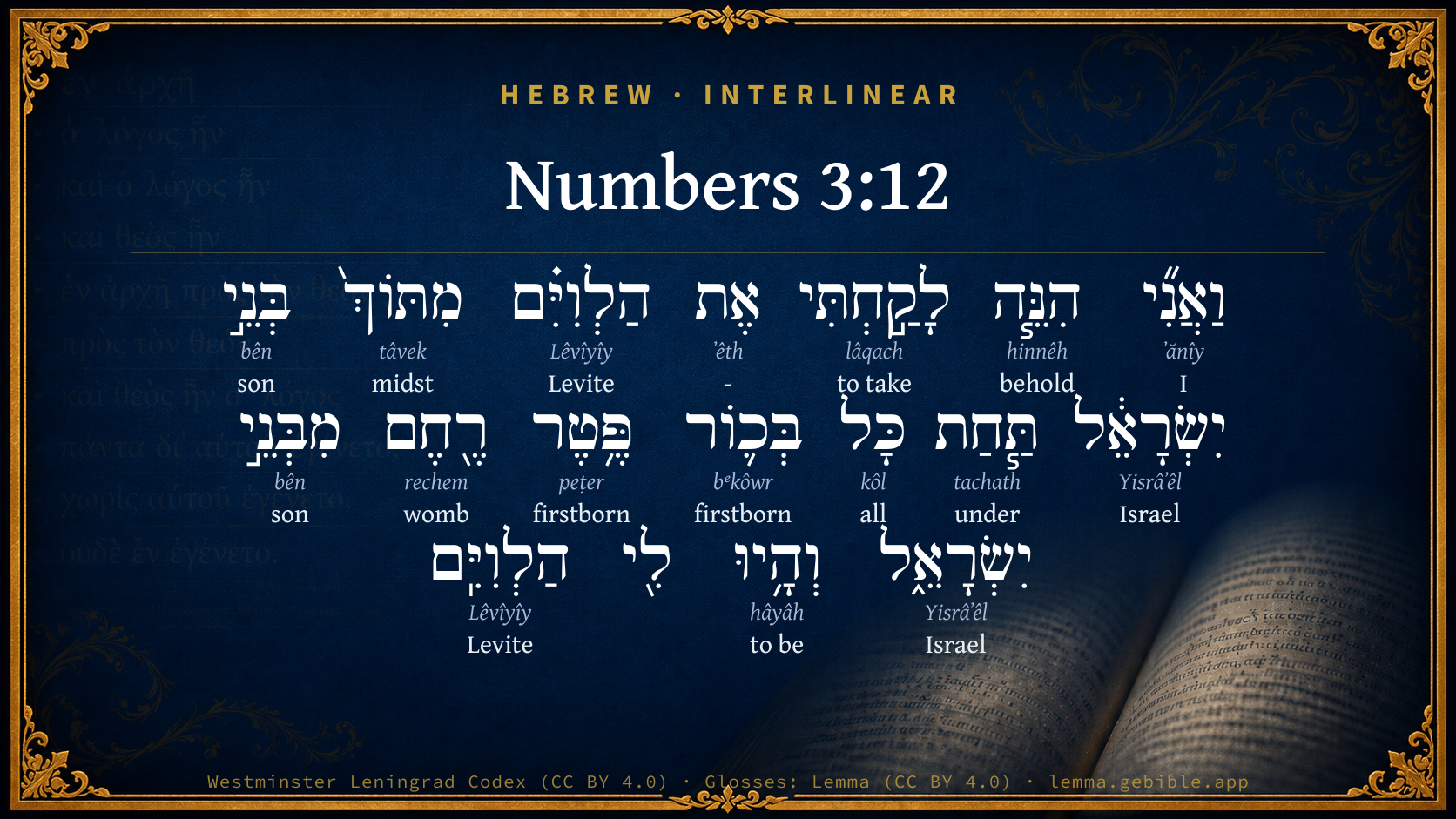
Hebrew (Westminster Leningrad Codex) Numbers 3:12 appears in the Hebrew Old Testament. The text above is from the Westminster Leningrad Codex. Each word links to its Strong’s number, a concise gloss, and parsing drawn from the Open Scriptures Hebrew Bible morphology. Click any word for its full Brown-Driver-Briggs (BDB) entry.
Download image
Cite this verse

Numbers 3:12 (World English Bible). Public Domain. Lemma interlinear Bible study tool, https://lemma.gebible.app/v/numbers/3/12.

Show BibTeX & RIS
BibTeX
RIS
English Translation
"Behold, I have taken the Levites from among the children of Israel instead of all the firstborn who open the womb among the children of Israel; and the Levites shall be mine:
World English Bible · Public Domain
Download a study sheet

One document with this verse’s original text, its word-by-word gloss line, the meaning frame, cross-references with their text, attributed commentary, and full source and license credits — printable, and it pastes into notes with its structure intact.

This verse Autodidact and up

Study sheet (.html) Plain text (.txt)

A passage Seminary Student

Up to 50 verses in one chapter. A passage sheet keeps up to 6 commentary sources and 12 cross-references per verse, in the order this page ranks them, and says so on the sheet whenever that leaves anything out. Ask for a single verse and you get the Autodidact verse sheet above.

Everything on this page stays free to read, with no account — the sheet is a download of what is already on screen, not access to it.

Want to remove ads? Support Godless Engineer
Compare translations 3

The same verse in 3 English versions, stacked beneath the original-language interlinear above. Click any original word for its lexicon entry.

Each is an independent rendering of the whole verse — the interlinear is not word-aligned to these translations.

Highlighted words mark where these versions differ — a whole-verse word diff, not a word-by-word alignment.

  • World English Bible Public Domain
    "Behold, I have taken the Levites from among the children of Israel instead of all the firstborn who open the womb among the children of Israel; and the Levites shall be mine:
  • King James Version Public Domain
    And I, behold, I have taken the Levites from among the children of Israel instead of all the firstborn that openeth the matrix among the children of Israel: therefore the Levites shall be mine;
  • unfoldingWord Literal Text CC BY-SA 4.0
    “And I, behold, I have taken the Levites from the midst of the sons of Israel instead of every firstborn, the opener of the womb from the sons of Israel, and the Levites shall be for me,

unfoldingWord Literal Text — © unfoldingWord, licensed CC BY-SA 4.0. Word-aligned USFM3 via Door43 (git.door43.org/unfoldingWord/en_ult).

Versions to compare (up to 4)

3 of 4 selected

Show all 18 translations

Every available English version of this verse, each an independent rendering of the whole verse.

  • World English Bible Public Domain
    "Behold, I have taken the Levites from among the children of Israel instead of all the firstborn who open the womb among the children of Israel; and the Levites shall be mine:
  • Berean Standard Bible Public Domain
    “Behold, I have taken the Levites from among the children of Israel in place of every firstborn Israelite from the womb. The Levites belong to Me,
  • Majority Standard Bible Public Domain
    “Behold, I have taken the Levites from among the children of Israel in place of every firstborn Israelite from the womb. The Levites belong to Me,
  • King James Version Public Domain
    And I, behold, I have taken the Levites from among the children of Israel instead of all the firstborn that openeth the matrix among the children of Israel: therefore the Levites shall be mine;
  • American Standard Version (1901) Public Domain
    And I, behold, I have taken the Levites from among the children of Israel instead of all the first-born that openeth the womb among the children of Israel; and the Levites shall be mine:
  • Revised Version (1885) Public Domain
    And I, behold, I have taken the Levites from among the children of Israel instead of all the firstborn that openeth the womb among the children of Israel; and the Levites shall be mine:
  • Geneva Bible (1599) Public Domain
    Beholde, I haue euen taken the Leuites from among the childre of Israel: for al the first borne that openeth the matrice among the children of Israel, and the Leuites shalbe mine,
  • Douay-Rheims (1899) Public Domain
    I have taken the Levites from the children of Israel, for every firstborn that openeth the womb among the children of Israel, and the Levites shall be mine.
  • Young's Literal Translation Public Domain
    `And I, lo, I have taken the Levites from the midst of the sons of Israel instead of every first-born opening a womb among the sons of Israel, and the Levites have been Mine;
  • Literal Standard Version CC BY-SA 4.0
    “And I, behold, have taken the Levites from the midst of the sons of Israel instead of every firstborn opening a womb among the sons of Israel, and the Levites have been Mine;
  • Unlocked Literal Bible CC BY-SA 4.0
    “Look, I have taken the Levites from among the people of Israel. I have done this instead of taking each firstborn male who is born among the people of Israel. The Levites belong to me.
  • unfoldingWord Literal Text CC BY-SA 4.0
    “And I, behold, I have taken the Levites from the midst of the sons of Israel instead of every firstborn, the opener of the womb from the sons of Israel, and the Levites shall be for me,
  • Darby Bible Public Domain
    And I, behold, I have taken the Levites from among the children of Israel instead of every firstborn that breaketh open the womb among the children of Israel, and the Levites shall be mine;
  • World Messianic Bible Public Domain
    “Behold, I have taken the Levites from among the children of Israel instead of all the firstborn who open the womb among the children of Israel; and the Levites shall be mine,
  • Webster's Bible Public Domain
    And I, behold, I have taken the Levites from among the children of Israel, instead of all the first-born that openeth the matrix among the children of Israel: therefore the Levites shall be mine;
  • Free Bible Version CC BY-SA 4.0
    “I've taken the Levites from the Israelites in place of every one of their firstborn. The Levites belong to me
  • Bible in Basic English Public Domain
    See, I have taken the Levites out of the children of Israel to be mine in place of the first sons of the children of Israel;
  • JPS Tanakh (1917) Public Domain
    'And I, behold, I have taken the Levites from among the children of Israel instead of every first-born that openeth the womb among the children of Israel; and the Levites shall be Mine;

Literal Standard Version (2020), Covenant Press — licensed CC BY-SA 4.0. Text via the HelloAO Bible API (eBible.org). Unlocked Literal Bible (unfoldingWord) — licensed CC BY-SA 4.0. Text via the HelloAO Bible API (eBible.org). unfoldingWord Literal Text — © unfoldingWord, licensed CC BY-SA 4.0. Word-aligned USFM3 via Door43 (git.door43.org/unfoldingWord/en_ult). Free Bible Version, Dr. Jonathan Gallagher — licensed CC BY-SA 4.0. Text via the HelloAO Bible API (eBible.org).

Word by word

More ways to search: Search by grammar → Find every occurrence → Compare this word →

Practice this passage: Drill this verse → Learn its vocabulary →

פֶּ֥טֶר
peṭer
H6363
“firstborn of”
Noun, Common, Masculine, Singular, Construct
Part of Speech
Noun
Type
Common
Gender
Masculine
Number
Singular
State
Construct
Full BDB Definition

Origin: from H6362

TWOT: 1764a , 1764b

firstborn, firstling, that which separates or first opens
  1. וַאֲנִ֞י ʼănîy H589 “and · I” Conjunction + Pronoun, Personal, 1st Person, Common, Singular
  2. הִנֵּ֧ה hinnêh H2009 “behold” Particle, Demonstrative
  3. לָקַ֣חְתִּי lâqach H3947 “to take” Verb, Qal, Perfect, 1st Person, Common, Singular
  4. אֶת ʼêth H853 “-” Particle, Direct Object
  5. הַלְוִיִּ֗ם Lêvîyîy H3881 “the · Levites” Particle, Definite Article + Noun, Gentilic, Masculine, Plural, Absolute
  6. מִתּוֹךְ֙ tâvek H8432 “from · midst of” Preposition + Noun, Common, Masculine, Singular, Construct
  7. בְּנֵ֣י bên H1121 “sons of” Noun, Common, Masculine, Plural, Construct
  8. יִשְׂרָאֵ֔ל Yisrâʼêl H3478 “Israel” Noun, Proper
  9. תַּ֧חַת tachath H8478 “under” Preposition
  10. כָּל kôl H3605 “all of” Noun, Common, Masculine, Singular, Construct
  11. בְּכ֛וֹר bᵉkôwr H1060 “firstborn” Noun, Common, Masculine, Singular, Absolute
  12. רֶ֖חֶם rechem H7358 “womb” Noun, Common, Masculine, Singular, Absolute
  13. מִבְּנֵ֣י bên H1121 “from · sons of” Preposition + Noun, Common, Masculine, Plural, Construct
  14. יִשְׂרָאֵ֑ל Yisrâʼêl H3478 “Israel” Noun, Proper
  15. וְהָ֥יוּ hâyâh H1961 “and · to be” Conjunction + Verb, Qal, Sequential Perfect, 3rd Person, Common, Plural
  16. הַלְוִיִּֽם Lêvîyîy H3881 “the · Levites” Particle, Definite Article + Noun, Gentilic, Masculine, Plural, Absolute

About this verse

These counts appear in no published source. They are computed here, from the morphology-tagged text and Lemma’s own curated glosses. What Lemma adds →

18
words
14
distinct lemmas
Pentateuch
section

Notable vocabulary

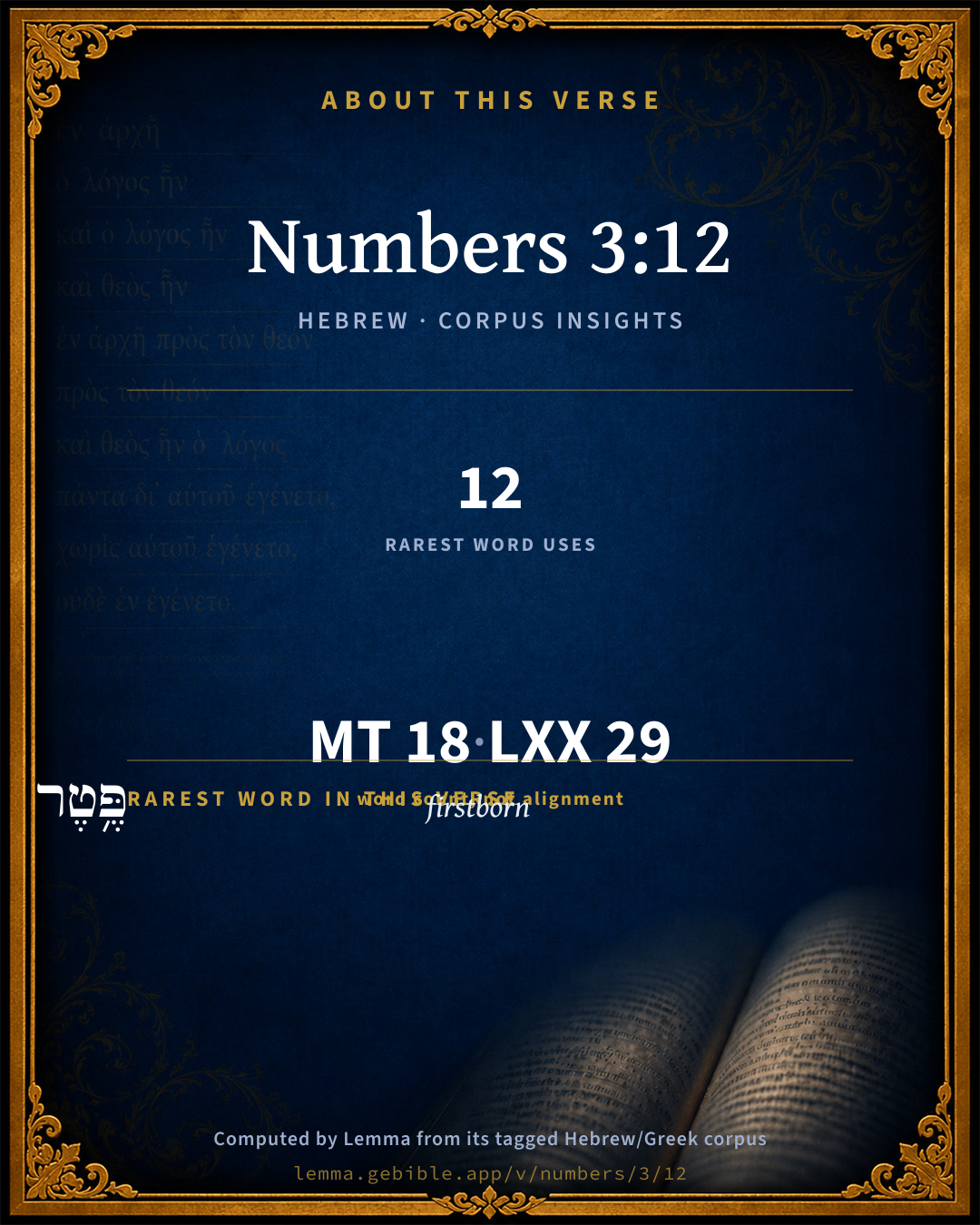
The rarest word here is פֶּ֥טֶר firstborn H6363 — appearing just 12 times in the whole Hebrew Bible.

Shared distinctive vocabulary

פֶּ֥טֶר firstborn H6363 occurs in 10 verses of the Hebrew Bible. Also found in:

Grammatical profile

  • 2 verbs
  • 11 nouns
  • 1 pronoun
  • 2 prepositions
  • 2 particles

Verb forms

  • לָקַ֣חְתִּי Qal · Perfect
  • וְהָ֥יוּ Qal · Sequential Perfect

Repetition

Words recur within this verse — often emphatic in Hebrew:

  • הַלְוִיִּ֗ם Levite H3881 ×2
  • בְּנֵ֣י son H1121 ×2
  • יִשְׂרָאֵ֔ל Israel H3478 ×2

Hebrew & Septuagint length

In English translation the verse runs 32 words from the Hebrew and 39 from the Septuagint (LXX English) — closely comparable.

A rough comparison of the two English renderings, which tokenize alike — not a word-level alignment.

Word counts can differ between the Hebrew and the Greek without any difference in meaning — e.g. the Hebrew direct-object marker אֵת has no separate Greek word, and Greek often adds the article ὁ.

In the original languages it is 18 Hebrew tokens and 29 Greek tokens — but the two are counted differently (Hebrew bundles its prefixes and suffixes into one token; the Greek is in lemma form), so that isn’t a like-for-like length.

Cross-references

6

Topical passages linked to Numbers 3:12 in the Treasury of Scripture Knowledge — connected by theme and wording, ordered by reader-vote popularity; previews shown in the World English Bible.

  • Numbers 3:41 You shall take the Levites for me (I am Yahweh) instead of all the firstborn among the children of Israel; and the cattle of the Levites instead of all the firstborn among the cattle of the children of Israel."
  • Numbers 8:16 For they are wholly given to me from among the children of Israel; instead of all who open the womb, even the firstborn of all the children of Israel, I have taken them to me.
  • Numbers 18:6 I, behold, I have taken your brothers the Levites from among the children of Israel: to you they are a gift, given to Yahweh, to do the service of the tent of meeting.
  • Exodus 13:2 "Sanctify to me all of the firstborn, whatever opens the womb among the children of Israel, both of man and of animal. It is mine."
  • Numbers 3:45 "Take the Levites instead of all the firstborn among the children of Israel, and the cattle of the Levites instead of their cattle; and the Levites shall be mine. I am Yahweh.
  • Numbers 8:18 I have taken the Levites instead of all the firstborn among the children of Israel.

Cross-references courtesy of OpenBible.info (CC BY 4.0).

Hebrew and Greek witnesses Masoretic Hebrew ↔ Greek Septuagint

The same verse in the two great witnesses to the Old Testament, shown verse-for-verse.

These are two independent witnesses, not word-aligned to each other, and the Septuagint is shown in lemma (dictionary) form.

Hebrew Numbers 3:12 Masoretic · Westminster Leningrad Codex

וַאֲנִ֞י הִנֵּ֧ה לָקַ֣חְתִּי אֶת הַלְוִיִּ֗ם מִתּוֹךְ֙ בְּנֵ֣י יִשְׂרָאֵ֔ל תַּ֧חַת כָּל בְּכ֛וֹר פֶּ֥טֶר רֶ֖חֶם מִבְּנֵ֣י יִשְׂרָאֵ֑ל וְהָ֥יוּ לִ֖י הַלְוִיִּֽם

"Behold, I have taken the Levites from among the children of Israel instead of all the firstborn who open the womb among the children of Israel; and the Levites shall be mine:

World English Bible · Public Domain

Greek LXX Numbers 3:12 Septuagint · lemma form

καί ἐγώ ἰδού λαμβάνω ὁ λευίτης ἐκ μέσος ὁ υἱός ἰσραήλ ἀντί πᾶς πρωτότοκος δια ἀναοἴγω μήτρα παρά ὁ υἱός ἰσραήλ λύτρον αὐτός εἰμί καί εἰμί ἐγώ ὁ λευίτης

Behold, I have taken the Levites from the midst of the children of Israel, instead of every male that opens the womb from among the children of Israel: they shall be their ransom, and the Levites shall be mine.

LXX2012 (modern English Septuagint) · Public Domain

On this verse, The Pulpit Commentary discusses the Septuagint’s reading. Read the note in Commentary ↓

Hebrew: Westminster Leningrad Codex (CC BY 4.0). Greek: Septuagint (public domain); English from LXX2012 (modern English Septuagint) (Public Domain). How the Septuagint differs from the Hebrew →

Targum (Aramaic paraphrase)

2

The Targum is the ancient Jewish Aramaic paraphrase of the Hebrew Scriptures — an interpretive translation, not the Hebrew text itself. Onkelos (literal) and Pseudo-Jonathan (expansive) render the Torah, and Jonathan the Prophets. Coverage is partial: where no permissively-licensed English translation exists for a verse, only the Aramaic is shown. This is verse-level text, not a word-by-word alignment to the Hebrew.

  1. Targum Onkelos Torah (Genesis–Deuteronomy)
    וַאֲנָא הָא קְרֵבִית יָת לֵוָאֵי מִגוֹ בְּנֵי יִשְׂרָאֵל חֲלַף כָּל בּוּכְרָא פְּתַח וַלְדָא מִבְּנֵי יִשְׂרָאֵל וִיהוֹן מְשַׁמְשִׁין קֳדָמַי לֵוָאֵי

    (no public-domain English translation for this verse)

    Targum Onkelos — Aramaic: “Onkelos Genesis” (public domain); “Onkelos Exodus” (public domain); “Onkelos Leviticus” (public domain); “Onkelos Numbers” (public domain); “Onkelos Deuteronomy” (public domain). English: “Sefaria Community Translation” (CC0 1.0 (public-domain dedication)); “J.W. Etheridge. The Targums of Onkelos and Jonathan Ben Uzziel on the Pentateuch. London: Longmans, Green, 1862” (public domain). Text via Sefaria.

  2. Targum Pseudo-Jonathan Torah (Genesis–Deuteronomy)
    וַאֲנָא הָא קָרֵיבִית יַת לֵיוָאֵי מִגוֹ בְּנֵי יִשְרָאֵל חֲלַף כָּל בּוּכְרַיָא פְּתַח וַלְדָא מִבְּנֵי יִשְרָאֵל וִיהוֹן מְשַׁמְשִׁין קֳדָמַי לֵיוָאֵי

    And I, behold, I have brought nigh the Levites from among the sons of Israel, instead of all the first-born who open the womb among the sons of Israel; and the Levites shall minister before Me.

    Targum Pseudo-Jonathan — Aramaic: “Targum Jonathan on Genesis” (public domain); “Targum Jonathan on Exodus” (public domain); “Targum Jonathan on Leviticus” (public domain); “Targum Jonathan on Numbers” (public domain); “Targum Jonathan on Deuteronomy” (public domain). English: “The Targum of Jonathan ben Uzziel, trans. J. W. Etheridge, London, 1862” (public domain). Text via Sefaria.

Commentary

Notes on Numbers 3:12 from classic Christian and Jewish commentators (each source and its license shown beneath its notes). The classic Christian expositions comment on the surrounding passage and are grouped to its opening verse, so a note may address several verses; the Jewish commentaries on the Tanakh (Rashi and others) are per-verse, so they appear only where the commentator wrote on this verse.

Lemma curates 59 commentaries, every one of them public domain or Creative Commons licensed, each selected and text-cleaned for this edition rather than reprinted as found. About our sources →

Joseph Benson's Commentary

Num 3:12. The firstborn — Who were God’s property: (Exo 13:12,) and to whom the administration of holy things was formerly committed, which now was taken away from them, either because they had forfeited this privilege by joining with the rest of their brethren in the idolatrous worship of the calf, or because they were to be mainly concerned in the distribution and management of the inheritances which now they were going to possess, and therefore could not be at leisure to attend upon the service of the sanctuary: and God would not commit it to some other persons in each tribe, which might be an occasion of idolatry, confusion, division, and contempt of sacred things, but to one distinct tribe, which might be entirely devoted to that service, and particularly to the tribe of Levi; partly out of his respect to Moses and Aaron, branches of this tribe; partly as a recompense of their zeal for God against idolaters, and partly because it was the smallest of the tribes, and therefore most likely to find both employment in, and maintenance for the work.

Joseph Benson's Commentary on the Old and New Testaments (1811–1818) — public domain. Text from a community e-Sword module.

Adam Clarke's Commentary

Verse 12. I have taken the Levites - instead of all the first-born] The Levites are taken for the service of the sanctuary in place of the first-born. The first-born were dedicated to God in commemoration of his slaying the first-born of the Egyptians, and preserving those of the Israelites. Even the cattle of the Levites were taken in place of the first-born of the cattle of the rest of the tribes. See Nu 3:45.

Several reasons have been assigned why God should give this honour to the tribe of Levi in preference to all the others, but they do not seem to me to be conclusive. Their zeal in destroying those who had corrupted the worship of God in the business of the golden calf, Ex 32:28, has been thought a sufficient reason. A better reason is, that this was the smallest tribe, and they were quite enough for the service. To have had a more numerous tribe at this time would have been very inconvenient.

Aaron, says Mr. Ainsworth, being in his priesthood a type of Christ, all these rites are fulfilled in him. For unto Christ God gave children, Heb 2:13. And they are a congregation of first-born, whose names are written in heaven, Heb 12:23, being of God's own will begotten by the word of truth, that they should be a kind of first-fruits of his creatures, Jas 1:18, to whom he also gives the first-fruits of his Spirit, Ro 8:23. These wait on and follow the Lamb, being first-fruits unto God and to the Lamb, Re 14:4; and Christ hath made us kings and priests unto God and his Father, that we may serve him day and night in his temple, Re 1:6; Re 7:15.

Adam Clarke's Commentary on the Bible (1810–1826) — public domain. Text from a community e-Sword/MySword module.

The Cambridge Bible for Schools and Colleges

gen. ed. J. J. S. Perowne

12. All male first-born of men and animals are sacred to God, i.e. they must be sacrificed. In very primitive ages it is probable that this custom actually prevailed (cf. Genesis 22, 2Ki_3:27, Mic_6:7), but the Israelite practice of redeeming human first-born by an equivalent in money or animals must have arisen at an early date. The practice of offering the firstborn is enjoined in J E (Exo_22:29 (E ), Num_13:11-33 [Note: J, however, differs from P in dating the offering of first-born not from the Exodus but from the entrance into Canaan.] , Num_34:19 f. (J )), Num_18:15 f. (P ), and the redemption (in P ) is to be by a money payment. But at this point, in P , a different form of redemption is commanded, i.e. the handing over of the Levites for service. This subject is resumed in Num_3:40-51, where it is explained that the Levites were substituted only for those firstborn who were more than a month old at the time.

The Cambridge Bible for Schools and Colleges (gen. ed. J. J. S. Perowne; Cambridge University Press, 1878–1918) — public domain. Text from a community e-Sword module.

John Gill's Exposition

And I, behold, I have taken the Levites from among the children of Israel,.... Separated them from others, and set them apart for the service of the sanctuary; this was his own act and deed, and which he did of his own will and pleasure, who is a sovereign Being, and might and would do whatsoever he pleased, nor should any object unto him, or contradict him: and this he did:

instead of all the firstborn that openeth the matrix among the children of Israel; he made an exchange of those for the Levites; upon the destruction of the firstborn of Egypt, and saving the firstborn of Israel, he claimed the latter as his own in a special sense, and now he gave up his right to them, and instead thereof took the Levites; nor could the people of Israel reasonably object to this, nor be uneasy at it, but rather be pleased with it; since hereby they were not only freed from the charge of redeeming their firstborn, but since they were the Lord's, he might have appointed them to be servants to the priests; and every Israelite would choose rather, no doubt, to part with a tribe for this service than to have their firstborn sons employed in it; and there were none so fit as the tribe of Levi, not only because it was a small tribe, but because the priests were of this tribe, to whom they were to minister; and therefore as there was a connection between them, the Levites would readily serve them: it is a notion that has obtained both among Jews and Christians, that the firstborn before this time were priests in the family, but now the Levites were taken in their room; and Jarchi particularly observes, that when the firstborn sinned in the business of the calf, they were rejected, and the Levites, who did not commit idolatry, were chosen in their room; but it does not appear, before the fixing the priesthood in Aaron's family, that the firstborn in a family were priests, and officiated as such, but rather the father and head of the family for the whole, or everyone for himself, as in Adam's family, he and his two sons; and moreover, it was a recent thing, and only among the Hebrews, that the firstborn were in a peculiar manner the Lord's, not as priests, only to be redeemed, and now the Levites were redeemed in their room; it was not to be priests, but the servants of the priests (r):

therefore the Levites shall be mine; whom he gave to the priests to assist them in their work, which was for him and his glory.

(r) Vid. Outram. de Sacrificiis, l. 1. c. 4. sect. 1, 2, 3.

John Gill's Exposition of the Whole Bible (1746–1763) — public domain (CC PDM 1.0). Text via the HelloAO Bible API.

Haydock's Catholic Bible Commentary

Mine. God claimed the first-born, on account of having spared them, Exodus xii. 23. He requires that all males shall be redeemed, except those of the tribe of Levi, whom he claims as his peculiar portion, as the price of the redemption of those who were living in Egypt, when the destroying angel passed by. This honour was wholly gratuitous, though the Levites deserved to obtain a confirmation of it by their zeal, Exodus xxxii. 29., and Deuteronomy xxxiii. 9. God seems to have revealed to Moses the destination of Aaron’s family, long before they were appointed to exercise the functions of the priesthood, Exodus xix. 22, 24, and xxiv. 1. (Calmet)

George Leo Haydock (1774–1849), Haydock's Catholic Family Bible and Commentary, 1859 edition — public domain. Excludes Psalms (Douay-Rheims chapter numbering differs from Protestant) and Deuterocanonical books (Catholic canon only).

Matthew Poole's English Annotations

Instead of all the first-born, who were God’s propriety by right of redemption, Exo 13:12, and to whom the administration of holy things was formerly committed, which now was taken away from them, either because they had forfeited this privilege by joining with the rest of their brethren in the idolatrous worship of the calf, or because they were to be mainly concerned in the distribution and management of the inheritances which now they were going to possess, and therefore could not be at leisure to attend upon the service of the sanctuary; which made it fit that this work should be committed to other hands. And God would not commit it to some other persons in each tribe, which might be an occasion of idolatry, confusion, division, and contempt of sacred things, but to one distinct tribe, which might be entirely devoted to that service, and particularly to the tribe of Levi; partly, out of his respect to Moses and Aaron, branches of this tribe; partly, as a recompence of their zeal for God and against idolaters; see Exo 32:26,29; Deu 33:9; and partly, because it was the smallest of the tribes, and therefore most likely to find both employment in and maintenance for the work.

Matthew Poole's English Annotations on the Holy Bible (1683–1685) — public domain. Text from a community e-Sword/MySword module.

Whedon's Commentary on the Bible

Daniel D. Whedon

12. Openeth the matrix — Or womb. “This expression is generally employed in cases in which a common term is required to designate the firstborn of both man and beast, (Exo_13:2; Exo_13:12-15; Exo_34:19-20; Num_8:16-17; also Num_18:15; Eze_20:26;) but even then, wherever the two are distinguished, the term פשׂר, peter, is applied to the firstborn of animals, and בכורto the firstborn sons of men. On the other hand, where only firstborn sons are referred to, as in Deu_21:15-17, we look in vain for the expression peter rechem — ’openeth the womb.’ Again, the Old Testament, like modern law, recognises only firstborn sons, and does not apply the term firstborn to daughters at all.” — Keil and Delitzsch. The law of inheritance omits the daughter in designating the firstborn. In case of polygamy there was only one firstborn.

Daniel D. Whedon (gen. ed.), Commentary on the Old and New Testaments (1874–1909) — public domain. Text from a community e-Sword module.

The Pulpit Commentary

I have taken the Levites. The actual separation of Levi had been already anticipated, (see Num_1:47, Num_1:53) but the meaning and purpose of that separation is now formally declared, into reason, however, is assigned for the choice of this particular tribe. It is almost always assumed that their zeal in the matter of the golden calf was the ground of the preference shown to them now. But it may be doubted whether there was any "preference" in the matter at all. To Aaron and his seed on undoubted and important preference was shown, but the functions and position of the Levites were not such as to give them any preeminence, or to secure them any substantial advantage. They were tied down to the performance of routine duties, which demanded no intelligence, and gave scope for no ambitions. The one obvious reason why Levi was selected is to be found in the fact that he was by far the smallest in numbers among the tribes, being less than half the next smallest, Manasseh, and almost exactly balancing the first-born. A larger tribe could not have been spared, and would not have been needed, for the purpose in question. If any more recondite motive must be sought for the Divine selection, it must be found in the prophecy of Gen_49:7. Levi as well as Simeon, though in a different way, was doomed never to raise his head as a united and powerful tribe among his brethren.

Instead of all the first-born. The Septuagint inserts here, "they shall be their ransom."

The Pulpit Commentary (1880–1919), ed. H.D.M. Spence-Jones & Joseph S. Exell — public domain. Text from a community e-Sword module.

John Wesley's Explanatory Notes

The first-born - Who were God's property, Exod. xiii, 12, and to whom the administration of holy things was formerly committed, which now was taken away from them, either because they had forfeited this privilege by joining with the rest of their brethren in the idolatrous worship of the calf, or because they were to be mainly concerned in the distribution and management of the inheritances which now they were going to possess, and therefore could not be at leisure to attend upon the service of the sanctuary: and God would not commit it to some other persons in each tribe, which might be an occasion of idolatry, confusion, division, and contempt of sacred things, but to one distinct tribe, which might be entirely devoted to that service, and particularly to the tribe of Levi; partly out of his respect to Moses and Aaron, branches of this tribe; partly as a recompence of their zeal for God against idolaters, and partly because it was the smallest of the tribes, and therefore most likely to find both employment in, and maintenance for the work.

John Wesley, Explanatory Notes Upon the Whole Bible (1754–1765) — public domain. Text via the GEBible commentary corpus.

Rashi

Rabbi Shlomo Yitzchaki (Rashi)

ואני הנה לקחתי AND I, BEHOLD I HAVE TAKEN [THE LEVITES FROM AMONG THE CHILDREN OF ISRAEL] — This means: And I — whence do “I” claim the right on them from among the children of Israel, that the Israelites should have to hire them (cf. Rashi on v. 8) for My service? It is through the firstborn — to whom I surely have a title — that I have a claim on them (the Levites) and so I take them in their (the firstborns’) stead. For originally the service (the priestly functions) was performed by the firstborn, but when they (the Israelites and among them their firstborn too) sinned by worshipping the golden calf they became disqualified, and the Levites who had not worshipped the idol were chosen in their stead (cf. Zevachim 112b).

Rashi on the Tanakh — English translations: “The Judaica Press complete Tanach with Rashi, translated by A. J. Rosenberg” (CC BY 4.0); “Pentateuch with Rashi's commentary by M. Rosenbaum and A.M. Silbermann, 1929-1934” (public domain); “The Metsudah Tanach series, Lakewood, N.J” (CC BY 4.0); and “The Book of Joshua, Metsudah Publications, 1997” (CC BY 4.0). Text via Sefaria.

Lesson kit

Teaching starters — assembled from the data on this page, not authored interpretation. Every prompt links to the verse data it draws on. Edit before teaching.

Numbers, in the Pentateuch, opens this verse with 18 words (14 distinct Hebrew lemmas). Its most distinctive word is peṭer (“firstborn”). A historical commentator’s framing appears above. Read the whole chapter for the surrounding context.

Discussion questions

  1. What does “firstborn” (peṭer) contribute to the verse as a whole?
  2. Exodus 13:2 shares the word «firstborn» with this verse. How do the two illuminate each other?
  3. “Levite” occurs 2× in this one verse. What is the effect of the repetition?
  4. These translations render this verse differently. What is at stake in choosing one wording over another?
  5. The verb «לָקַ֣חְתִּי» is Qal Perfect. How does its form color the action?
  6. Reading how Joseph Benson's Commentary and Adam Clarke's Commentary read this verse, where do the two commentators agree and where do they part?

Things to notice

Reading settings

Reading text

Shown beneath each verse's original-language words.

Old Testament
Old Testament edition

Read the OT as the Masoretic Hebrew (MT) or the Greek Septuagint (LXX).

English shown for the Greek Septuagint (in the Hebrew ↔ Greek comparison).

Comparing translations? Open the Compare panel on any verse page to stack up to four side by side.