
Ezekiel 34:8

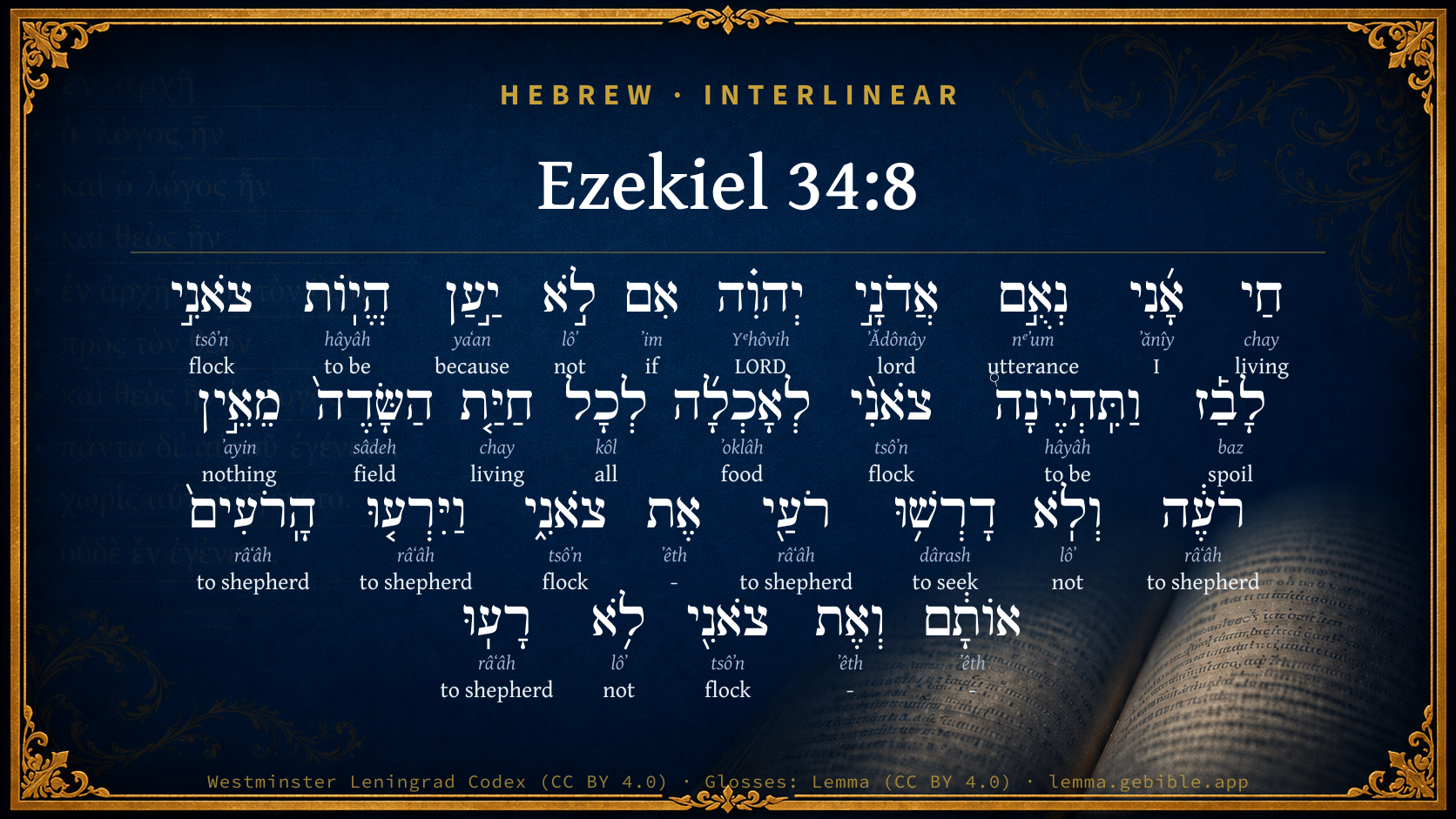
Hebrew (Westminster Leningrad Codex) Ezekiel 34:8 appears in the Hebrew Old Testament. The text above is from the Westminster Leningrad Codex. Each word links to its Strong’s number, a concise gloss, and parsing drawn from the Open Scriptures Hebrew Bible morphology. Click any word for its full Brown-Driver-Briggs (BDB) entry.
Download image
Cite this verse

Ezekiel 34:8 (World English Bible). Public Domain. Lemma interlinear Bible study tool, https://lemma.gebible.app/v/ezekiel/34/8.

Show BibTeX & RIS
BibTeX
RIS
English Translation
As I live, says the Lord Yahweh, surely because my sheep became a prey, and my sheep became food to all the animals of the field, because there was no shepherd, neither did my shepherds search for my sheep, but the shepherds fed themselves, and didn't feed my sheep;
World English Bible · Public Domain
Download a study sheet

One document with this verse’s original text, its word-by-word gloss line, the meaning frame, cross-references with their text, attributed commentary, and full source and license credits — printable, and it pastes into notes with its structure intact.

This verse Autodidact and up

Study sheet (.html) Plain text (.txt)

A passage Seminary Student

Up to 50 verses in one chapter. A passage sheet keeps up to 6 commentary sources and 12 cross-references per verse, in the order this page ranks them, and says so on the sheet whenever that leaves anything out. Ask for a single verse and you get the Autodidact verse sheet above.

Everything on this page stays free to read, with no account — the sheet is a download of what is already on screen, not access to it.

Want to remove ads? Support Godless Engineer
Compare translations 3

The same verse in 3 English versions, stacked beneath the original-language interlinear above. Click any original word for its lexicon entry.

Each is an independent rendering of the whole verse — the interlinear is not word-aligned to these translations.

Highlighted words mark where these versions differ — a whole-verse word diff, not a word-by-word alignment.

  • World English Bible Public Domain
    As I live, says the Lord Yahweh, surely because my sheep became a prey, and my sheep became food to all the animals of the field, because there was no shepherd, neither did my shepherds search for my sheep, but the shepherds fed themselves, and didn't feed my sheep;
  • King James Version Public Domain
    As I live, saith the Lord GOD, surely because my flock became a prey, and my flock became meat to every beast of the field, because there was no shepherd, neither did my shepherds search for my flock, but the shepherds fed themselves, and fed not my flock;
  • unfoldingWord Literal Text CC BY-SA 4.0
    As I live—this is the Lord Yahweh’s declaration—because my flock has become plunder and food for all the beasts in the fields, because there was no shepherd and none of my shepherds sought my flock, but the shepherds guarded themselves and did not shepherd my flock.

unfoldingWord Literal Text — © unfoldingWord, licensed CC BY-SA 4.0. Word-aligned USFM3 via Door43 (git.door43.org/unfoldingWord/en_ult).

Versions to compare (up to 4)

3 of 4 selected

Show all 18 translations

Every available English version of this verse, each an independent rendering of the whole verse.

  • World English Bible Public Domain
    As I live, says the Lord Yahweh, surely because my sheep became a prey, and my sheep became food to all the animals of the field, because there was no shepherd, neither did my shepherds search for my sheep, but the shepherds fed themselves, and didn't feed my sheep;
  • Berean Standard Bible Public Domain
    ‘As surely as I live, declares the Lord GOD, because My flock lacks a shepherd and has become prey and food for every wild beast, and because My shepherds did not search for My flock but fed themselves instead,
  • Majority Standard Bible Public Domain
    ‘As surely as I live, declares the Lord GOD, because My flock lacks a shepherd and has become prey and food for every wild beast, and because My shepherds did not search for My flock but fed themselves instead,
  • King James Version Public Domain
    As I live, saith the Lord GOD, surely because my flock became a prey, and my flock became meat to every beast of the field, because there was no shepherd, neither did my shepherds search for my flock, but the shepherds fed themselves, and fed not my flock;
  • American Standard Version (1901) Public Domain
    As I live, saith the Lord Jehovah, surely forasmuch as my sheep became a prey, and my sheep became food to all the beasts of the field, because there was no shepherd, neither did my shepherds search for my sheep, but the shepherds fed themselves, and fed not my sheep;
  • Revised Version (1885) Public Domain
    As I live, saith the Lord GOD, surely forasmuch as my sheep became a prey, and my sheep became meat to all the beasts of the field, because there was no shepherd, neither did my shepherds search for my sheep, but the shepherds fed themselves, and fed not my sheep;
  • Geneva Bible (1599) Public Domain
    As I liue, sayeth the Lord God, surely because my flocke was spoyled, and my sheepe were deuoured of all the beasts of the fielde, hauing no shepherde, neither did my shepherdes seeke my sheepe, but the shepherdes fedde them selues, and fedde not my sheepe,
  • Douay-Rheims (1899) Public Domain
    As I live, saith the Lord God, forasmuch as my flocks have been made a spoil, and my sheep are become a prey to all the beasts of the field, because there was no shepherd: for my shepherds did not seek after my flock, but the shepherds fed themselves, and fed not my flocks:
  • Young's Literal Translation Public Domain
    I live -- an affirmation of the Lord Jehovah, If not, because of My flock being for a prey, Yea, My flock is for food to every beast of the field, Because there is no shepherd, And My shepherds have not sought My flock, And the shepherds do feed themselves, And My flock they have not fed.
  • Literal Standard Version CC BY-SA 4.0
    [As] I live—a declaration of Lord YHWH, || If not, because of My flock being for a prey, || Indeed, My flock is for food to every beast of the field, || Because there is no shepherd, || And My shepherds have not sought My flock, || And the shepherds feed themselves, || And they have not fed My flock.
  • Unlocked Literal Bible CC BY-SA 4.0
    As I live—this is the Lord Yahweh's declaration—because my flock has become plunder and food for all the beasts in the fields, because there was no shepherd and none of my shepherds sought my flock, but the shepherds guarded themselves and did not shepherd my flock.
  • unfoldingWord Literal Text CC BY-SA 4.0
    As I live—this is the Lord Yahweh’s declaration—because my flock has become plunder and food for all the beasts in the fields, because there was no shepherd and none of my shepherds sought my flock, but the shepherds guarded themselves and did not shepherd my flock.
  • Darby Bible Public Domain
    [As] I live, saith the Lord Jehovah, verily because my sheep have been a prey, and my sheep have been meat to every beast of the field, because there was no shepherd, and my shepherds searched not for my flock, but the shepherds fed themselves, and fed not my flock,
  • World Messianic Bible Public Domain
    “As I live,” says the Lord GOD, “surely because my sheep became a prey, and my sheep became food to all the animals of the field, because there was no shepherd, and my shepherds didn’t search for my sheep, but the shepherds fed themselves, and didn’t feed my sheep,
  • Webster's Bible Public Domain
    As I live, saith the Lord GOD, surely because my flock became a prey, and my flock became food to every beast of the field, because there was no shepherd, neither did my shepherds search for my flock, but the shepherds fed themselves, and fed not my flock;
  • Free Bible Version CC BY-SA 4.0
    As I live, declares the Lord God, because my sheep didn't have a shepherd and were preyed on by all the wild animals for food, and because my shepherds didn't look after my sheep but instead only fed themselves,
  • Bible in Basic English Public Domain
    By my life, says the Lord, truly, because my sheep have been taken away, and my sheep became food for all the beasts of the field, because there was no keeper, and my keepers did not go in search of the sheep, but the keepers took food for themselves and gave my sheep no food;
  • JPS Tanakh (1917) Public Domain
    As I live, saith the Lord GOD, surely forasmuch as My sheep became a prey, and My sheep became food to all the beasts of the field, because there was no shepherd, neither did My shepherds search for My sheep, but the shepherds fed themselves, and fed not My sheep;

Literal Standard Version (2020), Covenant Press — licensed CC BY-SA 4.0. Text via the HelloAO Bible API (eBible.org). Unlocked Literal Bible (unfoldingWord) — licensed CC BY-SA 4.0. Text via the HelloAO Bible API (eBible.org). unfoldingWord Literal Text — © unfoldingWord, licensed CC BY-SA 4.0. Word-aligned USFM3 via Door43 (git.door43.org/unfoldingWord/en_ult). Free Bible Version, Dr. Jonathan Gallagher — licensed CC BY-SA 4.0. Text via the HelloAO Bible API (eBible.org).

Word by word

More ways to search: Search by grammar → Find every occurrence → Compare this word →

Practice this passage: Drill this verse → Learn its vocabulary →

לְאָכְלָ֜ה
ʼoklâh
H402
“to/for · food”
Preposition + Noun, Common, Feminine, Singular, Absolute
Part of Speech
Preposition + Noun
Type
Common
Gender
Feminine
Number
Singular
State
Absolute
Full BDB Definition

Origin: from H401

TWOT: 85b

food - food, eating - object of devouring, consuming - by wild beasts (figurative) - in fire - of judgment (figurative)
  1. חַי chay H2416 “living” Adjective, Adjective, Masculine, Singular, Absolute
  2. אָ֜נִי ʼănîy H589 “I” Pronoun, Personal, 1st Person, Common, Singular
  3. נְאֻ֣ם nᵉʼum H5002 “utterance of” Noun, Common, Masculine, Singular, Construct
  4. אֲדֹנָ֣י ʼĂdônây H136 “Lord · my” Noun, Common, Masculine, Plural, Construct + Suffix, Personal, 1st Person, Common, Singular
  5. יְהוִ֗ה Yᵉhôvih H3069 “LORD” Noun, Proper
  6. אִם ʼim H518 “if” Conjunction
  7. לֹ֣א lôʼ H3808 “not” Particle, Negative
  8. יַ֣עַן yaʻan H3282 “because” Conjunction
  9. הֱיֽוֹת hâyâh H1961 “to be” Verb, Qal, Infinitive Construct
  10. צֹאנִ֣י tsôʼn H6629 “flock · my” Noun, Common, Both, Singular, Construct + Suffix, Personal, 1st Person, Common, Singular
  11. לָבַ֡ז baz H957 “to/for · spoil” Preposition + Noun, Common, Masculine, Singular, Absolute
  12. וַתִּֽהְיֶינָה֩ hâyâh H1961 “and · to be” Conjunction + Verb, Qal, Sequential Imperfect, 3rd Person, Feminine, Plural
  13. צֹאנִ֨י tsôʼn H6629 “flock · my” Noun, Common, Both, Singular, Construct + Suffix, Personal, 1st Person, Common, Singular
  14. לְכָל kôl H3605 “to/for · all of” Preposition + Noun, Common, Masculine, Singular, Construct
  15. חַיַּ֤ת chay H2416 “living of” Noun, Common, Feminine, Singular, Construct
  16. הַשָּׂדֶה֙ sâdeh H7704 “the · field” Particle, Definite Article + Noun, Common, Masculine, Singular, Absolute
  17. מֵאֵ֣ין ʼayin H369 “from · nothing” Preposition + Particle, Negative
  18. רֹעֶ֔ה râʻâh H7462 “shepherding” Verb, Qal, Participle Active, Masculine, Singular, Absolute
  19. וְלֹֽא lôʼ H3808 “and · not” Conjunction + Particle, Negative
  20. דָרְשׁ֥וּ dârash H1875 “to seek” Verb, Qal, Perfect, 3rd Person, Common, Plural
  21. רֹעַ֖י râʻâh H7462 “shepherding · me” Verb, Qal, Participle Active, Masculine, Plural, Construct + Suffix, Personal, 1st Person, Common, Singular
  22. אֶת ʼêth H853 “-” Particle, Direct Object
  23. צֹאנִ֑י tsôʼn H6629 “flock · my” Noun, Common, Both, Singular, Construct + Suffix, Personal, 1st Person, Common, Singular
  24. וַיִּרְע֤וּ râʻâh H7462 “and · to shepherd” Conjunction + Verb, Qal, Sequential Imperfect, 3rd Person, Masculine, Plural
  25. הָֽרֹעִים֙ râʻâh H7462 “the · shepherding” Particle, Definite Article + Verb, Qal, Participle Active, Masculine, Plural, Absolute
  26. אוֹתָ֔ם ʼêth H853 “- · them” Particle, Direct Object + Suffix, Personal, 3rd Person, Masculine, Plural
  27. וְאֶת ʼêth H853 “and · -” Conjunction + Particle, Direct Object
  28. צֹאנִ֖י tsôʼn H6629 “flock · my” Noun, Common, Both, Singular, Construct + Suffix, Personal, 1st Person, Common, Singular
  29. לֹ֥א lôʼ H3808 “not” Particle, Negative
  30. רָעֽוּ râʻâh H7462 “to shepherd” Verb, Qal, Perfect, 3rd Person, Common, Plural

About this verse

These counts appear in no published source. They are computed here, from the morphology-tagged text and Lemma’s own curated glosses. What Lemma adds →

31
words
18
distinct lemmas
Prophets
section

Notable vocabulary

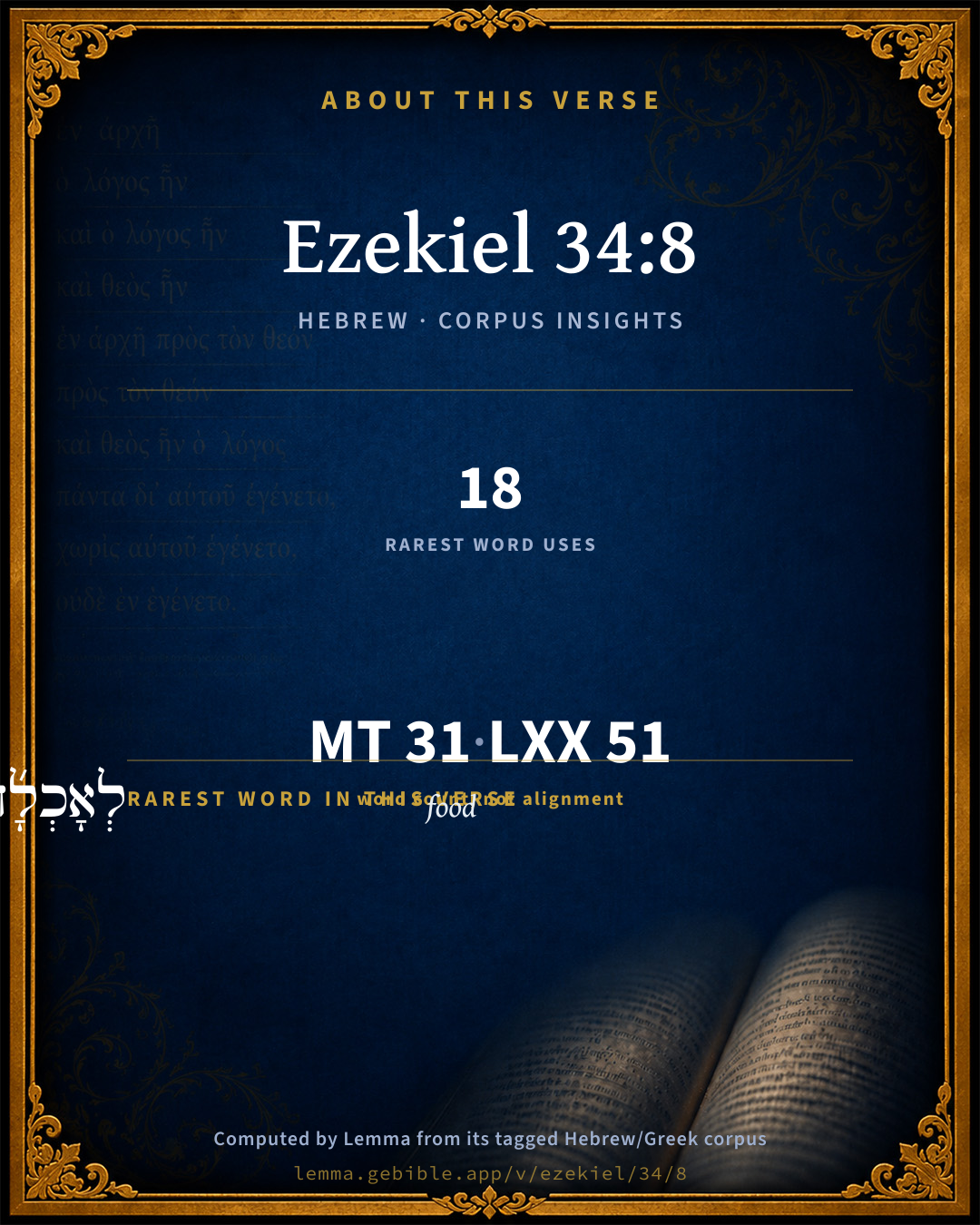
The rarest word here is לְאָכְלָ֜ה food H402 — appearing just 18 times in the whole Hebrew Bible.

Shared distinctive vocabulary

לְאָכְלָ֜ה food H402 occurs in 18 verses of the Hebrew Bible. Also found in:

Grammatical profile

  • 8 verbs
  • 12 nouns
  • 1 adjective
  • 1 pronoun
  • 2 conjunctions
  • 7 particles

Verb forms

  • הֱיֽוֹת Qal · Infinitive Construct
  • וַתִּֽהְיֶינָה֩ Qal · Sequential Imperfect
  • רֹעֶ֔ה Qal · Participle Active
  • דָרְשׁ֥וּ Qal · Perfect
  • רֹעַ֖י Qal · Participle Active
  • וַיִּרְע֤וּ Qal · Sequential Imperfect
  • הָֽרֹעִים֙ Qal · Participle Active
  • רָעֽוּ Qal · Perfect

Repetition

Words recur within this verse — often emphatic in Hebrew:

  • רֹעֶ֔ה to shepherd H7462 ×5
  • צֹאנִ֣י flock H6629 ×4
  • חַי living H2416 ×2
  • הֱיֽוֹת to be H1961 ×2
  • לֹ֣א not H3808 ×3

Hebrew & Septuagint length

In English translation the verse runs 49 words from the Hebrew and 50 from the Septuagint (LXX English) — closely comparable.

A rough comparison of the two English renderings, which tokenize alike — not a word-level alignment.

Word counts can differ between the Hebrew and the Greek without any difference in meaning — e.g. the Hebrew direct-object marker אֵת has no separate Greek word, and Greek often adds the article ὁ.

In the original languages it is 31 Hebrew tokens and 51 Greek tokens — but the two are counted differently (Hebrew bundles its prefixes and suffixes into one token; the Greek is in lemma form), so that isn’t a like-for-like length.

Cross-references

9

Topical passages linked to Ezekiel 34:8 in the Treasury of Scripture Knowledge — connected by theme and wording, ordered by reader-vote popularity; previews shown in the World English Bible.

  • 2 Peter 2:13 receiving the wages of unrighteousness; people who count it pleasure to revel in the day-time, spots and blemishes, reveling in their deceit while they feast with you;
  • Ezekiel 34:2–3 Son of man, prophesy against the shepherds of Israel, prophesy, and tell them, even to the shepherds, Thus says the Lord Yahweh: Woe to the shepherds of Israel who feed themselves! Shouldn't the shepherds feed the sheep?
  • Ezekiel 34:5–6 They were scattered, because there was no shepherd; and they became food to all the animals of the field, and were scattered.
  • Ezekiel 34:10 Thus says the Lord Yahweh: Behold, I am against the shepherds; and I will require my sheep at their hand, and cause them to cease from feeding the sheep; neither shall the shepherds feed themselves any more; and I will deliver my sheep from their mouth, that they may not be food for them.
  • Ezekiel 34:18 Seems it a small thing to you to have fed on the good pasture, but you must tread down with your feet the residue of your pasture? and to have drunk of the clear waters, but you must foul the residue with your feet?
  • Ezekiel 34:31 You my sheep, the sheep of my pasture, are men, and I am your God, says the Lord Yahweh.
  • Acts 20:33 I coveted no one's silver, or gold, or clothing.
  • 1 Corinthians 9:15 But I have used none of these things, and I don't write these things that it may be done so in my case; for I would rather die, than that anyone should make my boasting void.
  • Jude 1:12 These are hidden rocky reefs in your love feasts when they feast with you, shepherds who without fear feed themselves; clouds without water, carried along by winds; autumn leaves without fruit, twice dead, plucked up by the roots;

Cross-references courtesy of OpenBible.info (CC BY 4.0).

Hebrew and Greek witnesses Masoretic Hebrew ↔ Greek Septuagint

The same verse in the two great witnesses to the Old Testament, shown verse-for-verse.

These are two independent witnesses, not word-aligned to each other, and the Septuagint is shown in lemma (dictionary) form.

Hebrew Ezekiel 34:8 Masoretic · Westminster Leningrad Codex

חַי אָ֜נִי נְאֻ֣ם אֲדֹנָ֣י יְהוִ֗ה אִם לֹ֣א יַ֣עַן הֱיֽוֹת צֹאנִ֣י לָבַ֡ז וַתִּֽהְיֶינָה֩ צֹאנִ֨י לְאָכְלָ֜ה לְכָל חַיַּ֤ת הַשָּׂדֶה֙ מֵאֵ֣ין רֹעֶ֔ה וְלֹֽא דָרְשׁ֥וּ רֹעַ֖י אֶת צֹאנִ֑י וַיִּרְע֤וּ הָֽרֹעִים֙ אוֹתָ֔ם וְאֶת צֹאנִ֖י לֹ֥א רָעֽוּ

As I live, says the Lord Yahweh, surely because my sheep became a prey, and my sheep became food to all the animals of the field, because there was no shepherd, neither did my shepherds search for my sheep, but the shepherds fed themselves, and didn't feed my sheep;

World English Bible · Public Domain

Greek LXX Ezekiel 34:8 Septuagint · lemma form

ζάω ἐγώ λέγω κύριος κύριος εἰ μήν ἀντί ὁ γίγνομαι ὁ πρόβατον ἐγώ εἰς προνομή καί γίγνομαι ὁ πρόβατον ἐγώ εἰς κατάβρωμα πᾶς ὁ θηρίον ὁ πεδίον παρά ὁ μή εἰμί ποιμήν καί οὐ ἐκζητέω ὁ ποιμήν ὁ πρόβατον ἐγώ καί βόσκω ὁ ποιμήν ἑαυτοῦ ὁ δέ πρόβατον ἐγώ οὐ βόσκω

As I live, says the Lord God, surely because my sheep became a prey, and my sheep became meat to all the wild beasts of the field, because there were no shepherds, and the shepherds sought not out my sheep, and the shepherds fed themselves, but fed not my sheep.

LXX2012 (modern English Septuagint) · Public Domain

Hebrew: Westminster Leningrad Codex (CC BY 4.0). Greek: Septuagint (public domain); English from LXX2012 (modern English Septuagint) (Public Domain). How the Septuagint differs from the Hebrew →

Targum (Aramaic paraphrase)

1

The Targum is the ancient Jewish Aramaic paraphrase of the Hebrew Scriptures — an interpretive translation, not the Hebrew text itself. Onkelos (literal) and Pseudo-Jonathan (expansive) render the Torah, and Jonathan the Prophets. Coverage is partial: where no permissively-licensed English translation exists for a verse, only the Aramaic is shown. This is verse-level text, not a word-by-word alignment to the Hebrew.

  1. Targum Jonathan Prophets (Joshua–Malachi)
    קַיָם אֲנָא אֲמַר יְיָ אֱלֹהִים אִם לָא חֲלַף דַהֲווֹ עַמִי לְבִזָא וְאִתְמְסַרוּ עַמִי לְאִשְׁתֵּיצָאָה לְכָל מַלְכְּוַת עַמְמַיָא מִבְּלִי פַּרְנָס וְלָא תְבָעוּ פַּרְנָסַיָא יַת עַמִי וּפַרְנִיסוּ פַּרְנָסַיָא יַת נַפְשֵׁיהוֹן וְיַת עַמִי לָא פַרְנִיסוּ:

    (no public-domain English translation for this verse)

    Targum Jonathan — Aramaic: “Mikraot Gedolot” (public domain). English: “Sefaria Community Translation” (CC0 1.0 (public-domain dedication)); “London "Chaldee Paraphrase," 1871” (public domain). Text via Sefaria.

Commentary

Notes on Ezekiel 34:8 from classic Christian and Jewish commentators (each source and its license shown beneath its notes). The classic Christian expositions comment on the surrounding passage and are grouped to its opening verse, so a note may address several verses; the Jewish commentaries on the Tanakh (Rashi and others) are per-verse, so they appear only where the commentator wrote on this verse.

Lemma curates 59 commentaries, every one of them public domain or Creative Commons licensed, each selected and text-cleaned for this edition rather than reprinted as found. About our sources →

Trapp's Complete Commentary

John Trapp

Eze 34:8 [As] I live, saith the Lord GOD, surely because my flock became a prey, and my flock became meat to every beast of the field, because [there was] no shepherd, neither did my shepherds search for my flock, but the shepherds fed themselves, and fed not my flock;

Ver. 8. As I live, saith the Lord, surely because,] {a} God here seemeth to be in a great heat, in a perturbation of spirit, causing a kind of impediment in his speech, so thoroughly was he moved against these lewd shepherds, whose faults he rippeth up again to make better way to their sentence.

Because my flock became a prey.] To the Chaldees, but especially to that old man slayer.

Because there was no shepherd.] None but a company of nominals, or rather nullities.

{a} Hyperbaton aetiologicum.

John Trapp, A Commentary or Exposition upon All the Books of the Old and New Testament (1647–1656) — public domain. Text from a community e-Sword module.

John Gill's Exposition

Therefore, O ye shepherds, hear the word of the Lord. This is repeated, that it might be observed, and for the confirmation of it; it might be depended upon that what follows would be accomplished, unless they changed their conduct and behaviour; and, to leave them inexcusable, they are again called upon to hear what the Lord should say unto them. The Targum is,

"therefore, O ye wicked governors, return to the law, and I will have mercy on you; hearken to the doctrine of the law, and receive the word of the Lord.''

John Gill's Exposition of the Whole Bible (1746–1763) — public domain (CC PDM 1.0). Text via the HelloAO Bible API.

Haydock's Catholic Bible Commentary

No shepherd. Pastors who seek only their temporal advantage, (1 Timothy vi. 5., and Titus i. 7.; Haydock) are hirelings; and if they teach false doctrine, they are wolves, John x. (Worthington)

George Leo Haydock (1774–1849), Haydock's Catholic Family Bible and Commentary, 1859 edition — public domain. Excludes Psalms (Douay-Rheims chapter numbering differs from Protestant) and Deuterocanonical books (Catholic canon only).

Matthew Poole's English Annotations

See Eze 34:2,3,5,6.

My shepherds: government governors are by God’s appointment, and here he owns the careless, worst of rulers as his shepherds.

Matthew Poole's English Annotations on the Holy Bible (1683–1685) — public domain. Text from a community e-Sword/MySword module.

Rashi

Rabbi Shlomo Yitzchaki (Rashi)

and the shepherds shepherded themselves [Heb. אוֹתָם, lit. them.]

Rashi on the Tanakh — English translations: “The Judaica Press complete Tanach with Rashi, translated by A. J. Rosenberg” (CC BY 4.0); “Pentateuch with Rashi's commentary by M. Rosenbaum and A.M. Silbermann, 1929-1934” (public domain); “The Metsudah Tanach series, Lakewood, N.J” (CC BY 4.0); and “The Book of Joshua, Metsudah Publications, 1997” (CC BY 4.0). Text via Sefaria.

Lesson kit

Teaching starters — assembled from the data on this page, not authored interpretation. Every prompt links to the verse data it draws on. Edit before teaching.

Ezekiel, in the Prophets, opens this verse with 31 words (18 distinct Hebrew lemmas). Its most distinctive word is ʼoklâh (“food”). A historical commentator’s framing appears above. Read the whole chapter for the surrounding context.

Discussion questions

  1. The word ʼoklâh carries the sense “food.” How does it shape the verse?
  2. Genesis 1:29 shares the word «food» with this verse. How do the two illuminate each other?
  3. “to shepherd” occurs 5× in this one verse. What is the effect of the repetition?
  4. These translations render this verse differently. What is at stake in choosing one wording over another?
  5. The verb «הֱיֽוֹת» is Qal Infinitive Construct. How does its form color the action?
  6. Reading how Trapp's Complete Commentary and John Gill's Exposition read this verse, where do the two commentators agree and where do they part?

Things to notice

Reading settings

Reading text

Shown beneath each verse's original-language words.

Old Testament
Old Testament edition

Read the OT as the Masoretic Hebrew (MT) or the Greek Septuagint (LXX).

English shown for the Greek Septuagint (in the Hebrew ↔ Greek comparison).

Comparing translations? Open the Compare panel on any verse page to stack up to four side by side.