Leviticus 21:12

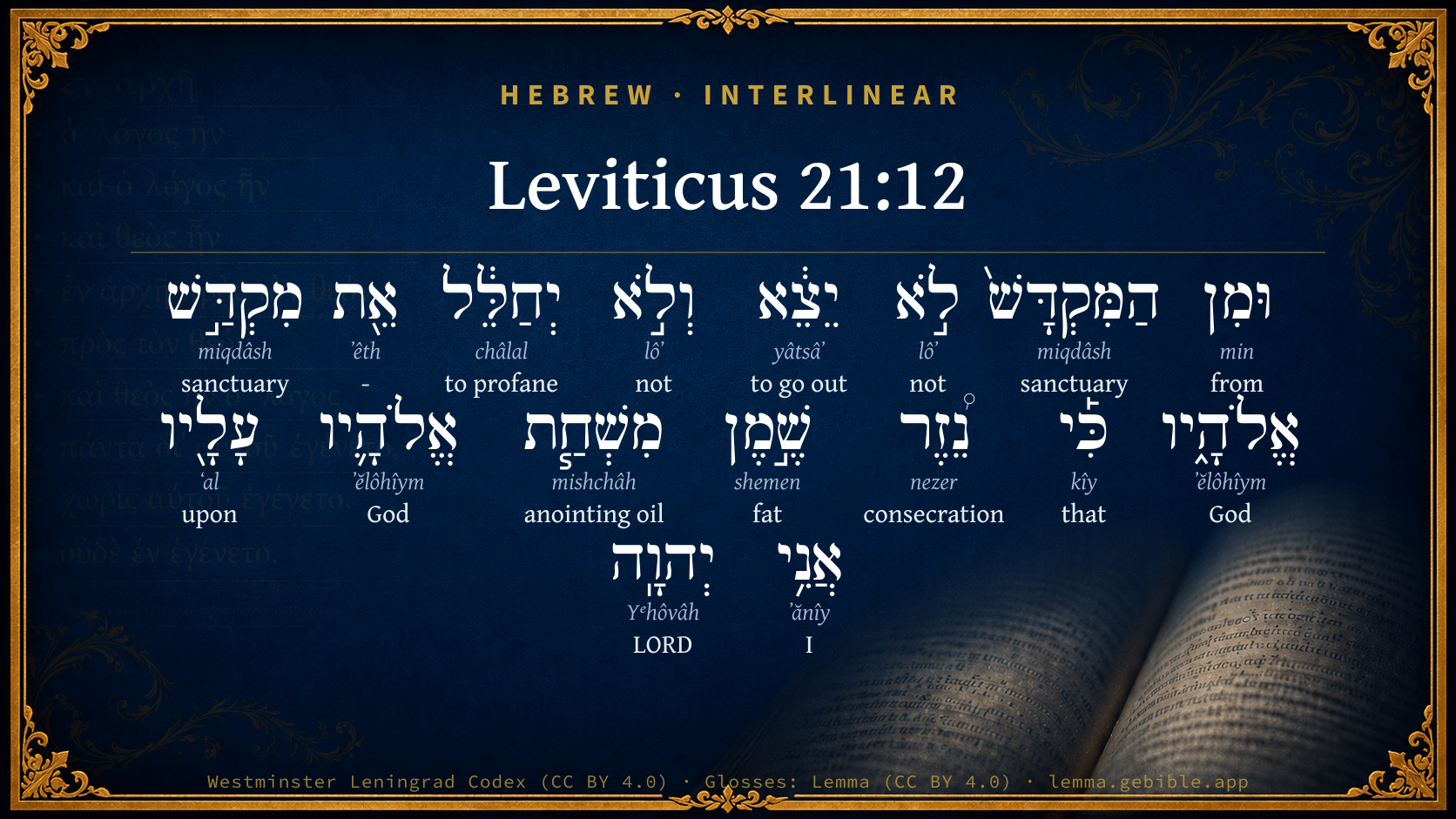
Hebrew (Westminster Leningrad Codex) Leviticus 21:12 appears in the Hebrew Old Testament. The text above is from the Westminster Leningrad Codex. Each word links to its Strong’s number, a concise gloss, and parsing drawn from the Open Scriptures Hebrew Bible morphology. Click any word for its full Brown-Driver-Briggs (BDB) entry.
Download image
Cite this verse

Leviticus 21:12 (World English Bible). Public Domain. Lemma interlinear Bible study tool, https://lemma.gebible.app/v/leviticus/21/12.

Show BibTeX & RIS
BibTeX
RIS
English Translation
neither shall he go out of the sanctuary, nor profane the sanctuary of his God; for the crown of the anointing oil of his God is upon him. I am Yahweh.
World English Bible · Public Domain
Download a study sheet

One document with this verse’s original text, its word-by-word gloss line, the meaning frame, cross-references with their text, attributed commentary, and full source and license credits — printable, and it pastes into notes with its structure intact.

This verse Autodidact and up

Study sheet (.html) Plain text (.txt)

A passage Seminary Student

Up to 50 verses in one chapter. A passage sheet keeps up to 6 commentary sources and 12 cross-references per verse, in the order this page ranks them, and says so on the sheet whenever that leaves anything out. Ask for a single verse and you get the Autodidact verse sheet above.

Everything on this page stays free to read, with no account — the sheet is a download of what is already on screen, not access to it.

Want to remove ads? Support Godless Engineer
Compare translations 3

The same verse in 3 English versions, stacked beneath the original-language interlinear above. Click any original word for its lexicon entry.

Each is an independent rendering of the whole verse — the interlinear is not word-aligned to these translations.

Highlighted words mark where these versions differ — a whole-verse word diff, not a word-by-word alignment.

  • World English Bible Public Domain
    neither shall he go out of the sanctuary, nor profane the sanctuary of his God; for the crown of the anointing oil of his God is upon him. I am Yahweh.
  • King James Version Public Domain
    Neither shall he go out of the sanctuary, nor profane the sanctuary of his God; for the crown of the anointing oil of his God is upon him: I am the LORD.
  • unfoldingWord Literal Text CC BY-SA 4.0
    And he shall not go out from the Holy Place, and he shall not profane the Holy Place of his God, for the crown of the oil of the anointing of his God on him. I Yahweh.

unfoldingWord Literal Text — © unfoldingWord, licensed CC BY-SA 4.0. Word-aligned USFM3 via Door43 (git.door43.org/unfoldingWord/en_ult).

Versions to compare (up to 4)

3 of 4 selected

Show all 18 translations

Every available English version of this verse, each an independent rendering of the whole verse.

  • World English Bible Public Domain
    neither shall he go out of the sanctuary, nor profane the sanctuary of his God; for the crown of the anointing oil of his God is upon him. I am Yahweh.
  • Berean Standard Bible Public Domain
    He must not leave or desecrate the sanctuary of his God, for the consecration of the anointing oil of his God is on him. I am the LORD.
  • Majority Standard Bible Public Domain
    He must not leave or desecrate the sanctuary of his God, for the consecration of the anointing oil of his God is on him. I am the LORD.
  • King James Version Public Domain
    Neither shall he go out of the sanctuary, nor profane the sanctuary of his God; for the crown of the anointing oil of his God is upon him: I am the LORD.
  • American Standard Version (1901) Public Domain
    neither shall he go out of the sanctuary, nor profane the sanctuary of his God; for the crown of the anointing oil of his God is upon him: I am Jehovah.
  • Revised Version (1885) Public Domain
    neither shall he go out of the sanctuary, nor profane the sanctuary of his God; for the crown of the anointing oil of his God is upon him: I am the LORD.
  • Geneva Bible (1599) Public Domain
    Neither shall he goe out of the Sanctuarie, nor pollute the holy place of his God: for the crowne of the anoynting oyle of his God is vpon him: I am the Lord.
  • Douay-Rheims (1899) Public Domain
    Neither shall he go out of the holy places, lest he defile the sanctuary of the Lord, because the oil of the holy unction of his God is upon him. I am the Lord.
  • Young's Literal Translation Public Domain
    nor from the sanctuary doth he go out, nor doth he pollute the sanctuary of his God, for the separation of the anointing oil of his God `is' on him; I `am' Jehovah.
  • Literal Standard Version CC BY-SA 4.0
    nor does he go out from the sanctuary, nor does he defile the sanctuary of his God, for the separation of the anointing oil of his God [is] on him; I [am] YHWH.
  • Unlocked Literal Bible CC BY-SA 4.0
    The high priest must not leave the sanctuary area of the tabernacle or profane the sanctuary of his God, because he has been consecrated as high priest by the anointing oil of his God. I am Yahweh.
  • unfoldingWord Literal Text CC BY-SA 4.0
    And he shall not go out from the Holy Place, and he shall not profane the Holy Place of his God, for the crown of the oil of the anointing of his God on him. I Yahweh.
  • Darby Bible Public Domain
    neither shall he go out of the sanctuary, nor profane the sanctuary of his God; for the consecration of the anointing oil of his God is upon him: I am Jehovah.
  • World Messianic Bible Public Domain
    He shall not go out of the sanctuary, nor profane the sanctuary of his God; for the crown of the anointing oil of his God is upon him. I am the LORD.
  • Webster's Bible Public Domain
    Neither shall he go out of the sanctuary, nor profane the sanctuary of his God; for the crown of the anointing oil of his God is upon him: I am the LORD.
  • Free Bible Version CC BY-SA 4.0
    He must not leave to deal with someone who has died or make the sanctuary of his God unclean because he has been dedicated by the anointing oil of his God. I am the Lord.
  • Bible in Basic English Public Domain
    He may not go out of the holy place or make the holy place of his God common; for the crown of the holy oil of his God is on him: I am the Lord.
  • JPS Tanakh (1917) Public Domain
    neither shall he go out of the sanctuary, nor profane the sanctuary of his God; for the consecration of the anointing oil of his God is upon him: I am the LORD.

Literal Standard Version (2020), Covenant Press — licensed CC BY-SA 4.0. Text via the HelloAO Bible API (eBible.org). Unlocked Literal Bible (unfoldingWord) — licensed CC BY-SA 4.0. Text via the HelloAO Bible API (eBible.org). unfoldingWord Literal Text — © unfoldingWord, licensed CC BY-SA 4.0. Word-aligned USFM3 via Door43 (git.door43.org/unfoldingWord/en_ult). Free Bible Version, Dr. Jonathan Gallagher — licensed CC BY-SA 4.0. Text via the HelloAO Bible API (eBible.org).

Word by word

More ways to search: Search by grammar → Find every occurrence → Compare this word →

Practice this passage: Drill this verse → Learn its vocabulary →

נֵ֠זֶר
nezer
H5145
“consecration of”
Noun, Common, Masculine, Singular, Construct
Part of Speech
Noun
Type
Common
Gender
Masculine
Number
Singular
State
Construct
Full BDB Definition

Origin: from H5144

TWOT: 1340a

consecration, crown, separation, Nazariteship - crown (as sign of consecration), earring - stones of a crown, diadem, stones of charming - woman's hair - consecration - of high priest - of Nazarite
  1. וּמִן min H4480 “and · from” Conjunction + Preposition
  2. הַמִּקְדָּשׁ֙ miqdâsh H4720 “the · sanctuary” Particle, Definite Article + Noun, Common, Masculine, Singular, Absolute
  3. לֹ֣א lôʼ H3808 “not” Particle, Negative
  4. יֵצֵ֔א yâtsâʼ H3318 “to go out” Verb, Qal, Imperfect, 3rd Person, Masculine, Singular
  5. וְלֹ֣א lôʼ H3808 “and · not” Conjunction + Particle, Negative
  6. יְחַלֵּ֔ל châlal H2490 “to profane” Verb, Piel, Imperfect, 3rd Person, Masculine, Singular
  7. אֵ֖ת ʼêth H853 “-” Particle, Direct Object
  8. מִקְדַּ֣שׁ miqdâsh H4720 “sanctuary of” Noun, Common, Masculine, Singular, Construct
  9. אֱלֹהָ֑יו ʼĕlôhîym H430 “God(s) · his” Noun, Common, Masculine, Plural, Construct + Suffix, Personal, 3rd Person, Masculine, Singular
  10. כִּ֡י kîy H3588 “that” Conjunction
  11. שֶׁ֣מֶן shemen H8081 “fat of” Noun, Common, Masculine, Singular, Construct
  12. מִשְׁחַ֧ת mishchâh H4888 “anointing oil of” Noun, Common, Feminine, Singular, Construct
  13. אֱלֹהָ֛יו ʼĕlôhîym H430 “God(s) · his” Noun, Common, Masculine, Plural, Construct + Suffix, Personal, 3rd Person, Masculine, Singular
  14. עָלָ֖יו ʻal H5921 “upon · him” Preposition + Suffix, Personal, 3rd Person, Masculine, Singular
  15. אֲנִ֥י ʼănîy H589 “I” Pronoun, Personal, 1st Person, Common, Singular
  16. יְהוָֽה Yᵉhôvâh H3068 “LORD” Noun, Proper

About this verse

These counts appear in no published source. They are computed here, from the morphology-tagged text and Lemma’s own curated glosses. What Lemma adds →

17
words
14
distinct lemmas
Pentateuch
section

Notable vocabulary

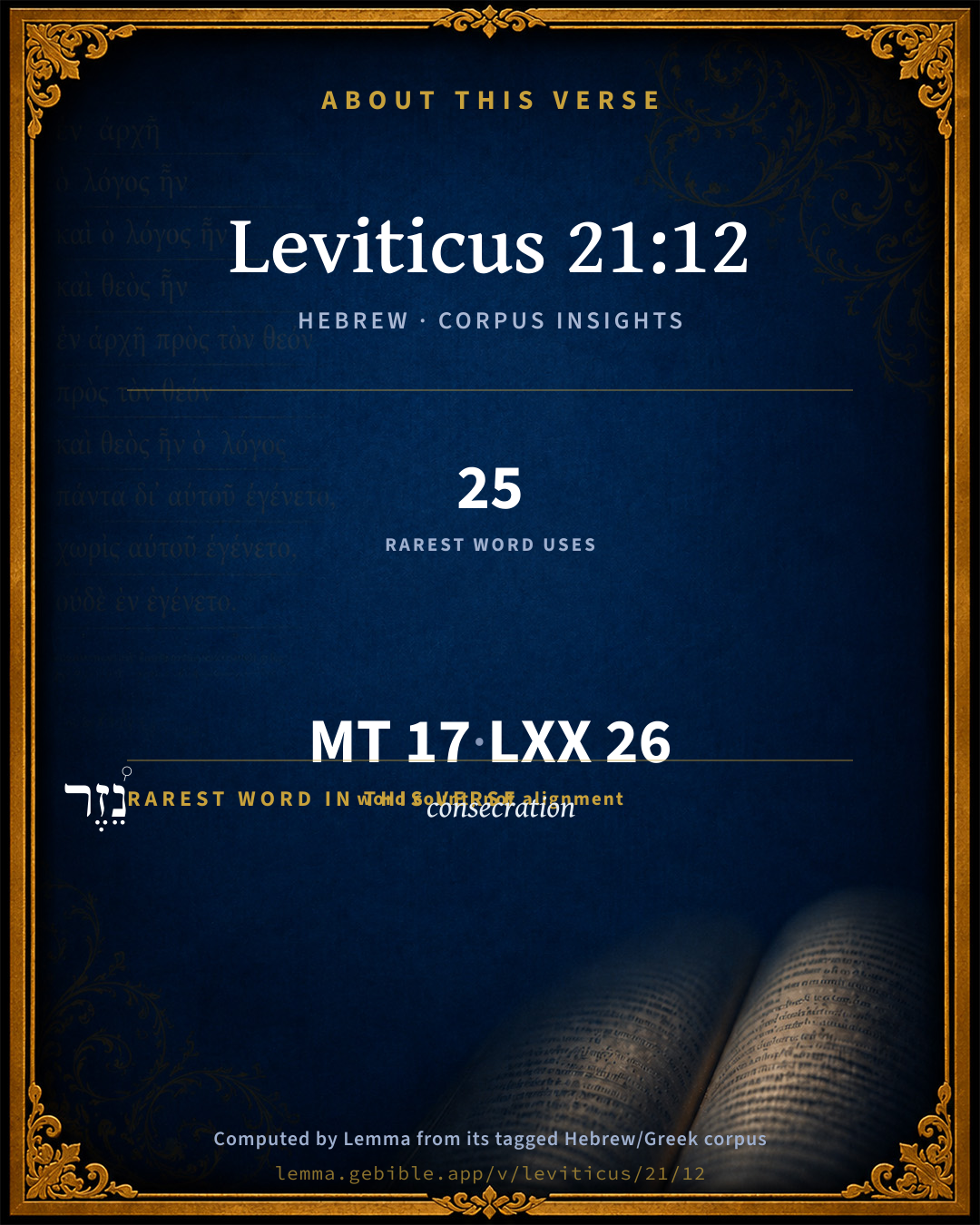
The rarest word here is נֵ֠זֶר consecration H5145 — appearing just 25 times in the whole Hebrew Bible.

Shared distinctive vocabulary

נֵ֠זֶר consecration H5145 occurs in 22 verses of the Hebrew Bible. Also found in:

Grammatical profile

  • 2 verbs
  • 8 nouns
  • 1 pronoun
  • 2 prepositions
  • 1 conjunction
  • 3 particles

Verb forms

  • יֵצֵ֔א Qal · Imperfect
  • יְחַלֵּ֔ל Piel · Imperfect

Repetition

Words recur within this verse — often emphatic in Hebrew:

  • הַמִּקְדָּשׁ֙ sanctuary H4720 ×2
  • אֱלֹהָ֑יו God H430 ×2
  • לֹ֣א not H3808 ×2

Hebrew & Septuagint length

In English translation the verse runs 31 words from the Hebrew and 34 from the Septuagint (LXX English) — closely comparable.

A rough comparison of the two English renderings, which tokenize alike — not a word-level alignment.

Word counts can differ between the Hebrew and the Greek without any difference in meaning — e.g. the Hebrew direct-object marker אֵת has no separate Greek word, and Greek often adds the article ὁ.

In the original languages it is 17 Hebrew tokens and 26 Greek tokens — but the two are counted differently (Hebrew bundles its prefixes and suffixes into one token; the Greek is in lemma form), so that isn’t a like-for-like length.

Cross-references

7

Topical passages linked to Leviticus 21:12 in the Treasury of Scripture Knowledge — connected by theme and wording, ordered by reader-vote popularity; previews shown in the World English Bible.

  • Leviticus 10:7 You shall not go out from the door of the Tent of Meeting, lest you die; for the anointing oil of Yahweh is on you." They did according to the word of Moses.
  • Exodus 28:36 "You shall make a plate of pure gold, and engrave on it, like the engravings of a signet, 'HOLY TO YAHWEH.'
  • Exodus 29:6–7 and you shall set the turban on his head, and put the holy crown on the turban.
  • Leviticus 8:9–12 He set the turban on his head; and on the turban, in front, he set the golden plate, the holy crown; as Yahweh commanded Moses.
  • Leviticus 8:30 Moses took some of the anointing oil, and some of the blood which was on the altar, and sprinkled it on Aaron, on his garments, and on his sons, and on his sons' garments with him, and sanctified Aaron, his garments, and his sons, and his sons' garments with him.
  • Isaiah 61:1 The Spirit of the Lord Yahweh is on me; because Yahweh has anointed me to preach good news to the humble; he has sent me to bind up the broken-hearted, to proclaim liberty to the captives, and the opening [of the prison] to those who are bound;
  • Acts 10:38 even Jesus of Nazareth, how God anointed him with the Holy Spirit and with power, who went about doing good and healing all who were oppressed by the devil, for God was with him.

Cross-references courtesy of OpenBible.info (CC BY 4.0).

Hebrew and Greek witnesses Masoretic Hebrew ↔ Greek Septuagint

The same verse in the two great witnesses to the Old Testament, shown verse-for-verse.

These are two independent witnesses, not word-aligned to each other, and the Septuagint is shown in lemma (dictionary) form.

Hebrew Leviticus 21:12 Masoretic · Westminster Leningrad Codex

וּמִן הַמִּקְדָּשׁ֙ לֹ֣א יֵצֵ֔א וְלֹ֣א יְחַלֵּ֔ל אֵ֖ת מִקְדַּ֣שׁ אֱלֹהָ֑יו כִּ֡י נֵ֠זֶר שֶׁ֣מֶן מִשְׁחַ֧ת אֱלֹהָ֛יו עָלָ֖יו אֲנִ֥י יְהוָֽה

neither shall he go out of the sanctuary, nor profane the sanctuary of his God; for the crown of the anointing oil of his God is upon him. I am Yahweh.

World English Bible · Public Domain

Greek LXX Leviticus 21:12 Septuagint · lemma form

καί ἐκ ὁ ἅγιος οὐ ἐκἔρχομαι καί οὐ βεβηλόω ὁ ἁγιάζω ὁ θεός αὐτός ὅτι ὁ ἅγιος ἔλαιον ὁ χριστός ὁ θεός ἐπί αὐτός ἐγώ κύριος

And he shall not go forth out of the sanctuary, and he shall not profane the sanctuary of his God, because the holy anointing oil of God is upon him: I am the Lord.

LXX2012 (modern English Septuagint) · Public Domain

Hebrew: Westminster Leningrad Codex (CC BY 4.0). Greek: Septuagint (public domain); English from LXX2012 (modern English Septuagint) (Public Domain). How the Septuagint differs from the Hebrew →

Targum (Aramaic paraphrase)

2

The Targum is the ancient Jewish Aramaic paraphrase of the Hebrew Scriptures — an interpretive translation, not the Hebrew text itself. Onkelos (literal) and Pseudo-Jonathan (expansive) render the Torah, and Jonathan the Prophets. Coverage is partial: where no permissively-licensed English translation exists for a verse, only the Aramaic is shown. This is verse-level text, not a word-by-word alignment to the Hebrew.

  1. Targum Onkelos Torah (Genesis–Deuteronomy)
    וּמִן מַקְדְשָׁא לָא יִפּוֹק וְלָא יַחֵל יָת מַקְדְשָׁא דֶאֱלָהֵהּ אֲרֵי כְּלִיל מְשַׁח רְבוּתָא דֶאֱלָהֵהּ עֲלוֹהִי אֲנָא יְיָ

    (no public-domain English translation for this verse)

    Targum Onkelos — Aramaic: “Onkelos Genesis” (public domain); “Onkelos Exodus” (public domain); “Onkelos Leviticus” (public domain); “Onkelos Numbers” (public domain); “Onkelos Deuteronomy” (public domain). English: “Sefaria Community Translation” (CC0 1.0 (public-domain dedication)); “J.W. Etheridge. The Targums of Onkelos and Jonathan Ben Uzziel on the Pentateuch. London: Longmans, Green, 1862” (public domain). Text via Sefaria.

  2. Targum Pseudo-Jonathan Torah (Genesis–Deuteronomy)
    וּמִן מַקְדְשָׁא לָא יִפּוֹק וְלָא יָפִיס יַת מַקְדְשָׁא דֶאֱלָהֵיהּ אֲרוּם מְשַׁח רְבוּת אֱלָהֵיהּ עֲלוֹי אֲנָא יְיָ

    And he shall not go forth from the sanctuary, or profane the sanctuary of his God; for the anointing oil of his God is upon him: I am the Lord.

    Targum Pseudo-Jonathan — Aramaic: “Targum Jonathan on Genesis” (public domain); “Targum Jonathan on Exodus” (public domain); “Targum Jonathan on Leviticus” (public domain); “Targum Jonathan on Numbers” (public domain); “Targum Jonathan on Deuteronomy” (public domain). English: “The Targum of Jonathan ben Uzziel, trans. J. W. Etheridge, London, 1862” (public domain). Text via Sefaria.

Commentary

Notes on Leviticus 21:12 from classic Christian and Jewish commentators (each source and its license shown beneath its notes). The classic Christian expositions comment on the surrounding passage and are grouped to its opening verse, so a note may address several verses; the Jewish commentaries on the Tanakh (Rashi and others) are per-verse, so they appear only where the commentator wrote on this verse.

Lemma curates 59 commentaries, every one of them public domain or Creative Commons licensed, each selected and text-cleaned for this edition rather than reprinted as found. About our sources →

Trapp's Complete Commentary

John Trapp

Lev 21:12 Neither shall he go out of the sanctuary, nor profane the sanctuary of his God; for the crown of the anointing oil of his God [is] upon him: I [am] the LORD.

Ver. 12. For the crown of the anointing.] Noting thereby that Christ, now risen, is crowned with glory and honour; {Heb 2:7 Zec 6:12} and so shall we with him. {Heb 2:9-10 1Co 15:47-49}

John Trapp, A Commentary or Exposition upon All the Books of the Old and New Testament (1647–1656) — public domain. Text from a community e-Sword module.

Joseph Benson's Commentary

Lev 21:12. Out of the sanctuary — To attend the funeral of any person: for upon other occasions he might, and did commonly go out. Nor profane the sanctuary — Either by the performance of a civility, or by entering into the sanctuary before the seven days allotted for his cleansing (Num 19:11) were expired. The crown of the anointing oil — Or, the crown, the golden plate, which is called the holy crown, (Exo 29:6,) and the anointing oil of his God are upon him. So there is only an ellipsis of the conjunction and, which is frequent. And these two things, being most eminent, are put for the rest, as the sign is put for the thing signified, as if he had said, For he is God’s high-priest. But the word נזר, Nezer, which we render crown, more properly signifies separation, or consecration; and so the clause might here be rendered, — The consecration of the anointing oil of his God is upon him.

Joseph Benson's Commentary on the Old and New Testaments (1811–1818) — public domain. Text from a community e-Sword module.

Geneva Bible (1599)

Geneva Bible translators

To go to the dead.

For by his anointing he was preferred to the other Priests and therefore could not lament the dead, lest he should have polluted his holy anointing.

Geneva Bible (1599) marginal notes — public domain. Text via Bolls.life.

Adam Clarke's Commentary

Verse 12. The crown of the anointing oil - is upon him] By his office the priest represented Christ in his sacrificial character; by his anointing, the prophetic influence; and by the crown, the regal dignity of our Lord.

Adam Clarke's Commentary on the Bible (1810–1826) — public domain. Text from a community e-Sword/MySword module.

Ellicott's Commentary for English Readers

(12) Neither shall he go out of the sanctuary.—Better, and he shall not go out of the sanctuary as in Lev_10:7. When the tidings of the death of a parent is brought to him during the service, he must not desist from the service and quit the sanctuary, lest it should appear that he has a greater regard for the dead than for the service of the living God. The difference between the ordinary priest and the high priest in this respect was, that when the former heard, during the service, of the death of any one of the seven relations for whom he had to mourn, he was obliged to discontinue the service, though he too could not leave the precincts of the sanctuary; whilst the former, under these circumstances, was bound to continue the service. The former, by becoming a mourner, profaned the service if he continued it; the latter never became a mourner, and hence profaned the service if he discontinued it.

A Bible Commentary for English Readers, edited by Charles John Ellicott (1878–1897) — public domain. Text from a community e-Sword module.

The Cambridge Bible for Schools and Colleges

gen. ed. J. J. S. Perowne

12. go out, etc.] lest, on returning to the sanctuary, he should pollute it. The words seem to imply that the sanctuary was his usual abode. Cp. 1Sa_1:9; 1Sa_3:2. But they may only mean that he was not to go out during the ceremonial.

crown] R.V. mg. consecration. The former is the literal rendering, but the mg. gives the sense here. The oil was the symbol of his office, marking him out as a crowned one among his brethren. The original word is used elsewhere in the special sense of the consecration of a Nazirite (Num_6:7, etc.).

The Cambridge Bible for Schools and Colleges (gen. ed. J. J. S. Perowne; Cambridge University Press, 1878–1918) — public domain. Text from a community e-Sword module.

John Gill's Exposition

Neither shall he go out of the sanctuary,.... In the time of service, upon any occasion whatever; otherwise, when there was a necessity for it, he might go out from thence, though this was rarely done, and only in the night time: Maimonides (m) says he had a house prepared for him in the sanctuary, called the chamber of the high priest; and it was his honour and his glory to remain in the sanctuary all the day, and he did not go out, except to his own house, and that only in the night, or an hour or two in the day; and his house was in Jerusalem, and from thence he never removed: but this law respects him only in the case of his dead; as when any news was brought him of the death of his father, or of his mother, if in his service, he was not to quit it on any account; for we are told (n), that an high priest might offer when mourning, though he might not eat in such a circumstance, whereas a common priest might neither offer nor eat; nor might an high priest go out of the sanctuary on such an occasion, if he was not in service, as to follow the dead corpse or bier, as Jarchi and Aben Ezra interpret it; at least, he was to go no further than the gate of the city; though even this is not allowed by others, who say (o), if the dead were his, he might not go out after it; he might not go out of the door of his house, nor out of the sanctuary, and all the people were to come and comfort him at his own house:

nor profane the sanctuary of his God; by deserting the service of it, on any account, and particularly on account of the dead, by departing from it to go after them, and by entering into it again before the time, when so defiled:

for the crown of the anointing oil of his God is upon him; the anointing oil, which was a crown of glory, and gave him a superior dignity to others, which it became him to be careful not to debase by any of the above things: or "the crown and the anointing oil", so some (p) supply the word "and"; both the golden plate or the holy crown, as it is sometimes called, and the anointing oil were upon him, which showed him to be a very dignified person, a sort of king as well as a priest, and so a type of Christ, who is a priest upon his throne, Zac 6:13,

I am the Lord: whose high priest he is, and who command him all these things, and expect to be obeyed in them.

(m) Cele Hamikdash, c. 5. sect. 7. (n) Misn. Horayot, c. 3. sect. 5. (o) Maimon. Cele Hamikdash, c. 5. sect. 5, 6. Vid. Misn. Sanhedrim, c. 2. sect. 1. (p) So Junius & Tremellius, Piscator, &c.

John Gill's Exposition of the Whole Bible (1746–1763) — public domain (CC PDM 1.0). Text via the HelloAO Bible API.

Albert Barnes' Notes on the Bible

Go out of the sanctuary - i. e. not for the purpose to which reference is here made. The words do not mean, as some have imagined, that his abode was confined to the sanctuary.

Albert Barnes' Notes on the Bible (1834–1885) — public domain. Text from a community e-Sword/MySword module.

Haydock's Catholic Bible Commentary

Places. This is to be understood in the same sense. He must not leave his sacred functions to attend any corpse whatever. Having the honour of representing God, and being his first minister on earth, the utmost purity is required of him. Inferior priests may mourn on some occasions; and the Levites are not distinguished, in this respect, from the people; to shew that God requires a sanctity in his officers, proportionate to their exaltation. --- Oil. Hebrew, "He is the Nozor; or the crown of the anointing oil of," &c. Joseph has the title of Nazir, (Genesis xlix. 26,) which is borne by the prime ministers of the Eastern kings. Such is the high priest in the temple. Let Christian priests hence learn what sanctity will be required of them. But why is the pontiff forbidden to bury his father, since he obtains that dignity after his decease. St. Augustine (q. 83,) answers, that he was to be consecrated immediately after, that he might offer incense. Another might, however, perform that office. On some occasions, the high priest was deposed, or the dignity transferred to another family. Infirmities might also hinder him from performing the duty. (Calmet) --- Priests must be detached, as much as possible, from all things which might divert them from their sacred offices. The greatest holiness is required of those who receive the body of Jesus Christ. (Du Hamel)

George Leo Haydock (1774–1849), Haydock's Catholic Family Bible and Commentary, 1859 edition — public domain. Excludes Psalms (Douay-Rheims chapter numbering differs from Protestant) and Deuterocanonical books (Catholic canon only).

Matthew Poole's English Annotations

Out of the sanctuary, to wit, to attend the funerals of any person; for upon other occasions he might and did commonly go out.

Nor profane the sanctuary; either by making the service thereof give place to the discharge of his passions, or the performance of a civility, or by entering into the sanctuary before the seven days allotted for his cleansing (Num 19:11) were expired.

The crown of the anointing oil, i.e. the anointing oil, which to him was instead of a crown, by which he was advanced not only above the rest of his brethren, but even above all the people, whose chief governor he was in the things of God, though subject and accountable to the civil magistrate, by which also he was made an eminent type of Christ, who was to be King and Priest. Or, the crown, to wit, the golden plate, which is called the holy crown, Exo 29:6, and

the anointing oil of his God are upon him. So there is only an ellipsis of the conjunction and, which is frequent, as Psa 144:9; Isa 63:11; Hab 3:11, &c. And these two things being most eminent, are put for the rest, and the sign is put for the thing signified, q.d. for he is God’s high priest. Or, the consecration (for so nezer signifies) of the anointing oil, which by an hypallage may be put for the anointing oil of the consecration, i.e. whereby he is consecrated, is upon him; i.e. though that action be past, yet the virtue of it remains still upon him; he is a sacred person in the highest degree, and therefore not to defile himself in any kind.

Matthew Poole's English Annotations on the Holy Bible (1683–1685) — public domain. Text from a community e-Sword/MySword module.

Whedon's Commentary on the Bible

Daniel D. Whedon

12. Neither shall he go out of the sanctuary — During the time spent in the service in the tabernacle, he shall not interrupt, abridge, or postpone his service for the purpose of visiting the sick, dying, or dead. No possible event could occur in the camp which could justify the neglect of Jehovah’s honour. In this respect Jesus Christ was exercising the prerogative of the high priest when he said, “Let the dead bury their dead.”

Crown of the anointing — A metaphorical expression denoting the excellency of the oil, and the dignity its use conferred. It symbolized the Holy Spirit, the crowning gift of the Father to the Son at his baptism: through Christ’s mediation it is bestowed upon all perfect believers, as the greatest gift that man can wish or Heaven can send. 1Jn_2:20; 1Jn_2:27. Dr. A. Clarke suggests that the regal dignity of our Lord is prefigured by this crown, his sacrificial character by his office, and his prophetic influence by his anointing. The Samaritan MS. has “crown of the excellency.”

Daniel D. Whedon (gen. ed.), Commentary on the Old and New Testaments (1874–1909) — public domain. Text from a community e-Sword module.

John Wesley's Explanatory Notes

Out of the sanctuary - To attend the funerals of any person: for upon other occasions he might and did commonly go out. Nor profane the sanctuary - Either by the performance of a civility, or by entering into the sanctuary before the seven days allotted for his cleansing, Num. xix, 11, were expired. The crown of the anointing oil - Or, the crown, the golden plate, which is called the holy crown, Exod. xxix, 6, and the anointing oil of his God are upon him. So there is only an ellipsis of the conjunction and, which is frequent. And these two things, being most eminent, are put for the rest, as the sign is put for the thing signified, that is, for he is God's high-priest.

John Wesley, Explanatory Notes Upon the Whole Bible (1754–1765) — public domain. Text via the GEBible commentary corpus.

Rashi

Rabbi Shlomo Yitzchaki (Rashi)

ומן המקדש לא יצא NEITHER SHALL HE GO OUT FROM THE SANCTUARY — This means that he must not follow the bier (attend the funeral of his father or mother) (Sanhedrin 18a). Our Rabbis further derived from this (Sanhedrin 84a) the Halacha that the High Priest may perform the sacrificial rites when an “Onan”. The following is how this is implied: even if his father or his mother died he is not required to leave the Sanctuary as may be assumed, but may perform the service;

ולא יחלל את מקדש means because he does not thereby (by remaining in the Sanctuary) profane the sacred service, since Scripture permits him to remain and to perform it; it follows therefore that an ordinary priest who officiated when an "Onan" did profane the service (Zevachim 16a; Sanhedrin 84a).

Rashi on the Tanakh — English translations: “The Judaica Press complete Tanach with Rashi, translated by A. J. Rosenberg” (CC BY 4.0); “Pentateuch with Rashi's commentary by M. Rosenbaum and A.M. Silbermann, 1929-1934” (public domain); “The Metsudah Tanach series, Lakewood, N.J” (CC BY 4.0); and “The Book of Joshua, Metsudah Publications, 1997” (CC BY 4.0). Text via Sefaria.

Ramban (Nachmanides)

Rabbi Moshe ben Nachman (Ramban / Nachmanides)

NEITHER SHALL HE GO OUT OF THE SANCTUARY. “He does not follow the bier [of a near relative]. Our Rabbis have further derived from this verse [the principle] that the High Priest may perform [the Divine Service] when he is an onen (a mourner), Note 85. the meaning of the verse thus being as follows: Even if his father or his mother died, he need not leave the Sanctuary but he may perform the Service. Nor shall he profane the Sanctuary of his G-d, means that [the High Priest] does not profane thereby the Service by ministering when he is an onen, Note 85. since Scripture permitted him to minister. From this you deduce that a common priest who officiated when he is an onen, does profane the Service.” This is Rashi’s language.But these two interpretations [that Rashi mentioned, namely, that the High Priest is not to follow the bier of a near relative, and that he may officiate when he is an onen], are really opposing opinions, for since the verse permitted the High Priest not to leave the Sanctuary on account of his mourning, as a common priest must do, but instead he may [continue to] officiate when he is an onen, Note 85. then there is no admonition here against his following the bier of his near relative.. In interpreting the phrase, neither shall he go out of the Sanctuary as a prohibition, meaning that he is not permitted to leave the Sanctuary to follow the bier, how could Rashi continue on the basis of the same phrase to state that he need not leave the Sanctuary, but he may perform the Service, since these two interpretations of the same phrase are contradictory to each other! This is the meaning of Ramban’s succinct objection: “Since the verse permitted the High Priest … then there is no admonition …” Mizrachi, in defense of Rashi, answers that Rashi was not referring only to the first phrase [as if both the permission and the admonition are derived from the same phrase], but rather to both phrases of the verse, the first one [neither shall he go out …] establishing the prohibition, and the second one [nor profane …] constituting the negation. Ramban will also further on defend Rashi’s position from another standpoint. Similarly, nor shall he profane the Sanctuary of his G-d is, according to this interpretation [of Rashi], nothing but a statement that the Service of the High Priest does not become profaned [although performed when he is an onen], from which you are to deduce that a common priest who officiates when he is an onen, does defile the Service. But if so, this verse is merely a negation, not a prohibition, and yet the “masters of the Halachoth”.” From the ensuing phrase [“counted it among the negative commandments in the Hilchoth Gedoloth”], it is obvious that Ramban is referring to one particular work. But if so, why does he speak of “the masters” [in the plural] of that work? It may be that this is because it has long been in doubt whether the authorship of that book is to be ascribed to Rav Yehudai Gaon or to Rabbi Shimon Kairo, or to both. Hence Ramban writes here “the masters of the Halachoth.” See, however, in Exodus 21:7, where Ramban writes of “the master of the Hilchoth Gedoloth” — in the singular. See Vol. II, p. 350, Note 70. counted it among the negative commandments in the Hilchoth Gedoloth! Moreover, I have already quoted the Beraitha, Note 209. which is taught in the Torath Kohanim 42. Ramban quoted it above, 10:6. where it is clearly explained that this verse is a proper prohibition [and not a mere negation], as it is taught: “And ye shall not go out from the door of the Tent of Meeting. I might think that [upon becoming apprised of the death of a near relative, an ordinary priest may not leave the Sanctuary] whether he is ministering or not; Scripture therefore says, Neither shall he go out of the Sanctuary, nor shall he profane. When is he not permitted to go out [so that only by his staying there] he does not profane it? I must say that this applies only when he is ministering.” And it further states there [in the Torath Kohanim]: 43. “I would only know that this tells me that Aaron and his sons, who were anointed with the oil of anointment, are liable to death [by the hand of Heaven] if they leave the Sanctuary while they are ministering. How do I know that this [prohibition] applies also to all priests of all times? etc.” Thus it is clear that the verse before us constitutes an actual negative commandment, prohibiting the priest from leaving the Service and going out [of the Sanctuary].Therefore I say in order to maintain the words of all the Sages [i.e., of Rashi and of the author of the Hilchoth Gedoloth, as will be explained], that the main purpose of this verse is to admonish the High Priest not to leave the Sanctuary while he is ministering, on [becoming apprised of] the death of any near relative, and he is not to profane the Sanctuary by leaving its Service for the honor of the dead. Instead, the honor of the Sanctuary and its Service is to be greater to him than his honor of and love for the dead, and it follows all the more so that if he left his ministration for no reason at all, and went out of the Sanctuary, that he has violated this negative commandment. However, Scripture warned him with [especial] reference to the dead, in order [incidentally] to permit the High Priest to perform the Service when he is an onen (a mourner), Note 85. and since it is permissible for him to perform it, therefore if he leaves it voluntarily it constitutes a profanation of the Sanctuary. This is the meaning of this verse, and I have already written it in the section of Vay’hi Bayom Ha’shemini. We find furthermore that our Rabbis have differed in the second chapter of Tractate Zebachim [on this matter, namely whether the verse before us is a prohibition, or a mere negation]. Thus they have said: “How do we know that an onen [who performs] profanes the Service? Because it is written, Neither shall he [i.e., the High Priest] go out of the Sanctuary, nor profane; but any other priest who does not go out [of the Sanctuary], does profane it [i.e., if he officiates when he is an onen]. And Rabbi Ilai, Rabbi Eleazar. said, We derive it from this verse: Behold, this day have they offered their sin-offering and their burnt-offering perform the rites of the offerings? It was I, the High Priest, who ministered, and the High Priest may indeed minister whilst an onen. And as for the reason why that offering was burnt etc.” (see above, 10:19). — it is ‘I’ [Aaron — the High Priest] who offered! From this you may learn that if they [Aaron’s sons — Elazar and Ithamar] had performed the rites of the offerings, they would have acted correctly [in burning them, since common priests who minister when in a state of aninuth (mourning) invalidate the Service] etc. And Rabbi Ilai, why does he not derive this principle from the verse, Neither shall he go out of the Sanctuary, nor profane? He will answer you: Is it after all written, ‘But any other priest who does not go out of the Sanctuary does profane it’?” The meaning of [Rabbi Ilai’s answer] is that since Scripture states an admonition with reference to the High Priest, that he is not to leave the Sanctuary and that he should not profane the Service by leaving it [on becoming apprised of the death of a near relative], there is no implication here that a common priest does profane the Service if he officiates when he is an onen [and hence Rabbi Ilai resorted to another verse — Behold, this day etc. perform the rites of the offerings? It was I, the High Priest, who ministered, and the High Priest may indeed minister whilst an onen. And as for the reason why that offering was burnt etc.” (see above, 10:19). — from which he learned that a common priest who is an onen profanes the Service]. From this text, then, there is another proof that it is not [merely] a permission [that the Torah extended] to the High Priest, permitting him to perform the Service, and informing him that his ministration will not become profaned [as Rashi had stated it], for if that were the case, it would surely have followed that a common priest does profane it by ministering [when he is an onen]. Thus it appears from the interpretation of the text, that according to the opinion of the first answer [stated above, that we know that an onen profanes the Service from the verse about the High Priest, Neither shall he go out etc., which teaches by implication: “but any other priest who does not go out, does profane it”], it constitutes a mere negation as far as the High Priest is concerned, against a common priest ministering whilst in mourning from the verse about the High Priest [as explained in the text], this perforce shows that this Sage holds that with reference to the High Priest, the verse is a mere negation, and the reasoning is as follows: “Since Scripture states that the High Priest need not leave his ministration, we understand by implication that the common priest must leave it.” Thus with reference to the High Priest the verse is a mere negation, but, by implication, it is an admonition to the common priest. Rashi’s interpretation quoted at the beginning of this verse, that the verse is a negation, is thus justified and is in accord with the opinion of this Beraitha. — Thus far Ramban argued on the basis of the interpretation of the text of the Beraitha, that it substantiates Rashi’s position. Ramban will now turn his attention to the fact that a cursory reading of the Beraitha does convey the thought that the verse is an admonition to the High Priest, which is the opinion of the Hilchoth Gedoloth [as mentioned above], and he will explain the Beraitha accordingly. Thus Ramban has “validated the words of all the Sages” — Rashi and Hilchoth Gedoloth as he promised above in the text. [to teach us] that he does not profane his Service [and invalidate it if he officiates whilst he is an onen], as is the language of Rashi. However, because in the Beraitha [quoted above] it is clearly stated that it is an admonition [an opinion held by the Hilchoth Gedoloth], we shall say that they ” (see Note 30 above). hold that since the admonition pertains only to the High Priest, and by implication we reason that a common priest does go out [of the Sanctuary] and leave the ministration, from this we learn that [if the common priest would continue ministering], the Service would be profaned, for if it would have been valid, [the Torah] would not have permitted him to leave it. And so it is taught in the Torath Kohanim in this section: 2:6. “How do we know that if [the High Priest] officiates [whilst he is an onen] that his Service is valid? Because Scripture says, Nor shall he profane. But if a common priest officiates whilst in mourning, his Service is invalid.”Now as to the text written in Tractate Sanhedrin: the High Priest from following the bier of his near relative, so that he should not become defiled thereby and thus “go out from his sanctity” (see Note 44 further). From this text it would then appear that the verse is not an admonition against his going out of the Sanctuary because of the honor of the Service, but because of the honor of his own sanctity, which would thus be a contradiction to what was said above. This, in short, is the intention of Ramban in quoting this text, and further on he will remove the difficulty. “Neither shall he go out ‘min hamikdash’ (of the Sanctuary) — this means that he may not follow after the bier with the bearers, but [he may go forth with them as long as they do not see one another, thus:] when they [who form the funeral cortege] are hidden [from his view, as when entering an alley], he [the High Priest] appears; when they emerge, he disappears [in the alley]. These are the words of Rabbi Meir. But Rabbi Yehudah says: He may not go forth from the Sanctuary at all, for it is said, Neither shall he go out of the Sanctuary.” And [in the Gemara there] the Rabbis explained that the reason of Rabbi Meir is that he interprets the verse as follows: “‘u’min hamikdash — out of his sanctity — he shall not go forth,’ to follow the bier, but must guard himself against touching it or its bearers, and hence he must never be in sight of the funeral cortege. and as long as he has some distinction [to remind him not to defile himself, namely, the fact that he is not in sight of the funeral cortege], he will not come to touch the dead. And Rabbi Yehudah [is of the opinion that] on account of his grief, he might by chance touch it.” [Now this whole text would seem to indicate that the verse before us is an admonition whose purpose is to guard the sanctity of the High Priest, and not, as we have said above, that its purpose is to guard the sanctity of the Service!] However, all this is merely a Scriptural support for a Rabbinic ordinance. It is they [i.e., the Rabbis] who [decided to] guard the dignity of the High Priest, that he should not go out after the bier, because he is not permitted to defile himself for near relatives; and since people are upset about their dead, [they feared] lest he will touch it, similar to that which is written, And Joseph fell upon his father’s face. But a common priest must defile himself for his near relatives, and he is not so upset about other people that there is a fear lest he defile himself; [therefore there was no need for the Rabbis to institute a restriction against a common priest following the funeral cortege of people other than his near relatives]. Thus it is clear that all this is a mark of distinction [for the High Priest] by law of the Rabbis, and they gave it support by reference to this verse, as is the manner of asmachtoth in the Talmud. So also have I found in the Tosephta of Sanhedrin:, Note 124. “The Sages said to Rabbi Yehudah: The verse Neither shall he go out of the Sanctuary, only refers to his leaving the Sanctuary at the time of ministration.” There are also proofs in the Talmud Yerushalmi there, Note 44. [to the correctness of this explanation], but this is not the place to mention them.

Ramban (Nachmanides) on the Tanakh — English translation: “Commentary on the Torah by Ramban (Nachmanides). Translated and annotated by Charles B. Chavel. New York, Shilo Pub. House, 1971-1976” (CC BY 4.0). Text via Sefaria.

Lesson kit

Teaching starters — assembled from the data on this page, not authored interpretation. Every prompt links to the verse data it draws on. Edit before teaching.

Leviticus, in the Pentateuch, opens this verse with 17 words (14 distinct Hebrew lemmas). Its most distinctive word is nezer (“consecration”). A historical commentator’s framing appears above. Read the whole chapter for the surrounding context.

Discussion questions

  1. How does “consecration” (nezer) shape what this verse is saying?
  2. Exodus 29:6 shares the word «consecration» with this verse. How do the two illuminate each other?
  3. “sanctuary” occurs 2× in this one verse. What is the effect of the repetition?
  4. The translations on this page render this verse differently — a whole-verse word diff, not a word-by-word alignment. What might account for the different wordings?
  5. The verb «יֵצֵ֔א» is Qal Imperfect. How does its form color the action?
  6. Reading how Trapp's Complete Commentary and Joseph Benson's Commentary read this verse, where do the two commentators agree and where do they part?

Things to notice

Reading settings

Reading text

Shown beneath each verse's original-language words.

Old Testament
Old Testament edition

Read the OT as the Masoretic Hebrew (MT) or the Greek Septuagint (LXX).

English shown for the Greek Septuagint (in the Hebrew ↔ Greek comparison).

Comparing translations? Open the Compare panel on any verse page to stack up to four side by side.