
Leviticus 18:30

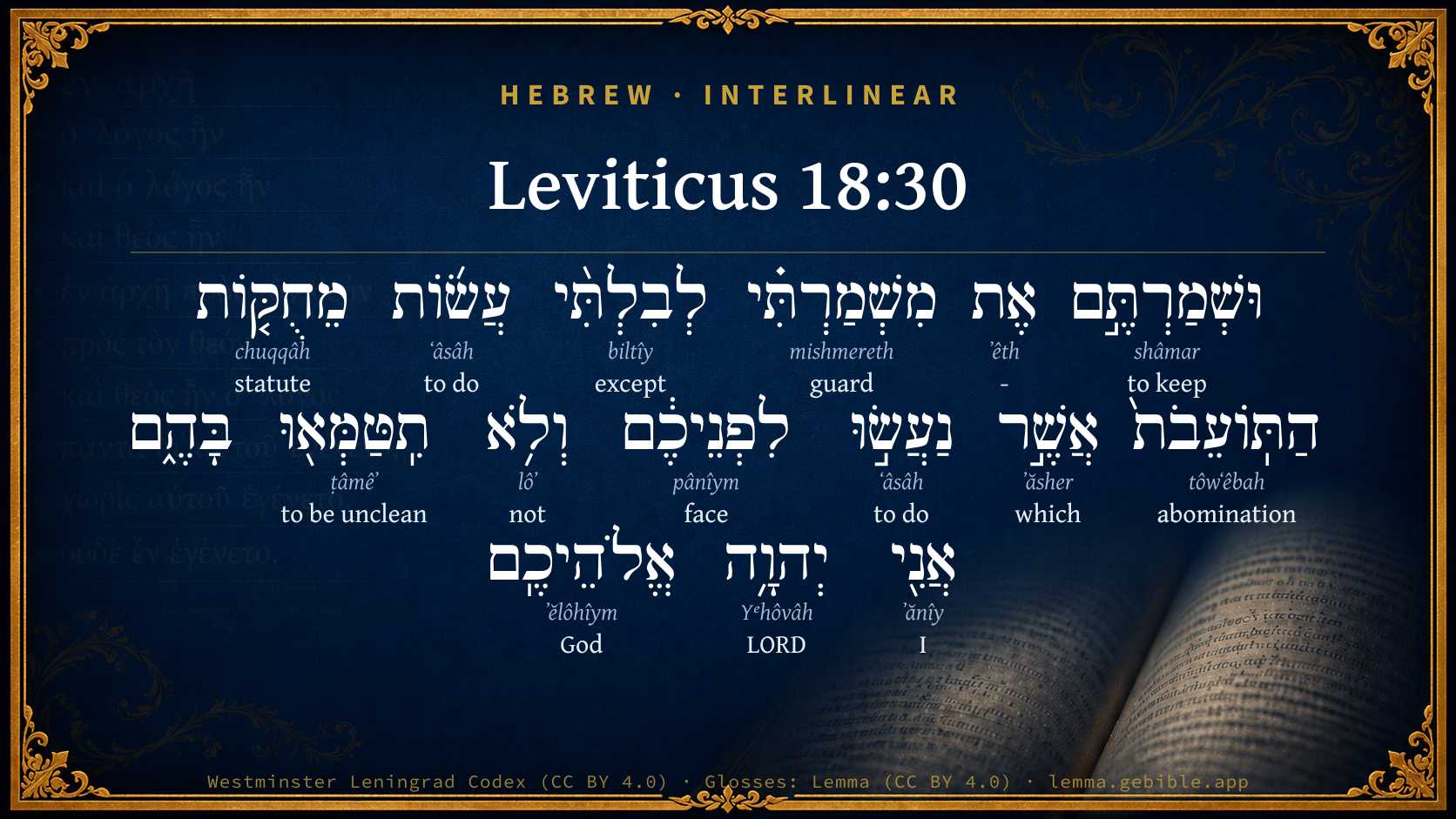
Hebrew (Westminster Leningrad Codex) Leviticus 18:30 appears in the Hebrew Old Testament. The text above is from the Westminster Leningrad Codex. Each word links to its Strong’s number, a concise gloss, and parsing drawn from the Open Scriptures Hebrew Bible morphology. Click any word for its full Brown-Driver-Briggs (BDB) entry.
Download image
Cite this verse

Leviticus 18:30 (World English Bible). Public Domain. Lemma interlinear Bible study tool, https://lemma.gebible.app/v/leviticus/18/30.

Show BibTeX & RIS
BibTeX
RIS
English Translation
Therefore you shall keep my charge, that you do not practice any of these abominable customs, which were practiced before you, and that you do not defile yourselves with them: I am Yahweh your God.'"
World English Bible · Public Domain
Download a study sheet

One document with this verse’s original text, its word-by-word gloss line, the meaning frame, cross-references with their text, attributed commentary, and full source and license credits — printable, and it pastes into notes with its structure intact.

This verse Autodidact and up

Study sheet (.html) Plain text (.txt)

A passage Seminary Student

Up to 50 verses in one chapter. A passage sheet keeps up to 6 commentary sources and 12 cross-references per verse, in the order this page ranks them, and says so on the sheet whenever that leaves anything out. Ask for a single verse and you get the Autodidact verse sheet above.

Everything on this page stays free to read, with no account — the sheet is a download of what is already on screen, not access to it.

Want to remove ads? Support Godless Engineer
Compare translations 3

The same verse in 3 English versions, stacked beneath the original-language interlinear above. Click any original word for its lexicon entry.

Each is an independent rendering of the whole verse — the interlinear is not word-aligned to these translations.

Highlighted words mark where these versions differ — a whole-verse word diff, not a word-by-word alignment.

  • World English Bible Public Domain
    Therefore you shall keep my charge, that you do not practice any of these abominable customs, which were practiced before you, and that you do not defile yourselves with them: I am Yahweh your God.'"
  • King James Version Public Domain
    Therefore shall ye keep mine ordinance, that ye commit not any one of these abominable customs, which were committed before you, and that ye defile not yourselves therein: I am the LORD your God.
  • unfoldingWord Literal Text CC BY-SA 4.0
    And you shall keep my watch not to do the statutes, the abominations that are done to your faces, and you shall not make yourselves unclean by them. I Yahweh your God.’”

unfoldingWord Literal Text — © unfoldingWord, licensed CC BY-SA 4.0. Word-aligned USFM3 via Door43 (git.door43.org/unfoldingWord/en_ult).

Versions to compare (up to 4)

3 of 4 selected

Show all 18 translations

Every available English version of this verse, each an independent rendering of the whole verse.

  • World English Bible Public Domain
    Therefore you shall keep my charge, that you do not practice any of these abominable customs, which were practiced before you, and that you do not defile yourselves with them: I am Yahweh your God.'"
  • Berean Standard Bible Public Domain
    You must keep My charge not to practice any of the abominable customs that were practiced before you, so that you do not defile yourselves by them. I am the LORD your God.”
  • Majority Standard Bible Public Domain
    You must keep My charge not to practice any of the abominable customs that were practiced before you, so that you do not defile yourselves by them. I am the LORD your God.”
  • King James Version Public Domain
    Therefore shall ye keep mine ordinance, that ye commit not any one of these abominable customs, which were committed before you, and that ye defile not yourselves therein: I am the LORD your God.
  • American Standard Version (1901) Public Domain
    Therefore shall ye keep my charge, that ye practise not any of these abominable customs, which were practised before you, and that ye defile not yourselves therein: I am Jehovah your God.
  • Revised Version (1885) Public Domain
    Therefore shall ye keep my charge, that ye do not any of these abominable customs, which were done before you, and that ye defile not yourselves therein: I am the LORD your God.
  • Geneva Bible (1599) Public Domain
    Therefore shall yee keepe mine ordinances that ye do not any of the abominable customes, which haue bene done before you, and that yee defile not your selues therein: for I am the Lord your God.
  • Douay-Rheims (1899) Public Domain
    Keep my commandments. Do not the things which they have done, that have been before you, and be not defiled therein. I am the Lord your God.
  • Young's Literal Translation Public Domain
    and ye have kept My charge, so as not to do `any' of the abominable statutes which have been done before you, and ye do not defile yourselves with them; I `am' Jehovah your God.'
  • Literal Standard Version CC BY-SA 4.0
    and you have kept My charge, so as not to do [any] of the abominable statutes which have been done before you, and you do not defile yourselves with them; I [am] your God YHWH.”
  • Unlocked Literal Bible CC BY-SA 4.0
    Therefore you must keep my command not to practice any of these detestable customs which were practiced here before you, so that you do not defile yourselves by them. I am Yahweh your God.'”
  • unfoldingWord Literal Text CC BY-SA 4.0
    And you shall keep my watch not to do the statutes, the abominations that are done to your faces, and you shall not make yourselves unclean by them. I Yahweh your God.’”
  • Darby Bible Public Domain
    And ye shall observe my charge, that ye commit not [any] of the abominable customs which were committed before you; and ye shall not make yourselves unclean therein: I am Jehovah your God.
  • World Messianic Bible Public Domain
    Therefore you shall keep my requirements, that you do not practice any of these abominable customs which were practiced before you, and that you do not defile yourselves with them. I am the LORD your God.’”
  • Webster's Bible Public Domain
    Therefore shall ye keep my ordinance, that ye commit not any one of these abominable customs, which were committed before you, and that ye defile not yourselves in them; I am the LORD your God.
  • Free Bible Version CC BY-SA 4.0
    You must accept my demand that you don't follow any of these disgusting practices done before you arrived. Don't pollute yourselves and make yourselves unclean. I am the Lord your God.”
  • Bible in Basic English Public Domain
    So then, keep my orders, so that you may not do any of these disgusting things which were done before you, or make yourselves unclean through them: I am the Lord your God.
  • JPS Tanakh (1917) Public Domain
    Therefore shall ye keep My charge, that ye do not any of these abominable customs, which were done before you, and that ye defile not yourselves therein: I am the LORD your God.

Literal Standard Version (2020), Covenant Press — licensed CC BY-SA 4.0. Text via the HelloAO Bible API (eBible.org). Unlocked Literal Bible (unfoldingWord) — licensed CC BY-SA 4.0. Text via the HelloAO Bible API (eBible.org). unfoldingWord Literal Text — © unfoldingWord, licensed CC BY-SA 4.0. Word-aligned USFM3 via Door43 (git.door43.org/unfoldingWord/en_ult). Free Bible Version, Dr. Jonathan Gallagher — licensed CC BY-SA 4.0. Text via the HelloAO Bible API (eBible.org).

Word by word

More ways to search: Search by grammar → Find every occurrence → Compare this word →

Practice this passage: Drill this verse → Learn its vocabulary →

מִשְׁמַרְתִּ֗י
mishmereth
H4931
“guard · my”
Noun, Common, Feminine, Singular, Construct + Suffix, Personal, 1st Person, Common, Singular
Part of Speech
Noun
Type
Common
Gender
Feminine
Number
Singular
State
Construct
Full BDB Definition

Origin: from H4929

TWOT: 2414g

guard, charge, function, obligation, service, watch - guard, watch, house of detention or confinement - keeping, preserving - charge, injunction - office, function (ceremonial)
  1. וּשְׁמַרְתֶּ֣ם shâmar H8104 “and · to keep” Conjunction + Verb, Qal, Sequential Perfect, 2nd Person, Masculine, Plural
  2. אֶת ʼêth H853 “-” Particle, Direct Object
  3. לְבִלְתִּ֨י biltîy H1115 “to/for · except” Preposition + Conjunction
  4. עֲשׂ֜וֹת ʻâsâh H6213 “to do” Verb, Qal, Infinitive Construct
  5. מֵחֻקּ֤וֹת chuqqâh H2708 “from · statutes of” Preposition + Noun, Common, Both, Plural, Construct
  6. הַתּֽוֹעֵבֹת֙ tôwʻêbah H8441 “the · abominations” Particle, Definite Article + Noun, Common, Feminine, Plural, Absolute
  7. אֲשֶׁ֣ר ʼăsher H834 “which” Particle, Relative
  8. נַעֲשׂ֣וּ ʻâsâh H6213 “to do” Verb, Niphal, Perfect, 3rd Person, Common, Plural
  9. לִפְנֵיכֶ֔ם pânîym H6440 “to/for · face(s) · your” Preposition + Noun, Common, Both, Plural, Construct + Suffix, Personal, 2nd Person, Masculine, Plural
  10. וְלֹ֥א lôʼ H3808 “and · not” Conjunction + Particle, Negative
  11. תִֽטַּמְּא֖וּ ṭâmêʼ H2930 “to be unclean” Verb, Hithpael, Imperfect, 2nd Person, Masculine, Plural
  12. אֲנִ֖י ʼănîy H589 “I” Pronoun, Personal, 1st Person, Common, Singular
  13. יְהוָ֥ה Yᵉhôvâh H3068 “LORD” Noun, Proper
  14. אֱלֹהֵיכֶֽם ʼĕlôhîym H430 “God(s) · your” Noun, Common, Masculine, Plural, Construct + Suffix, Personal, 2nd Person, Masculine, Plural

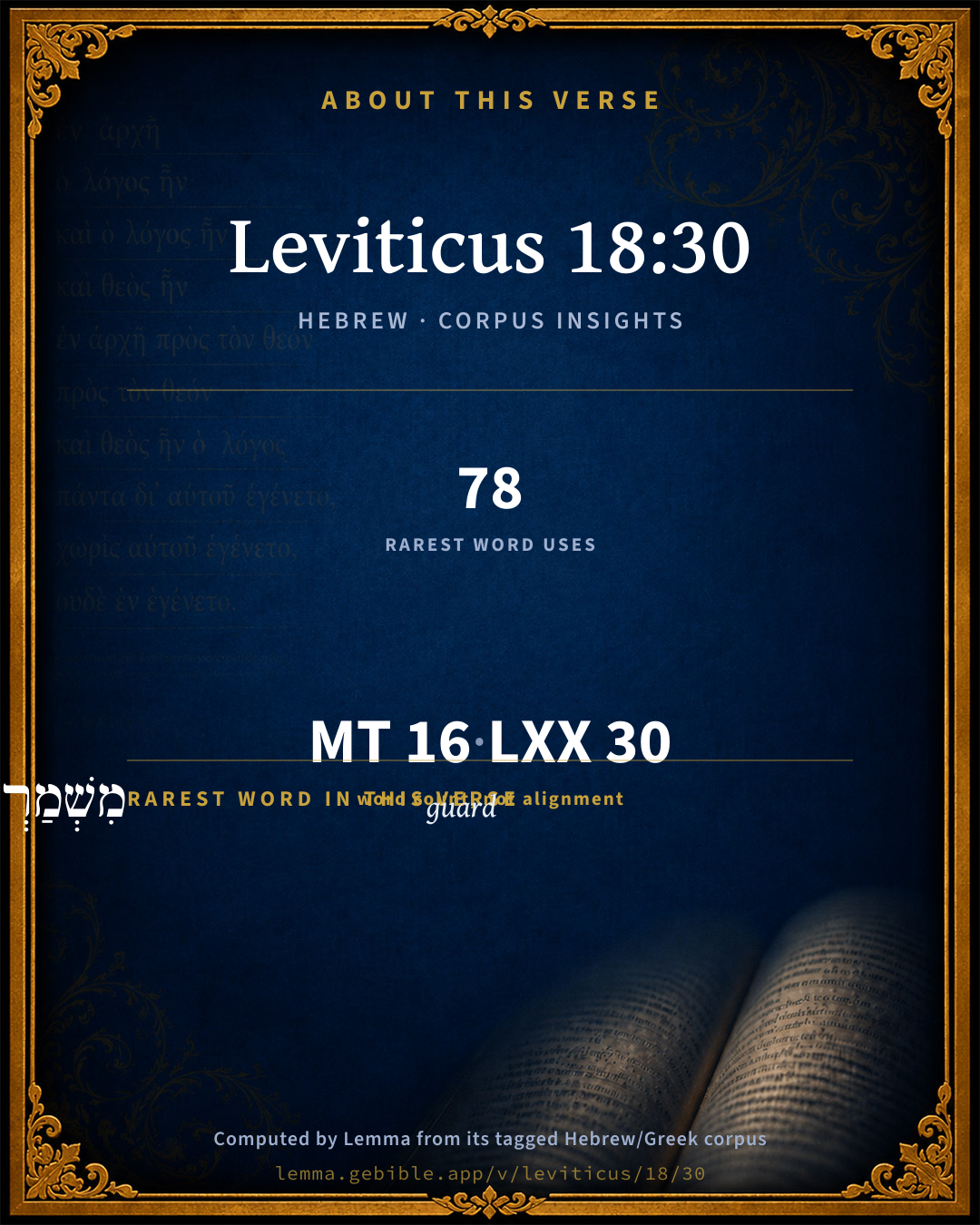
About this verse

These counts appear in no published source. They are computed here, from the morphology-tagged text and Lemma’s own curated glosses. What Lemma adds →

16
words
14
distinct lemmas
Pentateuch
section

Grammatical profile

  • 4 verbs
  • 6 nouns
  • 1 pronoun
  • 1 preposition
  • 1 conjunction
  • 3 particles

Verb forms

  • וּשְׁמַרְתֶּ֣ם Qal · Sequential Perfect
  • עֲשׂ֜וֹת Qal · Infinitive Construct
  • נַעֲשׂ֣וּ Niphal · Perfect
  • תִֽטַּמְּא֖וּ Hithpael · Imperfect

Repetition

A word recurs within this verse — often emphatic in Hebrew:

  • עֲשׂ֜וֹת to do H6213 ×2

Hebrew & Septuagint length

In English translation the verse runs 35 words from the Hebrew and 38 from the Septuagint (LXX English) — closely comparable.

A rough comparison of the two English renderings, which tokenize alike — not a word-level alignment.

Word counts can differ between the Hebrew and the Greek without any difference in meaning — e.g. the Hebrew direct-object marker אֵת has no separate Greek word, and Greek often adds the article ὁ.

In the original languages it is 16 Hebrew tokens and 30 Greek tokens — but the two are counted differently (Hebrew bundles its prefixes and suffixes into one token; the Greek is in lemma form), so that isn’t a like-for-like length.

Cross-references

6

Topical passages linked to Leviticus 18:30 in the Treasury of Scripture Knowledge — connected by theme and wording, ordered by reader-vote popularity; previews shown in the World English Bible.

  • Leviticus 20:23 You shall not walk in the customs of the nation, which I am casting out before you: for they did all these things, and therefore I abhorred them.
  • Deuteronomy 18:9–12 When you are come into the land which Yahweh your God gives you, you shall not learn to do after the abominations of those nations.
  • Leviticus 22:9 "'They shall therefore keep my charge, lest they bear sin for it, and die therein, if they profane it. I am Yahweh who sanctifies them.
  • Leviticus 18:2–4 "Speak to the children of Israel, and say to them, 'I am Yahweh your God.
  • Leviticus 18:26–27 You therefore shall keep my statutes and my ordinances, and shall not do any of these abominations; neither the native-born, nor the stranger who lives as a foreigner among you;
  • Deuteronomy 11:1 Therefore you shall love Yahweh your God, and keep his charge, and his statutes, and his ordinances, and his commandments, always.

Cross-references courtesy of OpenBible.info (CC BY 4.0).

Hebrew and Greek witnesses Masoretic Hebrew ↔ Greek Septuagint

The same verse in the two great witnesses to the Old Testament, shown verse-for-verse.

These are two independent witnesses, not word-aligned to each other, and the Septuagint is shown in lemma (dictionary) form.

Hebrew Leviticus 18:30 Masoretic · Westminster Leningrad Codex

וּשְׁמַרְתֶּ֣ם אֶת מִשְׁמַרְתִּ֗י לְבִלְתִּ֨י עֲשׂ֜וֹת מֵחֻקּ֤וֹת הַתּֽוֹעֵבֹת֙ אֲשֶׁ֣ר נַעֲשׂ֣וּ לִפְנֵיכֶ֔ם וְלֹ֥א תִֽטַּמְּא֖וּ בָּהֶ֑ם אֲנִ֖י יְהוָ֥ה אֱלֹהֵיכֶֽם

Therefore you shall keep my charge, that you do not practice any of these abominable customs, which were practiced before you, and that you do not defile yourselves with them: I am Yahweh your God.'"

World English Bible · Public Domain

Greek LXX Leviticus 18:30 Septuagint · lemma form

καί φυλάσσω ὁ πρόσταγμα ἐγώ ὅπως μή ποιέω ἀπό πᾶς ὁ νόμιμος ὁ βδελύσσω ὅς γίγνομαι πρό ὁ σύ καί οὐ μιαίνω ἐν αὐτός ὅτι ἐγώ κύριος ὁ θεός σύ

And you⌃ shall keep my ordinances, that you⌃ may not do any of the abominable practices, which have taken place before your time: and you⌃ shall not be polluted in them; for I am the Lord your God.

LXX2012 (modern English Septuagint) · Public Domain

Hebrew: Westminster Leningrad Codex (CC BY 4.0). Greek: Septuagint (public domain); English from LXX2012 (modern English Septuagint) (Public Domain). How the Septuagint differs from the Hebrew →

Targum (Aramaic paraphrase)

2

The Targum is the ancient Jewish Aramaic paraphrase of the Hebrew Scriptures — an interpretive translation, not the Hebrew text itself. Onkelos (literal) and Pseudo-Jonathan (expansive) render the Torah, and Jonathan the Prophets. Coverage is partial: where no permissively-licensed English translation exists for a verse, only the Aramaic is shown. This is verse-level text, not a word-by-word alignment to the Hebrew.

  1. Targum Onkelos Torah (Genesis–Deuteronomy)
    וְתִטְרוּן יָת מַטְרַת מֵימְרִי בְּדִיל דְלָא לְמֶעְבַּד מִנִימוֹסֵי תוֹעֶבְתָּא דְאִתְעֲבָדָא קֳדָמֵיכוֹן וְלָא תִסְתַּאֲבוּן בְּהוֹן אֲנָא יְיָ אֱלָהָכוֹן

    (no public-domain English translation for this verse)

    Targum Onkelos — Aramaic: “Onkelos Genesis” (public domain); “Onkelos Exodus” (public domain); “Onkelos Leviticus” (public domain); “Onkelos Numbers” (public domain); “Onkelos Deuteronomy” (public domain). English: “Sefaria Community Translation” (CC0 1.0 (public-domain dedication)); “J.W. Etheridge. The Targums of Onkelos and Jonathan Ben Uzziel on the Pentateuch. London: Longmans, Green, 1862” (public domain). Text via Sefaria.

  2. Targum Pseudo-Jonathan Torah (Genesis–Deuteronomy)
    וְתִטְרוּן יַת מַטְרַת מֵימְרִי לְאִזְדַהֲרָא מְטוֹל לְמֶעֱבַד מִנִימוּסֵי תּוֹעֵבְתָּא דְאִיתְעַבִידוּ בְּאַרְעָא קֳדָמֵיכוֹן וְלָא תִסְתַּאֲבוּן בְּהוֹן אֲנָא הוּא יְיָ אֱלָהָכוֹן

    Observe you (then) the keeping of My Word, in being careful to avoid the practice of these abominable rites, which have been practised in the land before you, and the defilement of yourselves by them: I am the Lord.

    Targum Pseudo-Jonathan — Aramaic: “Targum Jonathan on Genesis” (public domain); “Targum Jonathan on Exodus” (public domain); “Targum Jonathan on Leviticus” (public domain); “Targum Jonathan on Numbers” (public domain); “Targum Jonathan on Deuteronomy” (public domain). English: “The Targum of Jonathan ben Uzziel, trans. J. W. Etheridge, London, 1862” (public domain). Text via Sefaria.

Commentary

Notes on Leviticus 18:30 from classic Christian and Jewish commentators (each source and its license shown beneath its notes). The classic Christian expositions comment on the surrounding passage and are grouped to its opening verse, so a note may address several verses; the Jewish commentaries on the Tanakh (Rashi and others) are per-verse, so they appear only where the commentator wrote on this verse.

Lemma curates 59 commentaries, every one of them public domain or Creative Commons licensed, each selected and text-cleaned for this edition rather than reprinted as found. About our sources →

Trapp's Complete Commentary

John Trapp

Lev 18:30 Therefore shall ye keep mine ordinance, that [ye] commit not [any one] of these abominable customs, which were committed before you, and that ye defile not yourselves therein: I [am] the LORD your God.

Ver. 30. These abominable customs.] Heb., Statutes of abominations. Their evil customs became as laws: that tyrant of three letters, Mos, had made them so.

John Trapp, A Commentary or Exposition upon All the Books of the Old and New Testament (1647–1656) — public domain. Text from a community e-Sword module.

Jamieson, Fausset & Brown

Robert Jamieson, A. R. Fausset & David Brown

Therefore shall ye keep mine ordinance, that ye commit not any one of these abominable customs--In giving the Israelites these particular institutions, God was only re-delivering the law imprinted on the natural heart of man; for there is every reason to believe that the incestuous alliances and unnatural crimes prohibited in this chapter were forbidden to all men by a law expressed or understood from the beginning of the world, or at least from the era of the flood, since God threatens to condemn and punish, in a manner so sternly severe, these atrocities in the practice of the Canaanites and their neighbors, who were not subject to the laws of the Hebrew nation.

Next: Leviticus Chapter 19

Jamieson, Fausset & Brown — Commentary Critical and Explanatory on the Whole Bible (1871) — public domain (CC PDM 1.0). Text via the HelloAO Bible API.

Adam Clarke's Commentary

Verse 30. Shall ye keep mine ordinance] The only way to be preserved from all false worship is seriously to consider and devoutly to observe the ordinances of the true religion. He who in the things of God goes no farther than he can say, Thus it is written, and thus it behoves me to do, is never likely to receive a false creed, nor perform a superstitious act of worship.

1. How true is that word, The law of the Lord is PERFECT! In a small compass, and in a most minute detail, it comprises every thing that is calculated to instruct, direct, convince, correct, and fortify the mind of man. Whatever has a tendency to corrupt or injure man, that it forbids; whatever is calculated to comfort him, promote and secure his best interests, that it commands. It takes him in all possible states, views him in all connections, and provides for his present and eternal happiness.

2. As the human soul is polluted and tends to pollution, the great doctrine of the law is holiness to the Lord: this it keeps invariably in view in all its commands, precepts, ordinances, rites, and ceremonies. And how forcibly in all these does it say, Thou shalt love the Lord thy God with all thy heart, and with all thy soul, and with all thy mind, and with all thy strength; and thy neighbour as thyself! This is the prominent doctrine of the preceding chapter; and this shall be fulfilled in all them who believe, for Christ is the end of the law for righteousness to them that believe.

Reader, magnify God for his law, for by it is the knowledge of sin; and magnify him for his Gospel, for by this is the cure of sin. Let the law be thy schoolmaster to bring thee to Christ, that thou mayest be justified by faith; and that the righteousness of the law may be fulfilled in thee, and that thou mayest walk, not after the flesh, but after the Spirit.

Adam Clarke's Commentary on the Bible (1810–1826) — public domain. Text from a community e-Sword/MySword module.

Ellicott's Commentary for English Readers

(30) Therefore shall ye keep mine ordinance. As God is no respecter of persons, and as He will assuredly visit His own people with the same punishment which He inflicted upon the former occupants of the laud, the Israelites are to take special care to keep inviolate His ordinances.

Commit not any one of these abominable customs, which were committed before you. Better, Do not any one of these abominable statutes which were done, as the Authorised Version translates the word in Deu_6:24; Deu_16:12; Deu_26:16. These abominations were not practised simply as customs, but were legally enacted as statutes of the land, and formed part of their religious institutions (see Lev_18:3). A similar state of degeneracy is described by Isaiah, who tells us that the Divine statutes, which is the same word used in the passage before us, were changed. By deviating here from the usual rendering of this phrase the Authorised Version mars the import of the passage.

I am the Lord your God.—This is the declaration with which this group of laws was introduced. Its repetition at the end imparts peculiar solemnity to these enactments. (See Lev_18:1.)

A Bible Commentary for English Readers, edited by Charles John Ellicott (1878–1897) — public domain. Text from a community e-Sword module.

John Gill's Exposition

Therefore shall ye keep mine ordinance,.... Whatever the Lord appointed them and commanded, whether contained in this chapter, or elsewhere:

that ye commit not anyone of these abominable customs; for attending to the ordinances of God, and a close in them, they would be preserved from the commission of such abominable things, and giving in to such detestable customs as before warned against:

which were committed before you; by the inhabitants of Canaan; and by the punishment on them for them they might be deterred from doing the same:

and that ye defile not yourselves therein; for though the land is so often said to be defiled, yet, properly speaking, and chiefly, it was the inhabitants that were defiled by their abominable customs; and so would the Israelites also, should they observe the same, and thereby become abominable in the sight of God, and incur his displeasure, and be liable to his vengeance:

I am the Lord your God; who had a sovereign authority over them, and a right to give out what commands he pleased, both negative and affirmative; and to whom they were under obligations to obey, as the God of nature and providence, from whom they had their beings, and were supported in them, and as their covenant God, who had bestowed special and spiritual favours on them.

Next: Leviticus Chapter 19

John Gill's Exposition of the Whole Bible (1746–1763) — public domain (CC PDM 1.0). Text via the HelloAO Bible API.

Rashi

Rabbi Shlomo Yitzchaki (Rashi)

ושמרתם את משמרתי THEREFORE SHALL YE KEEP (OR, WATCH OVER) MY CHARGE — This is intended to caution the court regarding this (Sifra, Acharei Mot, Chapter 13 22).

ולא תטמאו בהם אני ה' אלהיכם AND IF YE DEFILE NOT YOURSELVES THEREIN, I AM THE LORD YOUR GOD — If, however, you do defile yourselves I shall no longer be your God (אלהיכם) since you have cut yourselves off from following after Me. What use then can I have of you? Consequently you deserve annihilation! That is why Scripture states: I am the Lord your God (Sifra, Acharei Mot, Chapter 13 22).

Rashi on the Tanakh — English translations: “The Judaica Press complete Tanach with Rashi, translated by A. J. Rosenberg” (CC BY 4.0); “Pentateuch with Rashi's commentary by M. Rosenbaum and A.M. Silbermann, 1929-1934” (public domain); “The Metsudah Tanach series, Lakewood, N.J” (CC BY 4.0); and “The Book of Joshua, Metsudah Publications, 1997” (CC BY 4.0). Text via Sefaria.

Lesson kit

Teaching starters — assembled from the data on this page, not authored interpretation. Every prompt links to the verse data it draws on. Edit before teaching.

Leviticus, in the Pentateuch, opens this verse with 16 words (14 distinct Hebrew lemmas). Its most distinctive word is mishmereth (“guard”). A historical commentator’s framing appears above. Read the whole chapter for the surrounding context.

Discussion questions

  1. The word mishmereth carries the sense “guard.” How does it shape the verse?
  2. Leviticus 20:23 shares this passage’s theme. How do the two illuminate each other?
  3. “to do” occurs 2× in this one verse. What is the effect of the repetition?
  4. These translations render this verse differently. What is at stake in choosing one wording over another?
  5. The verb «וּשְׁמַרְתֶּ֣ם» is Qal Sequential Perfect. How does its form color the action?
  6. Reading how Trapp's Complete Commentary and Jamieson, Fausset & Brown read this verse, where do the two commentators agree and where do they part?

Things to notice

Reading settings

Reading text

Shown beneath each verse's original-language words.

Old Testament
Old Testament edition

Read the OT as the Masoretic Hebrew (MT) or the Greek Septuagint (LXX).

English shown for the Greek Septuagint (in the Hebrew ↔ Greek comparison).

Comparing translations? Open the Compare panel on any verse page to stack up to four side by side.