
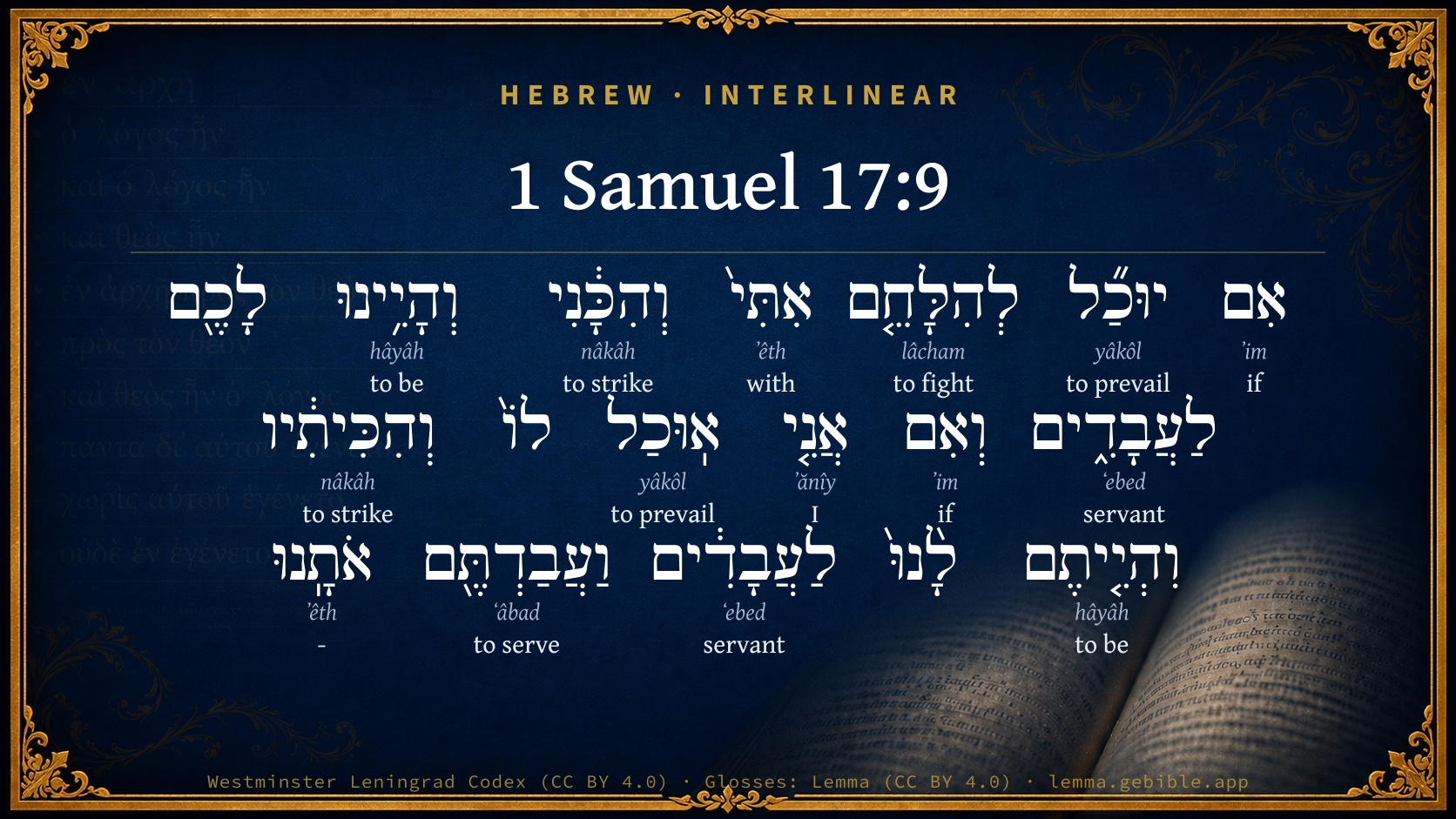
1 Samuel 17:9

Hebrew (Westminster Leningrad Codex) 1 Samuel 17:9 appears in the Hebrew Old Testament. The text above is from the Westminster Leningrad Codex. Each word links to its Strong’s number, a concise gloss, and parsing drawn from the Open Scriptures Hebrew Bible morphology. Click any word for its full Brown-Driver-Briggs (BDB) entry.
Download image
Cite this verse

1 Samuel 17:9 (World English Bible). Public Domain. Lemma interlinear Bible study tool, https://lemma.gebible.app/v/1-samuel/17/9.

Show BibTeX & RIS
BibTeX
RIS
English Translation
If he be able to fight with me, and kill me, then will we be your servants; but if I prevail against him, and kill him, then shall you be our servants, and serve us.
World English Bible · Public Domain
Download a study sheet

One document with this verse’s original text, its word-by-word gloss line, the meaning frame, cross-references with their text, attributed commentary, and full source and license credits — printable, and it pastes into notes with its structure intact.

This verse Autodidact and up

Study sheet (.html) Plain text (.txt)

A passage Seminary Student

Up to 50 verses in one chapter. A passage sheet keeps up to 6 commentary sources and 12 cross-references per verse, in the order this page ranks them, and says so on the sheet whenever that leaves anything out. Ask for a single verse and you get the Autodidact verse sheet above.

Everything on this page stays free to read, with no account — the sheet is a download of what is already on screen, not access to it.

Want to remove ads? Support Godless Engineer
Compare translations 3

The same verse in 3 English versions, stacked beneath the original-language interlinear above. Click any original word for its lexicon entry.

Each is an independent rendering of the whole verse — the interlinear is not word-aligned to these translations.

Highlighted words mark where these versions differ — a whole-verse word diff, not a word-by-word alignment.

  • World English Bible Public Domain
    If he be able to fight with me, and kill me, then will we be your servants; but if I prevail against him, and kill him, then shall you be our servants, and serve us.
  • King James Version Public Domain
    If he be able to fight with me, and to kill me, then will we be your servants: but if I prevail against him, and kill him, then shall ye be our servants, and serve us.
  • unfoldingWord Literal Text CC BY-SA 4.0
    If he is able to fight with me and he strikes me, then we will become servants to you. But if I am able against him and I strike him, then you will become servants to us, and you will serve us.”

unfoldingWord Literal Text — © unfoldingWord, licensed CC BY-SA 4.0. Word-aligned USFM3 via Door43 (git.door43.org/unfoldingWord/en_ult).

Versions to compare (up to 4)

3 of 4 selected

Show all 18 translations

Every available English version of this verse, each an independent rendering of the whole verse.

  • World English Bible Public Domain
    If he be able to fight with me, and kill me, then will we be your servants; but if I prevail against him, and kill him, then shall you be our servants, and serve us.
  • Berean Standard Bible Public Domain
    If he is able to fight me and kill me, then we will be your servants. But if I prevail against him and kill him, then you shall be our servants and labor for us.”
  • Majority Standard Bible Public Domain
    If he is able to fight me and kill me, then we will be your servants. But if I prevail against him and kill him, then you shall be our servants and work for us.”
  • King James Version Public Domain
    If he be able to fight with me, and to kill me, then will we be your servants: but if I prevail against him, and kill him, then shall ye be our servants, and serve us.
  • American Standard Version (1901) Public Domain
    If he be able to fight with me, and kill me, then will we be your servants; but if I prevail against him, and kill him, then shall ye be our servants, and serve us.
  • Revised Version (1885) Public Domain
    If he be able to fight with me, and kill me, then will we be your servants: but if I prevail against him, and kill him, then shall ye be our servants, and serve us.
  • Geneva Bible (1599) Public Domain
    If he be able to fight with me, and kill me, then wil we be your seruants: but if I ouercome him, and kill him, then shall yee be our seruants, and serue vs.
  • Douay-Rheims (1899) Public Domain
    If he be able to fight with me, and kill me, we will be servants to you: but if I prevail against him, and kill him, you shall be servants, and shall serve us.
  • Young's Literal Translation Public Domain
    if he be able to fight with me, and have smitten me, then we have been to you for servants; and if I am able for him, and have smitten him, then ye have been to us for servants, and have served us.'
  • Literal Standard Version CC BY-SA 4.0
    if he is able to fight with me, and has struck me, then we have been for servants to you; and if I prevail against him, and have struck him, then you have been for servants to us, and have served us.”
  • Unlocked Literal Bible CC BY-SA 4.0
    If he is able to fight with me and kill me, then will we be your servants. But if I defeat him and kill him, then you will be our servants and serve us.”
  • unfoldingWord Literal Text CC BY-SA 4.0
    If he is able to fight with me and he strikes me, then we will become servants to you. But if I am able against him and I strike him, then you will become servants to us, and you will serve us.”
  • Darby Bible Public Domain
    If he be able to fight with me, and to smite me, then will we be your servants; but if I overcome and smite him, then shall ye be our servants and serve us.
  • World Messianic Bible Public Domain
    If he is able to fight with me and kill me, then will we be your servants; but if I prevail against him and kill him, then you will be our servants and serve us.”
  • Webster's Bible Public Domain
    If he shall be able to fight with me, and to kill me, then will we be your servants: but if I shall prevail against him, and kill him, then shall ye be our servants, and serve us.
  • Free Bible Version CC BY-SA 4.0
    If he can fight me and kill me, then we will be your slaves. But if I beat him and kill him, then you'll be our slaves and work for us.”
  • Bible in Basic English Public Domain
    If he is able to have a fight with me and overcome me, then we will be your servants: but if I am able to overcome him, then you will be our servants and do work for us.
  • JPS Tanakh (1917) Public Domain
    If he be able to fight with me, and kill me, then will we be your servants; but if I prevail against him, and kill him, then shall ye be our servants, and serve us.'

Literal Standard Version (2020), Covenant Press — licensed CC BY-SA 4.0. Text via the HelloAO Bible API (eBible.org). Unlocked Literal Bible (unfoldingWord) — licensed CC BY-SA 4.0. Text via the HelloAO Bible API (eBible.org). unfoldingWord Literal Text — © unfoldingWord, licensed CC BY-SA 4.0. Word-aligned USFM3 via Door43 (git.door43.org/unfoldingWord/en_ult). Free Bible Version, Dr. Jonathan Gallagher — licensed CC BY-SA 4.0. Text via the HelloAO Bible API (eBible.org).

Word by word

More ways to search: Search by grammar → Find every occurrence → Compare this word →

Practice this passage: Drill this verse → Learn its vocabulary →

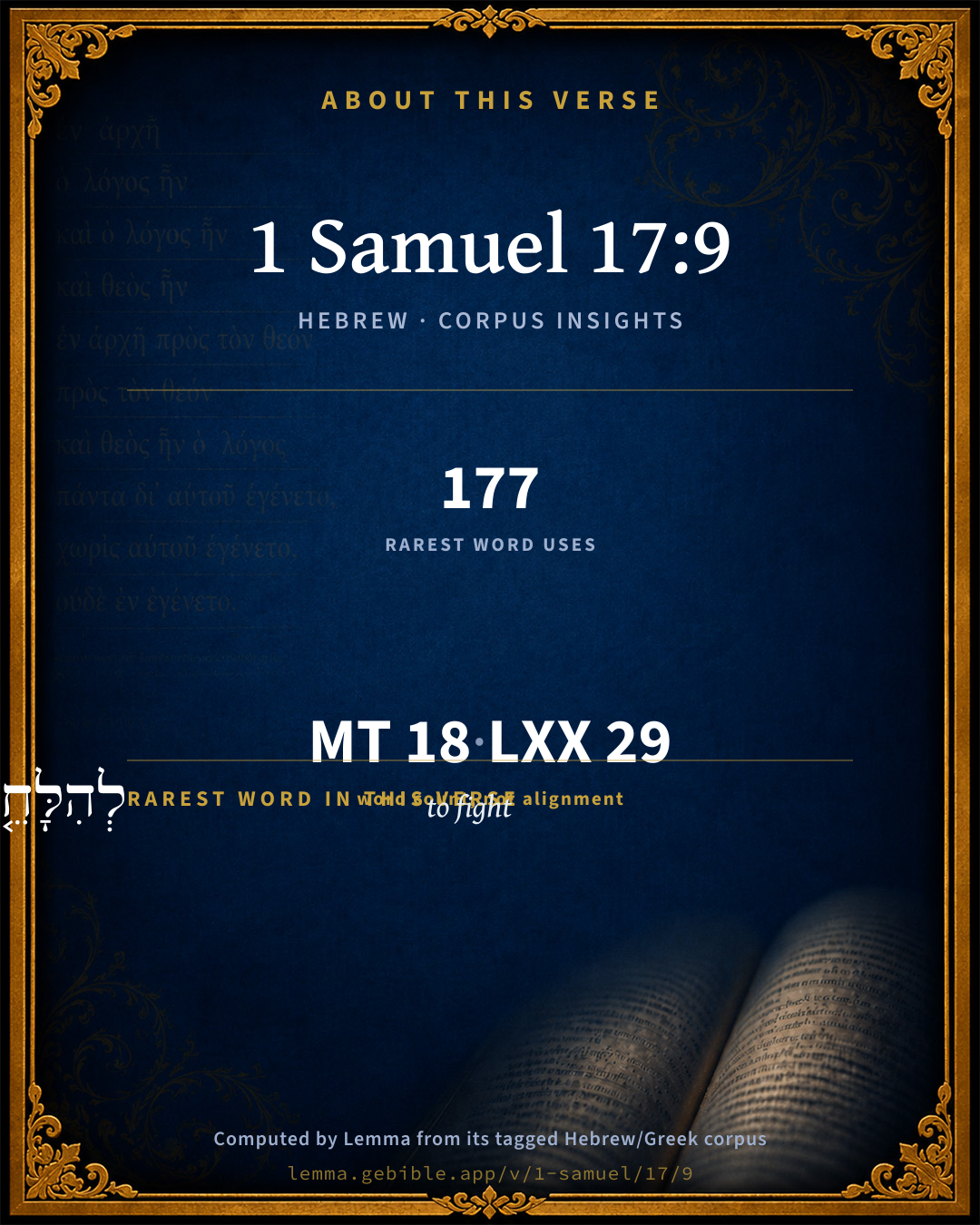
לְהִלָּחֵ֤ם
lâcham
H3898
“to fight”
Preposition + Verb, Niphal, Infinitive Construct
Part of Speech
Preposition + Verb
Stem
Niphal
Form
Infinitive Construct
Full BDB Definition

Origin: a primitive root

TWOT: 1104 , 1105

to fight, do battle, make war - (Qal) to fight, do battle - (Niphal) to engage in battle, wage war - (Qal) to eat, use as food
  1. אִם ʼim H518 “if” Conjunction
  2. יוּכַ֞ל yâkôl H3201 “to prevail” Verb, Qal, Imperfect, 3rd Person, Masculine, Singular
  3. אִתִּי֙ ʼêth H854 “with · me” Preposition + Suffix, Personal, 1st Person, Common, Singular
  4. וְהִכָּ֔נִי nâkâh H5221 “and · to strike · me” Conjunction + Verb, Hiphil, Perfect, 3rd Person, Masculine, Singular + Suffix, Personal, 1st Person, Common, Singular
  5. וְהָיִ֥ינוּ hâyâh H1961 “and · to be” Conjunction + Verb, Qal, Sequential Perfect, 1st Person, Common, Plural
  6. לַעֲבָדִ֑ים ʻebed H5650 “to/for · servants” Preposition + Noun, Common, Masculine, Plural, Absolute
  7. וְאִם ʼim H518 “and · if” Conjunction + Conjunction
  8. אֲנִ֤י ʼănîy H589 “I” Pronoun, Personal, 1st Person, Common, Singular
  9. אֽוּכַל yâkôl H3201 “to prevail” Verb, Qal, Imperfect, 1st Person, Common, Singular
  10. וְהִכִּיתִ֔יו nâkâh H5221 “and · to strike · him” Conjunction + Verb, Hiphil, Perfect, 1st Person, Common, Singular + Suffix, Personal, 3rd Person, Masculine, Singular
  11. וִהְיִ֤יתֶם hâyâh H1961 “and · to be” Conjunction + Verb, Qal, Sequential Perfect, 2nd Person, Masculine, Plural
  12. לַעֲבָדִ֔ים ʻebed H5650 “to/for · servants” Preposition + Noun, Common, Masculine, Plural, Absolute
  13. וַעֲבַדְתֶּ֖ם ʻâbad H5647 “and · to serve” Conjunction + Verb, Qal, Sequential Perfect, 2nd Person, Masculine, Plural
  14. אֹתָֽנוּ ʼêth H853 “- · us” Particle, Direct Object + Suffix, Personal, 1st Person, Common, Plural

About this verse

These counts appear in no published source. They are computed here, from the morphology-tagged text and Lemma’s own curated glosses. What Lemma adds →

18
words
10
distinct lemmas
Historical
section

Grammatical profile

  • 8 verbs
  • 2 nouns
  • 1 pronoun
  • 4 prepositions
  • 2 conjunctions
  • 1 particle

Verb forms

  • יוּכַ֞ל Qal · Imperfect
  • לְהִלָּחֵ֤ם Niphal · Infinitive Construct
  • וְהִכָּ֔נִי Hiphil · Perfect
  • וְהָיִ֥ינוּ Qal · Sequential Perfect
  • אֽוּכַל Qal · Imperfect
  • וְהִכִּיתִ֔יו Hiphil · Perfect
  • וִהְיִ֤יתֶם Qal · Sequential Perfect
  • וַעֲבַדְתֶּ֖ם Qal · Sequential Perfect

Repetition

Words recur within this verse — often emphatic in Hebrew:

  • יוּכַ֞ל to prevail H3201 ×2
  • וְהִכָּ֔נִי to strike H5221 ×2
  • וְהָיִ֥ינוּ to be H1961 ×2
  • לַעֲבָדִ֑ים servant H5650 ×2
  • אִם if H518 ×2

Hebrew & Septuagint length

In English translation the verse runs 35 words from the Hebrew and 36 from the Septuagint (LXX English) — closely comparable.

A rough comparison of the two English renderings, which tokenize alike — not a word-level alignment.

Word counts can differ between the Hebrew and the Greek without any difference in meaning — e.g. the Hebrew direct-object marker אֵת has no separate Greek word, and Greek often adds the article ὁ.

In the original languages it is 18 Hebrew tokens and 29 Greek tokens — but the two are counted differently (Hebrew bundles its prefixes and suffixes into one token; the Greek is in lemma form), so that isn’t a like-for-like length.

Cross-references

1

Topical passages linked to 1 Samuel 17:9 in the Treasury of Scripture Knowledge — connected by theme and wording, ordered by reader-vote popularity; previews shown in the World English Bible.

  • 1 Samuel 11:1 Then Nahash the Ammonite came up, and encamped against Jabesh Gilead: and all the men of Jabesh said to Nahash, Make a covenant with us, and we will serve you.

Cross-references courtesy of OpenBible.info (CC BY 4.0).

Hebrew and Greek witnesses Masoretic Hebrew ↔ Greek Septuagint

The same verse in the two great witnesses to the Old Testament, shown verse-for-verse.

These are two independent witnesses, not word-aligned to each other, and the Septuagint is shown in lemma (dictionary) form.

Hebrew 1 Samuel 17:9 Masoretic · Westminster Leningrad Codex

אִם יוּכַ֞ל לְהִלָּחֵ֤ם אִתִּי֙ וְהִכָּ֔נִי וְהָיִ֥ינוּ לָכֶ֖ם לַעֲבָדִ֑ים וְאִם אֲנִ֤י אֽוּכַל לוֹ֙ וְהִכִּיתִ֔יו וִהְיִ֤יתֶם לָ֨נוּ֙ לַעֲבָדִ֔ים וַעֲבַדְתֶּ֖ם אֹתָֽנוּ

If he be able to fight with me, and kill me, then will we be your servants; but if I prevail against him, and kill him, then shall you be our servants, and serve us.

World English Bible · Public Domain

Greek LXX 1 Samuel 17:9 Septuagint · lemma form

καί ἐάν δύναμαι πρός ἐγώ πολεμέω καί ἐάν πατάσσω ἐγώ καί εἰμί σύ εἰς δοῦλος ἐάν δέ ἐγώ δύναμαι καί πατάσσω αὐτός εἰμί ἐγώ εἰς δοῦλος καί δουλεύω ἐγώ

And if he shall be able to fight against me, and shall strike me, then will we be your servants: but if I should prevail and strike him, you⌃ shall be our servants, and serve us.

LXX2012 (modern English Septuagint) · Public Domain

Hebrew: Westminster Leningrad Codex (CC BY 4.0). Greek: Septuagint (public domain); English from LXX2012 (modern English Septuagint) (Public Domain). How the Septuagint differs from the Hebrew →

Targum (Aramaic paraphrase)

1

The Targum is the ancient Jewish Aramaic paraphrase of the Hebrew Scriptures — an interpretive translation, not the Hebrew text itself. Onkelos (literal) and Pseudo-Jonathan (expansive) render the Torah, and Jonathan the Prophets. Coverage is partial: where no permissively-licensed English translation exists for a verse, only the Aramaic is shown. This is verse-level text, not a word-by-word alignment to the Hebrew.

  1. Targum Jonathan Prophets (Joshua–Malachi)
    אִם יִכּוּל לַאֲגָחָא קְרָבָא עִמִי וְיִקְטְלִינַנִי וּנְהֵי לְכוֹן לְעַבְדִין וְאִם אֲנָא אִכּוּל לֵיהּ וְאַקְטִלִינֵיהּ וּתְהוֹן לָנָא לְעַבְדִין וְתִפְלְחוּן יָתָנָא:

    (no public-domain English translation for this verse)

    Targum Jonathan — Aramaic: “Mikraot Gedolot” (public domain). English: “Sefaria Community Translation” (CC0 1.0 (public-domain dedication)); “London "Chaldee Paraphrase," 1871” (public domain). Text via Sefaria.

Commentary

Notes on 1 Samuel 17:9 from classic Christian and Jewish commentators (each source and its license shown beneath its notes). The classic Christian expositions comment on the surrounding passage and are grouped to its opening verse, so a note may address several verses; the Jewish commentaries on the Tanakh (Rashi and others) are per-verse, so they appear only where the commentator wrote on this verse.

Lemma curates 59 commentaries, every one of them public domain or Creative Commons licensed, each selected and text-cleaned for this edition rather than reprinted as found. About our sources →

Trapp's Complete Commentary

John Trapp

1Sa 17:9 If he be able to fight with me, and to kill me, then will we be your servants: but if I prevail against him, and kill him, then shall ye be our servants, and serve us.

Ver. 9. If he be able, … then will we be your servants.] Thus of old the Romans and Albans put the trial of the common cause upon the hazard of three champions on each side. Our ordinary duellers who, like those youngsters of Helkath Hazzurim, {2Sa 2:14-16} sheath their swords in their fellows’ bowels, are doubtless set on by that old manslayer, that he may feed upon them both at once, as the cock-pit-masters do upon their cocks of the game. What David did in this monomachy {duel}, was by a singular instinct of God.

John Trapp, A Commentary or Exposition upon All the Books of the Old and New Testament (1647–1656) — public domain. Text from a community e-Sword module.

Geneva Bible (1599)

Geneva Bible translators

Hebrew, smite me.

Geneva Bible (1599) marginal notes — public domain. Text via Bolls.life.

Adam Clarke's Commentary

Verse 9. Then will we be your servants] Of this stipulation we hear nothing farther.

Adam Clarke's Commentary on the Bible (1810–1826) — public domain. Text from a community e-Sword/MySword module.

Ellicott's Commentary for English Readers

(9) Then will we be your servants.—Each of the positions which the two opposing armies held was well-nigh impregnable; thus it seemed as though a single combat was the only way of deciding the present campaign: besides which, in those far back times such single combats between renowned chieftains of the opposing armies were not by any means uncommon. The reader of the Iliad will ever readily call to mind—in colloquies before the deadly duel—words not altogether unlike the haughty, boastful challenge of the giant Philistine. See, for instance, the speeches of Glaucus and Diomede in Book VI. of the Iliad: “Come hither,” says Glaucus, “that you may quickly reach the goal of death.”

A Bible Commentary for English Readers, edited by Charles John Ellicott (1878–1897) — public domain. Text from a community e-Sword module.

The Cambridge Bible for Schools and Colleges

gen. ed. J. J. S. Perowne

9. then will we be your servants] Compare the agreement between the Romans and Albans about the combat of the Horatii and Curiatii, “that the nation whose citizens conquered in the combat should rule the other in peace” (Livy I. 24). Paris challenged Menelaus to decide the Trojan war by single combat (Hom. Il. III. 86 ff.).

The Cambridge Bible for Schools and Colleges (gen. ed. J. J. S. Perowne; Cambridge University Press, 1878–1918) — public domain. Text from a community e-Sword module.

John Gill's Exposition

If he be able to fight with me, and to kill me, then will we be your servants,.... For which it does not appear he had any commission or authority to say; nor did the Philistines think themselves obliged to abide by what he said, since, when he was slain, they did not yield themselves servants to the Israelites:

but if I prevail against him, and kill him, then shall ye be our servants, and serve us; to which terms also the Israelites did not consent; nor did David, who engaged with him, enter the fray on such conditions.

John Gill's Exposition of the Whole Bible (1746–1763) — public domain (CC PDM 1.0). Text via the HelloAO Bible API.

Haydock's Catholic Bible Commentary

Us. It does not appear that this proposal was accepted or ratified by either party. The Israelites had still to pursue the enemy. (Estius)

George Leo Haydock (1774–1849), Haydock's Catholic Family Bible and Commentary, 1859 edition — public domain. Excludes Psalms (Douay-Rheims chapter numbering differs from Protestant) and Deuterocanonical books (Catholic canon only).

Lesson kit

Teaching starters — assembled from the data on this page, not authored interpretation. Every prompt links to the verse data it draws on. Edit before teaching.

1 Samuel, in the Historical, opens this verse with 18 words (10 distinct Hebrew lemmas). Its most distinctive word is lâcham (“to fight”). A historical commentator’s framing appears above. Read the whole chapter for the surrounding context.

Discussion questions

  1. The word lâcham carries the sense “to fight.” How does it shape the verse?
  2. How does 1 Samuel 11:1, which shares this passage’s theme, read alongside this verse?
  3. What does the repetition of “to prevail” (2× in this one verse) do in this verse?
  4. These translations render this verse differently; the difference is in the English rendering, not the original. What questions does that raise?
  5. «יוּכַ֞ל» is a Qal Imperfect verb. How does that grammatical form shape the action described?
  6. Compare how Trapp's Complete Commentary and Geneva Bible (1599) read this verse. Where do they agree or differ?

Things to notice

Reading settings

Reading text

Shown beneath each verse's original-language words.

Old Testament
Old Testament edition

Read the OT as the Masoretic Hebrew (MT) or the Greek Septuagint (LXX).

English shown for the Greek Septuagint (in the Hebrew ↔ Greek comparison).

Comparing translations? Open the Compare panel on any verse page to stack up to four side by side.