Leviticus 25:38

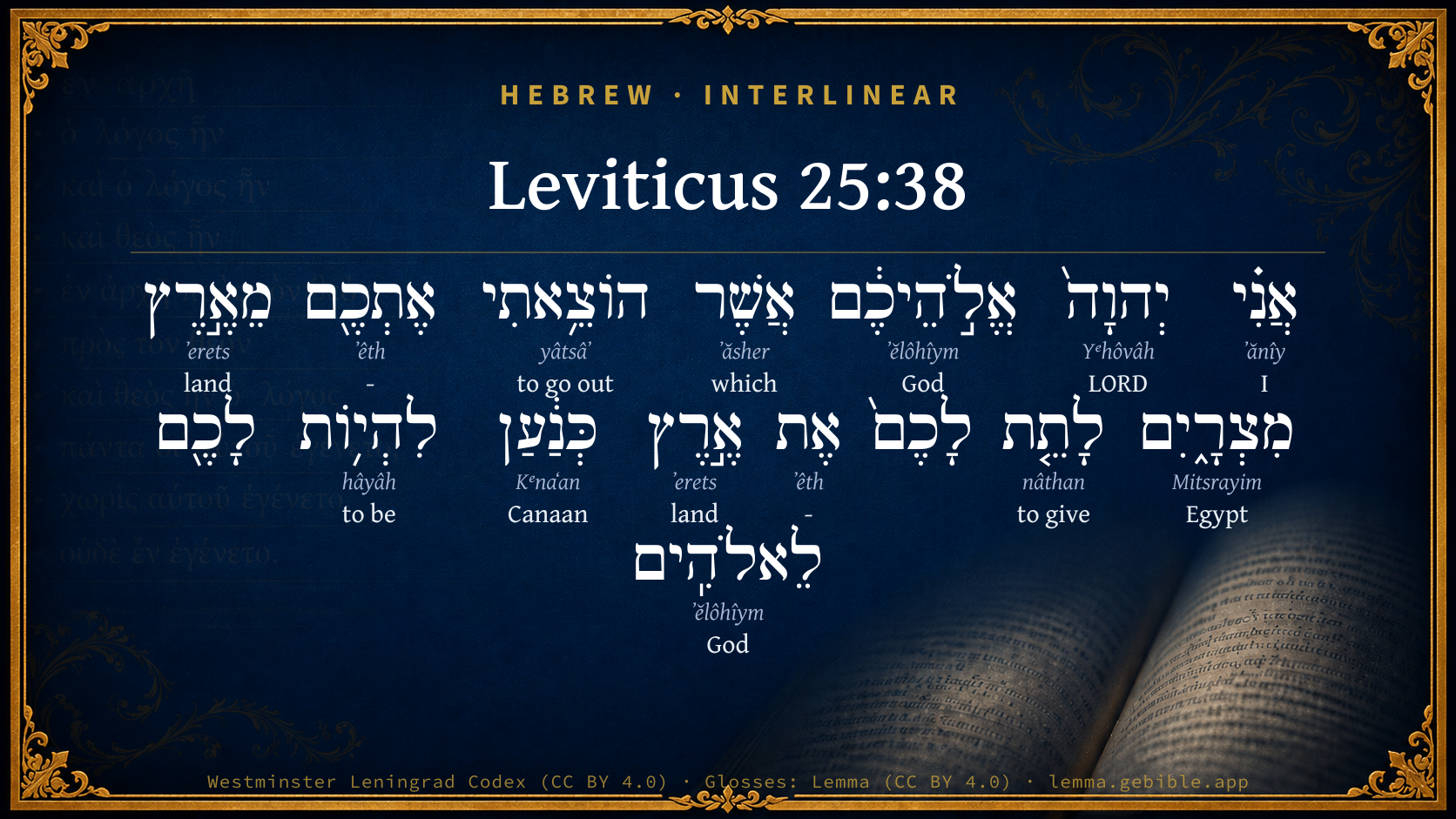
Hebrew (Westminster Leningrad Codex) Leviticus 25:38 appears in the Hebrew Old Testament. The text above is from the Westminster Leningrad Codex. Each word links to its Strong’s number, a concise gloss, and parsing drawn from the Open Scriptures Hebrew Bible morphology. Click any word for its full Brown-Driver-Briggs (BDB) entry.
Download image
Cite this verse

Leviticus 25:38 (World English Bible). Public Domain. Lemma interlinear Bible study tool, https://lemma.gebible.app/v/leviticus/25/38.

Show BibTeX & RIS
BibTeX
RIS
English Translation
I am Yahweh your God, who brought you forth out of the land of Egypt, to give you the land of Canaan, and to be your God.
World English Bible · Public Domain
Download a study sheet

One document with this verse’s original text, its word-by-word gloss line, the meaning frame, cross-references with their text, attributed commentary, and full source and license credits — printable, and it pastes into notes with its structure intact.

This verse Autodidact and up

Study sheet (.html) Plain text (.txt)

A passage Seminary Student

Up to 50 verses in one chapter. A passage sheet keeps up to 6 commentary sources and 12 cross-references per verse, in the order this page ranks them, and says so on the sheet whenever that leaves anything out. Ask for a single verse and you get the Autodidact verse sheet above.

Everything on this page stays free to read, with no account — the sheet is a download of what is already on screen, not access to it.

Want to remove ads? Support Godless Engineer
Compare translations 3

The same verse in 3 English versions, stacked beneath the original-language interlinear above. Click any original word for its lexicon entry.

Each is an independent rendering of the whole verse — the interlinear is not word-aligned to these translations.

Highlighted words mark where these versions differ — a whole-verse word diff, not a word-by-word alignment.

  • World English Bible Public Domain
    I am Yahweh your God, who brought you forth out of the land of Egypt, to give you the land of Canaan, and to be your God.
  • King James Version Public Domain
    I am the LORD your God, which brought you forth out of the land of Egypt, to give you the land of Canaan, and to be your God.
  • unfoldingWord Literal Text CC BY-SA 4.0
    I Yahweh your God, who brought you out from the land of Egypt, to give to you the land of Canaan, to be God to you.

unfoldingWord Literal Text — © unfoldingWord, licensed CC BY-SA 4.0. Word-aligned USFM3 via Door43 (git.door43.org/unfoldingWord/en_ult).

Versions to compare (up to 4)

3 of 4 selected

Show all 18 translations

Every available English version of this verse, each an independent rendering of the whole verse.

  • World English Bible Public Domain
    I am Yahweh your God, who brought you forth out of the land of Egypt, to give you the land of Canaan, and to be your God.
  • Berean Standard Bible Public Domain
    I am the LORD your God, who brought you out of the land of Egypt to give you the land of Canaan and to be your God.
  • Majority Standard Bible Public Domain
    I am the LORD your God, who brought you out of the land of Egypt to give you the land of Canaan and to be your God.
  • King James Version Public Domain
    I am the LORD your God, which brought you forth out of the land of Egypt, to give you the land of Canaan, and to be your God.
  • American Standard Version (1901) Public Domain
    I am Jehovah your God, who brought you forth out of the land of Egypt, to give you the land of Canaan, `and' to be your God.
  • Revised Version (1885) Public Domain
    I am the LORD your God, which brought you forth out of the land of Egypt, to give you the land of Canaan, to be your God.
  • Geneva Bible (1599) Public Domain
    I am the Lord your God, which haue brought you out of the lande of Egypt, to giue you the lande of Canaan, and to be your God.
  • Douay-Rheims (1899) Public Domain
    I am the Lord your God, who brought you out of the land of Egypt, that I might give you the land of Chanaan, and might be your God.
  • Young's Literal Translation Public Domain
    I `am' Jehovah your God, who hath brought you out of the land of Egypt, to give to you the land of Canaan, to become your God.
  • Literal Standard Version CC BY-SA 4.0
    I [am] your God YHWH, who has brought you out of the land of Egypt to give the land of Canaan to you, to become your God.
  • Unlocked Literal Bible CC BY-SA 4.0
    I am Yahweh your God, who brought you out of the land of Egypt, in order that I might give you the land of Canaan, and that I might be your God.
  • unfoldingWord Literal Text CC BY-SA 4.0
    I Yahweh your God, who brought you out from the land of Egypt, to give to you the land of Canaan, to be God to you.
  • Darby Bible Public Domain
    I am Jehovah your God, who brought you forth out of the land of Egypt, to give you the land of Canaan, to be your God.
  • World Messianic Bible Public Domain
    I am the LORD your God, who brought you out of the land of Egypt, to give you the land of Canaan, and to be your God.
  • Webster's Bible Public Domain
    I am the LORD your God, who brought you out of the land of Egypt, to give you the land of Canaan, and to be your God.
  • Free Bible Version CC BY-SA 4.0
    Remember, I am the Lord your God who led you out of Egypt to give you the land of Canaan and to be your God.
  • Bible in Basic English Public Domain
    I am the Lord your God, who took you out of the land of Egypt to give you the land of Canaan, that I might be your God.
  • JPS Tanakh (1917) Public Domain
    I am the LORD your God, who brought you forth out of the land of Egypt, to give you the land of Canaan, to be your God.

Literal Standard Version (2020), Covenant Press — licensed CC BY-SA 4.0. Text via the HelloAO Bible API (eBible.org). Unlocked Literal Bible (unfoldingWord) — licensed CC BY-SA 4.0. Text via the HelloAO Bible API (eBible.org). unfoldingWord Literal Text — © unfoldingWord, licensed CC BY-SA 4.0. Word-aligned USFM3 via Door43 (git.door43.org/unfoldingWord/en_ult). Free Bible Version, Dr. Jonathan Gallagher — licensed CC BY-SA 4.0. Text via the HelloAO Bible API (eBible.org).

Word by word

More ways to search: Search by grammar → Find every occurrence → Compare this word →

Practice this passage: Drill this verse → Learn its vocabulary →

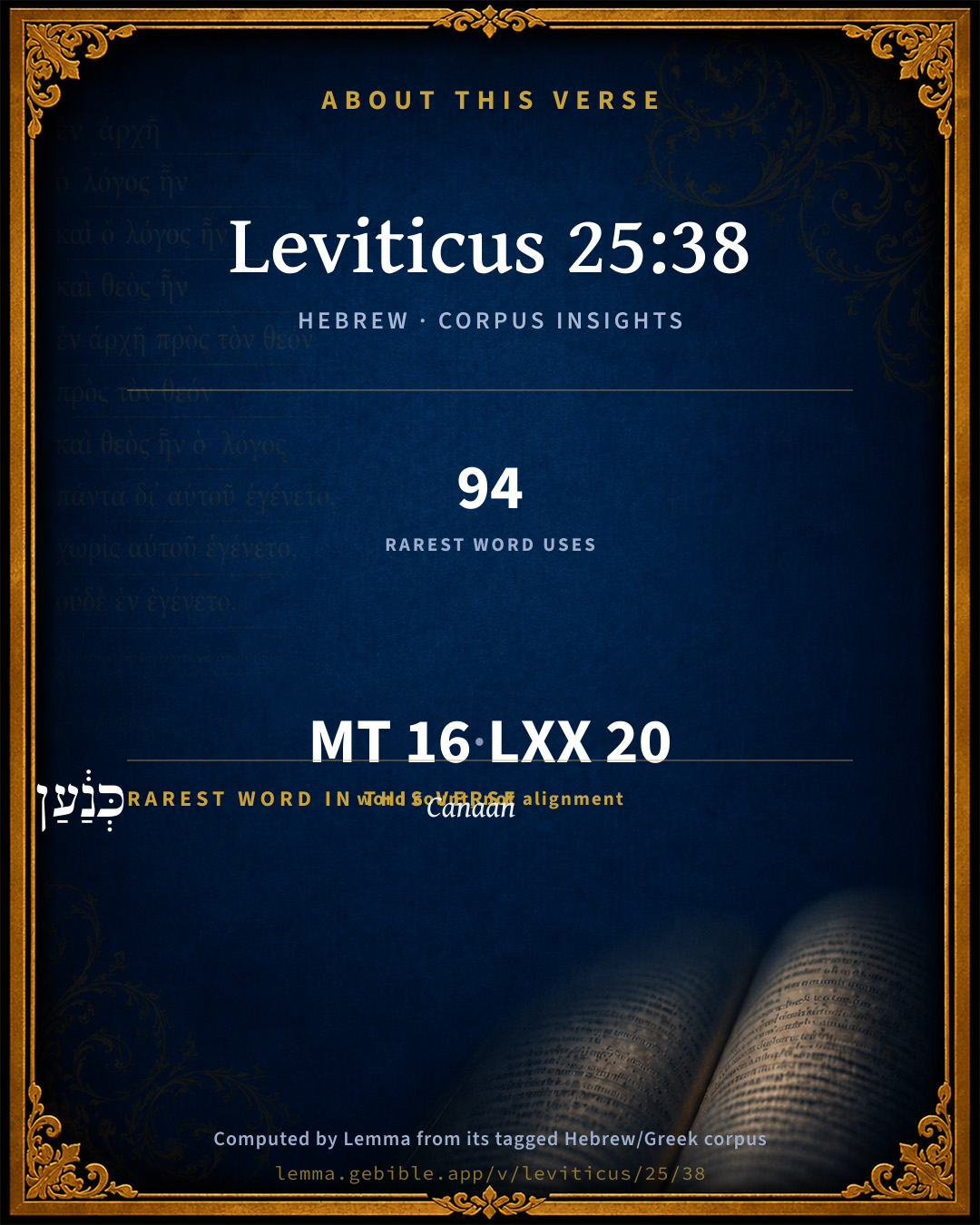
כְּנַ֔עַן
Kᵉnaʻan
H3667
“Canaan”
Noun, Proper
Part of Speech
Noun
Type
Proper
Full BDB Definition

Origin: from H3665

TWOT: 1002 , 1002b

Canaan = "lowland" - the 4th son of Ham and the progenitor of the Phoenicians and of the various nations who peopled the seacoast of Palestine (noun proper masculine) - the land west of the Jordan peopled by the descendants of Canaan and subsequently conquered by the Israelites under Joshua (noun proper locative) - merchant, trader (noun masculine)
  1. אֲנִ֗י ʼănîy H589 “I” Pronoun, Personal, 1st Person, Common, Singular
  2. יְהוָה֙ Yᵉhôvâh H3068 “LORD” Noun, Proper
  3. אֱלֹ֣הֵיכֶ֔ם ʼĕlôhîym H430 “God(s) · your” Noun, Common, Masculine, Plural, Construct + Suffix, Personal, 2nd Person, Masculine, Plural
  4. אֲשֶׁר ʼăsher H834 “which” Particle, Relative
  5. הוֹצֵ֥אתִי yâtsâʼ H3318 “to go out” Verb, Hiphil, Perfect, 1st Person, Common, Singular
  6. אֶתְכֶ֖ם ʼêth H853 “- · you” Particle, Direct Object + Suffix, Personal, 2nd Person, Masculine, Plural
  7. מֵאֶ֣רֶץ ʼerets H776 “from · land of” Preposition + Noun, Common, Both, Singular, Construct
  8. מִצְרָ֑יִם Mitsrayim H4714 “Egypt” Noun, Proper
  9. לָתֵ֤ת nâthan H5414 “to give” Preposition + Verb, Qal, Infinitive Construct
  10. אֶת ʼêth H853 “-” Particle, Direct Object
  11. אֶ֣רֶץ ʼerets H776 “land of” Noun, Common, Both, Singular, Construct
  12. לִהְי֥וֹת hâyâh H1961 “to be” Preposition + Verb, Qal, Infinitive Construct
  13. לֵאלֹהִֽים ʼĕlôhîym H430 “to/for · God(s)” Preposition + Noun, Common, Masculine, Plural, Absolute

About this verse

These counts appear in no published source. They are computed here, from the morphology-tagged text and Lemma’s own curated glosses. What Lemma adds →

16
words
11
distinct lemmas
Pentateuch
section

Grammatical profile

  • 3 verbs
  • 7 nouns
  • 1 pronoun
  • 2 prepositions
  • 3 particles

Verb forms

  • הוֹצֵ֥אתִי Hiphil · Perfect
  • לָתֵ֤ת Qal · Infinitive Construct
  • לִהְי֥וֹת Qal · Infinitive Construct

Repetition

Words recur within this verse — often emphatic in Hebrew:

  • אֱלֹ֣הֵיכֶ֔ם God H430 ×2
  • מֵאֶ֣רֶץ land H776 ×2

Hebrew & Septuagint length

In English translation the verse runs 27 words from the Hebrew and 28 from the Septuagint (LXX English) — closely comparable.

A rough comparison of the two English renderings, which tokenize alike — not a word-level alignment.

Word counts can differ between the Hebrew and the Greek without any difference in meaning — e.g. the Hebrew direct-object marker אֵת has no separate Greek word, and Greek often adds the article ὁ.

In the original languages it is 16 Hebrew tokens and 20 Greek tokens — but the two are counted differently (Hebrew bundles its prefixes and suffixes into one token; the Greek is in lemma form), so that isn’t a like-for-like length.

Cross-references

9

Topical passages linked to Leviticus 25:38 in the Treasury of Scripture Knowledge — connected by theme and wording, ordered by reader-vote popularity; previews shown in the World English Bible.

  • Leviticus 11:45 For I am Yahweh who brought you up out of the land of Egypt, to be your God. You shall therefore be holy, for I am holy.
  • Exodus 20:2 "I am Yahweh your God, who brought you out of the land of Egypt, out of the house of bondage.
  • Numbers 15:41 I am Yahweh your God, who brought you out of the land of Egypt, to be your God: I am Yahweh your God.
  • Genesis 17:7 I will establish my covenant between me and you and your seed after you throughout their generations for an everlasting covenant, to be a God to you and to your seed after you.
  • Leviticus 22:32–33 You shall not profane my holy name, but I will be made holy among the children of Israel. I am Yahweh who makes you holy,
  • Jeremiah 31:1 At that time, says Yahweh, will I be the God of all the families of Israel, and they shall be my people.
  • Jeremiah 31:33 But this is the covenant that I will make with the house of Israel after those days, says Yahweh: I will put my law in their inward parts, and in their heart will I write it; and I will be their God, and they shall be my people:
  • Jeremiah 32:38 and they shall be my people, and I will be their God:
  • Hebrews 11:16 But now they desire a better country, that is, a heavenly one. Therefore God is not ashamed of them, to be called their God, for he has prepared a city for them.

Cross-references courtesy of OpenBible.info (CC BY 4.0).

Hebrew and Greek witnesses Masoretic Hebrew ↔ Greek Septuagint

The same verse in the two great witnesses to the Old Testament, shown verse-for-verse.

These are two independent witnesses, not word-aligned to each other, and the Septuagint is shown in lemma (dictionary) form.

Hebrew Leviticus 25:38 Masoretic · Westminster Leningrad Codex

אֲנִ֗י יְהוָה֙ אֱלֹ֣הֵיכֶ֔ם אֲשֶׁר הוֹצֵ֥אתִי אֶתְכֶ֖ם מֵאֶ֣רֶץ מִצְרָ֑יִם לָתֵ֤ת לָכֶם֙ אֶת אֶ֣רֶץ כְּנַ֔עַן לִהְי֥וֹת לָכֶ֖ם לֵאלֹהִֽים

I am Yahweh your God, who brought you forth out of the land of Egypt, to give you the land of Canaan, and to be your God.

World English Bible · Public Domain

Greek LXX Leviticus 25:38 Septuagint · lemma form

ἐγώ κύριος ὁ θεός σύ ὁ ἐκἄγω σύ ἐκ γῆ αἴγυπτος δίδωμι σύ ὁ γῆ χανααν ὥστε εἰμί σύ θεός

I am the Lord your God, who brought you out of the land of Egypt, to give you the land of Chanaan, so as to be your God.

LXX2012 (modern English Septuagint) · Public Domain

Hebrew: Westminster Leningrad Codex (CC BY 4.0). Greek: Septuagint (public domain); English from LXX2012 (modern English Septuagint) (Public Domain). How the Septuagint differs from the Hebrew →

Targum (Aramaic paraphrase)

2

The Targum is the ancient Jewish Aramaic paraphrase of the Hebrew Scriptures — an interpretive translation, not the Hebrew text itself. Onkelos (literal) and Pseudo-Jonathan (expansive) render the Torah, and Jonathan the Prophets. Coverage is partial: where no permissively-licensed English translation exists for a verse, only the Aramaic is shown. This is verse-level text, not a word-by-word alignment to the Hebrew.

  1. Targum Onkelos Torah (Genesis–Deuteronomy)
    אֲנָא יְיָ אֱלָהֲכוֹן דִי אַפֵּקִית יָתְכוֹן מֵאַרְעָא דְמִצְרָיִם לְמִתַּן לְכוֹן יָת אַרְעָא דִכְנַעַן לְמֶהֱוֵי לְכוֹן לֶאֱלָהּ

    (no public-domain English translation for this verse)

    Targum Onkelos — Aramaic: “Onkelos Genesis” (public domain); “Onkelos Exodus” (public domain); “Onkelos Leviticus” (public domain); “Onkelos Numbers” (public domain); “Onkelos Deuteronomy” (public domain). English: “Sefaria Community Translation” (CC0 1.0 (public-domain dedication)); “J.W. Etheridge. The Targums of Onkelos and Jonathan Ben Uzziel on the Pentateuch. London: Longmans, Green, 1862” (public domain). Text via Sefaria.

  2. Targum Pseudo-Jonathan Torah (Genesis–Deuteronomy)
    אֲנָא הוּא יְיָ אֱלָהָכוֹן דִי פְרִיקִית וַאֲפֵיקִית יַתְכוֹן פְרִיקִין מִן אַרְעָא דְמִצְרַיִם מְטוֹל לְמִתַּן לְכוֹן יַת אַרְעָא דִכְנַעַן לְמֶהֱוֵי לְכוֹן לֶאֱלָהָא

    I am the Lord your God, who redeemed and brought you out redeemed from the land of Mizraim, to give unto you the land of Kenaan, and to be unto you Eloha.

    Targum Pseudo-Jonathan — Aramaic: “Targum Jonathan on Genesis” (public domain); “Targum Jonathan on Exodus” (public domain); “Targum Jonathan on Leviticus” (public domain); “Targum Jonathan on Numbers” (public domain); “Targum Jonathan on Deuteronomy” (public domain). English: “The Targum of Jonathan ben Uzziel, trans. J. W. Etheridge, London, 1862” (public domain). Text via Sefaria.

Commentary

Notes on Leviticus 25:38 from classic Christian and Jewish commentators (each source and its license shown beneath its notes). The classic Christian expositions comment on the surrounding passage and are grouped to its opening verse, so a note may address several verses; the Jewish commentaries on the Tanakh (Rashi and others) are per-verse, so they appear only where the commentator wrote on this verse.

Lemma curates 59 commentaries, every one of them public domain or Creative Commons licensed, each selected and text-cleaned for this edition rather than reprinted as found. About our sources →

Trapp's Complete Commentary

John Trapp

Lev 25:38 I [am] the LORD your God, which brought you forth out of the land of Egypt, to give you the land of Canaan, [and] to be your God.

Ver. 38. I am the Lord your God.] Freely you have received, freely lend. You have had me your benefactor, you shall have me your debtor.

John Trapp, A Commentary or Exposition upon All the Books of the Old and New Testament (1647–1656) — public domain. Text from a community e-Sword module.

Tyndale Open Study Notes

Tyndale Open Resources

25:38 The mention of the land of Egypt reminded the Israelites that they had been slaves at one time. They were to help the poor among them because of God’s covenant relationship with them (cp. Exod 20:2 and Deut 5:6, where God’s covenant with them is initiated).

Tyndale Open Study Notes — © Tyndale Open Resources, licensed CC BY-SA 4.0. Text via the HelloAO Bible API.

Ellicott's Commentary for English Readers

(38) Which brought you forth out of the land of Egypt.—For this appeal to the signal act of redemption from Egypt, see Lev. 12:45.

A Bible Commentary for English Readers, edited by Charles John Ellicott (1878–1897) — public domain. Text from a community e-Sword module.

John Gill's Exposition

I am the Lord your God, which brought you out of the land of Egypt,.... Where they had been strangers and sojourners, and therefore should be kind to such in necessitous circumstances, and relieve them, and especially their brethren; and where God had given them favour in the eyes of the Egyptians, and they had lent them jewels of gold and silver, and raiment, and therefore they should lend freely to persons in distress; and who had brought them out from thence, that they might take upon them his commandments, though they might be grievous, as Jarchi observes; and this, it may be remarked, is the preface to the ten commandments:

to give you the land of Canaan; freely, a land flowing with milk and honey; and therefore, since he had dealt so bountifully with them, and had given them plenty of good things, they need not grudge giving to their poor brethren, and others in necessitous circumstances:

and to be your God; their covenant God, to bless and prosper them, protect and defend them.

John Gill's Exposition of the Whole Bible (1746–1763) — public domain (CC PDM 1.0). Text via the HelloAO Bible API.

Albert Barnes' Notes on the Bible

Here, and in Lev 25:42, Lev 25:55, is expressed the principle which was to limit and modify the servitude of Hebrew servants.

Albert Barnes' Notes on the Bible (1834–1885) — public domain. Text from a community e-Sword/MySword module.

Whedon's Commentary on the Bible

Daniel D. Whedon

38. I am the Lord — In this verse there are four reasons for obedience:

Daniel D. Whedon (gen. ed.), Commentary on the Old and New Testaments (1874–1909) — public domain. Text from a community e-Sword module.

Rashi

Rabbi Shlomo Yitzchaki (Rashi)

'אשר הוצאתי וגו‎‎ [I AM THE LORD YOUR GOD] WHO BROUGHT YOU FORTH [FROM THE LAND OF EGYPT] and distinguished between those who were firstborn and those who were not firstborn (a matter which is hidden from human cognizance), I also know the true facts of this matter and I will exact punishment from him who lends money to an Israelite saying that it belongs to a non-Jew (Bava Metzia 61b; cf. Rashi on Leviticus 19:36). Another explanation is: I am the Lord your God Who brought you forth from the land of Egypt on condition that you take upon yourselves the fulfillment of My commands although they be hard for you (cf. Sifra, Behar, Section 5 3)

לתת לכם את ארץ כנען TO GIVE YOU THE LAND OF CANAAN as a reward for your taking upon yourselves to fulfill My commandments.

להיות לכם לאלהים TO BE YOUR GOD —Because to him who dwells in the land of Israel I am God; while he who leaves it may be regarded as though he were an idolator (Sifra, Behar, Section 5 4; Ketubot 110b).

Rashi on the Tanakh — English translations: “The Judaica Press complete Tanach with Rashi, translated by A. J. Rosenberg” (CC BY 4.0); “Pentateuch with Rashi's commentary by M. Rosenbaum and A.M. Silbermann, 1929-1934” (public domain); “The Metsudah Tanach series, Lakewood, N.J” (CC BY 4.0); and “The Book of Joshua, Metsudah Publications, 1997” (CC BY 4.0). Text via Sefaria.

Lesson kit

Teaching starters — assembled from the data on this page, not authored interpretation. Every prompt links to the verse data it draws on. Edit before teaching.

Leviticus, in the Pentateuch, opens this verse with 16 words (11 distinct Hebrew lemmas). Its most distinctive word is Kᵉnaʻan (“Canaan”). A historical commentator’s framing appears above. Read the whole chapter for the surrounding context.

Discussion questions

  1. How does “Canaan” (Kᵉnaʻan) shape what this verse is saying?
  2. Leviticus 11:45 shares this passage’s theme. How do the two illuminate each other?
  3. “God” occurs 2× in this one verse. What is the effect of the repetition?
  4. These translations render this verse differently. What is at stake in choosing one wording over another?
  5. The verb «הוֹצֵ֥אתִי» is Hiphil Perfect. How does its form color the action?
  6. Reading how Trapp's Complete Commentary and Tyndale Open Study Notes read this verse, where do the two commentators agree and where do they part?

Things to notice

Reading settings

Reading text

Shown beneath each verse's original-language words.

Old Testament
Old Testament edition

Read the OT as the Masoretic Hebrew (MT) or the Greek Septuagint (LXX).

English shown for the Greek Septuagint (in the Hebrew ↔ Greek comparison).

Comparing translations? Open the Compare panel on any verse page to stack up to four side by side.