
Leviticus 17:11

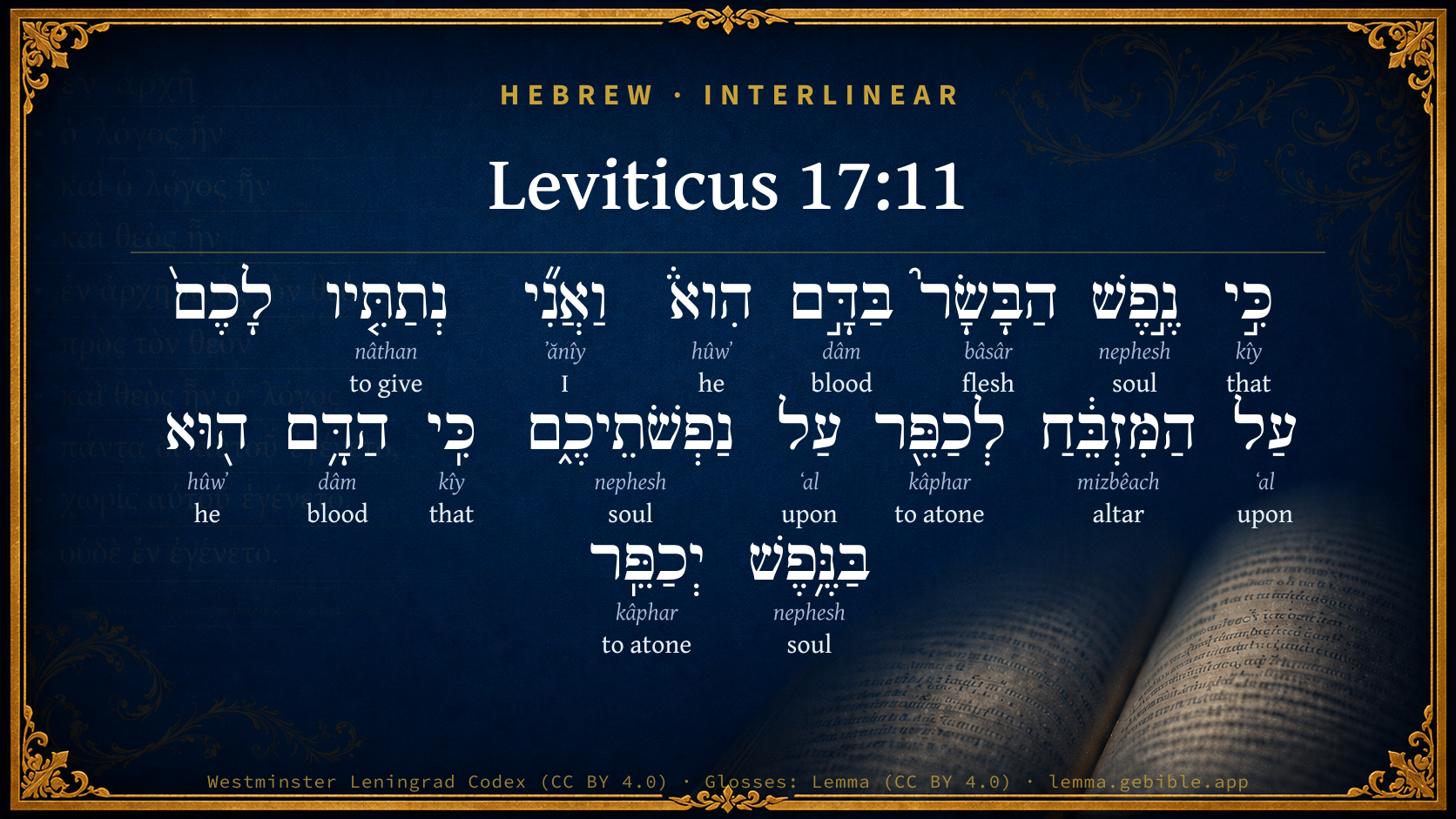
Hebrew (Westminster Leningrad Codex) Leviticus 17:11 appears in the Hebrew Old Testament. The text above is from the Westminster Leningrad Codex. Each word links to its Strong’s number, a concise gloss, and parsing drawn from the Open Scriptures Hebrew Bible morphology. Click any word for its full Brown-Driver-Briggs (BDB) entry.
Download image
Cite this verse

Leviticus 17:11 (World English Bible). Public Domain. Lemma interlinear Bible study tool, https://lemma.gebible.app/v/leviticus/17/11.

Show BibTeX & RIS
BibTeX
RIS
English Translation
For the life of the flesh is in the blood; and I have given it to you on the altar to make atonement for your souls: for it is the blood that makes atonement by reason of the life.
World English Bible · Public Domain
Download a study sheet

One document with this verse’s original text, its word-by-word gloss line, the meaning frame, cross-references with their text, attributed commentary, and full source and license credits — printable, and it pastes into notes with its structure intact.

This verse Autodidact and up

Study sheet (.html) Plain text (.txt)

A passage Seminary Student

Up to 50 verses in one chapter. A passage sheet keeps up to 6 commentary sources and 12 cross-references per verse, in the order this page ranks them, and says so on the sheet whenever that leaves anything out. Ask for a single verse and you get the Autodidact verse sheet above.

Everything on this page stays free to read, with no account — the sheet is a download of what is already on screen, not access to it.

Want to remove ads? Support Godless Engineer
Compare translations 3

The same verse in 3 English versions, stacked beneath the original-language interlinear above. Click any original word for its lexicon entry.

Each is an independent rendering of the whole verse — the interlinear is not word-aligned to these translations.

Highlighted words mark where these versions differ — a whole-verse word diff, not a word-by-word alignment.

  • World English Bible Public Domain
    For the life of the flesh is in the blood; and I have given it to you on the altar to make atonement for your souls: for it is the blood that makes atonement by reason of the life.
  • King James Version Public Domain
    For the life of the flesh is in the blood: and I have given it to you upon the altar to make an atonement for your souls: for it is the blood that maketh an atonement for the soul.
  • unfoldingWord Literal Text CC BY-SA 4.0
    For the life of the flesh, it is in the blood, and I myself have given it to you on the altar to make atonement for your lives. For the blood, it makes atonement with the life.

unfoldingWord Literal Text — © unfoldingWord, licensed CC BY-SA 4.0. Word-aligned USFM3 via Door43 (git.door43.org/unfoldingWord/en_ult).

Versions to compare (up to 4)

3 of 4 selected

Show all 18 translations

Every available English version of this verse, each an independent rendering of the whole verse.

  • World English Bible Public Domain
    For the life of the flesh is in the blood; and I have given it to you on the altar to make atonement for your souls: for it is the blood that makes atonement by reason of the life.
  • Berean Standard Bible Public Domain
    For the life of the flesh is in the blood, and I have given it to you to make atonement for your souls upon the altar; for it is the blood that makes atonement for the soul.
  • Majority Standard Bible Public Domain
    For the life of the flesh is in the blood, and I have given it to you to make atonement for your souls upon the altar; for it is the blood that makes atonement for the soul.
  • King James Version Public Domain
    For the life of the flesh is in the blood: and I have given it to you upon the altar to make an atonement for your souls: for it is the blood that maketh an atonement for the soul.
  • American Standard Version (1901) Public Domain
    For the life of the flesh is in the blood; and I have given it to you upon the altar to make atonement for your souls: for it is the blood that maketh atonement by reason of the life.
  • Revised Version (1885) Public Domain
    For the life of the flesh is in the blood: and I have given it to you upon the altar to make atonement for your souls: for it is the blood that maketh atonement by reason of the life.
  • Geneva Bible (1599) Public Domain
    For the life of the flesh is in the blood, and I haue giuen it vnto you to offer vpon the altar, to make an atonement for your soules: for this blood shall make an atonement for the soule.
  • Douay-Rheims (1899) Public Domain
    Because the life of the flesh is in the blood: and I have given it to you, that you may make atonement with it upon the altar for your souls, and the blood may be for an expiation of the soul.
  • Young's Literal Translation Public Domain
    for the life of the flesh is in the blood, and I have given it to you on the altar, to make atonement for your souls; for it `is' the blood which maketh atonement for the soul.
  • Literal Standard Version CC BY-SA 4.0
    for the life of the flesh is in the blood, and I have given it to you on the altar, to make atonement for your souls; for it [is] the blood which makes atonement for the soul.
  • Unlocked Literal Bible CC BY-SA 4.0
    For the life of an animal is in its blood. I have given its blood to you to make atonement on the altar for your lives, because it is the blood that makes atonement, for it is the blood that atones for the life.
  • unfoldingWord Literal Text CC BY-SA 4.0
    For the life of the flesh, it is in the blood, and I myself have given it to you on the altar to make atonement for your lives. For the blood, it makes atonement with the life.
  • Darby Bible Public Domain
    for the soul of the flesh is in the blood; and I have given it to you upon the altar to make atonement for your souls, for it is the blood that maketh atonement for the soul.
  • World Messianic Bible Public Domain
    For the life of the flesh is in the blood. I have given it to you on the altar to make atonement for your souls; for it is the blood that makes atonement by reason of the life.
  • Webster's Bible Public Domain
    For the life of the flesh is in the blood: and I have given it to you upon the altar, to make an atonement for your souls: for it is the blood that maketh an atonement for the soul.
  • Free Bible Version CC BY-SA 4.0
    Life is in the body's blood. I have given it to you so that by putting it on the altar your lives can be made right, for it is the lifeblood that makes people's lives right.
  • Bible in Basic English Public Domain
    For the life of the flesh is in its blood; and I have given it to you on the altar to take away your sin: for it is the blood which makes free from sin because of the life in it.
  • JPS Tanakh (1917) Public Domain
    For the life of the flesh is in the blood; and I have given it to you upon the altar to make atonement for your souls; for it is the blood that maketh atonement by reason of the life.

Literal Standard Version (2020), Covenant Press — licensed CC BY-SA 4.0. Text via the HelloAO Bible API (eBible.org). Unlocked Literal Bible (unfoldingWord) — licensed CC BY-SA 4.0. Text via the HelloAO Bible API (eBible.org). unfoldingWord Literal Text — © unfoldingWord, licensed CC BY-SA 4.0. Word-aligned USFM3 via Door43 (git.door43.org/unfoldingWord/en_ult). Free Bible Version, Dr. Jonathan Gallagher — licensed CC BY-SA 4.0. Text via the HelloAO Bible API (eBible.org).

Word by word

More ways to search: Search by grammar → Find every occurrence → Compare this word →

Practice this passage: Drill this verse → Learn its vocabulary →

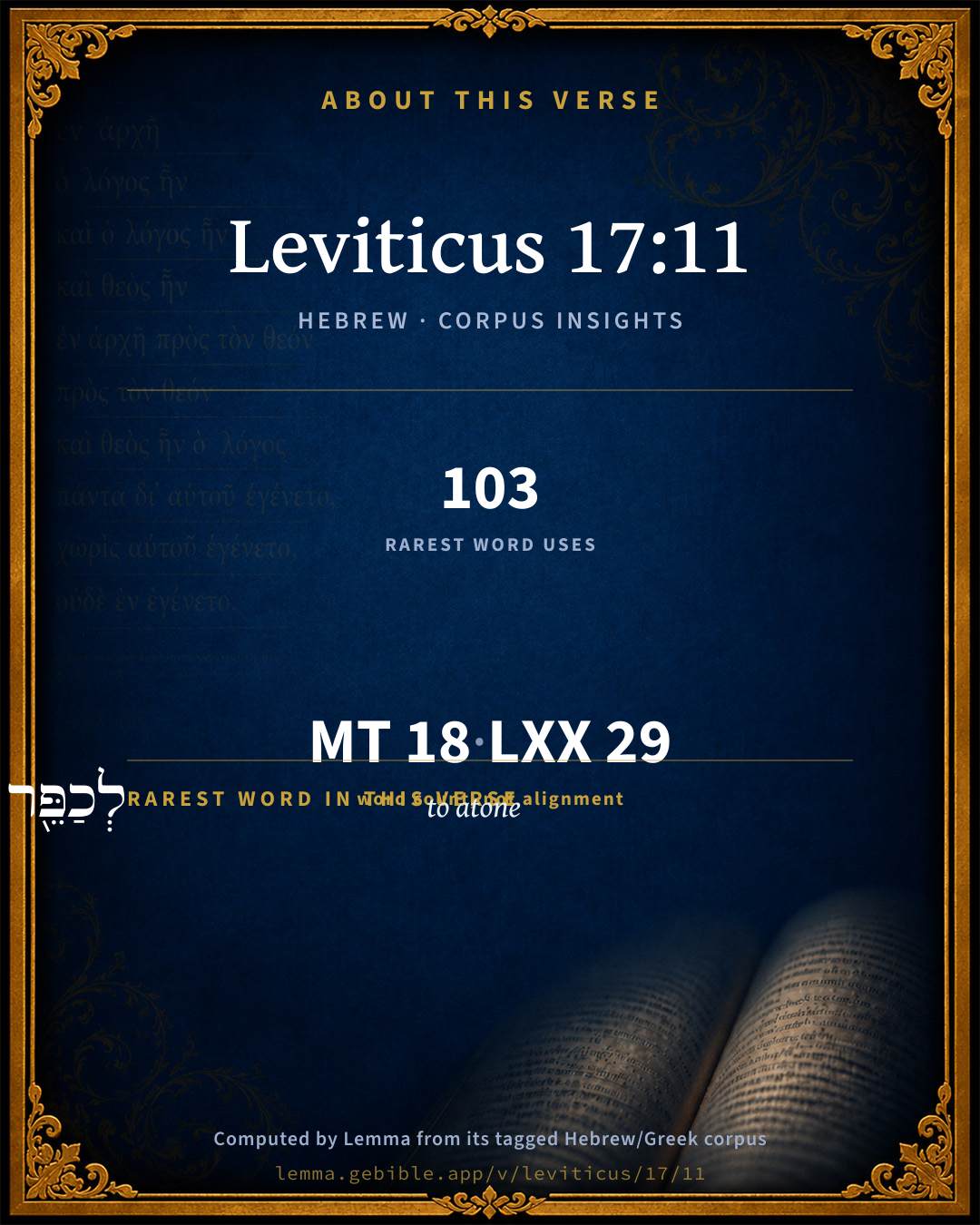
לְכַפֵּ֖ר
kâphar
H3722
“to atone”
Preposition + Verb, Piel, Infinitive Construct
Part of Speech
Preposition + Verb
Stem
Piel
Form
Infinitive Construct
Full BDB Definition

Origin: a primitive root

TWOT: 1023 , 1024 , 1025 , 1026

to cover, purge, make an atonement, make reconciliation, cover over with pitch - (Qal) to coat or cover with pitch - (Piel) - to cover over, pacify, propitiate - to cover over, atone for sin, make atonement for - to cover over, atone for sin and persons by legal rites - (Pual) - to be covered over - to make atonement for - (Hithpael) to be covered
  1. כִּ֣י kîy H3588 “that” Conjunction
  2. נֶ֣פֶשׁ nephesh H5315 “soul of” Noun, Common, Both, Singular, Construct
  3. הַבָּשָׂר֮ bâsâr H1320 “the · flesh” Particle, Definite Article + Noun, Common, Masculine, Singular, Absolute
  4. בַּדָּ֣ם dâm H1818 “in/at the · blood” Preposition, Determined + Noun, Common, Masculine, Singular, Absolute
  5. הִוא֒ hûwʼ H1931 “he” Pronoun, Personal, 3rd Person, Feminine, Singular
  6. וַאֲנִ֞י ʼănîy H589 “and · I” Conjunction + Pronoun, Personal, 1st Person, Common, Singular
  7. נְתַתִּ֤יו nâthan H5414 “to give · him” Verb, Qal, Perfect, 1st Person, Common, Singular + Suffix, Personal, 3rd Person, Masculine, Singular
  8. עַל ʻal H5921 “upon” Preposition
  9. הַמִּזְבֵּ֔חַ mizbêach H4196 “the · altar” Particle, Definite Article + Noun, Common, Masculine, Singular, Absolute
  10. עַל ʻal H5921 “upon” Preposition
  11. נַפְשֹׁתֵיכֶ֑ם nephesh H5315 “souls · your” Noun, Common, Both, Plural, Construct + Suffix, Personal, 2nd Person, Masculine, Plural
  12. כִּֽי kîy H3588 “that” Conjunction
  13. הַדָּ֥ם dâm H1818 “the · blood” Particle, Definite Article + Noun, Common, Masculine, Singular, Absolute
  14. ה֖וּא hûwʼ H1931 “he” Pronoun, Personal, 3rd Person, Masculine, Singular
  15. בַּנֶּ֥פֶשׁ nephesh H5315 “in/at the · soul” Preposition, Determined + Noun, Common, Both, Singular, Absolute
  16. יְכַפֵּֽר kâphar H3722 “to atone” Verb, Piel, Imperfect, 3rd Person, Masculine, Singular

About this verse

These counts appear in no published source. They are computed here, from the morphology-tagged text and Lemma’s own curated glosses. What Lemma adds →

18
words
10
distinct lemmas
Pentateuch
section

Grammatical profile

  • 3 verbs
  • 7 nouns
  • 3 pronouns
  • 3 prepositions
  • 2 conjunctions

Verb forms

  • נְתַתִּ֤יו Qal · Perfect
  • לְכַפֵּ֖ר Piel · Infinitive Construct
  • יְכַפֵּֽר Piel · Imperfect

Repetition

Words recur within this verse — often emphatic in Hebrew:

  • נֶ֣פֶשׁ soul H5315 ×3
  • בַּדָּ֣ם blood H1818 ×2
  • עַל upon H5921 ×2
  • לְכַפֵּ֖ר to atone H3722 ×2
  • כִּ֣י that H3588 ×2
  • הִוא֒ he H1931 ×2

Hebrew & Septuagint length

In English translation the verse runs 39 words from the Hebrew and 33 from the Septuagint (LXX English) — closely comparable.

A rough comparison of the two English renderings, which tokenize alike — not a word-level alignment.

Word counts can differ between the Hebrew and the Greek without any difference in meaning — e.g. the Hebrew direct-object marker אֵת has no separate Greek word, and Greek often adds the article ὁ.

In the original languages it is 18 Hebrew tokens and 29 Greek tokens — but the two are counted differently (Hebrew bundles its prefixes and suffixes into one token; the Greek is in lemma form), so that isn’t a like-for-like length.

Cross-references

19

Topical passages linked to Leviticus 17:11 in the Treasury of Scripture Knowledge — connected by theme and wording, ordered by reader-vote popularity; previews shown in the World English Bible.

  • Hebrews 9:22 According to the law, nearly everything is cleansed with blood, and apart from shedding of blood there is no remission.
  • 1 John 1:7 But if we walk in the light, as he is in the light, we have fellowship with one another, and the blood of Jesus Christ, his Son, cleanses us from all sin.
  • Romans 3:25 whom God set forth to be an atoning sacrifice, through faith in his blood, for a demonstration of his righteousness through the passing over of prior sins, in God's forbearance;
  • Revelation 1:5 and from Jesus Christ, the faithful witness, the firstborn of the dead, and the ruler of the kings of the earth. To him who loves us, and washed us from our sins by his blood;
  • Mark 14:24 He said to them, "This is my blood of the new covenant, which is poured out for many.
  • Genesis 9:4 But flesh with the life of it, the blood of it, you shall not eat.
  • Matthew 26:28 for this is my blood of the new covenant, which is poured out for many for the remission of sins.
  • Colossians 1:14 in whom we have our redemption, the forgiveness of our sins;
  • Ephesians 1:7 in whom we have our redemption through his blood, the forgiveness of our trespasses, according to the riches of his grace,
  • Hebrews 13:12 Therefore Jesus also, that he might sanctify the people through his own blood, suffered outside of the gate.
  • Leviticus 17:14 For as to the life of all flesh, its blood is with its life: therefore I said to the children of Israel, "You shall not eat the blood of any kind of flesh; for the life of all flesh is its blood. Whoever eats it shall be cut off."
  • Leviticus 8:15 He killed it; and Moses took the blood, and put it on the horns of the altar round about with his finger, and purified the altar, and poured out the blood at the base of the altar, and sanctified it, to make atonement for it.
  • Leviticus 16:11 "Aaron shall present the bull of the sin offering, which is for himself, and shall make atonement for himself and for his house, and shall kill the bull of the sin offering which is for himself.
  • 1 Peter 1:2 according to the foreknowledge of God the Father, in sanctification of the Spirit, that you may obey Jesus Christ and be sprinkled in his blood: Grace to you and peace be multiplied.
  • Matthew 20:28 even as the Son of Man came not to be served, but to serve, and to give his life as a ransom for many."
  • Romans 5:9 Much more then, being now justified by his blood, we will be saved from God's wrath through him.
  • 1 John 2:2 And he is the atoning sacrifice for our sins, and not for ours only, but also for the whole world.
  • Colossians 1:20 and through him to reconcile all things to himself, by him, whether things on the earth, or things in the heavens, having made peace through the blood of his cross.
  • Leviticus 16:14–19 He shall take some of the blood of the bull, and sprinkle it with his finger on the mercy seat on the east; and before the mercy seat he shall sprinkle some of the blood with his finger seven times.

Cross-references courtesy of OpenBible.info (CC BY 4.0).

Hebrew and Greek witnesses Masoretic Hebrew ↔ Greek Septuagint

The same verse in the two great witnesses to the Old Testament, shown verse-for-verse.

These are two independent witnesses, not word-aligned to each other, and the Septuagint is shown in lemma (dictionary) form.

Hebrew Leviticus 17:11 Masoretic · Westminster Leningrad Codex

כִּ֣י נֶ֣פֶשׁ הַבָּשָׂר֮ בַּדָּ֣ם הִוא֒ וַאֲנִ֞י נְתַתִּ֤יו לָכֶם֙ עַל הַמִּזְבֵּ֔חַ לְכַפֵּ֖ר עַל נַפְשֹׁתֵיכֶ֑ם כִּֽי הַדָּ֥ם ה֖וּא בַּנֶּ֥פֶשׁ יְכַפֵּֽר

For the life of the flesh is in the blood; and I have given it to you on the altar to make atonement for your souls: for it is the blood that makes atonement by reason of the life.

World English Bible · Public Domain

Greek LXX Leviticus 17:11 Septuagint · lemma form

ὁ γάρ ψυχή πᾶς σάρξ αἷμα αὐτός εἰμί καί ἐγώ δίδωμι αὐτός σύ ἐπί ὁ θυσιαστήριον ἐκἱλάσκομαι περί ὁ ψυχή σύ ὁ γάρ αἷμα αὐτός ἀντί ὁ ψυχή ἐκἱλάσκομαι

For the life of flesh is its blood, and I have given it to you on the altar to make atonement for your souls; for its blood shall make atonement for the soul.

LXX2012 (modern English Septuagint) · Public Domain

Hebrew: Westminster Leningrad Codex (CC BY 4.0). Greek: Septuagint (public domain); English from LXX2012 (modern English Septuagint) (Public Domain). How the Septuagint differs from the Hebrew →

Targum (Aramaic paraphrase)

2

The Targum is the ancient Jewish Aramaic paraphrase of the Hebrew Scriptures — an interpretive translation, not the Hebrew text itself. Onkelos (literal) and Pseudo-Jonathan (expansive) render the Torah, and Jonathan the Prophets. Coverage is partial: where no permissively-licensed English translation exists for a verse, only the Aramaic is shown. This is verse-level text, not a word-by-word alignment to the Hebrew.

  1. Targum Onkelos Torah (Genesis–Deuteronomy)
    אֲרֵי נְפַשׁ בִּסְרָא בִּדְמָא הִיא וַאֲנָא יְהָבִתֵּהּ לְכוֹן עַל מַדְבְּחָא לְכַפָּרָא עַל נַפְשָׁתֵיכוֹן אֲרֵי דְמָא הוּא עַל נַפְשָׁא מְכַפֵּר

    (no public-domain English translation for this verse)

    Targum Onkelos — Aramaic: “Onkelos Genesis” (public domain); “Onkelos Exodus” (public domain); “Onkelos Leviticus” (public domain); “Onkelos Numbers” (public domain); “Onkelos Deuteronomy” (public domain). English: “Sefaria Community Translation” (CC0 1.0 (public-domain dedication)); “J.W. Etheridge. The Targums of Onkelos and Jonathan Ben Uzziel on the Pentateuch. London: Longmans, Green, 1862” (public domain). Text via Sefaria.

  2. Targum Pseudo-Jonathan Torah (Genesis–Deuteronomy)
    אֲרוּם קִיוּם נְפָשׁ כָּל בִּישְרָא בְּאַדְמָא הוּא וַאֲנָא יְהַבְתִּיהָ לְכוֹן לִגְזֵירָתָא דְתִיתְּנוּן אֲדַם נִיכְסָא עַל מַדְבְּחָא מְטוֹל לִמְכַפְּרָא אֲדַם עַל נַפְשַׁתְכוֹן אֲרוּם אֲדַם נִיכְסָא הוּא עַל חוֹבֵי נַפְשָׁא מְכַפֵּר

    Because the subsistence of the life of all flesh is in the blood, and I have given it to you for a decree, that you shall bring the blood of the victim unto the altar to make atonement for the blood of your lives, because the blood of the victim is to atone for the guilt of the soul.

    Targum Pseudo-Jonathan — Aramaic: “Targum Jonathan on Genesis” (public domain); “Targum Jonathan on Exodus” (public domain); “Targum Jonathan on Leviticus” (public domain); “Targum Jonathan on Numbers” (public domain); “Targum Jonathan on Deuteronomy” (public domain). English: “The Targum of Jonathan ben Uzziel, trans. J. W. Etheridge, London, 1862” (public domain). Text via Sefaria.

Commentary

Notes on Leviticus 17:11 from classic Christian and Jewish commentators (each source and its license shown beneath its notes). The classic Christian expositions comment on the surrounding passage and are grouped to its opening verse, so a note may address several verses; the Jewish commentaries on the Tanakh (Rashi and others) are per-verse, so they appear only where the commentator wrote on this verse.

Lemma curates 59 commentaries, every one of them public domain or Creative Commons licensed, each selected and text-cleaned for this edition rather than reprinted as found. About our sources →

Adam Clarke's Commentary

Verse 11. For the life of the flesh is in the blood] This sentence, which contains a most important truth, had existed in the Mosaic writings for 3600 years before the attention of any philosopher was drawn to the subject. This is the more surprising, as the nations in which philosophy flourished were those which especially enjoyed the Divine oracles in their respective languages. That the blood actually possesses a living principle, and that the life of the whole body is derived from it, is a doctrine of Divine revelation, and a doctrine which the observations and experiments of the most accurate anatomists have served strongly to confirm. The proper circulation of this important fluid through the whole human system was first taught by Solomon in figurative language, Ec 12:6; and discovered, as it is called, and demonstrated, by Dr. Harvey in 1628; though some Italian philosophers had the same notion a little before. This accurate anatomist was the first who fully revived the Mosaic notion of the vitality of the blood; which notion was afterward adopted by the justly celebrated Dr. John Hunter, professor of anatomy in London, and fully established by him by a great variety of strong reasoning and accurate experiments. To support this opinion Dr. Hunter proves: -

1. That the blood unites living parts in some circumstances as certainly as the yet recent juices of the branch of one tree unite with that of another; and he thinks that if either of these fluids were dead matter, they would act as stimuli, and no union would take place in the animal or vegetable kingdom; and he shows that in the nature of things there is not a more intimate connection between life and a solid than between life and a fluid.

2. He shows that the blood becomes vascular, like other living parts of the body; and he demonstrated this by a preparation in which vessels were clearly seen to arise from what had been a coagulum of blood; for those vessels opened into the stream of the circulating blood, which was in contiguity with this coagulated mass.

3. He proves that if blood be taken from the arm in the most intense cold that the human body can suffer, it will raise the thermometer to the same height as blood taken in the most sultry heat. This is a very powerful argument for the vitality of the blood, as it is well known that living bodies alone have the power of resisting great degrees of heat and cold, and of maintaining in almost every situation while in health that temperature which we distinguish by the name of animal heat.

4. He proves that blood is capable of being acted upon by a stimulus, as it coagulates on exposure to the air, as certainly as the cavities of the abdomen and thorax become inflamed from the same cause. The more the blood is alive, i. e., the more the animal is in health, the sooner the blood coagulates on exposure; and the more it has lost of the living principle, as in cases of violent inflammation, the less sensible it is to the stimulus produced by being exposed, and coagulates more slowly.

5. He proves that the blood preserves life in different parts of the body. When the nerves going to any part are tied or cut, the part becomes paralytic, and loses all power of motion, but it does not mortify. But let the artery be cut, and then the part dies and mortification ensues. It must therefore be the vital principle of the blood that keeps the part alive; nor does it appear that this fact can be accounted for on any other principle.

6. He thinks this vitality farther proved from the case of a person who was brought to St. George's hospital for a simple fracture of the os humeri, and who died about a month after. As the bones had not united, he injected the arm, and thus found that the coagulated blood which filled the cavity between the extremities of the fractured bones was become vascular, and in some places very much so, which vessels, had it been dead matter, it never could have produced.

This system has been opposed, and arguments have been adduced to prove that the principle of vitality exists not in the blood but in the nervous system. But every argument on this ground appears to be done away by the simple consideration that the whole nervous system, as well as every other part of the body, is originally derived from the blood; for is it not from the blood of the mother that the fetus has its being and nourishment in the womb? Do not all the nerves, as well as the brain, c., originate from that alone? And if it be not vital can it give the principle of vitality to something else, which then exclusively (though the effect of a cause) becomes the principle of vitality to all the solids and fluids of the body? This seems absurd. That the human being proceeded originally from the blood admits of no doubt and it is natural and reasonable to suppose that as it was the cause under God which generated all the other parts of the body, so it still continues to be the principle of life, and by it alone all the wastes of the system are repaired. Two points relative to this subject are strongly asserted in Divine revelation, one by MOSES, the other by ST. PAUL.

1. Moses says, The LIFE of the flesh is in the BLOOD, Le 17:11. This has been proved by the most indisputable facts.

2. St. Paul says, God hath made of ONE BLOOD all nations of men, Ac 17:26. And this is demonstrated, not only from there being only one pair from whom all the nations of men have been derived, but also from the fact that every human being, from the first-born of Eve to the present hour, has been formed out of and supported by the mother's blood; and that from the agency of this fluid the human body, after being born into the world, has its increment and support.

The reason given by God for the law against eating blood is perfectly conclusive: I will set my face against that soul that eateth blood - for the LIFE (נפש nephesh) of the flesh is in the BLOOD, and I have given it to you upon the altar, to make an atonement for your souls (נפשתיכם naphshotheychem, your LIVES:) for it is the blood (because it is the LIFE, נפש nephesh) that maketh an atonement for the soul (בנפש bannephesh, for the life; for the word is the same in all these cases.) By transgression a man forfeits his LIFE to Divine justice, and he must die, did not mercy provide him a substitute. The life of a beast is appointed and accepted by God as a substitute for the sinner's life (in reference to the life of Christ, which was to be given for the life of the world;) but as this life is in the BLOOD, and as the blood is the grand principle of vitality, therefore the blood is to be poured out upon the altar: and thus the life of the beast becomes a substitute for the life of the man.

And it is well worthy of being remarked, that Christ not only died for sinners, but our redemption is everywhere attributed to his BLOOD, and the shedding of that blood; and that on the altar of the cross, this might make an atonement for the lives and souls of men, he not only bowed his head, and gave up the ghost, but his side was opened, the pericardium and the heart evidently pierced, that the vital fluid might be poured out from the very seat of life, and that thus the blood, which is the life, should be poured out to make an atonement for the life of the soul.

The doctrine of Moses and Paul proves the truth of the doctrine of Harvey and Hunter; and the reasonings and experiments of Harvey and Hunter illustrate and confirm the doctrine of Moses and Paul. - Here then is a farther proof of the truth and authority of Divine revelation. See Clarke on Ge 9:4; Dr. J. Corrie's Essay on the Vitality of the Blood; and the article Blood, in the Encyclopaedias.

Adam Clarke's Commentary on the Bible (1810–1826) — public domain. Text from a community e-Sword/MySword module.

Trapp's Complete Commentary

John Trapp

Lev 17:11 For the life of the flesh [is] in the blood: and I have given it to you upon the altar to make an atonement for your souls: for it [is] the blood [that] maketh an atonement for the soul.

Ver. 11. And I have given it to you.] I have set it apart for a sacred use: therefore you may not make food of that which is a figure of Christ.

John Trapp, A Commentary or Exposition upon All the Books of the Old and New Testament (1647–1656) — public domain. Text from a community e-Sword module.

Joseph Benson's Commentary

Lev 17:11. Is in the blood — Depends upon the blood, is preserved and nourished by it. The blood maketh atonement — Typically, and in respect of the blood of Christ which it represented, and by which the atonement is really made. So the reason is double. 1st, Because this was eating the ransom of their own lives, which in construction was the destroying themselves. 2d, Because it was ingratitude and irreverence toward that sacred blood of Christ, which they ought to have had in continual veneration.

Joseph Benson's Commentary on the Old and New Testaments (1811–1818) — public domain. Text from a community e-Sword module.

Tyndale Open Study Notes

Tyndale Open Resources

17:11 the life of the body is in its blood: Israel was forbidden to consume blood (17:10) because it was symbolic of the life given by God and was reserved as God’s portion of each animal offering. God had also designated the sacrificial blood as the means of atonement. In other words, God’s grace permitted the life of the animal to be accepted in exchange for the life of the sinner. In the New Testament, the blood of Christ—representing his life freely given—has provided eternal redemption for believers (Heb 9:12).

Tyndale Open Study Notes — © Tyndale Open Resources, licensed CC BY-SA 4.0. Text via the HelloAO Bible API.

Jamieson, Fausset & Brown

Robert Jamieson, A. R. Fausset & David Brown

the life of the flesh is in the blood: and I have given it to you upon the altar to make an atonement for your souls--God, as the sovereign author and proprietor of nature, reserved the blood to Himself and allowed men only one use of it--in the way of sacrifices.

Jamieson, Fausset & Brown — Commentary Critical and Explanatory on the Whole Bible (1871) — public domain (CC PDM 1.0). Text via the HelloAO Bible API.

Ellicott's Commentary for English Readers

(11) For the life of the flesh is in the blood.—Better, for the soul of the flesh is in the blood. The word here rendered “life” in the Authorised Version occurs twice more in this very verse, and is in both instances properly translated soul. Though it is immaterial whether the word in question is translated life or soul, it is essential that it should be rendered uniformly throughout the passage. By translating it differently in the first clause, the Authorised Version has unnecessarily increased the difficulty of the verse. This clause assigns the reason why blood must not be eaten. It is the principle of vitality, it constitutes the soul of animal life. Hence blood and life are used interchangeably in the Scriptures. Thus, when the Psalmist exclaims, “what profit is there in my blood” (Psa_30:9), he uses it for life.

I have given it to you upon the altar.—For the sake of emphasis, the words in the original denoting “upon the altar” are placed first in the Hebrew, and the Authorised Version follows this order. It is however better to translate this clause, For I have ordained it upon the altar to make atonement for your souls. Because it is the principle of life, therefore God has ordained it to be offered upon the altar as an expiation for the offerer’s life.

For it is the blood that maketh an atonement for the soul.—Better, for it is the blood that maketh atonement by means of the soul. As the blood of the victim is identical with its life, and represents the soul of the animal, hence God has appointed it as a substitute for the sinner’s life. Thus the life of the sacrifice atones for the life of the offerer. Hence the remark of the Apostle, “without shedding of blood there is no remission” (Heb_9:22).

A Bible Commentary for English Readers, edited by Charles John Ellicott (1878–1897) — public domain. Text from a community e-Sword module.

The Cambridge Bible for Schools and Colleges

gen. ed. J. J. S. Perowne

11. The reason for avoiding blood is given.

the life … your souls … the life] The Heb. word néphesh is the same in the three cases.

it is the blood that maketh atonement by reason of the life] i.e. the life which it contains, not as A.V. ‘maketh atonement for the soul.’

The Cambridge Bible for Schools and Colleges (gen. ed. J. J. S. Perowne; Cambridge University Press, 1878–1918) — public domain. Text from a community e-Sword module.

John Gill's Exposition

For the life of the flesh is in the blood,.... The animal life or soul, the life and soul of every creature, and even the animal life and soul of man; agreeably to which our famous Dr. Harvey, who found out the circulation of the blood, says of it, that it is the principal part which first appears in generation; is the genital part, the fountain of life the first that lives, and the last that dies; the primary seat of the soul or life, from whence motion and pulsation take their rise; in which the innate heat is produced the vital spirit is generated and the life consists (i); and therefore it is spread all over the body, and according to the condition that it is in, such is the health and such the diseases of the body; yea, the affections of the mind, such as fear, shame, joy, and anger are discovered by it. Hence Antoninus the emperor, more than once, calls the soul a vapour or exhalation arising out of the blood (k); and the sentiments of various Jewish writers agree herewith: says Aben Ezra, it is a truth, that the soul or life, with which man lives, is in the blood of the heart; so says Jarchi the soul or life depends upon the blood; and Ben Gersom observes, that the blood is the vessel of the soul to carry in it the fundamental heat, and food to the parts of the body; and hence the animal only dies when the blood is removed:

and I have given it unto you to make an atonement for your souls: that being the life of the creature, was given for theirs to preserve them alive, and secure them from death their sins deserved; and so the Targum of Jonathan is, for the sins of the soul; which shows that these sacrifices were vicarious, in the room of men, and for the life of them, and to atone for them; and is the reason given why blood should not be eaten, at least while these typical expiatory sacrifices were used. Ben Gersom seems to intimate, as if it was only the blood of those that was forbidden: his words are, hence we learn says he, that they were not guilty of cutting off, but on account of the blood, which, according to its way was put upon the altar; and this was the blood of the soul as it saith the blood of the bullock, and the blood of the goat; but the blood that was pressed out, and the blood of the members they were not guilty of cutting off, on account of them:

for it is the blood that maketh an atonement for the soul; so here was life for life, soul for soul as Aben Ezra expresses it; it was a vicarious sacrifice and atonement, typical of the sacrifice and atonement of Christ, in the room and stead of his people, there being no atonement, no remission of sins without shedding of blood; and the reason of the prohibition of eating blood was to direct to that blood as the atonement for sin, and to keep up a reverence of it, and a value and esteem for it; but now seeing that blood has been shed and atonement made by it, the end of the law is answered, and the reason of it ceased, and so the law itself; and as Christ's blood is now to be eaten in a spiritual sense, the eating of blood in a literal sense, properly dressed, is lawful. And indeed, as before observed the law concerning it was never binding upon Gentiles, only on Jews and proselytes.

(i) De Generatione Animal. Exercitat. 51. p. 302, 303, &c. (k) De Seipso, l. 5. sect. 25. & l. 6. sect. 11.

John Gill's Exposition of the Whole Bible (1746–1763) — public domain (CC PDM 1.0). Text via the HelloAO Bible API.

Haydock's Catholic Bible Commentary

Life, (anima). The sensitive soul depends on the blood. The soul and the blood are often used in the same sense. (Deuteronomy xii. 23; Psalm xxix. 10.) Sanguine quærendi reditus animaque litandum---Argolica. (Virgil, Æneid ii.) (Calmet) --- If any one think that blood is the soul of cattle, we need not examine this question very nicely. (St. Augustine, q. 57.) (Du Hamel)

George Leo Haydock (1774–1849), Haydock's Catholic Family Bible and Commentary, 1859 edition — public domain. Excludes Psalms (Douay-Rheims chapter numbering differs from Protestant) and Deuterocanonical books (Catholic canon only).

Matthew Poole's English Annotations

Of the flesh, i.e. of living creatures.

Is in the blood, i.e. it depends upon the blood, is preserved and nourished by it, and is extinguished when the blood is gone. And this law was given to the Jews, and hard-hearted people, as they are oft said to be, that by this restraint from the blood of brute creatures they might be wrought to the greater abhorrency of taking away the life of a man.

It is the blood that maketh an atonement; typically, and in respect of the blood of Christ, which it represented, by which the atonement is really made, Heb 9:12. So the reason is double:

1. Because this was the eating up of the price or ransom of their own lives, which in construction was the destroying of themselves.

2. Because this was ingratitude and irreverence towards that sacred blood of Christ which they ought to have in continual veneration.

Matthew Poole's English Annotations on the Holy Bible (1683–1685) — public domain. Text from a community e-Sword/MySword module.

Whedon's Commentary on the Bible

Daniel D. Whedon

11. The life… in the blood — Literally, “the nephesh (soul) of the flesh.” The soul has a double sphere of life. It is both animus, the subject of all the activities of knowing, feeling, and willing, and anima, the principle of animal life vitalizing the blood and operating in nutrition and respiration. In 1628 Dr. Harvey discovered the vitality of the blood, for the circulation of the blood results from a living principle inhering in it. This wonderful discovery of anatomical science had been standing as an open secret in the Mosaic writings three thousand years, overlooked by science in her pride and disbelief of revelation. This is more surprising when we read Solomon’s beautiful announcement of the same truth in Ecc_12:6. The Bible, when rightly understood, never contradicts science.

I have given it… for your souls — Jehovah has not only devised the scheme of an atonement, but he gives the blood which is demanded to perfect this scheme. He not only saves through sacrifice, but he affords the victim. “Behold the Lamb of God” — the Lamb which God requires, and which he accepts, himself provides. The atonement originates with the Father. Joh_3:16. He is not, as some blasphemously portray him, an inexorable Shylock demanding his pound of flesh. The blood which he demands he gives. How widely different the divine scheme from human attempts at propitiation, in which the god to be appeased is to be bought off by costly sacrifices. God provides his own means of propitiation, so that all boasting is excluded, for we are saved by grace through faith in the one God-given, atoning sacrifice. “The death of Christ,” says Delitzsch, “was a conscious act of loving free-will, the central act of his own self-sacrifice, the solution of the enigma, ‘I have given it,’ in which the saints of the Old Testament had to rest their implicit faith.”

Atonement for the soul — All the versions, except the Revised Version, have missed the great truth revealed in the Hebrew, “it is the blood that maketh atonement BY REASON OF THE LIFE.” בis plainly an instrumental preposition, and not to be rendered αντι, instead of, as the Seventy, nor pro, for, as the Vulgate, nor fur, as Luther. See extensive discussion in the Introduction, (6.) Men are redeemed from death only by the price of a life. Jesus gave his life a ransom for the world. Says Kalisch, “It is impossible to doubt that the doctrine of vicarious sacrifice was entertained by the Hebrews… The animal dies to symbolize the death deserved by the offerer on account of his sins.” The apparent discrepancy between this verse and Heb_10:4; Heb_10:11, is removed when, with Outram, we regard the blood as a “condition of pardon,” and with Ebrard and Alford, “not the instrument of complete vicarious propitiation, but an exhibition of the postulate of such propitiation.” See concluding note.

Daniel D. Whedon (gen. ed.), Commentary on the Old and New Testaments (1874–1909) — public domain. Text from a community e-Sword module.

The Pulpit Commentary

HOMILIES BY S.R. ALDRIDGE Ver. 11. The sanctity of the atoning blood.

No act was more strongly denounced than that of eating any manner of blood. The man guilty of that deed, whether an Israelite or a stranger sojourning in the land, was threatened with the displeasure of God and severest penalty. It seemed to partake of the nature of a ceremonial rather than a moral offense, yet it must be remembered that violations of ritual become moral transgressions when they are committed against the known will of the recognized Legislator. This is especially the case when, as here, the Lawgiver condescends to explain the reason upon which the prohibition is founded. Such explanation ought to secure intelligent observance of the enactment. And that enactment was but the reissue of the former decree that gave animals to man for food, but annexed a prohibition against tasting the blood. (Gen_9:4)

I The fact stated, that THE SHEDDING OF BLOOD CONSTITUTES AS ATONEMENT. Illustrated by the numerous sacrifices of the patriarchs, and the provisions of the Law that sacrifices should form a part of all national and individual festivals, as well as of all offerings to wipe away inadvertent transgression. See it in the sprinkling of the book and vessels and people at the ratification of the covenant. It is confirmed by the well-nigh universal practice of heathen nations, and is proved by direct Scripture statements in the Old and New Testaments. "Without shedding of blood is no remission". (Heb_9:22) It typified, therefore, the offering of Jesus Christ, whose blood redeems us "from our vain manner of life". (1Pe_1:18) "The blood of Jesus Christ his Son cleanseth us from all sin." This Mosaic way of speaking is ingrained in the apostles, showing how they regarded the death of Jesus as the fulfilment of the types of the Law.

II The truth implied that THE CHIEF VIRTUE OF BLOOD AS AN ATONEMENT IS DERIVED FROM GOD"S APPOINTMENT. "I have given it unto you" indicates that the blood of animals had no intrinsic efficacy to atone for sin. And the same truth is shadowed forth in the words, "upon the altar." There was no difference in itself between blood ordinarily spilt and that presented before God, but the presentation constituted the difference. To sprinkle the blood upon the altar was to bring it emblematically into the very presence of the Deity. "God set forth" Christ Jesus "to be a propitiation, through faith, by his blood.

III The reason afforded for the selection of BLOOD, that it IS THE VEHICLE OF LIFE. Physiology, and especially recent investigations with the microscope, confirm the dictum of Scripture, that "the blood is the life." It nourishes and sustains the whole physical frame; if it deteriorate in quality the body weakens, if it diminish in quantity power is lessened.

1. By such an atonement God is recognized as Lord of life and of all its consequences. He gave and takes away, to him alone should life be offered. Thus the sanctity of life was enforced. Man was not to feast upon that which was God"s prerogative; blood must be poured upon the ground like water, thus returning to the earth.

2. The enormity of sin is represented, as enacting the utmost for an atonement that can be rendered. "Life is the most cherished of possessions, since man is powerless to create or to restore it." The crowning proof of Christ"s compassion was that he gave "his life" a ransom for the many, and the gift revealed the awfulness of sin to require such a redemption.

3. It represents the substitution of one life for another, death being the sentence pronounced upon the sinner. "When thou shalt make his soul an offering for sin" was Isaiah"s prediction of the sacrifice of Christ. It may be observed that the word in the text translated "soul" and "life" is the same, corresponding to the use made of the equivalent Greek word in Mat_16:25, Mat_16:26. That but for the death of Jesus Christ we must have been subject to eternal death, is the plain import of many passages in the Word of God.

IV THE FUTURE ADVENT TYPIFIED OF ONE WHO SHOULD BY HIS OFFERING: FULFIL ALL THE CONDITIONS OF A PERFECT ATONEMENT. Every Israelite might not perceive in the insufficiency of his sacrifices a prediction of the Lamb of God, but there it was portrayed visibly enough. An innocent, holy, human victim, a voluntary offering, being himself the Lawgiver, and by incarnation subjecting himself to the Law, making adequate acknowledgment of the righteousness of God and of the ill deserts of God"s rebellious sinful children, revealing to man at once the loving heart of God and the hatefulness of sin which had estranged man from his Father in heaven, by his death exhibiting the length to which sin will go, and the willingness of Divine holiness and love to submit to extreme degradation and anguish in order that the curse might be removed and man"s heart won, this is the atonement of truest efficacy, a mighty moral power with God and man. This is the death that gives life to the world, the blood that cries out, not for vengeance, but for mercy, that sanctifies not merely to the purifying of the flesh, but to the purging of the conscience from dead works to serve the living God. And the shedding of the blood of Christ was the signal for release from the ceremonies and restrictions imposed by the Mosaic Law. The prohibition of the text had served its purpose.

CONCLUSION. With what rejoicing should we approach our altar, the cross of Christ! (Heb_13:10) And what guilt we incur if we slight the blood of Christ as little available for salvation, or, though professing to believe, yet by conduct show that we count the blood of the covenant an unholy thing! S.R.A.

The Pulpit Commentary (1880–1919), ed. H.D.M. Spence-Jones & Joseph S. Exell — public domain. Text from a community e-Sword module.

John Wesley's Explanatory Notes

Is in the blood - Depends upon the blood, is preserved and nourished by it. The blood maketh atonement - Typically, and in respect of the blood of Christ which it represented, by which the atonement is really made. So the reason is double;

1. because this was eating up the ransom of their own lives, which in construction was the destroying of themselves.

2. because it was ingratitude and irreverence towards that sacred blood of Christ which they ought to have in continual veneration.

John Wesley, Explanatory Notes Upon the Whole Bible (1754–1765) — public domain. Text via the GEBible commentary corpus.

Scofield Reference Notes

C. I. Scofield

altar

(1) The value of the "life" is the measure of the value of the "blood." This gives the blood of Christ its inconceivable value. When it was shed the sinless God-man gave His life. "It is not possible that the blood of bulls and of goats could take away sins" Heb 10:4.

(2) it is not the blood in the veins of the sacrifice, but the blood upon the altar which is efficacious. The Scripture knows nothing of salvation by the imitation or influence of Christ’s life, but only by that life yielded up on the cross.

blood

The meaning of all sacrifice is here explained. Every offering was an execution of the sentence of the law upon a substitute for the offender, and every such offering pointed forward to that substitutional death of Christ which alone vindicated the righteousness of God in passing over the sins of those who offered the typical sacrifices Rom 3:24; Rom 3:25; Exo 29:36.

atonement

(See Scofield "Exo 29:33").

The Scofield Reference Bible (1917 edition), notes by C. I. Scofield — public domain. Text from a community e-Sword module.

Rashi

Rabbi Shlomo Yitzchaki (Rashi)

כי נפש הבשר FOR THE LIFE OF THE FLESH of every creature, not only of animals brought as sacrifices, is dependent on its blood (בדם היא), and it is for this reason that I have placed it [on the altar] to make expiation for the life of man: let life come and expiate for life!

Rashi on the Tanakh — English translations: “The Judaica Press complete Tanach with Rashi, translated by A. J. Rosenberg” (CC BY 4.0); “Pentateuch with Rashi's commentary by M. Rosenbaum and A.M. Silbermann, 1929-1934” (public domain); “The Metsudah Tanach series, Lakewood, N.J” (CC BY 4.0); and “The Book of Joshua, Metsudah Publications, 1997” (CC BY 4.0). Text via Sefaria.

Ramban (Nachmanides)

Rabbi Moshe ben Nachman (Ramban / Nachmanides)

FOR THE LIFE OF THE FLESH IS IN THE BLOOD; AND I HAVE GIVEN IT TO YOU UPON THE ALTAR TO MAKE ATONEMENT FOR YOUR SOULS. The sense of this verse is to state that He forbade us [to eat] blood because He has given it to us to be upon the altar and to effect atonement for our souls, and it is therefore the part dedicated to G-d, just as is the case with the forbidden fat. And if one should ask: “Why then has He forbidden us to eat the blood of a wild animal and that of a fowl, from which offerings are not brought?” We will dismiss the questioner by saying that it was His wish to keep us far away from eating any kind of blood, in order that we should never make a mistake therein [and eat forbidden blood as a result of failing to distinguish between one kind of blood and another]. In the case of fat, however, He did not [categorically] forbid all kinds of fat, because [the permissible kind of fat] is distinguishable from the non-permissible. Now the Rabbi [Moshe ben Maimon] wrote in the Moreh Nebuchim that the Chaldeans loathed blood, considering it impure, and only those who sought to establish contact with the demons and to foretell the future would eat it. Now the Torah always seeks to destroy these foolish theories, by [ordaining measures which are] contrary to their ideas. Therefore He prohibited the eating of blood and chose it as the means of purifying [the impure] by means of the sprinklings thereof, and to throw it upon the altar of G-d for atonement. Therefore He said, I will set My face against that soul that eateth blood, just as He said with reference to him who gives of his children to Molech,. because this [practice of eating blood] leads to a kind of idol worship, such words not being stated concerning any other commandment. Now these words [of Rabbi Moshe ben Maimon] are sensible in themselves, however the verses do not indicate [that the reason for the prohibition against eating blood is] so [as the Rabbi has said], for they always state the reason for that prohibition to be, For as to the life of all flesh, the blood thereof is all one with the life thereof; For the life of the flesh is in the blood. And in the Book of Deuteronomy He again states, Only be steadfast in not eating the blood; for the blood is the life; and thou shalt not eat the life with the flesh. It is proper, therefore, to explain the reason for the prohibition against eating blood by saying that G-d created all lower creatures for the purpose of man, since only he amongst all of them recognizes his Creator. Nonetheless, He did not at first permit man to eat anything except for vegetation, but no living creatures at all, just as is stated in the Chapter of Creation where it is said, Behold, I have given you every herb yielding seed etc. for food; but when the flood came and they [the lower creatures] were saved by the merit of Noah, and he brought offerings from them to G-d which were acceptable before Him, 8:21. He gave man permission to slaughter [and eat them], just as He said, Every moving thing that liveth shall be for food for you; as the green herb have I given you all, 9:3. since their existence was because of man. Thus He permitted man to use their bodies for his benefit and needs because their life was on account of man’s sake, and that their soul [i.e., blood] should be used for man’s atonement when offering them up before Him, blessed be He, but not to eat it, since one creature possessed of a soul is not to eat another creature with a soul, for all souls belong to G-d. The life of man just as the life of the animal are all His, even one thing befalleth them; as the one dieth, so dieth the other; yea, they have all one breath. Now in the opinion of the Greek philosopher [i.e., Aristotle] as interpreted by those who scrutinize his words, it was out of the Active Intellect that there emitted a very fine and bright flash and glitter of light, from which came forth the spark which is the soul of the animal. It is thus in a certain sense a real soul. It therefore has sufficient understanding to avoid harm, and to seek its welfare, and a sense of recognition towards those with whom it is familiar, and love towards them, just as dogs love their masters, and they have a wonderful sense of recognition of the people of their households, and similarly pigeons have a sense of knowledge and recognition. Now it is also known that the food one eats is taken into the body of the eater and they become one flesh. If one were to eat the life of all flesh, it would then attach itself to one’s own blood and they would become united in one’s heart, and the result would be a thickening and coarsensss of the human soul so that it would closely approach the nature of the animal soul which resided in that which he ate, since blood does not require digestion as other foods do, which thereby become changed, and thus man’s soul will become combined with the blood of the animal! And Scripture states, Who knoweth the spirit of man whether it goeth upward, and the spirit of the beast whether it goeth downward to the earth? It is for this reason that He said, For as to the life of all flesh, the blood thereof is all one with the life thereof, for all flesh, whether man or beast, has its soul in the blood, and it is not fitting to mix the soul that is destined to destruction with that which is to live [in the hereafter]. Rather, it is to be as an atonement upon the altar to be acceptable before G-d. This is the sense of the expression, Therefore I said to the children of Israel: No soul of you shall eat blood, meaning: “Because the blood is identical with the soul, and it is not proper that one soul devour another, therefore I had compassion upon man’s life and gave it [the animal’s soul] to him upon the altar, so that the soul of the animal should effect atonement for his soul.” Thus we have been taught in the Sifre: 76. “Only be steadfast in not eating the blood. Rabbi Yehudah says, [From the fact that it states, only be steadfast, which indicates that a special effort was required], you learn that they were addicted to eating blood etc. For the blood is the life — this teaches you why it was prohibited. And thou shalt not eat the life with the flesh — this prohibits the eating of a limb cut from a living animal.” This is a hint and proof for what we have explained. It is for this reason that He further commanded that we are to cover up all blood of an [edible] wild beast or fowl [which have been ritually slaughtered] because their blood is not brought upon the altar, for even of fowls only two species [i.e., young pigeons and turtle doves] may be brought as offerings, and they too are not slaughtered [in the usual way]; but in the case of cattle, most of them that are found among men may be slaughtered to the Glorious Name and their blood is used for atonement, and it is therefore not to be covered. There was no necessity to require the covering of the blood of an ordinary [unconsecrated] animal, since the slaughtering of cattle for ordinary meat was not permitted in the desert, and even afterwards [when Israel came into the Land of Israel and a meal of ordinary meat was permitted], the commandment of the Torah is directed to the majority [and since in most cases cattle were brought as offerings, and their blood would be needed for the altar, therefore He did not require covering of the blood even if the cattle were not slaughtered as offerings].

Ramban (Nachmanides) on the Tanakh — English translation: “Commentary on the Torah by Ramban (Nachmanides). Translated and annotated by Charles B. Chavel. New York, Shilo Pub. House, 1971-1976” (CC BY 4.0). Text via Sefaria.

Lesson kit

Teaching starters — assembled from the data on this page, not authored interpretation. Every prompt links to the verse data it draws on. Edit before teaching.

Leviticus, in the Pentateuch, opens this verse with 18 words (10 distinct Hebrew lemmas). Its most distinctive word is kâphar (“to atone”). A historical commentator’s framing appears above. Read the whole chapter for the surrounding context.

Discussion questions

  1. What does “to atone” (kâphar) contribute to the verse as a whole?
  2. Hebrews 9:22 shares this passage’s theme. How do the two illuminate each other?
  3. “soul” occurs 3× in this one verse. What is the effect of the repetition?
  4. The translations on this page render this verse differently — a whole-verse word diff, not a word-by-word alignment. What might account for the different wordings?
  5. The verb «נְתַתִּ֤יו» is Qal Perfect. How does its form color the action?
  6. Reading how Adam Clarke's Commentary and Trapp's Complete Commentary read this verse, where do the two commentators agree and where do they part?

Things to notice

Reading settings

Reading text

Shown beneath each verse's original-language words.

Old Testament
Old Testament edition

Read the OT as the Masoretic Hebrew (MT) or the Greek Septuagint (LXX).

English shown for the Greek Septuagint (in the Hebrew ↔ Greek comparison).

Comparing translations? Open the Compare panel on any verse page to stack up to four side by side.