Numbers 15:2

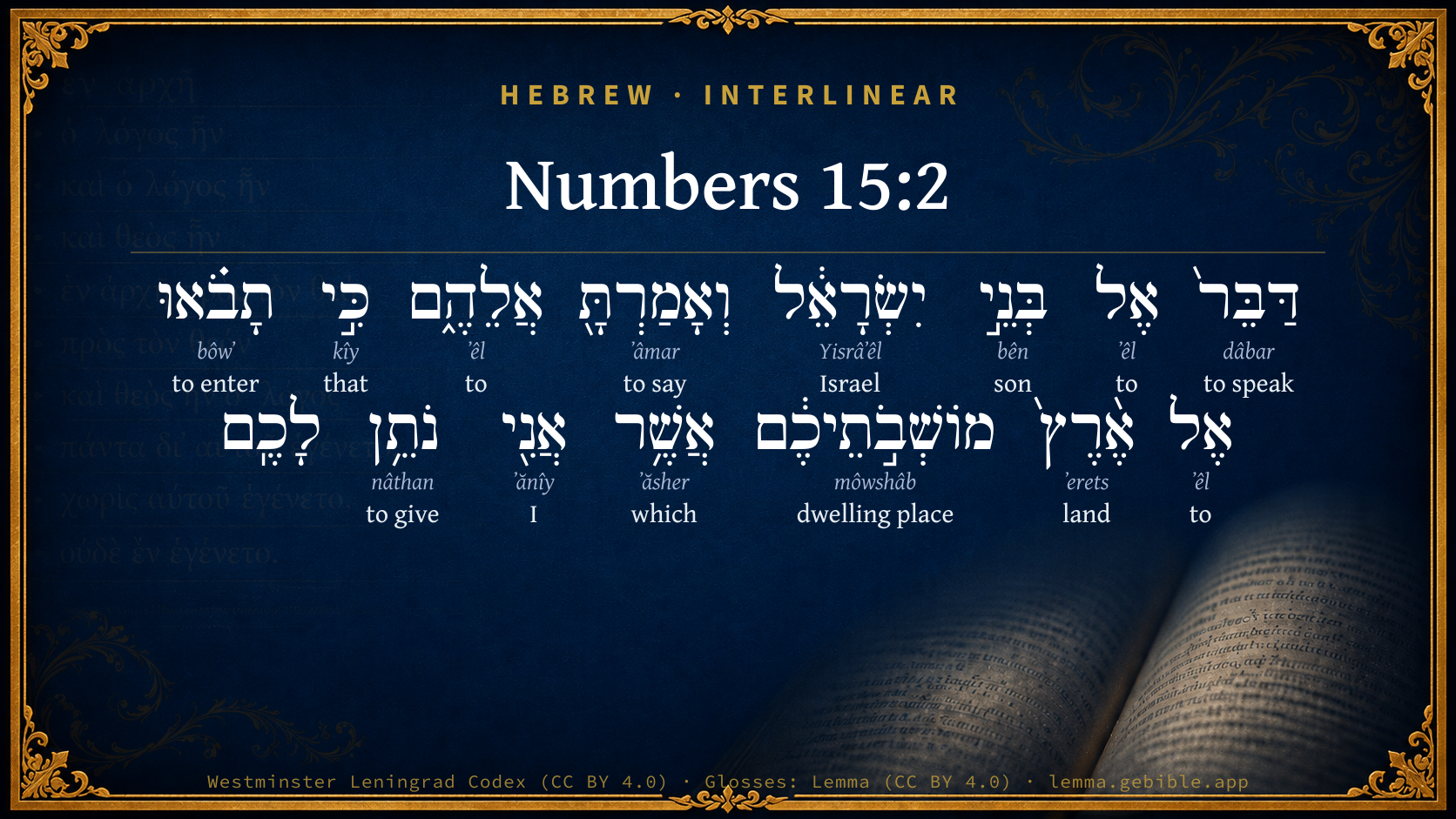
Hebrew (Westminster Leningrad Codex) Numbers 15:2 appears in the Hebrew Old Testament. The text above is from the Westminster Leningrad Codex. Each word links to its Strong’s number, a concise gloss, and parsing drawn from the Open Scriptures Hebrew Bible morphology. Click any word for its full Brown-Driver-Briggs (BDB) entry.
Download image
Cite this verse

Numbers 15:2 (World English Bible). Public Domain. Lemma interlinear Bible study tool, https://lemma.gebible.app/v/numbers/15/2.

Show BibTeX & RIS
BibTeX
RIS
English Translation
Speak to the children of Israel, and tell them, When you are come into the land of your habitations, which I give to you,
World English Bible · Public Domain
Download a study sheet

One document with this verse’s original text, its word-by-word gloss line, the meaning frame, cross-references with their text, attributed commentary, and full source and license credits — printable, and it pastes into notes with its structure intact.

This verse Autodidact and up

Study sheet (.html) Plain text (.txt)

A passage Seminary Student

Up to 50 verses in one chapter. A passage sheet keeps up to 6 commentary sources and 12 cross-references per verse, in the order this page ranks them, and says so on the sheet whenever that leaves anything out. Ask for a single verse and you get the Autodidact verse sheet above.

Everything on this page stays free to read, with no account — the sheet is a download of what is already on screen, not access to it.

Want to remove ads? Support Godless Engineer
Compare translations 3

The same verse in 3 English versions, stacked beneath the original-language interlinear above. Click any original word for its lexicon entry.

Each is an independent rendering of the whole verse — the interlinear is not word-aligned to these translations.

Highlighted words mark where these versions differ — a whole-verse word diff, not a word-by-word alignment.

  • World English Bible Public Domain
    Speak to the children of Israel, and tell them, When you are come into the land of your habitations, which I give to you,
  • King James Version Public Domain
    Speak unto the children of Israel, and say unto them, When ye be come into the land of your habitations, which I give unto you,
  • unfoldingWord Literal Text CC BY-SA 4.0
    “Speak to the sons of Israel and say to them, ‘When you go to the land of your dwellings, which I am giving to you,

unfoldingWord Literal Text — © unfoldingWord, licensed CC BY-SA 4.0. Word-aligned USFM3 via Door43 (git.door43.org/unfoldingWord/en_ult).

Versions to compare (up to 4)

3 of 4 selected

Show all 18 translations

Every available English version of this verse, each an independent rendering of the whole verse.

  • World English Bible Public Domain
    Speak to the children of Israel, and tell them, When you are come into the land of your habitations, which I give to you,
  • Berean Standard Bible Public Domain
    “Speak to the Israelites and tell them: After you enter the land that I am giving you as a home
  • Majority Standard Bible Public Domain
    “Speak to the Israelites and tell them: After you enter the land that I am giving you as a home
  • King James Version Public Domain
    Speak unto the children of Israel, and say unto them, When ye be come into the land of your habitations, which I give unto you,
  • American Standard Version (1901) Public Domain
    Speak unto the children of Israel, and say unto them, When ye are come into the land of your habitations, which I give unto you,
  • Revised Version (1885) Public Domain
    Speak unto the children of Israel, and say unto them, When ye be come into the land of your habitations, which I give unto you,
  • Geneva Bible (1599) Public Domain
    Speake vnto the children of Israel, and say vnto them, Whe ye be come into the land of your habitations, which I giue vnto you,
  • Douay-Rheims (1899) Public Domain
    Speak to the children of Israel and thou shalt say to them: When you shall be come into the land of your habitation, which I will give you,
  • Young's Literal Translation Public Domain
    `Speak unto the sons of Israel, and thou hast said unto them, When ye come in unto the land of your dwellings, which I am giving to you,
  • Literal Standard Version CC BY-SA 4.0
    “Speak to the sons of Israel, and you have said to them: When you come into the land of your dwellings, which I am giving to you,
  • Unlocked Literal Bible CC BY-SA 4.0
    “Speak to the people of Israel and say to them, 'When you go into the land where you will live, which Yahweh will give to you,
  • unfoldingWord Literal Text CC BY-SA 4.0
    “Speak to the sons of Israel and say to them, ‘When you go to the land of your dwellings, which I am giving to you,
  • Darby Bible Public Domain
    Speak unto the children of Israel, and say unto them, When ye come into the land of your dwellings, which I give unto you,
  • World Messianic Bible Public Domain
    “Speak to the children of Israel, and tell them, ‘When you have come into the land of your habitations, which I give to you,
  • Webster's Bible Public Domain
    Speak to the children of Israel, and say to them, When ye shall have come into the land of your habitations, which I give to you,
  • Free Bible Version CC BY-SA 4.0
    “Tell the Israelites, ‘These are instructions about what you are to do once you arrive in the country I'm giving you to live in.
  • Bible in Basic English Public Domain
    Say to the children of Israel, When you have come into the land which I am giving to you for your resting-place,
  • JPS Tanakh (1917) Public Domain
    Speak unto the children of Israel, and say unto them: When ye are come into the land of your habitations, which I give unto you,

Literal Standard Version (2020), Covenant Press — licensed CC BY-SA 4.0. Text via the HelloAO Bible API (eBible.org). Unlocked Literal Bible (unfoldingWord) — licensed CC BY-SA 4.0. Text via the HelloAO Bible API (eBible.org). unfoldingWord Literal Text — © unfoldingWord, licensed CC BY-SA 4.0. Word-aligned USFM3 via Door43 (git.door43.org/unfoldingWord/en_ult). Free Bible Version, Dr. Jonathan Gallagher — licensed CC BY-SA 4.0. Text via the HelloAO Bible API (eBible.org).

Word by word

More ways to search: Search by grammar → Find every occurrence → Compare this word →

Practice this passage: Drill this verse → Learn its vocabulary →

מוֹשְׁבֹ֣תֵיכֶ֔ם
môwshâb
H4186
“dwelling places · your”
Noun, Common, Masculine, Plural, Construct + Suffix, Personal, 2nd Person, Masculine, Plural
Part of Speech
Noun
Type
Common
Gender
Masculine
Number
Plural
State
Construct
Full BDB Definition

Origin: from H3427 ; a seat

TWOT: 922c

seat, assembly, dwelling-place, dwelling, dwellers - seat, sitting, those sitting, sitting company or assembly - dwelling place, dwelling - situation, location - time of dwelling - those dwelling, dweller
  1. דַּבֵּר֙ dâbar H1696 “speak” Verb, Piel, Imperative, 2nd Person, Masculine, Singular
  2. אֶל ʼêl H413 “to” Preposition
  3. בְּנֵ֣י bên H1121 “sons of” Noun, Common, Masculine, Plural, Construct
  4. יִשְׂרָאֵ֔ל Yisrâʼêl H3478 “Israel” Noun, Proper
  5. וְאָמַרְתָּ֖ ʼâmar H559 “and · to say” Conjunction + Verb, Qal, Sequential Perfect, 2nd Person, Masculine, Singular
  6. אֲלֵהֶ֑ם ʼêl H413 “to · them” Preposition + Suffix, Personal, 3rd Person, Masculine, Plural
  7. כִּ֣י kîy H3588 “that” Conjunction
  8. תָבֹ֗אוּ bôwʼ H935 “to enter” Verb, Qal, Imperfect, 2nd Person, Masculine, Plural
  9. אֶל ʼêl H413 “to” Preposition
  10. אֶ֨רֶץ֙ ʼerets H776 “land of” Noun, Common, Both, Singular, Construct
  11. אֲשֶׁ֥ר ʼăsher H834 “which” Particle, Relative
  12. אֲנִ֖י ʼănîy H589 “I” Pronoun, Personal, 1st Person, Common, Singular
  13. נֹתֵ֥ן nâthan H5414 “giving” Verb, Qal, Participle Active, Masculine, Singular, Absolute

About this verse

These counts appear in no published source. They are computed here, from the morphology-tagged text and Lemma’s own curated glosses. What Lemma adds →

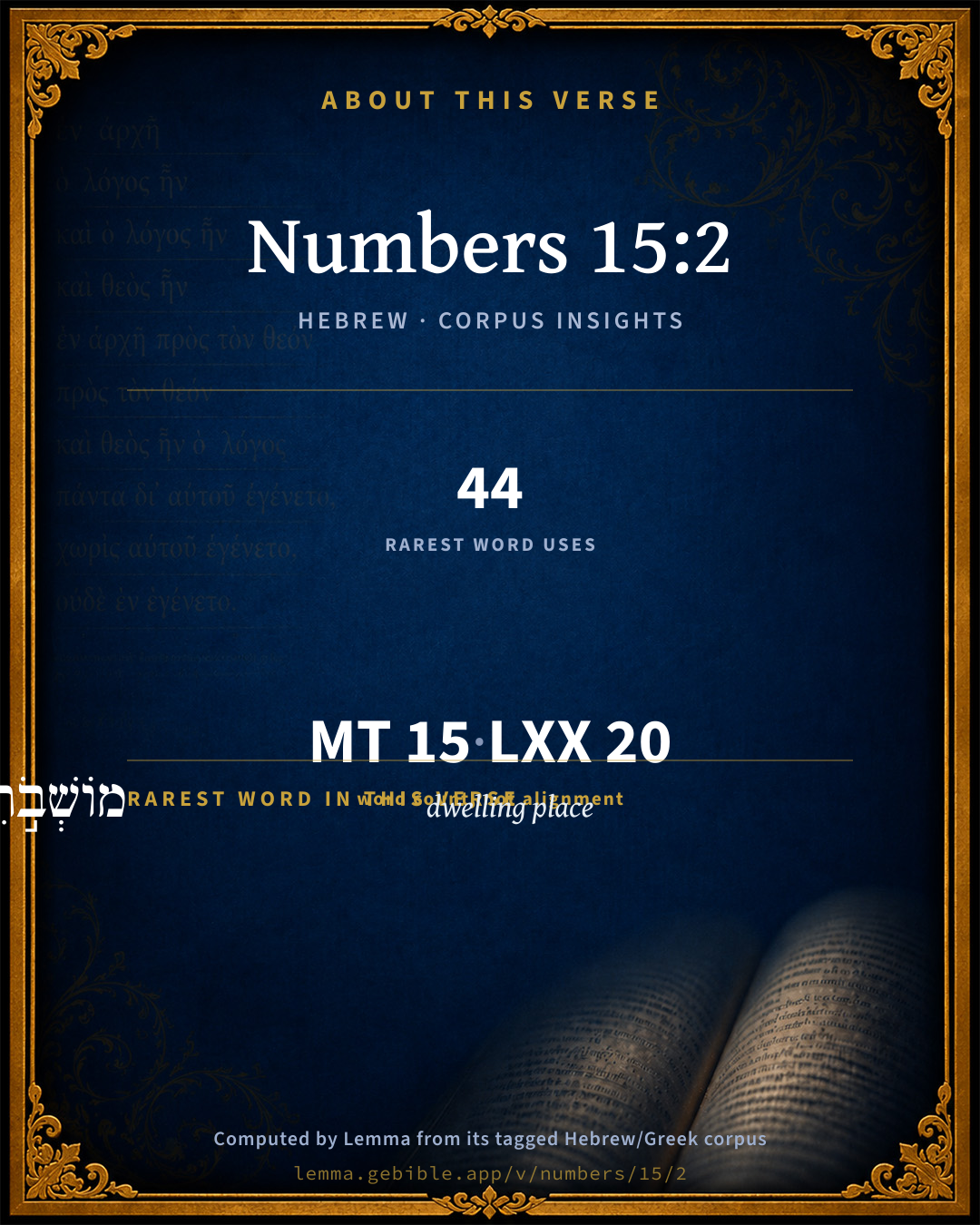
15
words
12
distinct lemmas
Pentateuch
section

Shared distinctive vocabulary

מוֹשְׁבֹ֣תֵיכֶ֔ם dwelling place H4186 occurs in 43 verses of the Hebrew Bible. Also found in:

Grammatical profile

  • 4 verbs
  • 4 nouns
  • 1 pronoun
  • 4 prepositions
  • 1 conjunction
  • 1 particle

Verb forms

  • דַּבֵּר֙ Piel · Imperative
  • וְאָמַרְתָּ֖ Qal · Sequential Perfect
  • תָבֹ֗אוּ Qal · Imperfect
  • נֹתֵ֥ן Qal · Participle Active

Repetition

A word recurs within this verse — often emphatic in Hebrew:

  • אֶל to H413 ×3

Hebrew & Septuagint length

In English translation the verse runs 24 words from the Hebrew and 27 from the Septuagint (LXX English) — closely comparable.

A rough comparison of the two English renderings, which tokenize alike — not a word-level alignment.

Word counts can differ between the Hebrew and the Greek without any difference in meaning — e.g. the Hebrew direct-object marker אֵת has no separate Greek word, and Greek often adds the article ὁ.

In the original languages it is 15 Hebrew tokens and 20 Greek tokens — but the two are counted differently (Hebrew bundles its prefixes and suffixes into one token; the Greek is in lemma form), so that isn’t a like-for-like length.

Cross-references

7

Topical passages linked to Numbers 15:2 in the Treasury of Scripture Knowledge — connected by theme and wording, ordered by reader-vote popularity; previews shown in the World English Bible.

  • Leviticus 23:10 "Speak to the children of Israel, and tell them, 'When you have come into the land which I give to you, and shall reap its the harvest, then you shall bring the sheaf of the first fruits of your harvest to the priest:
  • Numbers 15:18 Speak to the children of Israel, and tell them, When you come into the land where I bring you,
  • Leviticus 25:2 "Speak to the children of Israel, and tell them, 'When you come into the land which I give you, then the land shall keep a Sabbath to Yahweh.
  • Leviticus 14:34 "When you have come into the land of Canaan, which I give to you for a possession, and I put a spreading mildew in a house in the land of your possession,
  • Deuteronomy 7:1–2 When Yahweh your God shall bring you into the land where you go to possess it, and shall cast out many nations before you, the Hittite, and the Girgashite, and the Amorite, and the Canaanite, and the Perizzite, and the Hivite, and the Jebusite, seven nations greater and mightier than you;
  • Deuteronomy 12:1 These are the statutes and the ordinances which you shall observe to do in the land which Yahweh, the God of your fathers, has given you to possess it, all the days that you live on the earth.
  • Deuteronomy 12:9 for you haven't yet come to the rest and to the inheritance, which Yahweh your God gives you.

Cross-references courtesy of OpenBible.info (CC BY 4.0).

Hebrew and Greek witnesses Masoretic Hebrew ↔ Greek Septuagint

The same verse in the two great witnesses to the Old Testament, shown verse-for-verse.

These are two independent witnesses, not word-aligned to each other, and the Septuagint is shown in lemma (dictionary) form.

Hebrew Numbers 15:2 Masoretic · Westminster Leningrad Codex

דַּבֵּר֙ אֶל בְּנֵ֣י יִשְׂרָאֵ֔ל וְאָמַרְתָּ֖ אֲלֵהֶ֑ם כִּ֣י תָבֹ֗אוּ אֶל אֶ֨רֶץ֙ מוֹשְׁבֹ֣תֵיכֶ֔ם אֲשֶׁ֥ר אֲנִ֖י נֹתֵ֥ן לָכֶֽם

Speak to the children of Israel, and tell them, When you are come into the land of your habitations, which I give to you,

World English Bible · Public Domain

Greek LXX Numbers 15:2 Septuagint · lemma form

λαλέω ὁ υἱός ἰσραήλ καί εἶπον πρός αὐτός ὅταν εἰςἔρχομαι εἰς ὁ γῆ ὁ κατοίκησις σύ ὅς ἐγώ δίδωμι σύ

Speak to the children of Israel, and you shall say to them, When you⌃ are come into the land of your habitation, which I give to you,

LXX2012 (modern English Septuagint) · Public Domain

Hebrew: Westminster Leningrad Codex (CC BY 4.0). Greek: Septuagint (public domain); English from LXX2012 (modern English Septuagint) (Public Domain). How the Septuagint differs from the Hebrew →

Targum (Aramaic paraphrase)

2

The Targum is the ancient Jewish Aramaic paraphrase of the Hebrew Scriptures — an interpretive translation, not the Hebrew text itself. Onkelos (literal) and Pseudo-Jonathan (expansive) render the Torah, and Jonathan the Prophets. Coverage is partial: where no permissively-licensed English translation exists for a verse, only the Aramaic is shown. This is verse-level text, not a word-by-word alignment to the Hebrew.

  1. Targum Onkelos Torah (Genesis–Deuteronomy)
    מַלֵל עִם בְּנֵי יִשְׂרָאֵל וְתֵימַר לְהוֹן אֲרֵי תֵעֲלוּן לַאֲרַע מוֹתְבָנֵיכוֹן דִי אֲנָא יָהֵב לְכוֹן

    (no public-domain English translation for this verse)

    Targum Onkelos — Aramaic: “Onkelos Genesis” (public domain); “Onkelos Exodus” (public domain); “Onkelos Leviticus” (public domain); “Onkelos Numbers” (public domain); “Onkelos Deuteronomy” (public domain). English: “Sefaria Community Translation” (CC0 1.0 (public-domain dedication)); “J.W. Etheridge. The Targums of Onkelos and Jonathan Ben Uzziel on the Pentateuch. London: Longmans, Green, 1862” (public domain). Text via Sefaria.

  2. Targum Pseudo-Jonathan Torah (Genesis–Deuteronomy)
    מַלֵיל עִם בְּנֵי יִשְרָאֵל וְתֵימַר לְהוֹן אֲרוּם תֵּיעָלוּן לְאַרַע מוֹתְבָנֵיכוֹן דַאֲנָא יָהֵיב לְכוֹן

    Speak with the sons of Israel, and say to them: When you have entered into the land of your habitation which I will give you,

    Targum Pseudo-Jonathan — Aramaic: “Targum Jonathan on Genesis” (public domain); “Targum Jonathan on Exodus” (public domain); “Targum Jonathan on Leviticus” (public domain); “Targum Jonathan on Numbers” (public domain); “Targum Jonathan on Deuteronomy” (public domain). English: “The Targum of Jonathan ben Uzziel, trans. J. W. Etheridge, London, 1862” (public domain). Text via Sefaria.

Commentary

Notes on Numbers 15:2 from classic Christian and Jewish commentators (each source and its license shown beneath its notes). The classic Christian expositions comment on the surrounding passage and are grouped to its opening verse, so a note may address several verses; the Jewish commentaries on the Tanakh (Rashi and others) are per-verse, so they appear only where the commentator wrote on this verse.

Lemma curates 59 commentaries, every one of them public domain or Creative Commons licensed, each selected and text-cleaned for this edition rather than reprinted as found. About our sources →

Trapp's Complete Commentary

John Trapp

Num 15:2 Speak unto the children of Israel, and say unto them, When ye be come into the land of your habitations, which I give unto you,

Ver. 2. When ye be come into the land.] God, who in the midst of judgment remembereth mercy, and suffereth not his whole wrath to arise, seals up his love again to these recent revolters: and although he led them in and out, backward and forward, in that terrible wilderness, as if he had been treading a maze; yet he here gives them new directions what to do, when they, that is their children, came into the land of Canaan. Yea, he further tells them that he will smell a sweet savour of the herd, and of the flock; and is pleased to enlarge and explain some laws formerly delivered, in token of his reconciliation to them. So he renewed his favour to his relapsed spouse, now returning unto him, {Son 5:3; Son 6:4-5, &c.} and to his disciples, that had basely forsaken him, by giving them a new commission to execute the ministerial function. {Joh 20:21}

John Trapp, A Commentary or Exposition upon All the Books of the Old and New Testament (1647–1656) — public domain. Text from a community e-Sword module.

Geneva Bible (1599)

Geneva Bible translators

Into the land of Canaan.

Geneva Bible (1599) marginal notes — public domain. Text via Bolls.life.

Adam Clarke's Commentary

Verse 2. When ye be come into the land] Some learned men are of opinion that several offerings prescribed by the law were not intended to be made in the wilderness, but in the promised land; the former not affording those conveniences which were necessary to the complete observance of the Divine worship in this and several other respects.

Adam Clarke's Commentary on the Bible (1810–1826) — public domain. Text from a community e-Sword/MySword module.

John Gill's Exposition

Speak unto the children of Israel, and say unto them,.... The younger sort of them, such as were under twenty years of age; for those of that age and upwards, who had murmured against the Lord, had been assured by him with an oath that they should die in the wilderness, and not see the land of Canaan, Num 14:29; whereas those Moses is here bid to speak to were such that should possess it:

when ye come into the land of your habitations, which I give unto,

you; the land of Canaan, the grant of which is here renewed to them, and an assurance given of their coming into it and settlement in it; and that they should have dwelling places there for their several tribes and families.

John Gill's Exposition of the Whole Bible (1746–1763) — public domain (CC PDM 1.0). Text via the HelloAO Bible API.

Albert Barnes' Notes on the Bible

To the Israelites of the younger generation is conveyed the hope that the nation should yet enter into the land of promise. The ordinances that follow are more likely to have been addressed to adults than to children; and we may therefore assume that at the date of their delivery the new generation was growing up, and the period of wandering drawing toward its close. During that period the meat-offerings and drink-offerings prescribed by the Law had been probably intermitted by reason of the scanty supply of grain and wine in the wilderness. The command therefore to provide such offerings was a pledge to Israel that it should possess the land which was to furnish the wherewithal for them.

Albert Barnes' Notes on the Bible (1834–1885) — public domain. Text from a community e-Sword/MySword module.

Haydock's Catholic Bible Commentary

Speak. This law was probably given towards the end of the 40 years, ver. 23.

George Leo Haydock (1774–1849), Haydock's Catholic Family Bible and Commentary, 1859 edition — public domain. Excludes Psalms (Douay-Rheims chapter numbering differs from Protestant) and Deuterocanonical books (Catholic canon only).

Matthew Poole's English Annotations

i.e. Will certainly give you notwithstanding this great provacation, and my unchangeable commination. And for their better assurance hereof, he repeats and amplifies the laws of sacrifices, whereby through Christ he was or would be reconciled to them and theirs upon their repentance.

Matthew Poole's English Annotations on the Holy Bible (1683–1685) — public domain. Text from a community e-Sword/MySword module.

The Pulpit Commentary

When ye be come into the land. The same formula is used in Lev_23:10 concerning the wave-sheaf. It is only remarkable here because it tacitly assumes

(1) that the burnt offerings and sacrifices mentioned would not be offered any more in the wilderness;

(2) that the nation to which it was spoken would surely enter into Canaan at last.

The Pulpit Commentary (1880–1919), ed. H.D.M. Spence-Jones & Joseph S. Exell — public domain. Text from a community e-Sword module.

John Wesley's Explanatory Notes

I give you - Will certainly give you, not withstanding this great provocation. And for their better assurance hereof he repeats and amplifies the laws of sacrifices, whereby through Christ he would be reconciled to them and theirs upon their repentance.

John Wesley, Explanatory Notes Upon the Whole Bible (1754–1765) — public domain. Text via the GEBible commentary corpus.

Scofield Reference Notes

C. I. Scofield

When

It is remarkable that just when the people are turning in unbelief from the land, God gives directions for conduct when they shall have entered it. See Rom 11:29; Php 1:6.

The Scofield Reference Bible (1917 edition), notes by C. I. Scofield — public domain. Text from a community e-Sword module.

Rashi

Rabbi Shlomo Yitzchaki (Rashi)

כי תבאו WHEN YE ARE COME [INTO THE LAND] — He brought them the good tidings that they would enter the land.

Rashi on the Tanakh — English translations: “The Judaica Press complete Tanach with Rashi, translated by A. J. Rosenberg” (CC BY 4.0); “Pentateuch with Rashi's commentary by M. Rosenbaum and A.M. Silbermann, 1929-1934” (public domain); “The Metsudah Tanach series, Lakewood, N.J” (CC BY 4.0); and “The Book of Joshua, Metsudah Publications, 1997” (CC BY 4.0). Text via Sefaria.

Ramban (Nachmanides)

Rabbi Moshe ben Nachman (Ramban / Nachmanides)

WHEN YE ARE COME INTO THE LAND OF YOUR HABITATIONS. After He had assured the children [of those who had left Egypt] that they would come into the Land, He completed [telling] them the laws of the offerings, and that they should bring the drink-offerings when they enter the Land. Perhaps this [section] was [told to them] now in order to console them and give them an assurance [that they would indeed take possession of the Land], for they began to give up hope, saying: “Who knows what will happen in such a long time — after forty years — for may be the children will also sin?” Therefore the Holy One, blessed be He, saw fit to comfort them, for by commanding them precepts which are applicable [only] in the Land, He thereby was assuring them that it is clearly destined by Him that they will come into and inherit the Land.Now He commanded them concerning the drink-offerings [that they were to bring] in the Land when making burnt-offerings and peace-offerings, since in the wilderness they had no duty to bring drink-offerings except with the continual [daily] burnt-offering, concerning which it is said, and the fourth part of a hin of wine for a drink-offering for the one sheep; for there it is said [that it be brought continually every day] at the door of the Tent of Meeting before the Eternal, where I will meet with you, to speak there unto thee., Verse 42. Similarly the princes when bringing their dedication-offerings did not include amongst them drink-offerings.Now our Rabbis differed on this matter. Some of them said in the Sifre 107. that Scripture here teaches us that they only became obliged to bring drink-offerings from the time that they came into the Land onwards etc.; but some of them said that it is [only] the individual who was not obliged to bring drink-offerings [together with his offering] until they entered the Land [but public offerings were always accompanied by drink-offerings].He also completed [here] the laws relating to the priests by commanding the [duty of the] dough-offering, which was not applicable in the wilderness, for it was already known that the heave-offering and the tithes do not apply there, since such produce was winnowed by non-Jews and [grown] outside the Land of Israel. There is also a difference in the opinion of the Rabbis 110. concerning the [law of the] dough-offering [which is different from that of tithes etc.], namely that they became subject to the law of the dough-offering as soon as they entered the Land, but were not liable to [separate] tithes and the heave-offering until after [the fourteen years of] the conquest and settlement [of the Land].

Ramban (Nachmanides) on the Tanakh — English translation: “Commentary on the Torah by Ramban (Nachmanides). Translated and annotated by Charles B. Chavel. New York, Shilo Pub. House, 1971-1976” (CC BY 4.0). Text via Sefaria.

Lesson kit

Teaching starters — assembled from the data on this page, not authored interpretation. Every prompt links to the verse data it draws on. Edit before teaching.

Numbers, in the Pentateuch, opens this verse with 15 words (12 distinct Hebrew lemmas). Its most distinctive word is môwshâb (“dwelling place”). A historical commentator’s framing appears above. Read the whole chapter for the surrounding context.

Discussion questions

  1. The word môwshâb carries the sense “dwelling place.” How does it shape the verse?
  2. Genesis 10:30 shares the word «dwelling place» with this verse. How do the two illuminate each other?
  3. “to” occurs 3× in this one verse. What is the effect of the repetition?
  4. The translations on this page render this verse differently — a whole-verse word diff, not a word-by-word alignment. What might account for the different wordings?
  5. The verb «דַּבֵּר֙» is Piel Imperative. How does its form color the action?
  6. Reading how Trapp's Complete Commentary and Geneva Bible (1599) read this verse, where do the two commentators agree and where do they part?

Things to notice

Reading settings

Reading text

Shown beneath each verse's original-language words.

Old Testament
Old Testament edition

Read the OT as the Masoretic Hebrew (MT) or the Greek Septuagint (LXX).

English shown for the Greek Septuagint (in the Hebrew ↔ Greek comparison).

Comparing translations? Open the Compare panel on any verse page to stack up to four side by side.