Genesis 14:23

Hebrew (Westminster Leningrad Codex) Genesis 14:23 appears in the Hebrew Old Testament. The text above is from the Westminster Leningrad Codex. Each word links to its Strong’s number, a concise gloss, and parsing drawn from the Open Scriptures Hebrew Bible morphology. Click any word for its full Brown-Driver-Briggs (BDB) entry.
Download image
Cite this verse

Genesis 14:23 (World English Bible). Public Domain. Lemma interlinear Bible study tool, https://lemma.gebible.app/v/genesis/14/23.

Show BibTeX & RIS
BibTeX
RIS
English Translation
that I will not take a thread nor a shoe-latchet nor anything that is yours, lest you should say, 'I have made Abram rich.'
World English Bible · Public Domain
Highlights
  • 4 first appearances in the Hebrew Bible
Full analysis ↓
Download a study sheet

One document with this verse’s original text, its word-by-word gloss line, the meaning frame, cross-references with their text, attributed commentary, and full source and license credits — printable, and it pastes into notes with its structure intact.

This verse Autodidact and up

Study sheet (.html) Plain text (.txt)

A passage Seminary Student

Up to 50 verses in one chapter. A passage sheet keeps up to 6 commentary sources and 12 cross-references per verse, in the order this page ranks them, and says so on the sheet whenever that leaves anything out. Ask for a single verse and you get the Autodidact verse sheet above.

Everything on this page stays free to read, with no account — the sheet is a download of what is already on screen, not access to it.

Want to remove ads? Support Godless Engineer
Compare translations 3

The same verse in 3 English versions, stacked beneath the original-language interlinear above. Click any original word for its lexicon entry.

Each is an independent rendering of the whole verse — the interlinear is not word-aligned to these translations.

Highlighted words mark where these versions differ — a whole-verse word diff, not a word-by-word alignment.

  • World English Bible Public Domain
    that I will not take a thread nor a shoe-latchet nor anything that is yours, lest you should say, 'I have made Abram rich.'
  • King James Version Public Domain
    That I will not take from a thread even to a shoelatchet, and that I will not take any thing that is thine, lest thou shouldest say, I have made Abram rich:
  • unfoldingWord Literal Text CC BY-SA 4.0
    if from a thread even to the strap of a sandal, or if I take from anything that to you, so that you will not say, ‘I made Abram rich.’

unfoldingWord Literal Text — © unfoldingWord, licensed CC BY-SA 4.0. Word-aligned USFM3 via Door43 (git.door43.org/unfoldingWord/en_ult).

Versions to compare (up to 4)

3 of 4 selected

Show all 18 translations

Every available English version of this verse, each an independent rendering of the whole verse.

  • World English Bible Public Domain
    that I will not take a thread nor a shoe-latchet nor anything that is yours, lest you should say, 'I have made Abram rich.'
  • Berean Standard Bible Public Domain
    that I will not accept even a thread, or a strap of a sandal, or anything that belongs to you, lest you should say, ‘I have made Abram rich.’
  • Majority Standard Bible Public Domain
    that I will not accept even a thread, or a strap of a sandal, or anything that belongs to you, lest you should say, ‘I have made Abram rich.’
  • King James Version Public Domain
    That I will not take from a thread even to a shoelatchet, and that I will not take any thing that is thine, lest thou shouldest say, I have made Abram rich:
  • American Standard Version (1901) Public Domain
    that I will not take a thread nor a shoe-latchet nor aught that is thine, lest thou shouldest say, I have made Abram rich:
  • Revised Version (1885) Public Domain
    that I will not take a thread nor a shoelatchet nor aught that is thine, lest thou shouldest say, I have made Abram rich:
  • Geneva Bible (1599) Public Domain
    That I will not take of all that is thine, so much as a threde or shoolatchet, lest thou shouldest say, I haue made Abram riche,
  • Douay-Rheims (1899) Public Domain
    That from the very woof thread unto the shoe latchet, I will not take of any things that are thine, lest thou say I have enriched Abram:
  • Young's Literal Translation Public Domain
    from a thread even unto a shoe-latchet I take not of anything which thou hast, that thou say not, I -- I have made Abram rich;
  • Literal Standard Version CC BY-SA 4.0
    from a thread even to a shoe-strap I do not take of anything which you have, that you do not say, I have made Abram rich;
  • Unlocked Literal Bible CC BY-SA 4.0
    that I will not take a thread, a sandal strap, or anything that is yours, so that you can never say, 'I have made Abram rich.'
  • unfoldingWord Literal Text CC BY-SA 4.0
    if from a thread even to the strap of a sandal, or if I take from anything that to you, so that you will not say, ‘I made Abram rich.’
  • Darby Bible Public Domain
    if from a thread even to a sandal-thong, yes, if of all that is thine, I take [anything]...; that thou mayest not say, I have made Abram rich;
  • World Messianic Bible Public Domain
    that I will not take a thread nor a sandal strap nor anything that is yours, lest you should say, ‘I have made Abram rich.’
  • Webster's Bible Public Domain
    That I will not take from a thread even to a shoe-latchet, and that I will not take any thing that is thine, lest thou shouldest say, I have made Abram rich:
  • Free Bible Version CC BY-SA 4.0
    that I refuse to take anything belonging to you, not a single thread or a sandal strap. Otherwise you might claim, ‘It was me who made Abram rich!’
  • Bible in Basic English Public Domain
    That I will not take so much as a thread or the cord of a shoe of yours; so that you may not say, I have given wealth to Abram:
  • JPS Tanakh (1917) Public Domain
    that I will not take a thread nor a shoe-latchet nor aught that is thine, lest thou shouldest say: I have made Abram rich;

Literal Standard Version (2020), Covenant Press — licensed CC BY-SA 4.0. Text via the HelloAO Bible API (eBible.org). Unlocked Literal Bible (unfoldingWord) — licensed CC BY-SA 4.0. Text via the HelloAO Bible API (eBible.org). unfoldingWord Literal Text — © unfoldingWord, licensed CC BY-SA 4.0. Word-aligned USFM3 via Door43 (git.door43.org/unfoldingWord/en_ult). Free Bible Version, Dr. Jonathan Gallagher — licensed CC BY-SA 4.0. Text via the HelloAO Bible API (eBible.org).

Word by word

More ways to search: Search by grammar → Find every occurrence → Compare this word →

Practice this passage: Drill this verse → Learn its vocabulary →

שְׂרֽוֹךְ
sᵉrôwk
H8288
“sandal thong of”
Noun, Common, Masculine, Singular, Construct
Part of Speech
Noun
Type
Common
Gender
Masculine
Number
Singular
State
Construct
Full BDB Definition

Origin: from H8308

TWOT: 2290a

sandal thong
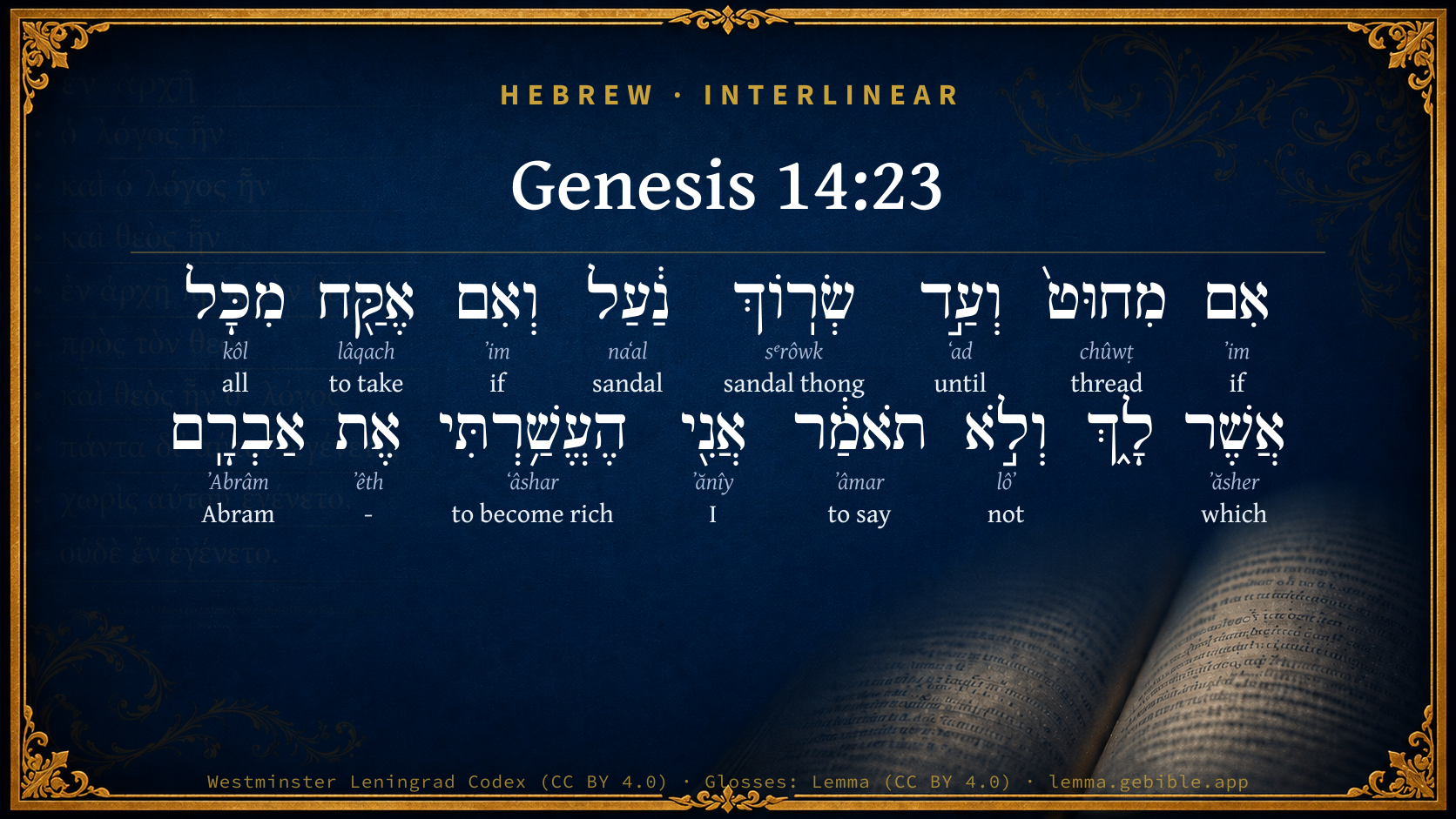
  1. אִם ʼim H518 “if” Conjunction
  2. מִחוּט֙ chûwṭ H2339 “from · thread” Preposition + Noun, Common, Masculine, Singular, Absolute
  3. וְעַ֣ד ʻad H5704 “and · until” Conjunction + Preposition
  4. נַ֔עַל naʻal H5275 “sandal” Noun, Common, Feminine, Singular, Absolute
  5. וְאִם ʼim H518 “and · if” Conjunction + Conjunction
  6. אֶקַּ֖ח lâqach H3947 “to take” Verb, Qal, Imperfect, 1st Person, Common, Singular
  7. מִכָּל kôl H3605 “from · all of” Preposition + Noun, Common, Masculine, Singular, Construct
  8. אֲשֶׁר ʼăsher H834 “which” Particle, Relative
  9. וְלֹ֣א lôʼ H3808 “and · not” Conjunction + Particle, Negative
  10. תֹאמַ֔ר ʼâmar H559 “to say” Verb, Qal, Imperfect, 2nd Person, Masculine, Singular
  11. אֲנִ֖י ʼănîy H589 “I” Pronoun, Personal, 1st Person, Common, Singular
  12. הֶעֱשַׁ֥רְתִּי ʻâshar H6238 “to become rich” Verb, Hiphil, Perfect, 1st Person, Common, Singular
  13. אֶת ʼêth H853 “-” Particle, Direct Object
  14. אַבְרָֽם ʼAbrâm H87 “Abram” Noun, Proper

About this verse

These counts appear in no published source. They are computed here, from the morphology-tagged text and Lemma’s own curated glosses. What Lemma adds →

16
words
14
distinct lemmas
Pentateuch
section

Notable vocabulary

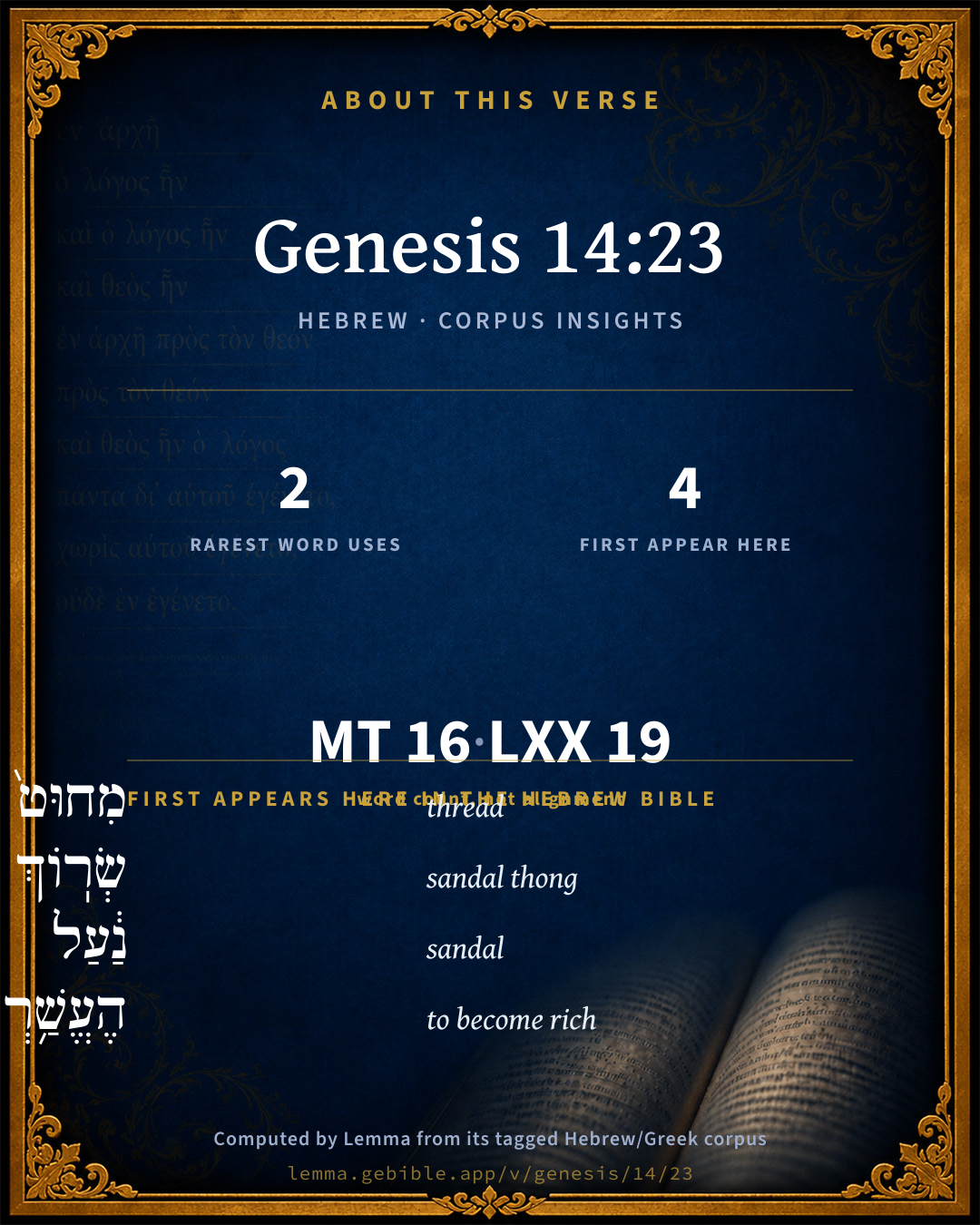
The rarest word here is שְׂרֽוֹךְ sandal thong H8288 — appearing just 2 times in the whole Hebrew Bible.

First appearance in Scripture

These words make their first canonical appearance in the Hebrew Bible here:

  • מִחוּט֙ thread H2339
  • שְׂרֽוֹךְ sandal thong H8288
  • נַ֔עַל sandal H5275
  • הֶעֱשַׁ֥רְתִּי to become rich H6238

Shared distinctive vocabulary

שְׂרֽוֹךְ sandal thong H8288 occurs in 2 verses of the Hebrew Bible. Also found in:

Grammatical profile

  • 3 verbs
  • 5 nouns
  • 1 pronoun
  • 2 prepositions
  • 2 conjunctions
  • 3 particles

Verb forms

  • אֶקַּ֖ח Qal · Imperfect
  • תֹאמַ֔ר Qal · Imperfect
  • הֶעֱשַׁ֥רְתִּי Hiphil · Perfect

Repetition

A word recurs within this verse — often emphatic in Hebrew:

  • אִם if H518 ×2

Hebrew & Septuagint length

In English translation the verse runs 24 words from the Hebrew and 24 from the Septuagint (LXX English) — the same length.

A rough comparison of the two English renderings, which tokenize alike — not a word-level alignment.

Word counts can differ between the Hebrew and the Greek without any difference in meaning — e.g. the Hebrew direct-object marker אֵת has no separate Greek word, and Greek often adds the article ὁ.

In the original languages it is 16 Hebrew tokens and 19 Greek tokens — but the two are counted differently (Hebrew bundles its prefixes and suffixes into one token; the Greek is in lemma form), so that isn’t a like-for-like length.

Cross-references

7

Topical passages linked to Genesis 14:23 in the Treasury of Scripture Knowledge — connected by theme and wording, ordered by reader-vote popularity; previews shown in the World English Bible.

  • 2 Kings 5:16 But he said, As Yahweh lives, before whom I stand, I will receive none. He urged him to take it; but he refused.
  • 2 Corinthians 11:9–12 When I was present with you and was in need, I wasn't a burden on anyone, for the brothers, when they came from Macedonia, supplied the measure of my need. In everything I kept myself from being burdensome to you, and I will continue to do so.
  • Esther 9:15–16 The Jews who were in Shushan gathered themselves together on the fourteenth day also of the month Adar, and killed three hundred men in Shushan; but they didn't lay their hand on the spoil.
  • Hebrews 13:5 Be free from the love of money, content with such things as you have, for he has said, "I will in no way leave you, neither will I in any way forsake you."
  • 1 Kings 13:8 The man of God said to the king, If you will give me half your house, I will not go in with you, neither will I eat bread nor drink water in this place;
  • 2 Kings 5:20 But Gehazi the servant of Elisha the man of God, said, Behold, my master has spared this Naaman the Syrian, in not receiving at his hands that which he brought: as Yahweh lives, I will run after him, and take somewhat of him.
  • 2 Corinthians 12:14 Behold, this is the third time I am ready to come to you, and I will not be a burden to you; for I seek not your possessions, but you. For the children ought not to save up for the parents, but the parents for the children.

Cross-references courtesy of OpenBible.info (CC BY 4.0).

Hebrew and Greek witnesses Masoretic Hebrew ↔ Greek Septuagint

The same verse in the two great witnesses to the Old Testament, shown verse-for-verse.

These are two independent witnesses, not word-aligned to each other, and the Septuagint is shown in lemma (dictionary) form.

Hebrew Genesis 14:23 Masoretic · Westminster Leningrad Codex

אִם מִחוּט֙ וְעַ֣ד שְׂרֽוֹךְ נַ֔עַל וְאִם אֶקַּ֖ח מִכָּל אֲשֶׁר לָ֑ךְ וְלֹ֣א תֹאמַ֔ר אֲנִ֖י הֶעֱשַׁ֥רְתִּי אֶת אַבְרָֽם

that I will not take a thread nor a shoe-latchet nor anything that is yours, lest you should say, 'I have made Abram rich.'

World English Bible · Public Domain

Greek LXX Genesis 14:23 Septuagint · lemma form

εἰ ἀπό σπαρτίον ἕως σφαιρωτήρ ὑπόδημα λαμβάνω ἀπό πᾶς ὁ σός ἵνα μή εἶπον ὅτι ἐγώ πλουτίζω ὁ αβραμ

that I will not take from all your goods from a string to a shoe-latchet, lest you should say, I have made Abram rich.

LXX2012 (modern English Septuagint) · Public Domain

Hebrew: Westminster Leningrad Codex (CC BY 4.0). Greek: Septuagint (public domain); English from LXX2012 (modern English Septuagint) (Public Domain). How the Septuagint differs from the Hebrew →

Targum (Aramaic paraphrase)

2

The Targum is the ancient Jewish Aramaic paraphrase of the Hebrew Scriptures — an interpretive translation, not the Hebrew text itself. Onkelos (literal) and Pseudo-Jonathan (expansive) render the Torah, and Jonathan the Prophets. Coverage is partial: where no permissively-licensed English translation exists for a verse, only the Aramaic is shown. This is verse-level text, not a word-by-word alignment to the Hebrew.

  1. Targum Onkelos Torah (Genesis–Deuteronomy)
    אִם מִחוּטָא וְעַד עַרְקַת מְסָנָא וְאִם אֶסַב מִכָּל דִי לָךְ וְלָא תֵימַר אֲנָא אַעְתָּרִית יָת אַבְרָם

    if from a thread unto the sole of a sandal I take of all that is thine, (and not that thou shouldst say, I have enriched Abram,)

    Targum Onkelos — Aramaic: “Onkelos Genesis” (public domain); “Onkelos Exodus” (public domain); “Onkelos Leviticus” (public domain); “Onkelos Numbers” (public domain); “Onkelos Deuteronomy” (public domain). English: “Sefaria Community Translation” (CC0 1.0 (public-domain dedication)); “J.W. Etheridge. The Targums of Onkelos and Jonathan Ben Uzziel on the Pentateuch. London: Longmans, Green, 1862” (public domain). Text via Sefaria.

  2. Targum Pseudo-Jonathan Torah (Genesis–Deuteronomy)
    אִין מִן חוּטָא וְעַד סַנְדְלַת רְצוּעָה אִין אֶסַב מִכָּל דִי לָךְ וְלָא תְהֵי מִתְרַבְרַב לְמֵימָר אֲנָא אַעֲתָרִית מִן דִידִי יַת אַבְרָם

    if from a thread to the latchet of a sandal I receive any thing of all that is thine; lest thou magnify thyself in saying, I have enriched Abram from mine own.

    Targum Pseudo-Jonathan — Aramaic: “Targum Jonathan on Genesis” (public domain); “Targum Jonathan on Exodus” (public domain); “Targum Jonathan on Leviticus” (public domain); “Targum Jonathan on Numbers” (public domain); “Targum Jonathan on Deuteronomy” (public domain). English: “The Targum of Jonathan ben Uzziel, trans. J. W. Etheridge, London, 1862” (public domain). Text via Sefaria.

Commentary

Notes on Genesis 14:23 from classic Christian and Jewish commentators (each source and its license shown beneath its notes). The classic Christian expositions comment on the surrounding passage and are grouped to its opening verse, so a note may address several verses; the Jewish commentaries on the Tanakh (Rashi and others) are per-verse, so they appear only where the commentator wrote on this verse.

Lemma curates 59 commentaries, every one of them public domain or Creative Commons licensed, each selected and text-cleaned for this edition rather than reprinted as found. About our sources →

Trapp's Complete Commentary

John Trapp

Gen 14:23 That I will not [take] from a thread even to a shoelatchet, and that I will not take any thing that [is] thine, lest thou shouldest say, I have made Abram rich:

Ver. 23. That I will not take from a thread.] Melchizedek, from God, had made Abram heir of all things; for, saith he, I am the priest of the most high God, possessor of heaven and earth, who hath sent me with this bread and wine, as by turf and twig, as by an earnest and a little for the whole, to give thee possession of both. Now, therefore, when the king of Sodom presently after offers him the goods he had taken, Abram would none; he was grown too great to accept of such an offer; God was his "exceeding great reward". {Gen 15:1} Aquila non captat muscas .

Lest thou shouldst say, I have made Abram rich.] Occasion must not be given to any to speak the least evil of us, lest Christ be dishonoured: for every Christian quartereth arms with Christ. And if Abram do anything unbeseeming himself, Abram’s God shall be blasphemed at Sodom.

John Trapp, A Commentary or Exposition upon All the Books of the Old and New Testament (1647–1656) — public domain. Text from a community e-Sword module.

Geneva Bible (1599)

Geneva Bible translators

Hebrew, If I take from thee a thread, etc. Read 1 Sam. 14:45.

Geneva Bible (1599) marginal notes — public domain. Text via Bolls.life.

Adam Clarke's Commentary

Verse 23. From a thread even to a shoelatchet] This was certainly a proverbial mode of expression, the full meaning of which is perhaps not known. Among the rabbinical writers חוט chut, or חוטי chuti, signifies a fillet worn by young women to tie up their hair; taken in this sense it will give a good meaning here. As Abram had rescued both the men and women carried off by the confederate kings, and the king of Sodom had offered him all the goods, claiming only the persons, he answers by protesting against the accepting any of their property: "I have vowed unto the Lord, the proprietor of heaven and earth, that I will not receive the smallest portion of the property either of the women or men, from a girl's fillet to a man's shoe-tie."

Adam Clarke's Commentary on the Bible (1810–1826) — public domain. Text from a community e-Sword/MySword module.

John Calvin's Commentaries

23. That I will not take from a thread even to a shoe - latchet. The Hebrews have an elliptical form of making oath, in which the imprecation of punishment is understood. In some places, the full expression of it occurs in the Scriptures, “The Lord do so to me and more also,” (1 Samuel 14:44.) Since however, it is a dreadful thing to fall into the hands of the living God, in order that the obligation of oaths may be the more binding, this abrupt form of speech admonishes men to reflect on what they are doing; for it is just as if they should put a restraint upon themselves, and should stop suddenly in the midst of their discourse. This indeed is most certain, that men never rashly swear, but they provoke the vengeance of God against them, and make Him their adversary.

Lest thou shouldst say. Although these words seem to denote a mind elated, and too much addicted to fame, yet since Abram is on this point commended by the Spirit, we conclude that this was a truly holy magnanimity. But an exception is added namely that he will not allow his own liberality to be injurious to his allies, nor make them subject to his laws. For this also is not the least part of virtue, to act rightly, yet in such a manner, that we do not bind others to our example, as to a rule. Let every one therefore regard what his own vocation demands, and what pertains to his own duty, in order that men may not prejudge one another according to their own will. For it is a moroseness too imperious, to wish that what we ourselves follow as right, and consonant with our duty, should be prescribed as a law to others.

John Calvin's Commentaries (1540-1563) — public domain. Text from the Calvin Translation Society English edition (1840s-50s) via the Christian Classics Ethereal Library (ccel.org). Calvin's coverage is partial (roughly two-thirds of the Bible); uncommented books and verses are honest gaps, never fabricated. The 19th-century editor's footnotes and remarks are omitted so the notes are faithfully Calvin's own voice.

The Cambridge Bible for Schools and Colleges

gen. ed. J. J. S. Perowne

23. a thread … a shoelatchet] Not the most trifling thing, not even, the lace for a sandal, will Abram take. The fact that Abram has already (Gen_14:20) given to Melchizedek a tithe of all the spoil, strictly speaking, conflicts with his refusal, in this verse, to take any share of the spoil. Probably this discrepancy is an indication that the episode of Melchizedek (Gen_14:18-20) has been introduced from a distinct source of tradition.

lest thou shouldest say, &c.] Abram emphasizes the fact, (1) that he did not make war in order to make himself richer or stronger: (2) that he and his household are not going to be beholden to the king of Sodom and the people of the Plain. What he had done, was not for gain, but for the safety of his relative Lot. Contrast, however, Abraham’s acceptance of gifts, in Gen_12:16, Gen_20:14-16, under different cumstances.

The Cambridge Bible for Schools and Colleges (gen. ed. J. J. S. Perowne; Cambridge University Press, 1878–1918) — public domain. Text from a community e-Sword module.

John Gill's Exposition

That I will not take from a thread even to a shoelatchet,.... That is, from a thread used in sewing garments to, a shoelatchet, or the string which fastens the shoes to the foot, the least belonging to that; or from the hair lace of the head, to the shoelatchet of the foot; that is, he would take nothing of his from head to foot: the meaning is, that he would not take that which was of the least value and importance that could be conceived of, and which is more clearly expressed by what follows:

and that I will not take anything that is thine; the least thing that belonged to him, or to any of his subjects, for this reason:

lest thou shouldest say, I have made Abram rich; lest he should upbraid him with it afterwards, and say, that all his riches were owing to him; whereas God had promised to bless him, and make him rich and great, as he had begun to do, and still would more and more; and in whom his trusted, and to whom he was desirous all the glory of his greatness and riches should be ascribed.

John Gill's Exposition of the Whole Bible (1746–1763) — public domain (CC PDM 1.0). Text via the HelloAO Bible API.

Haydock's Catholic Bible Commentary

Woof-thread. The first word is added by way of explanation. Abram declares he will not receive the smallest present for himself.

George Leo Haydock (1774–1849), Haydock's Catholic Family Bible and Commentary, 1859 edition — public domain. Excludes Psalms (Douay-Rheims chapter numbering differs from Protestant) and Deuterocanonical books (Catholic canon only).

Matthew Poole's English Annotations

That I will not take; Heb. If I shall take. Understand, God do so and so to me, which is expressed 1Sa 14:44. A defective manner of swearing used amongst the Hebrews, either to maintain the reverence of oaths, and the dread of perjury, seeing they were afraid so much as to mention the curse which they meant; or to show that they were willing to submit to any punishment which God should inflict upon them, without exception, if they violated their oaths.

Even to a shoe-latchet, i.e. any thing, though never so small or mean, lest thou shouldst claim a share with God in the honour due to him, to whose blessing alone I do and I will owe my riches. Or, lest thou shouldst say, Abram is enriched with my spoils; and however he pretended kindness and charity, yet indeed it was his covetousness that put him upon this work.

Matthew Poole's English Annotations on the Holy Bible (1683–1685) — public domain. Text from a community e-Sword/MySword module.

Whedon's Commentary on the Bible

Daniel D. Whedon

23. That I will not take — Literally, If from a thread even to a shoe-latchet, and if I take from all that is thine; and thou shalt not say — I have enriched Abram. Observe the emotionality of Abram’s language. In the face of temptation, and in possible danger of being misunderstood by those who could scarcely appreciate his lofty standpoint, he declares his holy vow not to take to himself any of the spoils. The particle if appears prominently in the ancient formulas of swearing. The full form appears in

1Sa_3:17 : “God do so to thee, and more also, if, etc.” “There is a marked difference between Abram’s conduct to Melchizedek and his conduct to the king of Sodom. From Melchizedek he receives refreshment and treats him with honour and respect. Toward the king of Sodom he is distant and reserved. Probably the vicious lives of the inhabitants of Sodom made him careful not to lay himself under any obligation to the king, lest he should become too much associated with him and them.” — Speaker’s Commentary.

Daniel D. Whedon (gen. ed.), Commentary on the Old and New Testaments (1874–1909) — public domain. Text from a community e-Sword module.

The Pulpit Commentary

That I will not take literally, if (sc. I shall take); an abbreviation for "May God do so to me, if...!" (cf. 1Sa_3:17; 2Sa_3:35) The particle has the force of a negative in adjuration from a thread even to a shoe-latchet, and that I will not take any thing (literally, and if I shall take anything) that is thine, literally, of all that (sc. belongs) to thee lest thou shouldest say (literally, and thou shalt not say), I have made Abram rich. Though not averse to accept presents from heathen monarchs, (Gen_12:16) the patriarch could not consent to share in the wealth of the impious Sodomites; in this a striking contrast to Lot.

The Pulpit Commentary (1880–1919), ed. H.D.M. Spence-Jones & Joseph S. Exell — public domain. Text from a community e-Sword module.

John Wesley's Explanatory Notes

From a thread to a shoe-latchet - Not the least thing that had ever belonged to the king of Sodom.

John Wesley, Explanatory Notes Upon the Whole Bible (1754–1765) — public domain. Text via the GEBible commentary corpus.

Rashi

Rabbi Shlomo Yitzchaki (Rashi)

אם מחוט ועד שרוך נעל NOT ANYTHING FROM A THREAD EVEN TO A SANDAL TIE shall I retain for myself from the spoil.

ואם אקח מכל אשר לך NOR ANYTHING THAT IS THINE WILL I TAKE — And if you say that you will reward me from your own treasures I will still not accept anything

'ולא תאמר וגו SO THAT THOU SHOULDST NOT SAY etc. — For the Holy One, blessed be He, has promised to give me riches, as it is said, (Genesis 12:2) “And I will bless thee” (see Rashi on this passage, where the blessing is explained to consist in ממון “wealth”).

Rashi on the Tanakh — English translations: “The Judaica Press complete Tanach with Rashi, translated by A. J. Rosenberg” (CC BY 4.0); “Pentateuch with Rashi's commentary by M. Rosenbaum and A.M. Silbermann, 1929-1934” (public domain); “The Metsudah Tanach series, Lakewood, N.J” (CC BY 4.0); and “The Book of Joshua, Metsudah Publications, 1997” (CC BY 4.0). Text via Sefaria.

Lesson kit

Teaching starters — assembled from the data on this page, not authored interpretation. Every prompt links to the verse data it draws on. Edit before teaching.

Genesis, in the Pentateuch, opens this verse with 16 words (14 distinct Hebrew lemmas). Its most distinctive word is sᵉrôwk (“sandal thong”). A historical commentator’s framing appears above. Read the whole chapter for the surrounding context.

Discussion questions

  1. What does “sandal thong” (sᵉrôwk) contribute to the verse as a whole?
  2. 4 words here appear for the first time in Scripture. What is being introduced at this debut?
  3. Isaiah 5:27 shares the word «sandal thong» with this verse. How do the two illuminate each other?
  4. “if” occurs 2× in this one verse. What is the effect of the repetition?
  5. The translations on this page render this verse differently — a whole-verse word diff, not a word-by-word alignment. What might account for the different wordings?
  6. The verb «אֶקַּ֖ח» is Qal Imperfect. How does its form color the action?
  7. Reading how Trapp's Complete Commentary and Geneva Bible (1599) read this verse, where do the two commentators agree and where do they part?

Things to notice

Reading settings

Reading text

Shown beneath each verse's original-language words.

Old Testament
Old Testament edition

Read the OT as the Masoretic Hebrew (MT) or the Greek Septuagint (LXX).

English shown for the Greek Septuagint (in the Hebrew ↔ Greek comparison).

Comparing translations? Open the Compare panel on any verse page to stack up to four side by side.