
Numbers 18:8

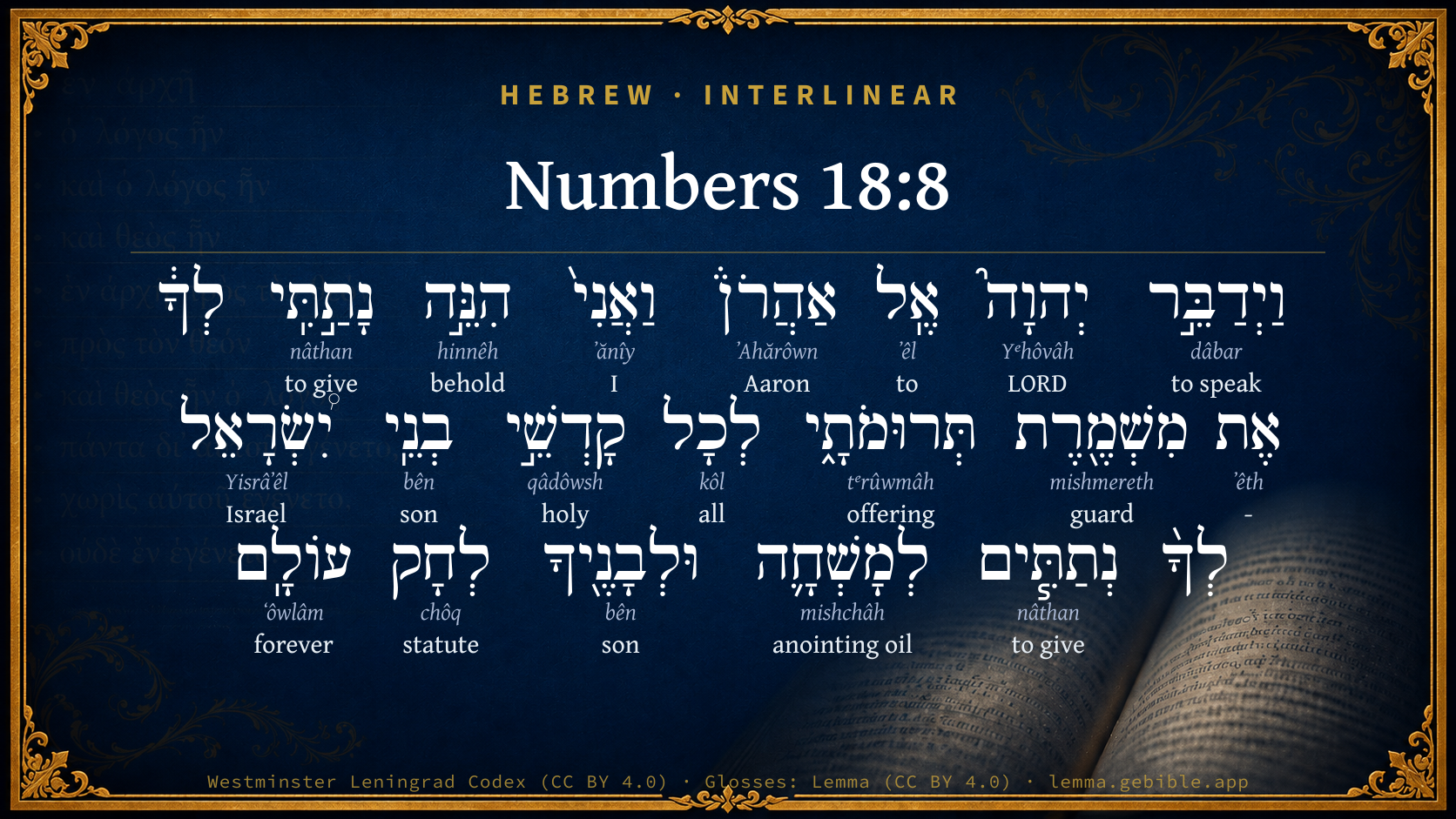
Hebrew (Westminster Leningrad Codex) Numbers 18:8 appears in the Hebrew Old Testament. The text above is from the Westminster Leningrad Codex. Each word links to its Strong’s number, a concise gloss, and parsing drawn from the Open Scriptures Hebrew Bible morphology. Click any word for its full Brown-Driver-Briggs (BDB) entry.
Download image
Cite this verse

Numbers 18:8 (World English Bible). Public Domain. Lemma interlinear Bible study tool, https://lemma.gebible.app/v/numbers/18/8.

Show BibTeX & RIS
BibTeX
RIS
English Translation
Yahweh spoke to Aaron, I, behold, I have given you the charge of my heave-offerings, even all the holy things of the children of Israel; to you have I given them by reason of the anointing, and to your sons, as a portion forever.
World English Bible · Public Domain
Download a study sheet

One document with this verse’s original text, its word-by-word gloss line, the meaning frame, cross-references with their text, attributed commentary, and full source and license credits — printable, and it pastes into notes with its structure intact.

This verse Autodidact and up

Study sheet (.html) Plain text (.txt)

A passage Seminary Student

Up to 50 verses in one chapter. A passage sheet keeps up to 6 commentary sources and 12 cross-references per verse, in the order this page ranks them, and says so on the sheet whenever that leaves anything out. Ask for a single verse and you get the Autodidact verse sheet above.

Everything on this page stays free to read, with no account — the sheet is a download of what is already on screen, not access to it.

Want to remove ads? Support Godless Engineer
Compare translations 3

The same verse in 3 English versions, stacked beneath the original-language interlinear above. Click any original word for its lexicon entry.

Each is an independent rendering of the whole verse — the interlinear is not word-aligned to these translations.

Highlighted words mark where these versions differ — a whole-verse word diff, not a word-by-word alignment.

  • World English Bible Public Domain
    Yahweh spoke to Aaron, I, behold, I have given you the charge of my heave-offerings, even all the holy things of the children of Israel; to you have I given them by reason of the anointing, and to your sons, as a portion forever.
  • King James Version Public Domain
    And the LORD spake unto Aaron, Behold, I also have given thee the charge of mine heave offerings of all the hallowed things of the children of Israel; unto thee have I given them by reason of the anointing, and to thy sons, by an ordinance for ever.
  • unfoldingWord Literal Text CC BY-SA 4.0
    And Yahweh spoke to Aaron, “And I, behold, I have given to you the keeping of my contributions, for all the holy things of the sons of Israel. To you I have given them for a portion and to your sons for a statute of eternity.

unfoldingWord Literal Text — © unfoldingWord, licensed CC BY-SA 4.0. Word-aligned USFM3 via Door43 (git.door43.org/unfoldingWord/en_ult).

Versions to compare (up to 4)

3 of 4 selected

Show all 18 translations

Every available English version of this verse, each an independent rendering of the whole verse.

  • World English Bible Public Domain
    Yahweh spoke to Aaron, I, behold, I have given you the charge of my heave-offerings, even all the holy things of the children of Israel; to you have I given them by reason of the anointing, and to your sons, as a portion forever.
  • Berean Standard Bible Public Domain
    Then the LORD said to Aaron, “Behold, I have put you in charge of My offerings. As for all the sacred offerings of the Israelites, I have given them to you and your sons as a portion and a permanent statute.
  • Majority Standard Bible Public Domain
    Then the LORD said to Aaron, “Behold, I have put you in charge of My offerings. As for all the sacred offerings of the Israelites, I have given them to you and your sons as a portion and a permanent statute.
  • King James Version Public Domain
    And the LORD spake unto Aaron, Behold, I also have given thee the charge of mine heave offerings of all the hallowed things of the children of Israel; unto thee have I given them by reason of the anointing, and to thy sons, by an ordinance for ever.
  • American Standard Version (1901) Public Domain
    And Jehovah spake unto Aaron, And I, behold, I have given thee the charge of my heave-offerings, even all the hallowed things of the children of Israel; unto thee have I given them by reason of the anointing, and to thy sons, as a portion for ever.
  • Revised Version (1885) Public Domain
    And the LORD spake unto Aaron, And I, behold, I have given thee the charge of mine heave offerings, even all the hallowed things of the children of Israel, unto thee have I given them by reason of the anointing, and to thy sons, as a due for ever.
  • Geneva Bible (1599) Public Domain
    Againe the Lord spake vnto Aaron, Behold, I haue giuen thee the keeping of mine offrings, of all the hallowed things of the children of Israel: vnto thee I haue giuen them for the anoyntings sake, and to thy sonnes, for a perpetuall ordinance.
  • Douay-Rheims (1899) Public Domain
    And the Lord said to Aaron: Behold I have given thee the charge of my firstfruits. All things that are sanctified by the children of Israel, I have delivered to thee and to thy sons for the priestly office, by everlasting ordinances.
  • Young's Literal Translation Public Domain
    And Jehovah speaketh unto Aaron: `And I, lo, I have given to thee the charge of My heave-offerings, of all the hallowed things of the sons of Israel -- to thee I have given them for the anointing, and to thy sons, by a statute age-during.
  • Literal Standard Version CC BY-SA 4.0
    And YHWH speaks to Aaron: “And I, behold, have given to you the charge of My raised-offerings, of all the hallowed things of the sons of Israel—I have given them to you and to your sons for the anointing, by a continuous statute.
  • Unlocked Literal Bible CC BY-SA 4.0
    Then Yahweh said to Aaron, “Look, I have given you the duty of handling the offerings raised up to me, and all the holy offerings that the people of Israel give to me. I have given these offerings to you and your sons as your ongoing share.
  • unfoldingWord Literal Text CC BY-SA 4.0
    And Yahweh spoke to Aaron, “And I, behold, I have given to you the keeping of my contributions, for all the holy things of the sons of Israel. To you I have given them for a portion and to your sons for a statute of eternity.
  • Darby Bible Public Domain
    And Jehovah spoke to Aaron, And I, behold, I have given thee the charge of my heave-offerings, of all the hallowed things of the children of Israel; to thee have I given them, because of the anointing, and to thy sons by an everlasting statute.
  • World Messianic Bible Public Domain
    The LORD spoke to Aaron, “Behold, I myself have given you the command of my wave offerings, even all the holy things of the children of Israel. I have given them to you by reason of the anointing, and to your sons, as a portion forever.
  • Webster's Bible Public Domain
    And the LORD spoke to Aaron, Behold, I also have given thee the charge of my heave-offerings of all the hallowed things of the children of Israel; to thee have I given them by reason of the anointing, and to thy sons, by an ordinance for ever.
  • Free Bible Version CC BY-SA 4.0
    The Lord told Aaron, “Listen, I have put you in charge of officiating at my offerings. All the holy contributions of the Israelites that they bring are reserved for you, and this is a permanent rule.
  • Bible in Basic English Public Domain
    And the Lord said to Aaron, See, I have given into your care my lifted offerings; even all the holy things of the children of Israel I have given to you and to your sons as your right for ever, because you have been marked with the holy oil.
  • JPS Tanakh (1917) Public Domain
    And the LORD spoke unto Aaron: 'And I, behold, I have given thee the charge of My heave-offerings; even of all the hallowed things of the children of Israel unto thee have I given them for a consecrated portion, and to thy sons, as a due for ever.

Literal Standard Version (2020), Covenant Press — licensed CC BY-SA 4.0. Text via the HelloAO Bible API (eBible.org). Unlocked Literal Bible (unfoldingWord) — licensed CC BY-SA 4.0. Text via the HelloAO Bible API (eBible.org). unfoldingWord Literal Text — © unfoldingWord, licensed CC BY-SA 4.0. Word-aligned USFM3 via Door43 (git.door43.org/unfoldingWord/en_ult). Free Bible Version, Dr. Jonathan Gallagher — licensed CC BY-SA 4.0. Text via the HelloAO Bible API (eBible.org).

Word by word

More ways to search: Search by grammar → Find every occurrence → Compare this word →

Practice this passage: Drill this verse → Learn its vocabulary →

לְמָשְׁחָ֛ה
mishchâh
H4888
“to/for · anointing oil”
Preposition + Noun, Common, Feminine, Singular, Absolute
Part of Speech
Preposition + Noun
Type
Common
Gender
Feminine
Number
Singular
State
Absolute
Full BDB Definition

Origin: from H4886

TWOT: 1255a , 1255b

consecrated portion, anointing oil, portion, ointment, anointing portion - ointment (used to consecrate by anointing) - anointing portion
  1. וַיְדַבֵּ֣ר dâbar H1696 “and · to speak” Conjunction + Verb, Piel, Sequential Imperfect, 3rd Person, Masculine, Singular
  2. יְהוָה֮ Yᵉhôvâh H3068 “LORD” Noun, Proper
  3. אֶֽל ʼêl H413 “to” Preposition
  4. אַהֲרֹן֒ ʼAhărôwn H175 “Aaron” Noun, Proper
  5. וַאֲנִי֙ ʼănîy H589 “and · I” Conjunction + Pronoun, Personal, 1st Person, Common, Singular
  6. הִנֵּ֣ה hinnêh H2009 “behold” Particle, Demonstrative
  7. נָתַ֣תִּֽי nâthan H5414 “to give” Verb, Qal, Perfect, 1st Person, Common, Singular
  8. אֶת ʼêth H853 “-” Particle, Direct Object
  9. מִשְׁמֶ֖רֶת mishmereth H4931 “guard of” Noun, Common, Feminine, Singular, Construct
  10. תְּרוּמֹתָ֑י tᵉrûwmâh H8641 “offerings · my” Noun, Common, Feminine, Plural, Construct + Suffix, Personal, 1st Person, Common, Singular
  11. לְכָל kôl H3605 “to/for · all of” Preposition + Noun, Common, Masculine, Singular, Construct
  12. קָדְשֵׁ֣י qâdôwsh H6918 “holy ones of” Noun, Common, Masculine, Plural, Construct
  13. בְנֵֽי bên H1121 “sons of” Noun, Common, Masculine, Plural, Construct
  14. יִ֠שְׂרָאֵל Yisrâʼêl H3478 “Israel” Noun, Proper
  15. נְתַתִּ֧ים nâthan H5414 “to give · them” Verb, Qal, Perfect, 1st Person, Common, Singular + Suffix, Personal, 3rd Person, Masculine, Plural
  16. וּלְבָנֶ֖יךָ bên H1121 “and · to/for · sons · your” Conjunction + Preposition + Noun, Common, Masculine, Plural, Construct + Suffix, Personal, 2nd Person, Masculine, Singular
  17. לְחָק chôq H2706 “to/for · statute of” Preposition + Noun, Common, Masculine, Singular, Construct
  18. עוֹלָֽם ʻôwlâm H5769 “forever” Noun, Common, Masculine, Singular, Absolute

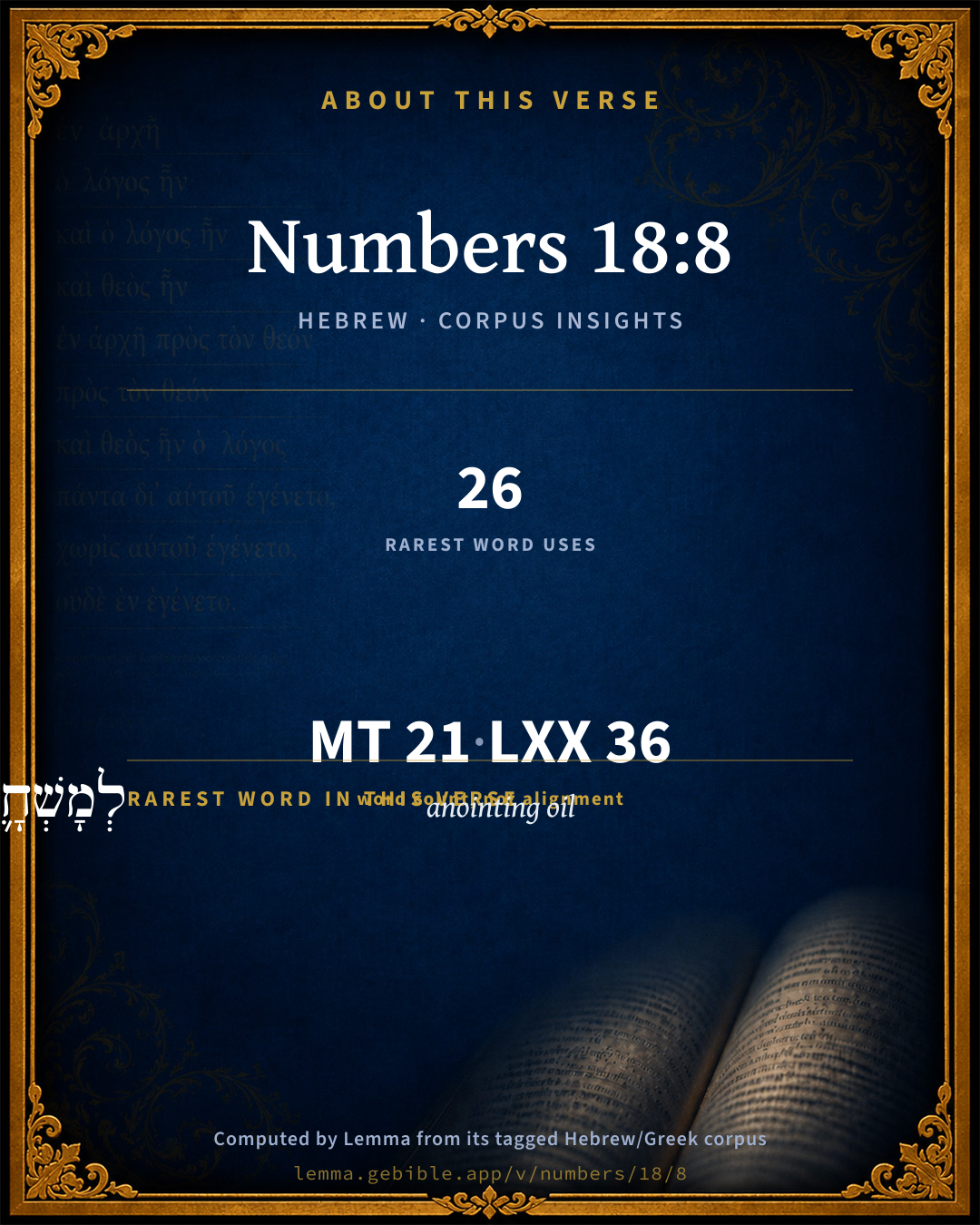
About this verse

These counts appear in no published source. They are computed here, from the morphology-tagged text and Lemma’s own curated glosses. What Lemma adds →

21
words
17
distinct lemmas
Pentateuch
section

Shared distinctive vocabulary

לְמָשְׁחָ֛ה anointing oil H4888 occurs in 24 verses of the Hebrew Bible. Also found in:

Grammatical profile

  • 3 verbs
  • 12 nouns
  • 1 pronoun
  • 3 prepositions
  • 2 particles

Verb forms

  • וַיְדַבֵּ֣ר Piel · Sequential Imperfect
  • נָתַ֣תִּֽי Qal · Perfect
  • נְתַתִּ֧ים Qal · Perfect

Repetition

Words recur within this verse — often emphatic in Hebrew:

  • נָתַ֣תִּֽי to give H5414 ×2
  • בְנֵֽי son H1121 ×2

Hebrew & Septuagint length

In English translation the verse runs 44 words from the Hebrew and 49 from the Septuagint (LXX English) — closely comparable.

A rough comparison of the two English renderings, which tokenize alike — not a word-level alignment.

Word counts can differ between the Hebrew and the Greek without any difference in meaning — e.g. the Hebrew direct-object marker אֵת has no separate Greek word, and Greek often adds the article ὁ.

In the original languages it is 21 Hebrew tokens and 36 Greek tokens — but the two are counted differently (Hebrew bundles its prefixes and suffixes into one token; the Greek is in lemma form), so that isn’t a like-for-like length.

Cross-references

21

Topical passages linked to Numbers 18:8 in the Treasury of Scripture Knowledge — connected by theme and wording, ordered by reader-vote popularity; previews shown in the World English Bible.

  • Leviticus 6:16 That which is left of it Aaron and his sons shall eat. It shall be eaten without yeast in a holy place. They shall eat it in the court of the Tent of Meeting
  • Exodus 29:29 "The holy garments of Aaron shall be for his sons after him, to be anointed in them, and to be consecrated in them.
  • Exodus 40:13 You shall put on Aaron the holy garments; and you shall anoint him, and sanctify him, that he may minister to me in the priest's office.
  • Exodus 40:15 You shall anoint them, as you anointed their father, that they may minister to me in the priest's office. Their anointing shall be to them for an everlasting priesthood throughout their generations.
  • Leviticus 6:18 Every male among the children of Aaron shall eat of it, as their portion forever throughout your generations, from the offerings of Yahweh made by fire. Whoever touches them shall be holy.'"
  • Leviticus 7:6 Every male among the priests may eat of it. It shall be eaten in a holy place. It is most holy.
  • Exodus 29:21 You shall take of the blood that is on the altar, and of the anointing oil, and sprinkle it on Aaron, and on his garments, and on his sons, and on the garments of his sons with him: and he shall be made holy, and his garments, and his sons, and his sons' garments with him.
  • Leviticus 6:20 "This is the offering of Aaron and of his sons, which they shall offer to Yahweh in the day when he is anointed: the tenth part of an ephah of fine flour for a meal offering perpetually, half of it in the morning, and half of it in the evening.
  • Leviticus 6:26 The priest who offers it for sin shall eat it. It shall be eaten in a holy place, in the court of the Tent of Meeting.
  • Leviticus 7:31–35 The priest shall burn the fat on the altar, but the breast shall be Aaron's and his sons'.
  • Leviticus 8:30 Moses took some of the anointing oil, and some of the blood which was on the altar, and sprinkled it on Aaron, on his garments, and on his sons, and on his sons' garments with him, and sanctified Aaron, his garments, and his sons, and his sons' garments with him.
  • Leviticus 10:14–15 The waved breast and the heaved thigh you shall eat in a clean place, you, and your sons, and your daughters with you: for they are given as your portion, and your sons' portion, out of the sacrifices of the peace offerings of the children of Israel.
  • Leviticus 21:10 "'He who is the high priest among his brothers, upon whose head the anointing oil is poured, and that is consecrated to put on the garments, shall not let the hair of his head hang loose, nor tear his clothes;
  • Numbers 18:9 This shall be your of the most holy things, [reserved] from the fire: every offering of theirs, even every meal-offering of theirs, and every sin-offering of theirs, and every trespass-offering of theirs, which they shall render to me, shall be most holy for you and for your sons.
  • Deuteronomy 12:6 and there you shall bring your burnt offerings, and your sacrifices, and your tithes, and the heave-offering of your hand, and your vows, and your freewill-offerings, and the firstborn of your herd and of your flock:
  • Deuteronomy 12:11 then it shall happen that to the place which Yahweh your God shall choose, to cause his name to dwell there, there shall you bring all that I command you: your burnt offerings, and your sacrifices, your tithes, and the heave-offering of your hand, and all your choice vows which you vow to Yahweh.
  • Deuteronomy 26:13 You shall say before Yahweh your God, I have put away the holy things out of my house, and also have given them to the Levite, and to the foreigner, to the fatherless, and to the widow, according to all your commandment which you have commanded me: I have not transgressed any of your commandments, neither have I forgotten them:
  • Isaiah 10:27 It shall happen in that day, that his burden shall depart from off your shoulder, and his yoke from off your neck, and the yoke shall be destroyed by reason of fatness.
  • Hebrews 1:9 You have loved righteousness, and hated iniquity; Therefore God, your God, has anointed you with the oil of gladness above your fellows."
  • 1 John 2:20 You have an anointing from the Holy One, and you know the truth.
  • 1 John 2:27 As for you, the anointing which you received from him remains in you, and you don't need for anyone to teach you. But as his anointing teaches you concerning all things, and is true, and is no lie, and even as it taught you, you will remain in him.

Cross-references courtesy of OpenBible.info (CC BY 4.0).

Hebrew and Greek witnesses Masoretic Hebrew ↔ Greek Septuagint

The same verse in the two great witnesses to the Old Testament, shown verse-for-verse.

These are two independent witnesses, not word-aligned to each other, and the Septuagint is shown in lemma (dictionary) form.

Hebrew Numbers 18:8 Masoretic · Westminster Leningrad Codex

וַיְדַבֵּ֣ר יְהוָה֮ אֶֽל אַהֲרֹן֒ וַאֲנִי֙ הִנֵּ֣ה נָתַ֣תִּֽי לְךָ֔ אֶת מִשְׁמֶ֖רֶת תְּרוּמֹתָ֑י לְכָל קָדְשֵׁ֣י בְנֵֽי יִ֠שְׂרָאֵל לְךָ֨ נְתַתִּ֧ים לְמָשְׁחָ֛ה וּלְבָנֶ֖יךָ לְחָק עוֹלָֽם

Yahweh spoke to Aaron, I, behold, I have given you the charge of my heave-offerings, even all the holy things of the children of Israel; to you have I given them by reason of the anointing, and to your sons, as a portion forever.

World English Bible · Public Domain

Greek LXX Numbers 18:8 Septuagint · lemma form

καί λαλέω κύριος πρός ἀαρών καί ἐγώ ἰδού δίδωμι σύ ὁ διατήρησις ὁ ἀπαρχή ἀπό πᾶς ὁ ἁγιάζω ἐγώ παρά ὁ υἱός ἰσραήλ σύ δίδωμι αὐτός εἰς γέρας καί ὁ υἱός σύ μετά σύ νόμιμος αἰώνιος

And the Lord said to Aaron, And, behold, I have given you the charge of the first fruits of all things consecrated to me by the children of Israel; and I have given them to you as an honor, and to your sons after you for a perpetual ordinance.

LXX2012 (modern English Septuagint) · Public Domain

On this verse, Haydock's Catholic Bible Commentary discusses the Septuagint’s reading. Read the note in Commentary ↓

Hebrew: Westminster Leningrad Codex (CC BY 4.0). Greek: Septuagint (public domain); English from LXX2012 (modern English Septuagint) (Public Domain). How the Septuagint differs from the Hebrew →

Targum (Aramaic paraphrase)

2

The Targum is the ancient Jewish Aramaic paraphrase of the Hebrew Scriptures — an interpretive translation, not the Hebrew text itself. Onkelos (literal) and Pseudo-Jonathan (expansive) render the Torah, and Jonathan the Prophets. Coverage is partial: where no permissively-licensed English translation exists for a verse, only the Aramaic is shown. This is verse-level text, not a word-by-word alignment to the Hebrew.

  1. Targum Onkelos Torah (Genesis–Deuteronomy)
    וּמַלֵיל יְיָ עִם אַהֲרֹן וַאֲנָא הָא יְהָבִית לָךְ יָת מַטְרַת אַפְרָשׁוּתָי לְכָל קוּדְשַׁיָא דִבְנֵי יִשְׂרָאֵל לָךְ יְהַבְתִּינוּן לִרְבוּ וְלִבְנָךְ לִקְיָם עֲלָם

    (no public-domain English translation for this verse)

    Targum Onkelos — Aramaic: “Onkelos Genesis” (public domain); “Onkelos Exodus” (public domain); “Onkelos Leviticus” (public domain); “Onkelos Numbers” (public domain); “Onkelos Deuteronomy” (public domain). English: “Sefaria Community Translation” (CC0 1.0 (public-domain dedication)); “J.W. Etheridge. The Targums of Onkelos and Jonathan Ben Uzziel on the Pentateuch. London: Longmans, Green, 1862” (public domain). Text via Sefaria.

  2. Targum Pseudo-Jonathan Torah (Genesis–Deuteronomy)
    וּמַלֵיל יְיָ עִם אַהֲרן וַאֲנָא בְּחֶדְוָא יְהָבִית לָךְ יַת מַטְרַת אַפְרָשׁוּתִי חַלְתָא וּבִכּוּרַיָא וְכָל קוּדְשַׁיָא דִבְנֵי יִשְרָאֵל לָךְ יְהַבְתִּינוּן לִרְבוּ וְלִבְנָךְ לִקְיַים עֲלָם

    And the Lord said to Aharon, And I have been pleased to give you the charge of My separated offerings; the cakes of the firstfruits, and all the consecrated things of the children of Israel, to thee have I given them, on account of the anointing, and to thy sons, by an everlasting statute.

    Targum Pseudo-Jonathan — Aramaic: “Targum Jonathan on Genesis” (public domain); “Targum Jonathan on Exodus” (public domain); “Targum Jonathan on Leviticus” (public domain); “Targum Jonathan on Numbers” (public domain); “Targum Jonathan on Deuteronomy” (public domain). English: “The Targum of Jonathan ben Uzziel, trans. J. W. Etheridge, London, 1862” (public domain). Text via Sefaria.

Commentary

Notes on Numbers 18:8 from classic Christian and Jewish commentators (each source and its license shown beneath its notes). The classic Christian expositions comment on the surrounding passage and are grouped to its opening verse, so a note may address several verses; the Jewish commentaries on the Tanakh (Rashi and others) are per-verse, so they appear only where the commentator wrote on this verse.

Lemma curates 59 commentaries, every one of them public domain or Creative Commons licensed, each selected and text-cleaned for this edition rather than reprinted as found. About our sources →

Matthew Henry's Commentary

The priest's service is called a warfare; and who goes a warfare at his own charges? As they were well employed, so they were well provided for, and well paid. None shall serve God for nought. All believers are spiritual priests, and God has promised to take care of them; they shall dwell in the land, and verily they shall be fed, and shall not want any good thing. Godliness has the promise of the life that now is. And from this plentiful provision here made for the priests the apostle infers that it is the duty of Christian churches to maintain their ministers; those that served at the altar lived upon the altar. So those that preach the gospel should live upon the gospel, and live comfortably, Co1 9:13, Co1 9:14. Scandalous maintenance makes scandalous ministers. Now observe, 1. That much of the provision that was made for them arose out of the sacrifices which they themselves were employed to offer. They had the skins of almost all the sacrifices, which they might sell, and they had a considerable share out of the meat-offerings, sin-offerings, etc. Those that had the charge of the offerings had the benefit, Num 18:8. Note, God's work is its own wages, and his service carries its recompence along with it. Even in keeping God's commandments there is great reward. The present pleasures of religion are part of its pay. 2. That they had not only a good table kept for them, but money likewise in their pockets for the redemption of the first-born, and those firstlings of cattle which might not be offered in sacrifice. Thus their maintenance was such as left them altogether disentangled from the affairs of this life; they had no grounds to occupy, no land to till, no vineyards to dress, no cattle to tend, no visible estate to take care of, and yet had a more plentiful income than any other families whatsoever. Thus God ordered it that they might be the more entirely addicted to their ministry, and not diverted from it, nor disturbed in it, by any worldly care or business (the ministry requires a whole man); and that they might be examples of living by faith, not only in God's providence, but in his ordinance. They lived from hand to mouth, that they might learn to take no thought for the morrow; sufficient for the day would be the provision thereof: and they had no estates to leave their children, that they might by faith leave their children, that they might by faith leave them to the care of that God who had fed them all their lives long. 3. Of the provision that was made for their tables some is said to be most holy (Num 18:9, Num 18:10), which was to be eaten by the priests themselves, and in the court of the tabernacle only; but other perquisites were less holy, of which their families might eat, at their own houses, provided they were clean, Num 18:11-13. See Lev 21:10, etc. 4. It is commanded that the best of the oil, and the best of the wine and wheat, should be offered for the first-fruits unto the Lord, which the priest were to have, Num 18:12. Note, We must always serve and honour God with the best we have, for he is the best, and best deserves it; he is the first, and therefore must have the first ripe. Those that think to save charges by putting God off with the refuse do but deceive themselves, for God is not mocked. 5. All this is given to the priests by reason of the anointing, Num 18:8. It was not for the sake of their personal merits above other Israelites that they had these tributes paid to them, be it known unto them; but purely for the sake of the office to which they were anointed. Thus all the comforts that are given to the Lord's people are given them by reason of the anointing which they have received. It is said to be given them by an ordinance for ever (Num 18:8), and it is a covenant of salt for ever, Num 18:19. As long as the priesthood should continue this should continue to be the maintenance of it, that this lamp might not go out for want of oil to keep it burning. Thus provision is made that a gospel ministry should continue till Christ comes, by an ordinance for ever. Lo, I am with you (that is their maintenance and support) always, even to the end of the world. Thanks be to the Redeemer, it is the word which he has commanded to a thousand generations.

Matthew Henry's Commentary on the Whole Bible (1708–1710) — public domain (CC PDM 1.0). Text via the HelloAO Bible API.

Jamieson, Fausset & Brown

Robert Jamieson, A. R. Fausset & David Brown

THE PRIESTS' PORTION. (Num 18:8-20)

the Lord spake unto Aaron, Behold, I also have given thee the charge of my heave offerings--A recapitulation is made in this passage of certain perquisites specially appropriated to the maintenance of the priests. They were parts of the votive and freewill offerings, including both meat and bread, wine and oil, and the first-fruits, which formed a large and valuable item.

Jamieson, Fausset & Brown — Commentary Critical and Explanatory on the Whole Bible (1871) — public domain (CC PDM 1.0). Text via the HelloAO Bible API.

Joseph Benson's Commentary

Num 18:8-9. Having pointed out to him the duties of his function, now follows a detail of the emoluments annexed to it; which emoluments are expressly declared to be for Aaron and his sons — That is, for the high- priest, who undoubtedly had a principal portion, and for the inferior priests. I also have given thee the charge — I have bestowed them upon thee for thine use, with a charge that none have them but thyself. By reason of the anointing — Because thou art anointed with the sacred oil, and thereby consecrated to the office of priest, see Lev 8:12. Most holy things — Such as were to be eaten only by the priests, and that in the sanctuary. Reserved from the fire — That is, such sacrifices, or parts of sacrifices, as were not burned in the fire. Which they shall render unto me — By way of compensation for a trespass committed against me, in which case a ram was to be offered, which was a most holy thing, and may be particularly designed here.

Joseph Benson's Commentary on the Old and New Testaments (1811–1818) — public domain. Text from a community e-Sword module.

Whedon's Commentary on the Bible

Daniel D. Whedon

THE PRIESTLY REVENUES, Num_18:8-20.

8. The charge — Hebrew, the keeping of all holy gifts for their portion instead of a territorial allotment in Canaan. See Lev_7:35; Jos_13:14, notes.

Heave offerings — The Hebrew word t’roomah is here used in its broadest sense, as in Exo_25:2; Lev_2:9, including all the holy gifts. See Lev_21:22, note. For the proper heave offering see Lev_7:14, note.

An ordinance for ever — See Lev_3:17, note.

Daniel D. Whedon (gen. ed.), Commentary on the Old and New Testaments (1874–1909) — public domain. Text from a community e-Sword module.

Keil & Delitzsch

C. F. Keil & F. Delitzsch

The Revenues of the Priests. - These are summed up in Num 18:8 in these words, "I give thee the keeping of My heave-offerings in all holy gifts for a portion, as an eternal statute." The notion of משׁמרת, keeping, as in Exo 12:6; Exo 16:23, Exo 16:32, is defined in the second parallel clause as משׁחה, a portion (see at Lev 7:35). The priests were to keep all the heave-offerings, as the portion which belonged to them, out of the sacrificial gifts that the children of Israel offered to the Lord. תּרוּמת, heave-offerings (see at Exo 25:2, and Lev 2:9), is used here in the broadest sense, as including all the holy gifts (kodashim, see Lev 21:22) which the Israelites lifted off from their possessions and presented to the Lord (as in Num 5:9). Among these, for example, were, first of all, the most holy gifts in the meat-offerings, sin-offerings, and trespass-offerings (Num 18:9, Num 18:10; see at Lev 2:3). The burnt-offerings are not mentioned, because the whole of the flesh of these was burned upon the altar, and the skin alone fell to the portion of the priest (Lev 7:8). "From the fire," sc., of the altar. אשׁ, fire, is equivalent to אשּׁה ot , firing (see Lev 1:9). These gifts they were to eat, as most holy, in a most holy place, i.e., in the court of the tabernacle (see Lev 6:9, Lev 6:19; Lev 7:6), which is called "most holy" here, to lay a stronger emphasis upon the precept. In the second place, these gifts included also "the holy gifts;" viz., (a) (Num 18:11) the heave-offering of their gifts in all wave-offerings (tenuphoth), i.e., the wave-breast and heave-leg of the peace-offerings, and whatever else was waved in connection with the sacrifices (see at Lev 7:33): these might be eaten by both the male and female members of the priestly families, provided they were legally clean (Lev 22:3.); (b) (Num 18:12) the gifts of first-fruits: "all the fat (i.e., the best, as in Gen 45:18) of oil, new wine, and corn," viz., ראשׁיתם, "the first of them," the בּכּוּרים, "the first-grown fruits" of the land, and that of all the fruit of the ground (Deu 26:2, Deu 26:10; Pro 3:9; Eze 44:30), corn, wine, oil, honey, and tree-fruit (Deu 8:8, compared with Lev 19:23-24), which were offered, according to Ch2 31:5; Neh 10:36, Neh 10:38, Tob. 1:6, as first-fruits every year (see Mishnah, Bikkur, i. 3, 10, where the first-fruits are specified according to the productions mentioned in Deu 8:8; the law prescribed nothing in relation to the quantity of the different first-fruits, but left this entirely to the offerer himself); (c) (Num 18:14) everything placed under a ban (see at Lev 27:28); and (d) (Num 18:15-18) the first-born of man and beast. The first-born of men and of unclean beasts were redeemed according to Num 3:47; Exo 13:12-13, and Lev 27:6, Lev 27:27; but such as were fit for sacrifice were actually offered, the blood being swung against the altar, and the fat portions burned upon it, whilst the whole of the flesh fell to the portion of the priests. So far as the redemption of human beings was concerned (Num 18:16), they were "to redeem from the monthly child," i.e., the first-born child as soon as it was a month old.

Keil & Delitzsch — Biblical Commentary on the Old Testament (1861–1891) — public domain (CC PDM 1.0). Text via the HelloAO Bible API. (Old Testament only.)

Tyndale Open Study Notes

Tyndale Open Resources

18:8-14 The priests and Levites were to be supported by the sacrificial system (see, e.g., Lev 7:28-36). God’s appointed representatives deserve compensation for their efforts (cp. Matt 10:9-10; 1 Cor 9:3-10).

Tyndale Open Study Notes — © Tyndale Open Resources, licensed CC BY-SA 4.0. Text via the HelloAO Bible API.

Geneva Bible (1599)

Geneva Bible translators

As the firstfruit, firstborn, and the tenths.

Geneva Bible (1599) marginal notes — public domain. Text via Bolls.life.

Ellicott's Commentary for English Readers

(8) The charge of mine heave offerings.—See Lev_7:34, and Num_18:11 of this chapter.

Unto thee have I given them by reason of the anointing.—Better, unto thee have I given them for an anointing portion. (See Lev_7:35, and Note.)

By an ordinance for ever.—Better, as an eternal statute.

A Bible Commentary for English Readers, edited by Charles John Ellicott (1878–1897) — public domain. Text from a community e-Sword module.

The Cambridge Bible for Schools and Colleges

gen. ed. J. J. S. Perowne

8. A general statement that all the holy things of Israel are the property of the priests. This is afterwards limited by the regulations in the following verses.

the charge of my contributions] i.e. the contributions made to me. See on Num_18:9. If ‘the charge’ (the ordinary rendering of the Heb. mishmereth) is correct, the expression must mean ‘the duty of taking care that the contributions are not profaned through being eaten by non-priestly persons.’ But it is better to render that which is kept of my contributions, i.e. that portion of the sacrifice which is not burnt, but reserved to be eaten. This concrete force of the word mishmereth is unique, but not impossible.

by reason of the anointing] The marg. for a portion is correct. In Lev_7:35 a word from the same root is rendered ‘anointing-portion,’ but it is doubtful if it has any connexion with the root mâshaḥ which signifies ‘anoint.’

8–20. The priests’ dues. These are as follows: (a) All meal-, sin-, and guilt-offerings, with the exception of those parts which are burnt on the altar, i.e. given to God. These may be eaten by any male member of the priestly families ‘in a very holy place’ (Num_18:9-10). (b) Those portions of a ‘gift’ (i.e. a peace-offering) which are not eaten by the worshipper himself, nor given to God by being burnt on the altar; the priests’ portions thus consisted of the ‘contribution,’ including that part of it called the ‘wave-offering.’ These may be eaten by any member, male or female, of the priestly families, who is free from ceremonial pollution (Num_18:11). The fact that females might eat it implies that it might be eaten anywhere outside the sacred precincts, into which no female was admitted, (c) All the best of the fresh oil, wine, and corn (further defined as ‘the first’ of them), and the first-ripe fruits. These may be eaten by the same persons as in (b) (Num_18:12-13). (d) Every ‘devoted’ thing (Num_18:14). (e) The first-born of all clean cattle (Num_18:15 a), with the exception of the blood and fat which were given to God (Num_18:17). (f) The five shekels paid for the redemption of the first-born of men, and the redemption price (amount not stated) of the first-born of unclean beasts (Num_18:15 b, Num_18:16).

The Cambridge Bible for Schools and Colleges (gen. ed. J. J. S. Perowne; Cambridge University Press, 1878–1918) — public domain. Text from a community e-Sword module.

John Gill's Exposition

And the Lord spake unto Aaron,.... Having pointed out to him the duty of his office, he now informs him of the perquisites of it; or having told him what was his work, now what his wages, or what was his service, and now his maintenance:

behold, I also have given thee the charge of my heave offerings, of all the hallowed things of the children of Israel; such as the heave shoulder and wave breast, and firstfruits, and all other holy things in general, such as were the most holy things; as in Num 18:9; and the lighter holy things, as the Jews call them, Num 18:11; the charge of these was given to keep for themselves, and for their families:

unto thee have I given them by reason of the anointing: because of his office as a priest, to which he was consecrated by anointing:

and to thy sons by an ordinance for ever; see Lev 7:34.

John Gill's Exposition of the Whole Bible (1746–1763) — public domain (CC PDM 1.0). Text via the HelloAO Bible API.

Albert Barnes' Notes on the Bible

By reason of the anointing - See Lev 7:35.

Albert Barnes' Notes on the Bible (1834–1885) — public domain. Text from a community e-Sword/MySword module.

Haydock's Catholic Bible Commentary

Charge, as stewards or dispensers (Calmet) of what is offered to me; part of which I abandon to your use, as long as your republic shall subsist. (Menochius) --- First-fruits, or "heave-offerings," which comprised also the victims, first-born, &c., over which the high priest had a general inspection. --- Office. Hebrew, "unction." Septuagint, "as a reward," or salary for your labour, in performing the duty of priest. (Calmet)

George Leo Haydock (1774–1849), Haydock's Catholic Family Bible and Commentary, 1859 edition — public domain. Excludes Psalms (Douay-Rheims chapter numbering differs from Protestant) and Deuterocanonical books (Catholic canon only).

Matthew Poole's English Annotations

Unto thee have I given them; not only the charge of them, but the use of them for thyself and family, in such manner as I have elsewhere expressed.

The anointing, to wit, to the priestly office, i.e. because thou art priest, and art to devote thyself wholly to my service; which, that thou mayst perform more diligently and cheerfully, I give thee this recompence.

Matthew Poole's English Annotations on the Holy Bible (1683–1685) — public domain. Text from a community e-Sword/MySword module.

The Pulpit Commentary

And the Lord spake unto Aaron. The charge and responsibility of the priests having been declared, the provision for their maintenance is now to be set forth. The charge, trmvmi, as in verse 5, &c.; but here it means "the keeping" for their own use. (cf. Exo_12:6) Mine heave offerings. ytmoWrT. The possessive pronoun marks the fact that these did not belong to the priest in the first instance, although they naturally came to be looked on as his perquisites, (cf. 1Sa_2:16) but were a gift to him from the Lord out of what the people had dedicated. The word terumoth must here be understood in its widest sense, as including everything which the Israelites dedicated or "lifted" of all their possessions, so far as these were not destroyed in the act of offering. Of all the hallowed things. The genitive of identity: "consisting of all the hallowed things." By reason of the anointing. Rather, "for a portion," hjvml. (see on Lev_7:35) The Septuagint has eiv gerav , "as an honour," or peculium.

Vers. 8-20. The provision for the priests.

Already, upon different occasions, something has been said as to parts of certain offerings being reserved for Aaron and his sons, (Exo_29:28, 31-33 Lev_2:3, 10 6:16-18, 26, 29, &c.); and now in this passage the whole question of how the priests were to be provided for is taken up and answered. It was a fitting occasion, seeing that priestly duties had just been laid down, so exacting and exclusive in their demands. When a man is called away from the ordinary business of life, where he is as it were naturally provided for by the fruits of his industry, it must always be an anxious question as to how he shall be supported. If the priests, along with the holding of their priestly office, had been able to farm or trade there would have been no need to point out a special means of support. But since the priest was to be wholly given to tabernacle service, it was right not only to assure him beforehand of the necessaries of life, but to point out to him something of the way in which they were to be provided.

I THE SUPPORT OF THE PRIESTS WAS CLOSELY CONNECTED WITH THE FAITHFUL DISCHARGE OF THEIR OFFICE. They were provided for in the very act of carrying out their priestly duties. Forsaking the appointed service of God at his altar, they found themselves forsaken of his providence. He might have continued for them some miraculous provision by manna or otherwise, if such a course had seemed fitting; but he rather arranged it that in faithful waiting upon the altar their support should come from day to day. Faithfulness was required of them, first of all, in keeping the people instructed and reminded as to all the offerings required. An omitted offering might mean an impoverished priest. Faithfulness also was required in being continually at the altar. It was the appointed place for the people to give and for the priest to receive. There was no call for him to go on mendicant expeditions round the land, or lean upon the suggestions of his own prudence in order to make sure of daily bread. When he went to the altar it was as to a table provided by rite Lord himself. So when God manifestly calls any of us to special service, our very faithfulness in the service will bring a sufficient supply for all our need. If we leave the path of duty we leave the path of Providence.

II THIS MODE OF PROVISION TENDED TO BIND PRIESTS AND PEOPLE CLOSER TOGETHER. The priest, while in some respects separated from the people by an impassable harrier, was in others united by an indissoluble bond. Standing before them as an anointed one, with awful and peculiar powers, treading unharmed where the first footstep of a common Israelite would have wrought instant death, he nevertheless appeared at the same time dependent for his bodily sustenance on the regular offerings of the people. Thus the priest was manifested as one of themselves. There was everything in this remarkable mingling of relations to keep the people from presumption and the priest from pride. Their dependence on him was not more manifest than his dependence on them. Thus, also, we observe in many and touching ways how dependent our Saviour was on those whom he came to save. He threw himself, as no one ever before or since, on the hospitality of the world, manifesting that there were real needs of his humanity which he looked even to sinful men to supply. And may we not well suppose that even in his glory Jesus is not only a giver to men, but a receiver from them? May it not be that by our fidelity and diligence in respect of the living sacrifice we are ministering a very real satisfaction to the glorified Jesus?

III As this provision required faithfulness in the discharge of duty, so also it required FAITH IN GOD. If he had said he would provide manna or some direct miraculous gift, such an intimation would have been easier to receive than the one actually made. That which has to come to us indirectly, gives occasion for a greater trial of faith than what has to come directly. The food of these priests was to flow through a circuitous and, to judge by late experience, not very promising channel. Had not these very people, whose offerings were to support the priests, only lately shown their contempt for Aaron and unbelief as to the reality of his office? How then should they be the channels of God"s providence? Thus the opportunity for faith comes in. Looking towards man, all is unlikely; looking through man to God, all appears certain and regular. God will make his own channels, in places we think unlikely, for those who put their trust in him. He knew that, stubborn and unsympathetic as the people now were, yet the day would come when their offerings might be looked for with a reasonable confidence. We are very poor judges by ourselves of what is likely or unlikely. The Divine arrangements, perplexing as they may appear on the surface, have in all cases a basis of knowledge and power which it is our wisdom humbly and gratefully to accept.

IV This provision EVIDENTLY GUARDED AGAINST ANYTHING LIKE EXTORTION. The people themselves knew exactly how the priests were to be provided for. And this was no small matter, seeing that in course of time the holy priesthood became in the hands of arrogant and grasping men an occasion for priestcraft. Priests learned only too soon the power of an ipse dixit over superstitious and timid minds. But God does not allow the authority of an ipse dixit to any but himself. The priest was bound by a written and definite commandment which lay open to the perception of every one who had to do with him. All these offerings, of which he had a certain part, were to be presented in any ease. They were not presented in order that he might be provided for, but, being presented, they gave occasion sufficiently to provide for him. The people were to feel that he was being supported by a reasonable service.

V THERE WAS A GREAT OPPORTUNITY FOR PEOPLE TO GIVE IN A RIGHT SPIRIT. If any one had a grudging and fault-finding disposition there was certainly opportunity for him to exercise it. He could say, not without plausibility in the ears of like-minded men, that the priests were managing things very cleverly, so as to be provided for at the public expense. Misrepresentation is not a very difficult thing to achieve if certain considerations, and these alone, are brought into view. God"s appointments for the support of the priesthood: were a standing trial of the people"s views with respect to it. Misrepresentations cannot be escaped, but woe to those who, without troubling fully and honestly to understand the thing of which they speak, are the authors of misrepresentations. The priesthood itself was a Divine, a necessary, and a beneficial institution, and every devout Israelite would count it a joy to support it, even though particular holders of the office might be very unworthy men. We must honour and support every Divine appointment, and that all the more if the persons appointed show themselves insensible to the duties laid upon them. Y.

The Pulpit Commentary (1880–1919), ed. H.D.M. Spence-Jones & Joseph S. Exell — public domain. Text from a community e-Sword module.

John Wesley's Explanatory Notes

I have given them - Not only the charge, but the use of them for thyself and family. By reason of the anointing - That is, because thou art priest, and art to devote thyself wholly to my service.

John Wesley, Explanatory Notes Upon the Whole Bible (1754–1765) — public domain. Text via the GEBible commentary corpus.

Kretzmann's Popular Commentary

Paul E. Kretzmann

The Priests’ Share of the Sacrifices

v. 8. And the Lord spake unto Aaron, Behold, I also have given thee the charge of mine heave-offerings of all the hallowed things of the children of Israel, whatever they set aside for the Lord, either by the Law or in the form of a free-will offering; unto thee have I given them by reason of the anointing and to thy sons by an ordinance forever. These were priestly revenues, Num 5:9.

v. 9. This shall be thine of the most holy things, reserved from the fire: every oblation of theirs, every meat-offering of theirs, and every sin-offering of theirs, and every trespass-offering of theirs which they shall render unto Me shall be most holy for thee and for thy sons. Falling to the lot of the priests out of the sacrificial fire, they were to be regarded as being strictly set apart from profane and common use.

v. 10. In the most holy place, in the place reserved for that purpose in the court of the Tabernacle, Lev 6:9; Lev 6:19; Lev 7:6, shalt thou eat it; every male shall eat it; it shall be holy unto thee. The burnt offering is not included in this list, since only the hide of such sacrifices became the portion of the priests.

v. 11. And this is thine: the heave-offering of their gift, all the offerings of the people that were made in this manner, with all the wave-offerings of the children of Israel; I have given them unto thee, and to thy sons and to thy daughters with thee, by a statute forever; every one that is clean in thy house shall eat of it. Lev 22:2-13.

v. 12. All the best of the oil and all the best of the wine and of the wheat, the first-fruits of them which they shall offer unto the Lord, them have I given thee. Cf Deu 26:2-10; Deu 8:8; Lev 19:23-24.

v. 13. And whatsoever is first ripe in the land, which they shall bring unto the Lord, Num 15:19; Exo 22:29; Exo 23:19; Exo 34:26; Lev 2:14, shall be thine; every one that is clean in thine house shall eat of it.

v. 14. Everything devoted in Israel, consecrated to God by a vow, shall be thine, Lev 27:28.

v. 15. Everything that openeth the matrix in all flesh, which they bring unto the Lord, whether it be of men or beasts, shall be thine, Exo 13:2; Exo 22:29; Lev 27:26; nevertheless the first-born of man shalt thou surely redeem, and the firstlings of unclean beasts shalt thou redeem, Exo 13:13; Exo 34:20.

v. 16. And those that are to be redeemed from a month old shalt thou redeem, according to thine estimation, for the money of five shekels, after the shekel of the Sanctuary, which is twenty gerahs. Cf Num 3:47; Lev 27:2 ff.

v. 17. But the firstling of a cow, or the firstling of a sheep, or the firstling of a goat thou shalt not redeem; they are holy. Being clean animals, they could be consecrated as sacrifices to the Lord. Thou shalt sprinkle their blood upon the altar, and shalt burn their fat for an offering made by fire, for a sweet savor unto the Lord, Lev 3:2-5.

v. 18. And the flesh of them shall be thine; as the wave-breast and as the right shoulder, the heave-shoulder, are thine.

v. 19. All the heave-offerings of the holy things which the children of Israel offer unto the Lord have I given thee, and thy sons and thy daughters with thee, by a statute forever; it is a covenant of salt forever before the Lord unto thee and to thy seed with thee, an indissoluble covenant, an inviolable agreement. Cf Lev 2:13. In this manner the priesthood of Aaron and his family was once more firmly established in Israel, to serve the people in upholding the fellowship between them and Jehovah.

Paul E. Kretzmann, Popular Commentary of the Bible (1921–1924) — public domain. Text from a community e-Sword module.

unfoldingWord translationNotes

Door43 World Missions Community

the offerings raised up to me

Here "raised up to me" represents giving or offering something to God. This can be stated in active form. AT: "the offerings that people give to me" (See: Idiom and Active or Passive)

I have given these offerings to you

God speaks as if he had already done this because it is a decision that he had already made. AT: "I give these offerings to you"

as your ongoing share

A share is a portion of something that someone receives. AT: "as the portion that you will continually receive"

kept from the fire

This can be stated in active form. AT: "that you do not completely burn on the altar" (See: Active or Passive)

translationWords

sacrifice

raise

holy

son

grain offering

sin offering

guilt offering

unfoldingWord translationNotes — © Distant Shores Media and the Door43 World Missions Community, licensed CC BY-SA 4.0. Source: git.door43.org/Door43/en_tn.

Rashi

Rabbi Shlomo Yitzchaki (Rashi)

ואני הנה נתתי לך AND I, BEHOLD, I HAVE ALSO GIVEN THEE [THE CHARGE OF MINE HEAVE OFFERING] with pleasure. This is suggested by the word “Behold”, for this is an expression used when something is done with pleasure, just as in, (Exodus 4:14) “Behold, he goeth forth to meet thee and when he will see thee he will rejoice in his heart!” A parable! This may be compared to a king who presented a field to his friend, but he did not write or seal a deed of gift nor did he record it in the court. When a man came and laid claim to the field, the king said to him, “It seems that anyone who wishes to do so may come and claim against you; behold, I will write and seal a deed of gift to you, and record it in the court! So here, too, because Korah came and made a claim against Aaron to the Priesthood, Scripture (God) came and gave him the twenty-four “gifts” of the priesthood as an everlasting covenant of salt (i.e. an enduring covenant). For this reason is this section recording the gifts of the priests placed here after that which narrates Korah’s rebellion (Sifrei Bamidbar 117:1).

משמרת תרומתי [I HAVE GIVEN UNTO YOU] THE KEEPING OF MY HEAVE OFFERINGS — This means that you have to keep them in a state of purity (to guard them against uncleanness).

למשחה means as a distinction (cf. Onkelos; Sifrei Bamidbar 117:2; Zevachim 91a).

Rashi on the Tanakh — English translations: “The Judaica Press complete Tanach with Rashi, translated by A. J. Rosenberg” (CC BY 4.0); “Pentateuch with Rashi's commentary by M. Rosenbaum and A.M. Silbermann, 1929-1934” (public domain); “The Metsudah Tanach series, Lakewood, N.J” (CC BY 4.0); and “The Book of Joshua, Metsudah Publications, 1997” (CC BY 4.0). Text via Sefaria.

Lesson kit

Teaching starters — assembled from the data on this page, not authored interpretation. Every prompt links to the verse data it draws on. Edit before teaching.

Numbers, in the Pentateuch, opens this verse with 21 words (17 distinct Hebrew lemmas). Its most distinctive word is mishchâh (“anointing oil”). A historical commentator’s framing appears above. Read the whole chapter for the surrounding context.

Discussion questions

  1. What does “anointing oil” (mishchâh) contribute to the verse as a whole?
  2. How does Exodus 25:6, which shares the word «anointing oil», read alongside this verse?
  3. What does the repetition of “to give” (2× in this one verse) do in this verse?
  4. These translations render this verse differently; the difference is in the English rendering, not the original. What questions does that raise?
  5. «וַיְדַבֵּ֣ר» is a Piel Sequential Imperfect verb. How does that grammatical form shape the action described?
  6. Compare how Matthew Henry's Commentary and Jamieson, Fausset & Brown read this verse. Where do they agree or differ?

Things to notice

Reading settings

Reading text

Shown beneath each verse's original-language words.

Old Testament
Old Testament edition

Read the OT as the Masoretic Hebrew (MT) or the Greek Septuagint (LXX).

English shown for the Greek Septuagint (in the Hebrew ↔ Greek comparison).

Comparing translations? Open the Compare panel on any verse page to stack up to four side by side.