
Leviticus 26:16

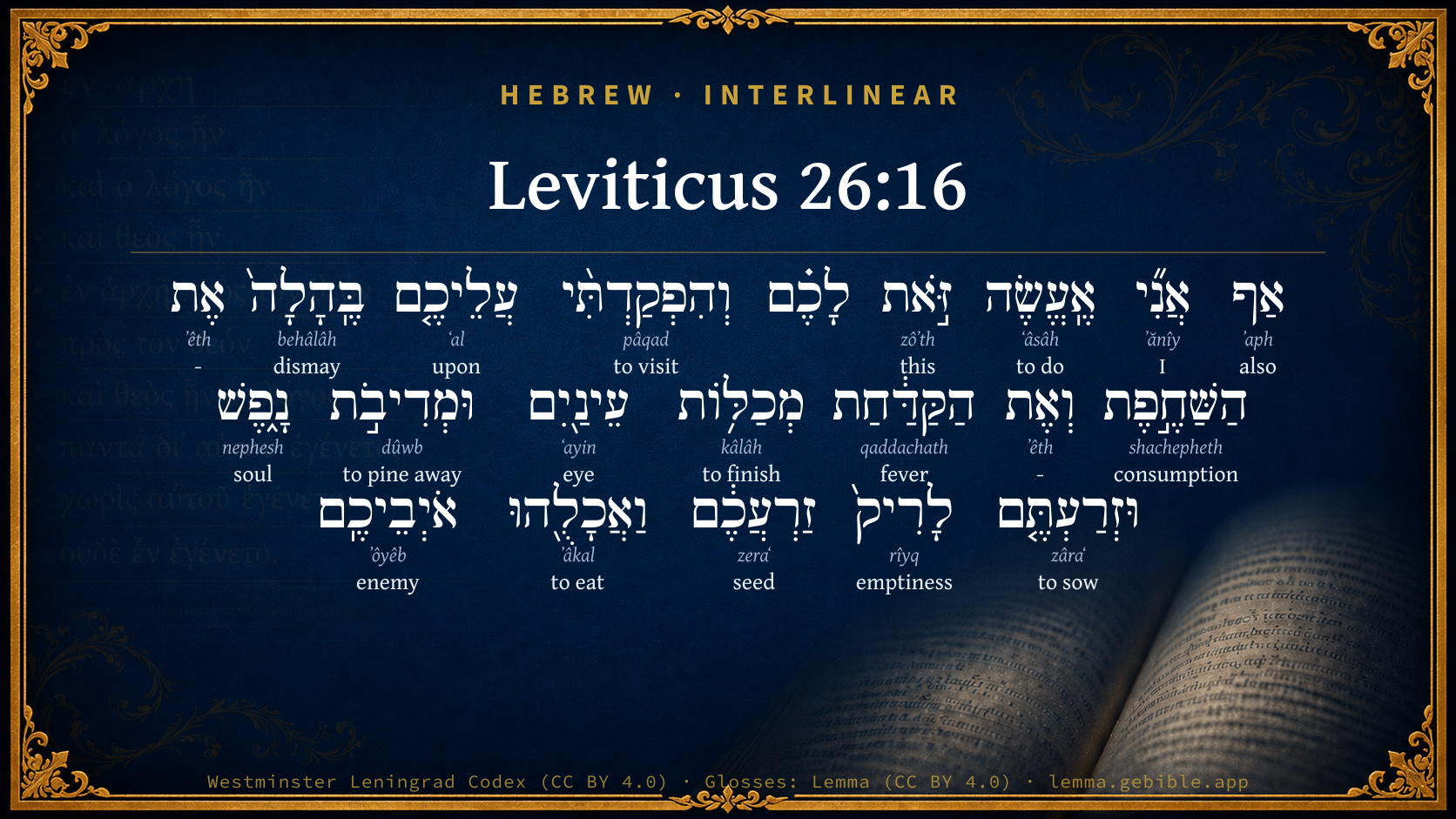
Hebrew (Westminster Leningrad Codex) Leviticus 26:16 appears in the Hebrew Old Testament. The text above is from the Westminster Leningrad Codex. Each word links to its Strong’s number, a concise gloss, and parsing drawn from the Open Scriptures Hebrew Bible morphology. Click any word for its full Brown-Driver-Briggs (BDB) entry.
Download image
Cite this verse

Leviticus 26:16 (World English Bible). Public Domain. Lemma interlinear Bible study tool, https://lemma.gebible.app/v/leviticus/26/16.

Show BibTeX & RIS
BibTeX
RIS
English Translation
I also will do this to you: I will appoint terror over you, even consumption and fever, that shall consume the eyes, and make the soul to pine away; and you will sow your seed in vain, for your enemies will eat it.
World English Bible · Public Domain
Highlights
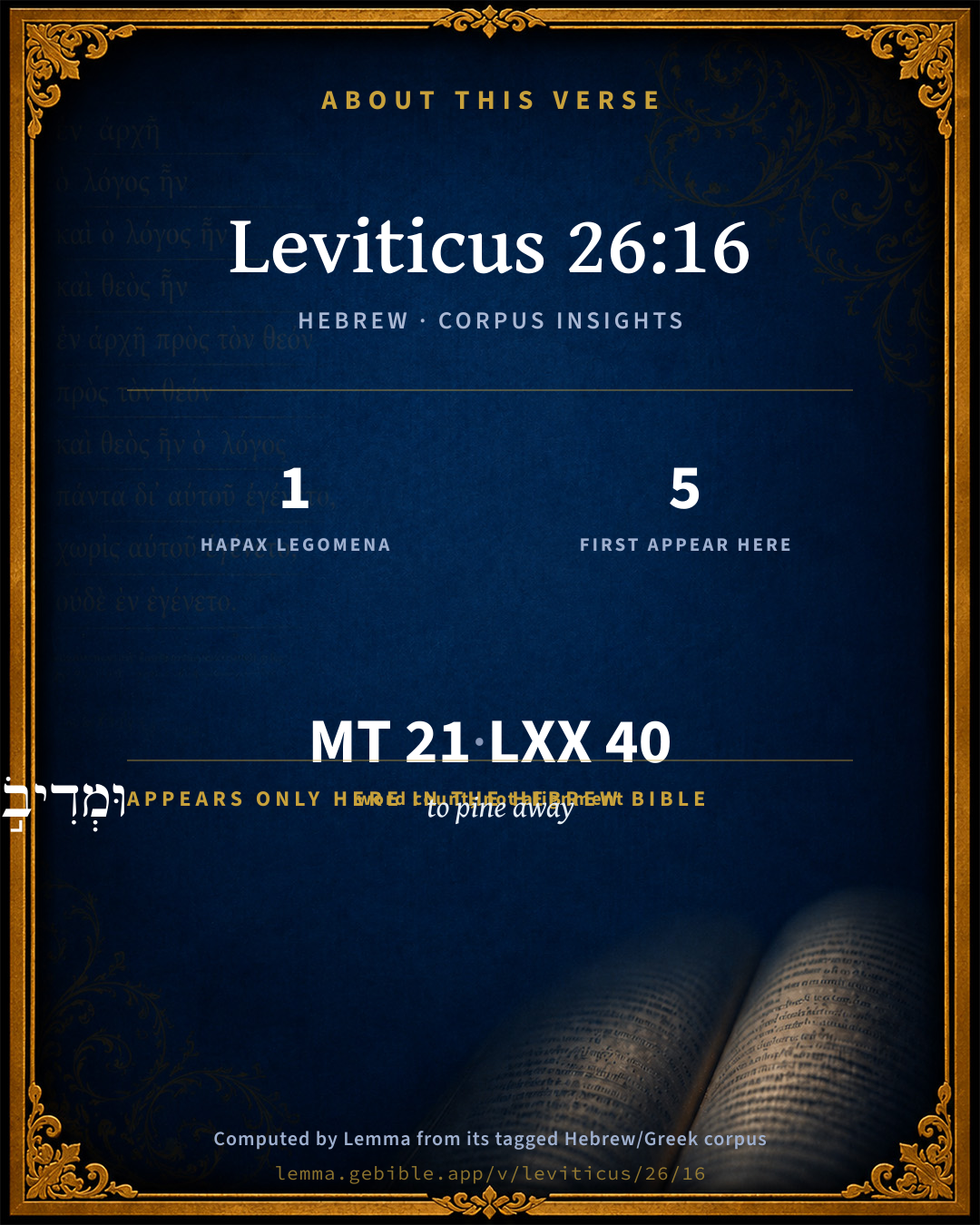
  • 1 hapax legomenon — only here in the Hebrew Bible
  • 5 first appearances in the Hebrew Bible
Full analysis ↓
Download a study sheet

One document with this verse’s original text, its word-by-word gloss line, the meaning frame, cross-references with their text, attributed commentary, and full source and license credits — printable, and it pastes into notes with its structure intact.

This verse Autodidact and up

Study sheet (.html) Plain text (.txt)

A passage Seminary Student

Up to 50 verses in one chapter. A passage sheet keeps up to 6 commentary sources and 12 cross-references per verse, in the order this page ranks them, and says so on the sheet whenever that leaves anything out. Ask for a single verse and you get the Autodidact verse sheet above.

Everything on this page stays free to read, with no account — the sheet is a download of what is already on screen, not access to it.

Want to remove ads? Support Godless Engineer
Compare translations 3

The same verse in 3 English versions, stacked beneath the original-language interlinear above. Click any original word for its lexicon entry.

Each is an independent rendering of the whole verse — the interlinear is not word-aligned to these translations.

Highlighted words mark where these versions differ — a whole-verse word diff, not a word-by-word alignment.

  • World English Bible Public Domain
    I also will do this to you: I will appoint terror over you, even consumption and fever, that shall consume the eyes, and make the soul to pine away; and you will sow your seed in vain, for your enemies will eat it.
  • King James Version Public Domain
    I also will do this unto you; I will even appoint over you terror, consumption, and the burning ague, that shall consume the eyes, and cause sorrow of heart: and ye shall sow your seed in vain, for your enemies shall eat it.
  • unfoldingWord Literal Text CC BY-SA 4.0
    I also, I will do this to you: And I will appoint over you terror, the consumption and the fever, making eyes fail and causing life to pine away. And you shall sow your seed vain, and your enemies shall eat it.

unfoldingWord Literal Text — © unfoldingWord, licensed CC BY-SA 4.0. Word-aligned USFM3 via Door43 (git.door43.org/unfoldingWord/en_ult).

Versions to compare (up to 4)

3 of 4 selected

Show all 18 translations

Every available English version of this verse, each an independent rendering of the whole verse.

  • World English Bible Public Domain
    I also will do this to you: I will appoint terror over you, even consumption and fever, that shall consume the eyes, and make the soul to pine away; and you will sow your seed in vain, for your enemies will eat it.
  • Berean Standard Bible Public Domain
    then this is what I will do to you: I will bring upon you sudden terror, wasting disease, and fever that will destroy your sight and drain your life. You will sow your seed in vain, because your enemies will eat it.
  • Majority Standard Bible Public Domain
    then this is what I will do to you: I will bring upon you sudden terror, wasting disease, and fever that will destroy your sight and drain your life. You will sow your seed in vain, because your enemies will eat it.
  • King James Version Public Domain
    I also will do this unto you; I will even appoint over you terror, consumption, and the burning ague, that shall consume the eyes, and cause sorrow of heart: and ye shall sow your seed in vain, for your enemies shall eat it.
  • American Standard Version (1901) Public Domain
    I also will do this unto you: I will appoint terror over you, even consumption and fever, that shall consume the eyes, and make the soul to pine away; and ye shall sow your seed in vain, for your enemies shall eat it.
  • Revised Version (1885) Public Domain
    I also will do this unto you; I will appoint terror over you, even consumption and fever, that shall consume the eyes, and make the soul to pine away: and ye shall sow your seed in vain, for your enemies shall eat it.
  • Geneva Bible (1599) Public Domain
    Then wil I also do this vnto you, I wil appoint ouer you fearefulnes, a consumption, and the burning ague to consume the eyes, and make the heart heauie, and you shall sowe your seede in vaine: for your enemies shall eate it:
  • Douay-Rheims (1899) Public Domain
    I also will do these things to you: I will quickly visit you with poverty, and burning heat, which shall waste your eyes, and consume your lives. You shall sow your seed in vain, which shall be devoured by your enemies.
  • Young's Literal Translation Public Domain
    I also do this to you, and I have appointed over you trouble, the consumption, and the burning fever, consuming eyes, and causing pain of soul; and your seed in vain ye have sowed, and your enemies have eaten it;
  • Literal Standard Version CC BY-SA 4.0
    I also do this to you: I have even appointed trouble over you, the consumption, and the burning fever, consuming eyes, and causing pain of soul; and you have sowed your seed in vain, and your enemies have eaten it;
  • Unlocked Literal Bible CC BY-SA 4.0
    —if you do these things, then I will do this to you: I will inflict terror on you, diseases and fever that will destroy the eyes and will drain away your life. You will plant your seeds for nothing, because your enemies will eat their produce.
  • unfoldingWord Literal Text CC BY-SA 4.0
    I also, I will do this to you: And I will appoint over you terror, the consumption and the fever, making eyes fail and causing life to pine away. And you shall sow your seed vain, and your enemies shall eat it.
  • Darby Bible Public Domain
    I also will do this unto you -- I will even appoint over you terror, consumption, and fever, which shall cause the eyes to fail, and the soul to waste away; and ye shall sow your seed in vain, for your enemies shall eat it.
  • World Messianic Bible Public Domain
    I also will do this to you: I will appoint terror over you, even consumption and fever, that shall consume the eyes, and make the soul to pine away. You will sow your seed in vain, for your enemies will eat it.
  • Webster's Bible Public Domain
    I also will do this to you, I will even appoint over you terror, consumption, and the burning ague, that shall consume the eyes, and cause sorrow of heart: and ye shall sow your seed in vain, for your enemies shall eat it.
  • Free Bible Version CC BY-SA 4.0
    then this is what I am going to do to you: I will make you panic, and suffer from diseases like tuberculosis and fever that make you blind and drain your life away. It will be pointless for you to sow seed in your fields because your enemies will eat the harvest.
  • Bible in Basic English Public Domain
    This will I do to you: I will put fear in your hearts, even wasting disease and burning pain, drying up the eyes and making the soul feeble, and you will get no profit from your seed, for your haters will take it for food.
  • JPS Tanakh (1917) Public Domain
    I also will do this unto you: I will appoint terror over you, even consumption and fever, that shall make the eyes to fail, and the soul to languish; and ye shall sow your seed in vain, for your enemies shall eat it.

Literal Standard Version (2020), Covenant Press — licensed CC BY-SA 4.0. Text via the HelloAO Bible API (eBible.org). Unlocked Literal Bible (unfoldingWord) — licensed CC BY-SA 4.0. Text via the HelloAO Bible API (eBible.org). unfoldingWord Literal Text — © unfoldingWord, licensed CC BY-SA 4.0. Word-aligned USFM3 via Door43 (git.door43.org/unfoldingWord/en_ult). Free Bible Version, Dr. Jonathan Gallagher — licensed CC BY-SA 4.0. Text via the HelloAO Bible API (eBible.org).

Word by word

More ways to search: Search by grammar → Find every occurrence → Compare this word →

Practice this passage: Drill this verse → Learn its vocabulary →

וּמְדִיבֹ֣ת
dûwb
H1727
“and · pining away”
Conjunction + Verb, Hiphil, Participle Active, Feminine, Plural, Absolute
Part of Speech
Conjunction + Verb
Stem
Hiphil
Form
Participle Active
Gender
Feminine
Number
Plural
State
Absolute
Full BDB Definition

Origin: a primitive root

TWOT: 409

to pine away, pass away - (Hiphil) to cause to pine away
  1. אַף ʼaph H637 “also” Particle, Accusative
  2. אֲנִ֞י ʼănîy H589 “I” Pronoun, Personal, 1st Person, Common, Singular
  3. אֶֽעֱשֶׂה ʻâsâh H6213 “to do” Verb, Qal, Imperfect, 1st Person, Common, Singular
  4. זֹּ֣את zôʼth H2063 “this” Pronoun, Demonstrative, Feminine, Singular
  5. וְהִפְקַדְתִּ֨י pâqad H6485 “and · to visit” Conjunction + Verb, Hiphil, Sequential Perfect, 1st Person, Common, Singular
  6. עֲלֵיכֶ֤ם ʻal H5921 “upon · you” Preposition + Suffix, Personal, 2nd Person, Masculine, Plural
  7. בֶּֽהָלָה֙ behâlâh H928 “dismay” Noun, Common, Feminine, Singular, Absolute
  8. אֶת ʼêth H853 “-” Particle, Direct Object
  9. הַשַּׁחֶ֣פֶת shachepheth H7829 “the · consumption” Particle, Definite Article + Noun, Common, Feminine, Singular, Absolute
  10. וְאֶת ʼêth H853 “and · -” Conjunction + Particle, Direct Object
  11. הַקַּדַּ֔חַת qaddachath H6920 “the · fever” Particle, Definite Article + Noun, Common, Feminine, Singular, Absolute
  12. מְכַלּ֥וֹת kâlâh H3615 “finishing” Verb, Piel, Participle Active, Feminine, Plural, Absolute
  13. עֵינַ֖יִם ʻayin H5869 “eyes” Noun, Common, Both, Dual, Absolute
  14. נָ֑פֶשׁ nephesh H5315 “soul” Noun, Common, Both, Singular, Absolute
  15. וּזְרַעְתֶּ֤ם zâraʻ H2232 “and · to sow” Conjunction + Verb, Qal, Sequential Perfect, 2nd Person, Masculine, Plural
  16. לָרִיק֙ rîyq H7385 “to/for the · emptiness” Preposition, Determined + Noun, Common, Masculine, Singular, Absolute
  17. זַרְעֲכֶ֔ם zeraʻ H2233 “seed · your” Noun, Common, Masculine, Singular, Construct + Suffix, Personal, 2nd Person, Masculine, Plural
  18. וַאֲכָלֻ֖הוּ ʼâkal H398 “and · to eat · him” Conjunction + Verb, Qal, Sequential Perfect, 3rd Person, Common, Plural + Suffix, Personal, 3rd Person, Masculine, Singular
  19. אֹיְבֵיכֶֽם ʼôyêb H341 “enemy · you” Verb, Qal, Participle Active, Masculine, Plural, Construct + Suffix, Personal, 2nd Person, Masculine, Plural

About this verse

These counts appear in no published source. They are computed here, from the morphology-tagged text and Lemma’s own curated glosses. What Lemma adds →

21
words
19
distinct lemmas
Pentateuch
section

Notable vocabulary

1 hapax legomenon — a word that appears only here in the entire Hebrew Bible:

  • וּמְדִיבֹ֣ת to pine away H1727

First appearance in Scripture

These words make their first canonical appearance in the Hebrew Bible here:

  • בֶּֽהָלָה֙ dismay H928
  • הַשַּׁחֶ֣פֶת consumption H7829
  • הַקַּדַּ֔חַת fever H6920
  • וּמְדִיבֹ֣ת to pine away H1727
  • לָרִיק֙ emptiness H7385

Shared distinctive vocabulary

הַשַּׁחֶ֣פֶת consumption H7829 occurs in 2 verses of the Hebrew Bible. Also found in:

Grammatical profile

  • 7 verbs
  • 7 nouns
  • 2 pronouns
  • 2 prepositions
  • 3 particles

Verb forms

  • אֶֽעֱשֶׂה Qal · Imperfect
  • וְהִפְקַדְתִּ֨י Hiphil · Sequential Perfect
  • מְכַלּ֥וֹת Piel · Participle Active
  • וּמְדִיבֹ֣ת Hiphil · Participle Active
  • וּזְרַעְתֶּ֤ם Qal · Sequential Perfect
  • וַאֲכָלֻ֖הוּ Qal · Sequential Perfect
  • אֹיְבֵיכֶֽם Qal · Participle Active

Hebrew & Septuagint length

In English translation the verse runs 43 words from the Hebrew and 47 from the Septuagint (LXX English) — closely comparable.

A rough comparison of the two English renderings, which tokenize alike — not a word-level alignment.

Word counts can differ between the Hebrew and the Greek without any difference in meaning — e.g. the Hebrew direct-object marker אֵת has no separate Greek word, and Greek often adds the article ὁ.

In the original languages it is 21 Hebrew tokens and 40 Greek tokens — but the two are counted differently (Hebrew bundles its prefixes and suffixes into one token; the Greek is in lemma form), so that isn’t a like-for-like length.

Cross-references

28

Topical passages linked to Leviticus 26:16 in the Treasury of Scripture Knowledge — connected by theme and wording, ordered by reader-vote popularity; previews shown in the World English Bible.

  • Job 31:8 Then let me sow, and let another eat; Yes, let the produce of my field be rooted out.
  • Jeremiah 5:17 They shall eat up your harvest, and your bread, [which] your sons and your daughters should eat; they shall eat up your flocks and your herds; they shall eat up your vines and your fig trees; they shall beat down your fortified cities, in which you trust, with the sword.
  • Micah 6:15 You will sow, but won't reap. You will tread the olives, but won't anoint yourself with oil; And crush grapes, but won't drink the wine.
  • 1 Samuel 2:33 The man of yours, [whom] I shall not cut off from my altar, [shall be] to consume your eyes, and to grieve your heart; and all the increase of your house shall die in the flower of their age.
  • Haggai 1:6 You have sown much, and bring in little. You eat, but you don't have enough. You drink, but you aren't filled with drink. You clothe yourselves, but no one is warm, and he who earns wages earns wages to put them into a bag with holes in it."
  • Deuteronomy 28:21–22 Yahweh will make the pestilence cleave to you, until he have consumed you from off the land, where you go in to possess it.
  • Deuteronomy 28:32–35 Your sons and your daughters shall be given to another people; and your eyes shall look, and fail with longing for them all the day: and there shall be nothing in the power of your hand.
  • Deuteronomy 28:51 and shall eat the fruit of your cattle, and the fruit of your ground, until you are destroyed; that also shall not leave you grain, new wine, or oil, the increase of your cattle, or the young of your flock, until they have caused you to perish.
  • Judges 6:3–6 So it was, when Israel had sown, that the Midianites came up, and the Amalekites, and the children of the east; they came up against them;
  • Psalms 78:33 Therefore he consumed their days in vanity, And their years in terror.
  • Exodus 15:26 and he said, "If you will diligently listen to the voice of Yahweh your God, and will do that which is right in his eyes, and will pay attention to his commandments, and keep all his statutes, I will put none of the diseases on you, which I have put on the Egyptians; for I am Yahweh who heals you."
  • Deuteronomy 28:65–67 Among these nations shall you find no ease, and there shall be no rest for the sole of your foot: but Yahweh will give you there a trembling heart, and failing of eyes, and pining of soul;
  • Deuteronomy 32:25 Outside shall the sword bereave, In the chambers terror; [It shall destroy] both young man and virgin, The suckling with the man of gray hairs.
  • Judges 6:11 The angel of Yahweh came, and sat under the oak which was in Ophrah, that pertained to Joash the Abiezrite: and his son Gideon was beating out wheat in the winepress, to hide it from the Midianites.
  • Job 15:20–21 The wicked man travails with pain all his days, Even the number of years that are laid up for the oppressor.
  • Job 18:11 Terrors shall make him afraid on every side, And shall chase him at his heels.
  • Job 20:25 He draws it forth, and it comes out of his body. Yes, the glittering point comes out of his liver. Terrors are on him.
  • Psalms 73:19 How they are suddenly destroyed! They are completely swept away with terrors.
  • Psalms 109:6 Set a wicked man over him. Let an adversary stand at his right hand.
  • Isaiah 7:2 It was told the house of David, saying, "Syria is allied with Ephraim." His heart trembled, and the heart of his people, as the trees of the forest tremble with the wind.
  • Isaiah 10:4 They shall only bow down under the prisoners, and shall fall under the slain. For all this his anger is not turned away, but his hand is stretched out still.
  • Isaiah 65:22–24 They shall not build, and another inhabit; they shall not plant, and another eat: for as the days of a tree shall be the days of my people, and my chosen shall long enjoy the work of their hands.
  • Jeremiah 12:13 They have sown wheat, and have reaped thorns; they have put themselves to pain, and profit nothing: and you shall be ashamed of your fruits, because of the fierce anger of Yahweh.
  • Jeremiah 15:8 Their widows are increased to me above the sand of the seas; I have brought on them against the mother of the young men a destroyer at noonday: I have caused anguish and terrors to fall on her suddenly.
  • Jeremiah 20:4 For thus says Yahweh, Behold, I will make you a terror to yourself, and to all your friends; and they shall fall by the sword of their enemies, and your eyes shall see it; and I will give all Judah into the hand of the king of Babylon, and he shall carry them captive to Babylon, and shall kill them with the sword.
  • Ezekiel 33:10 You, son of man, tell the house of Israel: Thus you speak, saying, Our transgressions and our sins are on us, and we pine away in them; how then can we live?
  • Zechariah 14:12 This will be the plague with which Yahweh will strike all the peoples who have warred against Jerusalem: their flesh will consume away while they stand on their feet, and their eyes will consume away in their sockets, and their tongue will consume away in their mouth.
  • Hebrews 10:31 It is a fearful thing to fall into the hands of the living God.

Cross-references courtesy of OpenBible.info (CC BY 4.0).

Hebrew and Greek witnesses Masoretic Hebrew ↔ Greek Septuagint

The same verse in the two great witnesses to the Old Testament, shown verse-for-verse.

These are two independent witnesses, not word-aligned to each other, and the Septuagint is shown in lemma (dictionary) form.

Hebrew Leviticus 26:16 Masoretic · Westminster Leningrad Codex

אַף אֲנִ֞י אֶֽעֱשֶׂה זֹּ֣את לָכֶ֗ם וְהִפְקַדְתִּ֨י עֲלֵיכֶ֤ם בֶּֽהָלָה֙ אֶת הַשַּׁחֶ֣פֶת וְאֶת הַקַּדַּ֔חַת מְכַלּ֥וֹת עֵינַ֖יִם וּמְדִיבֹ֣ת נָ֑פֶשׁ וּזְרַעְתֶּ֤ם לָרִיק֙ זַרְעֲכֶ֔ם וַאֲכָלֻ֖הוּ אֹיְבֵיכֶֽם

I also will do this to you: I will appoint terror over you, even consumption and fever, that shall consume the eyes, and make the soul to pine away; and you will sow your seed in vain, for your enemies will eat it.

World English Bible · Public Domain

Greek LXX Leviticus 26:16 Septuagint · lemma form

καί ἐγώ ποιέω οὕτως σύ καί ἐπι συνἵστημι ἐπί σύ ὁ ἀπορία ὁ τε ψώρα καί ὁ ἴκτερος καί σφακελίζω ὁ ὀφθαλμός σύ καί ὁ ψυχή σύ ἐκτήκω καί σπείρω διά κενός ὁ σπέρμα σύ καί ἐσθίω ὁ ὑπεναντίος σύ

then will I do thus to you: I will even bring upon you perplexity and the itch, and the fever that causes your eyes to waste away, and disease that consumes your life; and you⌃ shall sow your seeds in vain, and your enemies shall eat them.

LXX2012 (modern English Septuagint) · Public Domain

On this verse, Joseph Benson's Commentary discusses the Septuagint’s reading. Read the note in Commentary ↓

Hebrew: Westminster Leningrad Codex (CC BY 4.0). Greek: Septuagint (public domain); English from LXX2012 (modern English Septuagint) (Public Domain). How the Septuagint differs from the Hebrew →

Targum (Aramaic paraphrase)

2

The Targum is the ancient Jewish Aramaic paraphrase of the Hebrew Scriptures — an interpretive translation, not the Hebrew text itself. Onkelos (literal) and Pseudo-Jonathan (expansive) render the Torah, and Jonathan the Prophets. Coverage is partial: where no permissively-licensed English translation exists for a verse, only the Aramaic is shown. This is verse-level text, not a word-by-word alignment to the Hebrew.

  1. Targum Onkelos Torah (Genesis–Deuteronomy)
    אַף אֲנָא אֶעְבֶּד דָא לְכוֹן וְאַסְעַר עֲלֵיכוֹן בַּהֶלְתָּא יָת שַׁחֶפְתָּא וְיָת קַדַחְתָּא מְחַשְׁכָן עַיְנִין וּמַפְּחַן נְפָשׁ וְתִזְרְעוּן לְרֵקָנוּן זַרְעֲכוֹן וְיֵיכְלֻנֵהּ בַּעֲלֵי דְבָבֵיכוֹן

    (no public-domain English translation for this verse)

    Targum Onkelos — Aramaic: “Onkelos Genesis” (public domain); “Onkelos Exodus” (public domain); “Onkelos Leviticus” (public domain); “Onkelos Numbers” (public domain); “Onkelos Deuteronomy” (public domain). English: “Sefaria Community Translation” (CC0 1.0 (public-domain dedication)); “J.W. Etheridge. The Targums of Onkelos and Jonathan Ben Uzziel on the Pentateuch. London: Longmans, Green, 1862” (public domain). Text via Sefaria.

  2. Targum Pseudo-Jonathan Torah (Genesis–Deuteronomy)
    לְחוֹד אֲנָא אַעֲבֵּיד דָא לְכוֹן וְאַגְרֵי עֲלֵיכוֹן מַחַת מוֹתְנָהָא יַת שְׁחִיפוּתָא וְיַת קַדְחוּתָא מְכַלְיָא עַיְינִין וּמְסַייְפָא נְפָשׁ וְתִזְרְעוּן לְרֵיקָנוּ זַרְעֲכוֹן דְלָא יַצְמַח וְכַתַּיָיא יֵיכְלוּן יַתְהוֹן בַּעֲלֵי דְבָבֵיכוֹן

    this also will I do to you: I will draw out against you the smiting pestilence, the flame and the fever, to consume your eyes, and to exhaust life; and ye shall sow your seed in vain, for it shall not spring up, and that which groweth of itself shall your enemies devour.

    Targum Pseudo-Jonathan — Aramaic: “Targum Jonathan on Genesis” (public domain); “Targum Jonathan on Exodus” (public domain); “Targum Jonathan on Leviticus” (public domain); “Targum Jonathan on Numbers” (public domain); “Targum Jonathan on Deuteronomy” (public domain). English: “The Targum of Jonathan ben Uzziel, trans. J. W. Etheridge, London, 1862” (public domain). Text via Sefaria.

Commentary

Notes on Leviticus 26:16 from classic Christian and Jewish commentators (each source and its license shown beneath its notes). The classic Christian expositions comment on the surrounding passage and are grouped to its opening verse, so a note may address several verses; the Jewish commentaries on the Tanakh (Rashi and others) are per-verse, so they appear only where the commentator wrote on this verse.

Lemma curates 59 commentaries, every one of them public domain or Creative Commons licensed, each selected and text-cleaned for this edition rather than reprinted as found. About our sources →

Trapp's Complete Commentary

John Trapp

Lev 26:16 I also will do this unto you; I will even appoint over you terror, consumption, and the burning ague, that shall consume the eyes, and cause sorrow of heart: and ye shall sow your seed in vain, for your enemies shall eat it.

Ver. 16. I will even appoint.] Put them in commission; send them with such authority as shall be irresistible.

Terror, consumption, and the burning ague,] i.e., Terrible sicknesses of all sorts, such as was the sweating sickness, called Sudor Anglicus, quia Anglis perpetuum malum. {a} It reigned {b} here some forty years together, and slew so many, that strangers wondered how this island could be so populous to bear and bury such incredible multitudes. No stranger in England was touched with this disease, and yet the English were chased therewith, not only in England, but in other countries abroad: which made them like tyrants, both feared and avoided, wherever they came. {c}

{a} Sennert., De Febrib., lib. iv. cap. 15.

{b} Coepit anno 1486.

{c} Life of King Edward VI, by Sir John Heywood.

John Trapp, A Commentary or Exposition upon All the Books of the Old and New Testament (1647–1656) — public domain. Text from a community e-Sword module.

Joseph Benson's Commentary

Lev 26:16. I will appoint over you terror — The original word, בהלה, behalah, properly signifies a sudden and grievous consternation, and may be intended to denote that slavish fear, pusillanimity, and dejection which are consequent on the loss of confidence in God, and the testimony of a good conscience. Consumption — The word שׁחפת, shachpeth, thus rendered here, and Deu 28:22, is of very uncertain signification. In the Septuagint it is translated ψωραν, psoran, a scab, scall, the itch, or some cutaneous eruption, perhaps the small pox, or some such grievous complaint. The burning ague (or fever, as the word קדחת, kaddachath evidently signifies) that shall consume the eyes, and cause sorrow of heart — Two remarkable effects of this distemper, when it continues long. It eminently weakens the sight, and sinks the spirits. All chronical diseases are here included in the consumption, all acute in the burning ague or fever.

Joseph Benson's Commentary on the Old and New Testaments (1811–1818) — public domain. Text from a community e-Sword module.

Geneva Bible (1599)

Geneva Bible translators

Or, an hasty plague.

Geneva Bible (1599) marginal notes — public domain. Text via Bolls.life.

Jamieson, Fausset & Brown

Robert Jamieson, A. R. Fausset & David Brown

I will even appoint over you terror--the falling sickness [PATRICK].

consumption, and the burning ague--Some consider these as symptoms of the same disease--consumption followed by the shivering, burning, and sweating fits that are the usual concomitants of that malady. According to the Septuagint, "ague" is "the jaundice," which disorders the eyes and produces great depression of spirits. Others, however, consider the word as referring to a scorching wind; no certain explanation can be given.

Jamieson, Fausset & Brown — Commentary Critical and Explanatory on the Whole Bible (1871) — public domain (CC PDM 1.0). Text via the HelloAO Bible API.

Adam Clarke's Commentary

Verse 16. I will even appoint over you terror, &c.] How dreadful is this curse! A whole train of evils are here personified and appointed to be the governors of a disobedient people. Terror is to be one of their keepers. How awful a state! to be continually under the influence of dismay, feeling indescribable evils, and fearing worse! Consumption, שחפת shachepheth, generally allowed to be some kind of atrophy or marasmus, by which the flesh was consumed, and the whole body dried up by raging fever through lack of sustenance. See Clarke on Le 11:16. How circumstantially were all these threatenings fulfilled in this disobedient and rebellious people! Let a deist read over this chapter and compare it with the state of the Jews since the days of Vespasian, and then let him doubt the authenticity of this word if he can.

Adam Clarke's Commentary on the Bible (1810–1826) — public domain. Text from a community e-Sword/MySword module.

Ellicott's Commentary for English Readers

(16) I also will do this unto you.—That is, He will do the same unto them; He will requite them in the same way, and abhor them.

I will even appoint over you terror.—Better, and I will appoint, &c, that is, God will visit them with terrible things, consisting of consumption and burning ague. These two diseases also occur together in Deu_28:22, the only passage in the Bible where they occur again. The second of the two, however, which is here translated “burning ague” in the Authorised Version, is, in the Deuteronomy passage, rendered simply by “fever.” The two passages ought to be uniformly rendered.

That shall consume the eyes, and cause sorrow of heart.—Better, that shall extinguish the eyes, and cause life to waste away. The rendering of the Authorised Version, “consume the eyes,” though giving the sense, is misleading, inasmuch as it suggests that the verb “consume” is the same as the disease, “consumption” mentioned in the preceding clause. For the phrase “extinguish the eye”—the eye failing—see Job_11:20; Job_17:5; Job_31:16, &c, and for the whole phrase, comp. Deu_28:65; 1Sa_2:23.

And ye shall sow your seed in vain, for your enemies shall eat it.—Besides these terrible diseases, the production of the soil, which is necessary for the sustenance of life, and which is to be so abundant and secure against enemies when the Israelites obey the Divine commandments (see Lev_26:4-6), will be carried off by strangers. Similar threatenings in case of disobedience are to be found both in the Pentateuch (Deut. xxviii, 33, 51) and in the prophets (Jer_5:17). The most striking parallel is the one in Micah, “Thou shalt sow, but thou shalt not reap; thou shalt tread the olives, but thou shalt not anoint thee with oil” (Mic_6:15). For the reverse state of things, see Isa_62:8; Isa_65:22-23.

A Bible Commentary for English Readers, edited by Charles John Ellicott (1878–1897) — public domain. Text from a community e-Sword module.

The Cambridge Bible for Schools and Colleges

gen. ed. J. J. S. Perowne

16. terror] i.e. terrible things, viz. those that follow.

the soul] your life.

The Cambridge Bible for Schools and Colleges (gen. ed. J. J. S. Perowne; Cambridge University Press, 1878–1918) — public domain. Text from a community e-Sword module.

John Gill's Exposition

And I will set my face against you,.... Exert his power, and stir up his wrath and indignation against them, as enemies of his, to cut them off; see Psa 34:16; which is the reverse of having respect to them, Lev 26:9,

and ye shall be slain before your enemies; as they were sometimes by the Philistines and others:

and they that hate you shall reign over you; as did the Chaldeans and Babylonians; see Psa 106:41,

and ye shall flee when none pursueth you; of such pusillanimous spirits should they be, and filled with such dread and terror of their enemies, so contrary from what is promised them on their obedience, Lev 26:8.

John Gill's Exposition of the Whole Bible (1746–1763) — public domain (CC PDM 1.0). Text via the HelloAO Bible API.

Haydock's Catholic Bible Commentary

Heat. Hebrew kaddachath, is rendered "scab and jaundice," by the Septuagint: and by others "a dangerous wind," like that which causes so many diseases in Egypt. The precise meaning of some terms in this verse is not well known.

George Leo Haydock (1774–1849), Haydock's Catholic Family Bible and Commentary, 1859 edition — public domain. Excludes Psalms (Douay-Rheims chapter numbering differs from Protestant) and Deuterocanonical books (Catholic canon only).

Matthew Poole's English Annotations

I will even appoint over you; I will give them power over you, that you shall not be able to avoid or resist them. Shall consume the eyes, by the decay of spirits, and affluence of ill humours.

Matthew Poole's English Annotations on the Holy Bible (1683–1685) — public domain. Text from a community e-Sword/MySword module.

Whedon's Commentary on the Bible

Daniel D. Whedon

16. Appoint over you — This is the very verb used to indicate that Potiphar made Joseph overseer in his house. Gen_39:5. They who throw off allegiance to Jehovah will fall under the dominion of the ministers of his vengeance who, as the satraps of the rejected king, shall rule these rebels with the utmost rigour till they sue for pardon and peace.

Terror — Appalling fear, ever present by day and by night — a state of the utmost insecurity and alarm, of which the subjects of a stable and strong government in time of peace have no conception.

Consumption — Emaciation naturally results from terror. Many a culprit, carrying a guilty secret in his bosom, has been wasted to a skeleton.

The burning ague — Rather, the burning of fever. See R.V. When a tide of fire courses through the veins, the helpless victim realizes that he is under the rod of Omnipotence.

Consume the eyes — The eye is the organ of grief. When sunken, it indicates extreme and long-continued suffering.

Sorrow of heart — Causing the soul to grieve. The entire being, soul and body, shall be the vehicle of anguish.

Ye shall sow… in vain — The insecurity of the people in some portions of the Holy Land, especially east of the Jordan, even now destroys the motive to activity in agriculture and turns the fertile plains into a desert.

Daniel D. Whedon (gen. ed.), Commentary on the Old and New Testaments (1874–1909) — public domain. Text from a community e-Sword module.

John Wesley's Explanatory Notes

That shall consume the eyes, and cause sorrow of heart - Two remarkable effects of this distemper, when it continues long. It eminently weakens the sight, and sinks the spirit. All chronical diseases are here included in the consumption, all acute in the burning ague or fever. 19. The pride of your power - That is, your strength of which you are proud, your numerous and united forces, your kingdom, yea, your ark and sanctuary. I will make your heaven as iron - The heavens shall yield you no rain, nor the earth fruits.

John Wesley, Explanatory Notes Upon the Whole Bible (1754–1765) — public domain. Text via the GEBible commentary corpus.

unfoldingWord translationNotes

Door43 World Missions Community

if you do these things

The phrase "these things" refers to the things listed in Leviticus 26:14-15.

I will inflict terror on you

Here "terror" represents the things that will cause them to be terrified. AT: "I will send disasters that will terrify you" (See: Metaphor)

will drain away your life

"will slowly take away your life" or "will slowly make you die." It is the diseases and the fever that will do this.

You will plant your seeds for nothing

The phrase "for nothing" means that they would get nothing from their work. AT: "You will plant your seeds in vain" or "You will plant your seeds, but you will not get anything from them" (See: Idiom)

I will set my face against you

This idiom means he "firmly decided." AT: "I have made up my mind to oppose you" (See: Idiom)

you will be overpowered by your enemies

This can be stated in active form. AT: "your enemies will defeat you" (See: Active or Passive)

translationWords

terror

seed

face

rule

unfoldingWord translationNotes — © Distant Shores Media and the Door43 World Missions Community, licensed CC BY-SA 4.0. Source: git.door43.org/Door43/en_tn.

Rashi

Rabbi Shlomo Yitzchaki (Rashi)

והפקדתי עליכם means, I will order upon you the following calamities.

שחפת CONSUMPTION — A disease which swells the flesh, ampoules in old French; it resembles a thing that has been distended, the distension of which has become reduced — and the appearance of his (the sick man’s) face is thin and woebegone.

קדחת is a disease which inflames the body, makes it hot and burning (feverish). It is similar in meaning to the verb in, (Deuteronomy 32:22) “For a fire burns (קדחה) in My nostril”.

מכלות עינים ומדיבת נפש THAT THE EYES PINE AND CAUSE SORROW TO THE SOUL — The eyes look expectantly and pine to see that he (the sick) should be relieved and healed, and in the end it turns out that he is not healed, and the souls of his family grieve when he dies. Any desire that does not come to fulfilment and any hope deferred is termed כליון עינים, “pining of the eyes”.

וזרעתם לריק AND YE SHALL SOW [YOUR SEED] IN VAIN — ye shall sow your seed but it shall not grow — and if it does grow, ואכלוהו איביכם YOUR ENEMIES SHALL EAT IT.

Rashi on the Tanakh — English translations: “The Judaica Press complete Tanach with Rashi, translated by A. J. Rosenberg” (CC BY 4.0); “Pentateuch with Rashi's commentary by M. Rosenbaum and A.M. Silbermann, 1929-1934” (public domain); “The Metsudah Tanach series, Lakewood, N.J” (CC BY 4.0); and “The Book of Joshua, Metsudah Publications, 1997” (CC BY 4.0). Text via Sefaria.

Ramban (Nachmanides)

Rabbi Moshe ben Nachman (Ramban / Nachmanides)

APH ANI E’ESEH ZOTH LACHEM’ (ALSO I WILL DO THIS UNTO YOU). By way of the Truth, the meaning [of this verse is] as if it were inverted: ‘aph ani zoth e’eseh lachem’ [meaning: “also ani — the term for the Divine attribute called zoth, which signifies judgment — will do unto you”]. This is why He always mentions in this section the word ani (I): then will ‘ani’ (I) also walk; And ‘ani’ (I) also will smite you; and ‘ani’ (I) also will chastise you; and ‘ani (I) will bring the Land into desolation; ‘ani’ (I) also will walk contrary unto them. And in the Midrash of Rabbi Nechunya ben Hakanah [we find it interpreted]: “It will not suffice for Me [merely] to pronounce judgment [and have it executed by a messenger], but even I also will chastise [you], etc.”The principle [of this section] is that it is the Holy One, blessed be He, Who makes this covenant, and this is the meaning of the expressions: seven for your sins; seven according to your sins. And the oaths are [thus] the oaths of the covenant, for the expressions are from the mouth of the Almighty, [speaking] in the language of the first person: ‘I’ will do; and ‘I’ will chastise; and ‘I’ will smite. Therefore Scripture states [concerning this covenant], which the Eternal made between Him and the children of Israel, for He by His Great Name made this covenant. But in the Book of Deuteronomy [Scripture] states, If thou wilt not hearken unto the voice of the Eternal thy G-d, to observe to do all His commandments, and it continually mentions there an expression of cursing, thus it starts them [the words of the covenant] with: cursed shalt thou be, Verse 16. since the blessing is absent from them, and it further states, the Eternal will make., Verse 24. It is this which is the [intention of the] saying of our Rabbis: “The imprecations of the Book of Leviticus were [prounounced] in plural terms [if ‘ye’ will not hearken … if ‘ye’ shall reject …], and Moses, in saying them, said them from the mouth of the Almighty [stating: “Thus did the Holy One blessed be He, say unto me, ‘If ye will not hearken unto Me’ “], but those [imprecations mentioned] in the Book of Deuteronomy were [pronounced] in the singular [if ‘thou’ wilt not hearken … which I command ‘thee'…] and Moses in saying them said them [as though they came] from his own mouth, for the Almighty made Moses a messenger between Him and between all Israel.”Know and understand that these oaths [stated in this section] allude to the first exile [i.e., the Babylonian exile following the destruction of the First Temple], for it is with reference to the First Temple that all the words of this covenant, concerning the exile and the redemption therefrom, apply. For thus you will see in the exhortations [here] that He stated, And if ye shall reject My statutes, and if your soul abhor Mine ordinances, and He further stated, that ye void My covenant, mentioning among them [the rejected statutes]: the high places [on which they offered forbidden sacrifices], sun-images, and idols, and it was [in the times of the First Temple] that they worshipped idols and did all evil things. It is in connection with this that He said, And I will bring your Sanctuaries unto desolation, and I will not smell the savor of your sweet odors, thus warning them that He will remove from them His Sanctuary and the acceptance of the offerings which were favorable to Him in that Sanctuary, and the punishments which were to follow upon them were: the sword, wild beasts, pestilence, famine, and finally exile. And all these things occurred then [at the destruction of the First Temple], as is clearly stated in the Book of Jeremiah. Of that [first] exile He stated, Then shall the Land be paid her Sabbaths; As long as it lieth desolate it shall have a rest; even the rest which it had not [in your Sabbath], because the years of the [Babylonian] exile were [as many] as the years in which they failed to observe [the laws of] the Sabbatical years. So also does Scripture state concerning that exile, [that it was] To fulfill the word of the Eternal by the mouth of Jeremiah, until the Land had been paid her Sabbaths; for as long as she lay desolate she kept Sabbath, to fulfill threescore and ten years. Thus He warned them and thus it happened to them. If so, it is clear that Scripture speaks here of that [first] exile.If you examine further the subject of the redemption from it [the Babylonian exile, you see], that He only assures [Israel] that He will remember the covenant of the fathers, and of the remembrance of the Land, but not that He will forgive their iniquity and their sin and that He will once again love them as of old, nor that He will gather together those of them who are dispersed. For such indeed happened when they came up from Babylon, for only [the tribes of] Judah and Benjamin returned together with a small group of Levites who were with them, and some of the other tribes …” — “some” but not all, and therefore the words of G-d as spoken by His prophets will still be fulfilled in the future when the ge’ulah shleimah (the perfect redemption) will take place, as the return from Babylon did not represent that final and complete redemption. It is obvious that this constitutes a major principle in our faith of Israel’s future and destiny. Ramban will touch upon this theme of the perfect redemption further on in the text. See also further, Note 154. of the [other] tribes that had been exiled to Babylon, and they returned in poverty, and in servitude to the kings of Persia. Nor does He state that they will return to Him in complete repentance, but only that they shall confess their iniquity, and the iniquity of their fathers, and we find that the people of the Second Temple did so, as Daniel confessed: We have sinned, we have dealt iniquitously, and have done wickedly, and have rebelled, and have turned aside from Thy commandments etc. O Eternal, to us belongeth confusion of face, to our kings, to our princes, and to our fathers., Verse 8. Thus they confessed also the sins of their fathers. The same applies to the following verses. And it is further written, because of our sins, and for the iniquities of our fathers, Jerusalem and Thy people are a reproach., Verse 16. And so did Nehemiah confess. And Ezra said, Neither have our kings, our princes, our priests, nor our fathers, kept Thy law., 9:34. It should be noted that Scripture there ascribes the actual confession to the Levites, and Ezra’s name is not directly mentioned. However, the implication in Chapter 8 Verse 13 is clearly that it was at Ezra’s instigation that they kept the Festival of Tabernacles and the subsequent confession following it (see ibid., 9:1). Besides, Ezra being a priest (ibid., 8:2) he was automatically of the tribe of Levi and was thus included among the Levites who recited the confession. Thus they all deduced from the Torah that they should confess their iniquity and [also] the iniquity of their fathers. All these [matters] are clear indications that this covenant does indeed allude to the first exile and the redemption therefrom.However the covenant in the Book of Deuteronomy alludes to this our [present] exile, and to the redemption by which we will be redeemed from it. Thus we observe first that there [in the second covenant] neither the end nor the duration [of the exile] are alluded to, and that He did not assure us of redemption [i.e., promising that it would take place at a certain future time as was the case with the Babylonian captivity, whose end was foretold as a definite event in our section here in Leviticus as explained above], but He made it dependent upon [our] repentance. Neither did He mention among the sins [for which they would be exiled that] they would make any Asherim and sun-images, or that they would worship any idols whatsoever. Rather, He said, But it shall come to pass, if thou wilt not hearken unto the voice of the Eternal thy G-d, to observe to do all His commandments and His statutes, thus stating that because they will transgress some of His commandments, and will not keep and observe all of them, they would be punished. Such indeed was the case during the Second Temple, just as the Rabbis have said: “Why was the First Temple destroyed? Because of idolatry, immorality and bloodshed. But the Second Temple, of which we know that they [the people of that period], were engaged in the study of Torah and the practice of loving kindness, why was it destroyed? It was because of the causeless enmity which was among them.” Neither does He mention there [in the covenant in the Book of Deuteronomy] the Sanctuary, or “the pleasing odor” [of the offerings], as He mentioned here, because the [Heavenly] fire did not come down and consume the offerings [that were brought] in the Second Temple, as the Rabbis testified there in Tractate Yoma. And He further states there among the imprecations, The Eternal will bring a nation against thee from far, from the end of the earth, as the vulture swoops down, alluding to the coming upon them of the Romans, who were very far from them. Thus He states there, a nation that thou hast not known;, Verse 36. a nation whose tongue thou shalt not understand, because of their great distance from our Land. Such is not the case concerning the words of this covenant [before us], for [it speaks of the time when] they were exiled to Babylon and Assyria, which are near to [our] Land, and they always warred with them; ] could not apply to the period of the First Temple, as their warring enemies were nearby. The case was far different during the Second Temple when the Romans came from far-off Italy. and the stock of Israel comes from there, and they [the Jews] knew their language, as it is said, Speak, I pray thee, to thy servants in the Aramean language, for we understand it. Similarly, the verse stating [there in the Book of Deuteronomy], And the Eternal shall scatter thee among all peoples, from the one end of the earth unto the other is [a reference to] our exile today, in which we are scattered from one end of the world to the other. Again He stated [there], And the Eternal shall bring thee back into Egypt in ships, Verse 68. and this happened in our [present] exile, when Titus filled the ships with them [captives], as it is written in the books of the Romans. Similarly, that which Scripture says there, Thy sons and thy daughters shall be given unto another people and thy eyes shall see; Thou shalt beget sons and daughters, and they shall not be thine, for they shall go into captivity, Verse 41. Ramban’s illuminating comment on these verses (see following text) brings to light the ruthless cruelty of the Romans at the destruction of the Second Temple, when they deported all the young and only “the fathers [i.e. the old] remained in the Land.” — these are not references to the [Babylonian] exile, when both fathers and sons were exiled, but [refer] to that captivity of the sons alone [following the destruction of the Second Temple by the Romans], when the fathers remained in the Land. Such is not stated in the first covenant, because the exile [which it speaks of] was a complete one [for both fathers and sons], but it is mentioned in the second covenant, because the Romans ruled in our Land and took the sons and daughters at their will. Similarly, [the verse stating], Therefore shalt thou serve thine enemy whom the Eternal shall send against thee in hunger, and in thirst, Verse 48. is a reference to our servitude when we were subject to the Romans in our Land, and their officers ruled over us, pressing upon us a heavy yoke and taking away our people and our wealth, as is known in the [history] books. Another proof [that the covenant in the Book of Deuteronomy refers to the exile after the destruction of the Second Temple] is that He said, The Eternal will bring thee, and thy king whom thou shalt set over thee, unto a nation that thou hast not known, thou nor thy fathers, Verse 36. for King Agrippa went to Rome at the end of the [period of the] Second Temple, and on account of his going there the Temple was destroyed. Now Scripture does not state: “the king who will rule over thee,” but it says, thy king whom ‘thou shalt set’. Thus He, blessed be He, is hinting to us that he [that ruler] was not fit to be king, since he was forbidden to be king over Israel according to the law of the Torah [as he was a descendant of King Herod, the son of Antipater the Idumean, and Scripture states, thou mayest not put a foreigner over thee, who is not thy brother], but they “set up” him and his fathers as kings over them against the law, as is mentioned in Tractate Sotah. Now all the hints such as these clearly indicate that the meaning of this matter is this our [present] exile, and the redemption [mentioned] in this second covenant, which will be a complete redemption, superior to all [preceding ones]. Thus He said, And it shall come to pass, when all these things are come upon thee, the blessing and the curse etc.; and He promised, And He will do thee good, and multiply thee above thy fathers, Verse 5. this being a promise to all the tribes of Israel, not [merely] to one-sixth tribes of Israel. Hence the coming redemption will be more complete than all preceding ones. of the people; and there He promised [also] that He would cut down and destroy those who caused our exile, as it is said, And the Eternal thy G-d will put all these curses upon thine enemies, and on them that hate thee, that persecuted thee, Verse 7. the expressions, thine enemies and those that hate thee alluding to the two nations that continually persecute us. Now these words [And He will do thee good, and multiply thee above thy fathers, Verse 5.] assure us of the coming redemption with a more perfect assurance than all the visions of Daniel.Similarly, that which He stated here, and your enemies that shall dwell therein shall be desolate in it constitutes a good tiding, proclaiming that during all our exiles, our Land will not accept our enemies. This also is a great proof and assurance to us, for in the whole inhabited part of the world one cannot find such a good and large Land which was always lived in and yet is as ruined as it is [today], for since the time that we left it, it has not accepted any nation or people, and they all try to settle it, but to no avail. Now the first covenant mentioned in this section the Holy One, blessed be He, made, for His Great Name was indeed with us in the First Temple, and the second covenant in the section of V’hayah Ki Thavo, 28:1-68. expressed by the mouth of Moses, alludes to the removal of his Divine Presence entirely, since in the Second Temple only the Glory of His Name was present, as it is said, and I will take pleasure in it [i.e., the Second Temple] ‘v’ikavdah’ (and I will be glorified). The additional letter hei is in this instance actually written without the hei at the end. Ramban however is referring to the fact that according to the Masorah it is to be read as if it had the letter at the end. Hence his language: “the ‘additional’ hei” … alludes to the second hei in the Great Name [i.e., the Tetragrammaton — which refers to the Glory of His Name]. The Rabbis have also already interpreted this verse by means of another exposition, [that the missing hei in the word v’ikavdah, whose numerical value is five], alludes to the five things which the Second Temple lacked etc. ). For Urim and Thummim see Ramban on Exodus 28:30 (Vol. II, pp. 480-4).

Ramban (Nachmanides) on the Tanakh — English translation: “Commentary on the Torah by Ramban (Nachmanides). Translated and annotated by Charles B. Chavel. New York, Shilo Pub. House, 1971-1976” (CC BY 4.0). Text via Sefaria.

Ibn Ezra

Rabbi Abraham ibn Ezra

I will impose upon you — as a man who is in charge of another will impose whatever he wants on him.

Terror, swelling and fever. These were known diseases. The meaning of את is “with.”

“Terror (בהלה)” means you will be in terror and you will not know what to do. There are those who say בהלה connotes suddenness. Many say that “swelling and fever” are both crop blights, like blasting and yellowing, for it says, “You will plant in vain.” There is no need for this explanation, though, because it means they will have sicknesses, and if the farm villages are attacked the looters will eat all the produce, because there will be no one to drive them away.

That consume the eyes. These diseases will darken their eyesight and cause depression.

Ibn Ezra on the Tanakh — English translations: “Sefaria Community Translation” (CC0 1.0 (public-domain dedication)); “Yalkut, Sifsei Chachomim Chumash, Metsudah Publications, 2009” (CC BY 4.0); and “Commentary of Ibn Ezra on Isaiah - trans. by M. Friedlander, 1873” (public domain). Text via Sefaria.

Lesson kit

Teaching starters — assembled from the data on this page, not authored interpretation. Every prompt links to the verse data it draws on. Edit before teaching.

Leviticus, in the Pentateuch, opens this verse with 21 words (19 distinct Hebrew lemmas). Its most distinctive word is dûwb (“to pine away”). A historical commentator’s framing appears above. Read the whole chapter for the surrounding context.

Discussion questions

  1. What does “to pine away” (dûwb) contribute to the verse as a whole?
  2. 1 word here appears nowhere else in the Hebrew Bible. Why might the author reach for such rare wording?
  3. 5 words make their first appearance in Scripture here. What does this debut establish?
  4. How does Deuteronomy 28:22, which shares the word «consumption», read alongside this verse?
  5. These translations render this verse differently; the difference is in the English rendering, not the original. What questions does that raise?
  6. «אֶֽעֱשֶׂה» is a Qal Imperfect verb. How does that grammatical form shape the action described?
  7. Compare how Trapp's Complete Commentary and Joseph Benson's Commentary read this verse. Where do they agree or differ?

Things to notice

Reading settings

Reading text

Shown beneath each verse's original-language words.

Old Testament
Old Testament edition

Read the OT as the Masoretic Hebrew (MT) or the Greek Septuagint (LXX).

English shown for the Greek Septuagint (in the Hebrew ↔ Greek comparison).

Comparing translations? Open the Compare panel on any verse page to stack up to four side by side.