Daniel 10:4

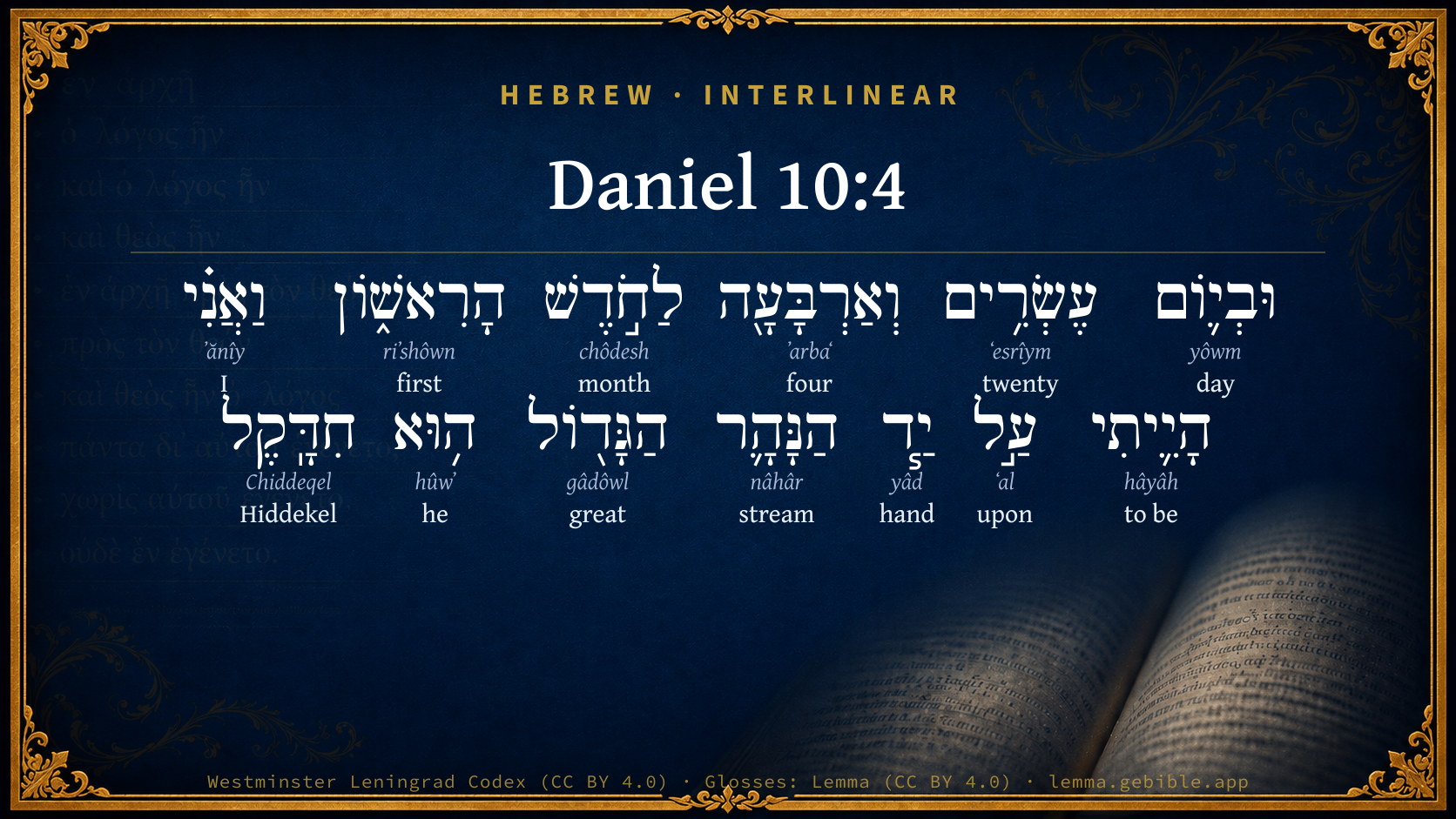
Hebrew (Westminster Leningrad Codex) Daniel 10:4 appears in the Hebrew Old Testament. The text above is from the Westminster Leningrad Codex. Each word links to its Strong’s number, a concise gloss, and parsing drawn from the Open Scriptures Hebrew Bible morphology. Click any word for its full Brown-Driver-Briggs (BDB) entry.
Download image
Cite this verse

Daniel 10:4 (World English Bible). Public Domain. Lemma interlinear Bible study tool, https://lemma.gebible.app/v/daniel/10/4.

Show BibTeX & RIS
BibTeX
RIS
English Translation
In the four and twentieth day of the first month, as I was by the side of the great river, which is Hiddekel,
World English Bible · Public Domain
Download a study sheet

One document with this verse’s original text, its word-by-word gloss line, the meaning frame, cross-references with their text, attributed commentary, and full source and license credits — printable, and it pastes into notes with its structure intact.

This verse Autodidact and up

Study sheet (.html) Plain text (.txt)

A passage Seminary Student

Up to 50 verses in one chapter. A passage sheet keeps up to 6 commentary sources and 12 cross-references per verse, in the order this page ranks them, and says so on the sheet whenever that leaves anything out. Ask for a single verse and you get the Autodidact verse sheet above.

Everything on this page stays free to read, with no account — the sheet is a download of what is already on screen, not access to it.

Want to remove ads? Support Godless Engineer
Compare translations 3

The same verse in 3 English versions, stacked beneath the original-language interlinear above. Click any original word for its lexicon entry.

Each is an independent rendering of the whole verse — the interlinear is not word-aligned to these translations.

Highlighted words mark where these versions differ — a whole-verse word diff, not a word-by-word alignment.

  • World English Bible Public Domain
    In the four and twentieth day of the first month, as I was by the side of the great river, which is Hiddekel,
  • King James Version Public Domain
    And in the four and twentieth day of the first month, as I was by the side of the great river, which is Hiddekel;
  • unfoldingWord Literal Text CC BY-SA 4.0
    On the twenty-fourth day of the first month, as I was on the bank of the great river (that is, the Tigris),

unfoldingWord Literal Text — © unfoldingWord, licensed CC BY-SA 4.0. Word-aligned USFM3 via Door43 (git.door43.org/unfoldingWord/en_ult).

Versions to compare (up to 4)

3 of 4 selected

Show all 18 translations

Every available English version of this verse, each an independent rendering of the whole verse.

  • World English Bible Public Domain
    In the four and twentieth day of the first month, as I was by the side of the great river, which is Hiddekel,
  • Berean Standard Bible Public Domain
    On the twenty-fourth day of the first month, as I was standing on the bank of the great river, the Tigris,
  • Majority Standard Bible Public Domain
    On the twenty-fourth day of the first month, as I was standing on the bank of the great river, the Tigris,
  • King James Version Public Domain
    And in the four and twentieth day of the first month, as I was by the side of the great river, which is Hiddekel;
  • American Standard Version (1901) Public Domain
    And in the four and twentieth day of the first month, as I was by the side of the great river, which is Hiddekel,
  • Revised Version (1885) Public Domain
    And in the four and twentieth day of the first month, as I was by the side of the great river, which is Hiddekel,
  • Geneva Bible (1599) Public Domain
    And in the foure and twentieth day of the first moneth, as I was by the side of that great riuer, euen Hiddekel,
  • Douay-Rheims (1899) Public Domain
    And in the four and twentieth day of the first month I was by the great river which is the Tigris.
  • Young's Literal Translation Public Domain
    `And in the twenty and fourth day of the first month, I have been by the side of the great river, that `is' Hiddekel:
  • Literal Standard Version CC BY-SA 4.0
    And in the twenty-fourth day of the first month, I have been by the side of the great river, that [is] Hiddekel:
  • Unlocked Literal Bible CC BY-SA 4.0
    On the twenty-fourth day of the first month, as I was beside the great river (that is, the Tigris),
  • unfoldingWord Literal Text CC BY-SA 4.0
    On the twenty-fourth day of the first month, as I was on the bank of the great river (that is, the Tigris),
  • Darby Bible Public Domain
    And on the four-and-twentieth day of the first month, I was by the side of the great river, which is Hiddekel:
  • World Messianic Bible Public Domain
    In the twenty-fourth day of the first month, as I was by the side of the great river, which is Hiddekel,
  • Webster's Bible Public Domain
    And in the four and twentieth day of the first month, as I was by the side of the great river, which is Hiddekel;
  • Free Bible Version CC BY-SA 4.0
    On the twenty-fourth day of the first month I was standing on the bank of the great River Tigris.
  • Bible in Basic English Public Domain
    And on the twenty-fourth day of the first month I was by the side of the great river;
  • JPS Tanakh (1917) Public Domain
    And in the four and twentieth day of the first month, as I was by the side of the great river, which is Tigris,

Literal Standard Version (2020), Covenant Press — licensed CC BY-SA 4.0. Text via the HelloAO Bible API (eBible.org). Unlocked Literal Bible (unfoldingWord) — licensed CC BY-SA 4.0. Text via the HelloAO Bible API (eBible.org). unfoldingWord Literal Text — © unfoldingWord, licensed CC BY-SA 4.0. Word-aligned USFM3 via Door43 (git.door43.org/unfoldingWord/en_ult). Free Bible Version, Dr. Jonathan Gallagher — licensed CC BY-SA 4.0. Text via the HelloAO Bible API (eBible.org).

Word by word

More ways to search: Search by grammar → Find every occurrence → Compare this word →

Practice this passage: Drill this verse → Learn its vocabulary →

חִדָּֽקֶל
Chiddeqel
H2313
“Hiddekel”
Noun, Proper
Part of Speech
Noun
Type
Proper
Full BDB Definition

Origin: probably of foreign origin

TWOT: None

Hiddekel = "rapid" - one of the rivers of Eden which coursed east toward Assyria; better known as the Tigris (the LXX equivalent)
  1. וּבְי֛וֹם yôwm H3117 “and · in/at · day of” Conjunction + Preposition + Noun, Common, Masculine, Singular, Construct
  2. עֶשְׂרִ֥ים ʻesrîym H6242 “twenty” Adjective, Cardinal number, Both, Plural, Absolute
  3. וְאַרְבָּעָ֖ה ʼarbaʻ H702 “and · four” Conjunction + Adjective, Cardinal number, Masculine, Singular, Absolute
  4. לַחֹ֣דֶשׁ chôdesh H2320 “to/for the · month” Preposition, Determined + Noun, Common, Masculine, Singular, Absolute
  5. הָרִאשׁ֑וֹן riʼshôwn H7223 “the · first” Particle, Definite Article + Adjective, Ordinal number, Masculine, Singular, Absolute
  6. וַאֲנִ֗י ʼănîy H589 “and · I” Conjunction + Pronoun, Personal, 1st Person, Common, Singular
  7. הָיִ֛יתִי hâyâh H1961 “to be” Verb, Qal, Perfect, 1st Person, Common, Singular
  8. עַ֣ל ʻal H5921 “upon” Preposition
  9. יַ֧ד yâd H3027 “hand of” Noun, Common, Both, Singular, Construct
  10. הַנָּהָ֛ר nâhâr H5104 “the · stream” Particle, Definite Article + Noun, Common, Masculine, Singular, Absolute
  11. הַגָּד֖וֹל gâdôwl H1419 “the · great” Particle, Definite Article + Adjective, Adjective, Masculine, Singular, Absolute
  12. ה֥וּא hûwʼ H1931 “he” Pronoun, Personal, 3rd Person, Masculine, Singular

About this verse

These counts appear in no published source. They are computed here, from the morphology-tagged text and Lemma’s own curated glosses. What Lemma adds →

13
words
13
distinct lemmas
Prophets
section

Notable vocabulary

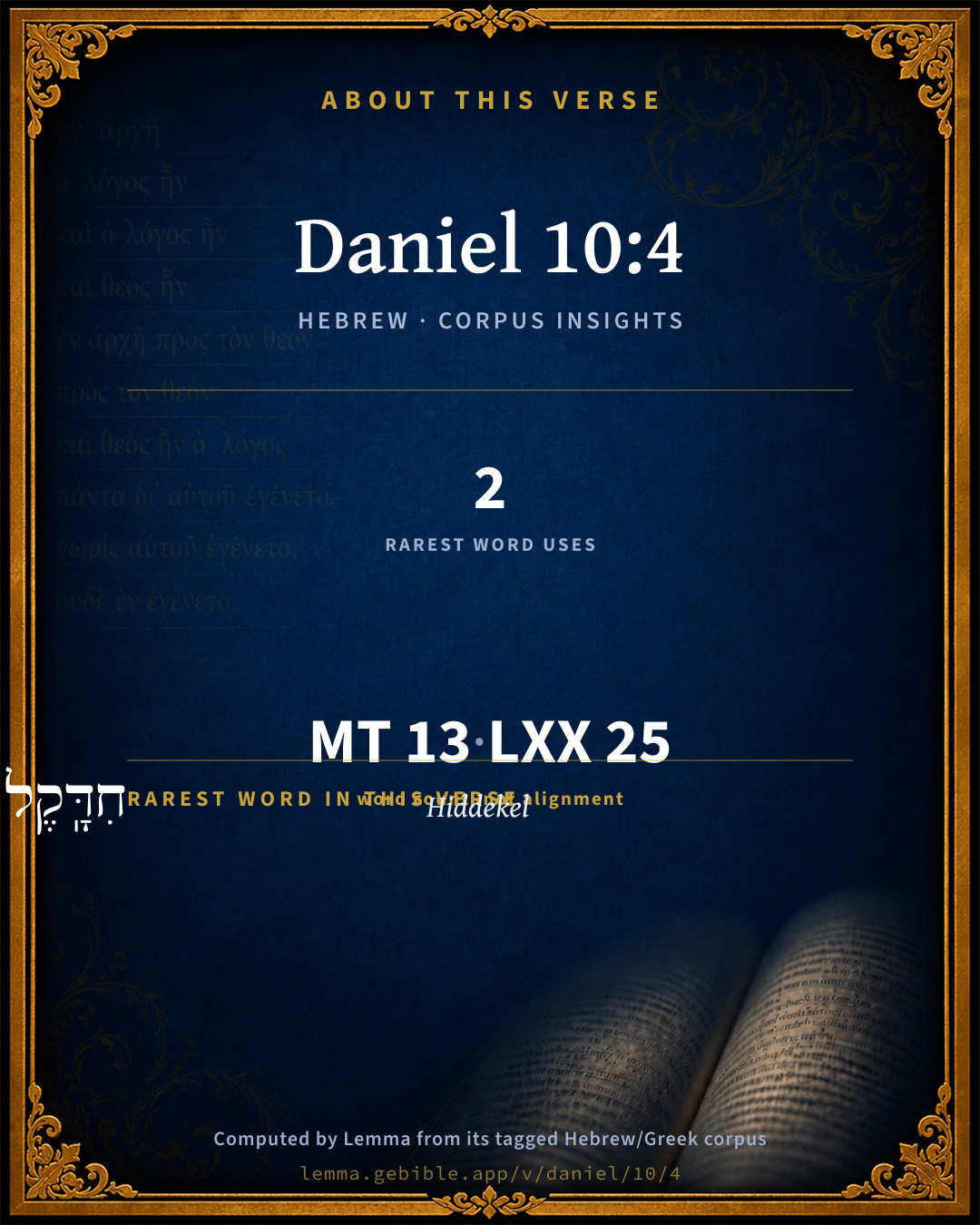
The rarest word here is חִדָּֽקֶל Hiddekel H2313 — appearing just 2 times in the whole Hebrew Bible.

Shared distinctive vocabulary

חִדָּֽקֶל Hiddekel H2313 occurs in 2 verses of the Hebrew Bible. Also found in:

Grammatical profile

  • 1 verb
  • 5 nouns
  • 4 adjectives
  • 2 pronouns
  • 1 preposition

Verb forms

  • הָיִ֛יתִי Qal · Perfect

Hebrew & Septuagint length

In English translation the verse runs 23 words from the Hebrew and 18 from the Septuagint (LXX English) — closely comparable.

A rough comparison of the two English renderings, which tokenize alike — not a word-level alignment.

Word counts can differ between the Hebrew and the Greek without any difference in meaning — e.g. the Hebrew direct-object marker אֵת has no separate Greek word, and Greek often adds the article ὁ.

In the original languages it is 13 Hebrew tokens and 25 Greek tokens — but the two are counted differently (Hebrew bundles its prefixes and suffixes into one token; the Greek is in lemma form), so that isn’t a like-for-like length.

Cross-references

3

Topical passages linked to Daniel 10:4 in the Treasury of Scripture Knowledge — connected by theme and wording, ordered by reader-vote popularity; previews shown in the World English Bible.

  • Genesis 2:14 The name of the third river is Hiddekel: this is the one which flows in front of Assyria. The fourth river is the Euphrates.
  • Ezekiel 1:3 the word of Yahweh came expressly to Ezekiel the priest, the son of Buzi, in the land of the Chaldeans by the river Chebar; and the hand of Yahweh was there on him.
  • Daniel 8:2 I saw in the vision; now it was so, that when I saw, I was in Shushan the palace, which is in the province of Elam; and I saw in the vision, and I was by the river Ulai.

Cross-references courtesy of OpenBible.info (CC BY 4.0).

Hebrew and Greek witnesses Masoretic Hebrew ↔ Greek Septuagint

The same verse in the two great witnesses to the Old Testament, shown verse-for-verse.

These are two independent witnesses, not word-aligned to each other, and the Septuagint is shown in lemma (dictionary) form.

Hebrew Daniel 10:4 Masoretic · Westminster Leningrad Codex

וּבְי֛וֹם עֶשְׂרִ֥ים וְאַרְבָּעָ֖ה לַחֹ֣דֶשׁ הָרִאשׁ֑וֹן וַאֲנִ֗י הָיִ֛יתִי עַ֣ל יַ֧ד הַנָּהָ֛ר הַגָּד֖וֹל ה֥וּא חִדָּֽקֶל

In the four and twentieth day of the first month, as I was by the side of the great river, which is Hiddekel,

World English Bible · Public Domain

Greek LXX Daniel 10:4 Septuagint · lemma form

καί γίγνομαι ὁ ἡμέρα ὁ τέταρτος καί εἰκάς ὁ μήν ὁ πρῶτος καί ἐγώ εἰμί ἐπί ὁ χεῖλος ὁ ποταμός ὁ μέγας ὅς εἰμί τίγρης

On the twenty-fourth day of the first month, I was near the great river, which is Tigris Eddekel.

LXX2012 (modern English Septuagint) · Public Domain

On this verse, The Pulpit Commentary discusses the Septuagint’s reading. Read the note in Commentary ↓

Hebrew: Westminster Leningrad Codex (CC BY 4.0). Greek: Septuagint (public domain); English from LXX2012 (modern English Septuagint) (Public Domain). How the Septuagint differs from the Hebrew →

Commentary

Notes on Daniel 10:4 from classic Christian and Jewish commentators (each source and its license shown beneath its notes). The classic Christian expositions comment on the surrounding passage and are grouped to its opening verse, so a note may address several verses; the Jewish commentaries on the Tanakh (Rashi and others) are per-verse, so they appear only where the commentator wrote on this verse.

Lemma curates 59 commentaries, every one of them public domain or Creative Commons licensed, each selected and text-cleaned for this edition rather than reprinted as found. About our sources →

Trapp's Complete Commentary

John Trapp

Dan 10:4 And in the four and twentieth day of the first month, as I was by the side of the great river, which [is] Hiddekel;

Ver. 4. And on the four and twentieth of the first month.] The day is thus noted, because the matters here revealed were most memorable.

As I was by the side of the great river.] Meditating likely, because the city was full of noise and tumult, and praying. {as Act 16:13} Broughton giveth this reason, because Seleucus Nicator, founder of the Seleucidae, much spoken of in the ensuing vision, built his chief city upon this river.

Which is Hiddekel,] i.e., Sharp swift; called also Tigris, from the swiftest of all beasts, the tiger; but Curtius and Pliny {a} say, that Tigris in the Median language signifieth an arrow. Here Daniel was personally present, and not visionally only. See Dan 10:7.

{a} Plin, lib. vi. cap. 7.

John Trapp, A Commentary or Exposition upon All the Books of the Old and New Testament (1647–1656) — public domain. Text from a community e-Sword module.

Joseph Benson's Commentary

Dan 10:4. In the four and twentieth day of the first month — “Nisan, if the Jewish computation be admitted; that is, the month in which was the paschal solemnity. Hence commentators have observed, from this fact of the prophet, that the Jews did not observe their festivals except in their own country, and in the place which God had appointed; but if the Persian computation should be followed, which seems not improbable, as the prophet dates his vision from the third year of Cyrus the Persian, then the month will be different.” I was by the side — Or, on the bank, of the great river Hiddekel — “Syriac, the Euphrates; but the Vulgate reads, the Tigris; the Greek and Arabic, Tigris-eddekel. It was probably near the junction of the two rivers, which was about Seleucia and Ctesiphon, in some part of Susiana, that the prophet was placed.” — Wintle.

Joseph Benson's Commentary on the Old and New Testaments (1811–1818) — public domain. Text from a community e-Sword module.

Geneva Bible (1599)

Geneva Bible translators

Called Abib, which containeth part of March, and part of April.

Being carried by the Spirit of prophecy to have the sight of this river Tigris.

Geneva Bible (1599) marginal notes — public domain. Text via Bolls.life.

Jamieson, Fausset & Brown

Robert Jamieson, A. R. Fausset & David Brown

first month--Nisan, the month most suited for considering Israel's calamity, being that in which the feast of unleavened bread reminded them of their Egyptian bondage. Daniel mourned not merely for the seven days appointed (Exo 12:18), from the evening of the fourteenth to the twenty-first of Nisan, but thrice seven days, to mark extraordinary sorrow. His mourning ended on the twenty-first day, the closing day of the passover feast; but the vision is not till the twenty-fourth, because of the opposition of "the prince of Persia" (Dan 10:13).

I was by . . . the . . . river--in waking reality, not a trance (Dan 10:7); when younger, he saw the future in images, but now when old, he receives revelations from angels in common language, that is, in the apocalyptic mode. In the patriarchal period God often appeared visibly, that is, theophany. In the prophets, next in the succession, the inward character of revelation is prominent. The consummation is when the seer looks up from earth into the unseen world, and has the future shown to him by angels, that is, apocalypse. So in the New Testament there is a parallel progression: God in the flesh, the spiritual activity of the apostles and the apocalypse [AUBERLEN].

Hiddekel--the Tigris.

Jamieson, Fausset & Brown — Commentary Critical and Explanatory on the Whole Bible (1871) — public domain (CC PDM 1.0). Text via the HelloAO Bible API.

Adam Clarke's Commentary

Verse 4. By the side of - Hiddekel] The same as the Tigris, the great river of Assyria; as the Euphrates of Syria, and the Nile of Egypt.

Adam Clarke's Commentary on the Bible (1810–1826) — public domain. Text from a community e-Sword/MySword module.

John Calvin's Commentaries

Daniel now narrates the acceptance of his prayers, because all angel appeared and instructed him in the future condition of the Church. Without the slightest doubt, the fasting already described was a preparation for prayer, as we have stated before, and as we may gather from many passages of Scripture, especially from the assertion of Christ, where he says, the demon could not be cast out except by prayer and fasting. (Matthew 17:21.) Daniel, therefore, did not abstain from all food, and wine, and luxuries, with the view of rendering any obedience to God, but of testifying his own grief: then he was anxious to rouse himself to prayer, and by that mark of humility, to prepare far better for repentance. He says now — on the twenty-fourth day of the first month — meaning March, the first month of the Jewish year — he stood on the bank of the great river, namely, the Tigris. The word יד, yid, is metaphorically used for the bank, and interpreters are agreed in identifying Hiddekel with the Tigris. Geographers state the name of this river to be in some places, and especially near its fountain, Digliton, which answers to the common Hebrew name Hidekel. Without doubt, this river is called Phison by Moses, since the Tigris has three names among profane nations. Its usual name is Tigris, and in one part of its course it becomes the Hidekel, and has also the names of Pasitigris and Phasis, which is equivalent to Phison. The Prophet relates, his standing on the bank of this great river It is uncertain whether he was then in that part of the world, or whether God set before him the prospect of the river, as we have seen elsewhere. I rather incline to the opinion of his being rapt in the prophetic spirit, and obtaining vision of the river, and not to his being really there. Possibly, that province might have been placed under his government in the course of the great changes which took place in those times. While Belshazzar lived, he could not have been at Susan, and so we were compelled to explain his former language by the prophetic rapture. And as to the present passage, I shall not quarrel with the opinion of any one who supposes Daniel to have dwelt in that district, but, as I have stated before, I think it most probable, that this spectacle was offered to the holy Prophet when far distant from the river’s bank, and only able to behold it in commenced his abstinence from flesh, and food, and all pleasant viands, and then relaxed his fast for three weeks, as he here marks the date on the twenty-fourth day. But I leave this doubtful, through the impossibility of ascertaining the point with certainty. Let us now proceed, —

John Calvin's Commentaries (1540-1563) — public domain. Text from the Calvin Translation Society English edition (1840s-50s) via the Christian Classics Ethereal Library (ccel.org). Calvin's coverage is partial (roughly two-thirds of the Bible); uncommented books and verses are honest gaps, never fabricated. The 19th-century editor's footnotes and remarks are omitted so the notes are faithfully Calvin's own voice.

Ellicott's Commentary for English Readers

(4) The four and twentieth day.—After the end of his three weeks’ fast the prophet was upon the bank of the Tigris, where he saw the following vision. Hiddekel is the Accadian name of the river. (Comp. Gen_2:14.) “Great river” is an epithet usually applied to the river Euphrates, as Gen_15:18. Daniel was here in the body, and not only in the spirit, as Dan_8:2.

A Bible Commentary for English Readers, edited by Charles John Ellicott (1878–1897) — public domain. Text from a community e-Sword module.

The Cambridge Bible for Schools and Colleges

gen. ed. J. J. S. Perowne

4. the first month] Abib (Exo_23:15), or (as it was called by the later Jews) Nisan (Neh_2:1),—the month in which the Passover (on the 14th day) and feast of Unleavened Cakes (15th–21st) were kept (Exo_12:1-20). These sacred seasons thus fell within the period of Daniel’s fast.

the great river] elsewhere the Euphrates (Gen_15:18; Jos_1:4): here, of the Ḥiddeḳel (Gen_2:14), i.e. the Tigris (Ass. Idiglat or Idiḳlat): cf. the Syr. form Deḳlath. (Tigris is probably a Persian modification of the same name, suggested by the Old Pers. tighri, arrow cf. [tighra, pointed, sharp], on account of the swiftness of its stream: see Delitzsch, Paradies, p. 170 ff., who cites Strabo, xi. 14, 8, διὰ τὴν ὀξύτητα, ἀφʼ οὗ καὶ τοὔνομα, Μήδων τίγριν καλούντων τὸ τόξευμα.)

The Cambridge Bible for Schools and Colleges (gen. ed. J. J. S. Perowne; Cambridge University Press, 1878–1918) — public domain. Text from a community e-Sword module.

John Gill's Exposition

And in the four and twentieth day of the first month,.... Of the third year of Cyrus, as Jacchiades; or rather of the Jewish year, the month Ab or Nisan, which answers to part of March and April; so that Daniel's fast began on the third day of the month, and lasted to the twenty fourth, in which time was the Jewish passover; and by this it seems it was not now kept; and perhaps in those times was not used to be observed by the Jews in a foreign land:

as I was by the side of the great river, which is Hiddekel; the same with the Tigris, called by both names from the swiftness and rapidity of its motion, "hiddekel" signifying both sharp and swift; and tigris, in the Persian language, a dart; see Gen 2:14. This is the same river the Targum of Jonathan on Gen 2:14 calls Diglath; and is by Pliny (e) called Diglito, who observes that it has the name of Tigris from its swiftness; so he says the Medes call an arrow; likewise Curtius (f) takes notice of the same, and says that it is named Tigris from the celerity with which it flows; for in the Persian language they call a dart "tigris": so signifies in the Hebrew language "sharp" or "polished", as an arrow is; and "swift", as an arrow flies, and both make Hiddekel: now this river was near Shushan, where Daniel resided; nay, Benjamin of Tudela (g) says, that the river Hiddekel divides the city of Shushan, over which is a bridge, on one side of which Jews dwelt, at the time he was there; unless he means that it cuts and divides the province of Elam in Persia, he had before been speaking of; and so Diodorus Siculus (h) says, that both Euphrates and Tigris pass through Media into Mesopotamia; wherefore it is no wonder to hear of Daniel by the side of the river Hiddekel or Tigris: here Daniel was, not in vision, but in person, having others with him, as appears from a following verse; by it he was walking, contemplating, praying, or conversing.

(e) Nat. Hist. l. 6. c. 27. (f) Hist. l. 4. c. 9. (g) Itinerarium, p. 86. (h) Bibliothec. l. 2. p. 99.

John Gill's Exposition of the Whole Bible (1746–1763) — public domain (CC PDM 1.0). Text via the HelloAO Bible API.

Albert Barnes' Notes on the Bible

And in the four and twentieth day of the first month - At the close of his season of fasting. Though he had not set apart this season of fasting with any view or expectation that it would be followed by such a result, yet there was a propriety that an occasion like this should be selected as that on which the communication which follows should be made to his mind, for

(a) his mind was in a prepared state by this extraordinary season of devotion for such a communication; and

(b) his attention during that period had been turned toward the condition of his people, and it was a fit opportunity to impart to him these extraordinary views of what would occur to them in future days.

It may be added, that we shall be more likely to receive Divine communications to our souls at the close of seasons of sincere and prolonged devotion than at other times, and that, though we may set apart such seasons for different purposes, the Spirit of God may take occasion from them to impart to us clear and elevated views of Divine truth, and of the Divine government. A man is in a better state to obtain such views, and is more likely to obtain them, in such circumstances than he is in others, and he who desires to understand God and his ways should wait upon him with intense and prolonged devotion. The “time” here specified is the “first month” - the month Nisan, answering to a part of our month April. This was the month in which the Passover was celebrated, and was a time, therefore, which a Jew would be likely to select as a season of extraordinary devotion. It was, for some reason, very common for the prophets to record “the very day” on which the visions which they saw appeared to them, or on which Divine communications were made to them. This was often of importance, because it served to determine the time when a prophecy was fulfilled.

I was by the side of the great river, which is Hiddekel - That is, the Tigris. The Syriac renders it the Euphrates. The name in the Scriptures, however, denotes the Tigris. Why Daniel was there he does not say. He was often away from Babylon (compare the notes at Dan 8:2), and he may have been now among some of his people who resided near the Tigris. Possibly he may at that time have ceased to reside at the court in Babylon, and have taken up his residence in some place on the Tigris. See the notes at Dan 10:1.

Albert Barnes' Notes on the Bible (1834–1885) — public domain. Text from a community e-Sword/MySword module.

Matthew Poole's English Annotations

The first month; it was the month Nisan, which is March. This

Hiddekel was Tigris, which is a great branch of Euphrates: the prophets had many of their visions by rivers.

Matthew Poole's English Annotations on the Holy Bible (1683–1685) — public domain. Text from a community e-Sword/MySword module.

The Pulpit Commentary

And in the four and twentieth day of the first month, as I was by the side of the great river, which is Hiddekel. The LXX differs from this only in rendering Hiddekel by its Greek name "Tigris." Theodotion subjoins to Tigris Eddekel, on the same principle that we have on the margin of our Bibles different renderings from those in the text. The Peshitta makes the river the Euphrates. The Vulgate follows the Septuagint. There seems no reasonable doubt that Behrmann is right in regarding the Phrat of the Syriac as a gloss. It certainly was a natural suggestion, that, as Babylon was on the Euphrates, Daniel should rather be found walking there at the termination of his fast, than forty or fifty miles off. The four and twentieth day of the first month; that is, the month Nisan or Abib the month in which the Passover was celebrated in every Jewish home. It would seem that Daniel did not join in this festival at this time. It is noted that, from the days of Saul, the two first days of every month were devoted to a feast, and hence, that Daniel"s fast could only begin on the third day. Since-he mast have refrained from partaking of the Paschal lamb, we cannot deduce that he might not occupy the opening days of the month with sadness rather than feasting. If Daniel is an ideal figure, intended to represent the model Jew resident in a foreign land, why is he thus represented as not partaking of the Paschal feast? It is true that, with the temple in ruins, the Paschal lamb could not be slain in the way enjoined in the Law; but the modern Jew keeps the Passover without the lamb. I was by the side of the great river, which is Hiddekel. The name is a transference of the Assyrian name Iddiklat. It would seem that Daniel was then on the banks of the Tigris, not in vision, but in actual person, as here there is no reference, as in Dan_8:2, to his being there in vision; the mention of attendants also renders it unlikely that it was only in vision that Daniel was on the banks of the Tigris. His purpose in being there was probably governmental, as he had attendants with him.

The Pulpit Commentary (1880–1919), ed. H.D.M. Spence-Jones & Joseph S. Exell — public domain. Text from a community e-Sword module.

John Wesley's Explanatory Notes

The first month - Nisan, which is March. Hiddekel - Or Tigris.

John Wesley, Explanatory Notes Upon the Whole Bible (1754–1765) — public domain. Text via the GEBible commentary corpus.

Keil & Delitzsch

C. F. Keil & F. Delitzsch

The Theophany. - On the day named Daniel found himself on the side (banks) of the river Hiddekel, i.e., the Tigris (see under Gen 2:14), along with some who accompanied him (Dan 10:7); thus he was there in reality, and not merely in vision as at the Ulai, Dan 8:2. For what purpose he was there is not said. Here he saw a celestial being, whose form is described, Dan 10:5, Dan 10:6. It was a man (אחד, one, not several) clothed in בּדּים, i.e., in a talar of shining white linen (regarding בּדּים, see under Eze 9:2), and his loins girt about with gold of Uphaz. אוּפז occurs nowhere else, except in Jer 10:9 : gold of Uphaz and silver of Tarshish, from which we must conclude that Uphaz is the name of a region, a country, probably only a dialectically different form for אופיר; the combination with the Sanscr. vipa - Hyphasis is, on the other hand, very far-fetched.

Keil & Delitzsch — Biblical Commentary on the Old Testament (1861–1891) — public domain (CC PDM 1.0). Text via the HelloAO Bible API. (Old Testament only.)

Scofield Reference Notes

C. I. Scofield

first month i.e. April.

The Scofield Reference Bible (1917 edition), notes by C. I. Scofield — public domain. Text from a community e-Sword module.

unfoldingWord translationNotes

Door43 World Missions Community

On the twenty-fourth day of the first month

This is the first month of the Hebrew calendar. The twenty-fourth day is near the middle of April on Western calendars. (See: Hebrew Months and Ordinal Numbers)

with a belt around his waist

"and he was wearing a belt"

Uphaz

Uphaz is a place. Its location is not known (See: How to Translate Names)

His body was like topaz

His body gleamed with blue or yellow light as if it were made of topaz. AT: "his body gleamed like topaz" (See: Simile)

topaz

a blue or yellow gemstone, also known as beryl, peridot, or chrysolite

his face was like lightning

His face shone brightly as a bolt of lightning shines. AT: "his face shone with light as bright as the flash of lightning" (See: Simile)

His eyes were like flaming torches

His eyes were bright with light as if they were flaming torches. AT: "his eyes were so bright that it seemed they had torches burning inside them" (See: Simile)

his arms and his feet were like polished bronze

His arms and feet were as shiny as if they were made of polished bronze. AT: "his arms and feet shone like polished bronze that reflects the light around it" (See: Simile)

The sound of his words was like the sound of a great crowd

His voice was so loud that it was as if a crowd of people were all talking loudly. AT: "his voice was as loud as a huge crowd all calling out together" (See: Simile)

translationWords

day

gold

bronze

word

unfoldingWord translationNotes — © Distant Shores Media and the Door43 World Missions Community, licensed CC BY-SA 4.0. Source: git.door43.org/Door43/en_tn.

Lesson kit

Teaching starters — assembled from the data on this page, not authored interpretation. Every prompt links to the verse data it draws on. Edit before teaching.

Daniel, in the Prophets, opens this verse with 13 words (13 distinct Hebrew lemmas). Its most distinctive word is Chiddeqel (“Hiddekel”). A historical commentator’s framing appears above. Read the whole chapter for the surrounding context.

Discussion questions

  1. How does “Hiddekel” (Chiddeqel) shape what this verse is saying?
  2. Genesis 2:14 shares the word «Hiddekel» with this verse. How do the two illuminate each other?
  3. These translations render this verse differently. What is at stake in choosing one wording over another?
  4. The verb «הָיִ֛יתִי» is Qal Perfect. How does its form color the action?
  5. Reading how Trapp's Complete Commentary and Joseph Benson's Commentary read this verse, where do the two commentators agree and where do they part?

Things to notice

Reading settings

Reading text

Shown beneath each verse's original-language words.

Old Testament
Old Testament edition

Read the OT as the Masoretic Hebrew (MT) or the Greek Septuagint (LXX).

English shown for the Greek Septuagint (in the Hebrew ↔ Greek comparison).

Comparing translations? Open the Compare panel on any verse page to stack up to four side by side.