Leviticus 19:31

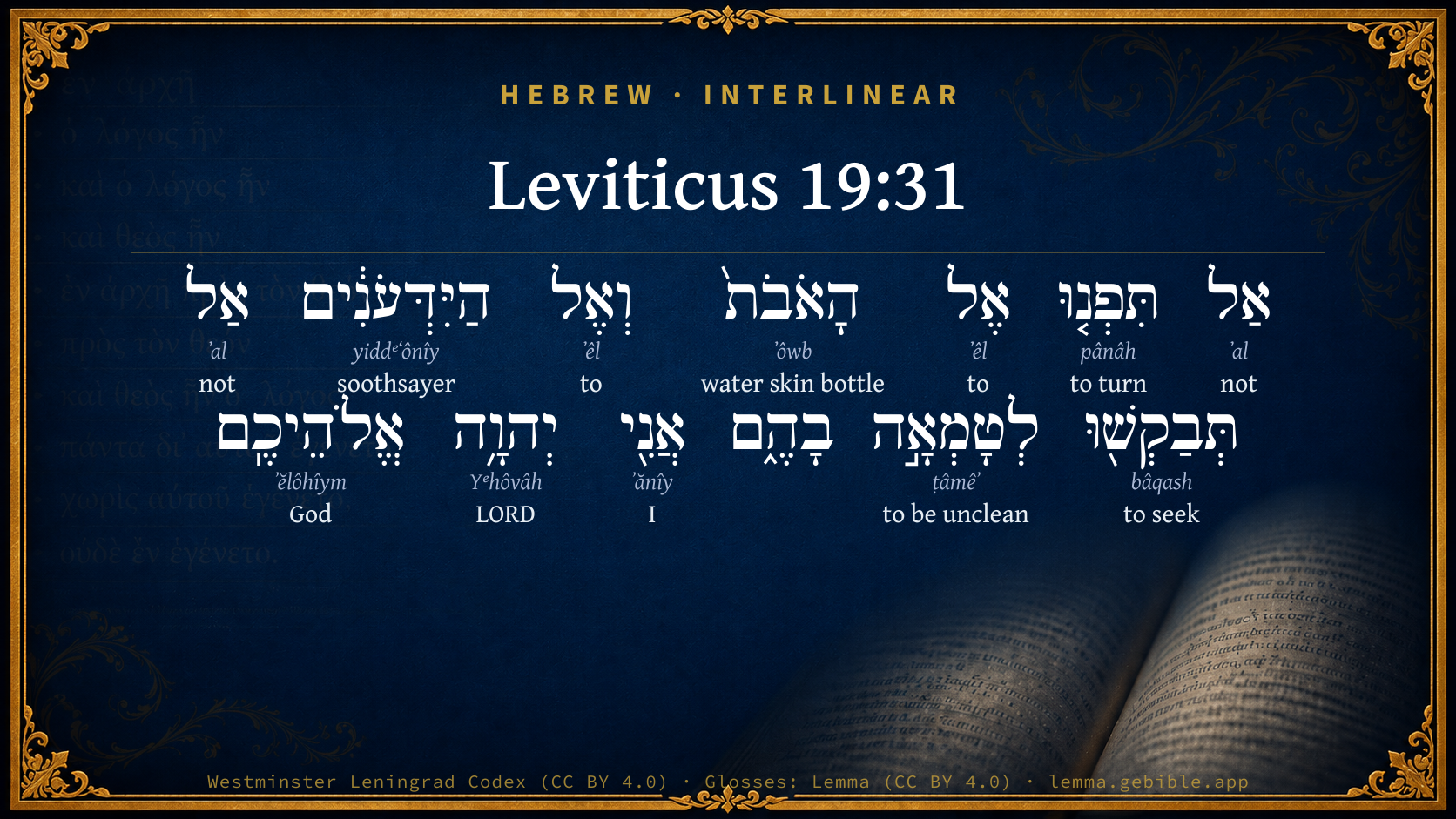
Hebrew (Westminster Leningrad Codex) Leviticus 19:31 appears in the Hebrew Old Testament. The text above is from the Westminster Leningrad Codex. Each word links to its Strong’s number, a concise gloss, and parsing drawn from the Open Scriptures Hebrew Bible morphology. Click any word for its full Brown-Driver-Briggs (BDB) entry.
Download image
Cite this verse

Leviticus 19:31 (World English Bible). Public Domain. Lemma interlinear Bible study tool, https://lemma.gebible.app/v/leviticus/19/31.

Show BibTeX & RIS
BibTeX
RIS
English Translation
"'Don't turn to those who are mediums, nor to the wizards. Don't seek them out, to be defiled by them. I am Yahweh your God.
World English Bible · Public Domain
Highlights
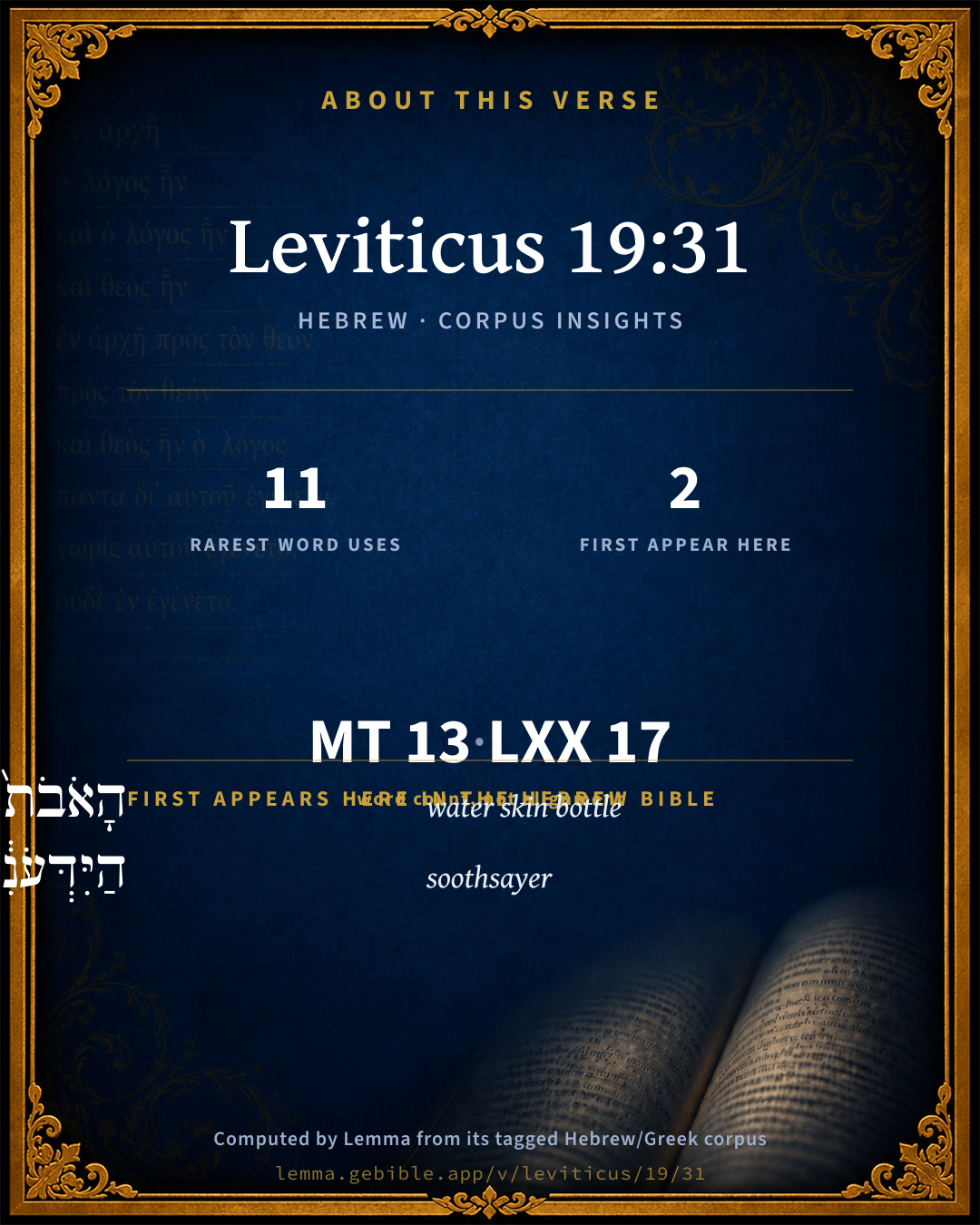
  • 2 first appearances in the Hebrew Bible
Full analysis ↓
Download a study sheet

One document with this verse’s original text, its word-by-word gloss line, the meaning frame, cross-references with their text, attributed commentary, and full source and license credits — printable, and it pastes into notes with its structure intact.

This verse Autodidact and up

Study sheet (.html) Plain text (.txt)

A passage Seminary Student

Up to 50 verses in one chapter. A passage sheet keeps up to 6 commentary sources and 12 cross-references per verse, in the order this page ranks them, and says so on the sheet whenever that leaves anything out. Ask for a single verse and you get the Autodidact verse sheet above.

Everything on this page stays free to read, with no account — the sheet is a download of what is already on screen, not access to it.

Want to remove ads? Support Godless Engineer
Compare translations 3

The same verse in 3 English versions, stacked beneath the original-language interlinear above. Click any original word for its lexicon entry.

Each is an independent rendering of the whole verse — the interlinear is not word-aligned to these translations.

Highlighted words mark where these versions differ — a whole-verse word diff, not a word-by-word alignment.

  • World English Bible Public Domain
    "'Don't turn to those who are mediums, nor to the wizards. Don't seek them out, to be defiled by them. I am Yahweh your God.
  • King James Version Public Domain
    Regard not them that have familiar spirits, neither seek after wizards, to be defiled by them: I am the LORD your God.
  • unfoldingWord Literal Text CC BY-SA 4.0
    You shall not turn to the mediums, and to the spiritists, you shall not seek to become unclean by them. I Yahweh your God.

unfoldingWord Literal Text — © unfoldingWord, licensed CC BY-SA 4.0. Word-aligned USFM3 via Door43 (git.door43.org/unfoldingWord/en_ult).

Versions to compare (up to 4)

3 of 4 selected

Show all 18 translations

Every available English version of this verse, each an independent rendering of the whole verse.

  • World English Bible Public Domain
    "'Don't turn to those who are mediums, nor to the wizards. Don't seek them out, to be defiled by them. I am Yahweh your God.
  • Berean Standard Bible Public Domain
    You must not turn to mediums or spiritists; do not seek them out, or you will be defiled by them. I am the LORD your God.
  • Majority Standard Bible Public Domain
    You must not turn to mediums or spiritists; do not seek them out, or you will be defiled by them. I am the LORD your God.
  • King James Version Public Domain
    Regard not them that have familiar spirits, neither seek after wizards, to be defiled by them: I am the LORD your God.
  • American Standard Version (1901) Public Domain
    Turn ye not unto them that have familiar spirits, nor unto the wizards; seek them not out, to be defiled by them: I am Jehovah your God.
  • Revised Version (1885) Public Domain
    Turn ye not unto them that have familiar spirits, nor unto the wizards; seek them not out, to be defiled by them: I am the LORD your God.
  • Geneva Bible (1599) Public Domain
    Ye shall not regarde them that worke with spirites, neither soothsayers: ye shall not seeke to them to be defiled by them: I am the Lord your God.
  • Douay-Rheims (1899) Public Domain
    Go not aside after wizards, neither ask any thing of soothsayers, to be defiled by them: I am the Lord your God.
  • Young's Literal Translation Public Domain
    `Ye do not turn unto those having familiar spirits; and unto wizards ye do not seek, for uncleanness by them; I `am' Jehovah your God.
  • Literal Standard Version CC BY-SA 4.0
    You do not turn to those having familiar spirits, and you do not seek for wizards, to become unclean by them; I [am] your God YHWH.
  • Unlocked Literal Bible CC BY-SA 4.0
    Do not turn to those who talk with the dead or with spirits. Do not seek them out, or they will defile you. I am Yahweh your God.
  • unfoldingWord Literal Text CC BY-SA 4.0
    You shall not turn to the mediums, and to the spiritists, you shall not seek to become unclean by them. I Yahweh your God.
  • Darby Bible Public Domain
    -- Turn not unto necromancers and unto soothsayers; seek not after them to make yourselves unclean: I am Jehovah your God.
  • World Messianic Bible Public Domain
    “‘Don’t turn to those who are mediums, nor to the wizards. Don’t seek them out, to be defiled by them. I am the LORD your God.
  • Webster's Bible Public Domain
    Regard not them that have familiar spirits, neither seek after wizards, to be defiled by them: I am the LORD your God.
  • Free Bible Version CC BY-SA 4.0
    Don't try and find help from mediums or spiritists—don't even go looking for them, otherwise they will corrupt you. I am the Lord your God.
  • Bible in Basic English Public Domain
    Do not go after those who make use of spirits, or wonder-workers; do not go in their ways or become unclean through them: I am the Lord your God.
  • JPS Tanakh (1917) Public Domain
    Turn ye not unto the ghosts, nor unto familiar spirits; seek them not out, to be defiled by them: I am the LORD your God.

Literal Standard Version (2020), Covenant Press — licensed CC BY-SA 4.0. Text via the HelloAO Bible API (eBible.org). Unlocked Literal Bible (unfoldingWord) — licensed CC BY-SA 4.0. Text via the HelloAO Bible API (eBible.org). unfoldingWord Literal Text — © unfoldingWord, licensed CC BY-SA 4.0. Word-aligned USFM3 via Door43 (git.door43.org/unfoldingWord/en_ult). Free Bible Version, Dr. Jonathan Gallagher — licensed CC BY-SA 4.0. Text via the HelloAO Bible API (eBible.org).

Word by word

More ways to search: Search by grammar → Find every occurrence → Compare this word →

Practice this passage: Drill this verse → Learn its vocabulary →

הַיִּדְּעֹנִ֔ים
yiddᵉʻônîy
H3049
“the · soothsayers”
Particle, Definite Article + Noun, Common, Masculine, Plural, Absolute
Part of Speech
Particle + Noun
Type
Common
Gender
Masculine
Number
Plural
State
Absolute
Full BDB Definition

Origin: from H3045

TWOT: 848d

a knower, one who has a familiar spirit - a familiar spirit, soothsayer, necromancer (metonymy)
  1. אַל ʼal H408 “not” Particle, Negative
  2. תִּפְנ֤וּ pânâh H6437 “to turn” Verb, Qal, Jussive, 2nd Person, Masculine, Plural
  3. אֶל ʼêl H413 “to” Preposition
  4. הָאֹבֹת֙ ʼôwb H178 “the · water skin bottles” Particle, Definite Article + Noun, Common, Masculine, Plural, Absolute
  5. וְאֶל ʼêl H413 “and · to” Conjunction + Preposition
  6. אַל ʼal H408 “not” Particle, Negative
  7. תְּבַקְשׁ֖וּ bâqash H1245 “to seek” Verb, Piel, Jussive, 2nd Person, Masculine, Plural
  8. לְטָמְאָ֣ה ṭâmêʼ H2930 “to be unclean” Preposition + Verb, Qal, Infinitive Construct
  9. אֲנִ֖י ʼănîy H589 “I” Pronoun, Personal, 1st Person, Common, Singular
  10. יְהוָ֥ה Yᵉhôvâh H3068 “LORD” Noun, Proper
  11. אֱלֹהֵיכֶֽם ʼĕlôhîym H430 “God(s) · your” Noun, Common, Masculine, Plural, Construct + Suffix, Personal, 2nd Person, Masculine, Plural

About this verse

These counts appear in no published source. They are computed here, from the morphology-tagged text and Lemma’s own curated glosses. What Lemma adds →

13
words
10
distinct lemmas
Pentateuch
section

Notable vocabulary

The rarest word here is הַיִּדְּעֹנִ֔ים soothsayer H3049 — appearing just 11 times in the whole Hebrew Bible.

First appearance in Scripture

These words make their first canonical appearance in the Hebrew Bible here:

  • הָאֹבֹת֙ water skin bottle H178
  • הַיִּדְּעֹנִ֔ים soothsayer H3049

Shared distinctive vocabulary

הַיִּדְּעֹנִ֔ים soothsayer H3049 occurs in 11 verses of the Hebrew Bible. Also found in:

Grammatical profile

  • 3 verbs
  • 4 nouns
  • 1 pronoun
  • 3 prepositions
  • 2 particles

Verb forms

  • תִּפְנ֤וּ Qal · Jussive
  • תְּבַקְשׁ֖וּ Piel · Jussive
  • לְטָמְאָ֣ה Qal · Infinitive Construct

Repetition

Words recur within this verse — often emphatic in Hebrew:

  • אַל not H408 ×2
  • אֶל to H413 ×2

Hebrew & Septuagint length

In English translation the verse runs 25 words from the Hebrew and 28 from the Septuagint (LXX English) — closely comparable.

A rough comparison of the two English renderings, which tokenize alike — not a word-level alignment.

Word counts can differ between the Hebrew and the Greek without any difference in meaning — e.g. the Hebrew direct-object marker אֵת has no separate Greek word, and Greek often adds the article ὁ.

In the original languages it is 13 Hebrew tokens and 17 Greek tokens — but the two are counted differently (Hebrew bundles its prefixes and suffixes into one token; the Greek is in lemma form), so that isn’t a like-for-like length.

Cross-references

20

Topical passages linked to Leviticus 19:31 in the Treasury of Scripture Knowledge — connected by theme and wording, ordered by reader-vote popularity; previews shown in the World English Bible.

  • Isaiah 8:19 When they shall tell you, "Consult with those who have familiar spirits and with the wizards, who chirp and who mutter:" shouldn't a people consult with their God? on behalf of the living [should they consult] with the dead?
  • Leviticus 20:27 "'A man or a woman that is a medium, or is a wizard, shall surely be put to death: they shall stone them with stones; their blood shall be upon them.'"
  • Leviticus 20:6–7 "'The person that turns to those who are mediums, and to the wizards, to play the prostitute after them, I will even set my face against that person, and will cut him off from among his people.
  • 2 Chronicles 33:6 He also made his children to pass through the fire in the valley of the son of Hinnom; and he practiced sorcery, and used enchantments, and practiced sorcery, and dealt with those who had familiar spirits, and with wizards: he worked much evil in the sight of Yahweh, to provoke him to anger.
  • Deuteronomy 18:10–14 There shall not be found with you anyone who makes his son or his daughter to pass through the fire, one who uses divination, one who practices sorcery, or an enchanter, or a sorcerer,
  • 2 Kings 21:6 He made his son to pass through the fire, and practiced sorcery, and used enchantments, and dealt with those who had familiar spirits, and with wizards: he worked much evil in the sight of Yahweh, to provoke him to anger.
  • 1 Chronicles 10:13 So Saul died for his trespass which he committed against Yahweh, because of the word of Yahweh, which he didn't keep; and also because he asked counsel of one who had a familiar spirit, to inquire [thereby],
  • 1 Samuel 28:3 Now Samuel was dead, and all Israel had lamented him, and buried him in Ramah, even in his own city. Saul had put away those who had familiar spirits, and the wizards, out of the land.
  • Revelation 21:8 But for the cowardly, unbelieving, sinners, abominable, murderers, sexually immoral, sorcerers, idolaters, and all liars, their part is in the lake that burns with fire and sulfur, which is the second death."
  • Exodus 22:18 "You shall not allow a sorceress to live.
  • Isaiah 29:4 You shall be brought down, and shall speak out of the ground, and your speech shall be low out of the dust; and your voice shall be as of one who has a familiar spirit, out of the ground, and your speech shall whisper out of the dust.
  • Isaiah 47:13 You are wearied in the multitude of your counsels: let now the astrologers, the star-gazers, the monthly prognosticators, stand up, and save you from the things that shall come on you.
  • 2 Kings 17:17 They caused their sons and their daughters to pass through the fire, and used divination and enchantments, and sold themselves to do that which was evil in the sight of Yahweh, to provoke him to anger.
  • Acts 16:16–18 It happened, as we were going to prayer, that a certain girl having a spirit of divination met us, who brought her masters much gain by fortune telling.
  • Acts 19:19–20 Many of those who practiced magical arts brought their books together and burned them in the sight of all. They counted the price of them, and found it to be fifty thousand pieces of silver.
  • Galatians 5:20 idolatry, sorcery, hatred, strife, jealousies, outbursts of anger, rivalries, divisions, heresies,
  • Leviticus 19:26 "'You shall not eat any meat with the blood still in it; neither shall you use enchantments, nor practice sorcery.
  • 1 Samuel 28:7–9 Then said Saul to his servants, Seek me a woman who has a familiar spirit, that I may go to her, and inquire of her. His servants said to him, Behold, there is a woman who has a familiar spirit at En-dor.
  • Acts 8:11 They listened to him, because for a long time he had amazed them with his sorceries.
  • Acts 13:6–8 When they had gone through the island to Paphos, they found a certain sorcerer, a false prophet, a Jew, whose name was Bar Jesus,

Cross-references courtesy of OpenBible.info (CC BY 4.0).

Hebrew and Greek witnesses Masoretic Hebrew ↔ Greek Septuagint

The same verse in the two great witnesses to the Old Testament, shown verse-for-verse.

These are two independent witnesses, not word-aligned to each other, and the Septuagint is shown in lemma (dictionary) form.

Hebrew Leviticus 19:31 Masoretic · Westminster Leningrad Codex

אַל תִּפְנ֤וּ אֶל הָאֹבֹת֙ וְאֶל הַיִּדְּעֹנִ֔ים אַל תְּבַקְשׁ֖וּ לְטָמְאָ֣ה בָהֶ֑ם אֲנִ֖י יְהוָ֥ה אֱלֹהֵיכֶֽם

"'Don't turn to those who are mediums, nor to the wizards. Don't seek them out, to be defiled by them. I am Yahweh your God.

World English Bible · Public Domain

Greek LXX Leviticus 19:31 Septuagint · lemma form

οὐ ἐπιἀκολουθέω ἐγγαστρίμυθος καί ὁ ἐπαοιδός οὐ προςκολλάω ἐκμιαίνω ἐν αὐτός ἐγώ εἰμί κύριος ὁ θεός σύ

You⌃ shall not attend to those who have in them divining spirits, nor attach yourselves to enchanters, to pollute yourselves with them: I am the Lord your God.

LXX2012 (modern English Septuagint) · Public Domain

On this verse, The Cambridge Bible for Schools and Colleges discusses the Septuagint’s reading. Read the note in Commentary ↓

Hebrew: Westminster Leningrad Codex (CC BY 4.0). Greek: Septuagint (public domain); English from LXX2012 (modern English Septuagint) (Public Domain). How the Septuagint differs from the Hebrew →

Targum (Aramaic paraphrase)

2

The Targum is the ancient Jewish Aramaic paraphrase of the Hebrew Scriptures — an interpretive translation, not the Hebrew text itself. Onkelos (literal) and Pseudo-Jonathan (expansive) render the Torah, and Jonathan the Prophets. Coverage is partial: where no permissively-licensed English translation exists for a verse, only the Aramaic is shown. This is verse-level text, not a word-by-word alignment to the Hebrew.

  1. Targum Onkelos Torah (Genesis–Deuteronomy)
    לָא תִתְפְּנוּן בָּתַר בִּדִין וּדְכוּרוּ לָא תִתְבְּעוּן לְאִסְתָּאָבָא בְהוֹן אֲנָא יְיָ אֱלָהָכוֹן

    (no public-domain English translation for this verse)

    Targum Onkelos — Aramaic: “Onkelos Genesis” (public domain); “Onkelos Exodus” (public domain); “Onkelos Leviticus” (public domain); “Onkelos Numbers” (public domain); “Onkelos Deuteronomy” (public domain). English: “Sefaria Community Translation” (CC0 1.0 (public-domain dedication)); “J.W. Etheridge. The Targums of Onkelos and Jonathan Ben Uzziel on the Pentateuch. London: Longmans, Green, 1862” (public domain). Text via Sefaria.

  2. Targum Pseudo-Jonathan Torah (Genesis–Deuteronomy)
    לָא תִסְטוּן בָּתַר שַׁאֲלֵי בִּידִין וּמַסִיק זְכוּרוּ וְתַבְעֵי גְרַם יָדוֹעַ וְלָא תִיתְבְּעוּן לְאִיסְתַּאֲבָא בְהוֹן אֲנָא יְיָ אֳלָהָכוֹן

    Go not astray after those who inquire of impostors, or bring up the dead, or interrogate the bone of Jeddua: neither be ye inquirers with them, to pollute yourselves thereby I am the Lord your God.

    Targum Pseudo-Jonathan — Aramaic: “Targum Jonathan on Genesis” (public domain); “Targum Jonathan on Exodus” (public domain); “Targum Jonathan on Leviticus” (public domain); “Targum Jonathan on Numbers” (public domain); “Targum Jonathan on Deuteronomy” (public domain). English: “The Targum of Jonathan ben Uzziel, trans. J. W. Etheridge, London, 1862” (public domain). Text via Sefaria.

Commentary

Notes on Leviticus 19:31 from classic Christian and Jewish commentators (each source and its license shown beneath its notes). The classic Christian expositions comment on the surrounding passage and are grouped to its opening verse, so a note may address several verses; the Jewish commentaries on the Tanakh (Rashi and others) are per-verse, so they appear only where the commentator wrote on this verse.

Lemma curates 59 commentaries, every one of them public domain or Creative Commons licensed, each selected and text-cleaned for this edition rather than reprinted as found. About our sources →

Trapp's Complete Commentary

John Trapp

Lev 19:31 Regard not them that have familiar spirits, neither seek after wizards, to be defiled by them: I [am] the LORD your God.

Ver. 31. I am the Lord your God.] What need you then run to the devil for direction? Is it because there is no God in Israel? Every one that consults with Satan, worships him, though he bow not: neither doth that evil spirit desire any other reverence than to be sought unto.

John Trapp, A Commentary or Exposition upon All the Books of the Old and New Testament (1647–1656) — public domain. Text from a community e-Sword module.

The Biblical Illustrator

Joseph S. Exell

Lev_19:31

Them that have familiar spirits.

Prohibition of traffic with familiar spirits

This verse prohibits all inquiring of them that have familiar spirits, and of wizards, who pretend to make relevations through the help of supernatural powers. According to 1Sa_28:7-11, and Isa_8:19, the familiar spirit is a supposed spirit of a dead man, from whom one professes to be able to give communications to the living. This pretended commerce with the spirits of the dead has been common enough in heathenism always, and it is not strange to find it mentioned here, when Israel was to be in so intimate relations with heathen peoples. But it is truly must extraordinary that in Christian lands, as especially in the United States of America, and that in the full light, religious and intellectual, of the last half of the nineteenth century, such a prohibition should be fully as pertinent as in Israe! For no words could more precisely describe the pretensions of the so-called modern spiritualism, which within the last half century has led away hum]reds of thousands of deluded souls, and those, in many cases, not from the ignorant and degraded, but from circles which boast of more than average culture and intellectual enlightenment. And inasmuch as experience sadly shows that even those who profess to be disciples of Christ are in danger of being led away by our modern wizards and traffickers with familiar spirits, it is by no means unnecessary to observe that there is not the slightest reason to believe that this which was rigidly forbidden by God in the fifteenth century B.C., can now be well-pleasing to Him in the nineteenth century A.D. And those who have most carefully watched the moral developments of this latter-day delusion will most appreciate the added phrase which speaks of this as defiling a man. (S. H. Kellogg, D. D.)

The Biblical Illustrator, edited by Joseph S. Exell (c. 1880s–1900s) — public domain. Text from a community e-Sword module.

Joseph Benson's Commentary

Lev 19:31. Wizards — Them that have entered into covenant with the devil, by whose help they foretel many things to come, and acquaint men with secret things; see Lev 20:27; Deu 18:11; 1Sa 28:3; 1Sa 28:7; 1Sa 28:9; 2Ki 21:6.

Joseph Benson's Commentary on the Old and New Testaments (1811–1818) — public domain. Text from a community e-Sword module.

Tyndale Open Study Notes

Tyndale Open Resources

19:31 mediums: Cp. 1 Sam 28:7-25. • The Hebrew term for consult the spirits (yidde‘oni) is derived from a root meaning “to know.” It describes those who claim to have special occult knowledge and use it to communicate with the dead.

Tyndale Open Study Notes — © Tyndale Open Resources, licensed CC BY-SA 4.0. Text via the HelloAO Bible API.

Jamieson, Fausset & Brown

Robert Jamieson, A. R. Fausset & David Brown

Regard not them that have familiar spirits--The Hebrew word, rendered "familiar spirit," signifies the belly, and sometimes a leathern bottle, from its similarity to the belly. It was applied in the sense of this passage to ventriloquists, who pretended to have communication with the invisible world. The Hebrews were strictly forbidden to consult them as the vain but high pretensions of those impostors were derogatory to the honor of God and subversive of their covenant relations with Him as His people.

neither seek after wizards--fortunetellers, who pretended, as the Hebrew word indicates, to prognosticate by palmistry (or an inspection of the lines of the hand) the future fate of those who applied to them.

Jamieson, Fausset & Brown — Commentary Critical and Explanatory on the Whole Bible (1871) — public domain (CC PDM 1.0). Text via the HelloAO Bible API.

Adam Clarke's Commentary

Verse 31. Regard not them that have familiar spirits] The Hebrew word oboth probably signifies a kind of engastromuthoi or ventriloquists, or such as the Pythoness mentioned Lev 16:16; Lev 16:18; persons who, while under the influence of their demon, became greatly inflated, as the Hebrew word implies, and gave answers in a sort of phrensy. See a case of this kind in Virgil, AEneid, l. vi., ver. 46, c.: -

"----Deus ecce, Deus! cui talla fanti

Ante fores, subito non vultus, non color unus,

Non comptae mansere comae sed pectus anhelum,

Et rabie fera corda tument; majorque videri,

Nec mortale sonans, afflata est numine quando

Jam propiore Dei."

-------------------Invoke the skies,

I feel the god, the rushing god, she cries.

While yet she spoke, enlarged her features grew,

Her colour changed, her locks dishevelled flew.

The heavenly tumult reigns in every part,

Pants in her breast, and swells her rising heart:

Still swelling to the sight, the priestess glowed,

And heaved impatient of the incumbent god.

PITT.

Neither seek after wizards] ידענים yiddeonim, the wise or knowing ones, from ידע yada, to know or understand; called wizard in Scotland, wise or cunning man in England; and hence also the wise woman, the white witch. Not only all real dealers with familiar spirits, or necromantic or magical superstitions, are here forbidden, but also all pretenders to the knowledge of futurity, fortune-tellers, astrologers, &c., &c. To attempt to know what God has not thought proper to reveal, is a sin against his wisdom, providence, and goodness. In mercy, great mercy, God has hidden the knowledge of futurity from man, and given him hope - the expectation of future good, in its place. See Clarke on Ex 22:18.

Adam Clarke's Commentary on the Bible (1810–1826) — public domain. Text from a community e-Sword/MySword module.

Ellicott's Commentary for English Readers

(31) Regard not.—Better, Turn ye not unto, as the Authorised Version renders this very phrase in Lev_19:4.

Them that have familiar spirits.—This phrase represents the single word oboth in the original, and the translators of our Authorised Version by adopting it implied that those who practised this craft were supposed to be attended by an invisible spirit who was subject to their call to supply them with supernatural information. According to the authorities during the second Temple it denotes one who has a spirit speaking from under his arm-holes, or chest, with a hollow voice, as if it came out of a bottle, which is the meaning of ob in Job_32:19. They identified it with the spirit of Python, by which the ancient Chaldee Version renders it.

Neither seek after wizards.—The expression “wizard,” which in old English denotes “wise man,” “sage,” is almost the exact equivalent of the word in the original. These cunning men pretended to tell people their fortunes, where their lost property was to be found, &c. According to ancient tradition, these wizards took in their mouth a bone of a certain bird called yaduâ, burned incense, thus producing fumes which sent them off into an ecstacy, and then foretold future events. Hence their name, yidonee, as it is in the original. It occurs eleven times in the Bible, and always together with the word translated “familiar spirit.”

A Bible Commentary for English Readers, edited by Charles John Ellicott (1878–1897) — public domain. Text from a community e-Sword module.

The Cambridge Bible for Schools and Colleges

gen. ed. J. J. S. Perowne

31. familiar spirits … wizards] Cp. ch. Lev_20:6; Lev_20:27. For the difference between the two see Driver on Deu_18:11. The former expression (’ôb) may be rendered ghost. Its oracles were uttered in a twittering voice, which, through ventriloquism, appeared to rise from the ground. Accordingly the LXX. mostly renders the word by ἐγγαστρίμυθοι, ventriloquists. See the narrative of the witch of Endor (1 Samuel 28). The latter of the two appellations, lit. knowing (but Rob.-Sm. Journal of Philology, xiii. 273 ff.; xiv. 113 ff., prefers acquaintance), may fitly be rendered familiar spirit. The distinction between the two modes of divination will then be that ‘those who divine by the former profess (1Sa_28:11) to call up any ghost; those who divine by the latter consult only the particular spirit which is their familiar’ (Driver as above).

The Cambridge Bible for Schools and Colleges (gen. ed. J. J. S. Perowne; Cambridge University Press, 1878–1918) — public domain. Text from a community e-Sword module.

John Gill's Exposition

Regard not them that have familiar spirits,.... The word used signifies "bottles", and that sort of diviners here intended go by this name, either because what they sat on when they divined was in the form of a bottle, or they divined by one, or they were swelled and inflated as bottles when they delivered out their answers, or spoke as out of a bottle or hollow place; hence they are called masters or mistresses of the bottle: they seem to be the same with the ventriloquists, and so the Septuagint version here calls them; such whose voice seemed to come out of their bellies, and even the lower parts of them; and such was the Pythian prophetess at Delphos, and very probably the maid in the times of the apostles, who had a spirit of divination, or of Python, Act 16:16; and so the words may be rendered here, "look not to the Python" (n), or those who have the spirit of Python; so Jarchi from the Misnah (o) interprets the word here used, "Baal Ob" or the master of the bottle, this is Python, one that speaks from under his arm holes:

neither seek after wizards; such as pretend to a great deal of knowledge, as the word signifies; such as are called cunning men, who pretend to know where lost or stolen goods are, and to tell people their fortunes, and what will befall them hereafter:

to be defiled by them; for by seeking to them, and believing what is said by them, and trusting thereunto, and expecting events answerable to their predictions, they would be guilty of a gross sin, and so bring pollution and guilt on them; according to the Jewish canons (p), such sort of persons as are cautioned against were to be stoned, and they that consulted them to be reproved:

I am the Lord your God; who only is to be regarded and sought unto for advice and assistance; see Isa 8:19.

(n) "ne respiciatis ad Pythonas", Montanus; so Junius & Tremellius, Piscator. (o) Misn. Sanhedrin, c. 7. sect. 7. (p) lbid.

John Gill's Exposition of the Whole Bible (1746–1763) — public domain (CC PDM 1.0). Text via the HelloAO Bible API.

Albert Barnes' Notes on the Bible

The devotion of faith, which would manifest itself in obedience to the commandment to keep God’s Sabbaths and to reverence His sanctuary Lev 19:30, is the true preservative against the superstition which is forbidden in this verse. The people whose God was Yahweh were not to indulge those wayward feelings of their human nature which are gratified in magical arts and pretensions. Compare Isa 8:19.

Familiar spirits - literally, “bottles”. This application of the word is supposed to have been suggested by the tricks of ventriloquists, within whose bodies (as vessels or bottles) it was fancied that spirits used to speak. In other cases, the word is used for the familiar spirit which a man pretended to employ in order to consult, or to raise, the spirits of the dead. See 1Sa 28:7-8.

Wizard - A word equivalent to “a knowing man”, or, “a cunning man”.

Albert Barnes' Notes on the Bible (1834–1885) — public domain. Text from a community e-Sword/MySword module.

Haydock's Catholic Bible Commentary

Wizards. Hebrew oboth, denotes familiar spirits, (1 Kings viii.[xxviii.?] 7,) which gave answers from the belly or breast, as from a bottle; whence such wizards are called by the Greeks, engastrimuthoi; and by Sophocles, sternomanteis. (Calmet) --- Soothsayers, are properly those who will judge what will happen by inspecting victims. (Menochius) --- Hebrew yiddehonim, means connoisseurs, intelligent people, gnostics, or those who pretend that they can penetrate the secrets naturally impenetrable to the mind of man. Septuagint epaoidoi, "enchanters," who undertake to keep off all misfortunes. "Surely, (says Pliny, xxx. 1,) to learn this art, (of magic) Pythagoras....and Plato undertook long voyages by sea, or rather went into banishment. This they extolled at their return; this they kept as a secret. Hanc in arcanis habuere."

George Leo Haydock (1774–1849), Haydock's Catholic Family Bible and Commentary, 1859 edition — public domain. Excludes Psalms (Douay-Rheims chapter numbering differs from Protestant) and Deuterocanonical books (Catholic canon only).

Matthew Poole's English Annotations

Them that have familiar spirits; that have entered into covenant with the devil, by whose help they foretell many things to come, and acquaint men with secret things. See Lev 20:27; Deu 18:11; 1Sa 28:3,7,9; 2Ki 21:6.

Wizards; another name expressing the same thing for substance, to wit, persons in league with the devil, with some difference only in the manner of their operation,

Matthew Poole's English Annotations on the Holy Bible (1683–1685) — public domain. Text from a community e-Sword/MySword module.

Whedon's Commentary on the Bible

Daniel D. Whedon

31. Familiar spirits — The Hebrew oboth signifies skins used for bottles, Job_32:19. Its secondary meaning is the hollow belly of conjurers, supposed to be inflated by the spirit. Hence the obh properly denotes, not the conjurer himself but the spirit which is conjured by him, and is supposed to speak in him. See the Seventy, who render it by εγγαστριμυθοι, ventriloquists. The “familiar” is not in the Hebrew; it comes from the idea that the necromancers, soothsayers, and the like had spirits or demons whom they could summon from the unseen world to wait upon them as famuli, servants, and execute their commands. The ventriloquists “peeped and muttered,” (Isa_8:19; Isa_29:4,) to imitate the voice of the revealing “familiar.” All the descriptions of the ancient necromancy are strikingly like the practices of modern spirit-circles. The sin in such consultations of the dead is the implied abandonment of God and his word as man’s only and sufficient light on all questions respecting the future state, and the resort to unauthorized sources of revelation, whose utterances are repugnant to the Holy Scriptures, and frequently grossly immoral.

Wizards — Wizard is derived from wise and the old English termination ard — a wise man, hence a magician or sorcerer. The Hebrew and Greek terms have the same meaning, indicating those that could by any means reveal the future. The rabbins derive the Hebrew word from a certain man-shaped beast, the bones of which the diviner held in his teeth. The Greek wizard ate certain portions of beasts supposed to be endowed with the faculty of divination. “Admitting that the terms ‘witchcraft,’ ‘wizard,’ and the like were used in their modern signification, as implying the possession of supernatural or magical powers by compact with evil spirits, it would follow, upon theocratic principles, that he who so much as pretends to exercise this power, seducing the people from their allegiance to God, would be worthy of death.” The law, like that on the statute books of England against the pretence to witchcraft among the negroes of Jamaica, does not assume the real existence of any such Satanic power attainable by men, but it pronounces its penalty against him or her who assumes to exercise this nefarious art. But Sir Walter Scott observes: “The sorcery or witchcraft of the Old Testament resolves itself into a trafficking with idols and asking counsel of false deities; or, in other words, into idolatry.” R.S. Poole regards it as a distinctive characteristic of the Bible that from first to last it warrants no trust in or dread of charms and incantations as capable of producing evil consequences when used against a man. In the Psalms, the most personal of all the books of Scripture, there is no prayer to be protected against magical influences, though every other kind of evil to body or soul is mentioned. These facts prove that the modern notion of witchcraft was a superstition entirely unknown to the early Hebrews.

Daniel D. Whedon (gen. ed.), Commentary on the Old and New Testaments (1874–1909) — public domain. Text from a community e-Sword module.

The Pulpit Commentary

This verse contains a prohibition of all dealings with those that have familiar spirits or are wizards. The punishment of such persons is appointed in the next chapter. Both in the Old and the New Testament, the real existence of evil spirits and their power of communicating with the human spirit is assumed.

The Pulpit Commentary (1880–1919), ed. H.D.M. Spence-Jones & Joseph S. Exell — public domain. Text from a community e-Sword module.

John Wesley's Explanatory Notes

Wizards - Them that have entered into covenant with the devil, by whose help they foretel many things to come, and acquaint men with secret things. See ver. 27 Deut. xviii, 11; 1 Sam. xxviii, 3, 7, 9; 2 Kings xxi, 6.

John Wesley, Explanatory Notes Upon the Whole Bible (1754–1765) — public domain. Text via the GEBible commentary corpus.

unfoldingWord translationNotes

Door43 World Missions Community

the dead or with spirits

Possible meanings are 1) that "the dead" and "spirits" are two different things or 2) that this is a doublet that means "the spirits of dead people." (See: Doublet)

Do not seek them out, or they will defile you

"Do not seek those people out. If you do, they will defile you"

translationWords

turn

die

defile

Yahweh

God

unfoldingWord translationNotes — © Distant Shores Media and the Door43 World Missions Community, licensed CC BY-SA 4.0. Source: git.door43.org/Door43/en_tn.

Rashi

Rabbi Shlomo Yitzchaki (Rashi)

אל תפנו DO NOT TURN [TO THE אבת NOR TO THE ידענים] — This is a warning addressed to the necromancers and the charmers themselves (not to the people who consult these tricksters). The בעל אוב, the controller of the spirit אוב, as the necromancer is called (cf. I Samuel 28:7), is identical with the פיתום (in Greek: πύξωυ); he is one who speaks out of his arm-pit; ידעני is one who puts a bone of an animal the name of which is ידוע into his mouth and the bone speaks (Sanhedrin 65b).

אל תבקשו means DO NOT SEEK to busy yourselves with them, for if you busy yourselves with them, you will become defiled in My sight and I shall abhor you.

אני ה' אלהיכם I AM THE LORD YOUR GOD — Just think Whom you are changing (by these practices which lead to idolatry) for whom! (Sifra, Kedoshim, Chapter 7 11)

Rashi on the Tanakh — English translations: “The Judaica Press complete Tanach with Rashi, translated by A. J. Rosenberg” (CC BY 4.0); “Pentateuch with Rashi's commentary by M. Rosenbaum and A.M. Silbermann, 1929-1934” (public domain); “The Metsudah Tanach series, Lakewood, N.J” (CC BY 4.0); and “The Book of Joshua, Metsudah Publications, 1997” (CC BY 4.0). Text via Sefaria.

Lesson kit

Teaching starters — assembled from the data on this page, not authored interpretation. Every prompt links to the verse data it draws on. Edit before teaching.

Leviticus, in the Pentateuch, opens this verse with 13 words (10 distinct Hebrew lemmas). Its most distinctive word is yiddᵉʻônîy (“soothsayer”). A historical commentator’s framing appears above. Read the whole chapter for the surrounding context.

Discussion questions

  1. What does “soothsayer” (yiddᵉʻônîy) contribute to the verse as a whole?
  2. 2 words here appear for the first time in Scripture. What is being introduced at this debut?
  3. Leviticus 20:6 shares the word «soothsayer» with this verse. How do the two illuminate each other?
  4. “not” occurs 2× in this one verse. What is the effect of the repetition?
  5. These translations render this verse differently. What is at stake in choosing one wording over another?
  6. The verb «תִּפְנ֤וּ» is Qal Jussive. How does its form color the action?
  7. Reading how Trapp's Complete Commentary and The Biblical Illustrator read this verse, where do the two commentators agree and where do they part?

Things to notice

Reading settings

Reading text

Shown beneath each verse's original-language words.

Old Testament
Old Testament edition

Read the OT as the Masoretic Hebrew (MT) or the Greek Septuagint (LXX).

English shown for the Greek Septuagint (in the Hebrew ↔ Greek comparison).

Comparing translations? Open the Compare panel on any verse page to stack up to four side by side.