
Leviticus 19:10

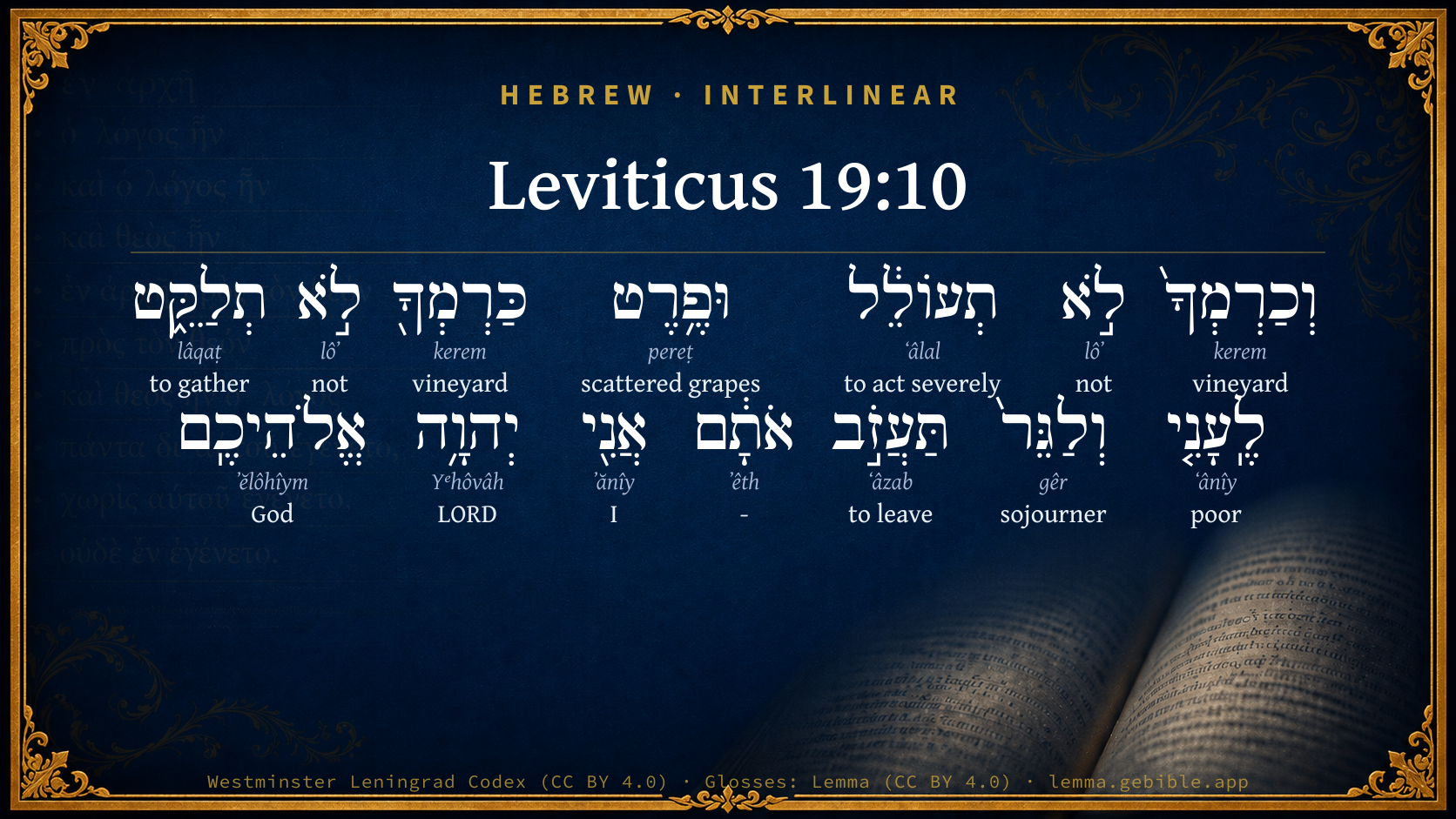
Hebrew (Westminster Leningrad Codex) Leviticus 19:10 appears in the Hebrew Old Testament. The text above is from the Westminster Leningrad Codex. Each word links to its Strong’s number, a concise gloss, and parsing drawn from the Open Scriptures Hebrew Bible morphology. Click any word for its full Brown-Driver-Briggs (BDB) entry.
Download image
Cite this verse

Leviticus 19:10 (World English Bible). Public Domain. Lemma interlinear Bible study tool, https://lemma.gebible.app/v/leviticus/19/10.

Show BibTeX & RIS
BibTeX
RIS
English Translation
You shall not glean your vineyard, neither shall you gather the fallen grapes of your vineyard; you shall leave them for the poor and for the foreigner. I am Yahweh your God.
World English Bible · Public Domain
Highlights
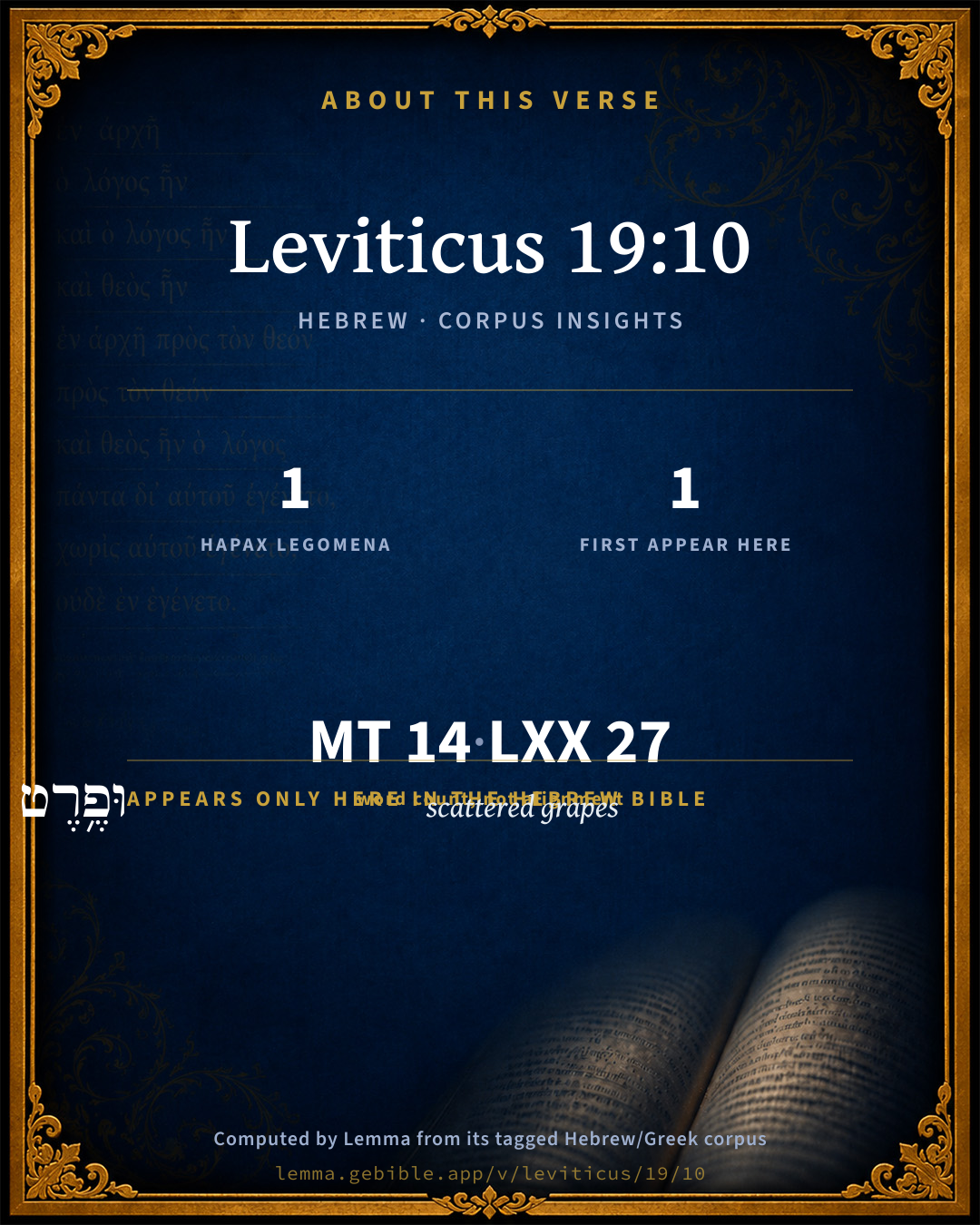
  • 1 hapax legomenon — only here in the Hebrew Bible
  • 1 first appearance in the Hebrew Bible
Full analysis ↓
Download a study sheet

One document with this verse’s original text, its word-by-word gloss line, the meaning frame, cross-references with their text, attributed commentary, and full source and license credits — printable, and it pastes into notes with its structure intact.

This verse Autodidact and up

Study sheet (.html) Plain text (.txt)

A passage Seminary Student

Up to 50 verses in one chapter. A passage sheet keeps up to 6 commentary sources and 12 cross-references per verse, in the order this page ranks them, and says so on the sheet whenever that leaves anything out. Ask for a single verse and you get the Autodidact verse sheet above.

Everything on this page stays free to read, with no account — the sheet is a download of what is already on screen, not access to it.

Want to remove ads? Support Godless Engineer
Compare translations 3

The same verse in 3 English versions, stacked beneath the original-language interlinear above. Click any original word for its lexicon entry.

Each is an independent rendering of the whole verse — the interlinear is not word-aligned to these translations.

Highlighted words mark where these versions differ — a whole-verse word diff, not a word-by-word alignment.

  • World English Bible Public Domain
    You shall not glean your vineyard, neither shall you gather the fallen grapes of your vineyard; you shall leave them for the poor and for the foreigner. I am Yahweh your God.
  • King James Version Public Domain
    And thou shalt not glean thy vineyard, neither shalt thou gather every grape of thy vineyard; thou shalt leave them for the poor and stranger: I am the LORD your God.
  • unfoldingWord Literal Text CC BY-SA 4.0
    And your vineyard you shall not strip, and the grapes of your vineyard you shall not glean. For the poor and for the sojourner you shall leave them. I Yahweh your God.

unfoldingWord Literal Text — © unfoldingWord, licensed CC BY-SA 4.0. Word-aligned USFM3 via Door43 (git.door43.org/unfoldingWord/en_ult).

Versions to compare (up to 4)

3 of 4 selected

Show all 18 translations

Every available English version of this verse, each an independent rendering of the whole verse.

  • World English Bible Public Domain
    You shall not glean your vineyard, neither shall you gather the fallen grapes of your vineyard; you shall leave them for the poor and for the foreigner. I am Yahweh your God.
  • Berean Standard Bible Public Domain
    You must not strip your vineyard bare or gather its fallen grapes. Leave them for the poor and the foreigner. I am the LORD your God.
  • Majority Standard Bible Public Domain
    You must not strip your vineyard bare or gather its fallen grapes. Leave them for the poor and the foreigner. I am the LORD your God.
  • King James Version Public Domain
    And thou shalt not glean thy vineyard, neither shalt thou gather every grape of thy vineyard; thou shalt leave them for the poor and stranger: I am the LORD your God.
  • American Standard Version (1901) Public Domain
    And thou shalt not glean thy vineyard, neither shalt thou gather the fallen fruit of thy vineyard; thou shalt leave them for the poor and for the sojourner: I am Jehovah your God.
  • Revised Version (1885) Public Domain
    And thou shalt not glean thy vineyard, neither shalt thou gather the fallen fruit of thy vineyard; thou shalt leave them for the poor and for the stranger: I am the LORD your God.
  • Geneva Bible (1599) Public Domain
    Thou shalt not gather the grapes of thy vineyarde cleane, neyther gather euery grape of thy vineyarde, but thou shalt leaue them for the poore and for the straunger: I am the Lord your God.
  • Douay-Rheims (1899) Public Domain
    Neither shalt thou gather the bunches and grapes that fall down in thy vineyard, but shalt leave them to the poor and the strangers to take. I am the Lord your God.
  • Young's Literal Translation Public Domain
    and thy vineyard thou dost not glean, even the omitted part of thy vineyard thou dost not gather, to the poor and to the sojourner thou dost leave them; I `am' Jehovah your God.
  • Literal Standard Version CC BY-SA 4.0
    and you do not glean your vineyard, even the omitted part of your vineyard you do not gather, you leave them for the poor and for the sojourner; I [am] your God YHWH.
  • Unlocked Literal Bible CC BY-SA 4.0
    You must not gather every grape from your vineyard, nor gather the grapes that have fallen on the ground in your vineyard. You must leave them for the poor and for the foreigner. I am Yahweh your God.
  • unfoldingWord Literal Text CC BY-SA 4.0
    And your vineyard you shall not strip, and the grapes of your vineyard you shall not glean. For the poor and for the sojourner you shall leave them. I Yahweh your God.
  • Darby Bible Public Domain
    And thy vineyard shalt thou not glean, neither shalt thou gather what hath been left of thy vineyard; thou shalt leave them for the poor and the stranger: I am Jehovah your God.
  • World Messianic Bible Public Domain
    You shall not glean your vineyard, neither shall you gather the fallen grapes of your vineyard. You shall leave them for the poor and for the foreigner. I am the LORD your God.
  • Webster's Bible Public Domain
    And thou shalt not glean thy vineyard, neither shalt thou gather every grape of thy vineyard; thou shalt leave them for the poor and stranger: I am the LORD your God.
  • Free Bible Version CC BY-SA 4.0
    Don't take every last grape from your vineyard or pick up the ones that have fallen. Leave them for the poor people and foreigners. I am the Lord your God.
  • Bible in Basic English Public Domain
    And do not take all the grapes from your vine-garden, or the fruit dropped on the earth; let the poor man, and the man from another country, have these: I am the Lord your God.
  • JPS Tanakh (1917) Public Domain
    And thou shalt not glean thy vineyard, neither shalt thou gather the fallen fruit of thy vineyard; thou shalt leave them for the poor and for the stranger: I am the LORD your God.

Literal Standard Version (2020), Covenant Press — licensed CC BY-SA 4.0. Text via the HelloAO Bible API (eBible.org). Unlocked Literal Bible (unfoldingWord) — licensed CC BY-SA 4.0. Text via the HelloAO Bible API (eBible.org). unfoldingWord Literal Text — © unfoldingWord, licensed CC BY-SA 4.0. Word-aligned USFM3 via Door43 (git.door43.org/unfoldingWord/en_ult). Free Bible Version, Dr. Jonathan Gallagher — licensed CC BY-SA 4.0. Text via the HelloAO Bible API (eBible.org).

Word by word

More ways to search: Search by grammar → Find every occurrence → Compare this word →

Practice this passage: Drill this verse → Learn its vocabulary →

וּפֶ֥רֶט
pereṭ
H6528
“and · scattered grapes of”
Conjunction + Noun, Common, Masculine, Singular, Construct
Part of Speech
Conjunction + Noun
Type
Common
Gender
Masculine
Number
Singular
State
Construct
Full BDB Definition

Origin: from H6527

TWOT: 1816a

the broken off, something scattered - fallen grapes
  1. וְכַרְמְךָ֙ kerem H3754 “and · vineyard · your” Conjunction + Noun, Common, Both, Singular, Construct + Suffix, Personal, 2nd Person, Masculine, Singular
  2. לֹ֣א lôʼ H3808 “not” Particle, Negative
  3. תְעוֹלֵ֔ל ʻâlal H5953 “to act severely” Verb, Poel, Imperfect, 2nd Person, Masculine, Singular
  4. כַּרְמְךָ֖ kerem H3754 “vineyard · your” Noun, Common, Both, Singular, Construct + Suffix, Personal, 2nd Person, Masculine, Singular
  5. לֹ֣א lôʼ H3808 “not” Particle, Negative
  6. תְלַקֵּ֑ט lâqaṭ H3950 “to gather” Verb, Piel, Imperfect, 2nd Person, Masculine, Singular
  7. לֶֽעָנִ֤י ʻânîy H6041 “to/for the · poor” Preposition, Determined + Adjective, Adjective, Masculine, Singular, Absolute
  8. וְלַגֵּר֙ gêr H1616 “and · to/for the · sojourner” Conjunction + Preposition, Determined + Noun, Common, Masculine, Singular, Absolute
  9. תַּעֲזֹ֣ב ʻâzab H5800 “to leave” Verb, Qal, Imperfect, 2nd Person, Masculine, Singular
  10. אֹתָ֔ם ʼêth H853 “- · them” Particle, Direct Object + Suffix, Personal, 3rd Person, Masculine, Plural
  11. אֲנִ֖י ʼănîy H589 “I” Pronoun, Personal, 1st Person, Common, Singular
  12. יְהוָ֥ה Yᵉhôvâh H3068 “LORD” Noun, Proper
  13. אֱלֹהֵיכֶֽם ʼĕlôhîym H430 “God(s) · your” Noun, Common, Masculine, Plural, Construct + Suffix, Personal, 2nd Person, Masculine, Plural

About this verse

These counts appear in no published source. They are computed here, from the morphology-tagged text and Lemma’s own curated glosses. What Lemma adds →

14
words
12
distinct lemmas
Pentateuch
section

Notable vocabulary

1 hapax legomenon — a word that appears only here in the entire Hebrew Bible:

  • וּפֶ֥רֶט scattered grapes H6528

First appearance in Scripture

This word makes its first canonical appearance in the Hebrew Bible here:

  • וּפֶ֥רֶט scattered grapes H6528

Shared distinctive vocabulary

תְעוֹלֵ֔ל to act severely H5953 occurs in 18 verses of the Hebrew Bible. Also found in:

Grammatical profile

  • 3 verbs
  • 6 nouns
  • 1 adjective
  • 1 pronoun
  • 3 particles

Verb forms

  • תְעוֹלֵ֔ל Poel · Imperfect
  • תְלַקֵּ֑ט Piel · Imperfect
  • תַּעֲזֹ֣ב Qal · Imperfect

Repetition

Words recur within this verse — often emphatic in Hebrew:

  • וְכַרְמְךָ֙ vineyard H3754 ×2
  • לֹ֣א not H3808 ×2

Hebrew & Septuagint length

In English translation the verse runs 32 words from the Hebrew and 37 from the Septuagint (LXX English) — closely comparable.

A rough comparison of the two English renderings, which tokenize alike — not a word-level alignment.

Word counts can differ between the Hebrew and the Greek without any difference in meaning — e.g. the Hebrew direct-object marker אֵת has no separate Greek word, and Greek often adds the article ὁ.

In the original languages it is 14 Hebrew tokens and 27 Greek tokens — but the two are counted differently (Hebrew bundles its prefixes and suffixes into one token; the Greek is in lemma form), so that isn’t a like-for-like length.

Cross-references

7

Topical passages linked to Leviticus 19:10 in the Treasury of Scripture Knowledge — connected by theme and wording, ordered by reader-vote popularity; previews shown in the World English Bible.

  • Leviticus 25:6 The Sabbath of the land shall be for food for you; for yourself, for your servant, for your maid, for your hired servant, and for your stranger, who lives as a foreigner with you.
  • Isaiah 17:6 Yet there shall be left therein gleanings, as the shaking of an olive tree, two or three berries in the top of the uppermost bough, four or five in the outmost branches of a fruitful tree, says Yahweh, the God of Israel.
  • Isaiah 24:13 For thus shall it be in the midst of the earth among the peoples, as the shaking of an olive tree, as the gleanings when the vintage is done.
  • Judges 8:2 He said to them, What have I now done in comparison with you? Isn't the gleaning of the grapes of Ephraim better than the vintage of Abiezer?
  • Jeremiah 49:9 If grape-gatherers came to you, would they not leave some gleaning grapes? if thieves by night, wouldn't they destroy until they had enough?
  • Obadiah 1:5 If thieves came to you, if robbers by night-- oh, what disaster awaits you--wouldn't they only steal until they had enough? If grape pickers came to you, wouldn't they leave some gleaning grapes?
  • Micah 7:1 Misery is mine! Indeed, I am like one who gathers the summer fruits, as gleanings of the vinyard: There is no cluster of grapes to eat. My soul desires to eat the early fig.

Cross-references courtesy of OpenBible.info (CC BY 4.0).

Hebrew and Greek witnesses Masoretic Hebrew ↔ Greek Septuagint

The same verse in the two great witnesses to the Old Testament, shown verse-for-verse.

These are two independent witnesses, not word-aligned to each other, and the Septuagint is shown in lemma (dictionary) form.

Hebrew Leviticus 19:10 Masoretic · Westminster Leningrad Codex

וְכַרְמְךָ֙ לֹ֣א תְעוֹלֵ֔ל וּפֶ֥רֶט כַּרְמְךָ֖ לֹ֣א תְלַקֵּ֑ט לֶֽעָנִ֤י וְלַגֵּר֙ תַּעֲזֹ֣ב אֹתָ֔ם אֲנִ֖י יְהוָ֥ה אֱלֹהֵיכֶֽם

You shall not glean your vineyard, neither shall you gather the fallen grapes of your vineyard; you shall leave them for the poor and for the foreigner. I am Yahweh your God.

World English Bible · Public Domain

Greek LXX Leviticus 19:10 Septuagint · lemma form

καί ὁ ἀμπελών σύ οὐ ἐπι ἀνατρυγάω οὐδέ ὁ ῥώξ ὁ ἀμπελών σύ συνλέγω ὁ πτωχός καί ὁ προσήλυτος καταλείπω αὐτός ἐγώ εἰμί κύριος ὁ θεός σύ

And you shall not go over the gathering of your vineyard, neither shall you gather the remaining grapes of your vineyard: you shall leave them for the poor and the stranger: I am the Lord your God.

LXX2012 (modern English Septuagint) · Public Domain

On this verse, Haydock's Catholic Bible Commentary discusses the Septuagint’s reading. Read the note in Commentary ↓

Hebrew: Westminster Leningrad Codex (CC BY 4.0). Greek: Septuagint (public domain); English from LXX2012 (modern English Septuagint) (Public Domain). How the Septuagint differs from the Hebrew →

Targum (Aramaic paraphrase)

2

The Targum is the ancient Jewish Aramaic paraphrase of the Hebrew Scriptures — an interpretive translation, not the Hebrew text itself. Onkelos (literal) and Pseudo-Jonathan (expansive) render the Torah, and Jonathan the Prophets. Coverage is partial: where no permissively-licensed English translation exists for a verse, only the Aramaic is shown. This is verse-level text, not a word-by-word alignment to the Hebrew.

  1. Targum Onkelos Torah (Genesis–Deuteronomy)
    וְכַרְמָךְ לָא תְעַלֵל וְנִתְרָא דְכַרְמָךְ לָא תְלַקֵט לְעַנְיֵי וּלְגִיוֹרֵי תִּשְׁבּוֹק יָתְהוֹן אֲנָא יְיָ אֱלָהָכוֹן

    (no public-domain English translation for this verse)

    Targum Onkelos — Aramaic: “Onkelos Genesis” (public domain); “Onkelos Exodus” (public domain); “Onkelos Leviticus” (public domain); “Onkelos Numbers” (public domain); “Onkelos Deuteronomy” (public domain). English: “Sefaria Community Translation” (CC0 1.0 (public-domain dedication)); “J.W. Etheridge. The Targums of Onkelos and Jonathan Ben Uzziel on the Pentateuch. London: Longmans, Green, 1862” (public domain). Text via Sefaria.

  2. Targum Pseudo-Jonathan Torah (Genesis–Deuteronomy)
    וּכְרָמֵיכוֹן לָא תְבַעֲרוּן טוֹטְלְוַתְהוֹן וְנִתְרָא דְכַרְמָךְ לָא תְלַקֵט לַעֲנִיֵי וּלְגִיוֹרֵי תִּשְׁבּוֹק יַתְהוֹן בְּחִבּוּרֵיהוֹן אֲנָא הוּא יְיָ אֳלָהָכוֹן

    Neither mayest thou shake out thy vines; (the whole of) their bunches, and the remnant of thy vines thou shalt not gather: thou shalt leave them for the poor and for the strangers at the time of their collection: I am the Lord your God.

    Targum Pseudo-Jonathan — Aramaic: “Targum Jonathan on Genesis” (public domain); “Targum Jonathan on Exodus” (public domain); “Targum Jonathan on Leviticus” (public domain); “Targum Jonathan on Numbers” (public domain); “Targum Jonathan on Deuteronomy” (public domain). English: “The Targum of Jonathan ben Uzziel, trans. J. W. Etheridge, London, 1862” (public domain). Text via Sefaria.

Commentary

Notes on Leviticus 19:10 from classic Christian and Jewish commentators (each source and its license shown beneath its notes). The classic Christian expositions comment on the surrounding passage and are grouped to its opening verse, so a note may address several verses; the Jewish commentaries on the Tanakh (Rashi and others) are per-verse, so they appear only where the commentator wrote on this verse.

Lemma curates 59 commentaries, every one of them public domain or Creative Commons licensed, each selected and text-cleaned for this edition rather than reprinted as found. About our sources →

Trapp's Complete Commentary

John Trapp

Lev 19:10 And thou shalt not glean thy vineyard, neither shalt thou gather [every] grape of thy vineyard; thou shalt leave them for the poor and stranger: I [am] the LORD your God.

Ver. 10. I am the Lord.] The chief owner of all thou hast.

Your God.] Whom thou oughtest to honour with thy substance. {Pro 3:9}

John Trapp, A Commentary or Exposition upon All the Books of the Old and New Testament (1647–1656) — public domain. Text from a community e-Sword module.

Ellicott's Commentary for English Readers

(10) And thou shalt not glean thy vineyard.—In gathering in the vine care is to be taken only to cut off’ the large clusters, but not the infantas, as the expression literally denotes, which is here rendered by “glean.” Those branches or twigs which had only one or two grapes on them were to be left to the poor.

Neither shalt thou gather every grape.—Better, Nor shalt thou gather the scattered grapes, that is, those single grapes which had either fallen to the ground during the process of cutting off the branches, or those which were scattered about the ground after the vintage was completed. Like the gleanings of the field these grapes were the portion of the poor both of Jewish origin and proselytes.

A Bible Commentary for English Readers, edited by Charles John Ellicott (1878–1897) — public domain. Text from a community e-Sword module.

John Gill's Exposition

And thou shalt not glean thy vineyard,.... Or cut off the little clusters which are, as Aben Ezra observes, like an infant, as the word signifies, infant clusters, which were small in comparison of the large ones, as infants are to men; those which had but a grape or two, or very few upon them, were not to be cut off, but left for the poor: and Gersom says, if the whole vine consisted of such clusters, it all belonged to the poor:

neither shall thou gather every grape of thy vineyard; every particular single grape; these were such as were left on the vine after the large clusters were gathered, and a man upon viewing it again might not gather such as had only a single grape or two upon them; for the Misnic doctors say (s), two grapes or berries make a "peret" (the word here rendered "every grape"), but three do not; so that if there were three grapes upon a cluster it was the owner's, and might be gathered, but if fewer, then it belonged to the poor; or this may be understood (t) also of such single grapes that fell to the ground in gathering, which might not be taken up by the owners, but were to be left to the poor; and, as Gersom says the grape gatherers might not put a bushel under the vines in the time of gathering, to catch the single grapes that fell:

thou shall leave them for the poor and stranger: for the poor Israelite, and the stranger that sojourns with you, as Aben Ezra interprets it; the stranger intends a proselyte, not a proselyte of the gate, but a proselyte of righteousness, as Gersom and it is a rule laid down by Maimonides (u), that every stranger spoken of concerning the gifts of the poor is no other than a proselyte of righteousness, one that has been circumcised upon embracing the Jewish religion, and agreeing to conform to all the laws and rituals of it; though the same writer observes, that they do not restrain the poor of the Gentiles from these gifts, but they are in general included among the poor of Israel; and they come and take them because of the ways of peace; for the sake of peace, to promote peace and harmony among them:

I am the Lord your God; that gave them fields and vineyards, and times of harvest, and vintage, and blessed them with fruitful seasons, and therefore had a right to require such things of them; and they were in duty and gratitude bound to observe his commands; and this shows his regard unto, and concern for the poor, and that he is the father and patron of them.

(s) Maimon. & Bartenora in Misn. Peah, c.6. sect. 5. (t) So it is interpreted by R Sol. Urbin. Ohel Moed, fol. 59. 1. (u) Mattanot Anayim, c. 1. sect. 9.

John Gill's Exposition of the Whole Bible (1746–1763) — public domain (CC PDM 1.0). Text via the HelloAO Bible API.

Haydock's Catholic Bible Commentary

Strangers. Septuagint and Syriac, "proselytes," who might dwell in the country. As the soil did not belong to them, great compassion was requisite: otherwise they must have perished, or become slaves. --- Lord; the sole proprietor. (Calmet)

George Leo Haydock (1774–1849), Haydock's Catholic Family Bible and Commentary, 1859 edition — public domain. Excludes Psalms (Douay-Rheims chapter numbering differs from Protestant) and Deuterocanonical books (Catholic canon only).

Matthew Poole's English Annotations

Who gave you all these things with a reservation of my authority over you, and right in them, and with a charge of giving part of them to the poor.

Matthew Poole's English Annotations on the Holy Bible (1683–1685) — public domain. Text from a community e-Sword/MySword module.

Whedon's Commentary on the Bible

Daniel D. Whedon

10. Every grape — “The fallen fruit,” (R.V.)

For the poor — As soon as the grape harvest had been carried to the vats, the owner was forbidden to glean the vineyard again. The poor were to be relieved, not as beggars, by food from the granaries of the prosperous, but through their own industry. Thus their self-respect was preserved, and they were kept from the temptations of idleness.

The… stranger — For the origin of the strangers and the causes of their poverty, see Lev_23:22, note.

Daniel D. Whedon (gen. ed.), Commentary on the Old and New Testaments (1874–1909) — public domain. Text from a community e-Sword module.

John Wesley's Explanatory Notes

I am the Lord your God - Who gave you all these things with a reservation of my right in them, and with a charge of giving part of them to the poor.

John Wesley, Explanatory Notes Upon the Whole Bible (1754–1765) — public domain. Text via the GEBible commentary corpus.

Rashi

Rabbi Shlomo Yitzchaki (Rashi)

לא תעולל AND THOU SHALT NOT GLEAN [THY VINE YARD] — (עלל is a verb connected with the noun עולל "young, tender, not developed"; cf. Samuel 15:3: עולל ויונק) thus לא תעולל means, thou shalt not take the tender grapes of it. They can be recognized as such from the description given in Mishna Peah 7:4 (cf. also Sifra, Kedoshim, Chapter 3 3) where it is stated: What are עוללות? Clusters which have neither כתף, “arms" nor נטף, "drippings".

ופרט כרמך [NEITHER SHALT THOU COLLECT] THE FALLEN GRAPES OF THY VINE YARD — i. e. the single berries of the grapes which fall to the ground during the grape gathering.

אני ה'‏‎‎‎‎‎ אלהיכם I AM THE LORD YOUR GOD — the Judge Who am certain to punish if necessary and Who for the neglect of these duties will exact from you nothing less than your souls, as it is said (Proverbs 22:22, 23) "Rob not the poor… for the Lord will plead their cause, [and spoil the soul of those that spoiled them]" (Sifra, Kedoshim, Chapter 3 7).

Rashi on the Tanakh — English translations: “The Judaica Press complete Tanach with Rashi, translated by A. J. Rosenberg” (CC BY 4.0); “Pentateuch with Rashi's commentary by M. Rosenbaum and A.M. Silbermann, 1929-1934” (public domain); “The Metsudah Tanach series, Lakewood, N.J” (CC BY 4.0); and “The Book of Joshua, Metsudah Publications, 1997” (CC BY 4.0). Text via Sefaria.

Lesson kit

Teaching starters — assembled from the data on this page, not authored interpretation. Every prompt links to the verse data it draws on. Edit before teaching.

Leviticus, in the Pentateuch, opens this verse with 14 words (12 distinct Hebrew lemmas). Its most distinctive word is pereṭ (“scattered grapes”). A historical commentator’s framing appears above. Read the whole chapter for the surrounding context.

Discussion questions

  1. The word pereṭ carries the sense “scattered grapes.” How does it shape the verse?
  2. 1 word here appears nowhere else in the Hebrew Bible. Why might the author reach for such rare wording?
  3. This is the first place “scattered grapes” appears in Scripture (first appears here). What does its debut here establish?
  4. How does Exodus 10:2, which shares the word «to act severely», read alongside this verse?
  5. What does the repetition of “vineyard” (2× in this one verse) do in this verse?
  6. The translations on this page render this verse differently — a whole-verse word diff, not a word-by-word alignment. What might account for the different wordings?
  7. «תְעוֹלֵ֔ל» is a Poel Imperfect verb. How does that grammatical form shape the action described?
  8. Compare how Trapp's Complete Commentary and Ellicott's Commentary for English Readers read this verse. Where do they agree or differ?

Things to notice

  • 1 word in this verse appears nowhere else in the Hebrew Bible.
  • 1 word makes its first canonical appearance in Scripture here.
  • This verse counts 14 Hebrew ↔ 27 Greek words.
  • These translations choose different wording for 15 words in this verse.
  • “vineyard” occurs 2× in this single verse.

Reading settings

Reading text

Shown beneath each verse's original-language words.

Old Testament
Old Testament edition

Read the OT as the Masoretic Hebrew (MT) or the Greek Septuagint (LXX).

English shown for the Greek Septuagint (in the Hebrew ↔ Greek comparison).

Comparing translations? Open the Compare panel on any verse page to stack up to four side by side.