
Exodus 31:13

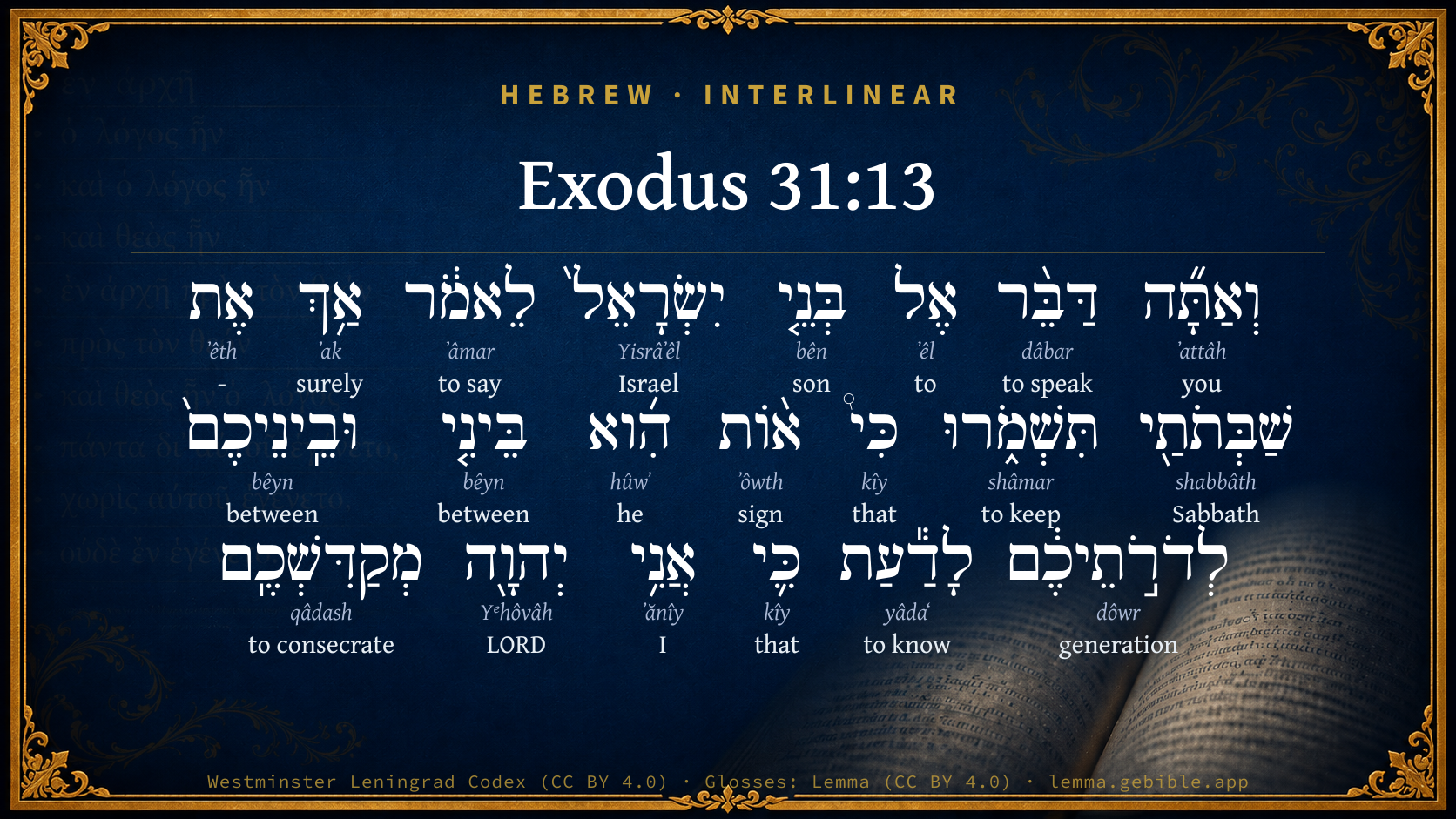
Hebrew (Westminster Leningrad Codex) Exodus 31:13 appears in the Hebrew Old Testament. The text above is from the Westminster Leningrad Codex. Each word links to its Strong’s number, a concise gloss, and parsing drawn from the Open Scriptures Hebrew Bible morphology. Click any word for its full Brown-Driver-Briggs (BDB) entry.
Download image
Cite this verse

Exodus 31:13 (World English Bible). Public Domain. Lemma interlinear Bible study tool, https://lemma.gebible.app/v/exodus/31/13.

Show BibTeX & RIS
BibTeX
RIS
English Translation
"Speak also to the children of Israel, saying, 'Most assuredly you shall keep my Sabbaths: for it is a sign between me and you throughout your generations; that you may know that I am Yahweh who sanctifies you.
World English Bible · Public Domain
Download a study sheet

One document with this verse’s original text, its word-by-word gloss line, the meaning frame, cross-references with their text, attributed commentary, and full source and license credits — printable, and it pastes into notes with its structure intact.

This verse Autodidact and up

Study sheet (.html) Plain text (.txt)

A passage Seminary Student

Up to 50 verses in one chapter. A passage sheet keeps up to 6 commentary sources and 12 cross-references per verse, in the order this page ranks them, and says so on the sheet whenever that leaves anything out. Ask for a single verse and you get the Autodidact verse sheet above.

Everything on this page stays free to read, with no account — the sheet is a download of what is already on screen, not access to it.

Want to remove ads? Support Godless Engineer
Compare translations 3

The same verse in 3 English versions, stacked beneath the original-language interlinear above. Click any original word for its lexicon entry.

Each is an independent rendering of the whole verse — the interlinear is not word-aligned to these translations.

Highlighted words mark where these versions differ — a whole-verse word diff, not a word-by-word alignment.

  • World English Bible Public Domain
    "Speak also to the children of Israel, saying, 'Most assuredly you shall keep my Sabbaths: for it is a sign between me and you throughout your generations; that you may know that I am Yahweh who sanctifies you.
  • King James Version Public Domain
    Speak thou also unto the children of Israel, saying, Verily my sabbaths ye shall keep: for it is a sign between me and you throughout your generations; that ye may know that I am the LORD that doth sanctify you.
  • unfoldingWord Literal Text CC BY-SA 4.0
    “And you, speak to the sons of Israel, saying: ‘Surely you shall keep my Sabbaths, for it is a sign between me and you throughout your generations so that you may know that I am Yahweh, who sets you apart.

unfoldingWord Literal Text — © unfoldingWord, licensed CC BY-SA 4.0. Word-aligned USFM3 via Door43 (git.door43.org/unfoldingWord/en_ult).

Versions to compare (up to 4)

3 of 4 selected

Show all 18 translations

Every available English version of this verse, each an independent rendering of the whole verse.

  • World English Bible Public Domain
    "Speak also to the children of Israel, saying, 'Most assuredly you shall keep my Sabbaths: for it is a sign between me and you throughout your generations; that you may know that I am Yahweh who sanctifies you.
  • Berean Standard Bible Public Domain
    “Tell the Israelites, ‘Surely you must keep My Sabbaths, for this will be a sign between Me and you for the generations to come, so that you may know that I am the LORD who sanctifies you.
  • Majority Standard Bible Public Domain
    “Tell the Israelites, ‘Surely you must keep My Sabbaths, for this will be a sign between Me and you for the generations to come, so that you may know that I am the LORD who sanctifies you.
  • King James Version Public Domain
    Speak thou also unto the children of Israel, saying, Verily my sabbaths ye shall keep: for it is a sign between me and you throughout your generations; that ye may know that I am the LORD that doth sanctify you.
  • American Standard Version (1901) Public Domain
    Speak thou also unto the children of Israel, saying, Verily ye shall keep my sabbaths: for it is a sign between me and you throughout your generations; that ye may know that I am Jehovah who sanctifieth you.
  • Revised Version (1885) Public Domain
    Speak thou also unto the children of Israel, saying, Verily ye shall keep my sabbaths: for it is a sign between me and you throughout your generations; that ye may know that I am the LORD which sanctify you.
  • Geneva Bible (1599) Public Domain
    Speake thou also vnto the children of Israel, and say, Notwithstanding keepe yee my Sabbaths: for it is a signe betweene me and you in your generations, that ye may know that I the Lord do sanctifie you.
  • Douay-Rheims (1899) Public Domain
    Speak to the children of Israel, and thou shalt say to them: See that thou keep my sabbath: because it is a sign between me and you in your generations: that you may know that I am the Lord, who sanctify you.
  • Young's Literal Translation Public Domain
    `And thou, speak unto the sons of Israel, saying, Only, My sabbaths ye do keep, for it `is' a sign between Me and you, to your generations, to know that I, Jehovah, am sanctifying you;
  • Literal Standard Version CC BY-SA 4.0
    “And you, speak to the sons of Israel, saying, Surely you keep My Sabbaths, for it [is] a sign between Me and you throughout your generations, to know that I, YHWH, am sanctifying you;
  • Unlocked Literal Bible CC BY-SA 4.0
    “Tell the Israelites: 'You must certainly keep Yahweh's Sabbath days, for these will be a sign between him and you throughout your people's generations so that you may know that he is Yahweh, who sets you apart for himself.
  • unfoldingWord Literal Text CC BY-SA 4.0
    “And you, speak to the sons of Israel, saying: ‘Surely you shall keep my Sabbaths, for it is a sign between me and you throughout your generations so that you may know that I am Yahweh, who sets you apart.
  • Darby Bible Public Domain
    And thou, speak thou unto the children of Israel, saying, Surely my sabbaths shall ye keep; for this is a sign between me and you throughout your generations, that ye may know that it is I, Jehovah, who do hallow you.
  • World Messianic Bible Public Domain
    “Speak also to the children of Israel, saying, ‘Most certainly you shall keep my Sabbaths; for it is a sign between me and you throughout your generations, that you may know that I am the LORD who sanctifies you.
  • Webster's Bible Public Domain
    Speak thou also to the children of Israel, saying, Verily my sabbaths ye shall keep: for it is a sign between me and you throughout your generations; that ye may know that I am the LORD that doth sanctify you.
  • Free Bible Version CC BY-SA 4.0
    “Tell the Israelites, ‘It's absolutely essential that you keep my Sabbaths. The Sabbath will be a sign between me and you for generations to come, so that you'll know that I am the Lord who makes you holy.
  • Bible in Basic English Public Domain
    Say to the children of Israel that they are to keep my Sabbaths; for the Sabbath day is a sign between me and you through all your generations; so that you may see that I am the Lord who makes you holy.
  • JPS Tanakh (1917) Public Domain
    'Speak thou also unto the children of Israel, saying: Verily ye shall keep My sabbaths, for it is a sign between Me and you throughout your generations, that ye may know that I am the LORD who sanctify you.

Literal Standard Version (2020), Covenant Press — licensed CC BY-SA 4.0. Text via the HelloAO Bible API (eBible.org). Unlocked Literal Bible (unfoldingWord) — licensed CC BY-SA 4.0. Text via the HelloAO Bible API (eBible.org). unfoldingWord Literal Text — © unfoldingWord, licensed CC BY-SA 4.0. Word-aligned USFM3 via Door43 (git.door43.org/unfoldingWord/en_ult). Free Bible Version, Dr. Jonathan Gallagher — licensed CC BY-SA 4.0. Text via the HelloAO Bible API (eBible.org).

Word by word

More ways to search: Search by grammar → Find every occurrence → Compare this word →

Practice this passage: Drill this verse → Learn its vocabulary →

א֨וֹת
ʼôwth
H226
“sign”
Noun, Common, Both, Singular, Absolute
Part of Speech
Noun
Type
Common
Gender
Both
Number
Singular
State
Absolute
Full BDB Definition

Origin: probably from H225 (in the sense of appearing)

TWOT: 41a

sign, signal - a distinguishing mark - banner - remembrance - miraculous sign - omen - warning - token, ensign, standard, miracle, proof
  1. וְאַתָּ֞ה ʼattâh H859 “and · you” Conjunction + Pronoun, Personal, 2nd Person, Masculine, Singular
  2. דַּבֵּ֨ר dâbar H1696 “speak” Verb, Piel, Imperative, 2nd Person, Masculine, Singular
  3. אֶל ʼêl H413 “to” Preposition
  4. בְּנֵ֤י bên H1121 “sons of” Noun, Common, Masculine, Plural, Construct
  5. יִשְׂרָאֵל֙ Yisrâʼêl H3478 “Israel” Noun, Proper
  6. לֵאמֹ֔ר ʼâmar H559 “to say” Preposition + Verb, Qal, Infinitive Construct
  7. אַ֥ךְ ʼak H389 “surely” Particle, Accusative
  8. אֶת ʼêth H853 “-” Particle, Direct Object
  9. שַׁבְּתֹתַ֖י shabbâth H7676 “Sabbaths · my” Noun, Common, Both, Plural, Construct + Suffix, Personal, 1st Person, Common, Singular
  10. תִּשְׁמֹ֑רוּ shâmar H8104 “to keep” Verb, Qal, Imperfect, 2nd Person, Masculine, Plural
  11. כִּי֩ kîy H3588 “that” Conjunction
  12. הִ֜וא hûwʼ H1931 “he” Pronoun, Personal, 3rd Person, Feminine, Singular
  13. בֵּינִ֤י bêyn H996 “between · me” Preposition + Suffix, Personal, 1st Person, Common, Singular
  14. וּבֵֽינֵיכֶם֙ bêyn H996 “and · between · you” Conjunction + Preposition + Suffix, Personal, 2nd Person, Masculine, Plural
  15. לְדֹרֹ֣תֵיכֶ֔ם dôwr H1755 “to/for · generations · your” Preposition + Noun, Common, Masculine, Plural, Construct + Suffix, Personal, 2nd Person, Masculine, Plural
  16. לָדַ֕עַת yâdaʻ H3045 “to know” Preposition + Verb, Qal, Infinitive Construct
  17. כִּ֛י kîy H3588 “that” Conjunction
  18. אֲנִ֥י ʼănîy H589 “I” Pronoun, Personal, 1st Person, Common, Singular
  19. יְהוָ֖ה Yᵉhôvâh H3068 “LORD” Noun, Proper
  20. מְקַדִּשְׁכֶֽם qâdash H6942 “consecrating · you” Verb, Piel, Participle Active, Masculine, Singular, Construct + Suffix, Personal, 2nd Person, Masculine, Plural

About this verse

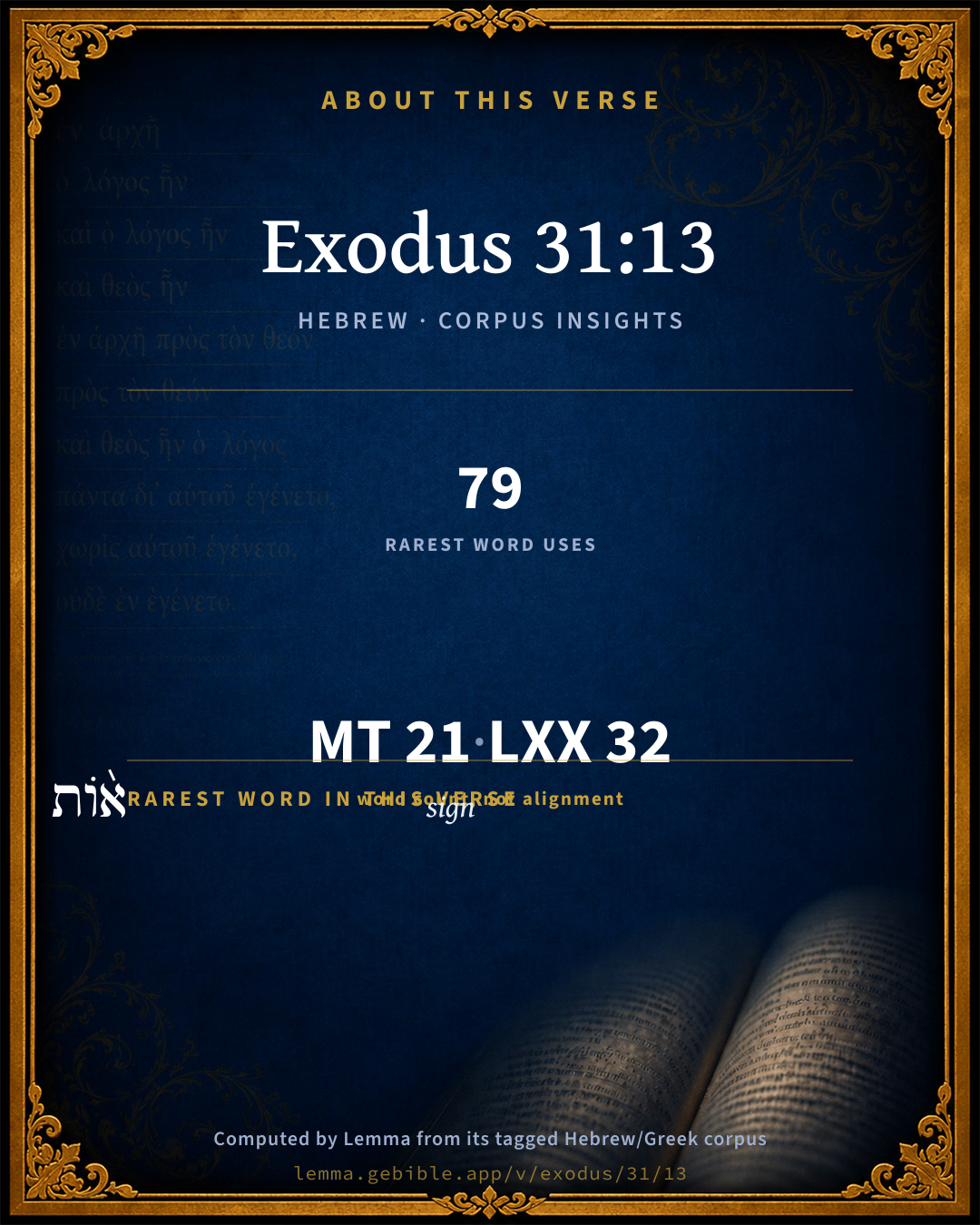
These counts appear in no published source. They are computed here, from the morphology-tagged text and Lemma’s own curated glosses. What Lemma adds →

21
words
19
distinct lemmas
Pentateuch
section

Grammatical profile

  • 5 verbs
  • 6 nouns
  • 3 pronouns
  • 3 prepositions
  • 2 conjunctions
  • 2 particles

Verb forms

  • דַּבֵּ֨ר Piel · Imperative
  • לֵאמֹ֔ר Qal · Infinitive Construct
  • תִּשְׁמֹ֑רוּ Qal · Imperfect
  • לָדַ֕עַת Qal · Infinitive Construct
  • מְקַדִּשְׁכֶֽם Piel · Participle Active

Repetition

Words recur within this verse — often emphatic in Hebrew:

  • בֵּינִ֤י between H996 ×2
  • כִּי֩ that H3588 ×2

Hebrew & Septuagint length

In English translation the verse runs 38 words from the Hebrew and 40 from the Septuagint (LXX English) — closely comparable.

A rough comparison of the two English renderings, which tokenize alike — not a word-level alignment.

Word counts can differ between the Hebrew and the Greek without any difference in meaning — e.g. the Hebrew direct-object marker אֵת has no separate Greek word, and Greek often adds the article ὁ.

In the original languages it is 21 Hebrew tokens and 32 Greek tokens — but the two are counted differently (Hebrew bundles its prefixes and suffixes into one token; the Greek is in lemma form), so that isn’t a like-for-like length.

Cross-references

18

Topical passages linked to Exodus 31:13 in the Treasury of Scripture Knowledge — connected by theme and wording, ordered by reader-vote popularity; previews shown in the World English Bible.

  • Ezekiel 20:12 Moreover also I gave them my Sabbaths, to be a sign between me and them, that they might know that I am Yahweh who sanctifies them.
  • Ezekiel 20:20 and make my Sabbaths holy; and they shall be a sign between me and you, that you may know that I am Yahweh your God.
  • Leviticus 19:30 "'You shall keep my Sabbaths, and reverence my sanctuary; I am Yahweh.
  • Exodus 20:8–11 "Remember the Sabbath day, to keep it holy.
  • Exodus 31:17 It is a sign between me and the children of Israel forever; for in six days Yahweh made heaven and earth, and on the seventh day he rested, and was refreshed.'"
  • 1 Thessalonians 5:23 May the God of peace himself sanctify you completely. May your whole spirit, soul, and body be preserved blameless at the coming of our Lord Jesus Christ.
  • Leviticus 20:8 You shall keep my statutes, and do them. I am Yahweh who sanctifies you.
  • Leviticus 19:3 "'Each one of you shall respect his mother and his father. You shall keep my Sabbaths. I am Yahweh your God.
  • John 17:17 Sanctify them in your truth. Your word is truth.
  • Leviticus 21:8 You shall sanctify him therefore; for he offers the bread of your God: he shall be holy to you: for I Yahweh, who sanctify you, am holy.
  • Leviticus 23:3 "'Six days shall work be done: but on the seventh day is a Sabbath of solemn rest, a holy convocation; you shall do no manner of work. It is a Sabbath to Yahweh in all your dwellings.
  • Nehemiah 9:14 and made known to them your holy Sabbath, and commanded them commandments, and statutes, and a law, by Moses your servant,
  • Ezekiel 37:28 The nations shall know that I am Yahweh who sanctifies Israel, when my sanctuary shall be in the midst of them forevermore.
  • Ezekiel 44:24 In a controversy they shall stand to judge; according to my ordinances shall they judge it: and they shall keep my laws and my statutes in all my appointed feasts; and they shall make my Sabbaths holy.
  • Leviticus 25:2 "Speak to the children of Israel, and tell them, 'When you come into the land which I give you, then the land shall keep a Sabbath to Yahweh.
  • Leviticus 26:2 "'You shall keep my Sabbaths, and have reverence for my sanctuary. I am Yahweh.
  • John 17:19 For their sakes I sanctify myself, that they themselves also may be sanctified in truth.
  • Jude 1:1 Jude, a servant of Jesus Christ, and brother of James, to those who are called, sanctified by God the Father, and kept for Jesus Christ:

Cross-references courtesy of OpenBible.info (CC BY 4.0).

Hebrew and Greek witnesses Masoretic Hebrew ↔ Greek Septuagint

The same verse in the two great witnesses to the Old Testament, shown verse-for-verse.

These are two independent witnesses, not word-aligned to each other, and the Septuagint is shown in lemma (dictionary) form.

Hebrew Exodus 31:13 Masoretic · Westminster Leningrad Codex

וְאַתָּ֞ה דַּבֵּ֨ר אֶל בְּנֵ֤י יִשְׂרָאֵל֙ לֵאמֹ֔ר אַ֥ךְ אֶת שַׁבְּתֹתַ֖י תִּשְׁמֹ֑רוּ כִּי֩ א֨וֹת הִ֜וא בֵּינִ֤י וּבֵֽינֵיכֶם֙ לְדֹרֹ֣תֵיכֶ֔ם לָדַ֕עַת כִּ֛י אֲנִ֥י יְהוָ֖ה מְקַדִּשְׁכֶֽם

"Speak also to the children of Israel, saying, 'Most assuredly you shall keep my Sabbaths: for it is a sign between me and you throughout your generations; that you may know that I am Yahweh who sanctifies you.

World English Bible · Public Domain

Greek LXX Exodus 31:13 Septuagint · lemma form

καί σύ συντάσσω ὁ υἱός ἰσραήλ λέγω ὁράω καί ὁ σάββατον ἐγώ φυλάσσω σημεῖον εἰμί παρά ἐγώ καί ἐν σύ εἰς ὁ γενεά σύ ἵνα γιγνώσκω ὅτι ἐγώ κύριος ὁ ἁγιάζω σύ

Do you also charge the children of Israel, saying, Take heed and keep my sabbaths; for they are a sign with me and among you throughout your generations, that you⌃ may know that I am the Lord that sanctifies you.

LXX2012 (modern English Septuagint) · Public Domain

Hebrew: Westminster Leningrad Codex (CC BY 4.0). Greek: Septuagint (public domain); English from LXX2012 (modern English Septuagint) (Public Domain). How the Septuagint differs from the Hebrew →

Targum (Aramaic paraphrase)

2

The Targum is the ancient Jewish Aramaic paraphrase of the Hebrew Scriptures — an interpretive translation, not the Hebrew text itself. Onkelos (literal) and Pseudo-Jonathan (expansive) render the Torah, and Jonathan the Prophets. Coverage is partial: where no permissively-licensed English translation exists for a verse, only the Aramaic is shown. This is verse-level text, not a word-by-word alignment to the Hebrew.

  1. Targum Onkelos Torah (Genesis–Deuteronomy)
    וְאַתְּ מַלֵל עִם בְּנֵי יִשְׂרָאֵל לְמֵימַר בְּרַם יָת יוֹמֵי שַׁבַּיָא דִי לִי תִּטְּרוּן אֲרֵי אָת הִיא בֵּין מֵימְרִי וּבֵינֵיכוֹן לְדָרֵיכוֹן לְמִדַע אֲרֵי אֲנָא יְיָ מְקַדִשְׁכוֹן:

    (no public-domain English translation for this verse)

    Targum Onkelos — Aramaic: “Onkelos Genesis” (public domain); “Onkelos Exodus” (public domain); “Onkelos Leviticus” (public domain); “Onkelos Numbers” (public domain); “Onkelos Deuteronomy” (public domain). English: “Sefaria Community Translation” (CC0 1.0 (public-domain dedication)); “J.W. Etheridge. The Targums of Onkelos and Jonathan Ben Uzziel on the Pentateuch. London: Longmans, Green, 1862” (public domain). Text via Sefaria.

  2. Targum Pseudo-Jonathan Torah (Genesis–Deuteronomy)
    וְאַנְתְּ תְּמַלֵּיל עִם בְּנֵי יִשְרָאֵל לְמֵימַר בְּרַם יַת יוֹמֵי שַׁבַּיָא דִי לִי תִנְטְרוּן אֲרוּם אָת הוּא בֵּין מֵימְרִי וּבֵינֵיכוֹן לְדָרֵיכוֹן לְמִידוֹעַ אֲרוּם אֲנָא הוּא יְיָ מְקַדִּישְׁכוֹן

    Also, speak thou with the sons of Israel, saying, Ye shall keep the day of My Sabbaths indeed; for it is a sign between My Word and you, that you may know that I am the Lord who sanctify you.

    Targum Pseudo-Jonathan — Aramaic: “Targum Jonathan on Genesis” (public domain); “Targum Jonathan on Exodus” (public domain); “Targum Jonathan on Leviticus” (public domain); “Targum Jonathan on Numbers” (public domain); “Targum Jonathan on Deuteronomy” (public domain). English: “The Targum of Jonathan ben Uzziel, trans. J. W. Etheridge, London, 1862” (public domain). Text via Sefaria.

Commentary

Notes on Exodus 31:13 from classic Christian and Jewish commentators (each source and its license shown beneath its notes). The classic Christian expositions comment on the surrounding passage and are grouped to its opening verse, so a note may address several verses; the Jewish commentaries on the Tanakh (Rashi and others) are per-verse, so they appear only where the commentator wrote on this verse.

Lemma curates 59 commentaries, every one of them public domain or Creative Commons licensed, each selected and text-cleaned for this edition rather than reprinted as found. About our sources →

Trapp's Complete Commentary

John Trapp

Exo 31:13 Speak thou also unto the children of Israel, saying, Verily my sabbaths ye shall keep: for it [is] a sign between me and you throughout your generations; that [ye] may know that I [am] the LORD that doth sanctify you.

Ver. 13. Verily my Sabbaths ye shall keep,] q.d., Though this sanctuary work is to be done, yet it shall be no Sabbath day’s work. The good women in the Gospel forbare on the Sabbath to anoint the dead body of our Saviour, "resting according to the commandment." {Luk 23:56}

For it is a sign.] And with it an effectual means to convey holiness into the heart.

John Trapp, A Commentary or Exposition upon All the Books of the Old and New Testament (1647–1656) — public domain. Text from a community e-Sword module.

Joseph Benson's Commentary

Exo 31:13. Verily my sabbaths ye shall keep — This had been mentioned thrice before, Exo 16:23; Exo 20:8; Exo 23:12; but seems here to be repeated lest they should think the sacred work enjoined in this chapter would warrant their breaking in upon the holy rest of that day. Wherefore the clause had better be translated, Nevertheless my sabbaths shall ye keep; for אךְach is often an exceptive particle, and is so rendered here by Arias, Montanus, Le Clerc, Junius, and Tremellius. It is a sign between me and you — Some late commentators have quoted Poole here, as follows: “The sabbath is a five-fold sign; 1st, Commemorative of God’s creation and dominion over them and all things, to whom they hereby profess their subjection. 2d, Indicative, showing that they were made to be holy, and that their sanctification could be had from none but God, as it here follows and from the observation of God’s days and appointments. 3d, Distinctive, whereby they owned themselves to be the Lord’s peculiar people, by a religious keeping of those sabbaths, which the rest of the world grossly neglected, and profanely scoffed at. 4th, Prefigurative of that rest which Christ should purchase for them, namely, a rest from the burden of the ceremonial, and the curses and rigours of the moral law, as also from sin and the wrath of God for ever, Heb 4:5 th, Confirmative, both assuring them of God’s good will to them, and that, as he blessed the sabbath for their sakes, so he would bless them in the holy use of it, with temporal, spiritual, and everlasting blessings; and assuring God of their standing, and that they would stand to the covenant made between God and them. So that this was a mutual stipulation or ratification of the covenant of grace on both sides.” Certainly the institution of the sabbath was a great instance of God’s favour, and a sign that he had separated them from all other people; and their religious observance of it was a great instance of their duty to him. God, by sanctifying this day among them, let them know that he sanctified them, and set them apart for his service, otherwise he would not have revealed to them his holy sabbaths, to be the support of religion among them. The Jews, by observing one day in seven, after six days’ labour, testified that they worshipped the God that made the world in six days, and rested the seventh; and so distinguished themselves from other nations, who, having first lost the sabbath, the memorial of the creation, by degrees lost the knowledge of the Creator, and gave the creature the honour due to him alone.

Joseph Benson's Commentary on the Old and New Testaments (1811–1818) — public domain. Text from a community e-Sword module.

The Pulpit Commentary

Verily. Rosenmuller suggests, "Nevertheless." But there is no need for any change. It is a sign. Hitherto circumcision had been the only visible "sign" that the Israelites were under a special covenant with God his people, bound to him by special ties. (Gen_17:9-14; Act_7:8) The adoption of circumcision by the Egyptians and other nations (Heb 2:104) had produced the effect that this "sign" was no longer distinguishing. It might be still" a sign of profession"; but it had ceased to be "a mark of difference"; and some other mark was therefore needed. Such the observance of the sabbath by entire abstinence from servile work became. No other nation adopted it. It continued to Roman times the mark and badge of a Jew. (Juv. Sat. 6:159; 14:96). That ye may know, etc. By keeping the sabbath day as a day of holy rest the Israelites would knowi.e. , would realise severally in their own per sons, that God was their sanctifier. Sanctification would be the fruit of their obedience.

Vers. 13-17. Covenant signs.

To each covenant which he has made with man, God has attached some special sign or signs. And each sign has been significant, has set before the mind of those to whom it was given some great religious truth.

I THE FIRST COVENANT SIGN WAS THE RAINBOW. God had destroyed by a deluge the whole human race, except eight persons. It pleased him, after this, to enter into a covenant with Noah and his sons, (Gen_9:8, Gen_9:9) and through them with the human race, that he would never bring such a destruction upon the world again (ib, 11). Of this covenant he appointed the rainbow to be the sign, symbolising by its brightness and beauty his own mercy ( ib, 14-17). Here the religious truth taught and impressed by the sign was that precious one, that God is not only a just, but also a merciful God.

II THE SECOND COVENANT SIGN WAS CIRCUMCISION. When God selected Abraham out of the entire mass of mankind to be the progenitor of the chosen race and of him especially in whom all the families of the earth should be blessed, and entered into a covenant with him, it was in these words shalt keep my covenant, thou and thy seed after thee in their generations this is my covenant which ye shall keep between me and you, and thy seed after thee, every man child among you shall be circumcised". (Gen_17:9, Gen_17:10) Hence the covenant itself was called "the covenant of circumcision". (Act_7:8) This rite of initiation, the covenant sign of the Abrahamic dispensation, shadowed forth the great truth that man has an impurity of nature, which must be put away before he can be brought near to God and received into his full favour.

III THE THIRD COVENANT SIGN WAS THE SABBATH. Its institution to be a covenant sign is set forth in the words, "Verily, my sabbaths ye shall keep, for it is a sign between me and you throughout your generations". (Exo_31:13) It witnessed to the truth that God requires distinct and open acknowledgment at the. hands of men, and not only so, but material worship at stated times, the least that will content him being one day in seven. The nations, when they served him at all, (Act_10:35) served him irregularly. They knew nothing of a definite day, or a formal apportionment of time, for his service. By the institution of the Sabbath the Israelites were taught, and through them the world, that God is interested in man, claims his thoughts, sets a value on his worship, and will not be satisfied with mere occasional acknowledgment, but demands that a fixed proportion of our time shall be dedicated to his worship exclusively.

IV OTHER COVENANT SIGNS. NO further covenant signs were given until our Lord came upon earth. Then two were instituted in the Sacraments. Baptism taught the same truth as circumcision the need of putting away impurity; but taught it by a simpler rite, and one to which no exception could be taken. The Lord"s Supper taught a new truth, the necessity of reconciliation through the death and atoning blood of Christ. It witnessed to the certain fact that man cannot save himself, cannot atone for his own sins, but needs a mediator, a redeemer, an atoner, to make satisfaction for him.

The Pulpit Commentary (1880–1919), ed. H.D.M. Spence-Jones & Joseph S. Exell — public domain. Text from a community e-Sword module.

Geneva Bible (1599)

Geneva Bible translators

Though I command these works to be done, yet will I not that you break my Sabbath days.

Geneva Bible (1599) marginal notes — public domain. Text via Bolls.life.

Adam Clarke's Commentary

Verse 13. My Sabbaths ye shall keep] See Clarke on Ge 2:3; and "Ex 20:8".

Adam Clarke's Commentary on the Bible (1810–1826) — public domain. Text from a community e-Sword/MySword module.

Ellicott's Commentary for English Readers

(13) It is a sign between me and you.—Circumcision had been given as a covenant sign to Abraham and his descendants (Gen_17:9-13); but its adoption by many of the heathen nations had rendered it no longer a distinguishing mark by which God’s people could be certainly known from others. Thus a new “sign” was needed. The observance of one day in seven as a day of holy rest became henceforth the distinguishing sign, and proved effectual. It was not likely to be adopted, and in point of fact was not adopted, by any of the heathen. We find it in the latest time of the Jewish nation still regarded as the special mark and badge of a Jew (Juv. Sat. vi. 159, 14:96; Mart. Epig. 4:4, 50:7, &c.).

A Bible Commentary for English Readers, edited by Charles John Ellicott (1878–1897) — public domain. Text from a community e-Sword module.

The Cambridge Bible for Schools and Colleges

gen. ed. J. J. S. Perowne

13. Speak thou also] And thou (emph.), speak thou (Exo_27:20).

Verily] cf. on Exo_12:15 (‘surely’).

ye shall keep my Sabbaths] the sabbaths sacred to me. Note exactly the same words in H, Lev_19:3; Lev_19:30; Lev_26:2 : ‘my sabbaths,’ also, often in Ezek. (Eze_20:12-13; Eze_20:16; Eze_20:20-21; Eze_20:24, Eze_22:8; Eze_22:26, Eze_23:38, Eze_44:24); only besides in Isa_56:4†.

a sign, &c.] The sabbath, as a day observed weekly in honour of Jehovah, and kept sacred to Him, is a constantly recurring memorial of Israel’s dedication to Him, and of the covenant-relation subsisting between them. Comp. Eze_20:12 (cited below).

throughout your generations] See on Exo_12:14. So v. 16.

that men may know (Heb. simply to know: so Psa_67:2 Heb.) &c.] that all the world may recognize, by means of the sabbath, that it is Jehovah who ‘sanctifies’ Israel, or provides it with the means of becoming a holy people. ‘I am Jehovah which sanctify [better, ‘which sancti fieth’] you (him, them)’ is one of the dominant thoughts of H (Lev_20:8; Lev_21:15 (cf. v. 8), Lev_21:23, Lev_22:9; Lev_22:16; Lev_22:32). Comp. Eze_20:12 ‘I gave them my Sabbaths, to be a sign between me and them, that men might know [Heb. to know] that I am Jehovah, which sanctifieth them’ (similarly v. 20); also, for the last clause, Eze_37:12.

The Cambridge Bible for Schools and Colleges (gen. ed. J. J. S. Perowne; Cambridge University Press, 1878–1918) — public domain. Text from a community e-Sword module.

John Gill's Exposition

Speak thou also unto the children of Israel,.... Notwithstanding all that has been said and ordered concerning making the tabernacle and all things belonging to it; yet this was not to be understood to the violation of the sabbath, or the neglect of that, in which no work was to be done, no, not any relating to the tabernacle and the vessels of it; and though that was to be made, and everything belonging to it, as soon as possible, yet the sabbath was to be observed, and not broken on that account; and this the people of Israel were told of:

saying; verily, or "nevertheless" (q):

my sabbaths ye shall keep not sabbaths of years, as the seventh year and the fiftieth year, but of weeks, expressed by the plural number, because there are many of them in course throughout the year, no less than fifty two; and so the apostle uses the same number, Col 2:16 and so do Heathen writers (r):

for it is a sign between me and you, throughout your generations; a token of the covenant between them, of his being their God and they his people in a peculiar sense; seeing they observed the same day as a day of rest now, on which he had rested at the finishing of the works of creation, which other nations of the world did not observe; of his sanctifying and separating them from all other people; for this was not a sign between him and other nations, but between him and the people of Israel only; and was to be observed throughout their ages, as long as their civil and church state lasted, but not through others:

that ye may know that I am the Lord that doth sanctify you; had separated and distinguished them from the rest of the nations of the world; but if this law had been given to all nations, it could not have been a distinguishing sign of them from others; nor could it be known hereby that God had separated them to himself above all people; and this was done that it might be known, not only by them, for the word "ye" is not in the text, but by others, the nations of the world, as Jarchi; that they were a distinct people, having distinct laws from all others, and particularly this.

(q) "veruntamen", Pagninus, Montanus, Tigurine version, Fagius, Vatablus, Drusius, Cartwright, Junius & Tremellius, Piscator. (r) "Metuentem sabbata" Juvenal. Satyr. 14.

John Gill's Exposition of the Whole Bible (1746–1763) — public domain (CC PDM 1.0). Text via the HelloAO Bible API.

Haydock's Catholic Bible Commentary

Sabbath. Let not the workmen do any thing for the tabernacle on that day. (Menochius) --- God reiterates and insists particularly on this commandment, which begins with the word remember; because men are so apt to forget, or to transgress a precept, which seems to interfere with those worldly concerns and profits, which they love more than God and their own souls. (Haydock)

George Leo Haydock (1774–1849), Haydock's Catholic Family Bible and Commentary, 1859 edition — public domain. Excludes Psalms (Douay-Rheims chapter numbering differs from Protestant) and Deuterocanonical books (Catholic canon only).

Matthew Poole's English Annotations

My sabbaths ye shall keep: this precept is here repeated, either,

1. To show the chief use of the tabernacle, and all this cost and trouble about it, to wit, that they might there acceptably serve God, as in some measure upon every day, so especially upon the sabbath day. Or rather,

2. To restrain the time for the doing of the forementioned works: q.d. Though the work of the tabernacle and utensils be holy, and for a holy use, yet I will not have it done upon my holy day. The sabbath was not made for them, but they for it, and therefore they shall give place to it.

It is a sign between me and you. The sabbath is a fivefold sign:

1. Commemorative, of God’s creation of and dominion over them and all other things, to whom they do hereby profess their subjection.

2. Indicative, showing that they were made to be holy, and that their sanctification can be had from none but from God, as it here follows, and from the observation of God’s days and appointments.

3. Distinctive, whereby they owned themselves to be the Lord’s peculiar people, by a religious keeping of those sabbaths, which the rest of the world grossly neglected and profanely scoffed at.

4. Prefigurative, of that rest which Christ should purchase for them, to wit, a rest from the burden of the ceremonial, and from the curses and rigours of the moral law, as also from sin and the wrath of God for ever. See Heb 4.

5. Confirmative, both assuring them of God’s good will to them, and that as he blessed the sabbath for their sakes, so he would bless them in the holy use of it with temporal, spiritual, and everlasting blessings, as he declares in many places of Scripture; and assuring God of their standing to that covenant made between God and them. So that this was a mutual stipulation or ratification of the covenant of grace on both sides.

That doth sanctify you; that selecteth you out of all people, and consecrateth you to myself, and to my service and worship, a great part whereof is the observation of the sabbath. Or, that sanctifieth you by my word and ordinances, which are in more eminent and solemn manner dispensed upon the sabbath day, by the observation whereof you declare that you own me as your only Sanctifier; and so we may observe, the sabbath owns the Lord as our Creator, and as our Redeemer, and as our Sanctifier; and therefore it is no wonder God so severely enjoins the sanctification of the sabbath, and punisheth the neglect of it, it being a tacit renouncing or disowning of God the Father, the Son, and the Holy Ghost.

Matthew Poole's English Annotations on the Holy Bible (1683–1685) — public domain. Text from a community e-Sword/MySword module.

John Wesley's Explanatory Notes

It is a sign between me and you - The institution of the sabbath was a great instance of God's favour, and a sign that he had distinguished them from all other people: and their religious observance of it, was a great instance of their duty to him. God, by sanctifying this day among them, let them know that he sanctified them, and set them apart for his service, otherwise he would not have revealed to them his holy sabbaths to be the support of religion among them. The Jews by observing one day in seven, after six days labour, testified that they worshipped the God that made the world in six days, and rested the seventh; and so distinguished themselves from other nations, who having first lost the sabbath, the memorial of the creation, by degrees lost the knowledge of the creator, and gave the creature the honour due to him alone.

John Wesley, Explanatory Notes Upon the Whole Bible (1754–1765) — public domain. Text via the GEBible commentary corpus.

Rashi

Rabbi Shlomo Yitzchaki (Rashi)

ואתה דבר אל בני ישראל SPEAK THOU ALSO UNTO THE CHILDREN OF ISRAEL — AND thou, although I have given thee charge to command them concerning the work of the Tabernacle let it not appear a light thing to thee to set the Sabbath aside on account of that work.

אך את שבתתי תשמרו BUT NEVERTHELESS MY SABBATHS SHALL YE KEEP — Even though you be anxious and alert to do the work promptly the Sabbath nevertheless you must not set aside on its account. The words אך and רק wherever they occur in Scripture have limitative force (Rosh Hashanah 17b; cf. Rashi on Rosh Hashanah 17b on אכין ורקין). Here Scripture intends by the word אך to except the Sabbath from the days on which the work of the Tabernacle may be done.

כי אות היא ביני וביניכם FOR IT IS A SIGN BETWEEN ME AND YOU — There is a mark of distinction in the relation that exists between us, viz., the fact that I have chosen you by letting you inherit for rest that day on which “I” rested.

לדעת TO KNOW — (not, “for you to know”, but) for the nations of the world to know through it, כי אני ה' מקדשכם THAT I AM THE LORD THAT DOTH SANCTIFY YOU.

Rashi on the Tanakh — English translations: “The Judaica Press complete Tanach with Rashi, translated by A. J. Rosenberg” (CC BY 4.0); “Pentateuch with Rashi's commentary by M. Rosenbaum and A.M. Silbermann, 1929-1934” (public domain); “The Metsudah Tanach series, Lakewood, N.J” (CC BY 4.0); and “The Book of Joshua, Metsudah Publications, 1997” (CC BY 4.0). Text via Sefaria.

Ramban (Nachmanides)

Rabbi Moshe ben Nachman (Ramban / Nachmanides)

ACH’ (BUT) YE SHALL KEEP MY SABBATHS. “Even though you may be anxious to do the work promptly, do not set aside the Sabbath on its account. All [Scriptural expressions containing] the words ach (but) or rak (only), intimate limiting qualifications; [in this case] it is to exclude the Sabbath from [the days on which] the work of the Tabernacle may be done.” This is Rashi’s language. But I have not been able to explain it. For according to the method used by our Rabbis to interpret the words ach (but) and rak (only), it should limit the scope of Sabbath-observance [and permit the work of the Tabernacle on the Sabbath], for the limiting qualifications [of ach and rak] everywhere apply to the subject of the commandment itself [and since the verse here speaks of Sabbath-observance, the word ach should be restricting its application]. Thus if we are to interpret [and apply] the limiting nature of the word ach to the subject of the work of the Tabernacle, it should follow that it is allowed to be done on the Sabbath! Rather, the limiting nature of the word ach here applies to circumcision [on the eighth day of the child], or to the saving of human life, and similar instances, [to tell us] that they set aside the Sabbath. And so the Rabbis said in Tractate Yoma: “And whence do we know that even in a doubt whether life is in danger, the Sabbath may be set aside? Rabbi Abohu said in the name of Rabbi Yochanan: ‘Ach’ ye shall keep My Sabbaths — [the word ach] has a limiting qualification.” And the reason why the work of the Tabernacle does not override the Sabbath [is not on account of the word ach, but] because He warned [about keeping the Sabbath] here [right next to the subject of the making of the Tabernacle, thus indicating that the Sabbath is not to be set aside on account of it]. And in line with the plain meaning of Scripture the verse states as follows: “You shall do the work of the Tent of Meeting, but My Sabbaths you shall keep forever.” And in the Torath Kohanim Section 3, 7:7. [the Rabbis have said as follows]: “I might think that the building of the Sanctuary overrides the Sabbath? Scripture therefore says, Ye shall keep My Sabbaths, and reverence My Sanctuary: I am the Eternal.” Now the reason for the word Shabtothai [in the plural] is because the Sabbaths of the year are many. By way of the Truth, [the mystic lore of the Cabala], He commanded here [the keeping of the “Sabbaths”] by zachor (above 20:8). and shamor, (Deuteronomy 5:12). as I have hinted with reference to their secret, this being the reason for the plural — My Sabbaths. Of the two of them [zachor and shamor] He says, for it is a sign [when He should have said “for they are a sign,” this is in order to indicate] that “it” [the Sabbath] is the sign between Me and you… that ye may know. He states, Ye shall keep the Sabbath, and declares that those that profane it are liable to extinction, for the spirit returneth unto G-d who gave it, but the soul of that one [who profanes the Sabbath] will be cut off from there. He states concerning the seventh day that it is a Sabbath of solemn rest holy to G-d, because it is the foundation of the world; of the Sabbath He also says that it is a perpetual covenant, and then He states again that it is a sign between Me and the children of Israel meaning that the Sabbath is the sign on the seventh day, and the purport thereof is that the [seventh] day itself is a sign, and [its sanctification as] the Sabbath is the sign forever., Note 23. This is also the purport of the expression, He ceased from work and rested, this being an allusion to “the extra [Sabbath] soul” which comes from The Foundation of the world, in Whose hand is the soul of every living thing. Thus the chapter is explained. I have already hinted at its meaning in [my commentary to] the Ten Commandments. The student learned [in the Cabala] will understand.

Ramban (Nachmanides) on the Tanakh — English translation: “Commentary on the Torah by Ramban (Nachmanides). Translated and annotated by Charles B. Chavel. New York, Shilo Pub. House, 1971-1976” (CC BY 4.0). Text via Sefaria.

Sforno

Rabbi Ovadia Sforno

You must still preserve My Shabbos. That is, the building the mishkon does not override Shabbos.

For it is a sign. If they desecrated this sign there would be no point in making the mishkon because in any event God’s Shechinah would not dwell among them.

Sforno on the Tanakh — English translation: “Yalkut, Sifsei Chachomim Chumash, Metsudah Publications, 2009” (CC BY 4.0). Text via Sefaria.

Lesson kit

Teaching starters — assembled from the data on this page, not authored interpretation. Every prompt links to the verse data it draws on. Edit before teaching.

Exodus, in the Pentateuch, opens this verse with 21 words (19 distinct Hebrew lemmas). Its most distinctive word is ʼôwth (“sign”). A historical commentator’s framing appears above. Read the whole chapter for the surrounding context.

Discussion questions

  1. What does “sign” (ʼôwth) contribute to the verse as a whole?
  2. Ezekiel 20:12 shares this passage’s theme. How do the two illuminate each other?
  3. “between” occurs 2× in this one verse. What is the effect of the repetition?
  4. These translations render this verse differently; the difference is in the English rendering, not the original. What questions does that raise?
  5. The verb «דַּבֵּ֨ר» is Piel Imperative. How does its form color the action?
  6. Reading how Trapp's Complete Commentary and Joseph Benson's Commentary read this verse, where do the two commentators agree and where do they part?

Things to notice

Reading settings

Reading text

Shown beneath each verse's original-language words.

Old Testament
Old Testament edition

Read the OT as the Masoretic Hebrew (MT) or the Greek Septuagint (LXX).

English shown for the Greek Septuagint (in the Hebrew ↔ Greek comparison).

Comparing translations? Open the Compare panel on any verse page to stack up to four side by side.