Leviticus 25:55

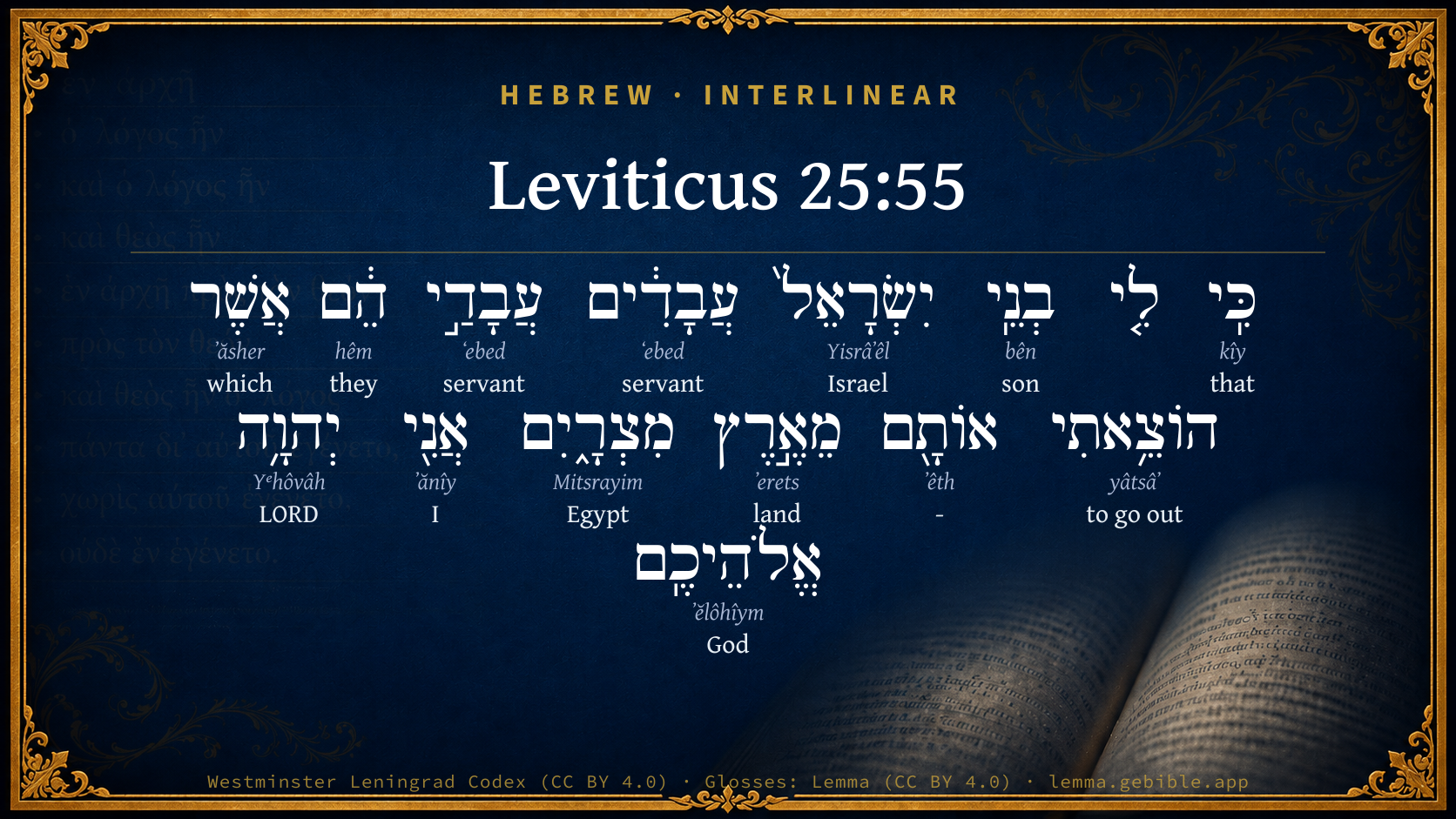
Hebrew (Westminster Leningrad Codex) Leviticus 25:55 appears in the Hebrew Old Testament. The text above is from the Westminster Leningrad Codex. Each word links to its Strong’s number, a concise gloss, and parsing drawn from the Open Scriptures Hebrew Bible morphology. Click any word for its full Brown-Driver-Briggs (BDB) entry.
Download image
Cite this verse

Leviticus 25:55 (World English Bible). Public Domain. Lemma interlinear Bible study tool, https://lemma.gebible.app/v/leviticus/25/55.

Show BibTeX & RIS
BibTeX
RIS
English Translation
For to me the children of Israel are servants; they are my servants whom I brought forth out of the land of Egypt. I am Yahweh your God.
World English Bible · Public Domain
Download a study sheet

One document with this verse’s original text, its word-by-word gloss line, the meaning frame, cross-references with their text, attributed commentary, and full source and license credits — printable, and it pastes into notes with its structure intact.

This verse Autodidact and up

Study sheet (.html) Plain text (.txt)

A passage Seminary Student

Up to 50 verses in one chapter. A passage sheet keeps up to 6 commentary sources and 12 cross-references per verse, in the order this page ranks them, and says so on the sheet whenever that leaves anything out. Ask for a single verse and you get the Autodidact verse sheet above.

Everything on this page stays free to read, with no account — the sheet is a download of what is already on screen, not access to it.

Want to remove ads? Support Godless Engineer
Compare translations 3

The same verse in 3 English versions, stacked beneath the original-language interlinear above. Click any original word for its lexicon entry.

Each is an independent rendering of the whole verse — the interlinear is not word-aligned to these translations.

Highlighted words mark where these versions differ — a whole-verse word diff, not a word-by-word alignment.

  • World English Bible Public Domain
    For to me the children of Israel are servants; they are my servants whom I brought forth out of the land of Egypt. I am Yahweh your God.
  • King James Version Public Domain
    For unto me the children of Israel are servants; they are my servants whom I brought forth out of the land of Egypt: I am the LORD your God.
  • unfoldingWord Literal Text CC BY-SA 4.0
    For the sons of Israel servants to me. They my servants whom I brought them out from the land of Egypt. I Yahweh your God.

unfoldingWord Literal Text — © unfoldingWord, licensed CC BY-SA 4.0. Word-aligned USFM3 via Door43 (git.door43.org/unfoldingWord/en_ult).

Versions to compare (up to 4)

3 of 4 selected

Show all 18 translations

Every available English version of this verse, each an independent rendering of the whole verse.

  • World English Bible Public Domain
    For to me the children of Israel are servants; they are my servants whom I brought forth out of the land of Egypt. I am Yahweh your God.
  • Berean Standard Bible Public Domain
    For the Israelites are My servants. They are My servants, whom I brought out of the land of Egypt. I am the LORD your God.
  • Majority Standard Bible Public Domain
    For the Israelites are My servants. They are My servants, whom I brought out of the land of Egypt. I am the LORD your God.
  • King James Version Public Domain
    For unto me the children of Israel are servants; they are my servants whom I brought forth out of the land of Egypt: I am the LORD your God.
  • American Standard Version (1901) Public Domain
    For unto me the children of Israel are servants; they are my servants whom I brought forth out of the land of Egypt: I am Jehovah your God.
  • Revised Version (1885) Public Domain
    For unto me the children of Israel are servants; they are my servants whom I brought forth out of the land of Egypt: I am the LORD your God.
  • Geneva Bible (1599) Public Domain
    For vnto me the children of Israel are seruants: they are my seruants, who I haue brought out of the land of Egypt: I am ye Lord your God.
  • Douay-Rheims (1899) Public Domain
    For the children of Israel are my servants, whom I brought forth out of the land of Egypt.
  • Young's Literal Translation Public Domain
    For to Me `are' the sons of Israel servants; My servants they `are', whom I have brought out of the land of Egypt; I, Jehovah, `am' your God.
  • Literal Standard Version CC BY-SA 4.0
    For the sons of Israel [are] servants to Me; they [are] My servants whom I have brought out of the land of Egypt; I [am] your God YHWH.”
  • Unlocked Literal Bible CC BY-SA 4.0
    To me the people of Israel are servants. They are my servants whom I brought out of the land of Egypt. I am Yahweh your God.'”
  • unfoldingWord Literal Text CC BY-SA 4.0
    For the sons of Israel servants to me. They my servants whom I brought them out from the land of Egypt. I Yahweh your God.
  • Darby Bible Public Domain
    For the children of Israel are servants unto me; they are my servants whom I brought forth out of the land of Egypt: I am Jehovah your God.
  • World Messianic Bible Public Domain
    For to me the children of Israel are servants; they are my servants whom I brought out of the land of Egypt. I am the LORD your God.
  • Webster's Bible Public Domain
    For to me the children of Israel are servants, they are my servants whom I brought out of the land of Egypt: I am the LORD your God.
  • Free Bible Version CC BY-SA 4.0
    For the Israelites belong to me as my slaves. They are my slaves—I led them out of Egypt. I am the Lord your God.”
  • Bible in Basic English Public Domain
    For the children of Israel are servants to me; they are my servants whom I took out of the land of Egypt: I am the Lord your God.
  • JPS Tanakh (1917) Public Domain
    For unto Me the children of Israel are servants; they are My servants whom I brought forth out of the land of Egypt: I am the LORD your God.

Literal Standard Version (2020), Covenant Press — licensed CC BY-SA 4.0. Text via the HelloAO Bible API (eBible.org). Unlocked Literal Bible (unfoldingWord) — licensed CC BY-SA 4.0. Text via the HelloAO Bible API (eBible.org). unfoldingWord Literal Text — © unfoldingWord, licensed CC BY-SA 4.0. Word-aligned USFM3 via Door43 (git.door43.org/unfoldingWord/en_ult). Free Bible Version, Dr. Jonathan Gallagher — licensed CC BY-SA 4.0. Text via the HelloAO Bible API (eBible.org).

Word by word

More ways to search: Search by grammar → Find every occurrence → Compare this word →

Practice this passage: Drill this verse → Learn its vocabulary →

הֵ֔ם
hêm
H1992
“they”
Pronoun, Personal, 3rd Person, Masculine, Plural
Part of Speech
Pronoun
Type
Personal
Person
3rd Person
Gender
Masculine
Number
Plural
Full BDB Definition

Origin: from H1981

TWOT: 504

they, these, the same, who
  1. כִּֽי kîy H3588 “that” Conjunction
  2. בְנֵֽי bên H1121 “sons of” Noun, Common, Masculine, Plural, Construct
  3. יִשְׂרָאֵל֙ Yisrâʼêl H3478 “Israel” Noun, Proper
  4. עֲבָדִ֔ים ʻebed H5650 “servants” Noun, Common, Masculine, Plural, Absolute
  5. עֲבָדַ֣י ʻebed H5650 “servants · my” Noun, Common, Masculine, Plural, Construct + Suffix, Personal, 1st Person, Common, Singular
  6. אֲשֶׁר ʼăsher H834 “which” Particle, Relative
  7. הוֹצֵ֥אתִי yâtsâʼ H3318 “to go out” Verb, Hiphil, Perfect, 1st Person, Common, Singular
  8. אוֹתָ֖ם ʼêth H853 “- · them” Particle, Direct Object + Suffix, Personal, 3rd Person, Masculine, Plural
  9. מֵאֶ֣רֶץ ʼerets H776 “from · land of” Preposition + Noun, Common, Both, Singular, Construct
  10. מִצְרָ֑יִם Mitsrayim H4714 “Egypt” Noun, Proper
  11. אֲנִ֖י ʼănîy H589 “I” Pronoun, Personal, 1st Person, Common, Singular
  12. יְהוָ֥ה Yᵉhôvâh H3068 “LORD” Noun, Proper
  13. אֱלֹהֵיכֶֽם ʼĕlôhîym H430 “God(s) · your” Noun, Common, Masculine, Plural, Construct + Suffix, Personal, 2nd Person, Masculine, Plural

About this verse

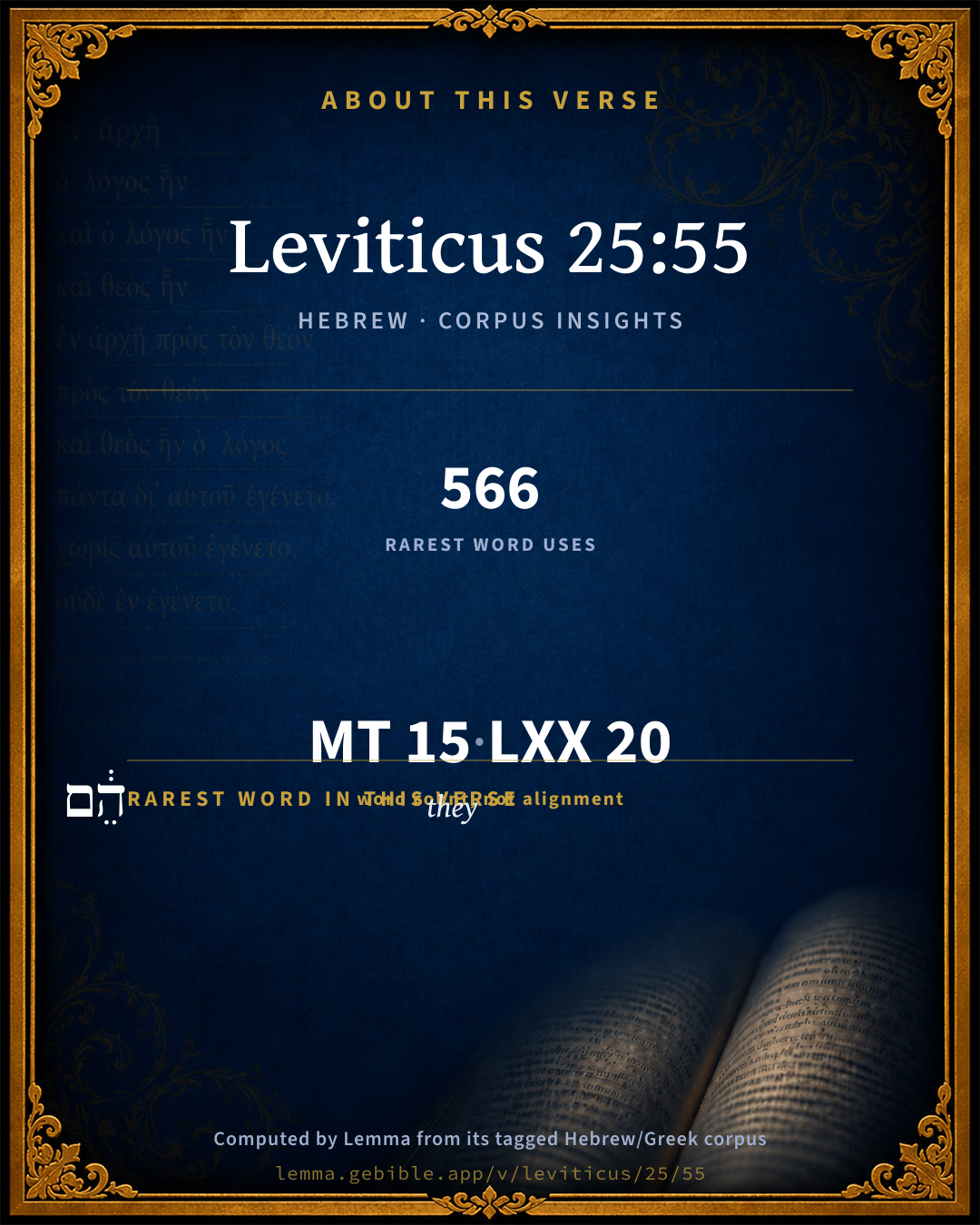
These counts appear in no published source. They are computed here, from the morphology-tagged text and Lemma’s own curated glosses. What Lemma adds →

15
words
13
distinct lemmas
Pentateuch
section

Grammatical profile

  • 1 verb
  • 8 nouns
  • 2 pronouns
  • 1 preposition
  • 1 conjunction
  • 2 particles

Verb forms

  • הוֹצֵ֥אתִי Hiphil · Perfect

Repetition

A word recurs within this verse — often emphatic in Hebrew:

  • עֲבָדִ֔ים servant H5650 ×2

Hebrew & Septuagint length

In English translation the verse runs 28 words from the Hebrew and 21 from the Septuagint (LXX English) — closely comparable.

A rough comparison of the two English renderings, which tokenize alike — not a word-level alignment.

Word counts can differ between the Hebrew and the Greek without any difference in meaning — e.g. the Hebrew direct-object marker אֵת has no separate Greek word, and Greek often adds the article ὁ.

In the original languages it is 15 Hebrew tokens and 20 Greek tokens — but the two are counted differently (Hebrew bundles its prefixes and suffixes into one token; the Greek is in lemma form), so that isn’t a like-for-like length.

Cross-references

13

Topical passages linked to Leviticus 25:55 in the Treasury of Scripture Knowledge — connected by theme and wording, ordered by reader-vote popularity; previews shown in the World English Bible.

  • Leviticus 25:42 For they are my servants, whom I brought forth out of the land of Egypt. They shall not be sold as slaves.
  • Exodus 13:3 Moses said to the people, "Remember this day, in which you came out from Egypt, out of the house of bondage; for by strength of hand Yahweh brought you out from this place. No leavened bread shall be eaten.
  • Exodus 20:2 "I am Yahweh your God, who brought you out of the land of Egypt, out of the house of bondage.
  • Psalms 116:16 Yahweh, truly I am your servant. I am your servant, the son of your handmaid. You have freed me from my chains.
  • Isaiah 43:3 For I am Yahweh your God, the Holy One of Israel, your Savior; I have given Egypt as your ransom, Ethiopia and Seba in your place.
  • Luke 1:74–75 To grant to us that we, being delivered out of the hand of our enemies, should serve him without fear,
  • Romans 6:14 For sin will not have dominion over you. For you are not under law, but under grace.
  • Romans 6:17–18 But thanks be to God, that, whereas you were bondservants of sin, you became obedient from the heart to that form of teaching whereunto you were delivered.
  • Romans 6:22 But now, being made free from sin, and having become servants of God, you have your fruit of sanctification, and the result of eternal life.
  • 1 Corinthians 7:22–23 For he who was called in the Lord being a bondservant is the Lord's free man. Likewise he who was called being free is Christ's bondservant.
  • 1 Corinthians 9:19 For though I was free from all, I brought myself under bondage to all, that I might gain the more.
  • 1 Corinthians 9:21 to those who are without law, as without law (not being without law toward God, but under law toward Christ), that I might win those who are without law.
  • Galatians 5:13 For you, brothers, were called for freedom. Only don't use your freedom for gain to the flesh, but through love be servants to one another.

Cross-references courtesy of OpenBible.info (CC BY 4.0).

Hebrew and Greek witnesses Masoretic Hebrew ↔ Greek Septuagint

The same verse in the two great witnesses to the Old Testament, shown verse-for-verse.

These are two independent witnesses, not word-aligned to each other, and the Septuagint is shown in lemma (dictionary) form.

Hebrew Leviticus 25:55 Masoretic · Westminster Leningrad Codex

כִּֽי לִ֤י בְנֵֽי יִשְׂרָאֵל֙ עֲבָדִ֔ים עֲבָדַ֣י הֵ֔ם אֲשֶׁר הוֹצֵ֥אתִי אוֹתָ֖ם מֵאֶ֣רֶץ מִצְרָ֑יִם אֲנִ֖י יְהוָ֥ה אֱלֹהֵיכֶֽם

For to me the children of Israel are servants; they are my servants whom I brought forth out of the land of Egypt. I am Yahweh your God.

World English Bible · Public Domain

Greek LXX Leviticus 25:55 Septuagint · lemma form

ὅτι ἐγώ ὁ υἱός ἰσραήλ οἰκέτης παῖς ἐγώ οὗτος εἰμί ὅς ἐκἄγω ἐκ γῆ αἴγυπτος ἐγώ κύριος ὁ θεός σύ

For the children of Israel are my servants: they are my attendants, whom I brought out of the land of Egypt.

LXX2012 (modern English Septuagint) · Public Domain

Hebrew: Westminster Leningrad Codex (CC BY 4.0). Greek: Septuagint (public domain); English from LXX2012 (modern English Septuagint) (Public Domain). How the Septuagint differs from the Hebrew →

Targum (Aramaic paraphrase)

2

The Targum is the ancient Jewish Aramaic paraphrase of the Hebrew Scriptures — an interpretive translation, not the Hebrew text itself. Onkelos (literal) and Pseudo-Jonathan (expansive) render the Torah, and Jonathan the Prophets. Coverage is partial: where no permissively-licensed English translation exists for a verse, only the Aramaic is shown. This is verse-level text, not a word-by-word alignment to the Hebrew.

  1. Targum Onkelos Torah (Genesis–Deuteronomy)
    אֲרֵי דִילִי בְנֵי יִשְׂרָאֵל עַבְדִין עַבְדַי אִנוּן דִי אַפֵּקִית יָתְהוֹן מֵאַרְעָא דְמִצְרָיִם אֲנָא יְיָ אֱלָהֲכוֹן

    (no public-domain English translation for this verse)

    Targum Onkelos — Aramaic: “Onkelos Genesis” (public domain); “Onkelos Exodus” (public domain); “Onkelos Leviticus” (public domain); “Onkelos Numbers” (public domain); “Onkelos Deuteronomy” (public domain). English: “Sefaria Community Translation” (CC0 1.0 (public-domain dedication)); “J.W. Etheridge. The Targums of Onkelos and Jonathan Ben Uzziel on the Pentateuch. London: Longmans, Green, 1862” (public domain). Text via Sefaria.

  2. Targum Pseudo-Jonathan Torah (Genesis–Deuteronomy)
    אֲרוּם דִילִי הִינוּן בְּנֵי יִשְרָאֵל מִשְׁתַּעְבְּדוּן לְאוֹרַיְיתָא עַבְדַי הִינוּן דְאַפֵּיקִית יַתְהוֹן פְּרִיקִין מֵאַרְעָא דְמִצְרַיִם אֲנָא הוּא יְיָ אֱלָהָכוֹן

    For the sons of Israel are Mine, to obey My laws; servants are they whom I brought out redeemed from the land of Mizraim. I am the Lord your God.

    Targum Pseudo-Jonathan — Aramaic: “Targum Jonathan on Genesis” (public domain); “Targum Jonathan on Exodus” (public domain); “Targum Jonathan on Leviticus” (public domain); “Targum Jonathan on Numbers” (public domain); “Targum Jonathan on Deuteronomy” (public domain). English: “The Targum of Jonathan ben Uzziel, trans. J. W. Etheridge, London, 1862” (public domain). Text via Sefaria.

Commentary

Notes on Leviticus 25:55 from classic Christian and Jewish commentators (each source and its license shown beneath its notes). The classic Christian expositions comment on the surrounding passage and are grouped to its opening verse, so a note may address several verses; the Jewish commentaries on the Tanakh (Rashi and others) are per-verse, so they appear only where the commentator wrote on this verse.

Lemma curates 59 commentaries, every one of them public domain or Creative Commons licensed, each selected and text-cleaned for this edition rather than reprinted as found. About our sources →

Adam Clarke's Commentary

Verse 55. For unto me the children of Israel are servants] The reason of this law we have already seen, (See Clarke on Le 25:42,) but we must look farther to see the great end of it. The Israelites were a typical people; they represented those under the Gospel dispensation who are children of God by faith in Christ Jesus. But these last have a peculiarity of blessing: they are not merely servants, but they are SONS; though they also serve God, yet it is in the newness of the spirit, and not in the oldness of the letter. And to this difference of state the apostle seems evidently to allude, Ga 4:6, c.: And because ye are SONS, God hath sent forth the Spirit of his Son into your hearts, crying Abba, Father. Wherefore thou art no more a SERVANT, but a SON and if a SON, then an HEIR of God through Christ; genuine believers in Christ not being heirs of an earthly inheritance, nor merely of a heavenly one, for they are heirs of God. God himself therefore is their portion, without whom even heaven itself would not be a state of consummate blessedness to an immortal spirit.

THE jubilee was a wonderful institution, and was of very great service to the religion, freedom, and independence of the Jewish people. "The motive of this law," says Calmet, "was to prevent the rich from oppressing the poor, and reducing them to perpetual slavery; and that they should not get possession of all the lands by way of purchase, mortgage, or, lastly, usurpation. That debts should not be multiplied too much, lest thereby the poor should be entirely ruined; and that slaves should not continue always, they, their wives and children, in servitude. Besides, Moses intended to preserve, as much as possible, personal liberty, an equality of property, and the regular order of families, among the Hebrews. Lastly, he designed that the people should be strongly attached to their country, lands, and inheritances; that they should have an affection for them, and consider them as estates which descended to them from their ancestors which they were to leave to their posterity, without any fear of their going ultimately out of their families."

But this institution especially pointed out the redemption of man by Christ Jesus:

1. Through him, he who was in debt to God's justice had his debt discharged, and his sin forgiven.

2. He who sold himself for naught, who was a bondslave of sin and Satan, regains his liberty and becomes a son of God through faith in his blood.

3. He who by transgression had forfeited all right and title to the kingdom of God, becomes an heir of God, and a joint heir with Christ. Heaven, his forfeited inheritance, is restored, for the kingdom of heaven is open to all believers; and thus, redeemed from his debt, restored to his liberty, united to the heavenly family, and re-entitled to his inheritance, he goes on his way rejoicing, till he enters the paradise of his Maker, and is for ever with the Lord.

Reader, hast thou applied for this redemption? Does not the trumpet of the jubilee, the glad tidings of salvation by Christ Jesus, sound in the land? Surely it does. Why then continue a bond-slave of sin, a child of wrath, and an heir of hell, when such a salvation is offered unto thee without money and without price? O suffer not this provision to be made ultimately in vain for thee! For what art thou advantaged if thou gain the whole world and lose thy soul?

Adam Clarke's Commentary on the Bible (1810–1826) — public domain. Text from a community e-Sword/MySword module.

Ellicott's Commentary for English Readers

(55) For unto me the children of Israel are servants.—See Lev_25:38; Lev_25:42.

A Bible Commentary for English Readers, edited by Charles John Ellicott (1878–1897) — public domain. Text from a community e-Sword module.

The Cambridge Bible for Schools and Colleges

gen. ed. J. J. S. Perowne

55. Cp. Lev_25:23; Lev_25:42.

The Cambridge Bible for Schools and Colleges (gen. ed. J. J. S. Perowne; Cambridge University Press, 1878–1918) — public domain. Text from a community e-Sword module.

John Gill's Exposition

For unto me the children of Israel are servants,.... And therefore not to be perpetual servants to men, as those who are bought and redeemed by the blood of Christ should not be, Co1 7:23; The Targum of Jonathan is, servants to my law; see Rom 7:25; those that are redeemed by Christ are also servants to his Gospel, and obey from their heart the form and doctrine delivered to them;

they are my servants, whom I brought forth out of the land of Egypt: where they were in cruel bondage, and made to serve with rigour, but now, being delivered from thence, were laid under obligation to serve the Lord; nor was it his will that others should rule over them with rigour, whether of their own nation or strangers, or that they should be bondmen and bondmaids, or perpetual servants to any:

I am the Lord your God; their covenant God, who had been kind to them, particularly in the instance mentioned, and would take care that they should not be ill used by others, and therefore ought to serve him readily and cheerfully.

Next: Leviticus Chapter 26

John Gill's Exposition of the Whole Bible (1746–1763) — public domain (CC PDM 1.0). Text via the HelloAO Bible API.

Whedon's Commentary on the Bible

Daniel D. Whedon

55. They are my servants — The term servant here implies property. Hence the Hebrews could never rightfully sell themselves to others as merchandise. No Hebrew had a right to enslave himself. He could only sell his labour till the jubilee. This limit was fixed as a safeguard against involuntary and unlimited slavery. “This is a remarkable expression as connected with the fact of which God is always reminding the children of Israel, namely, that he brought them out of the house of bondage and out of the land of Egypt. He appears to acquire his hold upon their confidence by continually reminding them that at one period of their history they were bondmen. Now he insists that the men whom he has brought into liberty have been brought only into another kind of service. This is the necessity of finite life. Every liberty is in some sense a bondage.” — Joseph Parker.

Daniel D. Whedon (gen. ed.), Commentary on the Old and New Testaments (1874–1909) — public domain. Text from a community e-Sword module.

Rashi

Rabbi Shlomo Yitzchaki (Rashi)

כי לי מי ישראל עבדים FOR UNTO ME THE CHILDREN OF ISRAEL ARE SERVANTS — My document (deed of purchase) is of an earlier date (cf. Rashi on v. 42).

אני ה׳ אלהיכם I AM THE LORD YOUR GOD — Whosoever enslaves thee (the Israelites) on earth enslaves, as it were, Him in Heaven (Sifra, Behar, Chapter 9 4).

Rashi on the Tanakh — English translations: “The Judaica Press complete Tanach with Rashi, translated by A. J. Rosenberg” (CC BY 4.0); “Pentateuch with Rashi's commentary by M. Rosenbaum and A.M. Silbermann, 1929-1934” (public domain); “The Metsudah Tanach series, Lakewood, N.J” (CC BY 4.0); and “The Book of Joshua, Metsudah Publications, 1997” (CC BY 4.0). Text via Sefaria.

Lesson kit

Teaching starters — assembled from the data on this page, not authored interpretation. Every prompt links to the verse data it draws on. Edit before teaching.

Leviticus, in the Pentateuch, opens this verse with 15 words (13 distinct Hebrew lemmas). Its most distinctive word is hêm (“they”). A historical commentator’s framing appears above. Read the whole chapter for the surrounding context.

Discussion questions

  1. The word hêm carries the sense “they.” How does it shape the verse?
  2. How does Leviticus 25:42, which shares this passage’s theme, read alongside this verse?
  3. What does the repetition of “servant” (2× in this one verse) do in this verse?
  4. These translations render this verse differently; the difference is in the English rendering, not the original. What questions does that raise?
  5. «הוֹצֵ֥אתִי» is a Hiphil Perfect verb. How does that grammatical form shape the action described?
  6. Compare how Adam Clarke's Commentary and Ellicott's Commentary for English Readers read this verse. Where do they agree or differ?

Things to notice

Reading settings

Reading text

Shown beneath each verse's original-language words.

Old Testament
Old Testament edition

Read the OT as the Masoretic Hebrew (MT) or the Greek Septuagint (LXX).

English shown for the Greek Septuagint (in the Hebrew ↔ Greek comparison).

Comparing translations? Open the Compare panel on any verse page to stack up to four side by side.