
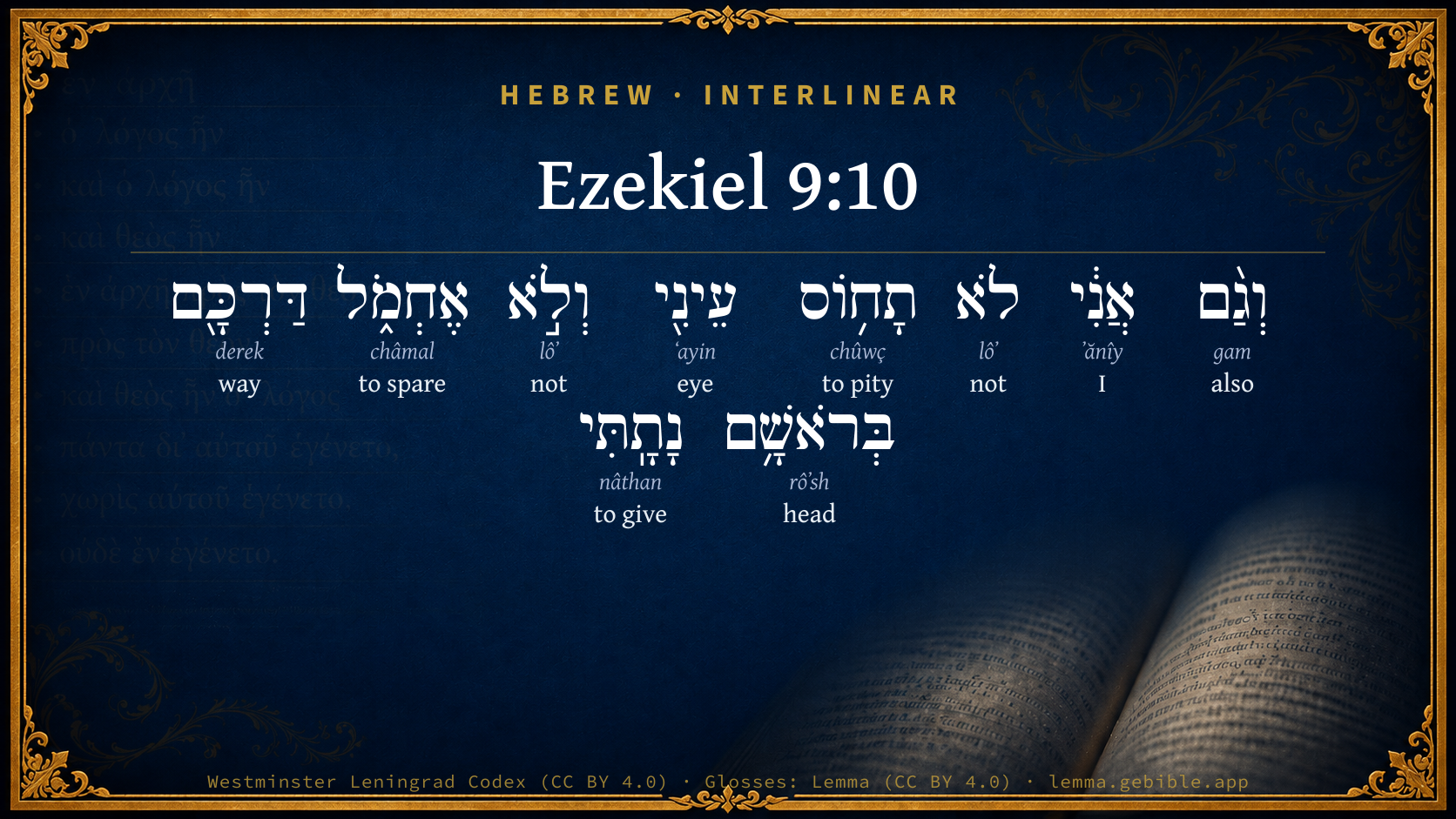
Ezekiel 9:10

Hebrew (Westminster Leningrad Codex) Ezekiel 9:10 appears in the Hebrew Old Testament. The text above is from the Westminster Leningrad Codex. Each word links to its Strong’s number, a concise gloss, and parsing drawn from the Open Scriptures Hebrew Bible morphology. Click any word for its full Brown-Driver-Briggs (BDB) entry.
Download image
Cite this verse

Ezekiel 9:10 (World English Bible). Public Domain. Lemma interlinear Bible study tool, https://lemma.gebible.app/v/ezekiel/9/10.

Show BibTeX & RIS
BibTeX
RIS
English Translation
As for me also, my eye shall not spare, neither will I have pity, but I will bring their way on their head.
World English Bible · Public Domain
Download a study sheet

One document with this verse’s original text, its word-by-word gloss line, the meaning frame, cross-references with their text, attributed commentary, and full source and license credits — printable, and it pastes into notes with its structure intact.

This verse Autodidact and up

Study sheet (.html) Plain text (.txt)

A passage Seminary Student

Up to 50 verses in one chapter. A passage sheet keeps up to 6 commentary sources and 12 cross-references per verse, in the order this page ranks them, and says so on the sheet whenever that leaves anything out. Ask for a single verse and you get the Autodidact verse sheet above.

Everything on this page stays free to read, with no account — the sheet is a download of what is already on screen, not access to it.

Want to remove ads? Support Godless Engineer
Compare translations 3

The same verse in 3 English versions, stacked beneath the original-language interlinear above. Click any original word for its lexicon entry.

Each is an independent rendering of the whole verse — the interlinear is not word-aligned to these translations.

Highlighted words mark where these versions differ — a whole-verse word diff, not a word-by-word alignment.

  • World English Bible Public Domain
    As for me also, my eye shall not spare, neither will I have pity, but I will bring their way on their head.
  • King James Version Public Domain
    And as for me also, mine eye shall not spare, neither will I have pity, but I will recompense their way upon their head.
  • unfoldingWord Literal Text CC BY-SA 4.0
    So then, my eye will not look with compassion, and I will not spare them. I will instead bring it all on their heads.”

unfoldingWord Literal Text — © unfoldingWord, licensed CC BY-SA 4.0. Word-aligned USFM3 via Door43 (git.door43.org/unfoldingWord/en_ult).

Versions to compare (up to 4)

3 of 4 selected

Show all 18 translations

Every available English version of this verse, each an independent rendering of the whole verse.

  • World English Bible Public Domain
    As for me also, my eye shall not spare, neither will I have pity, but I will bring their way on their head.
  • Berean Standard Bible Public Domain
    But as for Me, I will not look on them with pity, nor will I spare them. I will bring their deeds down upon their own heads.”
  • Majority Standard Bible Public Domain
    But as for Me, I will not look on them with pity, nor will I spare them. I will bring their deeds down upon their own heads.”
  • King James Version Public Domain
    And as for me also, mine eye shall not spare, neither will I have pity, but I will recompense their way upon their head.
  • American Standard Version (1901) Public Domain
    And as for me also, mine eye shall not spare, neither will I have pity, but I will bring their way upon their head.
  • Revised Version (1885) Public Domain
    And as for me also, mine eye shall not spare, neither will I have pity, but I will bring their way upon their head.
  • Geneva Bible (1599) Public Domain
    As touching me also, mine eye shall not spare them, neither will I haue pitie, but will recompence their wayes vpon their heades.
  • Douay-Rheims (1899) Public Domain
    Therefore neither shall my eye spare, nor will I have pity: I will requite their way upon their head.
  • Young's Literal Translation Public Domain
    And I also, Mine eye doth not pity, nor do I spare; their way on their own head I have put.'
  • Literal Standard Version CC BY-SA 4.0
    And I also, My eye does not pity, nor do I spare; I have put their way on their own head.”
  • Unlocked Literal Bible CC BY-SA 4.0
    So then, my eye will not look with compassion, and I will not spare them. I will instead bring it all on their heads.”
  • unfoldingWord Literal Text CC BY-SA 4.0
    So then, my eye will not look with compassion, and I will not spare them. I will instead bring it all on their heads.”
  • Darby Bible Public Domain
    And as for me also, mine eye shall not spare, neither will I have pity: I will recompense their way upon their head.
  • World Messianic Bible Public Domain
    As for me also, my eye won’t spare, neither will I have pity, but I will bring their way on their head.”
  • Webster's Bible Public Domain
    And as for me also, my eye shall not spare, neither will I have pity, but I will recompense their way upon their head.
  • Free Bible Version CC BY-SA 4.0
    But I certainly won't be kind to them or have mercy on them. I will make sure they suffer the consequences of what they've done.”
  • Bible in Basic English Public Domain
    And as for me, my eye will not have mercy, and I will have no pity, but I will send the punishment of their ways on their heads.
  • JPS Tanakh (1917) Public Domain
    And as for Me also, Mine eye shall not spare, neither will I have pity, but I will bring their way upon their head.'

Literal Standard Version (2020), Covenant Press — licensed CC BY-SA 4.0. Text via the HelloAO Bible API (eBible.org). Unlocked Literal Bible (unfoldingWord) — licensed CC BY-SA 4.0. Text via the HelloAO Bible API (eBible.org). unfoldingWord Literal Text — © unfoldingWord, licensed CC BY-SA 4.0. Word-aligned USFM3 via Door43 (git.door43.org/unfoldingWord/en_ult). Free Bible Version, Dr. Jonathan Gallagher — licensed CC BY-SA 4.0. Text via the HelloAO Bible API (eBible.org).

Word by word

More ways to search: Search by grammar → Find every occurrence → Compare this word →

Practice this passage: Drill this verse → Learn its vocabulary →

תָח֥וֹס
chûwç
H2347
“to pity”
Verb, Qal, Imperfect, 3rd Person, Feminine, Singular
Part of Speech
Verb
Stem
Qal
Form
Imperfect
Person
3rd Person
Gender
Feminine
Number
Singular
Full BDB Definition

Origin: a primitive root

TWOT: 626

(Qal) to pity, have compassion, spare, look upon with compassion
  1. וְגַ֨ם gam H1571 “and · also” Conjunction + Particle, Accusative
  2. אֲנִ֔י ʼănîy H589 “I” Pronoun, Personal, 1st Person, Common, Singular
  3. לֹא lôʼ H3808 “not” Particle, Negative
  4. עֵינִ֖י ʻayin H5869 “eye · my” Noun, Common, Both, Singular, Construct + Suffix, Personal, 1st Person, Common, Singular
  5. וְלֹ֣א lôʼ H3808 “and · not” Conjunction + Particle, Negative
  6. אֶחְמֹ֑ל châmal H2550 “to spare” Verb, Qal, Imperfect, 1st Person, Common, Singular
  7. דַּרְכָּ֖ם derek H1870 “way · their” Noun, Common, Both, Singular, Construct + Suffix, Personal, 3rd Person, Masculine, Plural
  8. בְּרֹאשָׁ֥ם rôʼsh H7218 “in/at · head · their” Preposition + Noun, Common, Masculine, Singular, Construct + Suffix, Personal, 3rd Person, Masculine, Plural
  9. נָתָֽתִּי nâthan H5414 “to give” Verb, Qal, Perfect, 1st Person, Common, Singular

About this verse

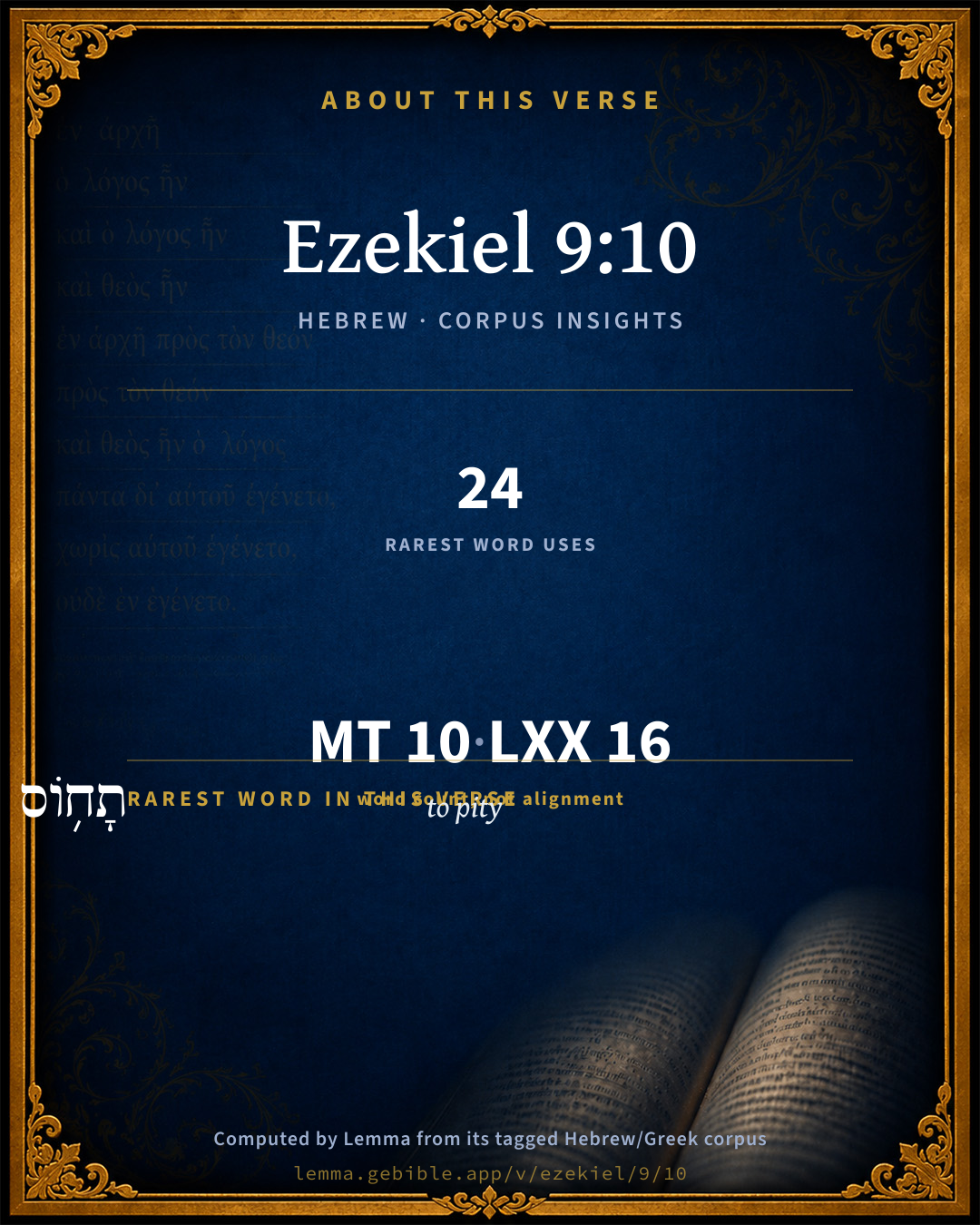
These counts appear in no published source. They are computed here, from the morphology-tagged text and Lemma’s own curated glosses. What Lemma adds →

10
words
9
distinct lemmas
Prophets
section

Notable vocabulary

The rarest word here is תָח֥וֹס to pity H2347 — appearing just 24 times in the whole Hebrew Bible.

Shared distinctive vocabulary

תָח֥וֹס to pity H2347 occurs in 24 verses of the Hebrew Bible. Also found in:

Grammatical profile

  • 3 verbs
  • 3 nouns
  • 1 pronoun
  • 3 particles

Verb forms

  • תָח֥וֹס Qal · Imperfect
  • אֶחְמֹ֑ל Qal · Imperfect
  • נָתָֽתִּי Qal · Perfect

Repetition

A word recurs within this verse — often emphatic in Hebrew:

Hebrew & Septuagint length

In English translation the verse runs 23 words from the Hebrew and 20 from the Septuagint (LXX English) — closely comparable.

A rough comparison of the two English renderings, which tokenize alike — not a word-level alignment.

Word counts can differ between the Hebrew and the Greek without any difference in meaning — e.g. the Hebrew direct-object marker אֵת has no separate Greek word, and Greek often adds the article ὁ.

In the original languages it is 10 Hebrew tokens and 16 Greek tokens — but the two are counted differently (Hebrew bundles its prefixes and suffixes into one token; the Greek is in lemma form), so that isn’t a like-for-like length.

Cross-references

14

Topical passages linked to Ezekiel 9:10 in the Treasury of Scripture Knowledge — connected by theme and wording, ordered by reader-vote popularity; previews shown in the World English Bible.

  • Ezekiel 7:4 My eye shall not spare you, neither will I have pity; but I will bring your ways on you, and your abominations shall be in the midst of you: and you shall know that I am Yahweh.
  • Isaiah 65:6 Behold, it is written before me: I will not keep silence, but will recompense, yes, I will recompense into their bosom,
  • Ezekiel 8:18 Therefore will I also deal in wrath; my eye shall not spare, neither will I have pity; and though they cry in my ears with a loud voice, yet will I not hear them.
  • Ezekiel 11:21 But as for them whose heart walks after the heart of their detestable things and their abominations, I will bring their way on their own heads, says the Lord Yahweh.
  • Ezekiel 5:11 Therefore, as I live, says the Lord Yahweh, surely, because you have defiled my sanctuary with all your detestable things, and with all your abominations, therefore will I also diminish [you]; neither shall my eye spare, and I also will have no pity.
  • Hosea 9:7 The days of visitation have come. The days of reckoning have come. Israel will consider the prophet to be a fool, And the man who is inspired to be insane, Because of the abundance of your sins, And because your hostility is great.
  • Deuteronomy 32:41 If I whet my glittering sword, My hand take hold on judgment; I will render vengeance to my adversaries, Will recompense those who hate me.
  • 2 Chronicles 6:23 then hear from heaven, and do, and judge your servants, requiting the wicked, to bring his way on his own head; and justifying the righteous, to give him according to his righteousness.
  • Ezekiel 7:8–9 Now will I shortly pour out my wrath on you, and accomplish my anger against you, and will judge you according to your ways; and I will bring on you all your abominations.
  • Ezekiel 9:5 To the others he said in my hearing, Go you through the city after him, and strike: don't let your eye spare, neither have you pity;
  • Ezekiel 21:31–32 I will pour out my indignation on you; I will blow on you with the fire of my wrath; and I will deliver you into the hand of brutish men, skillful to destroy.
  • Ezekiel 22:31 Therefore have I poured out my indignation on them; I have consumed them with the fire of my wrath: their own way have I brought on their heads, says the Lord Yahweh.
  • Joel 3:4 "Yes, and what are you to me, Tyre, and Sidon, And all the regions of Philistia? Will you repay me? And if you repay me, I will swiftly and speedily return your repayment on your own head.
  • Hebrews 10:30 For we know him who said, "Vengeance belongs to me," says the Lord, "I will repay." Again, "The Lord will judge his people."

Cross-references courtesy of OpenBible.info (CC BY 4.0).

Hebrew and Greek witnesses Masoretic Hebrew ↔ Greek Septuagint

The same verse in the two great witnesses to the Old Testament, shown verse-for-verse.

These are two independent witnesses, not word-aligned to each other, and the Septuagint is shown in lemma (dictionary) form.

Hebrew Ezekiel 9:10 Masoretic · Westminster Leningrad Codex

וְגַ֨ם אֲנִ֔י לֹא תָח֥וֹס עֵינִ֖י וְלֹ֣א אֶחְמֹ֑ל דַּרְכָּ֖ם בְּרֹאשָׁ֥ם נָתָֽתִּי

As for me also, my eye shall not spare, neither will I have pity, but I will bring their way on their head.

World English Bible · Public Domain

Greek LXX Ezekiel 9:10 Septuagint · lemma form

καί οὐ φείδομαι ἐγώ ὁ ὀφθαλμός οὐδέ μή ἐλεέω ὁ ὁδός αὐτός εἰς κεφαλή αὐτός δίδωμι

Therefore my eye shall not spare, neither will I have any mercy: I have recompensed their ways upon their heads.

LXX2012 (modern English Septuagint) · Public Domain

Hebrew: Westminster Leningrad Codex (CC BY 4.0). Greek: Septuagint (public domain); English from LXX2012 (modern English Septuagint) (Public Domain). How the Septuagint differs from the Hebrew →

Targum (Aramaic paraphrase)

1

The Targum is the ancient Jewish Aramaic paraphrase of the Hebrew Scriptures — an interpretive translation, not the Hebrew text itself. Onkelos (literal) and Pseudo-Jonathan (expansive) render the Torah, and Jonathan the Prophets. Coverage is partial: where no permissively-licensed English translation exists for a verse, only the Aramaic is shown. This is verse-level text, not a word-by-word alignment to the Hebrew.

  1. Targum Jonathan Prophets (Joshua–Malachi)
    וְאַף אֲנָא לָא אָחוּס מֵימְרִי וְלָא אַרְחֵים פּוּרְעֲנוּת אוֹרְחַתְהוֹן בְּרֵישֵׁיהוֹן יְהָבִית:

    (no public-domain English translation for this verse)

    Targum Jonathan — Aramaic: “Mikraot Gedolot” (public domain). English: “Sefaria Community Translation” (CC0 1.0 (public-domain dedication)); “London "Chaldee Paraphrase," 1871” (public domain). Text via Sefaria.

Commentary

Notes on Ezekiel 9:10 from classic Christian and Jewish commentators (each source and its license shown beneath its notes). The classic Christian expositions comment on the surrounding passage and are grouped to its opening verse, so a note may address several verses; the Jewish commentaries on the Tanakh (Rashi and others) are per-verse, so they appear only where the commentator wrote on this verse.

Lemma curates 59 commentaries, every one of them public domain or Creative Commons licensed, each selected and text-cleaned for this edition rather than reprinted as found. About our sources →

Trapp's Complete Commentary

John Trapp

Eze 9:10 And as for me also, mine eye shall not spare, neither will I have pity, [but] I will recompense their way upon their head.

Ver. 10. And as for me also.] Quapropter etiam ego, Wherefore also I; and there is a stop by an elegant aposiopesis. {a}

Mine eye shall not spare.] Eze 5:11; Eze 7:4; Eze 8:18. See a just commentary upon these words, Jer 9:3-17.

{a} A rhetorical artifice, in which the speaker comes to a sudden halt, as if unable or unwilling to proceed. ŒD

John Trapp, A Commentary or Exposition upon All the Books of the Old and New Testament (1647–1656) — public domain. Text from a community e-Sword module.

Jamieson, Fausset & Brown

Robert Jamieson, A. R. Fausset & David Brown

mine eye--to show them their mistake in saying, "The Lord seeth not."

recompense their way upon their head-- (Pro 1:31). Retribution in kind.

Jamieson, Fausset & Brown — Commentary Critical and Explanatory on the Whole Bible (1871) — public domain (CC PDM 1.0). Text via the HelloAO Bible API.

Adam Clarke's Commentary

Verse 10. Mine eye shall not spare] They say, the Lord seeth not: this is false; I have seen all their iniquities, and do see all their abominations; and I will bring deserved judgment upon them, and then that eye which now sees will neither pity nor spare.

Adam Clarke's Commentary on the Bible (1810–1826) — public domain. Text from a community e-Sword/MySword module.

John Calvin's Commentaries

Now God pronounces the Jews to be so obstinate in their malice as to have cut off from themselves all hope of pardon. For when he now says, that he would be hostile to them without pity, he shows the necessity of taking vengeance, because their impiety had penetrated even heaven, so that he could not spare them without denying himself. And abrupt speech increases vehemence, as if God pronounced that he had changed his plans. Now then we understand the meaning of this answer, that the Jews were bound by so many and such impious crimes, that they had closed the door of God’s pity: nay, they had compelled him to the utmost pitch of vengeance, because they continued to provoke him more and more. Let us learn then from this passage not to weigh God’s judgments in our scale, because we are too much accustomed to extenuate our sins, and to treat our serious iniquities as but slight errors, because we do not attribute just honor to God as the only judge. Now when God commands his Prophet to rest and be silent, without doubt he at the same time restrains that rashness of ours by which we burst forth in disobedience when he seems to us to be too rigid. But, as I have said, we do not consider the greatness of our sins. Therefore it is God’s province alone to pronounce concerning sins, that no mortal should estimate the quality of actions, for then we trench on God’s peculiar office. It follows —

John Calvin's Commentaries (1540-1563) — public domain. Text from the Calvin Translation Society English edition (1840s-50s) via the Christian Classics Ethereal Library (ccel.org). Calvin's coverage is partial (roughly two-thirds of the Bible); uncommented books and verses are honest gaps, never fabricated. The 19th-century editor's footnotes and remarks are omitted so the notes are faithfully Calvin's own voice.

The Cambridge Bible for Schools and Colleges

gen. ed. J. J. S. Perowne

10. Cf. ch. Eze_5:11, Eze_7:4, Eze_8:18.

The Cambridge Bible for Schools and Colleges (gen. ed. J. J. S. Perowne; Cambridge University Press, 1878–1918) — public domain. Text from a community e-Sword module.

John Gill's Exposition

And as for me also,.... As they have not spared the poor and the needy, the widow and the fatherless, but have perverted their judgment, and shed innocent blood:

mine eye shall not spare, neither will I have pity, but I will recompence their way upon their head; deal with them by the law of retaliation, and reward them according to their deserts; see Eze 7:4.

John Gill's Exposition of the Whole Bible (1746–1763) — public domain (CC PDM 1.0). Text via the HelloAO Bible API.

Matthew Poole's English Annotations

As for me, my resolution is fixed.

Mine eye, that eye they thought did not see to govern, shall see to punish.

I will recompense; they shall find me a Sovereign to vindicate myself, and do justice against their injustice. See Eze 5:11; 7:4.

Matthew Poole's English Annotations on the Holy Bible (1683–1685) — public domain. Text from a community e-Sword/MySword module.

Whedon's Commentary on the Bible

Daniel D. Whedon

10. Mine eye shall not spare — How constantly this terrible statement is repeated (Eze_5:11; Eze_7:4; Eze_8:18). Yet it must be remembered that this was only a prophetic vision of calamities that would certainly come if the people remained impenitent, but which might still be averted. Even the prophecies against Nineveh were recalled when the people repented. All these positive declarations, “mine eye shall not pity,” etc., are conditional upon the persistent and obstinate impiety of the nation; are in reality intended to drive back the people from their wickedness, and seem finally, at least in part, to have attained their merciful object. “The surgeon has a steadier hand than the soldier. His knife is more inexorable than the sword of war (Heb_12:6)” — Adeney.

Daniel D. Whedon (gen. ed.), Commentary on the Old and New Testaments (1874–1909) — public domain. Text from a community e-Sword module.

The Pulpit Commentary

The inexorable God.

We are so accustomed to dwell upon the forbearance, long suffering, and merciful disposition of God, that the inexorable character of his righteousness is not sufficiently considered. There are conditions in which he cannot show mercy.

I GOD WILL NOT SPARE THE IMPENITENT. He pardons on condition of repentance. "If we confess our sins, he is faithful and just to forgive us our sins". (1Jn_1:9) But if we will not humble ourselves to admit our guilt, nor cease to court and favour the things that God hates, it is simply impossible that he should regard us with complacency.

II GOD WILL NOT SPARE ANY FAVOURED PERSONS. The perpetual fallacy of Israel lay in considering itself a privileged nation, sure of the favour of God in spite of its own unfaithfulness, instead of understanding that it stood under covenant relations with him which involved a loyal observance of certain conditions if the Divine blessings were to be received. Christians are in danger of flattering themselves with a similar delusion, nod cast off his own people the Jews when they were faithless. God will cast off a faithless Church. Christians who break away from Christ will merit and will receive the "wrath of the Lamb." Those in highest positions in the Church will find. no immunity. No excuses will be available for real guilt.

III GOD WILL NOT SPARE ANY SIN. He means to destroy sin. If the sinner hold to it and identify his fate with it he must come under the destruction. If he cast it off as an alien, hateful, deadly thing a viper that he has plucked from his bosom God will destroy the sin. In the discipline of the Christian life God is always fighting against sin. He will not cease till he has killed the last of the vile brood of the serpent. Christ has come as the friend of the sinner, and therefore as the enemy of his sin. "He will throughly purge his floor," etc.. (Mat_3:12)

IV GOD WILL NOT SPARE ANY NEEDFUL CHASTISEMENT. It hurts the kind parent to have to chastise his son. Yet it would be an unkindness and a selfishness to spare himself the pain of inflicting wholesome punishment. The surgeon has a steadier hand than the soldier. His knife is more inexorable than the sword of war. The very fact that it cuts to heal makes it the more strong and certain. "Whom the Lord loveth he chasteneth". (Heb_12:6) Therefore the chastisement which love inspires is the more certain to fall.

V GOD DID NOT SPARE HIS OWN SON. (Rom_8:32) In the sacrifice of Christ God showed the firmness and strength of his love to us. A weak and soft love would not have gone to so great a cost. Even the tears of Gethsemane did not move the inexorable God, though, of course, this was really with the consent of Christ, who freely gave himself for as, and to whom therefore no wrong was done.

The Pulpit Commentary (1880–1919), ed. H.D.M. Spence-Jones & Joseph S. Exell — public domain. Text from a community e-Sword module.

Lesson kit

Teaching starters — assembled from the data on this page, not authored interpretation. Every prompt links to the verse data it draws on. Edit before teaching.

Ezekiel, in the Prophets, opens this verse with 10 words (9 distinct Hebrew lemmas). Its most distinctive word is chûwç (“to pity”). A historical commentator’s framing appears above. Read the whole chapter for the surrounding context.

Discussion questions

  1. What does “to pity” (chûwç) contribute to the verse as a whole?
  2. How does Genesis 45:20, which shares the word «to pity», read alongside this verse?
  3. What does the repetition of “not” (2× in this one verse) do in this verse?
  4. The translations on this page render this verse differently — a whole-verse word diff, not a word-by-word alignment. What might account for the different wordings?
  5. «תָח֥וֹס» is a Qal Imperfect verb. How does that grammatical form shape the action described?
  6. Compare how Trapp's Complete Commentary and Jamieson, Fausset & Brown read this verse. Where do they agree or differ?

Things to notice

Reading settings

Reading text

Shown beneath each verse's original-language words.

Old Testament
Old Testament edition

Read the OT as the Masoretic Hebrew (MT) or the Greek Septuagint (LXX).

English shown for the Greek Septuagint (in the Hebrew ↔ Greek comparison).

Comparing translations? Open the Compare panel on any verse page to stack up to four side by side.