
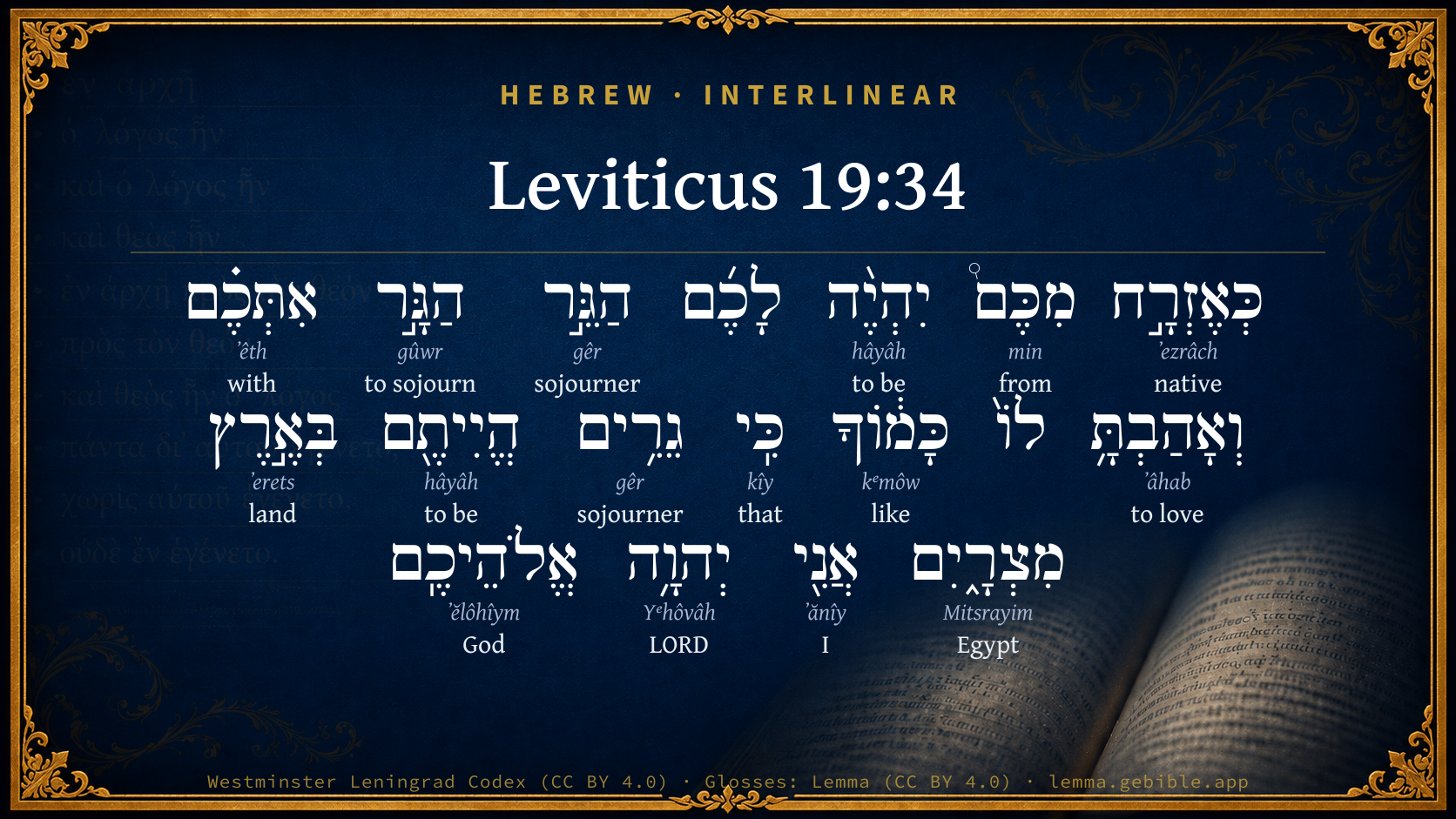
Leviticus 19:34

Hebrew (Westminster Leningrad Codex) Leviticus 19:34 appears in the Hebrew Old Testament. The text above is from the Westminster Leningrad Codex. Each word links to its Strong’s number, a concise gloss, and parsing drawn from the Open Scriptures Hebrew Bible morphology. Click any word for its full Brown-Driver-Briggs (BDB) entry.
Download image
Cite this verse

Leviticus 19:34 (World English Bible). Public Domain. Lemma interlinear Bible study tool, https://lemma.gebible.app/v/leviticus/19/34.

Show BibTeX & RIS
BibTeX
RIS
English Translation
The stranger who lives as a foreigner with you shall be to you as the native-born among you, and you shall love him as yourself; for you lived as foreigners in the land of Egypt. I am Yahweh your God.
World English Bible · Public Domain
Download a study sheet

One document with this verse’s original text, its word-by-word gloss line, the meaning frame, cross-references with their text, attributed commentary, and full source and license credits — printable, and it pastes into notes with its structure intact.

This verse Autodidact and up

Study sheet (.html) Plain text (.txt)

A passage Seminary Student

Up to 50 verses in one chapter. A passage sheet keeps up to 6 commentary sources and 12 cross-references per verse, in the order this page ranks them, and says so on the sheet whenever that leaves anything out. Ask for a single verse and you get the Autodidact verse sheet above.

Everything on this page stays free to read, with no account — the sheet is a download of what is already on screen, not access to it.

Want to remove ads? Support Godless Engineer
Compare translations 3

The same verse in 3 English versions, stacked beneath the original-language interlinear above. Click any original word for its lexicon entry.

Each is an independent rendering of the whole verse — the interlinear is not word-aligned to these translations.

Highlighted words mark where these versions differ — a whole-verse word diff, not a word-by-word alignment.

  • World English Bible Public Domain
    The stranger who lives as a foreigner with you shall be to you as the native-born among you, and you shall love him as yourself; for you lived as foreigners in the land of Egypt. I am Yahweh your God.
  • King James Version Public Domain
    But the stranger that dwelleth with you shall be unto you as one born among you, and thou shalt love him as thyself; for ye were strangers in the land of Egypt: I am the LORD your God.
  • unfoldingWord Literal Text CC BY-SA 4.0
    Like the native-born from you shall be to you the sojourner, the one sojourning with you. And you shall love him as yourself because you were sojourners in the land of Egypt. I Yahweh your God.

unfoldingWord Literal Text — © unfoldingWord, licensed CC BY-SA 4.0. Word-aligned USFM3 via Door43 (git.door43.org/unfoldingWord/en_ult).

Versions to compare (up to 4)

3 of 4 selected

Show all 18 translations

Every available English version of this verse, each an independent rendering of the whole verse.

  • World English Bible Public Domain
    The stranger who lives as a foreigner with you shall be to you as the native-born among you, and you shall love him as yourself; for you lived as foreigners in the land of Egypt. I am Yahweh your God.
  • Berean Standard Bible Public Domain
    You must treat the foreigner living among you as native-born and love him as yourself, for you were foreigners in the land of Egypt. I am the LORD your God.
  • Majority Standard Bible Public Domain
    You must treat the foreigner living among you as native-born and love him as yourself, for you were foreigners in the land of Egypt. I am the LORD your God.
  • King James Version Public Domain
    But the stranger that dwelleth with you shall be unto you as one born among you, and thou shalt love him as thyself; for ye were strangers in the land of Egypt: I am the LORD your God.
  • American Standard Version (1901) Public Domain
    The stranger that sojourneth with you shall be unto you as the home-born among you, and thou shalt love him as thyself; for ye were sojourners in the land of Egypt: I am Jehovah your God.
  • Revised Version (1885) Public Domain
    The stranger that sojourneth with you shall be unto you as the homeborn among you, and thou shalt love him as thyself; for ye were strangers in the land of Egypt: I am the LORD your God.
  • Geneva Bible (1599) Public Domain
    But the stranger that dwelleth with you, shalbe as one of your selues, and thou shalt loue him as thy selfe: for ye were strangers in the lad of Egypt: I am the Lord your God.
  • Douay-Rheims (1899) Public Domain
    But let him be among you as one of the same country: and you shall love him as yourselves: for you were strangers in the land of Egypt. I am the Lord your God.
  • Young's Literal Translation Public Domain
    as a native among you is the sojourner to you who is sojourning with you, and thou hast had love to him as to thyself, for sojourners ye have been in the land of Egypt; I `am' Jehovah your God.
  • Literal Standard Version CC BY-SA 4.0
    the sojourner who is sojourning with you is to you as a native among you, and you have had love for him as for yourself, for you have been sojourners in the land of Egypt; I [am] your God YHWH.
  • Unlocked Literal Bible CC BY-SA 4.0
    The foreigner who lives with you must be to you like the native-born Israelite who lives among you, and you must love him as yourself, because you were foreigners in the land of Egypt. I am Yahweh your God.
  • unfoldingWord Literal Text CC BY-SA 4.0
    Like the native-born from you shall be to you the sojourner, the one sojourning with you. And you shall love him as yourself because you were sojourners in the land of Egypt. I Yahweh your God.
  • Darby Bible Public Domain
    As one born among you shall the stranger who sojourneth with you be unto you; and thou shalt love him as thyself; for ye were strangers in the land of Egypt: I am Jehovah your God.
  • World Messianic Bible Public Domain
    The stranger who lives as a foreigner with you shall be to you as the native-born among you, and you shall love him as yourself; for you lived as foreigners in the land of Egypt. I am the LORD your God.
  • Webster's Bible Public Domain
    But the stranger that dwelleth with you shall be to you as one born among you, and thou shalt love him as thyself; for ye were strangers in the land of Egypt: I am the LORD your God.
  • Free Bible Version CC BY-SA 4.0
    Treat them in the same way as a fellow citizen, and love them as you love yourself, because you were once foreigners living in Egypt. I am the Lord your God.
  • Bible in Basic English Public Domain
    Let him be to you as one of your countrymen and have love for him as for yourself; for you were living in a strange land, in the land of Egypt: I am the Lord your God.
  • JPS Tanakh (1917) Public Domain
    The stranger that sojourneth with you shall be unto you as the home-born among you, and thou shalt love him as thyself; for ye were strangers in the land of Egypt: I am the LORD your God.

Literal Standard Version (2020), Covenant Press — licensed CC BY-SA 4.0. Text via the HelloAO Bible API (eBible.org). Unlocked Literal Bible (unfoldingWord) — licensed CC BY-SA 4.0. Text via the HelloAO Bible API (eBible.org). unfoldingWord Literal Text — © unfoldingWord, licensed CC BY-SA 4.0. Word-aligned USFM3 via Door43 (git.door43.org/unfoldingWord/en_ult). Free Bible Version, Dr. Jonathan Gallagher — licensed CC BY-SA 4.0. Text via the HelloAO Bible API (eBible.org).

Word by word

More ways to search: Search by grammar → Find every occurrence → Compare this word →

Practice this passage: Drill this verse → Learn its vocabulary →

כְּאֶזְרָ֣ח
ʼezrâch
H249
“like/as · native”
Preposition + Noun, Common, Masculine, Singular, Absolute
Part of Speech
Preposition + Noun
Type
Common
Gender
Masculine
Number
Singular
State
Absolute
Full BDB Definition

Origin: from H2224 (in the sense of springing up)

TWOT: 580b

a native (one rising from the soil) - of man, native Israelites - of tree, native (to Israel)
  1. מִכֶּם֩ min H4480 “from · you” Preposition + Suffix, Personal, 2nd Person, Masculine, Plural
  2. יִהְיֶ֨ה hâyâh H1961 “to be” Verb, Qal, Imperfect, 3rd Person, Masculine, Singular
  3. הַגֵּ֣ר gêr H1616 “the · sojourner” Particle, Definite Article + Noun, Common, Masculine, Singular, Absolute
  4. הַגָּ֣ר gûwr H1481 “the · sojourning” Particle, Definite Article + Verb, Qal, Participle Active, Masculine, Singular, Absolute
  5. אִתְּכֶ֗ם ʼêth H854 “with · you” Preposition + Suffix, Personal, 2nd Person, Masculine, Plural
  6. וְאָהַבְתָּ֥ ʼâhab H157 “and · to love” Conjunction + Verb, Qal, Sequential Perfect, 2nd Person, Masculine, Singular
  7. כָּמ֔וֹךָ kᵉmôw H3644 “like · you” Preposition + Suffix, Personal, 2nd Person, Masculine, Singular
  8. כִּֽי kîy H3588 “that” Conjunction
  9. גֵרִ֥ים gêr H1616 “sojourners” Noun, Common, Masculine, Plural, Absolute
  10. הֱיִיתֶ֖ם hâyâh H1961 “to be” Verb, Qal, Perfect, 2nd Person, Masculine, Plural
  11. בְּאֶ֣רֶץ ʼerets H776 “in/at · land of” Preposition + Noun, Common, Both, Singular, Construct
  12. מִצְרָ֑יִם Mitsrayim H4714 “Egypt” Noun, Proper
  13. אֲנִ֖י ʼănîy H589 “I” Pronoun, Personal, 1st Person, Common, Singular
  14. יְהוָ֥ה Yᵉhôvâh H3068 “LORD” Noun, Proper
  15. אֱלֹהֵיכֶֽם ʼĕlôhîym H430 “God(s) · your” Noun, Common, Masculine, Plural, Construct + Suffix, Personal, 2nd Person, Masculine, Plural

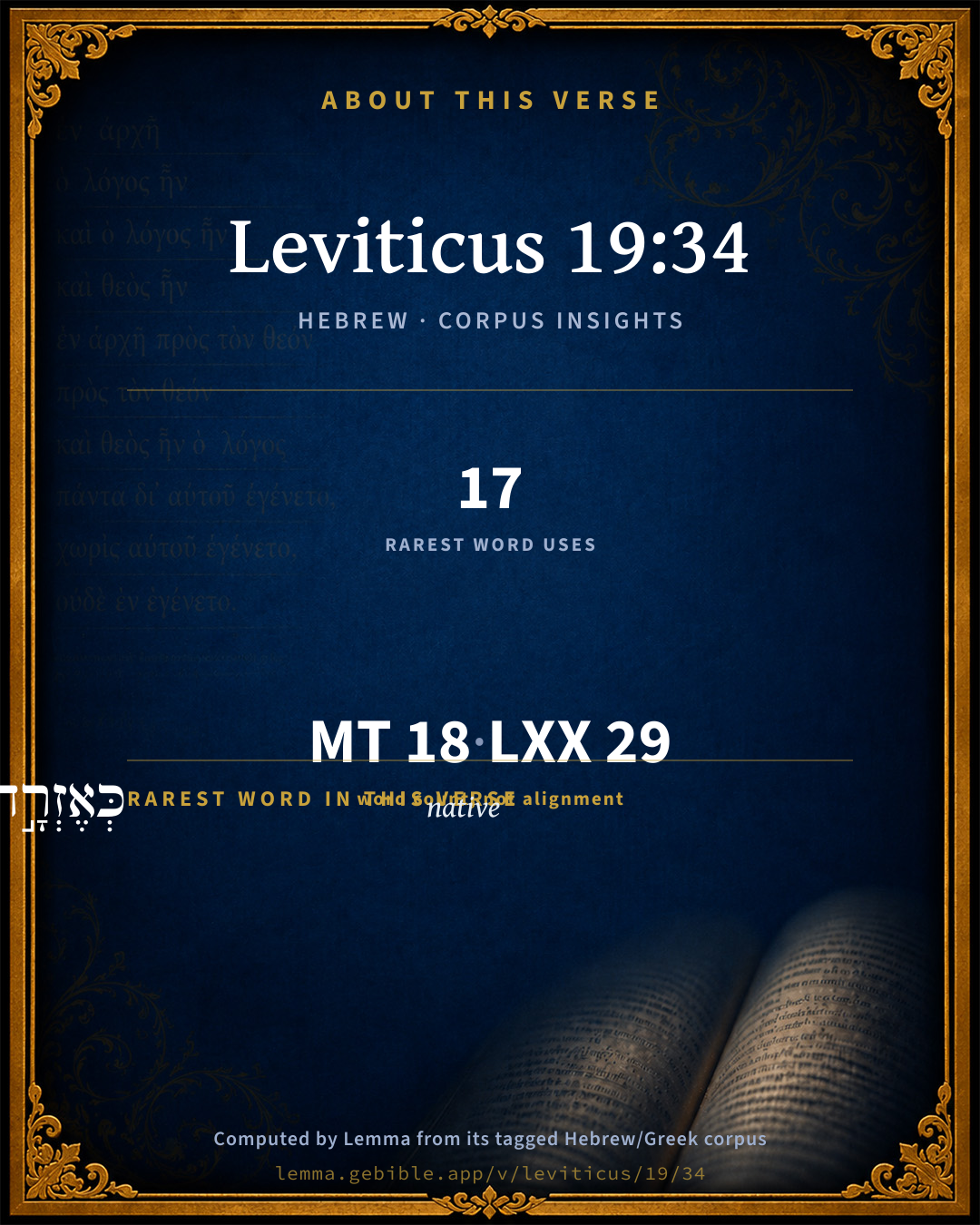
About this verse

These counts appear in no published source. They are computed here, from the morphology-tagged text and Lemma’s own curated glosses. What Lemma adds →

18
words
14
distinct lemmas
Pentateuch
section

Notable vocabulary

The rarest word here is כְּאֶזְרָ֣ח native H249 — appearing just 17 times in the whole Hebrew Bible.

Shared distinctive vocabulary

כְּאֶזְרָ֣ח native H249 occurs in 17 verses of the Hebrew Bible. Also found in:

Grammatical profile

  • 4 verbs
  • 7 nouns
  • 1 pronoun
  • 5 prepositions
  • 1 conjunction

Verb forms

  • יִהְיֶ֨ה Qal · Imperfect
  • הַגָּ֣ר Qal · Participle Active
  • וְאָהַבְתָּ֥ Qal · Sequential Perfect
  • הֱיִיתֶ֖ם Qal · Perfect

Repetition

Words recur within this verse — often emphatic in Hebrew:

  • יִהְיֶ֨ה to be H1961 ×2
  • הַגֵּ֣ר sojourner H1616 ×2

Hebrew & Septuagint length

In English translation the verse runs 40 words from the Hebrew and 35 from the Septuagint (LXX English) — closely comparable.

A rough comparison of the two English renderings, which tokenize alike — not a word-level alignment.

Word counts can differ between the Hebrew and the Greek without any difference in meaning — e.g. the Hebrew direct-object marker אֵת has no separate Greek word, and Greek often adds the article ὁ.

In the original languages it is 18 Hebrew tokens and 29 Greek tokens — but the two are counted differently (Hebrew bundles its prefixes and suffixes into one token; the Greek is in lemma form), so that isn’t a like-for-like length.

Cross-references

4

Topical passages linked to Leviticus 19:34 in the Treasury of Scripture Knowledge — connected by theme and wording, ordered by reader-vote popularity; previews shown in the World English Bible.

  • Deuteronomy 10:19 Therefore love the foreigner; for you were foreigners in the land of Egypt.
  • Leviticus 19:18 You shall not take vengeance, nor bear any grudge against the children of your people; but you shall love your neighbor as yourself. I am Yahweh.
  • Exodus 12:48–49 When a stranger shall live as a foreigner with you, and will keep the Passover to Yahweh, let all his males be circumcised, and then let him come near and keep it; and he shall be as one who is born in the land: but no uncircumcised person shall eat of it.
  • Matthew 5:43 "You have heard that it was said, 'You shall love your neighbor, and hate your enemy.'

Cross-references courtesy of OpenBible.info (CC BY 4.0).

Hebrew and Greek witnesses Masoretic Hebrew ↔ Greek Septuagint

The same verse in the two great witnesses to the Old Testament, shown verse-for-verse.

These are two independent witnesses, not word-aligned to each other, and the Septuagint is shown in lemma (dictionary) form.

Hebrew Leviticus 19:34 Masoretic · Westminster Leningrad Codex

כְּאֶזְרָ֣ח מִכֶּם֩ יִהְיֶ֨ה לָכֶ֜ם הַגֵּ֣ר הַגָּ֣ר אִתְּכֶ֗ם וְאָהַבְתָּ֥ לוֹ֙ כָּמ֔וֹךָ כִּֽי גֵרִ֥ים הֱיִיתֶ֖ם בְּאֶ֣רֶץ מִצְרָ֑יִם אֲנִ֖י יְהוָ֥ה אֱלֹהֵיכֶֽם

The stranger who lives as a foreigner with you shall be to you as the native-born among you, and you shall love him as yourself; for you lived as foreigners in the land of Egypt. I am Yahweh your God.

World English Bible · Public Domain

Greek LXX Leviticus 19:34 Septuagint · lemma form

ὡς ὁ αὐτόχθων ἐν σύ εἰμί ὁ προσήλυτος ὁ προςπορεύομαι πρός σύ καί ἀγαπάω αὐτός ὡς σεαυτοῦ ὅτι προσήλυτος γίγνομαι ἐν γῆ αἴγυπτος ἐγώ εἰμί κύριος ὁ θεός σύ

The stranger that comes to you shall be among you as the native, and you shall love him as yourself; for you⌃ were strangers in the land of Egypt: I am the Lord your God.

LXX2012 (modern English Septuagint) · Public Domain

Hebrew: Westminster Leningrad Codex (CC BY 4.0). Greek: Septuagint (public domain); English from LXX2012 (modern English Septuagint) (Public Domain). How the Septuagint differs from the Hebrew →

Targum (Aramaic paraphrase)

2

The Targum is the ancient Jewish Aramaic paraphrase of the Hebrew Scriptures — an interpretive translation, not the Hebrew text itself. Onkelos (literal) and Pseudo-Jonathan (expansive) render the Torah, and Jonathan the Prophets. Coverage is partial: where no permissively-licensed English translation exists for a verse, only the Aramaic is shown. This is verse-level text, not a word-by-word alignment to the Hebrew.

  1. Targum Onkelos Torah (Genesis–Deuteronomy)
    כְּיַצִיבָא מִנְכוֹן יְהֵי לְכוֹן גִיוֹרָא דְיִתְגַיַר בֵּינֵיכוֹן וּתְרַחֵם לֵהּ כְּוָתָךְ אֲרֵי דַיָרִין הֲוֵיתוּן בְּאַרְעָא דְמִצְרָיִם אֲנָא יְיָ אֱלָהָכוֹן

    (no public-domain English translation for this verse)

    Targum Onkelos — Aramaic: “Onkelos Genesis” (public domain); “Onkelos Exodus” (public domain); “Onkelos Leviticus” (public domain); “Onkelos Numbers” (public domain); “Onkelos Deuteronomy” (public domain). English: “Sefaria Community Translation” (CC0 1.0 (public-domain dedication)); “J.W. Etheridge. The Targums of Onkelos and Jonathan Ben Uzziel on the Pentateuch. London: Longmans, Green, 1862” (public domain). Text via Sefaria.

  2. Targum Pseudo-Jonathan Torah (Genesis–Deuteronomy)
    כְּיַצִיבָא מִנְכוֹן יְהֵי לְכוֹן גִיוֹרָא דְמִתְגַיֵיר עִמְכוֹן וְתִרְחַם לֵיהּ כְּוָותָךְ דְמָא אַתְּ סָנֵי לָךְ לָא תַעֲבֵיד לֵיהּ אֲרוּם דַיְירוּן הֲוֵיתוּן בְּאַרְעָא דְמִצְרַיִם אֲנָא הוּא יְיָ אֱלָהָכוֹן

    but the stranger who sojourneth among you shall be (treated) as the native born, and thou shalt love him as thyseIf: that which is hateful unto thee, thou shalt not do unto him; for ye were sojourners in the land of Mizraim: I am the Lord your God.

    Targum Pseudo-Jonathan — Aramaic: “Targum Jonathan on Genesis” (public domain); “Targum Jonathan on Exodus” (public domain); “Targum Jonathan on Leviticus” (public domain); “Targum Jonathan on Numbers” (public domain); “Targum Jonathan on Deuteronomy” (public domain). English: “The Targum of Jonathan ben Uzziel, trans. J. W. Etheridge, London, 1862” (public domain). Text via Sefaria.

Commentary

Notes on Leviticus 19:34 from classic Christian and Jewish commentators (each source and its license shown beneath its notes). The classic Christian expositions comment on the surrounding passage and are grouped to its opening verse, so a note may address several verses; the Jewish commentaries on the Tanakh (Rashi and others) are per-verse, so they appear only where the commentator wrote on this verse.

Lemma curates 59 commentaries, every one of them public domain or Creative Commons licensed, each selected and text-cleaned for this edition rather than reprinted as found. About our sources →

Trapp's Complete Commentary

John Trapp

Lev 19:34 [But] the stranger that dwelleth with you shall be unto you as one born among you, and thou shalt love him as thyself; for ye were strangers in the land of Egypt: I [am] the LORD your God.

Ver. 34. Shall be unto you as one born among you.] If he be a proselyte.

John Trapp, A Commentary or Exposition upon All the Books of the Old and New Testament (1647–1656) — public domain. Text from a community e-Sword module.

Joseph Benson's Commentary

Lev 19:34. As one born among you — Either, 1st, As to the matters of common right, so it reached to all strangers. Or, 2d, As to church privileges, so concerned only those who were proselytes. Ye were strangers — And therefore are sensible of the fears, distresses, and miseries of such; which call for your pity, and you ought to do to them, as you desired others should do to you, when you were such.

Joseph Benson's Commentary on the Old and New Testaments (1811–1818) — public domain. Text from a community e-Sword module.

Ellicott's Commentary for English Readers

(34)But the stranger that dwelleth.—Better, The stranger that sojourneth. The word “but” is not in the original, and its insertion mars the flow of the passage, whilst the expression rendered in the Authorised Version by “dwelleth” is the same which is translated “sojourn in the preceding verse. This stranger is in every respect to be treated as any other member of the commonwealth, and as a native.

Shalt love him as thyself.—He is not simply to be treated with consideration and courtesy because he is a foreigner, and enjoy the rights and receive the justice due to every human being, but he is to be put on a perfect equality with the ordinary Israelite. Hence the precept laid down in Lev_19:18, “thou shalt love thy neighbour as thyself,” is here enacted with regard to the stranger. It was this humane law which attracted so many strangers to Palestine. Hence we find that in the days of Solomon there were 153,600 strangers in the Holy Land.

For ye were strangers in the land of Egypt.—To enforce these kindly sentiments towards strangers, which was so contrary to the practice of the surrounding nations, who had an inveterate hatred of all foreigners, the lawgiver appeals to their own bitter experience. They knew with what inhumanity they were treated in Egypt because they were strangers, how they had been humiliated and reduced to slavery. The very thought of this will not only soften their hearts, but will enable them to see that the safety of all classes consists in basing our legislation upon the principle of equal rights to all inhabitants. This pathetic appeal is to be found three times more in the Pentateuch to enforce this precept (Exo_22:20; Exo_23:9; Deu_10:19).

A Bible Commentary for English Readers, edited by Charles John Ellicott (1878–1897) — public domain. Text from a community e-Sword module.

John Gill's Exposition

But a stranger that dwelleth with you shall be unto you as one born among you,.... Especially if a proselyte of righteousness; for then he enjoyed the same privileges, civil and religious, the Israelites did, for there was one law for them both, Exo 12:49,

and thou shalt love him as thyself; and show it by doing all the good things for him they would have done for themselves in like circumstances:

for ye were strangers in the land of Egypt: and therefore knew what hardships such were exposed unto; and it became them to put on bowels of compassion, and show pity to those in a like condition, and particularly consider, as Jarchi suggests, that they were idolaters there also, and therefore ought not to upbraid strangers with their former idolatry:

I am the Lord your God; who showed kindness to them when strangers in Egypt, and had brought them out of that land, and therefore ought to obey his commands, and particularly in this instance.

John Gill's Exposition of the Whole Bible (1746–1763) — public domain (CC PDM 1.0). Text via the HelloAO Bible API.

Matthew Poole's English Annotations

As one born among you; either,

1. As to the matters of common right, as it here follows: so it reacheth to all strangers. Or,

2. As to church privileges: so it concerns only those who were proselytes of righteousness.

For ye were strangers; and therefore are sensible of the fears, distresses, and miseries of such, which call for your pity, and you ought to do to them as you would that others should do to you when you were such.

Matthew Poole's English Annotations on the Holy Bible (1683–1685) — public domain. Text from a community e-Sword/MySword module.

Whedon's Commentary on the Bible

Daniel D. Whedon

34. The stranger… thou shalt love — Judaism, as Christianity in the bud, was a religion of love. The Mosaic law here sets up a safeguard against that hostility which is so natural to differences of race and religion that in the Latin tongue the word hostis, stranger, soon came to signify an enemy.

The contempt of the Gentile as a dog, which was manifested in the time of Christ, was no part of true Judaism, but a sad degeneracy from its own law. See Lev_23:22, note. The permission to exact interest on money loaned to a stranger, granted in Deuteronomy xxiii, 20, shows that this verse is not to be understood as making absolutely no distinction between an alien and a Hebrew.

Daniel D. Whedon (gen. ed.), Commentary on the Old and New Testaments (1874–1909) — public domain. Text from a community e-Sword module.

John Wesley's Explanatory Notes

As one born among you - Either 1, as to the matters of common right, so it reacheth to all strangers. Or 2, as to church- privileges, so it concerns only those who were proselytes. Ye were strangers - And therefore are sensible of the fears, distresses, and miseries of such, which call for your pity, and you ought to do to them, as you desired others should do to you, when you were such.

John Wesley, Explanatory Notes Upon the Whole Bible (1754–1765) — public domain. Text via the GEBible commentary corpus.

Rashi

Rabbi Shlomo Yitzchaki (Rashi)

כי גרים הייתם FOR YE WERE STRANGERS [IN THE LAND OF EGYPT] — "Do not reproach thy fellow-man for a fault which is also thine” (cf. Rashi on Exodus 22:20).

אני ה' אלהיכם I AM THE LORD YOUR GOD — Thy God and his God am I! (אלהיכם “your” God — the God of both of you).

Rashi on the Tanakh — English translations: “The Judaica Press complete Tanach with Rashi, translated by A. J. Rosenberg” (CC BY 4.0); “Pentateuch with Rashi's commentary by M. Rosenbaum and A.M. Silbermann, 1929-1934” (public domain); “The Metsudah Tanach series, Lakewood, N.J” (CC BY 4.0); and “The Book of Joshua, Metsudah Publications, 1997” (CC BY 4.0). Text via Sefaria.

Lesson kit

Teaching starters — assembled from the data on this page, not authored interpretation. Every prompt links to the verse data it draws on. Edit before teaching.

Leviticus, in the Pentateuch, opens this verse with 18 words (14 distinct Hebrew lemmas). Its most distinctive word is ʼezrâch (“native”). A historical commentator’s framing appears above. Read the whole chapter for the surrounding context.

Discussion questions

  1. The word ʼezrâch carries the sense “native.” How does it shape the verse?
  2. How does Exodus 12:19, which shares the word «native», read alongside this verse?
  3. What does the repetition of “to be” (2× in this one verse) do in this verse?
  4. These translations render this verse differently; the difference is in the English rendering, not the original. What questions does that raise?
  5. «יִהְיֶ֨ה» is a Qal Imperfect verb. How does that grammatical form shape the action described?
  6. Compare how Trapp's Complete Commentary and Joseph Benson's Commentary read this verse. Where do they agree or differ?

Things to notice

Reading settings

Reading text

Shown beneath each verse's original-language words.

Old Testament
Old Testament edition

Read the OT as the Masoretic Hebrew (MT) or the Greek Septuagint (LXX).

English shown for the Greek Septuagint (in the Hebrew ↔ Greek comparison).

Comparing translations? Open the Compare panel on any verse page to stack up to four side by side.