
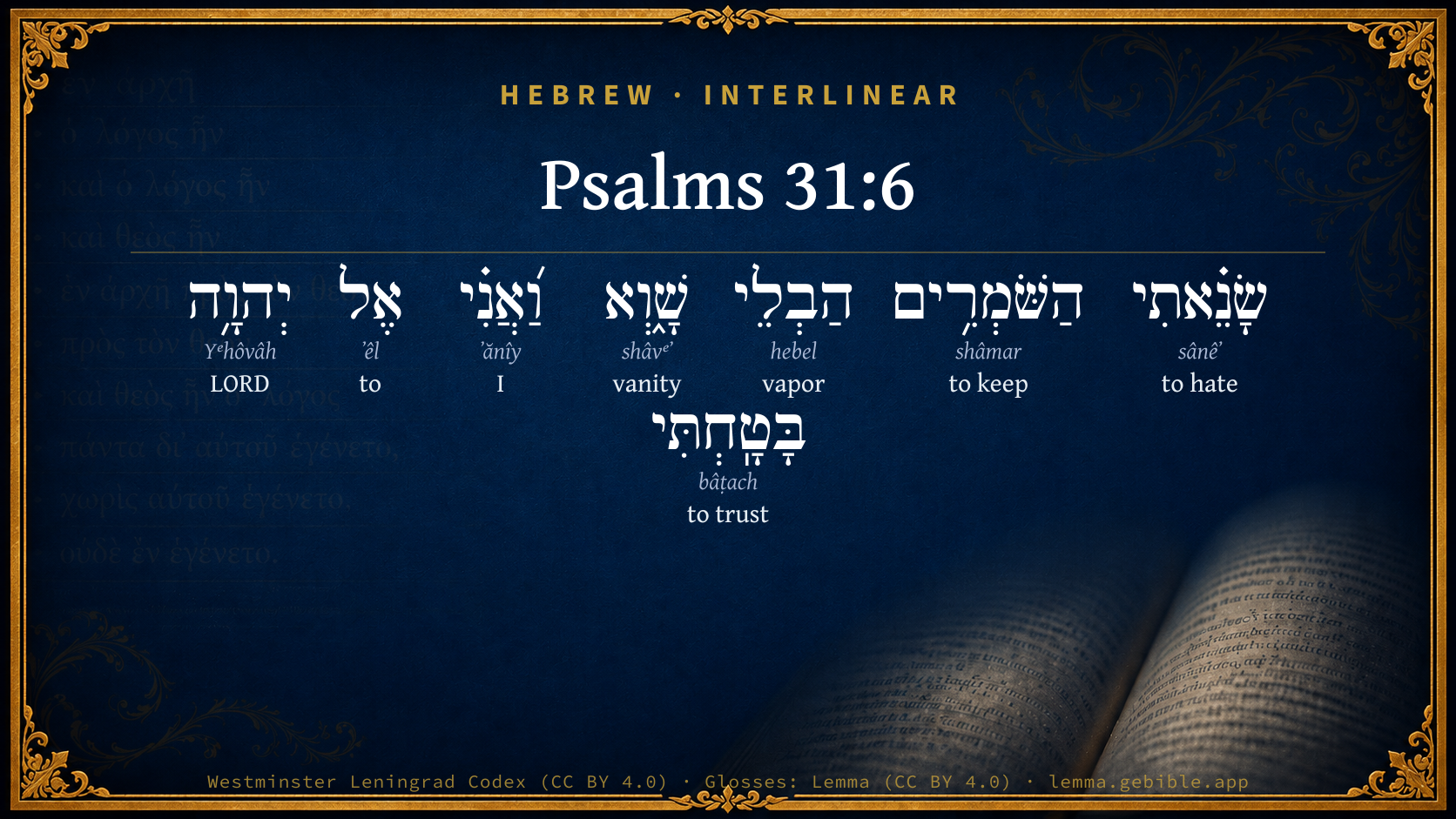
Psalms 31:6

Hebrew (Westminster Leningrad Codex) Psalms 31:6 appears in the Hebrew Old Testament. The text above is from the Westminster Leningrad Codex. Each word links to its Strong’s number, a concise gloss, and parsing drawn from the Open Scriptures Hebrew Bible morphology. Click any word for its full Brown-Driver-Briggs (BDB) entry.
Download image
Cite this verse

Psalms 31:6 (World English Bible). Public Domain. Lemma interlinear Bible study tool, https://lemma.gebible.app/v/psalms/31/6.

Show BibTeX & RIS
BibTeX
RIS
English Translation
I hate those who regard lying vanities, But I trust in Yahweh.
World English Bible · Public Domain
Download a study sheet

One document with this verse’s original text, its word-by-word gloss line, the meaning frame, cross-references with their text, attributed commentary, and full source and license credits — printable, and it pastes into notes with its structure intact.

This verse Autodidact and up

Study sheet (.html) Plain text (.txt)

A passage Seminary Student

Up to 50 verses in one chapter. A passage sheet keeps up to 6 commentary sources and 12 cross-references per verse, in the order this page ranks them, and says so on the sheet whenever that leaves anything out. Ask for a single verse and you get the Autodidact verse sheet above.

Everything on this page stays free to read, with no account — the sheet is a download of what is already on screen, not access to it.

Want to remove ads? Support Godless Engineer
Compare translations 3

The same verse in 3 English versions, stacked beneath the original-language interlinear above. Click any original word for its lexicon entry.

Each is an independent rendering of the whole verse — the interlinear is not word-aligned to these translations.

Highlighted words mark where these versions differ — a whole-verse word diff, not a word-by-word alignment.

  • World English Bible Public Domain
    I hate those who regard lying vanities, But I trust in Yahweh.
  • King James Version Public Domain
    I have hated them that regard lying vanities: but I trust in the LORD.
  • unfoldingWord Literal Text CC BY-SA 4.0
    I hate the ones keeping idols of worthlessness, but I trust in Yahweh.

unfoldingWord Literal Text — © unfoldingWord, licensed CC BY-SA 4.0. Word-aligned USFM3 via Door43 (git.door43.org/unfoldingWord/en_ult).

Versions to compare (up to 4)

3 of 4 selected

Show all 18 translations

Every available English version of this verse, each an independent rendering of the whole verse.

  • World English Bible Public Domain
    I hate those who regard lying vanities, But I trust in Yahweh.
  • Berean Standard Bible Public Domain
    I hate those who cling to worthless idols, but in the LORD I trust.
  • Majority Standard Bible Public Domain
    I hate those who cling to worthless idols, but in the LORD I trust.
  • King James Version Public Domain
    I have hated them that regard lying vanities: but I trust in the LORD.
  • American Standard Version (1901) Public Domain
    I hate them that regard lying vanities; But I trust in Jehovah.
  • Revised Version (1885) Public Domain
    I hate them that regard lying vanities: but I trust in the LORD.
  • Geneva Bible (1599) Public Domain
    I haue hated them that giue them selues to deceitfull vanities: for I trust in the Lord.
  • Douay-Rheims (1899) Public Domain
    Into thy hands I commend my spirit: thou hast redeemed me, O Lord, the God of truth.
  • Young's Literal Translation Public Domain
    I have hated the observers of lying vanities, And I toward Jehovah have been confident.
  • Literal Standard Version CC BY-SA 4.0
    I have hated the observers of lying vanities, || And I have been confident toward YHWH.
  • Unlocked Literal Bible CC BY-SA 4.0
    I hate those who serve worthless idols, but I trust in Yahweh.
  • unfoldingWord Literal Text CC BY-SA 4.0
    I hate the ones keeping idols of worthlessness, but I trust in Yahweh.
  • Darby Bible Public Domain
    I have hated them that observe lying vanities; and as for me, I have confided in Jehovah.
  • World Messianic Bible Public Domain
    I hate those who regard lying vanities, but I trust in the LORD.
  • Webster's Bible Public Domain
    \\31:5\\Into thy hand I commit my spirit: thou hast redeemed me, O LORD God of truth.
  • Free Bible Version CC BY-SA 4.0
    I hate those who devote themselves to pointless idols; I trust in the Lord.
  • Bible in Basic English Public Domain
    I am full of hate for those who go after false gods; but my hope is in the Lord.
  • JPS Tanakh (1917) Public Domain
    (31-7) I hate them that regard lying vanities; but I trust in the LORD.

Literal Standard Version (2020), Covenant Press — licensed CC BY-SA 4.0. Text via the HelloAO Bible API (eBible.org). Unlocked Literal Bible (unfoldingWord) — licensed CC BY-SA 4.0. Text via the HelloAO Bible API (eBible.org). unfoldingWord Literal Text — © unfoldingWord, licensed CC BY-SA 4.0. Word-aligned USFM3 via Door43 (git.door43.org/unfoldingWord/en_ult). Free Bible Version, Dr. Jonathan Gallagher — licensed CC BY-SA 4.0. Text via the HelloAO Bible API (eBible.org).

Word by word

More ways to search: Search by grammar → Find every occurrence → Compare this word →

Practice this passage: Drill this verse → Learn its vocabulary →

About this verse

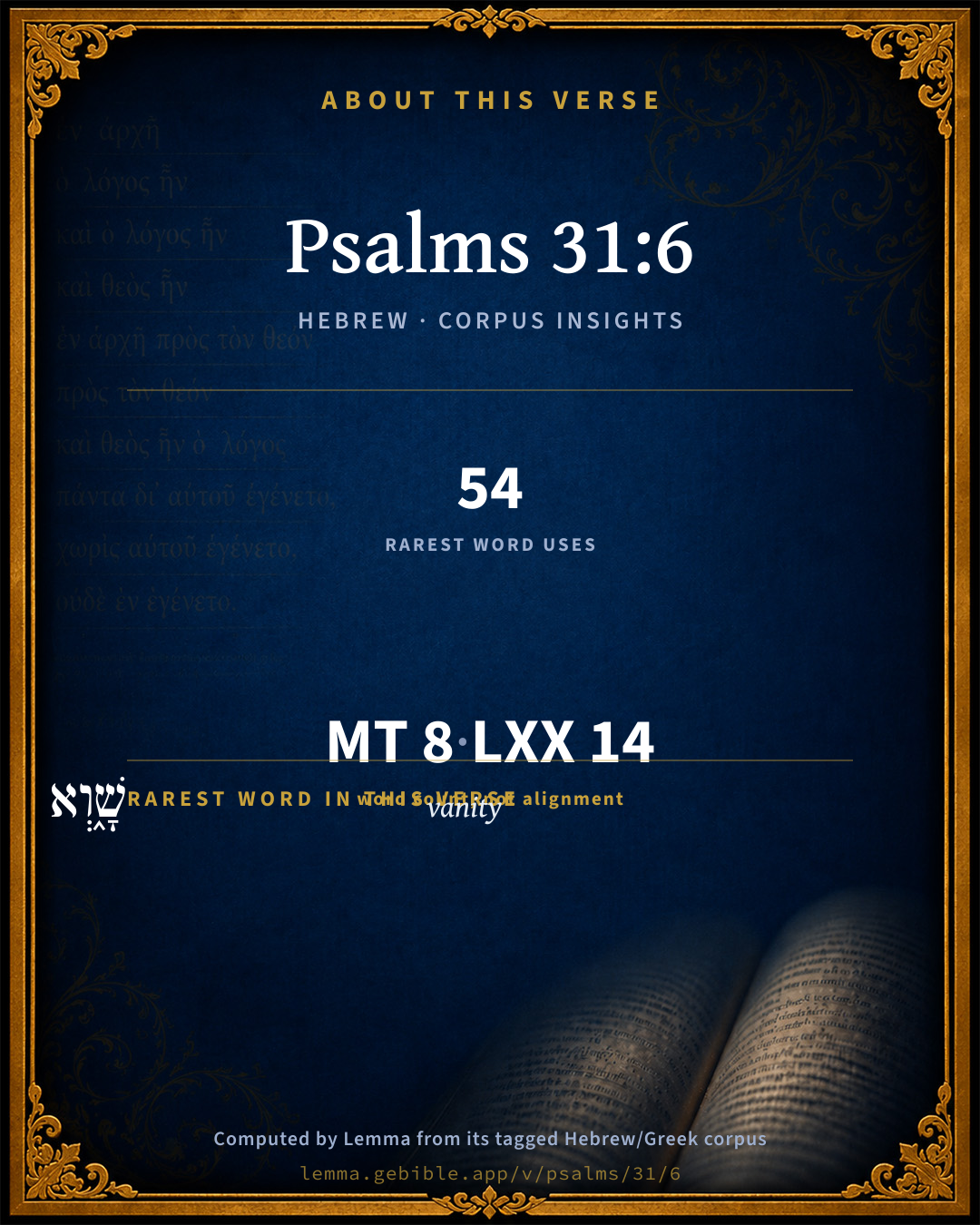
These counts appear in no published source. They are computed here, from the morphology-tagged text and Lemma’s own curated glosses. What Lemma adds →

8
words
8
distinct lemmas
Wisdom
section

Shared distinctive vocabulary

שָׁ֑וְא vanity H7723 occurs in 48 verses of the Hebrew Bible. Also found in:

Grammatical profile

  • 3 verbs
  • 3 nouns
  • 1 pronoun
  • 1 preposition

Verb forms

  • שָׂנֵ֗אתִי Qal · Perfect
  • הַשֹּׁמְרִ֥ים Qal · Participle Active
  • בָּטָֽחְתִּי Qal · Perfect

Hebrew & Septuagint length

In English translation the verse runs 12 words from the Hebrew and 16 from the Septuagint (LXX English) — closely comparable.

A rough comparison of the two English renderings, which tokenize alike — not a word-level alignment.

Word counts can differ between the Hebrew and the Greek without any difference in meaning — e.g. the Hebrew direct-object marker אֵת has no separate Greek word, and Greek often adds the article ὁ.

In the original languages it is 8 Hebrew tokens and 14 Greek tokens — but the two are counted differently (Hebrew bundles its prefixes and suffixes into one token; the Greek is in lemma form), so that isn’t a like-for-like length.

Cross-references

12

Topical passages linked to Psalms 31:6 in the Treasury of Scripture Knowledge — connected by theme and wording, ordered by reader-vote popularity; previews shown in the World English Bible.

  • Jonah 2:8 Those who regard lying vanities forsake their own mercy.
  • Psalms 24:4 He who has clean hands and a pure heart; Who has not lifted up his soul to falsehood, And has not sworn deceitfully.
  • Psalms 26:5 I hate the assembly of evil-doers, And will not sit with the wicked.
  • Jeremiah 10:8 But they are together brutish and foolish: the instruction of idols! it is but a stock.
  • Jeremiah 10:15 They are vanity, a work of delusion: in the time of their visitation they shall perish.
  • 1 Corinthians 8:4 Therefore concerning the eating of things sacrificed to idols, we know that no idol is anything in the world, and that there is no other God but one.
  • 1 Corinthians 10:20 But I say that the things which the Gentiles sacrifice, they sacrifice to demons, and not to God, and I don't desire that you would have communion with demons.
  • 1 Chronicles 16:28–29 Ascribe to Yahweh, you relatives of the peoples, Ascribe to Yahweh glory and strength;
  • Psalms 96:7–9 Ascribe to Yahweh, you families of nations, Ascribe to Yahweh glory and strength.
  • John 2:8 He said to them, "Now draw some out, and take it to the ruler of the feast." So they took it.
  • Romans 1:21 Because, knowing God, they didn't glorify him as God, neither gave thanks, but became vain in their reasoning, and their senseless heart was darkened.
  • Psalms 139:2 You know my sitting down and my rising up. You perceive my thoughts from afar.

Cross-references courtesy of OpenBible.info (CC BY 4.0).

Hebrew and Greek witnesses Masoretic Hebrew ↔ Greek Septuagint

The same verse in the two great witnesses to the Old Testament, shown verse-for-verse.

You’re reading Greek Psalm 30 (Hebrew Psalm 31). The Septuagint counts the superscription, so verse numbers can differ from the Hebrew — chapter-level alignment, not verse-by-verse. Numbering follows Rahlfs.

These are two independent witnesses, not word-aligned to each other, and the Septuagint is shown in lemma (dictionary) form.

Hebrew Psalms 31:6 Masoretic · Westminster Leningrad Codex

שָׂנֵ֗אתִי הַשֹּׁמְרִ֥ים הַבְלֵי שָׁ֑וְא וַ֝אֲנִ֗י אֶל יְהוָ֥ה בָּטָֽחְתִּי

I hate those who regard lying vanities, But I trust in Yahweh.

World English Bible · Public Domain

Greek LXX Greek Psalm 30:6 Septuagint · lemma form

εἰς χείρ σύ παρατίθημι ὁ πνεῦμα ἐγώ λυτρόω ἐγώ κύριος ὁ θεός ὁ ἀλήθεια

You have hated them that idly persist in vanities: but I have hoped in the Lord.

LXX2012 (modern English Septuagint) · Public Domain

On this verse, The Cambridge Bible for Schools and Colleges discusses the Septuagint’s reading. Read the note in Commentary ↓

Hebrew: Westminster Leningrad Codex (CC BY 4.0). Greek: Septuagint (public domain); English from LXX2012 (modern English Septuagint) (Public Domain). How the Septuagint differs from the Hebrew →

Commentary

Notes on Psalms 31:6 from classic Christian and Jewish commentators (each source and its license shown beneath its notes). The classic Christian expositions comment on the surrounding passage and are grouped to its opening verse, so a note may address several verses; the Jewish commentaries on the Tanakh (Rashi and others) are per-verse, so they appear only where the commentator wrote on this verse.

Lemma curates 59 commentaries, every one of them public domain or Creative Commons licensed, each selected and text-cleaned for this edition rather than reprinted as found. About our sources →

Trapp's Complete Commentary

John Trapp

Psa 31:6 I have hated them that regard lying vanities: but I trust in the LORD.

Ver. 6. I have hated them that regard lying vanities] i.e. Idols, or aught else besides the living God, who giveth us all things richly to enjoy, 1Ti 6:17 Jon 2:8. {See Trapp on "Jon 2:8"} Vanitates vanitatis, Vatablus rendereth it, and telleth us that some understand it of astrology. R. David doth so in this note of his upon the text, Astrologos et incantatores in fuga mea non consului, sed in Domino et prophetis eius confisus sum; I have not consulted astrologers and soothsayers in my trouble, but have trusted to the Lord and his prophets.

John Trapp, A Commentary or Exposition upon All the Books of the Old and New Testament (1647–1656) — public domain. Text from a community e-Sword module.

The Biblical Illustrator

Joseph S. Exell

Psa_31:6

I have hated them that regard lying vanities, but I trust in the Lord.

Trust the antidote of superstitious vanities

Many think that superstition is but an exaggerated faith; that it will diminish with the growth of intelligence, and that it is necessary in appealing to ignorant and vulgar people. But some who have been alive to its mischiefs and horrors have been willing to risk the loss of faith in order to get rid of it; but when the reaction has come, and we have felt that the world could not go on safely without some faith, we have been ready to tolerate a considerable amount of superstition, lest faith, its companion, should perish with it. But the psalmist looks at it from quite a different point of view. He opposes superstitious vanities to trust in the Lord. One is the protest against, the deliverance from, the other. This is the very spirit of the Old Testament. Trust in God--invisible and righteous, is the principle which every lawgiver, prophet, priest, is to exhibit in his actions, to enforce upon his land. So far as his trust fails, he fails to do the work he is called to do. Losing trust, they are told that they will infallibly bow down to objects of Nature, to idols of wood and stone; they will listen to wizards who peep and mutter; they will fear where no fear is; they will make their cruel imaginations into gods and worship them. Such was the message of Elijah. The people to whom he was sent were busy with religious acts and exercises. But he goes to turn them from these acts that they may trust in the Lord. So Hezekiah. The general of Sennacherib accused him of taking away altars: what hope, therefore, could he have of deliverance? But those very acts proved that Hezekiah trusted in the Lord more than all the kings that were before him. And so it is in the New Testament. The apostles found men everywhere bowing down to visible gods, trembling at the future, seeking for diviners who could penetrate its secrets. Wherever they went, they found men fearing gods, trying to conciliate their favour or avert their wrath. To interfere with them was not ill their power: state force, and mob opinion, were leagued in support of them. All they could do was to proclaim a Being whom men might trust. They did proclaim such a Being, they did incite men to trust in Him. And by so doing they struck such a blow at superstitious vanities as no iconoclast ever struck. They testified a hatred of them which they could not have testified, if they had had power to lay low every heathen altar, to cast every idol into the fire. They earned the hatred of those who held to these superstitious vanities. Not a martyr fell under the axe, or was tied to the stake, or was fastened to a cross, but because he would not do sacrifice to the likeness of some emperor, or some god whom the emperor sanctioned with his divine fiat. Not one had courage to make that denial, but because he trusted in the Lord, who had given His Son to be the perfect sacrifice for the sins of the world. And so Trust, because the object of it was more fully revealed, was a mightier destroyer of superstition than it had ever been. And our own experience confirms all this. Each one has some superstitious vanity or other to which he is prone: some dark shadow which haunts him; some visible or invisible terror, which is always ready to make a coward of him. And we cannot rid ourselves of it by reason or arguments of science, These often fail when they are wanted most. There is no help but in trust in God. It alone answers our dark fears. God has spoken to us sinners, and bid us confide in Him. And as we trust, so we conquer our sin; as we fail to trust, so are we overcome. What greater proof could there be that Superstition and Faith are not of the same kin, but are deadly and everlasting foes? And the history of Christendom leads to the same conclusion. (F. D. Maurice, M. A.)

The Biblical Illustrator, edited by Joseph S. Exell (c. 1880s–1900s) — public domain. Text from a community e-Sword module.

Joseph Benson's Commentary

Psa 31:6. I have hated them — Not the persons, but the ways of them, that regard — Hebrew, השׁמרים, hashomerim, that observe; that is, are attached to, depend upon, or expect help from, lying vanities, הבלי שׁוא, hablee shave, vanities of emptiness, or, most vain vanities, such as are foolish, deceitful, and fruitless. By which he means either, 1st, All human and carnal helps and dependances; or any and every arm of flesh, in which those that trust are pronounced accursed, Jer 17:5: or, 2d, idols, which are often called vanities, as Deu 32:21: or, 3d, curious arts, and all sorts of divinations, whether by the stars, or by the entrails of living creatures, or by the dead, &c., which practices were common and prevalent among the eastern people, and through their example were also practised by many of the Israelites.

Joseph Benson's Commentary on the Old and New Testaments (1811–1818) — public domain. Text from a community e-Sword module.

J. A. Alexander on Psalms

Joseph Addison Alexander

7. (Psa 31:6). I have hated those regarding vanities of falsehood, and I (for my part) in Jehovah have confided. The present is included in the preterite of the first clause. "I have hated them, and hate them still." "I hate them, and have done so heretofore." See above, Psa 16:4; Psa 26:5.—Regarding, religiously observing, waiting upon, watching with respect and trust. Compare Hos. iv. 10, Zec 11:11, Jon 2:9 (8). This last place contains also the word vanities here used, and even in the Law applied to idols, as no gods, and as "nothing in the world" (1Co 8:4). See Deu 32:21, and compare Jer 5:1-31; Jer 10:15; Jer 14:22; Jer 16:19; Jer 28:15. The words here combined are highly contemptuous, denoting vanities of emptiness, or nothings of nonentity, presented in contrast to Jehovah, God of truth, in whom the Psalmist has confided. And I, as opposed to them. See above, on Psa 2:6.

Joseph Addison Alexander, The Psalms Translated and Explained (1850) — public domain. Text from a community e-Sword module.

Tyndale Open Study Notes

Tyndale Open Resources

31:6-8 Trust in the Lord requires confidence that he has our best interests at heart.

Tyndale Open Study Notes — © Tyndale Open Resources, licensed CC BY-SA 4.0. Text via the HelloAO Bible API.

Geneva Bible (1599)

Geneva Bible translators

This affection ought to be in all God’s children, to hate whatsoever thing is not grounded upon a sure trust in God, as deceitful and vain.

Geneva Bible (1599) marginal notes — public domain. Text via Bolls.life.

Adam Clarke's Commentary

Verse 6. I have hated them] That is, I have abominated their ways. Idolaters are the persons of whom David speaks.

I trust in the Lord.] While they trust in vanities vain things; (for an idol is nothing in the world;) and in lying vanities; (for much is promised and nothing given;) I trust in Jehovah, who is God all-sufficient, and is my Shepherd, and therefore I shall lack no good thing.

Adam Clarke's Commentary on the Bible (1810–1826) — public domain. Text from a community e-Sword/MySword module.

John Calvin's Commentaries

6. I hate all that give heed to lying vanities. In order the better to express that his faith was firmly fixed on God, he affirms that he was free from the vile affections which usually turn away our minds from God, and under which unbelievers for the most part labor. For we know that by contrasting things which are opposite, a subject is better illustrated. To restrict the Hebrew word הבל, hebel, which we have rendered vanities, to magical arts, as some interpreters do, is absurd. Hammond considers “vanities” as referring to the practice of superstitiously having recourse to auguries and divinations for advice and direction, a practice which prevailed among the heathen, when they met with any difficulty or danger. To the responses of augury, they showed the greatest regard; although they were deceived and disappointed in the confidence which they reposed in them. David declares that he detested all such practices, and trusted for aid to God alone. French and Skinner, by lying vanities, understand idols. “Idols,” says Walford, “are often thus denominated; though the term is not to be confined to this sense, as all the pursuits of iniquity may be justly comprehended under it. - Vide Deuteronomy 32:21; Jonah 2:8.”

John Calvin's Commentaries (1540-1563) — public domain. Text from the Calvin Translation Society English edition (1840s-50s) via the Christian Classics Ethereal Library (ccel.org). Calvin's coverage is partial (roughly two-thirds of the Bible); uncommented books and verses are honest gaps, never fabricated. The 19th-century editor's footnotes and remarks are omitted so the notes are faithfully Calvin's own voice.

Ellicott's Commentary for English Readers

(6) Lying vanities.—Literally, breath of lies (Jon_2:8), undoubtedly idols, as the parallelism in Jer_8:19 shows. It was the term adopted by the Deuteronomist (Deu_32:21) and apparently brought into use by him.

A Bible Commentary for English Readers, edited by Charles John Ellicott (1878–1897) — public domain. Text from a community e-Sword module.

The Cambridge Bible for Schools and Colleges

gen. ed. J. J. S. Perowne

6. I have hated] Better, as R.V., I hate. He disclaims all sympathy and fellowship with the worshippers of false gods. But the LXX, Vulg., Syr., Jer. read, thou hatest (cp. Psa_5:5). This reading gives the contrast required by the next line, which must be rendered, but as for me, I trust in Jehovah.

that regard lying vanities] Cp. Jon_2:8. False gods are vanities of nothingness, having no real existence, and deluding their worshippers; the exact opposite of the God of truth, Who IS, and constantly proves His faithfulness (Deu_32:4; Deu_32:21). Vanity is a common expression for false gods in Jeremiah (Jer_8:19; &c.). For regard = pay respect to, worship, see Psa_59:9 (A.V. wait upon); Hos_4:10 (A.V. take heed to).

The Cambridge Bible for Schools and Colleges (gen. ed. J. J. S. Perowne; Cambridge University Press, 1878–1918) — public domain. Text from a community e-Sword module.

John Gill's Exposition

I have hated them that regard lying vanities,.... Soothsaying and divination, as Aben Ezra and others think; made use of by kings, and generals of armies, to know when it was proper to go out to war, and what success they should have; see Eze 21:21; but such men and their practices David abhorred; he took no such methods when in distress, but applied to the Lord, and trusted in him; or rather idol gods, as Jarchi, and others, who are vanity, and the work of errors, and are nothing in the world; see Jon 2:8; all will worship and superstition may be included in this phrase, which being not according to the will and word of God, is worshipping in vain, and carries off from true spiritual worship; and so is a lying vanity, and to be detested, and the abettors of it: as also all errors and heresies; these are great swelling words of vanity, and are lies in hypocrisy; and likewise all immorality and wickedness, which spring from the vanity of the mind, and promise much liberty and pleasure, but deceive, and therefore lying; yea, all worldly enjoyments are vanity and vexation of spirit, and are fallacious and deceitful when trusted in; and indeed every false trust and confidence may come under this name; such as trust in riches, in wisdom and knowledge, in carnal descent, and privileges, in a moral and legal righteousness, and even in a bare profession of true religion, and a subjection to Gospel ordinances; for there is no true object of trust, no Redeemer and Saviour, but the Lord: now such as regard those lying vanities are they that look to them, love them, embrace them, and put their confidence in them; and such are to be "hated"; not their persons, but their principles and practices, and they themselves are to be shunned and abstained from;

but I trust in the Lord; the God of truth, that cannot lie, deny himself, nor deceive; who is unchangeable, and without any variableness, or shadow of turning.

John Gill's Exposition of the Whole Bible (1746–1763) — public domain (CC PDM 1.0). Text via the HelloAO Bible API.

Albert Barnes' Notes on the Bible

I have hated them that regard lying vanities - This is evidently stated as a reason for the prayer offered in the previous verses. It is a reference by the psalmist to his own past life; to his general aim and conduct. The meaning is, that he had been a friend of God; that he had separated himself from wicked men; and he now prays in return for His protection and interposition. The sentiment is similar to that which occurs in Psa 26:3-5. See the notes at that passage. The word rendered “regard” here means to observe, to keep, to attend upon; and the reference is to those who show honor to what is here called “lying vanities;” that is, those who attend upon them, or who show them favor. The “lying vanities” are probably “idols,” and the allusion is to those who attended on the worship of idols as distinguished from those who worshipped the true God. Idols are often represented as false - as vain, or vanity, - as a lie - in contradistinction from that which is true and real. See the notes at 1Co 8:4. There is special emphasis in the language used here as denoting the “utter” worthlessness and vanity of idols. The language means “vanities of emptiness;” denoting that they were “utterly” vain and worthless.

But I trust in the Lord - In Yahweh, the true God, as distinguished from idols.

Albert Barnes' Notes on the Bible (1834–1885) — public domain. Text from a community e-Sword/MySword module.

Matthew Poole's English Annotations

I have hated them; their very persons, not simply, but for their wickedness. Compare Psa 139:21,22.

That regard, Heb. that observe, to wit, with respect to them, dependence upon them, or expectation of any good from them.

Lying vanities; or, most vain vanities; such as are foolish, and deceitful, and fruitless. By which he understands, either,

1. All human or carnal helps, any arm of flesh; for he that trusteth therein is pronounced cursed, Jer 17:5, and therefore is hateful. Or,

2. Idols, which are oft called vanities, as Deu 32:21; Jer 2:5; 8:19, &c. Or,

3. Curious arts, and all sorts of divinations by stars, or the notions or inwards of living creatures, or by the dead; which practices were common and prevalent among those Eastern people, and by their example were too rife among the Israelites also, Isa 2:6, of whom he here speaks; for the Gentiles that observed these vanities he rather pitied than hated; but the Israelites that did so were apostates from God, and professed enemies to him and his laws, and therefore were the proper objects of just hatred.

Matthew Poole's English Annotations on the Holy Bible (1683–1685) — public domain. Text from a community e-Sword/MySword module.

The Treasury of David

Charles H. Spurgeon

Ver. 6. I have hated them that regard lying vanities. Those who will not lean upon the true arm of strength, are sure to make to themselves vain confidences. Man must have a god, and if he will not adore the only living and true God, he makes a fool of himself, and pays superstitious regard to a lie, and waits with anxious hope upon a base delusion. Those who did this were none of David's friends; he had a constant dislike to them: the verb includes the present as well as the past tense. He hated them for hating God; he would not endure the presence of idolaters; his heart was set against them for their stupidity and wickedness. He had no patience with their superstitious observances, and calls their idols vanities of emptiness, nothings of nonentity. Small courtesy is more than Romanists and Puseyists deserve for their fooleries. Men who make gods of their riches, their persons, their wits, or anything else, are to be shunned by those whose faith rests upon God in Christ Jesus; and so far from being envied, they are to be pitied as depending upon utter vanities. But I trust in the Lord. This might be very unfashionable, but the psalmist dared to be singular. Bad example should not make us less decided for the truth, but the rather in the midst of general defection we should grow the more bold. This adherence to his trust in Jehovah is the great plea employed all along: the troubled one flies into the arms of his God, and ventures everything upon the divine faithfulness.

Ver. 6. I have hated. Holy men have strong passions, and are not so mincing and charitable towards evil doers as smooth tongued latitudinarians would have them. He who does not hate evil does not love good. There is such a thing as a good hater. C. H. S

Ver. 6. They that regard lying vanities. The Romanists feign miracles of the saints to make them, as they suppose, the more glorious. They say that the house wherein the Virgin Mary was when the angel Gabriel came unto her was, many hundred years after, translated, first, out of Galilee into Dalmatia, above 2,000 miles, and thence over the sea into Italy, where also it removed from one place to another, till at length it found a place where to abide, and many most miraculous cures, they say, were wrought by it, and that the very trees when it came, did bow unto it. Infinite stories they have of this nature, especially in the Legend of Saints, which they call "The Golden Legend, "a book so full of gross stuff that Ludovicus Vives, a Papist, but learned and ingenuous, with great indignations cried out, "What can be more abominable than that book?" and he wondered why they should call it "golden, "when as he that wrote it was a man "of an iron mouth and of a leaden heart." And Melchior Canus, a Romish bishop, passed the same censure upon that book, and complains (as Vives also had done before him), that Laertius wrote the lives of philosophers, and Suetonius the lives of the Caesars, more sincerely than some did the lives of the saints and martyrs. They are most vain and superstitious in the honour which they give to the relics of the saints; as their dead bodies, or some parts of them; their bones, flesh, hair; yea, their clothes that they wore, or the like. "You may now, everywhere, "saith Erasmus, "see held out for gain, "Mary's milk, which they honour almost as much as Christ's consecrated body; prodigious oil; so many pieces of the cross, that if they were all gathered together a great ship would scarce carry them. Here Francis's hood set forth to view; there the innermost garment of the Virgin Mary; in one place, Anna's comb; in another place, Joseph's stocking; in another place, Thomas of Canterbury's shoe; in another place, Christ's foreskin, which, though it be a thing uncertain, they worship more religiously than Christ's whole person. Neither do they bring forth these things as things that may be tolerated, and to please the common people, but all religion almost is placed in them. (Erasmus, on Mt 23:5). Christopher Cartwright.

Ver. 6. The sense lies thus, that heathen men, when any danger or difficulty approacheth them, are solemnly wont to apply themselves to auguries and divinations, and so to false gods, to receive advice and direction from them: but doing so and observing their responses most superstitiously, they yet gain nothing at all by it. These David detests, and keeps close to God, hoping for no aid but from him. H. Hammond, D.D.

Ver. 6. Holy detestation, as a virtue discriminated from bigotry: or, the good hater.

Psalms 31:7*

Charles H. Spurgeon's The Treasury of David (1869–1885) — public domain. Psalms only. Text from a community e-Sword/MySword module.

Whedon's Commentary on the Bible

Daniel D. Whedon

6. Lying vanities—Two words expressive of total emptiness and worthlessness, commonly applied to idols and the lying divinations of the heathen. Jon_2:8; Jer_2:5; Jer_8:9

Daniel D. Whedon (gen. ed.), Commentary on the Old and New Testaments (1874–1909) — public domain. Text from a community e-Sword module.

The Pulpit Commentary

I have hated them that regard lying vanities. By "lying vanities" are meant idolatrous practices, or possibly such superstitious usages as recourse to witch-craft and divination. (For David"s hatred of such persons as are here glanced at, see Psa_26:5) But I trust in the Lord. Who is the direct opposite of all "lying vanities," being at once Almighty, and the "God of truth" (ver. 5).

The Pulpit Commentary (1880–1919), ed. H.D.M. Spence-Jones & Joseph S. Exell — public domain. Text from a community e-Sword module.

John Wesley's Explanatory Notes

Vanities - Idols, which are often called Vanities, as Deut. xxxii, 21. Or, curious arts, and all sorts of divinations.

John Wesley, Explanatory Notes Upon the Whole Bible (1754–1765) — public domain. Text via the GEBible commentary corpus.

Rashi

Rabbi Shlomo Yitzchaki (Rashi)

I entrust Heb. אפקיד, komondere in Old French, I will entrust. I always entrust my spirit because You redeemed me from trouble.

Rashi on the Tanakh — English translations: “The Judaica Press complete Tanach with Rashi, translated by A. J. Rosenberg” (CC BY 4.0); “Pentateuch with Rashi's commentary by M. Rosenbaum and A.M. Silbermann, 1929-1934” (public domain); “The Metsudah Tanach series, Lakewood, N.J” (CC BY 4.0); and “The Book of Joshua, Metsudah Publications, 1997” (CC BY 4.0). Text via Sefaria.

Lesson kit

Teaching starters — assembled from the data on this page, not authored interpretation. Every prompt links to the verse data it draws on. Edit before teaching.

Psalms, in the Wisdom, opens this verse with 8 words (8 distinct Hebrew lemmas). Its most distinctive word is shâvᵉʼ (“vanity”). A historical commentator’s framing appears above. Read the whole chapter for the surrounding context.

Discussion questions

  1. What does “vanity” (shâvᵉʼ) contribute to the verse as a whole?
  2. Exodus 20:7 shares the word «vanity» with this verse. How do the two illuminate each other?
  3. These translations render this verse differently. What is at stake in choosing one wording over another?
  4. The verb «שָׂנֵ֗אתִי» is Qal Perfect. How does its form color the action?
  5. Reading how Trapp's Complete Commentary and The Biblical Illustrator read this verse, where do the two commentators agree and where do they part?

Things to notice

Reading settings

Reading text

Shown beneath each verse's original-language words.

Old Testament
Old Testament edition

Read the OT as the Masoretic Hebrew (MT) or the Greek Septuagint (LXX).

English shown for the Greek Septuagint (in the Hebrew ↔ Greek comparison).

Comparing translations? Open the Compare panel on any verse page to stack up to four side by side.