
Judges 16:17

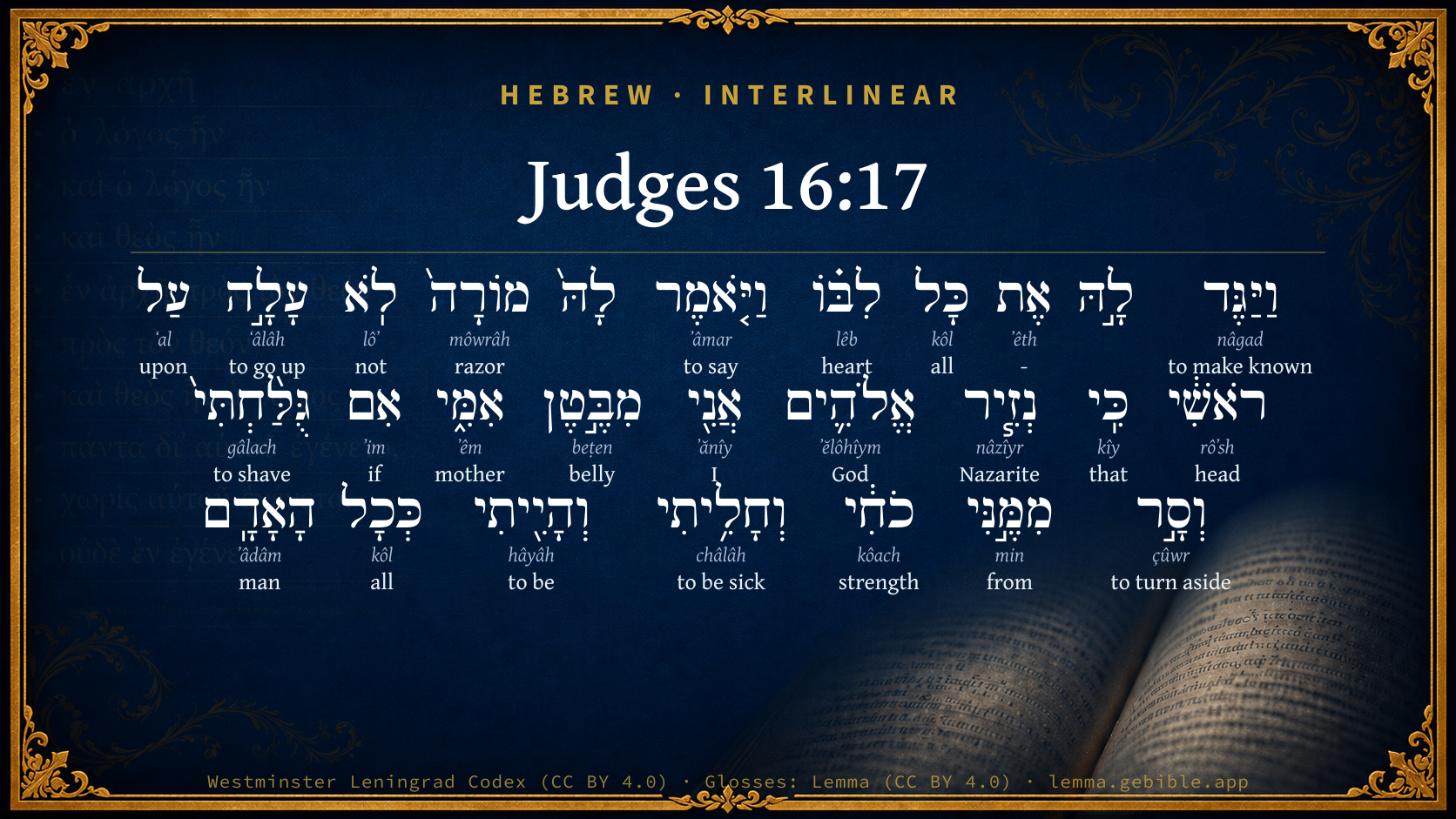
Hebrew (Westminster Leningrad Codex) Judges 16:17 appears in the Hebrew Old Testament. The text above is from the Westminster Leningrad Codex. Each word links to its Strong’s number, a concise gloss, and parsing drawn from the Open Scriptures Hebrew Bible morphology. Click any word for its full Brown-Driver-Briggs (BDB) entry.
Download image
Cite this verse

Judges 16:17 (World English Bible). Public Domain. Lemma interlinear Bible study tool, https://lemma.gebible.app/v/judges/16/17.

Show BibTeX & RIS
BibTeX
RIS
English Translation
He told her all his heart, and said to her, "No razor has ever come on my head; for I have been a Nazirite to God from my mother's womb. If I am shaved, then my strength will go from me, and I will become weak, and be like any other man."
World English Bible · Public Domain
Download a study sheet

One document with this verse’s original text, its word-by-word gloss line, the meaning frame, cross-references with their text, attributed commentary, and full source and license credits — printable, and it pastes into notes with its structure intact.

This verse Autodidact and up

Study sheet (.html) Plain text (.txt)

A passage Seminary Student

Up to 50 verses in one chapter. A passage sheet keeps up to 6 commentary sources and 12 cross-references per verse, in the order this page ranks them, and says so on the sheet whenever that leaves anything out. Ask for a single verse and you get the Autodidact verse sheet above.

Everything on this page stays free to read, with no account — the sheet is a download of what is already on screen, not access to it.

Want to remove ads? Support Godless Engineer
Compare translations 3

The same verse in 3 English versions, stacked beneath the original-language interlinear above. Click any original word for its lexicon entry.

Each is an independent rendering of the whole verse — the interlinear is not word-aligned to these translations.

Highlighted words mark where these versions differ — a whole-verse word diff, not a word-by-word alignment.

  • World English Bible Public Domain
    He told her all his heart, and said to her, "No razor has ever come on my head; for I have been a Nazirite to God from my mother's womb. If I am shaved, then my strength will go from me, and I will become weak, and be like any other man."
  • King James Version Public Domain
    That he told her all his heart, and said unto her, There hath not come a razor upon mine head; for I have been a Nazarite unto God from my mother's womb: if I be shaven, then my strength will go from me, and I shall become weak, and be like any other man.
  • unfoldingWord Literal Text CC BY-SA 4.0
    So he declared to her all of his heart, and he said to her, “A razor has not gone up on my head, for I a Nazirite of God from the womb of my mother. If I were shaved, then my strength would turn from me, and I would weaken and I would be like all of man.”

unfoldingWord Literal Text — © unfoldingWord, licensed CC BY-SA 4.0. Word-aligned USFM3 via Door43 (git.door43.org/unfoldingWord/en_ult).

Versions to compare (up to 4)

3 of 4 selected

Show all 18 translations

Every available English version of this verse, each an independent rendering of the whole verse.

  • World English Bible Public Domain
    He told her all his heart, and said to her, "No razor has ever come on my head; for I have been a Nazirite to God from my mother's womb. If I am shaved, then my strength will go from me, and I will become weak, and be like any other man."
  • Berean Standard Bible Public Domain
    Samson told her all that was in his heart: “My hair has never been cut, because I have been a Nazirite to God from my mother’s womb. If I am shaved, my strength will leave me, and I will become as weak as any other man.”
  • Majority Standard Bible Public Domain
    Samson told her all that was in his heart: “My hair has never been cut, because I have been a Nazirite to God from my mother’s womb. If I am shaved, my strength will leave me, and I will become as weak as any other man.”
  • King James Version Public Domain
    That he told her all his heart, and said unto her, There hath not come a razor upon mine head; for I have been a Nazarite unto God from my mother's womb: if I be shaven, then my strength will go from me, and I shall become weak, and be like any other man.
  • American Standard Version (1901) Public Domain
    And he told her all his heart, and said unto her, There hath not come a razor upon my head; for I have been a Nazirite unto God from my mother's womb: if I be shaven, then my strength will go from me, and I shall become weak, and be like any other man.
  • Revised Version (1885) Public Domain
    And he told her all his heart, and said unto her, There hath not come a razor upon mine head; for I have been a Nazirite unto God from my mother’s womb: if I be shaven, then my strength will go from me, and I shall become weak, and be like any other man.
  • Geneva Bible (1599) Public Domain
    Therefore he tolde her all his heart, and said vnto her, There neuer came rasor vpon mine head: for I am a Nazarite vnto God from my mothers wombe: therefore if I bee shauen, my strength will goe from me, and I shalbe weake, and be like all other men.
  • Douay-Rheims (1899) Public Domain
    Then opening the truth of the thing, he said to her: The razor hath never come upon my head, for I am a Nazarite, that is to say, consecrated to God from my mother's womb: if my head be shaven, my strength shall depart from me, and I shall become weak, and shall be like other men.
  • Young's Literal Translation Public Domain
    that he declareth to her all his heart, and saith to her, `A razor hath not gone up on my head, for a Nazarite to God I `am' from the womb of my mother; if I have been shaven, then hath my power turned aside from me, and I have been weak, and have been as any of the human race.'
  • Literal Standard Version CC BY-SA 4.0
    that he declares all his heart to her, and says to her, “A razor has not gone up on my head, for I [am] a Nazarite to God from the womb of my mother; if I have been shaven, then my power has turned aside from me, and I have been weak, and have been as all of mankind.”
  • Unlocked Literal Bible CC BY-SA 4.0
    So Samson told her everything and said to her, “I have never had a razor cut the hair on my head, for I have been a Nazirite for God from my mother's womb. If my head is shaved, then my strength will leave me, and I will become weak and be like every other man.”
  • unfoldingWord Literal Text CC BY-SA 4.0
    So he declared to her all of his heart, and he said to her, “A razor has not gone up on my head, for I a Nazirite of God from the womb of my mother. If I were shaved, then my strength would turn from me, and I would weaken and I would be like all of man.”
  • Darby Bible Public Domain
    And he told her all his mind, and said to her, "A razor has never come upon my head; for I have been a Nazirite to God from my mother's womb. If I be shaved, then my strength will leave me, and I shall become weak, and be like any other man."
  • World Messianic Bible Public Domain
    He told her all his heart and said to her, “No razor has ever come on my head; for I have been a Nazirite to God from my mother’s womb. If I am shaved, then my strength will go from me and I will become weak, and be like any other man.”
  • Webster's Bible Public Domain
    That he told her all his heart, and said to her, There hath not come a razor upon my head; for I have been a Nazarite to God from my birth: if I be shaved, then my strength will go from me, and I shall become weak, and be like any other man.
  • Free Bible Version CC BY-SA 4.0
    Eventually Samson confided in her, sharing everything. “My hair has never been cut, because I've been dedicated as a Nazirite to God from my birth. If I'm shaved, my strength will leave me, and I'll become as weak as anyone else.”
  • Bible in Basic English Public Domain
    And opening all his heart to her, he said to her, My head has never been touched by a blade, for I have been separate to God from the day of my birth: if my hair is cut off, then my strength will go from me and I will become feeble, and will be like any other man.
  • JPS Tanakh (1917) Public Domain
    And he told her all his heart, and said unto her: 'There hath not come a razor upon my head; for I have been a Nazirite unto God from my mother's womb; if I be shaven, then my strength will go from me, and I shall become weak, and be like any other man.'

Literal Standard Version (2020), Covenant Press — licensed CC BY-SA 4.0. Text via the HelloAO Bible API (eBible.org). Unlocked Literal Bible (unfoldingWord) — licensed CC BY-SA 4.0. Text via the HelloAO Bible API (eBible.org). unfoldingWord Literal Text — © unfoldingWord, licensed CC BY-SA 4.0. Word-aligned USFM3 via Door43 (git.door43.org/unfoldingWord/en_ult). Free Bible Version, Dr. Jonathan Gallagher — licensed CC BY-SA 4.0. Text via the HelloAO Bible API (eBible.org).

Word by word

More ways to search: Search by grammar → Find every occurrence → Compare this word →

Practice this passage: Drill this verse → Learn its vocabulary →

מוֹרָה֙
môwrâh
H4177
“razor”
Noun, Common, Masculine, Singular, Absolute
Part of Speech
Noun
Type
Common
Gender
Masculine
Number
Singular
State
Absolute
Full BDB Definition

Origin: from H4171 in the sense of shearing

TWOT: 1166

razor
  1. וַיַּגֶּד nâgad H5046 “and · to make known” Conjunction + Verb, Hiphil, Sequential Imperfect, 3rd Person, Masculine, Singular
  2. אֶת ʼêth H853 “-” Particle, Direct Object
  3. כָּל kôl H3605 “all of” Noun, Common, Masculine, Singular, Construct
  4. לִבּ֗וֹ lêb H3820 “heart · his” Noun, Common, Masculine, Singular, Construct + Suffix, Personal, 3rd Person, Masculine, Singular
  5. וַיֹּ֤אמֶר ʼâmar H559 “and · to say” Conjunction + Verb, Qal, Sequential Imperfect, 3rd Person, Masculine, Singular
  6. לֹֽא lôʼ H3808 “not” Particle, Negative
  7. עָלָ֣ה ʻâlâh H5927 “to go up” Verb, Qal, Perfect, 3rd Person, Masculine, Singular
  8. עַל ʻal H5921 “upon” Preposition
  9. רֹאשִׁ֔י rôʼsh H7218 “head · my” Noun, Common, Masculine, Singular, Construct + Suffix, Personal, 1st Person, Common, Singular
  10. כִּֽי kîy H3588 “that” Conjunction
  11. נְזִ֧יר nâzîyr H5139 “Nazarite of” Noun, Common, Masculine, Singular, Construct
  12. אֱלֹהִ֛ים ʼĕlôhîym H430 “God(s)” Noun, Common, Masculine, Plural, Absolute
  13. אֲנִ֖י ʼănîy H589 “I” Pronoun, Personal, 1st Person, Common, Singular
  14. מִבֶּ֣טֶן beṭen H990 “from · belly of” Preposition + Noun, Common, Feminine, Singular, Construct
  15. אִמִּ֑י ʼêm H517 “mother · my” Noun, Common, Feminine, Singular, Construct + Suffix, Personal, 1st Person, Common, Singular
  16. אִם ʼim H518 “if” Conjunction
  17. גֻּלַּ֨חְתִּי֙ gâlach H1548 “to shave” Verb, Pual, Perfect, 1st Person, Common, Singular
  18. וְסָ֣ר çûwr H5493 “and · to turn aside” Conjunction + Verb, Qal, Perfect, 3rd Person, Masculine, Singular
  19. מִמֶּ֣נִּי min H4480 “from · me” Preposition + Suffix, Personal, 1st Person, Common, Singular
  20. כֹחִ֔י kôach H3581 “strength · my” Noun, Common, Masculine, Singular, Construct + Suffix, Personal, 1st Person, Common, Singular
  21. וְחָלִ֥יתִי châlâh H2470 “and · to be sick” Conjunction + Verb, Qal, Perfect, 1st Person, Common, Singular
  22. וְהָיִ֖יתִי hâyâh H1961 “and · to be” Conjunction + Verb, Qal, Perfect, 1st Person, Common, Singular
  23. כְּכָל kôl H3605 “like/as · all of” Preposition + Noun, Common, Masculine, Singular, Construct
  24. הָאָדָֽם ʼâdâm H120 “the · man” Particle, Definite Article + Noun, Common, Masculine, Singular, Absolute

About this verse

These counts appear in no published source. They are computed here, from the morphology-tagged text and Lemma’s own curated glosses. What Lemma adds →

27
words
24
distinct lemmas
Historical
section

Notable vocabulary

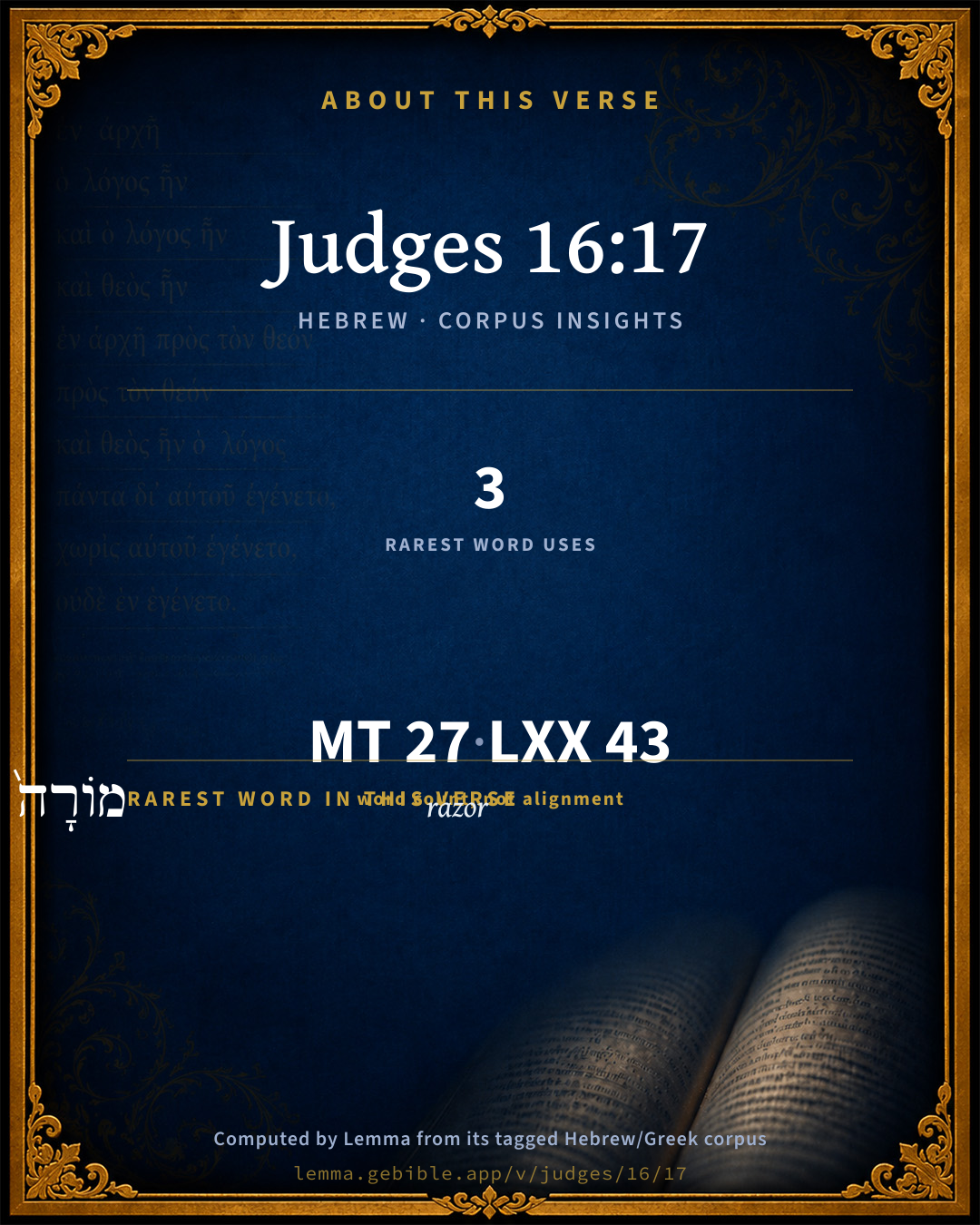
The rarest word here is מוֹרָה֙ razor H4177 — appearing just 3 times in the whole Hebrew Bible.

Shared distinctive vocabulary

מוֹרָה֙ razor H4177 occurs in 3 verses of the Hebrew Bible. Also found in:

Grammatical profile

  • 7 verbs
  • 11 nouns
  • 1 pronoun
  • 4 prepositions
  • 2 conjunctions
  • 2 particles

Verb forms

  • וַיַּגֶּד Hiphil · Sequential Imperfect
  • וַיֹּ֤אמֶר Qal · Sequential Imperfect
  • עָלָ֣ה Qal · Perfect
  • גֻּלַּ֨חְתִּי֙ Pual · Perfect
  • וְסָ֣ר Qal · Perfect
  • וְחָלִ֥יתִי Qal · Perfect
  • וְהָיִ֖יתִי Qal · Perfect

Repetition

A word recurs within this verse — often emphatic in Hebrew:

Hebrew & Septuagint length

In English translation the verse runs 52 words from the Hebrew and 57 from the Septuagint (LXX English) — closely comparable.

A rough comparison of the two English renderings, which tokenize alike — not a word-level alignment.

Word counts can differ between the Hebrew and the Greek without any difference in meaning — e.g. the Hebrew direct-object marker אֵת has no separate Greek word, and Greek often adds the article ὁ.

In the original languages it is 27 Hebrew tokens and 43 Greek tokens — but the two are counted differently (Hebrew bundles its prefixes and suffixes into one token; the Greek is in lemma form), so that isn’t a like-for-like length.

Cross-references

7

Topical passages linked to Judges 16:17 in the Treasury of Scripture Knowledge — connected by theme and wording, ordered by reader-vote popularity; previews shown in the World English Bible.

  • Micah 7:5 Don't trust in a neighbor. Don't put confidence in a friend. With the woman lying in your embrace, Be careful of the words of your mouth!
  • Judges 13:5 for, behold, you shall conceive, and bear a son; and no razor shall come on his head; for the child shall be a Nazirite to God from the womb: and he shall begin to save Israel out of the hand of the Philistines.
  • Proverbs 12:23 A prudent man keeps his knowledge, But the hearts of fools proclaim foolishness.
  • Numbers 6:5 "All the days of his vow of separation there shall no razor come on his head, until the days are fulfilled, in which he separates himself to Yahweh. He shall be holy. He shall let the locks of the hair of his head grow long.
  • Acts 18:18 Paul, having stayed after this many more days, took his leave of the brothers, and sailed from there for Syria, together with Priscilla and Aquila. He shaved his head in Cenchreae, for he had a vow.
  • Numbers 6:2 "Speak to the children of Israel, and tell them: When either man or woman shall make a special vow, the vow of a Nazirite, to separate himself to Yahweh,
  • Proverbs 29:12 If a ruler listens to lies, All of his officials are wicked.

Cross-references courtesy of OpenBible.info (CC BY 4.0).

Hebrew and Greek witnesses Masoretic Hebrew ↔ Greek Septuagint

The same verse in the two great witnesses to the Old Testament, shown verse-for-verse.

These are two independent witnesses, not word-aligned to each other, and the Septuagint is shown in lemma (dictionary) form.

Hebrew Judges 16:17 Masoretic · Westminster Leningrad Codex

וַיַּגֶּד לָ֣הּ אֶת כָּל לִבּ֗וֹ וַיֹּ֤אמֶר לָהּ֙ מוֹרָה֙ לֹֽא עָלָ֣ה עַל רֹאשִׁ֔י כִּֽי נְזִ֧יר אֱלֹהִ֛ים אֲנִ֖י מִבֶּ֣טֶן אִמִּ֑י אִם גֻּלַּ֨חְתִּי֙ וְסָ֣ר מִמֶּ֣נִּי כֹחִ֔י וְחָלִ֥יתִי וְהָיִ֖יתִי כְּכָל הָאָדָֽם

He told her all his heart, and said to her, "No razor has ever come on my head; for I have been a Nazirite to God from my mother's womb. If I am shaved, then my strength will go from me, and I will become weak, and be like any other man."

World English Bible · Public Domain

Greek LXX Judges 16:17 Septuagint · lemma form

καί ἀναἀγγέλλω αὐτός ὁ πᾶς καρδία αὐτός καί εἶπον αὐτός σίδηρος οὐ ἀναβαίνω ἐπί ὁ κεφαλή ἐγώ ὅτι ἅγιος θεός ἐγώ εἰμί ἀπό κοιλία μήτηρ ἐγώ ἐάν οὖν ξυράω ἀποἵστημι ἀπό ἐγώ ὁ ἰσχύς ἐγώ καί ἀσθενέω καί εἰμί ὡς πᾶς ὁ ἄνθρωπος

Then he told her all his heart, and said to her, A razor has not come upon my head, because I have been a holy one of God from my mother's womb; if then I should be shaven, my strength will depart from me, and I shall be weak, and I shall be as all other men.

LXX2012 (modern English Septuagint) · Public Domain

On this verse, Haydock's Catholic Bible Commentary discusses the Septuagint’s reading. Read the note in Commentary ↓

Hebrew: Westminster Leningrad Codex (CC BY 4.0). Greek: Septuagint (public domain); English from LXX2012 (modern English Septuagint) (Public Domain). How the Septuagint differs from the Hebrew →

Targum (Aramaic paraphrase)

1

The Targum is the ancient Jewish Aramaic paraphrase of the Hebrew Scriptures — an interpretive translation, not the Hebrew text itself. Onkelos (literal) and Pseudo-Jonathan (expansive) render the Torah, and Jonathan the Prophets. Coverage is partial: where no permissively-licensed English translation exists for a verse, only the Aramaic is shown. This is verse-level text, not a word-by-word alignment to the Hebrew.

  1. Targum Jonathan Prophets (Joshua–Malachi)
    וְחַוֵי לָהּ יַת כָּל לִבֵּיהּ וַאֲמַר לָהּ מִסְפַּר לָא עֲדָא עַל רֵישִׁי אֲרֵי נְזִירָא דַייָ אֲנָא מִבִּטְנָא דְאִמָא אִם אִתְגְלַח וְיַדְעִי מִנִי חֵילִי וְאֶחֱלוֹשׁ וְאֶהֱוֵי כְּחַד מִן בְּנֵי אֱנָשָׁא:

    (no public-domain English translation for this verse)

    Targum Jonathan — Aramaic: “Mikraot Gedolot” (public domain). English: “Sefaria Community Translation” (CC0 1.0 (public-domain dedication)); “London "Chaldee Paraphrase," 1871” (public domain). Text via Sefaria.

Commentary

Notes on Judges 16:17 from classic Christian and Jewish commentators (each source and its license shown beneath its notes). The classic Christian expositions comment on the surrounding passage and are grouped to its opening verse, so a note may address several verses; the Jewish commentaries on the Tanakh (Rashi and others) are per-verse, so they appear only where the commentator wrote on this verse.

Lemma curates 59 commentaries, every one of them public domain or Creative Commons licensed, each selected and text-cleaned for this edition rather than reprinted as found. About our sources →

Trapp's Complete Commentary

John Trapp

Jdg 16:17 That he told her all his heart, and said unto her, There hath not come a razor upon mine head; for I [have been] a Nazarite unto God from my mother’s womb: if I be shaven, then my strength will go from me, and I shall become weak, and be like any [other] man.

Ver. 17. There hath not come a razor upon my head, &c.] Of Tamerlane, that warlike Scythian, it is storied, that he nourished his hair, which his mother coming of the race of Samson, as he gave it out, willed him to do in token of his descent. This was the cause that made him to be more respected of his men of war, most part of them believing that in those hairs was some rare virtue, or rather some fatal destiny. {a}

{a} Turk. Hist., 236.

John Trapp, A Commentary or Exposition upon All the Books of the Old and New Testament (1647–1656) — public domain. Text from a community e-Sword module.

Joseph Benson's Commentary

Jdg 16:17. There hath not come a razor upon my head — Though we have no account of it before, yet it seems from this, that it had been revealed by God to Samson, either by a dream or in some other manner, that his supernatural strength should continue as long as he continued in a Nazarite state, and did not suffer a razor to come upon his head to take off his hair. If I be shaven — Not that his hair was in itself the cause of his strength, but because it was the chief condition of that covenant whereby God was pleased to engage to fit him for and assist him in that great work to which he had called him. But upon his violation of the condition, God justly withdraws his help.

Joseph Benson's Commentary on the Old and New Testaments (1811–1818) — public domain. Text from a community e-Sword module.

Geneva Bible (1599)

Geneva Bible translators

Thus his immoderate affections toward a wicked woman caused him to lose God’s excellent gifts, and become slave unto them whom he should have ruled.

Geneva Bible (1599) marginal notes — public domain. Text via Bolls.life.

Jamieson, Fausset & Brown

Robert Jamieson, A. R. Fausset & David Brown

if I be shaven, then my strength will go from me--His herculean powers did not arise from his hair, but from his peculiar relation to God as a Nazarite. His unshorn locks were a sign of his Nazaritism, and a pledge on the part of God that his supernatural strength would be continued.

Jamieson, Fausset & Brown — Commentary Critical and Explanatory on the Whole Bible (1871) — public domain (CC PDM 1.0). Text via the HelloAO Bible API.

Adam Clarke's Commentary

Verse 17. If I be shaven, then my strength will go from me] The miraculous strength of Samson must not be supposed to reside either in his hair or in his muscles, but in that relation in which he stood to God as a Nazarite, such a person being bound by a solemn vow to walk in a strict conformity to the laws of his Maker. It was a part of the Nazarite's vow to permit no razor to pass on his head; and his long hair was the mark of his Nazirate, and of his vow to God. When Samson permitted his hair to be shorn off, he renounced and broke his Nazir vow; in consequence of which God abandoned him, and therefore we are told, in Jdg 16:20, that the Lord was departed from him.

Adam Clarke's Commentary on the Bible (1810–1826) — public domain. Text from a community e-Sword/MySword module.

The Cambridge Bible for Schools and Colleges

gen. ed. J. J. S. Perowne

17. all his heart] i.e. all that he knew about his supernatural secret, Jdg_13:5-7. The heart in the O.T. is the seat not merely of the affections, but of the mind and will; so in Jdg_16:15; Jdg_16:18.

The Cambridge Bible for Schools and Colleges (gen. ed. J. J. S. Perowne; Cambridge University Press, 1878–1918) — public domain. Text from a community e-Sword module.

John Gill's Exposition

That he told her all his heart,.... All that was in his heart concerning this affair, all that he knew relating to it; he had told her something before, or at least what came nearer to the truth of the matter, when he directed her to the weaving of his locks into the web; but now he told her all, which is as follows:

and said unto her, there hath not come a razor upon mine head; his head had never been shaved since he was born; which was the order of the angel that foretold his birth, and it had been carefully observed to that time:

for I have been a Nazarite unto God from my mother's womb; one condition of which, or what was enjoined a Nazarite, was, that he should not be shaved, and which had been religiously observed in Samson; and whereas abstinence from wine and strong drink was another part of the law of Nazariteship, or what such persons were obliged unto, what Josephus says concerning Samson being drunk in the above cases could not be true; since his Nazariteship would have been made void by it, and so have affected his strength: but it must be owned that there were other things Nazarites were obliged to, which were dispensed with, as has been observed in the case of Samson, a perpetual Nazarite; and therefore it is probable, that the principal thing he was to regard, and upon which his strength was continued, was not shaving his head:

if I be shaven, then my strength will go from me, and I shall become weak, and be like any other man; in which he says more than he ever did before, namely, that his strength should go from him; for though that did not arise from his hair, yet the keeping on of that was the condition of his retaining it.

John Gill's Exposition of the Whole Bible (1746–1763) — public domain (CC PDM 1.0). Text via the HelloAO Bible API.

Haydock's Catholic Bible Commentary

Thing. Hebrew and Septuagint, "He told her all his heart." --- That is to say, consecrated, is added by the Vulgate. (Haydock) --- Men. Was the hair the physical, or only the moral, cause of his wonderful strength? It is generally believed that it was only a moral cause, or a token appointed by God, that as long as Samson retained his hair he should be endued with such force. The pagans relate, that the kingdom of Nisus and of Pterelaus depended on a fatal lock of hair, which their daughters cut off. Crinis inhœrebat, magni fiducia regni. (Ovid, Met. viii.; Apoll. 2.) (Calmet)

George Leo Haydock (1774–1849), Haydock's Catholic Family Bible and Commentary, 1859 edition — public domain. Excludes Psalms (Douay-Rheims chapter numbering differs from Protestant) and Deuterocanonical books (Catholic canon only).

Matthew Poole's English Annotations

Not that his hair was in itself the seat or cause of his strength, but because it was the chief condition of that vow or covenant, whereby as he stood obliged to him, so God was pleased graciously to engage himself to fit him for, and assist him in, that great work to which he called him; but upon his violation of his condition, God justly withdraws his help, and leaves him to himself.

Matthew Poole's English Annotations on the Holy Bible (1683–1685) — public domain. Text from a community e-Sword/MySword module.

Whedon's Commentary on the Bible

Daniel D. Whedon

17. Told her all his heart — Lust and love conquered at last. “Samson, when strong and brave,” says St. Ambrose, “strangled a lion, but could not strangle his own love. He burst the fetters of his foes, but not the cords of his own lust. He burned up the crops of others, and lost the fruit of his own virtue when burning with the flame enkindled by a single woman.”

Daniel D. Whedon (gen. ed.), Commentary on the Old and New Testaments (1874–1909) — public domain. Text from a community e-Sword module.

The Pulpit Commentary

That he told her. This begins a new sentence. Read, And he told her. Any other man. Rather, like all men. Man, though singular in the Hebrew, is collective as in ver. 7, and as the lier in wait in vers. 9 and 12, and is properly rendered men in English.

The Pulpit Commentary (1880–1919), ed. H.D.M. Spence-Jones & Joseph S. Exell — public domain. Text from a community e-Sword module.

John Wesley's Explanatory Notes

If I be shaven - Not that his hair was in itself the cause of his strength, but because it was the chief condition of that covenant, whereby God was pleased to ingage himself to fit him for, and assist him in that great work to which he called him: but upon his violation of the condition, God justly withdraws his help. (EFN Isaiah xl, 31 Psalm xxix, 11)

John Wesley, Explanatory Notes Upon the Whole Bible (1754–1765) — public domain. Text via the GEBible commentary corpus.

unfoldingWord translationNotes

Door43 World Missions Community

told her everything

everything about the source of his strength. This can be stated clearly. AT: "told her the source of his strength" or "told her the truth" (See: Assumed Knowledge and Implicit Information)

razor

a sharp blade used to cut hair close to a person's skin

a Nazirite for God

This means that he is devoted to God as a Nazirite. See how you translated a similar phrase in Judges 13:5. AT: "a Nazirite devoted to God" or "devoted to God as a Nazirite" (See: Assumed Knowledge and Implicit Information)

from my mother's womb

Here "from my mother's womb" refers to to when he was born. This means that he has been a Nazirite since he was born. AT: "my entire life" (See: Metonymy)

If my head is shaved

This can be stated in active form. AT: "If someone shaves my head" (See: Active or Passive)

shaved

to have had the hair cut close to the skin with a razor

my strength will leave me

Samson speaks about his strength as if it were a person who could leave him. AT: "I will not be strong any more" (See: Personification)

translationWords

Samson

Nazirite

God

womb

unfoldingWord translationNotes — © Distant Shores Media and the Door43 World Missions Community, licensed CC BY-SA 4.0. Source: git.door43.org/Door43/en_tn.

Lesson kit

Teaching starters — assembled from the data on this page, not authored interpretation. Every prompt links to the verse data it draws on. Edit before teaching.

Judges, in the Historical, opens this verse with 27 words (24 distinct Hebrew lemmas). Its most distinctive word is môwrâh (“razor”). A historical commentator’s framing appears above. Read the whole chapter for the surrounding context.

Discussion questions

  1. How does “razor” (môwrâh) shape what this verse is saying?
  2. How does Judges 13:5, which shares the word «razor», read alongside this verse?
  3. What does the repetition of “all” (2× in this one verse) do in this verse?
  4. These translations render this verse differently; the difference is in the English rendering, not the original. What questions does that raise?
  5. «וַיַּגֶּד» is a Hiphil Sequential Imperfect verb. How does that grammatical form shape the action described?
  6. Compare how Trapp's Complete Commentary and Joseph Benson's Commentary read this verse. Where do they agree or differ?

Things to notice

Reading settings

Reading text

Shown beneath each verse's original-language words.

Old Testament
Old Testament edition

Read the OT as the Masoretic Hebrew (MT) or the Greek Septuagint (LXX).

English shown for the Greek Septuagint (in the Hebrew ↔ Greek comparison).

Comparing translations? Open the Compare panel on any verse page to stack up to four side by side.