Judges 15:3

Hebrew (Westminster Leningrad Codex) Judges 15:3 appears in the Hebrew Old Testament. The text above is from the Westminster Leningrad Codex. Each word links to its Strong’s number, a concise gloss, and parsing drawn from the Open Scriptures Hebrew Bible morphology. Click any word for its full Brown-Driver-Briggs (BDB) entry.
Download image
Cite this verse

Judges 15:3 (World English Bible). Public Domain. Lemma interlinear Bible study tool, https://lemma.gebible.app/v/judges/15/3.

Show BibTeX & RIS
BibTeX
RIS
English Translation
Samson said to them, This time shall I be blameless in regard of the Philistines, when I do them a mischief.
World English Bible · Public Domain
Download a study sheet

One document with this verse’s original text, its word-by-word gloss line, the meaning frame, cross-references with their text, attributed commentary, and full source and license credits — printable, and it pastes into notes with its structure intact.

This verse Autodidact and up

Study sheet (.html) Plain text (.txt)

A passage Seminary Student

Up to 50 verses in one chapter. A passage sheet keeps up to 6 commentary sources and 12 cross-references per verse, in the order this page ranks them, and says so on the sheet whenever that leaves anything out. Ask for a single verse and you get the Autodidact verse sheet above.

Everything on this page stays free to read, with no account — the sheet is a download of what is already on screen, not access to it.

Want to remove ads? Support Godless Engineer
Compare translations 3

The same verse in 3 English versions, stacked beneath the original-language interlinear above. Click any original word for its lexicon entry.

Each is an independent rendering of the whole verse — the interlinear is not word-aligned to these translations.

Highlighted words mark where these versions differ — a whole-verse word diff, not a word-by-word alignment.

  • World English Bible Public Domain
    Samson said to them, This time shall I be blameless in regard of the Philistines, when I do them a mischief.
  • King James Version Public Domain
    And Samson said concerning them, Now shall I be more blameless than the Philistines, though I do them a displeasure.
  • unfoldingWord Literal Text CC BY-SA 4.0
    And Samson said to them, “This time I will be blameless regarding the Philistines when I do harm to them.”

unfoldingWord Literal Text — © unfoldingWord, licensed CC BY-SA 4.0. Word-aligned USFM3 via Door43 (git.door43.org/unfoldingWord/en_ult).

Versions to compare (up to 4)

3 of 4 selected

Show all 18 translations

Every available English version of this verse, each an independent rendering of the whole verse.

  • World English Bible Public Domain
    Samson said to them, This time shall I be blameless in regard of the Philistines, when I do them a mischief.
  • Berean Standard Bible Public Domain
    Samson said to them, “This time I will be blameless in doing harm to the Philistines.”
  • Majority Standard Bible Public Domain
    Samson said to them, “This time I will be blameless in doing harm to the Philistines.”
  • King James Version Public Domain
    And Samson said concerning them, Now shall I be more blameless than the Philistines, though I do them a displeasure.
  • American Standard Version (1901) Public Domain
    And Samson said unto them, This time shall I be blameless in regard of the Philistines, when I do them a mischief.
  • Revised Version (1885) Public Domain
    And Samson said unto them, This time shall I be blameless in regard of the Philistines, when I do them a mischief.
  • Geneva Bible (1599) Public Domain
    Then Samson saide vnto them, Nowe am I more blamelesse then the Philistims: therefore will I doe them displeasure.
  • Douay-Rheims (1899) Public Domain
    And Samson answered him: From this day I shall be blameless in what I do against the Philistines: for I will do you evils.
  • Young's Literal Translation Public Domain
    And Samson saith of them, `I am more innocent this time than the Philistines, though I am doing with them evil.'
  • Literal Standard Version CC BY-SA 4.0
    And Samson says of them, “I am more innocent this time than the Philistines, though I am doing evil with them.”
  • Unlocked Literal Bible CC BY-SA 4.0
    Samson said to them, “This time I will be innocent in regard to the Philistines when I hurt them.”
  • unfoldingWord Literal Text CC BY-SA 4.0
    And Samson said to them, “This time I will be blameless regarding the Philistines when I do harm to them.”
  • Darby Bible Public Domain
    And Samson said to them, "This time I shall be blameless in regard to the Philistines, when I do them mischief."
  • World Messianic Bible Public Domain
    Samson said to them, “This time I will be blameless in the case of the Philistines when I harm them.”
  • Webster's Bible Public Domain
    And Samson said concerning them, Now shall I be more blameless than the Philistines, though I do them a displeasure.
  • Free Bible Version CC BY-SA 4.0
    “This time I can't be blamed for the trouble I'm going to cause the Philistines,” Samson declared.
  • Bible in Basic English Public Domain
    Then Samson said to them, This time I will give payment in full to the Philistines, for I am going to do them great evil.
  • JPS Tanakh (1917) Public Domain
    And Samson said unto them: 'This time shall I be quits with the Philistines, when I do them a mischief.'

Literal Standard Version (2020), Covenant Press — licensed CC BY-SA 4.0. Text via the HelloAO Bible API (eBible.org). Unlocked Literal Bible (unfoldingWord) — licensed CC BY-SA 4.0. Text via the HelloAO Bible API (eBible.org). unfoldingWord Literal Text — © unfoldingWord, licensed CC BY-SA 4.0. Word-aligned USFM3 via Door43 (git.door43.org/unfoldingWord/en_ult). Free Bible Version, Dr. Jonathan Gallagher — licensed CC BY-SA 4.0. Text via the HelloAO Bible API (eBible.org).

Word by word

More ways to search: Search by grammar → Find every occurrence → Compare this word →

Practice this passage: Drill this verse → Learn its vocabulary →

שִׁמְשׁ֔וֹן
Shimshôwn
H8123
“Samson”
Noun, Proper
Part of Speech
Noun
Type
Proper
Full BDB Definition

Origin: from H8121

TWOT: None

Samson = "like the sun" - a Danite, son of Manoah, a Nazarite for life, and a judge of Israel for 20 years
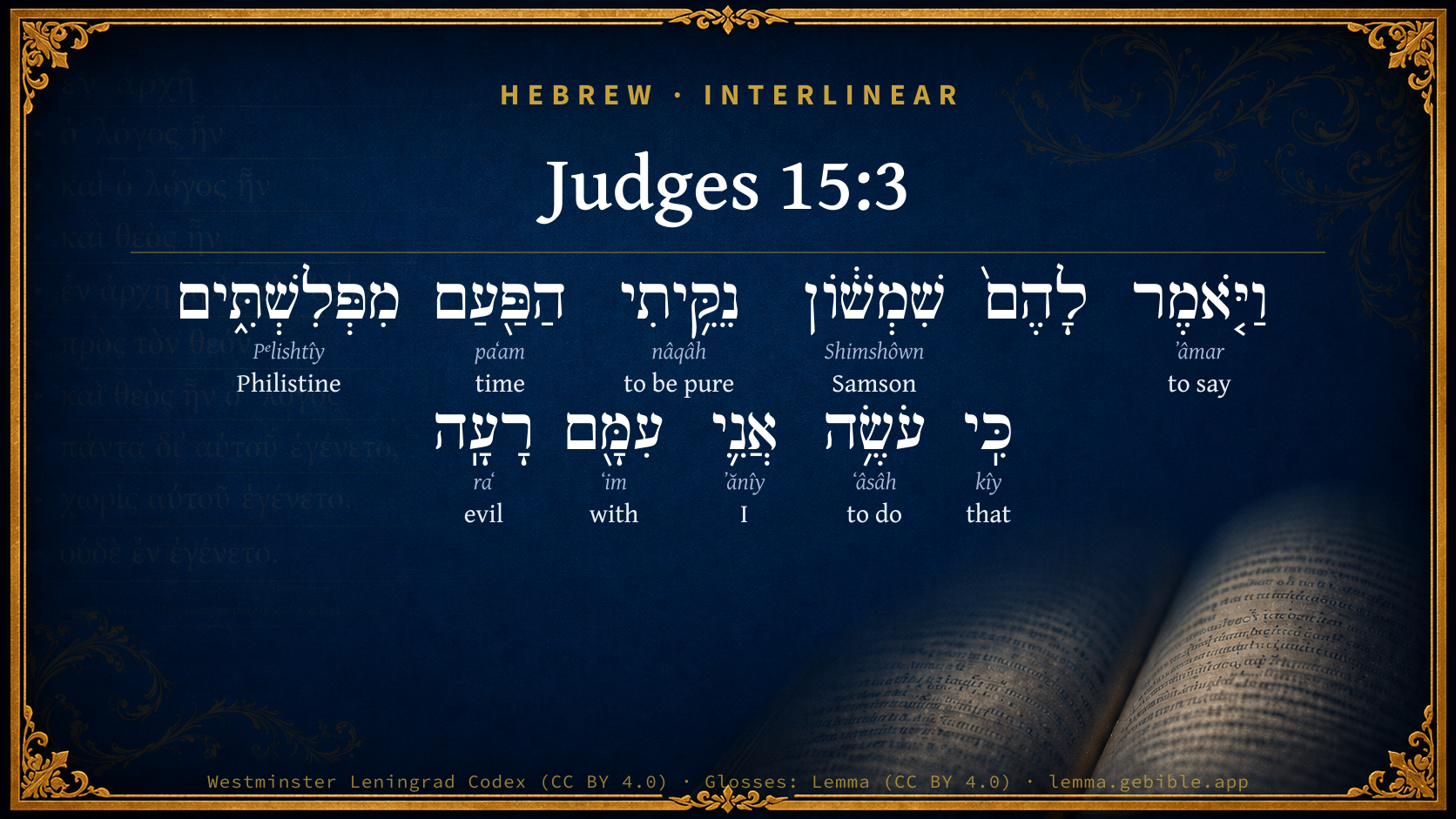
  1. וַיֹּ֤אמֶר ʼâmar H559 “and · to say” Conjunction + Verb, Qal, Sequential Imperfect, 3rd Person, Masculine, Singular
  2. נִקֵּ֥יתִי nâqâh H5352 “to be pure” Verb, Niphal, Perfect, 1st Person, Common, Singular
  3. הַפַּ֖עַם paʻam H6471 “the · time” Particle, Definite Article + Noun, Common, Feminine, Singular, Absolute
  4. מִפְּלִשְׁתִּ֑ים Pᵉlishtîy H6430 “from · Philistines” Preposition + Noun, Gentilic, Masculine, Plural, Absolute
  5. כִּֽי kîy H3588 “that” Conjunction
  6. עֹשֶׂ֥ה ʻâsâh H6213 “doing” Verb, Qal, Participle Active, Masculine, Singular, Absolute
  7. אֲנִ֛י ʼănîy H589 “I” Pronoun, Personal, 1st Person, Common, Singular
  8. עִמָּ֖ם ʻim H5973 “with · them” Preposition + Suffix, Personal, 3rd Person, Masculine, Plural
  9. רָעָֽה raʻ H7451 “evil” Noun, Common, Feminine, Singular, Absolute

About this verse

These counts appear in no published source. They are computed here, from the morphology-tagged text and Lemma’s own curated glosses. What Lemma adds →

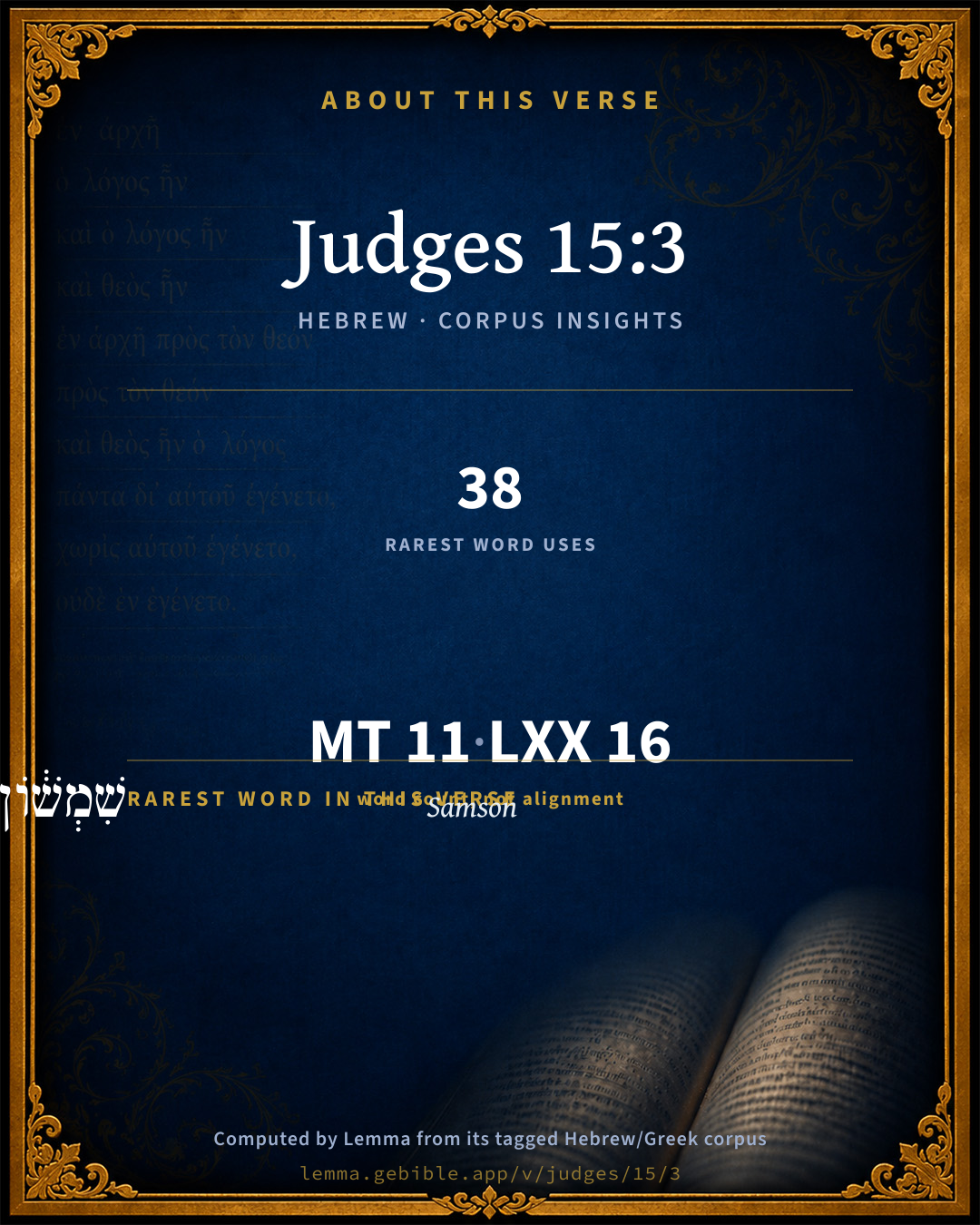
11
words
10
distinct lemmas
Historical
section

Shared distinctive vocabulary

שִׁמְשׁ֔וֹן Samson H8123 occurs in 37 verses of the Hebrew Bible. Also found in:

Grammatical profile

  • 3 verbs
  • 4 nouns
  • 1 pronoun
  • 2 prepositions
  • 1 conjunction

Verb forms

  • וַיֹּ֤אמֶר Qal · Sequential Imperfect
  • נִקֵּ֥יתִי Niphal · Perfect
  • עֹשֶׂ֥ה Qal · Participle Active

Hebrew & Septuagint length

In English translation the verse runs 21 words from the Hebrew and 23 from the Septuagint (LXX English) — closely comparable.

A rough comparison of the two English renderings, which tokenize alike — not a word-level alignment.

Word counts can differ between the Hebrew and the Greek without any difference in meaning — e.g. the Hebrew direct-object marker אֵת has no separate Greek word, and Greek often adds the article ὁ.

In the original languages it is 11 Hebrew tokens and 16 Greek tokens — but the two are counted differently (Hebrew bundles its prefixes and suffixes into one token; the Greek is in lemma form), so that isn’t a like-for-like length.

Cross-references

1

Topical passages linked to Judges 15:3 in the Treasury of Scripture Knowledge — connected by theme and wording, ordered by reader-vote popularity; previews shown in the World English Bible.

  • Judges 14:15 It happened on the seventh day, that they said to Samson's wife, Entice your husband, that he may declare to us the riddle, lest we burn you and your father's house with fire: have you called us to impoverish us? is it not [so]?

Cross-references courtesy of OpenBible.info (CC BY 4.0).

Hebrew and Greek witnesses Masoretic Hebrew ↔ Greek Septuagint

The same verse in the two great witnesses to the Old Testament, shown verse-for-verse.

These are two independent witnesses, not word-aligned to each other, and the Septuagint is shown in lemma (dictionary) form.

Hebrew Judges 15:3 Masoretic · Westminster Leningrad Codex

וַיֹּ֤אמֶר לָהֶם֙ שִׁמְשׁ֔וֹן נִקֵּ֥יתִי הַפַּ֖עַם מִפְּלִשְׁתִּ֑ים כִּֽי עֹשֶׂ֥ה אֲנִ֛י עִמָּ֖ם רָעָֽה

Samson said to them, This time shall I be blameless in regard of the Philistines, when I do them a mischief.

World English Bible · Public Domain

Greek LXX Judges 15:3 Septuagint · lemma form

καί εἶπον αὐτός σαμψων ἀθῳόω καί ὁ ἅπαξ ἀπό ἀλλόφυλος ὅτι ποιέω ἐγώ μετά αὐτός πονηρία

And Sampson said to them, Even for once am I guiltless with regard to the Philistines, in that I do mischief among them.

LXX2012 (modern English Septuagint) · Public Domain

On this verse, Ellicott's Commentary for English Readers discusses the Septuagint’s reading. Read the note in Commentary ↓

Hebrew: Westminster Leningrad Codex (CC BY 4.0). Greek: Septuagint (public domain); English from LXX2012 (modern English Septuagint) (Public Domain). How the Septuagint differs from the Hebrew →

Targum (Aramaic paraphrase)

1

The Targum is the ancient Jewish Aramaic paraphrase of the Hebrew Scriptures — an interpretive translation, not the Hebrew text itself. Onkelos (literal) and Pseudo-Jonathan (expansive) render the Torah, and Jonathan the Prophets. Coverage is partial: where no permissively-licensed English translation exists for a verse, only the Aramaic is shown. This is verse-level text, not a word-by-word alignment to the Hebrew.

  1. Targum Jonathan Prophets (Joshua–Malachi)
    וַאֲמַר לְהוֹן שִׁמְשׁוֹן זַכַּאי אֲנָא זִמְנָא הָדָא מִפְּלִשְׁתָּאֵי אֲרֵי עָבִיד אֲנָא עִמְהוֹן בִּישָׁא:

    (no public-domain English translation for this verse)

    Targum Jonathan — Aramaic: “Mikraot Gedolot” (public domain). English: “Sefaria Community Translation” (CC0 1.0 (public-domain dedication)); “London "Chaldee Paraphrase," 1871” (public domain). Text via Sefaria.

Commentary

Notes on Judges 15:3 from classic Christian and Jewish commentators (each source and its license shown beneath its notes). The classic Christian expositions comment on the surrounding passage and are grouped to its opening verse, so a note may address several verses; the Jewish commentaries on the Tanakh (Rashi and others) are per-verse, so they appear only where the commentator wrote on this verse.

Lemma curates 59 commentaries, every one of them public domain or Creative Commons licensed, each selected and text-cleaned for this edition rather than reprinted as found. About our sources →

Jamieson, Fausset & Brown

Robert Jamieson, A. R. Fausset & David Brown

HE BURNS THE PHILISTINES' CORN. (Jdg 15:3-8)

Samson said . . ., Now shall I be more blameless than the Philistines--This nefarious conduct provoked the hero's just indignation, and he resolved to take signal vengeance.

Jamieson, Fausset & Brown — Commentary Critical and Explanatory on the Whole Bible (1871) — public domain (CC PDM 1.0). Text via the HelloAO Bible API.

Trapp's Complete Commentary

John Trapp

Jdg 15:3 And Samson said concerning them, Now shall I be more blameless than the Philistines, though I do them a displeasure.

Ver. 3. Now shall I be more blameless than the Philistines.] Who all were in fault, because they either approved, or at least inhibited not this injury done to Samson; wherefore he proclaimeth open war against them all, vowing revenge.

John Trapp, A Commentary or Exposition upon All the Books of the Old and New Testament (1647–1656) — public domain. Text from a community e-Sword module.

Joseph Benson's Commentary

Jdg 15:3. Now shall I be more blameless than the Philistines — Or rather, blameless from the Philistines, because they have first provoked me by an irreparable injury. It seems probable from this, that the people of the place, in general, had approved of, and perhaps advised, the giving of Samson’s wife to another man. Though I do them a displeasure — Although this may look like an act of private revenge, yet it is plain, Samson acted as a judge (for such he was) and as an avenger of the public injuries which his people had suffered from the Philistines.

Joseph Benson's Commentary on the Old and New Testaments (1811–1818) — public domain. Text from a community e-Sword module.

Geneva Bible (1599)

Geneva Bible translators

For through his father-in-law’s occasion, he was moved again to take vengeance of the Philistines.

Geneva Bible (1599) marginal notes — public domain. Text via Bolls.life.

Ellicott's Commentary for English Readers

(3) Concerning them.—There is no reason for this rendering. It should be to them. The Vulg. has cui, and the LXX. “to them,” or “to him.”

Now—i.e., This time. He means that his second act of vengeance will at least have more excuse than his assault on the Askelonites.

More blameless than the Philistines.—Rather, innocent as regards the Philistines. The words are somewhat obscure. Ewald renders them—

“This time I am quit of the Philistines,

If ‘tis evil I think of doing them.”

A Bible Commentary for English Readers, edited by Charles John Ellicott (1878–1897) — public domain. Text from a community e-Sword module.

The Cambridge Bible for Schools and Colleges

gen. ed. J. J. S. Perowne

3. unto them] Cf. Jdg_15:7. The family and friends were no doubt discussing the situation with oriental excitement.

shall I be blameless in regard of] i.e. I am resolved to have my revenge on the Philistines, and no one will be able to blame me for it (cf. Num_32:22, 2Sa_3:28); Samson’s words express a resolve in a tone of exultation. When I do should be for I am going to do.

The Cambridge Bible for Schools and Colleges (gen. ed. J. J. S. Perowne; Cambridge University Press, 1878–1918) — public domain. Text from a community e-Sword module.

John Gill's Exposition

And Samson said concerning them,.... His wife's father, and other relations, and the citizens of Timnath; this, which is what follows, he said either within himself respecting them, or he said it to them openly and publicly before them all:

now shall I be more blameless than the Philistines, though I do them a displeasure; signifying, that if he did them an ill thing, or what might be reckoned an injury to their persons or properties, and which would be disagreeable and displeasing to them, they could not justly blame him for it, since they had given him such a provocation as to dispose of his wife to another man; though Samson did not mean to act, nor did he act in the following instances as a private person taking private revenge, but as a public person, and judge of Israel; and took occasion, from the private injuries done him, to avenge the public ones of the children of Israel upon the Philistines; and they might thank themselves for giving the opportunity, which they could not justly condemn him for taking.

John Gill's Exposition of the Whole Bible (1746–1763) — public domain (CC PDM 1.0). Text via the HelloAO Bible API.

Albert Barnes' Notes on the Bible

See the margin. Before, when the Philistines injured him he was in covenant with the Timnathites through his marriage and by the rites of hospitality, for which reason he went off to Ashkelon to take his revenge Jdg 14:19. But now the Philistines themselves had broken this bond, and so he was free to take his revenge on the spot.

Albert Barnes' Notes on the Bible (1834–1885) — public domain. Text from a community e-Sword/MySword module.

Haydock's Catholic Bible Commentary

Evils. This is a declaration of war, made by Samson in person, against a whole nation. (Haydock) --- He does not wish to engage his countrymen in the quarrel, that they may not be more oppressed. God chose that he should weaken the Philistines by degrees. They had been apprised of the injustice done to Samson, and did not strive to hinder it, so that they all deserved to suffer. (Grotius; Estius; Calmet)

George Leo Haydock (1774–1849), Haydock's Catholic Family Bible and Commentary, 1859 edition — public domain. Excludes Psalms (Douay-Rheims chapter numbering differs from Protestant) and Deuterocanonical books (Catholic canon only).

Matthew Poole's English Annotations

Because they have first provoked me by an irreparable injury. But although this may look like an act of private revenge, yet it is plain enough that Samson acted as a judge, (for so he was,) and as an avenger of the public injuries and oppressions of his people; as plainly appears from hence, that Samson designed this very thing before he had received any personal injury, Jdg 14:4.

Matthew Poole's English Annotations on the Holy Bible (1683–1685) — public domain. Text from a community e-Sword/MySword module.

The Pulpit Commentary

I shall be more blameless than the Philistines. The phrase rather means, I shall be blameless (or guiltless) before the Philistines, i.e. in relation to the Philistines, they will have nothing to lay to my charge; my revenge will be a just one, as in Num_32:22: Then shall ye be guiltless before the Lord, and be. fore Israel. He means that so grievous an injury as he had received in having his wife taken from him and given to a Philistine will justify any requitals on his part.

The Pulpit Commentary (1880–1919), ed. H.D.M. Spence-Jones & Joseph S. Exell — public domain. Text from a community e-Sword module.

John Wesley's Explanatory Notes

Now shall I, &c. - Because they have first provoked me by an irreparable injury: but although this may look like an act of private revenge; yet it is plain Samson acted as a judge (for so he was) and as an avenger of the publick injuries of his people.

John Wesley, Explanatory Notes Upon the Whole Bible (1754–1765) — public domain. Text via the GEBible commentary corpus.

Keil & Delitzsch

C. F. Keil & F. Delitzsch

Enraged at this answer, Samson said to them (i.e., to her father and those around him), "Now am I blameless before the Philistines, if I do evil to them." נקּה with מן, to be innocent away from a person, i.e., before him (see Num 32:22). Samson regarded the treatment which he had received from his father-in-law as but one effect of the disposition of the Philistines generally towards the Israelites, and therefore resolved to avenge the wrong which he had received from one member of the Philistines upon the whole nation, or at all events upon the whole of the city of Timnath.

Keil & Delitzsch — Biblical Commentary on the Old Testament (1861–1891) — public domain (CC PDM 1.0). Text via the HelloAO Bible API. (Old Testament only.)

unfoldingWord translationNotes

Door43 World Missions Community

I will be innocent in regard to the Philistines when I hurt them

Samson thinks that he will be innocent if he attacks the Philistines because they wronged him. This can be stated clearly. AT: "I will be innocent if I hurt the Philistines because they have wronged me" (See: Assumed Knowledge and Implicit Information)

three hundred foxes

"300 foxes" (See: Numbers)

foxes

Foxes are animals like dogs that have long tails and that eat nesting birds and other small animals.

each pair

a pair is two of anything, such as two foxes, or two tails

tail to tail

"by their tails"

torches

A torch is a stick of wood with something flammable attached to one end; a torch is often used to light other things or to be carried for light.

translationWords

Samson

innocent

Philistines

unfoldingWord translationNotes — © Distant Shores Media and the Door43 World Missions Community, licensed CC BY-SA 4.0. Source: git.door43.org/Door43/en_tn.

Rashi

Rabbi Shlomo Yitzchaki (Rashi)

At this time I am innocent. I shall be justified in inflicting injury upon them.

Rashi on the Tanakh — English translations: “The Judaica Press complete Tanach with Rashi, translated by A. J. Rosenberg” (CC BY 4.0); “Pentateuch with Rashi's commentary by M. Rosenbaum and A.M. Silbermann, 1929-1934” (public domain); “The Metsudah Tanach series, Lakewood, N.J” (CC BY 4.0); and “The Book of Joshua, Metsudah Publications, 1997” (CC BY 4.0). Text via Sefaria.

Lesson kit

Teaching starters — assembled from the data on this page, not authored interpretation. Every prompt links to the verse data it draws on. Edit before teaching.

Judges, in the Historical, opens this verse with 11 words (10 distinct Hebrew lemmas). Its most distinctive word is Shimshôwn (“Samson”). A historical commentator’s framing appears above. Read the whole chapter for the surrounding context.

Discussion questions

  1. What does “Samson” (Shimshôwn) contribute to the verse as a whole?
  2. How does Judges 13:24, which shares the word «Samson», read alongside this verse?
  3. These translations render this verse differently; the difference is in the English rendering, not the original. What questions does that raise?
  4. «וַיֹּ֤אמֶר» is a Qal Sequential Imperfect verb. How does that grammatical form shape the action described?
  5. Compare how Jamieson, Fausset & Brown and Trapp's Complete Commentary read this verse. Where do they agree or differ?

Things to notice

Reading settings

Reading text

Shown beneath each verse's original-language words.

Old Testament
Old Testament edition

Read the OT as the Masoretic Hebrew (MT) or the Greek Septuagint (LXX).

English shown for the Greek Septuagint (in the Hebrew ↔ Greek comparison).

Comparing translations? Open the Compare panel on any verse page to stack up to four side by side.