
Leviticus 19:4

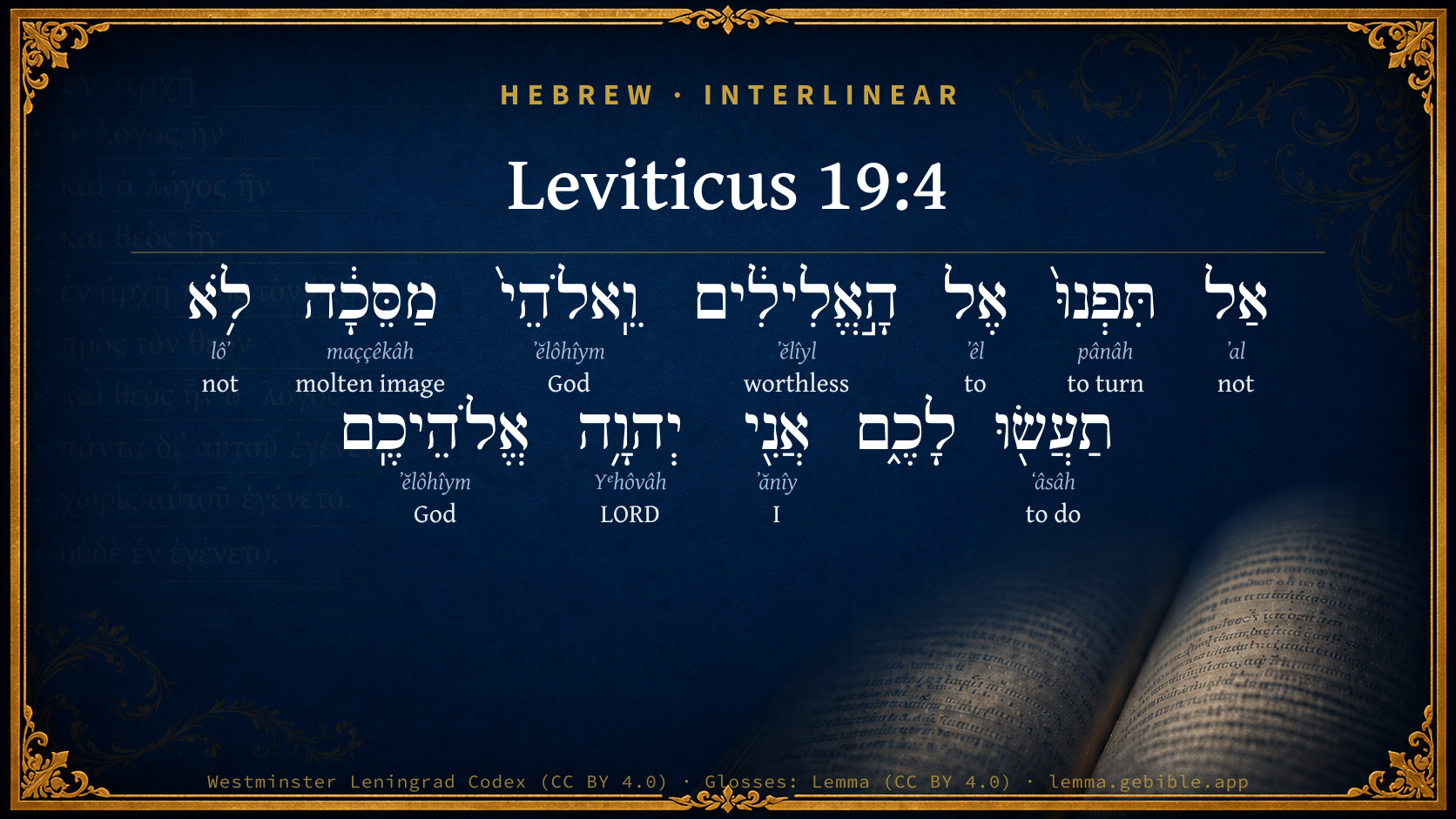
Hebrew (Westminster Leningrad Codex) Leviticus 19:4 appears in the Hebrew Old Testament. The text above is from the Westminster Leningrad Codex. Each word links to its Strong’s number, a concise gloss, and parsing drawn from the Open Scriptures Hebrew Bible morphology. Click any word for its full Brown-Driver-Briggs (BDB) entry.
Download image
Cite this verse

Leviticus 19:4 (World English Bible). Public Domain. Lemma interlinear Bible study tool, https://lemma.gebible.app/v/leviticus/19/4.

Show BibTeX & RIS
BibTeX
RIS
English Translation
"'Don't turn to idols, nor make molten gods for yourselves. I am Yahweh your God.
World English Bible · Public Domain
Highlights
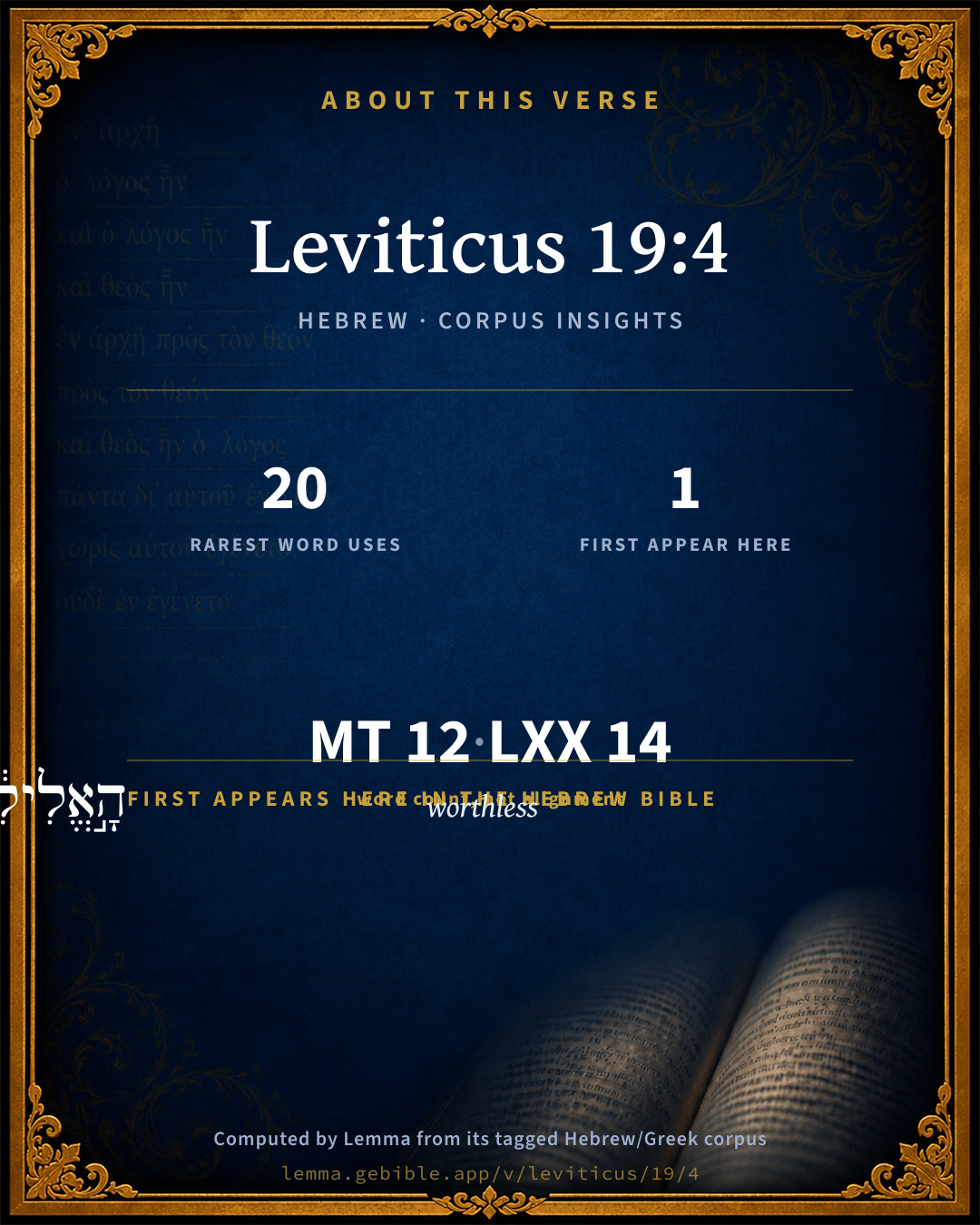
  • 1 first appearance in the Hebrew Bible
Full analysis ↓
Download a study sheet

One document with this verse’s original text, its word-by-word gloss line, the meaning frame, cross-references with their text, attributed commentary, and full source and license credits — printable, and it pastes into notes with its structure intact.

This verse Autodidact and up

Study sheet (.html) Plain text (.txt)

A passage Seminary Student

Up to 50 verses in one chapter. A passage sheet keeps up to 6 commentary sources and 12 cross-references per verse, in the order this page ranks them, and says so on the sheet whenever that leaves anything out. Ask for a single verse and you get the Autodidact verse sheet above.

Everything on this page stays free to read, with no account — the sheet is a download of what is already on screen, not access to it.

Want to remove ads? Support Godless Engineer
Compare translations 3

The same verse in 3 English versions, stacked beneath the original-language interlinear above. Click any original word for its lexicon entry.

Each is an independent rendering of the whole verse — the interlinear is not word-aligned to these translations.

Highlighted words mark where these versions differ — a whole-verse word diff, not a word-by-word alignment.

  • World English Bible Public Domain
    "'Don't turn to idols, nor make molten gods for yourselves. I am Yahweh your God.
  • King James Version Public Domain
    Turn ye not unto idols, nor make to yourselves molten gods: I am the LORD your God.
  • unfoldingWord Literal Text CC BY-SA 4.0
    You shall not turn to idols, and gods of cast metal you shall not make for yourselves. I Yahweh your God.

unfoldingWord Literal Text — © unfoldingWord, licensed CC BY-SA 4.0. Word-aligned USFM3 via Door43 (git.door43.org/unfoldingWord/en_ult).

Versions to compare (up to 4)

3 of 4 selected

Show all 18 translations

Every available English version of this verse, each an independent rendering of the whole verse.

  • World English Bible Public Domain
    "'Don't turn to idols, nor make molten gods for yourselves. I am Yahweh your God.
  • Berean Standard Bible Public Domain
    Do not turn to idols or make for yourselves molten gods. I am the LORD your God.
  • Majority Standard Bible Public Domain
    Do not turn to idols or make for yourselves molten gods. I am the LORD your God.
  • King James Version Public Domain
    Turn ye not unto idols, nor make to yourselves molten gods: I am the LORD your God.
  • American Standard Version (1901) Public Domain
    Turn ye not unto idols, nor make to yourselves molten gods: I am Jehovah your God.
  • Revised Version (1885) Public Domain
    Turn ye not unto idols, nor make to yourselves molten gods: I am the LORD your God.
  • Geneva Bible (1599) Public Domain
    Ye shall not turne vnto idoles, nor make you molten gods: I am the Lord your God.
  • Douay-Rheims (1899) Public Domain
    Turn ye not to idols, nor make to yourselves molten gods. I am the Lord your God.
  • Young's Literal Translation Public Domain
    `Ye do not turn unto the idols, and a molten god ye do not make to yourselves; I `am' Jehovah your God.
  • Literal Standard Version CC BY-SA 4.0
    You do not turn to the idols, and you do not make a molten god for yourselves; I [am] your God YHWH.
  • Unlocked Literal Bible CC BY-SA 4.0
    Do not turn to worthless idols, nor make for yourselves gods out of metal. I am Yahweh your God.
  • unfoldingWord Literal Text CC BY-SA 4.0
    You shall not turn to idols, and gods of cast metal you shall not make for yourselves. I Yahweh your God.
  • Darby Bible Public Domain
    Ye shall not turn unto idols, and ye shall not make to yourselves molten gods: I am Jehovah your God.
  • World Messianic Bible Public Domain
    “‘Don’t turn to idols, nor make molten gods for yourselves. I am the LORD your God.
  • Webster's Bible Public Domain
    Turn ye not to idols, nor make to yourselves molten gods: I am the LORD your God.
  • Free Bible Version CC BY-SA 4.0
    Don't turn to idols for help or make metal images of gods. I am the Lord your God.
  • Bible in Basic English Public Domain
    Do not go after false gods, and do not make metal images of gods for yourselves: I am the Lord your God.
  • JPS Tanakh (1917) Public Domain
    Turn ye not unto the idols, nor make to yourselves molten gods: I am the LORD your God.

Literal Standard Version (2020), Covenant Press — licensed CC BY-SA 4.0. Text via the HelloAO Bible API (eBible.org). Unlocked Literal Bible (unfoldingWord) — licensed CC BY-SA 4.0. Text via the HelloAO Bible API (eBible.org). unfoldingWord Literal Text — © unfoldingWord, licensed CC BY-SA 4.0. Word-aligned USFM3 via Door43 (git.door43.org/unfoldingWord/en_ult). Free Bible Version, Dr. Jonathan Gallagher — licensed CC BY-SA 4.0. Text via the HelloAO Bible API (eBible.org).

Word by word

More ways to search: Search by grammar → Find every occurrence → Compare this word →

Practice this passage: Drill this verse → Learn its vocabulary →

הָ֣אֱלִילִ֔ים
ʼĕlîyl
H457
“the · idols”
Particle, Definite Article + Noun, Common, Masculine, Plural, Absolute
Part of Speech
Particle + Noun
Type
Common
Gender
Masculine
Number
Plural
State
Absolute
Full BDB Definition

Origin: apparently from H408

TWOT: 99a

of nought, good for nothing, worthless - of physicians, a shepherd, a divination - of false gods
  1. אַל ʼal H408 “not” Particle, Negative
  2. תִּפְנוּ֙ pânâh H6437 “to turn” Verb, Qal, Jussive, 2nd Person, Masculine, Plural
  3. אֶל ʼêl H413 “to” Preposition
  4. וֵֽאלֹהֵי֙ ʼĕlôhîym H430 “and · God(s) of” Conjunction + Noun, Common, Masculine, Plural, Construct
  5. מַסֵּכָ֔ה maççêkâh H4541 “molten image” Noun, Common, Feminine, Singular, Absolute
  6. לֹ֥א lôʼ H3808 “not” Particle, Negative
  7. תַעֲשׂ֖וּ ʻâsâh H6213 “to do” Verb, Qal, Imperfect, 2nd Person, Masculine, Plural
  8. אֲנִ֖י ʼănîy H589 “I” Pronoun, Personal, 1st Person, Common, Singular
  9. יְהוָ֥ה Yᵉhôvâh H3068 “LORD” Noun, Proper
  10. אֱלֹהֵיכֶֽם ʼĕlôhîym H430 “God(s) · your” Noun, Common, Masculine, Plural, Construct + Suffix, Personal, 2nd Person, Masculine, Plural

About this verse

These counts appear in no published source. They are computed here, from the morphology-tagged text and Lemma’s own curated glosses. What Lemma adds →

12
words
10
distinct lemmas
Pentateuch
section

Notable vocabulary

The rarest word here is הָ֣אֱלִילִ֔ים worthless H457 — appearing just 20 times in the whole Hebrew Bible.

First appearance in Scripture

This word makes its first canonical appearance in the Hebrew Bible here:

  • הָ֣אֱלִילִ֔ים worthless H457

Shared distinctive vocabulary

הָ֣אֱלִילִ֔ים worthless H457 occurs in 18 verses of the Hebrew Bible. Also found in:

Grammatical profile

  • 2 verbs
  • 5 nouns
  • 1 pronoun
  • 2 prepositions
  • 2 particles

Verb forms

  • תִּפְנוּ֙ Qal · Jussive
  • תַעֲשׂ֖וּ Qal · Imperfect

Repetition

A word recurs within this verse — often emphatic in Hebrew:

  • וֵֽאלֹהֵי֙ God H430 ×2

Hebrew & Septuagint length

In English translation the verse runs 15 words from the Hebrew and 20 from the Septuagint (LXX English) — closely comparable.

A rough comparison of the two English renderings, which tokenize alike — not a word-level alignment.

Word counts can differ between the Hebrew and the Greek without any difference in meaning — e.g. the Hebrew direct-object marker אֵת has no separate Greek word, and Greek often adds the article ὁ.

In the original languages it is 12 Hebrew tokens and 14 Greek tokens — but the two are counted differently (Hebrew bundles its prefixes and suffixes into one token; the Greek is in lemma form), so that isn’t a like-for-like length.

Cross-references

11

Topical passages linked to Leviticus 19:4 in the Treasury of Scripture Knowledge — connected by theme and wording, ordered by reader-vote popularity; previews shown in the World English Bible.

  • Leviticus 26:1 "'You shall make for yourselves no idols, neither shall you raise up an engraved image or a pillar, neither shall you place any figured stone in your land, to bow down to it: for I am Yahweh your God.
  • Exodus 20:23 You shall most certainly not make alongside of me gods of silver, or gods of gold for yourselves.
  • Exodus 34:17 You shall make no cast idols for yourselves.
  • Psalms 115:4–7 Their idols are silver and gold, The work of men's hands.
  • Exodus 20:3–5 You shall have no other gods before me.
  • Deuteronomy 27:15 Cursed be the man who makes an engraved or molten image, an abomination to Yahweh, the work of the hands of the craftsman, and sets it up in secret. All the people shall answer and say, Amen.
  • Psalms 96:5 For all the gods of the peoples are idols, But Yahweh made the heavens.
  • 1 Corinthians 10:14 Therefore, my beloved, flee from idolatry.
  • 1 John 5:21 Little children, keep yourselves from idols.
  • Exodus 32:4 He received what they handed him, and fashioned it with an engraving tool, and made it a molten calf; and they said, "These are your gods, Israel, which brought you up out of the land of Egypt."
  • Haggai 2:18 'Consider, please, from this day and backward, from the twenty-fourth day of the ninth month, since the day that the foundation of Yahweh's temple was laid, consider it.

Cross-references courtesy of OpenBible.info (CC BY 4.0).

Hebrew and Greek witnesses Masoretic Hebrew ↔ Greek Septuagint

The same verse in the two great witnesses to the Old Testament, shown verse-for-verse.

These are two independent witnesses, not word-aligned to each other, and the Septuagint is shown in lemma (dictionary) form.

Hebrew Leviticus 19:4 Masoretic · Westminster Leningrad Codex

אַל תִּפְנוּ֙ אֶל הָ֣אֱלִילִ֔ים וֵֽאלֹהֵי֙ מַסֵּכָ֔ה לֹ֥א תַעֲשׂ֖וּ לָכֶ֑ם אֲנִ֖י יְהוָ֥ה אֱלֹהֵיכֶֽם

"'Don't turn to idols, nor make molten gods for yourselves. I am Yahweh your God.

World English Bible · Public Domain

Greek LXX Leviticus 19:4 Septuagint · lemma form

οὐ ἐπιἀκολουθέω εἴδωλον καί θεός χωνευτός οὐ ποιέω σύ ἐγώ κύριος ὁ θεός σύ

You⌃ shall not follow idols, and you⌃ shall not make to yourselves molten gods: I am the Lord your God.

LXX2012 (modern English Septuagint) · Public Domain

Hebrew: Westminster Leningrad Codex (CC BY 4.0). Greek: Septuagint (public domain); English from LXX2012 (modern English Septuagint) (Public Domain). How the Septuagint differs from the Hebrew →

Targum (Aramaic paraphrase)

2

The Targum is the ancient Jewish Aramaic paraphrase of the Hebrew Scriptures — an interpretive translation, not the Hebrew text itself. Onkelos (literal) and Pseudo-Jonathan (expansive) render the Torah, and Jonathan the Prophets. Coverage is partial: where no permissively-licensed English translation exists for a verse, only the Aramaic is shown. This is verse-level text, not a word-by-word alignment to the Hebrew.

  1. Targum Onkelos Torah (Genesis–Deuteronomy)
    לָא תִתְפְּנוּן בָּתַר טַעֲוָן וְדַחֲלָן דְמַתְּכָא לָא תַעְבְּדוּן לְכוֹן אֲנָא יְיָ אֱלָהָכוֹן

    (no public-domain English translation for this verse)

    Targum Onkelos — Aramaic: “Onkelos Genesis” (public domain); “Onkelos Exodus” (public domain); “Onkelos Leviticus” (public domain); “Onkelos Numbers” (public domain); “Onkelos Deuteronomy” (public domain). English: “Sefaria Community Translation” (CC0 1.0 (public-domain dedication)); “J.W. Etheridge. The Targums of Onkelos and Jonathan Ben Uzziel on the Pentateuch. London: Longmans, Green, 1862” (public domain). Text via Sefaria.

  2. Targum Pseudo-Jonathan Torah (Genesis–Deuteronomy)
    לָא תִסְטוּן לְפוּלְחַן טַעֲוָון וְדַחֲלָן דְמַתְּכָא לָא תַעַבְדוּן לְכוֹן אֲנָא יְיָ אֳלָהָכוֹן

    Go not astray after the worship of idols, nor make gods for yourselves that are molten: I am the Lord your God.

    Targum Pseudo-Jonathan — Aramaic: “Targum Jonathan on Genesis” (public domain); “Targum Jonathan on Exodus” (public domain); “Targum Jonathan on Leviticus” (public domain); “Targum Jonathan on Numbers” (public domain); “Targum Jonathan on Deuteronomy” (public domain). English: “The Targum of Jonathan ben Uzziel, trans. J. W. Etheridge, London, 1862” (public domain). Text via Sefaria.

Commentary

Notes on Leviticus 19:4 from classic Christian and Jewish commentators (each source and its license shown beneath its notes). The classic Christian expositions comment on the surrounding passage and are grouped to its opening verse, so a note may address several verses; the Jewish commentaries on the Tanakh (Rashi and others) are per-verse, so they appear only where the commentator wrote on this verse.

Lemma curates 59 commentaries, every one of them public domain or Creative Commons licensed, each selected and text-cleaned for this edition rather than reprinted as found. About our sources →

Trapp's Complete Commentary

John Trapp

Lev 19:4 Turn ye not unto idols, nor make to yourselves molten gods: I [am] the LORD your God.

Ver. 4. Turn ye not unto idols.] Heb., Elilim; deunculi, deastri; Petty gods, dunghill deities; of all which we should say, as he did once, Contemno minutulos istos deos, modo Iovem (Iehovam) mihi propitium habeam, I care for the favour of no god, but of the great God of gods.

John Trapp, A Commentary or Exposition upon All the Books of the Old and New Testament (1647–1656) — public domain. Text from a community e-Sword module.

The Biblical Illustrator

Joseph S. Exell

Lev_19:4

Turn ye not unto idols.

Folly of idolatry

A Chinese wife was one day seen by a missionary to enter a temple. In her hands were some humble offerings, such as a twig, or rice, for propitiating the poor, blind deity. There he stood, some forty feet high, blackened and begrimed with the smoke of incense for hundreds of years. She presented her petition; she called upon the idol to protect and return in safety her husband, then on the sea in a storm. A few weeks after the missionary was there, and saw the same female enter the temple in a rage. She stood before the grim idol and cursed it for being so blind, so deaf, so helpless, as to let her husband perish! Yes, the wailing widow of heathen life only echoed the sad complaints of millions in Christian lands. They found their hopes and build their plans on just such baseless, blind, deaf gods as this humble dweller in darkness. The worldling ever prays to a god that is deaf and blind I (VanDoren, D. D.)

The Biblical Illustrator, edited by Joseph S. Exell (c. 1880s–1900s) — public domain. Text from a community e-Sword module.

Joseph Benson's Commentary

Lev 19:4. Turn ye not unto idols — Hebrew, אלילם, Elilim, No gods, or nothings, as the word signifies, and as idols are called, (1Co 8:4,) many of them having no being but in the fancy of their worshippers, and all of them having no virtue or power to do good or evil, Isa 41:23.

Joseph Benson's Commentary on the Old and New Testaments (1811–1818) — public domain. Text from a community e-Sword module.

Adam Clarke's Commentary

Verse 4. Turn ye not unto idols] אלילם elilim, literally nothings; and to this St. Paul seems to allude 1Co 8:4, where he says, We know that an idol is NOTHING in the world.

Adam Clarke's Commentary on the Bible (1810–1826) — public domain. Text from a community e-Sword/MySword module.

Ellicott's Commentary for English Readers

(4) Turn ye not unto idols.—As the Lord is their God, and there is no other God besides Him, the Israelites must never turn their affections nor address prayers or enquiries to idols. This part of the verse therefore corresponds with the first commandment of the Decalogue (Exo_20:3). The expression here rendered “idols,” which, apart from the Prophets and Hagiographa, only occurs once more (see Lev_26:1), denotes non-entities—nothings, and it is in allusion to this import of the word that the Apostle remarks, “We know that an idol is nothing in the world” (1Co_8:4). According to the administrators of the law during the second Temple, the injunction here “turn not” means “face not,” and forbids even the looking at or the examination of an idol.

Nor make yourselves molten gods.—This part of the verse corresponds with the second commandment in the Decalogue (Exo_20:4-6), though the phrase “molten gods” only occurs once more where the same prohibition is enforced (Exo_34:17).

A Bible Commentary for English Readers, edited by Charles John Ellicott (1878–1897) — public domain. Text from a community e-Sword module.

The Cambridge Bible for Schools and Colleges

gen. ed. J. J. S. Perowne

4. Turn ye not unto] As in Lev_19:31 (A.V. ‘Regard not’), and Lev_20:6.

idols] (’ìlîlîm) things of nought R.V. mg. See reference there. The Heb. word occurs only here and Lev_26:1 in Pentateuch; a word of uncertain etymology, possibly suggesting the idea of gods from its sound (similar to that of ’ël and ’ĕlôhîm), but always associated with the idea of worthlessness. It is used by the prophets ironically of false gods in contrast to the true God.

molten gods] See Exo_34:17. Cp. Deu_27:15.

The Cambridge Bible for Schools and Colleges (gen. ed. J. J. S. Perowne; Cambridge University Press, 1878–1918) — public domain. Text from a community e-Sword module.

John Gill's Exposition

Turn ye not unto idols,.... From the one only true and living God to them that are not gods, as the word used signifies, who are nothing; for, as the apostle says, an idol is nothing in the world, Co1 8:4, is of no worth and value, of no consequence and importance, of no avail and usefulness to its devotees; wherefore to turn from the true God to such as these is the greatest stupidity, as well as wickedness: or "look not" at them (g) for help or assistance, for they are not able to give it: and to look at them so as to view them attentively, and consider their likeness, the Jews say (h) is forbidden; and even in the heart and mind, as Aben Ezra observes, to have respect unto them was not right; or in the thoughts, as Gersom:

nor make to yourselves molten gods; of gold, silver, or brass, melted and cast into a mould, as the golden calf was, to which respect may be had. These laws have a respect unto the first and second commandments, Exo 20:3,

I am the Lord, your God; who only is to be worshipped, and who has forbid the making and worshipping any image, molten or graven, and who will therefore resent idolatry of every sort, and punish for it.

(g) "ne respiciatis", Montanus, Tigurine version, Drusius. (h) Pesichta, Maimonides.

John Gill's Exposition of the Whole Bible (1746–1763) — public domain (CC PDM 1.0). Text via the HelloAO Bible API.

Haydock's Catholic Bible Commentary

Idols. Hebrew, "vain things." (Calmet) --- Molten, or any other sort of workmanship. (Menochius)

George Leo Haydock (1774–1849), Haydock's Catholic Family Bible and Commentary, 1859 edition — public domain. Excludes Psalms (Douay-Rheims chapter numbering differs from Protestant) and Deuterocanonical books (Catholic canon only).

Matthew Poole's English Annotations

Turn not your hearts and faces from me, whom alone you pretend to respect, unto them. He intimates, that their turning to idols is a turning from God, and that they could not serve both God and idols.

Unto idols: the word signifies such as are no gods, or nothings, as they are called, 1Co 8:4, many idols having no being, but only in the fancy of their worshippers, and all of them having no virtue or power to do good or evil, Isa 41:23. Molten gods, nor graven gods neither, as appears from Exo 20, whereby we learn that such expressions are generally to be understood synecdochically.

Matthew Poole's English Annotations on the Holy Bible (1683–1685) — public domain. Text from a community e-Sword/MySword module.

Whedon's Commentary on the Bible

Daniel D. Whedon

4. Idols — The Hebrew term elilim, nothings, or “things of naught,” (Jer_14:14,) is very expressive. There is a paronomasia, or similarity of sound with elohim, God, which heightens the contrast. “As the Living One, Jehovah, is placed in contrast to the gods of the heathen, which can reveal nothing, perform nothing, grant no requests, and send no help, Deu_32:37-39; which are nothings, and dead, Psa_106:28.” — Oehler. But Furst derives the word from el with a diminutive syllable, “little gods,” indicating the greatest contempt.

Molten gods — The massecha, or molten image, is spoken of in distinction from the graven or carved images. The precious metals were used. Exo_20:23; Exo_32:2; Exo_32:8.

Daniel D. Whedon (gen. ed.), Commentary on the Old and New Testaments (1874–1909) — public domain. Text from a community e-Sword module.

The Pulpit Commentary

Turn ye not unto idols. The word used for idols, elilim, meaning nothings, is contrasted with Elohim, God. Psalm 115 exhibits this contrast in several of its particulars. Cf. St. Paul"s statement, "We know that an idol is nothing in the world, and that there is none other God but one". (1Co_8:4) "If the heart of man becomes benumbed to the use of images of false gods of any kind, he sinks down to the idols which are his ideals, and becomes as dumb and unspiritual as they are" (Lunge). The remainder of the verse forbids the transgression of the second commandment, as the earlier part of the verse forbids the transgression of the first commandment: nor make to yourselves molten gods, as was done by Jeroboam when he set up the calves. (1Ki_12:23)

This verse contains the laws of piety and of faith. "Turn ye not unto idols forbids the worship of false gods; "nor make to yourselves molten gods forbids in addition the sin of worshipping the true God under the form of a molten shape.

I The great temptation to the Jews down to the time of their captivity appears to have been that of taking the gods of the nations round about them as their gods; Baal, Ashtoreth, Molech, Chemosh, drew off their affections from Jehovah. They did not desire apparently to give up the worship of God altogether, but to combine the worship of false gods with it, that is, to transfer a part of the religious affections which were due to God to some other object. This is done in the present day,

(1) by the Roman Catholic Church, which sanctions the transference of worship which ought to be confined to God, from him to St. Mary and other saints; and the moral and religious regard, which is due to God alone, not only to saints, but to a living man, who has been called the idol of the Vatican;

(2) by worldly men, who occupy their thoughts and feeling to such an excessive degree with the things of sense as to shut out Divine and spiritual things;

(3) by sophists, who, by the exercise of a subtle intellect in a presumptuous spirit, shut out God from their ken, and worship the universe, or humanity, or nothing.

II The Jews were also guilty of the kindred sin of worshipping Jehovah under the form of an idol. This was the sin of Aaron"s calf, which represented, not any strange god, but Jehovah himself, (Exo_32:5) and this was the case with Jeroboam"s two calves of gold. (1Ki_12:26-33) This offense is committed by any Christians who adore a representation of the Deity, sculptured or painted, or any sign or symbol of him, of whatever material or appearance it may be. It is the sin of men or Churches which have faith to believe that there is a God, but so feeble a faith that they require visible symbols of his presence instead of bravely trusting in the Unseen. The Israelites said to Aaron, "Up, make us gods, which shall go before us; for as for this Moses, the man that brought us up out of the land of Egypt, we wet not what is become of him." When they could not see Moses, the servant of God, they required a visible image of God. They could not trust him unseen; they required proof of his nearness; and this craving of a feeble faith led them to prefer the symbol of "a calf that eateth hay" (Deu_4:15) to no similitude at all. "Other nations, surrounding the Jews on every side, had their visible objects of worship, making their task of Divine duty and faith more easy. But to acquiesce in their unseen God, I am; to obey without immediate continual consciousness of his nearness; to trust in his protection at times when they had no sensible aid to help them to realize to their imagination his power; to let loose, as it were, their prayers into the air, without having some representative figure, or emblem, at the least, at which to point them; all this was too difficult a task for a feeble faith in things invisible and spiritual" (Moberly, "The Law of the Love of God").

The same feebleness of faith has produced the worship of images in the Christian Church. It was not till the seventh century that they crept into use for aids in worship, and when they were approved in the eighth century by the second Council of Nicea, that Council was at once rejected, and its doctrine of images was repudiated by the Council of Frankfort and the bishops of Charlemagne"s empire.

In like manner, a feeble faith craves for full light, for demonstration, for infallibility, where God has only given twilight moral certainty, and an authority which is not absolute. It craves for immediate resolution of spiritual difficulties where God demands a patient dealing with them; it asks after a sign where no sign is to be given; it seeks out for itself mediators instead of going straight to God.

Not only does the use of images in worship arise from a feeble faith, but it makes that faith feebler and feebler, and thus leads to materialism. After a while the symbol becomes substituted for the thing symbolized by it, and the affections which the emblem was intended to excite toward an unseen object, do not pass beyond the external sign. Materialism and weakness of faith are the spiritual effects of worshipping images and craving after visible symbols.

"A brave contentment with an invisible God, showing itself in faithful and strong-hearted maintenance of piety in the absence (if it should so please God) or the apparent scantiness of signs, tokens, miracles, and other visible indications of the presence and protection of the Omnipresent and Omnipotent, and a like courageous and faithful abstinence from making to themselves unauthorized images, symbols, and emblems of him who communicated with the people without similitude, must be the particular quality or part of Divine love enjoined under the second law. The peculiar affection enjoined is the brave, trusting, spiritual faith in God invisible, spiritual, absent to our sense, dim in his tokens, obscure sometimes in his providences, not demonstrable in his evidences, not invariable in his benefits.... Possessed of this spiritual faith in the Unseen, a man walks along his narrow path of life with a confidence, security, and cheerfulness which establish at once his comfort and his safety" (Moberly, "The Law of the Love of God").

The Pulpit Commentary (1880–1919), ed. H.D.M. Spence-Jones & Joseph S. Exell — public domain. Text from a community e-Sword module.

John Wesley's Explanatory Notes

Idols - The word signifies such as are no Gods, or nothings, as they are called, 1 Cor. viii, 4, many idols having no being, but in the fancy of their worshippers, and all of them having no virtue or power to do good or evil, Isaiah xli, 23.

John Wesley, Explanatory Notes Upon the Whole Bible (1754–1765) — public domain. Text via the GEBible commentary corpus.

Rashi

Rabbi Shlomo Yitzchaki (Rashi)

אל תפנו אל האלילים TURN YE NOT UNTO THE IDOLS — to worship them (Sifra, Kedoshim, Section 1 10). The word אלילים, idols, is connected with “not“ (אל) — it is regarded of “none" import.

ואלהי מסכה [NOR MAKE TO YOURSELVES] MOLTEN GODS - In the beginning they may appear as “nought" (אלילים) but if you turn unto them you will in the end make them gods (Sifra, Kedoshim, Section 1 11). The translation therefore is: do not turn unto these “non-entities", so that you may not in the end make them into molten gods for yourselves.

לא תעשו לכם implies: do not you make molten gods for others nor let others make such for you. Should you, however, say that לא תעשו לכם implies only “you shall not make them for yourselves" but others may make them for you, then I reply: But Scripture has already stated (Exodus 20:3) “Thou shalt have [no other gods]” — neither your own idol nor one which is the idol of (made by) others (Sifra, Kedoshim, Section 1 12).

Rashi on the Tanakh — English translations: “The Judaica Press complete Tanach with Rashi, translated by A. J. Rosenberg” (CC BY 4.0); “Pentateuch with Rashi's commentary by M. Rosenbaum and A.M. Silbermann, 1929-1934” (public domain); “The Metsudah Tanach series, Lakewood, N.J” (CC BY 4.0); and “The Book of Joshua, Metsudah Publications, 1997” (CC BY 4.0). Text via Sefaria.

Ramban (Nachmanides)

Rabbi Moshe ben Nachman (Ramban / Nachmanides)

He states, ‘Al tiphnu’ (Turn ye not) unto the idols, the term tiphnu (turn ye) being of the expressions: and if thy heart ‘yiphneh’ (turn away); whose heart ‘poneh’ (turneth away) this day., 29:17. The verse [here] is thus stating that one’s heart should not turn away to the idols, to believe that there is some benefit in [worshipping] them, or that the events that they foretell will really transpire; rather, they and all their activities should appear to him as things of nought, and vanity, and future events occur only by decree of the Most High. And so also have our Rabbis said: “It is forbidden to look at the statues [of the idols] themselves, because it says, ‘Turn ye not’ unto the idols.” Thus the Rabbis included within this prohibition even looking at the statues, so that one should not allow one’s thoughts to dwell on their matters at all.He states, nor make to yourselves molten gods, thus prohibiting them from the very moment that they are made. Admonitions against idolatry are stated in the Torah in many places.In the Midrash of Vayikra Rabbah the Rabbis mentioned concerning this section [of the Torah the following text]: “Rabbi Levi says: Because the Ten Commandments are included in this section [therefore it was proclaimed to the full assembly]. I am the Eternal thy G-d, and here it is written, I am the Eternal your G-d. Thou shalt have no other gods, and here it is written, nor make to yourselves molten gods. Thou shalt not take the Name of the Eternal thy G-d in vain, Verse 7. and here it is written, And ye shall not swear by My Name falsely. Remember the Sabbath day, Verse 8 (Vol. II, pp. 306-311). and here it is written, and ye shall keep My Sabbaths. Honor thy father and thy mother, and here it is written, Ye shall fear every man his mother and his father. Thou shalt not murder, and here it is written, Neither shalt thou stand idly by the blood of thy neighbor. Thou shalt not commit adultery, and here it is written, Profane not thy daughter, to make her a harlot., Verse 29. Thou shalt not steal, and here it is written, Ye shall not steal., Verse 11. Thou shalt not bear false witness, and here it is written, Thou shalt not go up and down as a talebearer among thy people. Thou shalt not covet, and here it is written, and thou shalt love thy neighbor as thyself.” Thus far is the text of the Midrash.

Ramban (Nachmanides) on the Tanakh — English translation: “Commentary on the Torah by Ramban (Nachmanides). Translated and annotated by Charles B. Chavel. New York, Shilo Pub. House, 1971-1976” (CC BY 4.0). Text via Sefaria.

Lesson kit

Teaching starters — assembled from the data on this page, not authored interpretation. Every prompt links to the verse data it draws on. Edit before teaching.

Leviticus, in the Pentateuch, opens this verse with 12 words (10 distinct Hebrew lemmas). Its most distinctive word is ʼĕlîyl (“worthless”). A historical commentator’s framing appears above. Read the whole chapter for the surrounding context.

Discussion questions

  1. How does “worthless” (ʼĕlîyl) shape what this verse is saying?
  2. The word “worthless” first appears here in Scripture. What is being introduced at this debut?
  3. Leviticus 26:1 shares the word «worthless» with this verse. How do the two illuminate each other?
  4. “God” occurs 2× in this one verse. What is the effect of the repetition?
  5. These translations render this verse differently; the difference is in the English rendering, not the original. What questions does that raise?
  6. The verb «תִּפְנוּ֙» is Qal Jussive. How does its form color the action?
  7. Reading how Trapp's Complete Commentary and The Biblical Illustrator read this verse, where do the two commentators agree and where do they part?

Things to notice

Reading settings

Reading text

Shown beneath each verse's original-language words.

Old Testament
Old Testament edition

Read the OT as the Masoretic Hebrew (MT) or the Greek Septuagint (LXX).

English shown for the Greek Septuagint (in the Hebrew ↔ Greek comparison).

Comparing translations? Open the Compare panel on any verse page to stack up to four side by side.