Isaiah 66:9

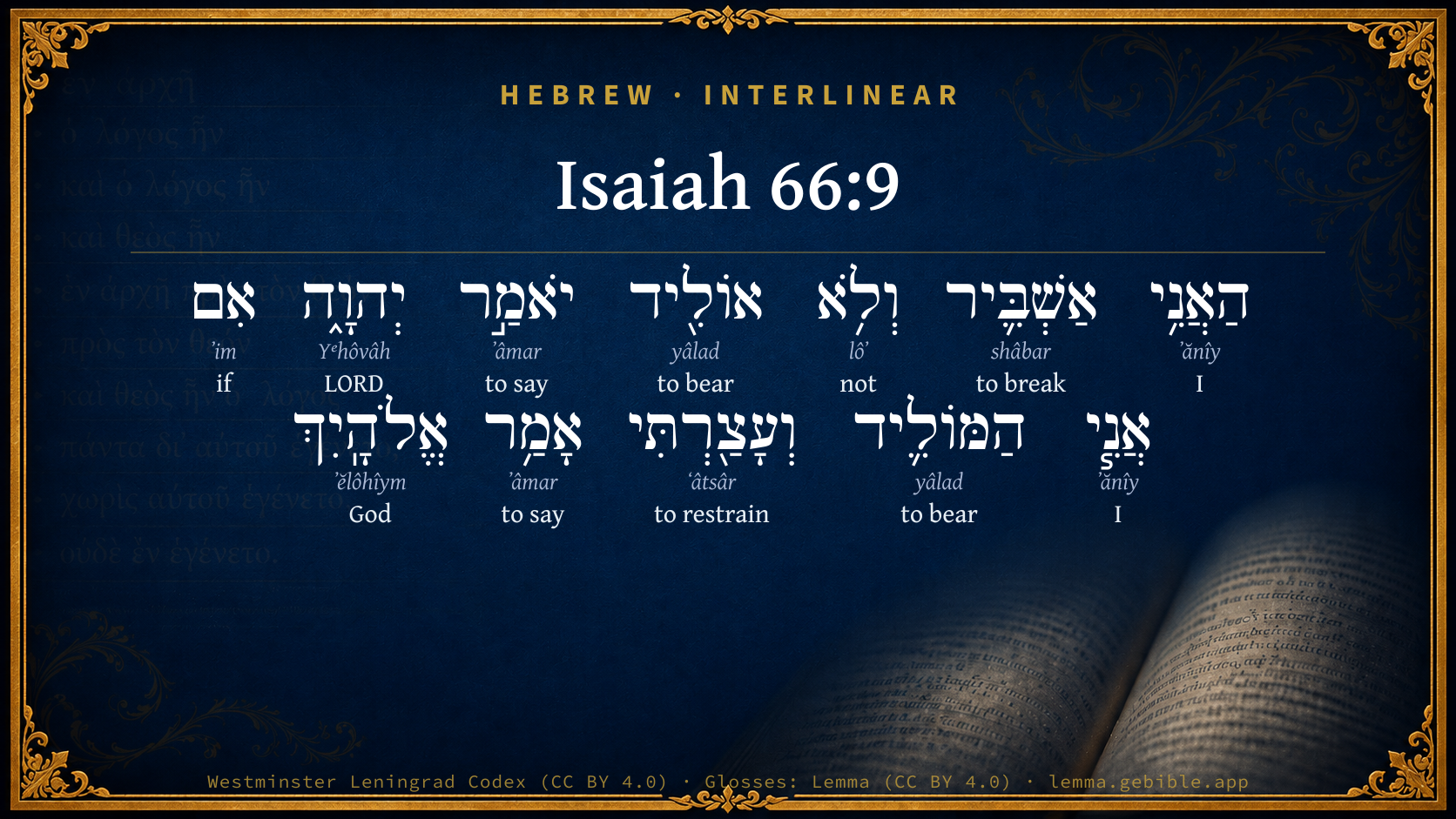
Hebrew (Westminster Leningrad Codex) Isaiah 66:9 appears in the Hebrew Old Testament. The text above is from the Westminster Leningrad Codex. Each word links to its Strong’s number, a concise gloss, and parsing drawn from the Open Scriptures Hebrew Bible morphology. Click any word for its full Brown-Driver-Briggs (BDB) entry.
Download image
Cite this verse

Isaiah 66:9 (World English Bible). Public Domain. Lemma interlinear Bible study tool, https://lemma.gebible.app/v/isaiah/66/9.

Show BibTeX & RIS
BibTeX
RIS
English Translation
Shall I bring to the birth, and not cause to bring forth? says Yahweh: shall I who cause to bring forth shut [the womb]? says your God.
World English Bible · Public Domain
Download a study sheet

One document with this verse’s original text, its word-by-word gloss line, the meaning frame, cross-references with their text, attributed commentary, and full source and license credits — printable, and it pastes into notes with its structure intact.

This verse Autodidact and up

Study sheet (.html) Plain text (.txt)

A passage Seminary Student

Up to 50 verses in one chapter. A passage sheet keeps up to 6 commentary sources and 12 cross-references per verse, in the order this page ranks them, and says so on the sheet whenever that leaves anything out. Ask for a single verse and you get the Autodidact verse sheet above.

Everything on this page stays free to read, with no account — the sheet is a download of what is already on screen, not access to it.

Want to remove ads? Support Godless Engineer
Compare translations 3

The same verse in 3 English versions, stacked beneath the original-language interlinear above. Click any original word for its lexicon entry.

Each is an independent rendering of the whole verse — the interlinear is not word-aligned to these translations.

Highlighted words mark where these versions differ — a whole-verse word diff, not a word-by-word alignment.

  • World English Bible Public Domain
    Shall I bring to the birth, and not cause to bring forth? says Yahweh: shall I who cause to bring forth shut [the womb]? says your God.
  • King James Version Public Domain
    Shall I bring to the birth, and not cause to bring forth? saith the LORD: shall I cause to bring forth, and shut the womb? saith thy God.
  • unfoldingWord Literal Text CC BY-SA 4.0
    “I, will I break open and not cause to birth?” says Yahweh. “If I am causing birth, then will I restrain?” says your God.

unfoldingWord Literal Text — © unfoldingWord, licensed CC BY-SA 4.0. Word-aligned USFM3 via Door43 (git.door43.org/unfoldingWord/en_ult).

Versions to compare (up to 4)

3 of 4 selected

Show all 18 translations

Every available English version of this verse, each an independent rendering of the whole verse.

  • World English Bible Public Domain
    Shall I bring to the birth, and not cause to bring forth? says Yahweh: shall I who cause to bring forth shut [the womb]? says your God.
  • Berean Standard Bible Public Domain
    Shall I bring a baby to the point of birth and not deliver it?” says the LORD. “Or will I who deliver close the womb?” says your God.
  • Majority Standard Bible Public Domain
    Shall I bring a baby to the point of birth and not deliver it?” says the LORD. “Or will I who deliver close the womb?” says your God.
  • King James Version Public Domain
    Shall I bring to the birth, and not cause to bring forth? saith the LORD: shall I cause to bring forth, and shut the womb? saith thy God.
  • American Standard Version (1901) Public Domain
    Shall I bring to the birth, and not cause to bring forth? saith Jehovah: shall I that cause to bring forth shut `the womb'? saith thy God.
  • Revised Version (1885) Public Domain
    Shall I bring to the birth, and not cause to bring forth? saith the LORD: shall I that cause to bring forth shut the womb? saith thy God.
  • Geneva Bible (1599) Public Domain
    Shall I cause to trauaile, and not bring forth? shall I cause to bring forth, and shall be baren, saith thy God?
  • Douay-Rheims (1899) Public Domain
    Shall not I that make others to bring forth children, myself bring forth, saith the Lord? shall I, that give generation to others, be barren, saith the Lord thy God?
  • Young's Literal Translation Public Domain
    `Do I bring to the birth, And not cause to bring forth?' saith Jehovah, `Am not I He who is causing to beget? I have also restrained,' said thy God.
  • Literal Standard Version CC BY-SA 4.0
    Do I bring to the birth, || And not cause to bring forth?” says YHWH, || “Am I not He who is causing to beget? I have also restrained,” said your God.
  • Unlocked Literal Bible CC BY-SA 4.0
    Do I bring a baby to the birth opening and not permit the child to be born?—asks Yahweh. Or do I bring a child to moment of delivery and then hold it back?—asks your God.”
  • unfoldingWord Literal Text CC BY-SA 4.0
    “I, will I break open and not cause to birth?” says Yahweh. “If I am causing birth, then will I restrain?” says your God.
  • Darby Bible Public Domain
    Shall I bring to the birth, and not cause to bring forth? saith Jehovah; I who cause to bring forth, shall I shut [the womb]? saith thy God.
  • World Messianic Bible Public Domain
    Shall I bring to the birth, and not cause to be delivered?” says the LORD. “Shall I who cause to give birth shut the womb?” says your God.
  • Webster's Bible Public Domain
    Shall I bring to the birth, and not cause to bring forth? saith the LORD: shall I cause to bring forth, and shut the womb? saith thy God.
  • Free Bible Version CC BY-SA 4.0
    Would I bring a baby to the point of birth and then not deliver it? the Lord asks. Would I who deliver the baby stop it from being born? the Lord asks again.
  • Bible in Basic English Public Domain
    Will I by whom the birth was started, not make it complete? says the Lord. Will I who make children come to birth, let them be kept back? says your God.
  • JPS Tanakh (1917) Public Domain
    Shall I bring to the birth, and not cause to bring forth? saith the LORD; Shall I that cause to bring forth shut the womb? saith thy God.

Literal Standard Version (2020), Covenant Press — licensed CC BY-SA 4.0. Text via the HelloAO Bible API (eBible.org). Unlocked Literal Bible (unfoldingWord) — licensed CC BY-SA 4.0. Text via the HelloAO Bible API (eBible.org). unfoldingWord Literal Text — © unfoldingWord, licensed CC BY-SA 4.0. Word-aligned USFM3 via Door43 (git.door43.org/unfoldingWord/en_ult). Free Bible Version, Dr. Jonathan Gallagher — licensed CC BY-SA 4.0. Text via the HelloAO Bible API (eBible.org).

Word by word

More ways to search: Search by grammar → Find every occurrence → Compare this word →

Practice this passage: Drill this verse → Learn its vocabulary →

וְעָצַ֖רְתִּי
ʻâtsâr
H6113
“and · to restrain”
Conjunction + Verb, Qal, Sequential Perfect, 1st Person, Common, Singular
Part of Speech
Conjunction + Verb
Stem
Qal
Form
Sequential Perfect
Person
1st Person
Gender
Common
Number
Singular
Full BDB Definition

Origin: a primitive root

TWOT: 1675

to restrain, retain, close up, shut, withhold, refrain, stay, detain - (Qal) - to restrain, halt, stop - to retain - (Niphal) to be restrained, be stayed, be under restraint
  1. הַאֲנִ֥י ʼănîy H589 “I” Particle, Interrogative + Pronoun, Personal, 1st Person, Common, Singular
  2. אַשְׁבִּ֛יר shâbar H7665 “to break” Verb, Hiphil, Imperfect, 1st Person, Common, Singular
  3. וְלֹ֥א lôʼ H3808 “and · not” Conjunction + Particle, Negative
  4. אוֹלִ֖יד yâlad H3205 “to bear” Verb, Hiphil, Imperfect, 1st Person, Common, Singular
  5. יֹאמַ֣ר ʼâmar H559 “to say” Verb, Qal, Imperfect, 3rd Person, Masculine, Singular
  6. יְהוָ֑ה Yᵉhôvâh H3068 “LORD” Noun, Proper
  7. אִם ʼim H518 “if” Conjunction
  8. אֲנִ֧י ʼănîy H589 “I” Pronoun, Personal, 1st Person, Common, Singular
  9. הַמּוֹלִ֛יד yâlad H3205 “the · bearing” Particle, Definite Article + Verb, Hiphil, Participle Active, Masculine, Singular, Absolute
  10. אָמַ֥ר ʼâmar H559 “to say” Verb, Qal, Perfect, 3rd Person, Masculine, Singular
  11. אֱלֹהָֽיִךְ ʼĕlôhîym H430 “God(s) · your” Noun, Common, Masculine, Plural, Construct + Suffix, Personal, 2nd Person, Feminine, Singular

About this verse

These counts appear in no published source. They are computed here, from the morphology-tagged text and Lemma’s own curated glosses. What Lemma adds →

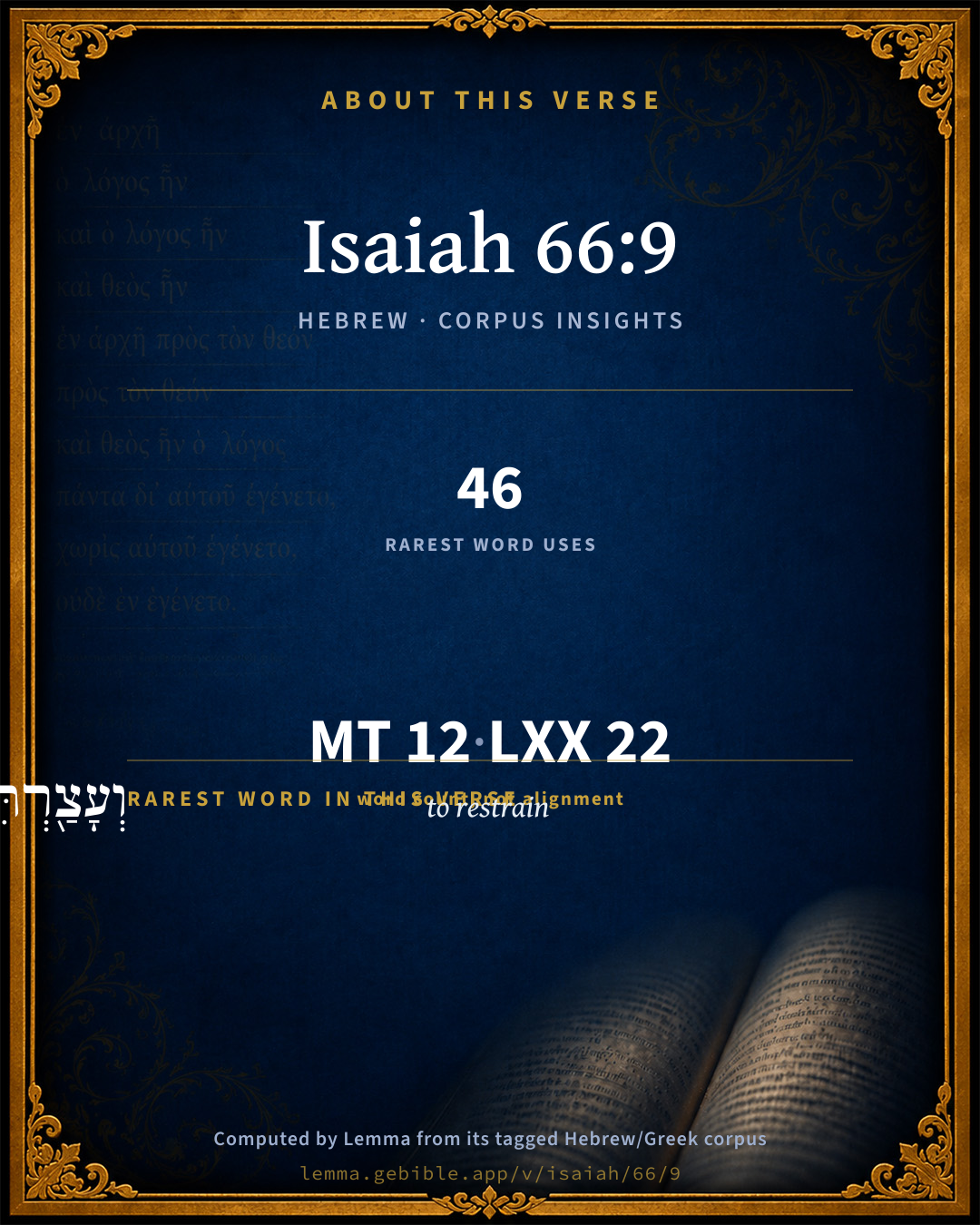
12
words
9
distinct lemmas
Prophets
section

Shared distinctive vocabulary

וְעָצַ֖רְתִּי to restrain H6113 occurs in 45 verses of the Hebrew Bible. Also found in:

Grammatical profile

  • 6 verbs
  • 2 nouns
  • 2 pronouns
  • 1 conjunction
  • 1 particle

Verb forms

  • אַשְׁבִּ֛יר Hiphil · Imperfect
  • אוֹלִ֖יד Hiphil · Imperfect
  • יֹאמַ֣ר Qal · Imperfect
  • הַמּוֹלִ֛יד Hiphil · Participle Active
  • וְעָצַ֖רְתִּי Qal · Sequential Perfect
  • אָמַ֥ר Qal · Perfect

Repetition

Words recur within this verse — often emphatic in Hebrew:

  • אוֹלִ֖יד to bear H3205 ×2
  • יֹאמַ֣ר to say H559 ×2
  • הַאֲנִ֥י I H589 ×2

Hebrew & Septuagint length

In English translation the verse runs 27 words from the Hebrew and 28 from the Septuagint (LXX English) — closely comparable.

A rough comparison of the two English renderings, which tokenize alike — not a word-level alignment.

Word counts can differ between the Hebrew and the Greek without any difference in meaning — e.g. the Hebrew direct-object marker אֵת has no separate Greek word, and Greek often adds the article ὁ.

In the original languages it is 12 Hebrew tokens and 22 Greek tokens — but the two are counted differently (Hebrew bundles its prefixes and suffixes into one token; the Greek is in lemma form), so that isn’t a like-for-like length.

Cross-references

2

Topical passages linked to Isaiah 66:9 in the Treasury of Scripture Knowledge — connected by theme and wording, ordered by reader-vote popularity; previews shown in the World English Bible.

  • Isaiah 37:3 They said to him, Thus says Hezekiah, This day is a day of trouble, and of rebuke, and of rejection; for the children have come to the birth, and there is no strength to bring forth.
  • Genesis 18:14 Is anything too hard for Yahweh? At the set time I will return to you, when the season comes round, and Sarah will have a son."

Cross-references courtesy of OpenBible.info (CC BY 4.0).

Hebrew and Greek witnesses Masoretic Hebrew ↔ Greek Septuagint

The same verse in the two great witnesses to the Old Testament, shown verse-for-verse.

These are two independent witnesses, not word-aligned to each other, and the Septuagint is shown in lemma (dictionary) form.

Hebrew Isaiah 66:9 Masoretic · Westminster Leningrad Codex

הַאֲנִ֥י אַשְׁבִּ֛יר וְלֹ֥א אוֹלִ֖יד יֹאמַ֣ר יְהוָ֑ה אִם אֲנִ֧י הַמּוֹלִ֛יד וְעָצַ֖רְתִּי אָמַ֥ר אֱלֹהָֽיִךְ

Shall I bring to the birth, and not cause to bring forth? says Yahweh: shall I who cause to bring forth shut [the womb]? says your God.

World English Bible · Public Domain

Greek LXX Isaiah 66:9 Septuagint · lemma form

ἐγώ δέ δίδωμι ὁ προσδοκία οὗτος καί οὐ μιμνήσκω ἐγώ εἶπον κύριος οὐ ἰδού ἐγώ γεννάω καί στεῖρα ποιέω εἶπον ὁ θεός

But I have raised this expectation, yet you have not remembered me, says the Lord: behold, have not I made the bearing and barren woman? says your God.

LXX2012 (modern English Septuagint) · Public Domain

Hebrew: Westminster Leningrad Codex (CC BY 4.0). Greek: Septuagint (public domain); English from LXX2012 (modern English Septuagint) (Public Domain). How the Septuagint differs from the Hebrew →

Targum (Aramaic paraphrase)

1

The Targum is the ancient Jewish Aramaic paraphrase of the Hebrew Scriptures — an interpretive translation, not the Hebrew text itself. Onkelos (literal) and Pseudo-Jonathan (expansive) render the Torah, and Jonathan the Prophets. Coverage is partial: where no permissively-licensed English translation exists for a verse, only the Aramaic is shown. This is verse-level text, not a word-by-word alignment to the Hebrew.

  1. Targum Jonathan Prophets (Joshua–Malachi)
    אֲנָא אֱלָהָא בְּרִית עַלְמָא מִבְּרֵאשִׁית אֲמַר יְיָ אֲנָא בְרֵית כָל אֱנָשָׁא אֲנָא בַדְרֵית יַתְהוֹן לְבֵינֵי עַמְמַיָא אַף אֲנָא עֲתִיד לְכַנָשָׁא גַלְוָתִיךְ אֲמַר אֱלָהָיִךְ:

    I am God; I have created the world from the beginning, saith the Lord; I, even I have created all men; I, even I have scattered them among the nations, also I will gather thy captivity, saith thy God.

    Targum Jonathan — Aramaic: “Mikraot Gedolot” (public domain). English: “Sefaria Community Translation” (CC0 1.0 (public-domain dedication)); “London "Chaldee Paraphrase," 1871” (public domain). Text via Sefaria.

Commentary

Notes on Isaiah 66:9 from classic Christian and Jewish commentators (each source and its license shown beneath its notes). The classic Christian expositions comment on the surrounding passage and are grouped to its opening verse, so a note may address several verses; the Jewish commentaries on the Tanakh (Rashi and others) are per-verse, so they appear only where the commentator wrote on this verse.

Lemma curates 59 commentaries, every one of them public domain or Creative Commons licensed, each selected and text-cleaned for this edition rather than reprinted as found. About our sources →

Trapp's Complete Commentary

John Trapp

Isa 66:9 Shall I bring to the birth, and not cause to bring forth? saith the LORD: shall I cause to bring forth, and shut [the womb]? saith thy God.

Ver. 9. Shall I bring to the birth, and not cause to bring forth?] i.e., Shall I set upon a work and not go through with it? God began and finished his work of creation. Christ is both "author and finisher" of his people’s faith. {Heb 12:2} The Holy Ghost will sanctify the elect wholly, "and keep them blameless unto the coming of our Lord Jesus Christ." {1Th 5:23} Nescit tarda molimina Spiritus Sancti gratia, saith Ambrose. Otherwise his power and mercy would not equally appear to his people in regeneration, as the power and mercy of the Father and the Son in creation and redemption.

John Trapp, A Commentary or Exposition upon All the Books of the Old and New Testament (1647–1656) — public domain. Text from a community e-Sword module.

Joseph Benson's Commentary

Isa 66:9. Shall I bring to the birth — Shall I disappoint and render abortive a design of which I myself was the author, when every thing is ripe for execution, and the effect just ready to be produced? Shall I begin a work and not perfect it? Shall I cause to bring forth, and shut the womb — That there should not be a continual succession of converts in all ages? Zion shall not bring forth once only, but she shall continue to be fruitful: her womb shall not be shut: she shall every day bring forth more and more children, and my presence shall be with my church to the end of the world. Thus the prophet still carries on the comparison between the natural and the spiritual birth.

Joseph Benson's Commentary on the Old and New Testaments (1811–1818) — public domain. Text from a community e-Sword module.

Tyndale Open Study Notes

Tyndale Open Resources

66:9 The Lord promised that he would surely recreate his holy nation.

Tyndale Open Study Notes — © Tyndale Open Resources, licensed CC BY-SA 4.0. Text via the HelloAO Bible API.

Geneva Bible (1599)

Geneva Bible translators

Declaring hereby, that as in his power and providence women travailed and delivered, so he giveth the power to bring forth the Church at his time appointed.

Geneva Bible (1599) marginal notes — public domain. Text via Bolls.life.

Jamieson, Fausset & Brown

Robert Jamieson, A. R. Fausset & David Brown

cause to bring forth, and shut--rather, "Shall I who beget, restrain the birth?" [LOWTH], (Isa 37:3; Hos 13:13); that is, Shall I who have begun, not finish My work of restoring Israel? (Sa1 3:12; Rom 11:1; Phi 1:6).

shut--(compare Rev 3:7-8).

Jamieson, Fausset & Brown — Commentary Critical and Explanatory on the Whole Bible (1871) — public domain (CC PDM 1.0). Text via the HelloAO Bible API.

Adam Clarke's Commentary

Verse 9. Shall I bring to the birth] האני אשביר haani ashbir, num ego matricem frangam; MONTANUS. The word means that which immediately precedes the appearance of the fetus - the breaking forth of the liquor amnii. This also is an expression that should be studiously avoided in prayers and sermons.

Adam Clarke's Commentary on the Bible (1810–1826) — public domain. Text from a community e-Sword/MySword module.

Ellicott's Commentary for English Readers

(9) Shall I bring to the birth . . .—The implied thought is that God will not leave His work of national restoration unfinished. There shall not be that frustration of hopes when they seem just on the point of being fulfilled which the history of the world so often records. (Comp. Isa_37:3.)

A Bible Commentary for English Readers, edited by Charles John Ellicott (1878–1897) — public domain. Text from a community e-Sword module.

The Cambridge Bible for Schools and Colleges

gen. ed. J. J. S. Perowne

9. Comp. ch. Isa_37:3; “the children are come to the birth, and there is not strength to bring forth.” But in this crisis Jehovah Himself is present, and what He begins He will carry on to its marvellous issue.

The second half of the verse should be rendered as in R.V. shall I that cause to bring forth shut the womb? &c.

The Cambridge Bible for Schools and Colleges (gen. ed. J. J. S. Perowne; Cambridge University Press, 1878–1918) — public domain. Text from a community e-Sword module.

John Gill's Exposition

Shall I bring to the birth, and not cause to bring forth, saith the Lord?.... Or, "to the place of breaking" forth of children, as in Hos 13:13, the womb, and the mouth of it: or, "shall I break or open" that, so some (s) render it; lest too much should or seem to be attributed to the Church, she being said to travail in birth, and bring forth children, this is said by the Lord. The church may pray, and her ministers preach, and both be said to travail in birth, but it is the Lord that brings to it; regeneration is not the work of man, but of God; it is he that beget, again, quickens, renews, and sanctifies; it is he that begins the work of grace in regeneration, in real and thorough convictions of sin; which are right when men are convinced of the impurity of their nature, the exceeding sinfulness of sin, have a godly sorrow for it, and forsake it: the work is begun when souls feel the burden of sin; the inward struggling, of grace and corruption; a want of spiritual food, and hunger after it; desires after spiritual things, and a glowing love and affection for them; and when light is infused, faith, fear, and love produced, and every other grace implanted; and he that has begun the good work will perform it; as Jarchi rightly gives the sense of the clause,

"shall I begin a thing, and not be able to finish it?''

no, he is a rock, and his work is perfect, as in creation and redemption, so in regeneration and conversion; as may be concluded, from his power to effect it, and his promise to do it; the grace of Christ, and the indwelling of the Spirit; the impotency of everything to hinder it, and the glory of the three divine Persons concerned in it. As in the natural birth it is he that gives strength to conceive, forms the embryo in the womb, ripens it for the birth, and takes the child out of its mother's womb; so he does all that answers hereunto in the spiritual birth.

Shall I cause to bring forth, and shut the womb, saith thy God? no, I will not. As God has regenerated many souls in the first times of the Gospel, and many more since, in various nations, in each of the ages and periods of time; so he has not ceased, nor will he cease from this work, until all his elect are born again; for everyone that is chosen of the Father, given to the Son, taken into covenant, and redeemed by his blood, shall be begotten again to a lively hope of a glorious inheritance; God will not shut the womb of conversion until they are all brought to faith in Christ, and repentance towards God. He will beget many more sons and daughters; and he will cause the fulness of the Gentiles to be brought forth and brought in, and convert his ancient people the Jews; all his promises shall be performed, and all prophecies relating to these things shall be accomplished.

(s) "matricem frangam?" Montanus; "an ego aperirem os matricis?" Junius & Tremellius, Piscator.

John Gill's Exposition of the Whole Bible (1746–1763) — public domain (CC PDM 1.0). Text via the HelloAO Bible API.

Albert Barnes' Notes on the Bible

Shall I bring to the birth? - The sense of this verse is plain. It is, that God would certainly accomplish what he had here predicted, and for which he had made ample arrangements and preparations. He would not commence the work, and then abandon it. The figure which is used here is obvious; but one which does not render very ample illustration proper. Jarchi has well expressed it: ‘Num ego adducerem uxorem meam ad sellam partus, sc. ad partitudinem, et non aperirem uterum ejus, ut foetum suum in lucem produceret? Quasi diceret; an ego incipiam rem nec possim eam perficere?’

Shall I cause to bring forth? - Lowth and Noyes render this, ‘Shall I, who begat, restrain the birth?’ This accurately expresses the idea. The meaning of the whole is, that God designed the great and sudden increase of his church; that the plan was long laid; and that, having done this, he would not abandon it, but would certainly effect his designs.

Albert Barnes' Notes on the Bible (1834–1885) — public domain. Text from a community e-Sword/MySword module.

Haydock's Catholic Bible Commentary

God. His grace converts the nations. (Calmet)

George Leo Haydock (1774–1849), Haydock's Catholic Family Bible and Commentary, 1859 edition — public domain. Excludes Psalms (Douay-Rheims chapter numbering differs from Protestant) and Deuterocanonical books (Catholic canon only).

Matthew Poole's English Annotations

The work before spoken of seemeth not after the manner of men, who do things that are great gradually, nor in an ordinary course of nature, whose motions also bring things by degrees to their perfection; but you must consider who it is that speaketh,

saith the Lord; now as is the God, so is his strength. Again, men may undertake things, and for want of power not bring them to perfection; but shall I do such a thing? I have by many prophecies and promises secured you in the expectation of such a thing, and shall I not by my providence effect it? I, that in the ordinary course of my providence use to give a birth to women, to whom I have given a power to conceive, shall I not give a birth to Zion, to my people, whom by my prophecies and promises I have made to conceive such hopes and expectations? Nor shall Zion once only bring forth, but she shall go on teeming; her womb shall not be shut, she shall every day bring forth more and more children; my presence shall be with my church to that end, to the end of the world.

Matthew Poole's English Annotations on the Holy Bible (1683–1685) — public domain. Text from a community e-Sword/MySword module.

The Pulpit Commentary

Shall I bring to the birth, etc.? i.e. "Should I arrange all the preliminary circumstances for the restoration of my people, and stop there?" (Cheyne). Nay, should I, having done so much, interpose at the last moment, to shut the womb? Without such interposition, matters have progressed so far, that the result must come.

The Pulpit Commentary (1880–1919), ed. H.D.M. Spence-Jones & Joseph S. Exell — public domain. Text from a community e-Sword module.

John Wesley's Explanatory Notes

Shall I - I, that in the ordinary course of my providence use to give a birth to women, to whom I have given a power to conceive, shall I not give a birth to my people, whom by my promises I have made to conceive such expectations? And shut - Nor shall Zion once only bring forth, but she shall go on, her womb shall not be shut, she shall every day bring forth more and more children, and my presence shall be with my church, to the end of the world.

John Wesley, Explanatory Notes Upon the Whole Bible (1754–1765) — public domain. Text via the GEBible commentary corpus.

J. A. Alexander on Isaiah

Joseph Addison Alexander

“Shall I bring to the birth and not cause to bring forth? saith Jehovah. Or am I the one causing to bring forth, and shall I shut up? saith thy God.” The sense now put upon the figure by the general consent of interpreters, is that He Who begins the work may be expected to accomplish it, to be both its author and its finisher. The reason why it is expressed in this form is not any peculiar adaptation or expressiveness in these unusual metaphors, but simply that the increase of the church had been already represented as a birth, and the additional ideas of the writer are expressed without a change of figure. The precise connection of the verse with that before it seems to be that it extenuates the wonder which had been described, by representing it as something which was to be expected in the case supposed. That is to say, if God had undertaken to supply the place of what His church had lost by new accessions, the extent and suddenness of the effect could not be matters of surprise. On the contrary, it would have been indeed surprising, if He Who began the change had stopped it short, and interfered for the prevention of His own designs. With the metaphor of this verse and the one preceding, compare Isa 26:18.

Joseph Addison Alexander, The Prophecies of Isaiah (1846–1847; New York: Scribner, 1870–1878) — public domain. Text from a community e-Sword module.

unfoldingWord translationNotes

Door43 World Missions Community

General Information:

Yahweh continues speaking about Jerusalem as if it were a mother. (See: Isaiah 66:7-8)

Do I bring a baby to the birth opening ... born?

Yahweh uses questions to emphasize that he will not fail to fulfill his promises to the people of Jerusalem. (See: Rhetorical Question and Metaphor)

translationWords

children

Yahweh

God

unfoldingWord translationNotes — © Distant Shores Media and the Door43 World Missions Community, licensed CC BY-SA 4.0. Source: git.door43.org/Door43/en_tn.

Rashi

Rabbi Shlomo Yitzchaki (Rashi)

Will I bring to the birth stool and not cause to give birth Will I bring a woman to the birth stool and not open her womb to bring out her fetus? That is to say, Shall I commence a thing and not be able to complete it? Am I not the One Who causes every woman in confinement to give birth, and now will I shut the womb? This is a question.

Rashi on the Tanakh — English translations: “The Judaica Press complete Tanach with Rashi, translated by A. J. Rosenberg” (CC BY 4.0); “Pentateuch with Rashi's commentary by M. Rosenbaum and A.M. Silbermann, 1929-1934” (public domain); “The Metsudah Tanach series, Lakewood, N.J” (CC BY 4.0); and “The Book of Joshua, Metsudah Publications, 1997” (CC BY 4.0). Text via Sefaria.

Ibn Ezra

Rabbi Abraham ibn Ezra

האני אשביר Shall I bring to birth. Comp. משבר בנים "birth of children" (Hos. 13:13). Shall I bring to birth etc. I have the power to do all this, to bring the woman, as it were, near the birth, and should I not be able to bring force? or should I could cause the whole world to bring forth a children, shut the womb of Zion?

Ibn Ezra on the Tanakh — English translations: “Sefaria Community Translation” (CC0 1.0 (public-domain dedication)); “Yalkut, Sifsei Chachomim Chumash, Metsudah Publications, 2009” (CC BY 4.0); and “Commentary of Ibn Ezra on Isaiah - trans. by M. Friedlander, 1873” (public domain). Text via Sefaria.

Lesson kit

Teaching starters — assembled from the data on this page, not authored interpretation. Every prompt links to the verse data it draws on. Edit before teaching.

Isaiah, in the Prophets, opens this verse with 12 words (9 distinct Hebrew lemmas). Its most distinctive word is ʻâtsâr (“to restrain”). A historical commentator’s framing appears above. Read the whole chapter for the surrounding context.

Discussion questions

  1. How does “to restrain” (ʻâtsâr) shape what this verse is saying?
  2. Genesis 16:2 shares the word «to restrain» with this verse. How do the two illuminate each other?
  3. “to bear” occurs 2× in this one verse. What is the effect of the repetition?
  4. The translations on this page render this verse differently — a whole-verse word diff, not a word-by-word alignment. What might account for the different wordings?
  5. The verb «אַשְׁבִּ֛יר» is Hiphil Imperfect. How does its form color the action?
  6. Reading how Trapp's Complete Commentary and Joseph Benson's Commentary read this verse, where do the two commentators agree and where do they part?

Things to notice

Reading settings

Reading text

Shown beneath each verse's original-language words.

Old Testament
Old Testament edition

Read the OT as the Masoretic Hebrew (MT) or the Greek Septuagint (LXX).

English shown for the Greek Septuagint (in the Hebrew ↔ Greek comparison).

Comparing translations? Open the Compare panel on any verse page to stack up to four side by side.