
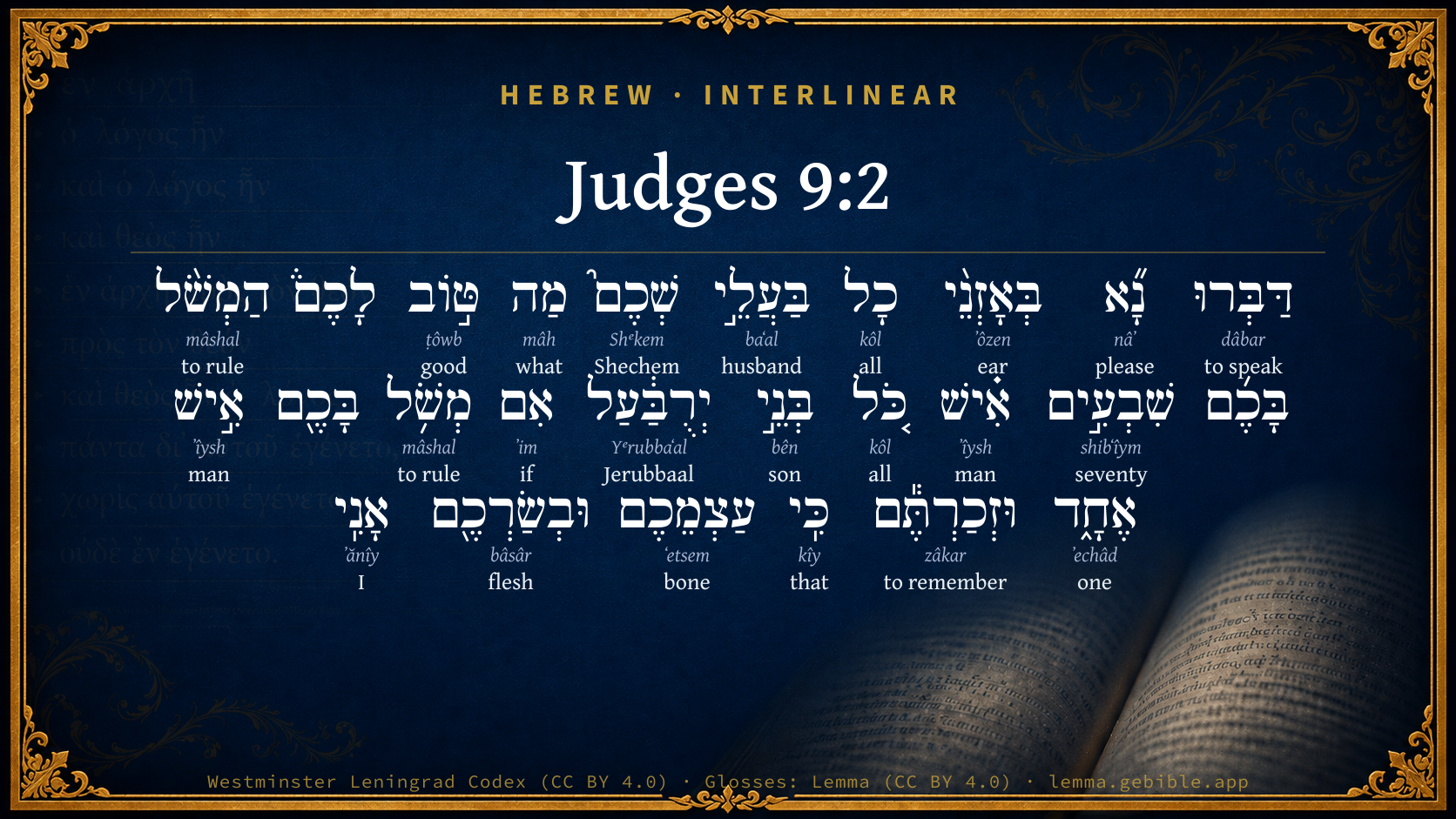
Judges 9:2

Hebrew (Westminster Leningrad Codex) Judges 9:2 appears in the Hebrew Old Testament. The text above is from the Westminster Leningrad Codex. Each word links to its Strong’s number, a concise gloss, and parsing drawn from the Open Scriptures Hebrew Bible morphology. Click any word for its full Brown-Driver-Briggs (BDB) entry.
Download image
Cite this verse

Judges 9:2 (World English Bible). Public Domain. Lemma interlinear Bible study tool, https://lemma.gebible.app/v/judges/9/2.

Show BibTeX & RIS
BibTeX
RIS
English Translation
Please speak in the ears of all the men of Shechem, Whether is better for you, that all the sons of Jerubbaal, who are seventy persons, rule over you, or that one rule over you? Remember also that I am your bone and your flesh.
World English Bible · Public Domain
Download a study sheet

One document with this verse’s original text, its word-by-word gloss line, the meaning frame, cross-references with their text, attributed commentary, and full source and license credits — printable, and it pastes into notes with its structure intact.

This verse Autodidact and up

Study sheet (.html) Plain text (.txt)

A passage Seminary Student

Up to 50 verses in one chapter. A passage sheet keeps up to 6 commentary sources and 12 cross-references per verse, in the order this page ranks them, and says so on the sheet whenever that leaves anything out. Ask for a single verse and you get the Autodidact verse sheet above.

Everything on this page stays free to read, with no account — the sheet is a download of what is already on screen, not access to it.

Want to remove ads? Support Godless Engineer
Compare translations 3

The same verse in 3 English versions, stacked beneath the original-language interlinear above. Click any original word for its lexicon entry.

Each is an independent rendering of the whole verse — the interlinear is not word-aligned to these translations.

Highlighted words mark where these versions differ — a whole-verse word diff, not a word-by-word alignment.

  • World English Bible Public Domain
    Please speak in the ears of all the men of Shechem, Whether is better for you, that all the sons of Jerubbaal, who are seventy persons, rule over you, or that one rule over you? Remember also that I am your bone and your flesh.
  • King James Version Public Domain
    Speak, I pray you, in the ears of all the men of Shechem, Whether is better for you, either that all the sons of Jerubbaal, which are threescore and ten persons, reign over you, or that one reign over you? remember also that I am your bone and your flesh.
  • unfoldingWord Literal Text CC BY-SA 4.0
    “Please speak in the ears of all of the lords of Shechem, ‘What is better for you, 70 men ruling over you, all of the sons of Jerubbaal, or one man ruling over you?’ Now remember that I your bone and your flesh.”

unfoldingWord Literal Text — © unfoldingWord, licensed CC BY-SA 4.0. Word-aligned USFM3 via Door43 (git.door43.org/unfoldingWord/en_ult).

Versions to compare (up to 4)

3 of 4 selected

Show all 18 translations

Every available English version of this verse, each an independent rendering of the whole verse.

  • World English Bible Public Domain
    Please speak in the ears of all the men of Shechem, Whether is better for you, that all the sons of Jerubbaal, who are seventy persons, rule over you, or that one rule over you? Remember also that I am your bone and your flesh.
  • Berean Standard Bible Public Domain
    “Please ask all the leaders of Shechem, ‘Is it better for you that seventy men, all the sons of Jerubbaal, rule over you, or just one man?’ Remember that I am your own flesh and blood.”
  • Majority Standard Bible Public Domain
    “Please ask all the leaders of Shechem, ‘Is it better for you that seventy men, all the sons of Jerubbaal, rule over you, or just one man?’ Remember that I am your own flesh and blood.”
  • King James Version Public Domain
    Speak, I pray you, in the ears of all the men of Shechem, Whether is better for you, either that all the sons of Jerubbaal, which are threescore and ten persons, reign over you, or that one reign over you? remember also that I am your bone and your flesh.
  • American Standard Version (1901) Public Domain
    Speak, I pray you, in the ears of all the men of Shechem, Whether is better for you, that all the sons of Jerubbaal, who are threescore and ten persons, rule over you, or that one rule over you? remember also that I am your bone and your flesh.
  • Revised Version (1885) Public Domain
    Speak, I pray you, in the ears of all the men of Shechem, Whether is better for you that all the sons of Jerubbaal, which are threescore and ten persons, rule over you, or that one rule over you? remember also that I am your bone and your flesh.
  • Geneva Bible (1599) Public Domain
    Say, I pray you, in the audience of all the men of Shechem, Whether is better for you, that all the sonnes of Ierubbaal, which are seuentie persons, reigne ouer you, either that one reigne ouer you? Remember also, that I am your bone, and your flesh.
  • Douay-Rheims (1899) Public Domain
    Speak to all the men of Sichem: whether is better for you that seventy men all the sons of Jerobaal should rule over you, or that one man should rule over you? And withal consider that I am your bone, and your flesh.
  • Young's Literal Translation Public Domain
    `Speak, I pray you, in the ears of all the masters of Shechem, Which `is' good for you -- the ruling over you of seventy men (all the sons of Jerubbaal), or the ruling over you of one man? -- and ye have remembered that I `am' your bone and your flesh.'
  • Literal Standard Version CC BY-SA 4.0
    “Now speak in the ears of all the masters of Shechem, Which [is] good for you—seventy men ruling over you (all the sons of Jerubba‘al), or one man ruling over you? And you have remembered that I [am] your bone and your flesh.”
  • Unlocked Literal Bible CC BY-SA 4.0
    “Please say this, so that all the leaders in Shechem may hear, 'Which is better for you, that all seventy sons of Jerub Baal rule over you, or that just one rule over you?' Remember that I am your bone and your flesh.”
  • unfoldingWord Literal Text CC BY-SA 4.0
    “Please speak in the ears of all of the lords of Shechem, ‘What is better for you, 70 men ruling over you, all of the sons of Jerubbaal, or one man ruling over you?’ Now remember that I your bone and your flesh.”
  • Darby Bible Public Domain
    "Say in the ears of all the citizens of Shechem, 'Which is better for you, that all seventy of the sons of Jerubba'al rule over you, or that one rule over you?' Remember also that I am your bone and your flesh."
  • World Messianic Bible Public Domain
    “Please speak in the ears of all the men of Shechem, ‘Is it better for you that all the sons of Jerubbaal, who are seventy persons, rule over you, or that one rule over you?’ Remember also that I am your bone and your flesh.”
  • Webster's Bible Public Domain
    Speak, I pray you, in the ears of all the men of Shechem, Which is better for you, either that all the sons of Jerubbaal, which are seventy persons, should reign over you, or that one should reign over you? remember also that I am your bone and your flesh.
  • Free Bible Version CC BY-SA 4.0
    “Please ask all the leaders of Shechem, ‘What's best for you? That seventy men, all of them Jerub-baal's sons, rule over you—or just one man?’ Remember I'm your own flesh and blood!”
  • Bible in Basic English Public Domain
    Say now in the ears of all the townsmen of Shechem, Is it better for you to be ruled by all the seventy sons of Jerubbaal or by one man only? And keep in mind that I am your bone and your flesh.
  • JPS Tanakh (1917) Public Domain
    'Speak, I pray you, in the ears of all the men of Shechem: Which is better for you, that all the sons of Jerubbaal, who are threescore and ten persons, rule over you, or that one rule over you? remember also that I am your bone and your flesh.'

Literal Standard Version (2020), Covenant Press — licensed CC BY-SA 4.0. Text via the HelloAO Bible API (eBible.org). Unlocked Literal Bible (unfoldingWord) — licensed CC BY-SA 4.0. Text via the HelloAO Bible API (eBible.org). unfoldingWord Literal Text — © unfoldingWord, licensed CC BY-SA 4.0. Word-aligned USFM3 via Door43 (git.door43.org/unfoldingWord/en_ult). Free Bible Version, Dr. Jonathan Gallagher — licensed CC BY-SA 4.0. Text via the HelloAO Bible API (eBible.org).

Word by word

More ways to search: Search by grammar → Find every occurrence → Compare this word →

Practice this passage: Drill this verse → Learn its vocabulary →

יְרֻבַּ֔עַל
Yᵉrubbaʻal
H3378
“Jerubbaal”
Noun, Proper
Part of Speech
Noun
Type
Proper
Full BDB Definition

Origin: from H7378 and H1168

TWOT: None

Jerubbaal = "let Baal contend" - name given to Gideon by his father when he destroyed the altar of Baal
  1. דַּבְּרוּ dâbar H1696 “speak” Verb, Piel, Imperative, 2nd Person, Masculine, Plural
  2. נָ֞א nâʼ H4994 “please” Particle, Exhortation
  3. בְּאָזְנֵ֨י ʼôzen H241 “in/at · ears of” Preposition + Noun, Common, Feminine, Dual, Construct
  4. כָל kôl H3605 “all of” Noun, Common, Masculine, Singular, Construct
  5. בַּעֲלֵ֣י baʻal H1167 “husbands of” Noun, Common, Masculine, Plural, Construct
  6. שְׁכֶם֮ Shᵉkem H7927 “Shechem” Noun, Proper
  7. מַה mâh H4100 “what” Particle, Interrogative
  8. טּ֣וֹב ṭôwb H2896 “good” Adjective, Adjective, Masculine, Singular, Absolute
  9. הַמְשֹׁ֨ל mâshal H4910 “to rule” Particle, Interrogative + Verb, Qal, Infinitive Construct
  10. שִׁבְעִ֣ים shibʻîym H7657 “seventy” Adjective, Cardinal number, Both, Plural, Absolute
  11. אִ֗ישׁ ʼîysh H376 “man” Noun, Common, Masculine, Singular, Absolute
  12. כֹּ֚ל kôl H3605 “all of” Noun, Common, Masculine, Singular, Construct
  13. בְּנֵ֣י bên H1121 “sons of” Noun, Common, Masculine, Plural, Construct
  14. אִם ʼim H518 “if” Conjunction
  15. מְשֹׁ֥ל mâshal H4910 “to rule” Verb, Qal, Infinitive Construct
  16. אִ֣ישׁ ʼîysh H376 “man” Noun, Common, Masculine, Singular, Absolute
  17. אֶחָ֑ד ʼechâd H259 “one” Adjective, Cardinal number, Masculine, Singular, Absolute
  18. וּזְכַרְתֶּ֕ם zâkar H2142 “and · to remember” Conjunction + Verb, Qal, Perfect, 2nd Person, Masculine, Plural
  19. כִּֽי kîy H3588 “that” Conjunction
  20. עַצְמֵכֶם ʻetsem H6106 “bone · your” Noun, Common, Feminine, Singular, Construct + Suffix, Personal, 2nd Person, Masculine, Plural
  21. וּבְשַׂרְכֶ֖ם bâsâr H1320 “and · flesh · your” Conjunction + Noun, Common, Masculine, Singular, Construct + Suffix, Personal, 2nd Person, Masculine, Plural
  22. אָנִֽי ʼănîy H589 “I” Pronoun, Personal, 1st Person, Common, Singular

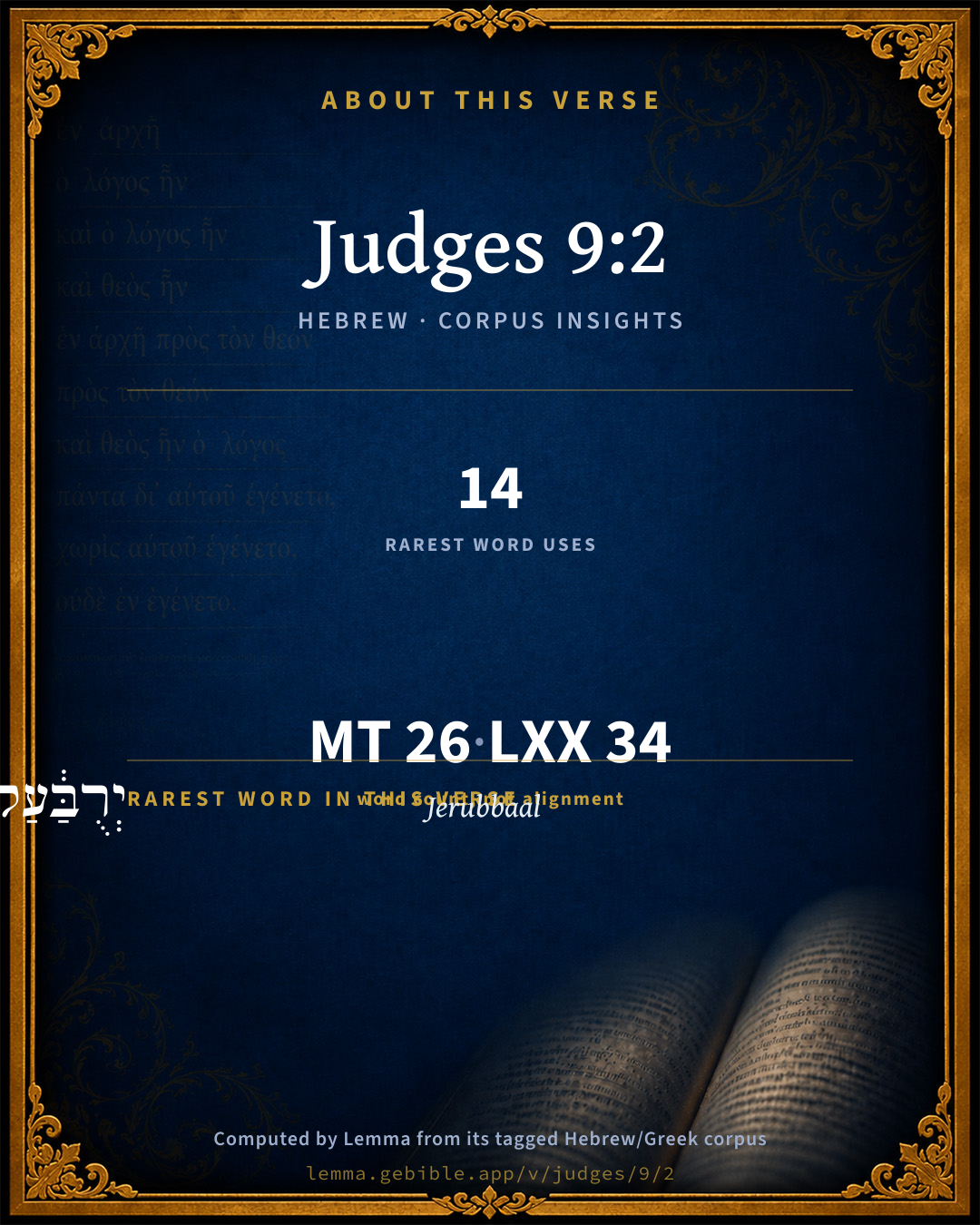
About this verse

These counts appear in no published source. They are computed here, from the morphology-tagged text and Lemma’s own curated glosses. What Lemma adds →

26
words
20
distinct lemmas
Historical
section

Notable vocabulary

The rarest word here is יְרֻבַּ֔עַל Jerubbaal H3378 — appearing just 14 times in the whole Hebrew Bible.

Shared distinctive vocabulary

יְרֻבַּ֔עַל Jerubbaal H3378 occurs in 13 verses of the Hebrew Bible. Also found in:

Grammatical profile

  • 4 verbs
  • 11 nouns
  • 3 adjectives
  • 1 pronoun
  • 3 prepositions
  • 2 conjunctions
  • 2 particles

Verb forms

  • דַּבְּרוּ Piel · Imperative
  • הַמְשֹׁ֨ל Qal · Infinitive Construct
  • מְשֹׁ֥ל Qal · Infinitive Construct
  • וּזְכַרְתֶּ֕ם Qal · Perfect

Repetition

Words recur within this verse — often emphatic in Hebrew:

  • כָל all H3605 ×2
  • הַמְשֹׁ֨ל to rule H4910 ×2
  • אִ֗ישׁ man H376 ×2

Hebrew & Septuagint length

In English translation the verse runs 45 words from the Hebrew and 50 from the Septuagint (LXX English) — closely comparable.

A rough comparison of the two English renderings, which tokenize alike — not a word-level alignment.

Word counts can differ between the Hebrew and the Greek without any difference in meaning — e.g. the Hebrew direct-object marker אֵת has no separate Greek word, and Greek often adds the article ὁ.

In the original languages it is 26 Hebrew tokens and 34 Greek tokens — but the two are counted differently (Hebrew bundles its prefixes and suffixes into one token; the Greek is in lemma form), so that isn’t a like-for-like length.

Cross-references

6

Topical passages linked to Judges 9:2 in the Treasury of Scripture Knowledge — connected by theme and wording, ordered by reader-vote popularity; previews shown in the World English Bible.

  • Genesis 29:14 Laban said to him, Surely you are my bone and my flesh. He lived with him for a month.
  • Judges 8:30 Gideon had seventy sons conceived from his body; for he had many wives.
  • 1 Chronicles 11:1 Then all Israel gathered themselves to David to Hebron, saying, Behold, we are your bone and your flesh.
  • Hebrews 2:14 Since then the children have shared in flesh and blood, he also himself in like manner partook of the same, that through death he might bring to nothing him who had the power of death, that is, the devil,
  • 2 Samuel 19:13 Say you to Amasa, Aren't you my bone and my flesh? God do so to me, and more also, if you aren't captain of the host before me continually in the room of Joab.
  • Ephesians 5:30 because we are members of his body, of his flesh and bones.

Cross-references courtesy of OpenBible.info (CC BY 4.0).

Hebrew and Greek witnesses Masoretic Hebrew ↔ Greek Septuagint

The same verse in the two great witnesses to the Old Testament, shown verse-for-verse.

These are two independent witnesses, not word-aligned to each other, and the Septuagint is shown in lemma (dictionary) form.

Hebrew Judges 9:2 Masoretic · Westminster Leningrad Codex

דַּבְּרוּ נָ֞א בְּאָזְנֵ֨י כָל בַּעֲלֵ֣י שְׁכֶם֮ מַה טּ֣וֹב לָכֶם֒ הַמְשֹׁ֨ל בָּכֶ֜ם שִׁבְעִ֣ים אִ֗ישׁ כֹּ֚ל בְּנֵ֣י יְרֻבַּ֔עַל אִם מְשֹׁ֥ל בָּכֶ֖ם אִ֣ישׁ אֶחָ֑ד וּזְכַרְתֶּ֕ם כִּֽי עַצְמֵכֶם וּבְשַׂרְכֶ֖ם אָנִֽי

Please speak in the ears of all the men of Shechem, Whether is better for you, that all the sons of Jerubbaal, who are seventy persons, rule over you, or that one rule over you? Remember also that I am your bone and your flesh.

World English Bible · Public Domain

Greek LXX Judges 9:2 Septuagint · lemma form

λαλέω δή ἐν ὁ οὖς πᾶς ὁ ἀνήρ συχεμ τίς ὁ ἀγαθός σύ κυριεύω σύ ἑβδομήκοντα ἀνήρ πᾶς υἱός ιεροβααλ ἤ κυριεύω σύ ἀνήρ εἷς καί μιμνήσκω ὅτι ὀστέον σύ καί σάρξ σύ εἰμί

Speak, I pray you, in the ears of all the men of Sychem, saying, Which is better for you, that seventy men, even all the sons of Jerobaal, should reign over you, or that one man should reign over you? and remember that I am your bone and your flesh.

LXX2012 (modern English Septuagint) · Public Domain

Hebrew: Westminster Leningrad Codex (CC BY 4.0). Greek: Septuagint (public domain); English from LXX2012 (modern English Septuagint) (Public Domain). How the Septuagint differs from the Hebrew →

Targum (Aramaic paraphrase)

1

The Targum is the ancient Jewish Aramaic paraphrase of the Hebrew Scriptures — an interpretive translation, not the Hebrew text itself. Onkelos (literal) and Pseudo-Jonathan (expansive) render the Torah, and Jonathan the Prophets. Coverage is partial: where no permissively-licensed English translation exists for a verse, only the Aramaic is shown. This is verse-level text, not a word-by-word alignment to the Hebrew.

  1. Targum Jonathan Prophets (Joshua–Malachi)
    מַלִילוּ כְּעַן קֳדָם כָּל יַתְבֵי שְׁכֶם מַה טַב לְכוֹן דְיִמְלְכוּן עֲלֵיכוֹן שַׁבְעִין גַבְרָא כָּל בְּנֵי יְרֻבַּעַל אוֹ דְיִמְלוֹךְ עֲלֵיכוֹן גַבְרָא חָד וְתִדְכְּרוּן אֲרֵי קָרִיבְכוֹן וּבִשְׂרְכוֹן אֲנָא:

    (no public-domain English translation for this verse)

    Targum Jonathan — Aramaic: “Mikraot Gedolot” (public domain). English: “Sefaria Community Translation” (CC0 1.0 (public-domain dedication)); “London "Chaldee Paraphrase," 1871” (public domain). Text via Sefaria.

Commentary

Notes on Judges 9:2 from classic Christian and Jewish commentators (each source and its license shown beneath its notes). The classic Christian expositions comment on the surrounding passage and are grouped to its opening verse, so a note may address several verses; the Jewish commentaries on the Tanakh (Rashi and others) are per-verse, so they appear only where the commentator wrote on this verse.

Lemma curates 59 commentaries, every one of them public domain or Creative Commons licensed, each selected and text-cleaned for this edition rather than reprinted as found. About our sources →

Trapp's Complete Commentary

John Trapp

Jdg 9:2 Speak, I pray you, in the ears of all the men of Shechem, Whether [is] better for you, either that all the sons of Jerubbaal, [which are] threescore and ten persons, reign over you, or that one reign over you? remember also that I [am] your bone and your flesh.

Ver. 2. Whether is better for yon.] Heb., What is good? The public good is usually pretended to private interest. He taketh it for granted that they would have a king, because they offered that dignity to his father: who, not so wise as he should have been, Abimelech thinks, refused it. He cunningly insinuateth also, that all Gideon’s sons affected domination over them; for so ill minded men muse as they use, and measure others by themselves; and would divide the kingdom amongst them, which would cause great stirs in the state.

Remember also that I am your bone and your flesh.] And will therefore favour you, and promote you. Thus he singeth a song of utile in their ears, which he knew would take with them. Machiavel was not now in rerum natura: but the devil was as great a master then as afterwards.

John Trapp, A Commentary or Exposition upon All the Books of the Old and New Testament (1647–1656) — public domain. Text from a community e-Sword module.

Geneva Bible (1599)

Geneva Bible translators

Of your kindred by my mother’s side.

Geneva Bible (1599) marginal notes — public domain. Text via Bolls.life.

Jamieson, Fausset & Brown

Robert Jamieson, A. R. Fausset & David Brown

Whether is better for you, either that all the sons of Jerubbaal, . . . or that one reign over you--a false insinuation, artfully contrived to stir up jealousy and alarm. Gideon had rejected, with abhorrence, the proposal to make himself or any of his family king, and there is no evidence that any of his other sons coveted the title.

Jamieson, Fausset & Brown — Commentary Critical and Explanatory on the Whole Bible (1871) — public domain (CC PDM 1.0). Text via the HelloAO Bible API.

Adam Clarke's Commentary

Verse 2. Whether is better for you, either that all the sons] This was a powerful argument: Whether will you have seventy tyrants or only one! For, as he had no right to the government, and God alone was king at that time in Israel; so he must support his usurped rule by whatever means were most likely to effect it: a usurped government is generally supported by oppression and the sword.

Adam Clarke's Commentary on the Bible (1810–1826) — public domain. Text from a community e-Sword/MySword module.

Ellicott's Commentary for English Readers

(2) All the men of Shechem.—Rather, the lords (Baali) of Shechem. These seem to be the same as “the men” (anoshi), or “lords (Baali) of the tower of Shechem,” in Jdg_9:46; Jdg_9:49. It is by no means impossible that the Canaanites may have still held possession of the fortress, though the Israelites were nominally predominant in the town. At any rate, this particular title of “lords,” as applied to the chief people of a town, seems to have been Canaanite rather than Hebrew: the “lords” of Jericho (Jos_24:11), the “lords” of Gibeah (Jdg_21:5), of Keilah (1Sa_23:11). The term is applied also to the Hittite Uriah (2Sa_11:20). What is clear is that, as in so many other towns of Palestine at this epoch (see Jdg_1:32, &c), there was a mixed population living side by side in a sort of armed neutrality, though with a mutual dislike, which might at any time break out in tumults. The Israelites held much the same position in many towns as the Normans among the English during the years after the conquest. The Israelites had the upper hand, but they were fewer in numbers, and might easily be overborne at any particular point. It must be borne in mind also that Abimelech, as a Shechemite, would more easily win the adherence of the proud and jealous Ephraimites, who disliked the hegemony (see on Jdg_8:1, and comp. 2Sa_20:1, 1Ki_12:16) which Manasseh had acquired from the victories of Gideon. The plans of Abimelech were deep-laid. In counsel no less than in courage—though both were so grievously misdirected—he shows himself his father’s son.

That all the sons of Jerubbaal . . . reign over you.—It seems to have been the merest calumny to suggest that they ever dreamt of making their father’s influence hereditary in this sense. Gideon had expressly repudiated all wish and claim to exercise “rule” (meshol, Jdg_8:23) of this kind. The remark of Abimelech is quite in the ancient spirit—

οὐκ άγαθὸν πολυκοίρανίη, εἶς κοιρανὸς ε̄̌στω.

(Comp. Eur. Suppl. 410.)

Your bone and your flesh.—The same phrase is found in Gen_2:23; Gen_29:14; 2Sa_5:1; 2Sa_19:12. He was akin to both the elements of the population: to the Ephraimites, from the place of his birth, or at any rate of his mother’s residence; and to the Canaanites (as the whole narrative implies), from her blood. The plea was “like that of our Henry II., the first Norman son of a Saxon mother” (Stanley).

A Bible Commentary for English Readers, edited by Charles John Ellicott (1878–1897) — public domain. Text from a community e-Sword module.

The Cambridge Bible for Schools and Colleges

gen. ed. J. J. S. Perowne

2. the men of Shechem] lit. possessors (plur. of ba‘al) i.e. citizens of S.; so throughout this chap., cf. Jdg_20:5, 1Sa_23:11 f. etc.

all the sons of Jerubbaal] Evidently Gideon had exercised some kind of authority in Ophrah and its neighbourhood which his sons claimed to inherit; see on Jdg_8:23. But we need not think of 70 men literally ‘ruling’; Abimelech wanted to put the case in the worst light possible. If his mother had been a ṣadâḳa wife (cf. Jdg_8:31), the children would have belonged to her clan and not the father’s; this would make the appeal to ‘bone and flesh’ all the stronger, cf. Gen_29:14, 2Sa_5:1; 2Sa_19:12 f.

The Cambridge Bible for Schools and Colleges (gen. ed. J. J. S. Perowne; Cambridge University Press, 1878–1918) — public domain. Text from a community e-Sword module.

John Gill's Exposition

Speak, I pray you, in the ears of all the men of Shechem,.... Which, though the Targum calls the inhabitants of the place, Ben Melech better interprets it the lords of Shechem, as the phrase will bear to be rendered; for it is more likely he would have this first whispered and suggested to the principal men of the city, before the common people were acquainted with it, and indeed in order to use their influence with them:

whether is better for you, either that all the sons of Jerubbaal, which are seventy persons, reign over you, or that one reign over you? intimating thereby, that though Gideon his father had refused the regal government when offered him, it was but reasonable that his sons, or some one of them, should be tried, whether it would be acceptable to them; nay, he would insinuate, that the sons of Gideon, who were seventy in number, were either contending with one another about it, or contriving to divide the government among them, and therefore desired it might be moved to consideration, whether it would not be more eligible to fix upon some one person to be their ruler, than to be under the government of seventy; or, in other words, whether it was not better to have one king than seventy kings; but in reality there was no necessity for any consultation about this matter, the sons of judges never succeeded their fathers in government; nor does it appear that any of Gideon's sons had any thought about it, nor any desire to be made kings, as appears from Jotham's parable; and this was only a wicked insinuation of this man's, with an ambitious view of getting the kingdom to himself, as follows:

remember also that I am your bone and your flesh; was of the same tribe and city with them, born among them, his mother always living with them, and he having now many near relations by his mother's side that dwelt there; and therefore while they had this affair of government under consideration, he would have them think of him to be their king, which would be to their honour, and to their advantage, to have one so nearly related to them on the throne, from whom they might expect many favours.

John Gill's Exposition of the Whole Bible (1746–1763) — public domain (CC PDM 1.0). Text via the HelloAO Bible API.

Albert Barnes' Notes on the Bible

The men of Shechem - literally, “the masters.” Compare Jos 24:11; 1Sa 23:11-12.

Albert Barnes' Notes on the Bible (1834–1885) — public domain. Text from a community e-Sword/MySword module.

Haydock's Catholic Bible Commentary

Men, particularly to those who have the greatest influence. Hebrew Bahalim. (Menochius) --- The argumentation of Abimelech tended to prove that monarchy was the most perfect and eligible form of government, and that it would be hard upon the people, and greatly weaken the state, if seventy princes were to be supported in al the dignity of kings. But it was easy to discern the fallacy of his reasons. The dignity of judge was not hereditary, and it does not appear that the sons of Gedeon claimed it. If it had belonged to his family, the eldest would have been entitled to it, or any of the children, in preference to this son of the servant, ver. 18. He was, indeed, born at Sichem; but the others were by no means strangers: (Calmet) and what right had the men of this town to give a ruler to Israel? (Haydock) --- Flesh, an usual expression in Scripture to denote kindred, ver. 3., Genesis ii. 23., and 2 Kings xix. 13. (Calmet)

George Leo Haydock (1774–1849), Haydock's Catholic Family Bible and Commentary, 1859 edition — public domain. Excludes Psalms (Douay-Rheims chapter numbering differs from Protestant) and Deuterocanonical books (Catholic canon only).

Matthew Poole's English Annotations

He supposeth that

the sons of Jerubbaal would take that government which their father modestly refused, and that the multitude of his sons would occasion horrible divisions, and confusions, and contests about the sovereign power; all which they might avoid by choosing him king; and so they might enjoy the monarchy which they had long and oft desired.

Your bone and your flesh; your kinsman, of the same tribe and city with you; which will be no small honour and advantage to you.

Matthew Poole's English Annotations on the Holy Bible (1683–1685) — public domain. Text from a community e-Sword/MySword module.

Whedon's Commentary on the Bible

Daniel D. Whedon

2. All the men of Shechem — Literally, all the lords of Shechem, that is, all the prominent citizens, whether Israelitish or Canaanitish. Comp. Jdg_9:28. Abimelech’s usurpation was shrewdly planned and most skillfully executed. His address to the citizens of his native place was well adapted to win their hearts. The name of Jerubbaal, the Baal-fighter, was alone calculated to rouse the animosity of the Shechemites, who were devoted to the worship of Baal, and had a house erected to his honour. Jdg_9:4. Then, the notion of being ruled by seventy kings instead of one would be anything but agreeable; and though there may have been no evidence that the seventy sons of Jerubbaal aspired to reign, it might have been thought wise to provide against such a contingency. But what most swayed their minds was Abimelech’s significant reminder, I am your bone and your flesh. His mother’s family stood high in Shechem, and her son seemed, therefore, to be a brother of them all.

Daniel D. Whedon (gen. ed.), Commentary on the Old and New Testaments (1874–1909) — public domain. Text from a community e-Sword module.

The Pulpit Commentary

All the sons,... which are threescore and ten persons. Mark the evils of polygamy producing family discord, extinguishing natural affection, causing civil strife, multiplying pretenders, and producing an ignoble and contemptible herd of helpless princes.

Vers. 2, 3. Unrighteous claims of kindred.

A great force in the arrangements and promotions of human life. The unrighteousness of it often felt when it cannot be explained. As much to be deprecated in the endeavour to secure the ordinary advantages of life as in the competition for its great prizes and honours. Let us look closely at this plea, "He is our brother.

I IT IS THE EXAGGERATION AND PROSTITUTION OF A NATURAL AND PROPER AFFECTION. Of the true claims of "our brother" how much might be said! A basis for moral obligations, and rights, and duties seldom fairly acknowledged. But to the desirable things of the world and "out in the open" there are many claimants whose title has to be weighed. The fond mother, desirous of such things for her son, may be asked, "Why your son, and not another"s?

II IT IGNORES AND TRAMPLES UPON GENERAL INTERESTS FOR THE SAKE OF INDIVIDUAL ADVANCEMENT. Next to the absolute appointment by God, and often indicative of it, is the greatest good of the greatest number." The king or other public officer is for the people, not vice versa. Although absolute right may be sometimes waived because of general advantage, when both are wanting the claim is weak.

III THE TRUE TITLE-DEEDS TO ADVANCEMENT ARE NOT RECOGNISED OR APPEALED TO. Divine appointment; unique capacity; desire for the good of others rather than the advantage of self; service rather than office; duty than right. M.

The Pulpit Commentary (1880–1919), ed. H.D.M. Spence-Jones & Joseph S. Exell — public domain. Text from a community e-Sword module.

John Wesley's Explanatory Notes

Reign - He supposed they would take that government which their father refused; and that the multitude of his sons would occasion divisions, and confusions, which they might avoid by chusing him king; and so they might enjoy the monarchy which they had long desired. Your bone and flesh - Your kinsman, of the same tribe and city with you; which will be no small honour and advantage to you.

John Wesley, Explanatory Notes Upon the Whole Bible (1754–1765) — public domain. Text via the GEBible commentary corpus.

Lesson kit

Teaching starters — assembled from the data on this page, not authored interpretation. Every prompt links to the verse data it draws on. Edit before teaching.

Judges, in the Historical, opens this verse with 26 words (20 distinct Hebrew lemmas). Its most distinctive word is Yᵉrubbaʻal (“Jerubbaal”). A historical commentator’s framing appears above. Read the whole chapter for the surrounding context.

Discussion questions

  1. How does “Jerubbaal” (Yᵉrubbaʻal) shape what this verse is saying?
  2. How does Judges 6:32, which shares the word «Jerubbaal», read alongside this verse?
  3. What does the repetition of “all” (2× in this one verse) do in this verse?
  4. The translations on this page render this verse differently — a whole-verse word diff, not a word-by-word alignment. What might account for the different wordings?
  5. «דַּבְּרוּ» is a Piel Imperative verb. How does that grammatical form shape the action described?
  6. Compare how Trapp's Complete Commentary and Geneva Bible (1599) read this verse. Where do they agree or differ?

Things to notice

Reading settings

Reading text

Shown beneath each verse's original-language words.

Old Testament
Old Testament edition

Read the OT as the Masoretic Hebrew (MT) or the Greek Septuagint (LXX).

English shown for the Greek Septuagint (in the Hebrew ↔ Greek comparison).

Comparing translations? Open the Compare panel on any verse page to stack up to four side by side.