
Numbers 13:2

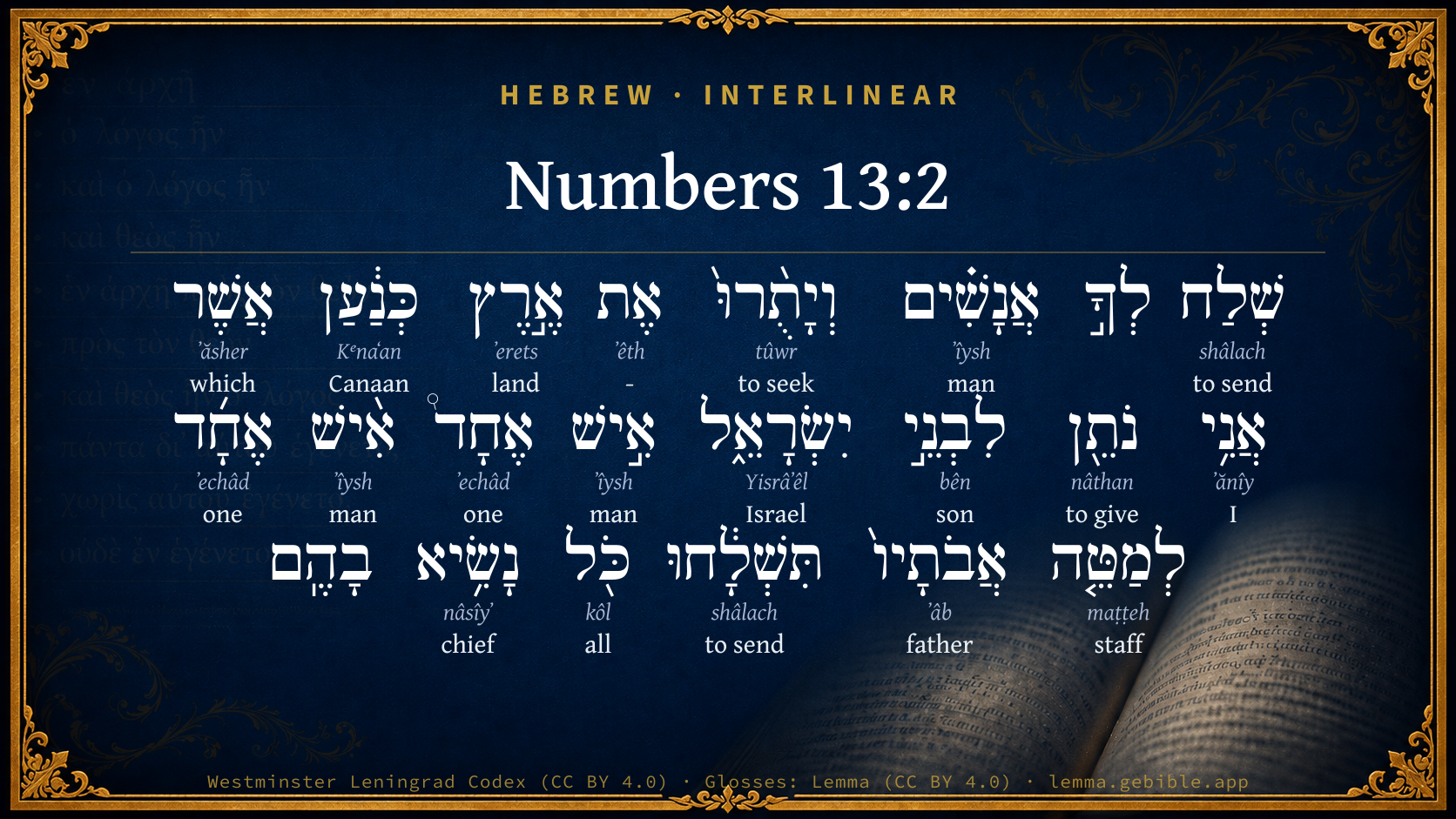
Hebrew (Westminster Leningrad Codex) Numbers 13:2 appears in the Hebrew Old Testament. The text above is from the Westminster Leningrad Codex. Each word links to its Strong’s number, a concise gloss, and parsing drawn from the Open Scriptures Hebrew Bible morphology. Click any word for its full Brown-Driver-Briggs (BDB) entry.
Download image
Cite this verse

Numbers 13:2 (World English Bible). Public Domain. Lemma interlinear Bible study tool, https://lemma.gebible.app/v/numbers/13/2.

Show BibTeX & RIS
BibTeX
RIS
English Translation
Send you men, that they may spy out the land of Canaan, which I give to the children of Israel: of every tribe of their fathers shall you send a man, everyone a prince among them.
World English Bible · Public Domain
Download a study sheet

One document with this verse’s original text, its word-by-word gloss line, the meaning frame, cross-references with their text, attributed commentary, and full source and license credits — printable, and it pastes into notes with its structure intact.

This verse Autodidact and up

Study sheet (.html) Plain text (.txt)

A passage Seminary Student

Up to 50 verses in one chapter. A passage sheet keeps up to 6 commentary sources and 12 cross-references per verse, in the order this page ranks them, and says so on the sheet whenever that leaves anything out. Ask for a single verse and you get the Autodidact verse sheet above.

Everything on this page stays free to read, with no account — the sheet is a download of what is already on screen, not access to it.

Want to remove ads? Support Godless Engineer
Compare translations 3

The same verse in 3 English versions, stacked beneath the original-language interlinear above. Click any original word for its lexicon entry.

Each is an independent rendering of the whole verse — the interlinear is not word-aligned to these translations.

Highlighted words mark where these versions differ — a whole-verse word diff, not a word-by-word alignment.

  • World English Bible Public Domain
    Send you men, that they may spy out the land of Canaan, which I give to the children of Israel: of every tribe of their fathers shall you send a man, everyone a prince among them.
  • King James Version Public Domain
    Send thou men, that they may search the land of Canaan, which I give unto the children of Israel: of every tribe of their fathers shall ye send a man, every one a ruler among them.
  • unfoldingWord Literal Text CC BY-SA 4.0
    “Send for you men, and they shall explore the land of Canaan, which I am giving to the sons of Israel. One man, one man to the tribe of his fathers you shall send, every a leader among them.”

unfoldingWord Literal Text — © unfoldingWord, licensed CC BY-SA 4.0. Word-aligned USFM3 via Door43 (git.door43.org/unfoldingWord/en_ult).

Versions to compare (up to 4)

3 of 4 selected

Show all 18 translations

Every available English version of this verse, each an independent rendering of the whole verse.

  • World English Bible Public Domain
    Send you men, that they may spy out the land of Canaan, which I give to the children of Israel: of every tribe of their fathers shall you send a man, everyone a prince among them.
  • Berean Standard Bible Public Domain
    “Send out for yourself men to spy out the land of Canaan, which I am giving to the Israelites. From each of their fathers’ tribes send one man who is a leader among them.”
  • Majority Standard Bible Public Domain
    “Send out for yourself men to spy out the land of Canaan, which I am giving to the Israelites. From each of their fathers’ tribes send one man who is a leader among them.”
  • King James Version Public Domain
    Send thou men, that they may search the land of Canaan, which I give unto the children of Israel: of every tribe of their fathers shall ye send a man, every one a ruler among them.
  • American Standard Version (1901) Public Domain
    Send thou men, that they may spy out the land of Canaan, which I give unto the children of Israel: of every tribe of their fathers shall ye send a man, every one a prince among them.
  • Revised Version (1885) Public Domain
    Send thou men, that they may spy out the land of Canaan, which I give unto the children of Israel: of every tribe of their fathers shall ye send a man, every one a prince among them.
  • Geneva Bible (1599) Public Domain
    And the Lord spake vnto Moses, saying,
  • Douay-Rheims (1899) Public Domain
    And there the Lord spoke to Moses, saying:
  • Young's Literal Translation Public Domain
    `Send for thee men, and they spy the land of Canaan, which I am giving to the sons of Israel; one man, one man for the tribe of his fathers ye do send, every one a prince among them.'
  • Literal Standard Version CC BY-SA 4.0
    “Send men for yourself, and they spy out the land of Canaan, which I am giving to the sons of Israel; one man—you send one man for the tribe of his fathers, everyone a prince among them.”
  • Unlocked Literal Bible CC BY-SA 4.0
    “Send some men to examine the land of Canaan, which I have given to the people of Israel. Send a man from every tribe of their ancestors. Each man must be a leader among them.”
  • unfoldingWord Literal Text CC BY-SA 4.0
    “Send for you men, and they shall explore the land of Canaan, which I am giving to the sons of Israel. One man, one man to the tribe of his fathers you shall send, every a leader among them.”
  • Darby Bible Public Domain
    Send thou men, that they may search out the land of Canaan, which I give unto the children of Israel. Ye shall send a man of every tribe of his fathers, each a prince among them.
  • World Messianic Bible Public Domain
    “Send men, that they may spy out the land of Canaan, which I give to the children of Israel. Of every tribe of their fathers, you shall send a man, every one a prince among them.”
  • Webster's Bible Public Domain
    Send thou men, that they may search the land of Canaan, which I give to the children of Israel: of every tribe of their fathers shall ye send a man, every one a ruler among them.
  • Free Bible Version CC BY-SA 4.0
    “Send some men to explore the land of Canaan, the country I'm giving to the Israelites. Choose one of the leaders from each of the tribes to go and do this.”
  • Bible in Basic English Public Domain
    Send men to get knowledge about the land of Canaan, which I am giving to the children of Israel; from every tribe of their fathers you are to send a man, every one a chief among them.
  • JPS Tanakh (1917) Public Domain
    'Send thou men, that they may spy out the land of Canaan, which I give unto the children of Israel; of every tribe of their fathers shall ye send a man, every one a prince among them.'

Literal Standard Version (2020), Covenant Press — licensed CC BY-SA 4.0. Text via the HelloAO Bible API (eBible.org). Unlocked Literal Bible (unfoldingWord) — licensed CC BY-SA 4.0. Text via the HelloAO Bible API (eBible.org). unfoldingWord Literal Text — © unfoldingWord, licensed CC BY-SA 4.0. Word-aligned USFM3 via Door43 (git.door43.org/unfoldingWord/en_ult). Free Bible Version, Dr. Jonathan Gallagher — licensed CC BY-SA 4.0. Text via the HelloAO Bible API (eBible.org).

Word by word

More ways to search: Search by grammar → Find every occurrence → Compare this word →

Practice this passage: Drill this verse → Learn its vocabulary →

וְיָתֻ֨רוּ֙
tûwr
H8446
“and · to seek”
Conjunction + Verb, Qal, Imperfect, 3rd Person, Masculine, Plural
Part of Speech
Conjunction + Verb
Stem
Qal
Form
Imperfect
Person
3rd Person
Gender
Masculine
Number
Plural
Full BDB Definition

Origin: a primitive root

TWOT: 2500

to seek, search out, spy out, explore - (Qal) - to seek out, select, find out how to do something - to spy out, explore - explorers, spies (participle) - to go about - merchant, trader (participle) - (Hiphil) to make a search, make a reconnaissance
  1. שְׁלַח shâlach H7971 “send” Verb, Qal, Imperative, 2nd Person, Masculine, Singular
  2. אֲנָשִׁ֗ים ʼîysh H376 “men” Noun, Common, Masculine, Plural, Absolute
  3. אֶת ʼêth H853 “-” Particle, Direct Object
  4. אֶ֣רֶץ ʼerets H776 “land of” Noun, Common, Both, Singular, Construct
  5. כְּנַ֔עַן Kᵉnaʻan H3667 “Canaan” Noun, Proper
  6. אֲשֶׁר ʼăsher H834 “which” Particle, Relative
  7. אֲנִ֥י ʼănîy H589 “I” Pronoun, Personal, 1st Person, Common, Singular
  8. נֹתֵ֖ן nâthan H5414 “giving” Verb, Qal, Participle Active, Masculine, Singular, Absolute
  9. לִבְנֵ֣י bên H1121 “to/for · sons of” Preposition + Noun, Common, Masculine, Plural, Construct
  10. יִשְׂרָאֵ֑ל Yisrâʼêl H3478 “Israel” Noun, Proper
  11. אִ֣ישׁ ʼîysh H376 “man” Noun, Common, Masculine, Singular, Absolute
  12. אֶחָד֩ ʼechâd H259 “one” Adjective, Cardinal number, Masculine, Singular, Absolute
  13. אִ֨ישׁ ʼîysh H376 “man” Noun, Common, Masculine, Singular, Absolute
  14. אֶחָ֜ד ʼechâd H259 “one” Adjective, Cardinal number, Masculine, Singular, Absolute
  15. לְמַטֵּ֤ה maṭṭeh H4294 “to/for · staff of” Preposition + Noun, Common, Masculine, Singular, Construct
  16. אֲבֹתָיו֙ ʼâb H1 “fathers · his” Noun, Common, Masculine, Plural, Construct + Suffix, Personal, 3rd Person, Masculine, Singular
  17. תִּשְׁלָ֔חוּ shâlach H7971 “to send” Verb, Qal, Imperfect, 2nd Person, Masculine, Plural
  18. כֹּ֖ל kôl H3605 “all” Noun, Common, Masculine, Singular, Absolute
  19. נָשִׂ֥יא nâsîyʼ H5387 “chief” Noun, Common, Masculine, Singular, Absolute

About this verse

These counts appear in no published source. They are computed here, from the morphology-tagged text and Lemma’s own curated glosses. What Lemma adds →

22
words
16
distinct lemmas
Pentateuch
section

Notable vocabulary

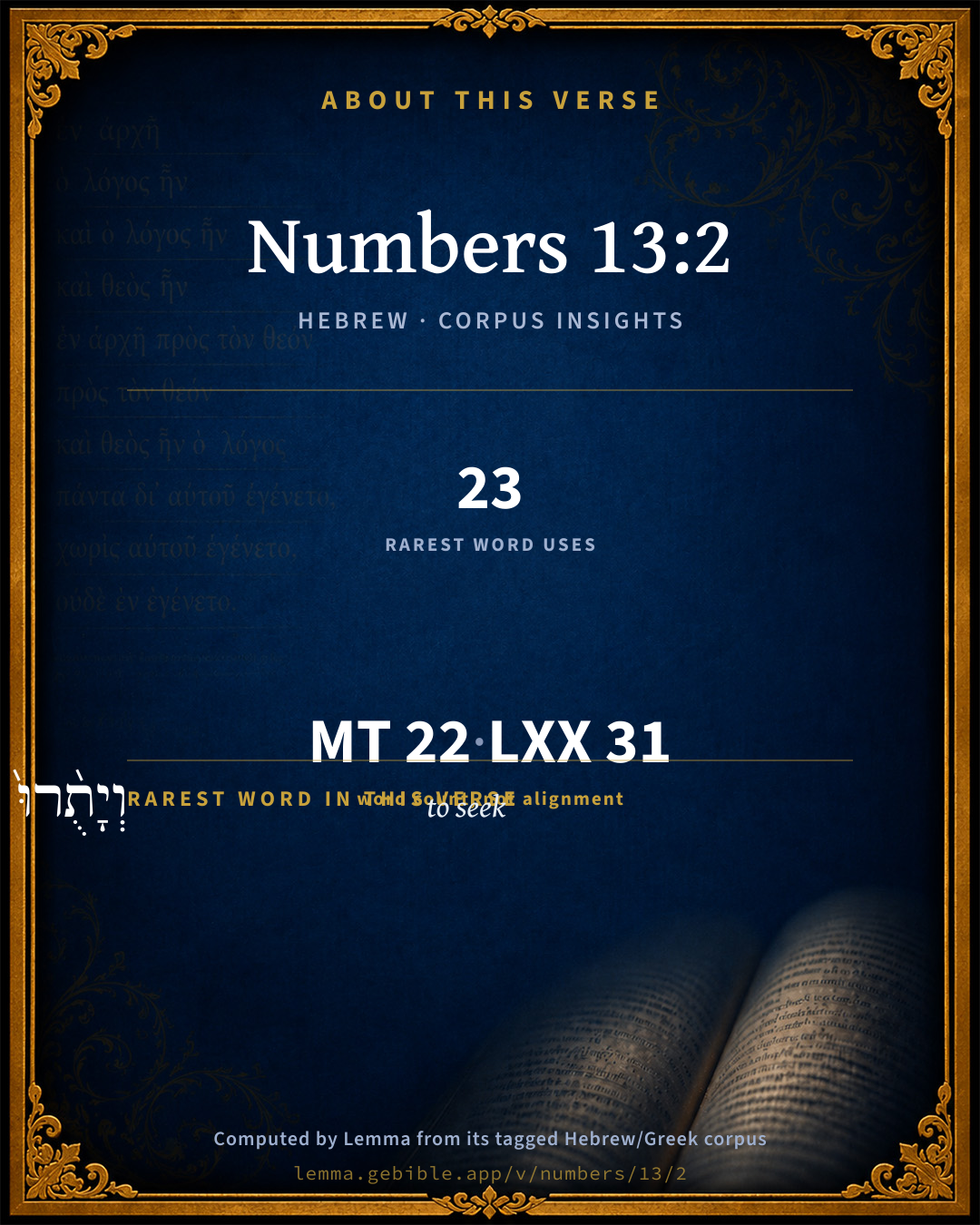
The rarest word here is וְיָתֻ֨רוּ֙ to seek H8446 — appearing just 23 times in the whole Hebrew Bible.

Shared distinctive vocabulary

וְיָתֻ֨רוּ֙ to seek H8446 occurs in 22 verses of the Hebrew Bible. Also found in:

Grammatical profile

  • 4 verbs
  • 11 nouns
  • 2 adjectives
  • 1 pronoun
  • 2 prepositions
  • 2 particles

Verb forms

  • שְׁלַח Qal · Imperative
  • וְיָתֻ֨רוּ֙ Qal · Imperfect
  • נֹתֵ֖ן Qal · Participle Active
  • תִּשְׁלָ֔חוּ Qal · Imperfect

Repetition

Words recur within this verse — often emphatic in Hebrew:

  • אֲנָשִׁ֗ים man H376 ×3
  • שְׁלַח to send H7971 ×2
  • אֶחָד֩ one H259 ×2

Hebrew & Septuagint length

In English translation the verse runs 36 words from the Hebrew and 7 from the Septuagint (LXX English) — the Septuagint runs noticeably shorter here. See the side-by-side →

A rough comparison of the two English renderings, which tokenize alike — not a word-level alignment.

Word counts can differ between the Hebrew and the Greek without any difference in meaning — e.g. the Hebrew direct-object marker אֵת has no separate Greek word, and Greek often adds the article ὁ.

In the original languages it is 22 Hebrew tokens and 31 Greek tokens — but the two are counted differently (Hebrew bundles its prefixes and suffixes into one token; the Greek is in lemma form), so that isn’t a like-for-like length.

Cross-references

8

Topical passages linked to Numbers 13:2 in the Treasury of Scripture Knowledge — connected by theme and wording, ordered by reader-vote popularity; previews shown in the World English Bible.

  • Deuteronomy 1:22–25 You came near to me everyone of you, and said, Let us send men before us, that they may search the land for us, and bring us word again of the way by which we must go up, and the cities to which we shall come.
  • Numbers 32:8 Thus did your fathers, when I sent them from Kadesh-barnea to see the land.
  • Numbers 34:18 You shall take one prince of every tribe, to divide the land for inheritance.
  • Exodus 18:25 Moses chose able men out of all Israel, and made them heads over the people, rulers of thousands, rulers of hundreds, rulers of fifties, and rulers of tens.
  • Numbers 1:4 With you there shall be a man of every tribe; everyone head of his fathers' house.
  • Numbers 11:16 Yahweh said to Moses, Gather to me seventy men of the elders of Israel, whom you know to be the elders of the people, and officers over them; and bring them to the tent of meeting, that they may stand there with you.
  • Deuteronomy 1:15 So I took the heads of your tribes, wise men, and known, and made them heads over you, captains of thousands, and captains of hundreds, and captains of fifties, and captains of tens, and officers, according to your tribes.
  • Joshua 2:1–24 Joshua the son of Nun sent out of Shittim two men as spies secretly, saying, Go, view the land, and Jericho. They went and came into the house of a prostitute whose name was Rahab, and lay there.

Cross-references courtesy of OpenBible.info (CC BY 4.0).

Hebrew and Greek witnesses Masoretic Hebrew ↔ Greek Septuagint

The same verse in the two great witnesses to the Old Testament, shown verse-for-verse.

Here the Septuagint runs noticeably shorter than the Hebrew — LXX2012 (modern English Septuagint) 7 words vs World English Bible 36. A rough length comparison of the two English translations, not a word-level alignment — read both below.

These are two independent witnesses, not word-aligned to each other, and the Septuagint is shown in lemma (dictionary) form.

Hebrew Numbers 13:2 Masoretic · Westminster Leningrad Codex

שְׁלַח לְךָ֣ אֲנָשִׁ֗ים וְיָתֻ֨רוּ֙ אֶת אֶ֣רֶץ כְּנַ֔עַן אֲשֶׁר אֲנִ֥י נֹתֵ֖ן לִבְנֵ֣י יִשְׂרָאֵ֑ל אִ֣ישׁ אֶחָד֩ אִ֨ישׁ אֶחָ֜ד לְמַטֵּ֤ה אֲבֹתָיו֙ תִּשְׁלָ֔חוּ כֹּ֖ל נָשִׂ֥יא בָהֶֽם

Send you men, that they may spy out the land of Canaan, which I give to the children of Israel: of every tribe of their fathers shall you send a man, everyone a prince among them.

World English Bible · Public Domain

Greek LXX Numbers 13:2 Septuagint · lemma form

ἀποστέλλω σεαυτοῦ ἀνήρ καί κατασκέπτομαι ὁ γῆ ὁ χαναναῖος ὅς ἐγώ δίδωμι ὁ υἱός ἰσραήλ εἰς κατάσχεσις ἀνήρ εἷς κατά φυλή κατά δῆμος πατριά αὐτός ἀποστέλλω αὐτός πᾶς ἀρχηγός ἐκ αὐτός

And the Lord spoke to Moses, saying,

LXX2012 (modern English Septuagint) · Public Domain

Hebrew: Westminster Leningrad Codex (CC BY 4.0). Greek: Septuagint (public domain); English from LXX2012 (modern English Septuagint) (Public Domain). How the Septuagint differs from the Hebrew →

Targum (Aramaic paraphrase)

2

The Targum is the ancient Jewish Aramaic paraphrase of the Hebrew Scriptures — an interpretive translation, not the Hebrew text itself. Onkelos (literal) and Pseudo-Jonathan (expansive) render the Torah, and Jonathan the Prophets. Coverage is partial: where no permissively-licensed English translation exists for a verse, only the Aramaic is shown. This is verse-level text, not a word-by-word alignment to the Hebrew.

  1. Targum Onkelos Torah (Genesis–Deuteronomy)
    שְׁלַח לָךְ גֻבְרִין וִיאַלְלוּן יָת אַרְעָא דִכְנָעַן דִי אֲנִי יָהֵב לִבְנֵי יִשְׂרָאֵל גַבְרָא חַד גַבְרָא חַד לְשִׁבְטָא דַאֲבָהָתוֹהִי תְּשַׁלְחוּן כֹּל רַבָּא דִבְהוֹן

    (no public-domain English translation for this verse)

    Targum Onkelos — Aramaic: “Onkelos Genesis” (public domain); “Onkelos Exodus” (public domain); “Onkelos Leviticus” (public domain); “Onkelos Numbers” (public domain); “Onkelos Deuteronomy” (public domain). English: “Sefaria Community Translation” (CC0 1.0 (public-domain dedication)); “J.W. Etheridge. The Targums of Onkelos and Jonathan Ben Uzziel on the Pentateuch. London: Longmans, Green, 1862” (public domain). Text via Sefaria.

  2. Targum Pseudo-Jonathan Torah (Genesis–Deuteronomy)
    שְׁלַח לָךְ גוּבְרִין חַרִיפִין וִיאַלְלוּן יַת אַרְעָא דִכְנַעַן דַאֲנָא יָהֵיב לִבְנֵי יִשְרָאֵל גַבְרָא חָד גַבְרָא חָד לְשִׁבְטָא דְאַבְהָתוֹי תְּשַׁלְחוּן מִן קֳדָם כָּל אַמַרְכּוֹל דִבְהוֹן

    Send thou keen-sighted men who may explore the land of Kenaan, which I will give to the children of Israel; one man for each tribe of their fathers, thou shalt send from the presence of all their leaders.

    Targum Pseudo-Jonathan — Aramaic: “Targum Jonathan on Genesis” (public domain); “Targum Jonathan on Exodus” (public domain); “Targum Jonathan on Leviticus” (public domain); “Targum Jonathan on Numbers” (public domain); “Targum Jonathan on Deuteronomy” (public domain). English: “The Targum of Jonathan ben Uzziel, trans. J. W. Etheridge, London, 1862” (public domain). Text via Sefaria.

Commentary

Notes on Numbers 13:2 from classic Christian and Jewish commentators (each source and its license shown beneath its notes). The classic Christian expositions comment on the surrounding passage and are grouped to its opening verse, so a note may address several verses; the Jewish commentaries on the Tanakh (Rashi and others) are per-verse, so they appear only where the commentator wrote on this verse.

Lemma curates 59 commentaries, every one of them public domain or Creative Commons licensed, each selected and text-cleaned for this edition rather than reprinted as found. About our sources →

Trapp's Complete Commentary

John Trapp

Num 13:2 Send thou men, that they may search the land of Canaan, which I give unto the children of Israel: of every tribe of their fathers shall ye send a man, every one a ruler among them.

Ver. 2. Every one a ruler amongst them.] That might be, as Uriah and Zachariah, {Isa 8:2} faithful witnesses; for lying lips become not a prince. {Pro 17:7}

John Trapp, A Commentary or Exposition upon All the Books of the Old and New Testament (1647–1656) — public domain. Text from a community e-Sword module.

Adam Clarke's Commentary

Verse 2. Send thou men, that they may search] It appears from De 1:19-24 that this was done in consequence of the request of the people, after the following address of Moses: "And when we departed from Horeb, we went through all that great and terrible wilderness - and we came unto Kadesh-Barnea; and I said unto you, Ye are come unto the mountain of the Amorites, which the Lord our God doth give unto us. Behold the Lord thy God hath set the land before thee: go up and possess it, as the Lord God of thy fathers hath said unto thee; fear not, neither be discouraged. And ye came near unto me every one of you, and said: WE WILL SEND MEN BEFORE US, AND THEY SHALL SEARCH US OUT THE LAND and bring us word again, by what way we must go up, and into what cities we shall come. And the saying pleased me well, and I took twelve men of you, one of a tribe," c., &c. Nearly the whole of these verses is added here by the Samaritan.

Every one a ruler] Not any of the princes of the people, (see Nu 1:4-16), for these names are different from those but these now sent were men of consideration and importance in their respective tribes.

Adam Clarke's Commentary on the Bible (1810–1826) — public domain. Text from a community e-Sword/MySword module.

Ellicott's Commentary for English Readers

(2) Every one a ruler among them.—Or, a prince among them, as in Num_1:16. A comparison of the names which follow with those which are given in Num_1:5-15 will show that the persons selected were not the tribal princes who are mentioned in connection with the census. The tribe of Levi, as in the former case, is not represented, as the Levites were to have no inheritance in the land, and the number of twelve, as in Numbers 1, is. made up by the division of the tribe of Joseph into the two tribes of Ephraim and Manasseh.

A Bible Commentary for English Readers, edited by Charles John Ellicott (1878–1897) — public domain. Text from a community e-Sword module.

The Cambridge Bible for Schools and Colleges

gen. ed. J. J. S. Perowne

2. a prince] The word is very characteristic of P . The spies were not the same princes as those who represented the tribes at the census (Num_1:5-15). Of the following 24 names, beside Joshua, Nun, Caleb and Jephunneh, a few are found in early times, e.g. Palti (1Sa_25:44), Ammiel (2Sa_9:4), Shaphat (1Ki_19:16), Shammua (2Sa_5:14), Igal (2Sa_23:36); in the last two cases, however, the text is uncertain. Others appear to be late. It is probable that the list is artificial, and not based on historical tradition. See on Num_1:5.

The Cambridge Bible for Schools and Colleges (gen. ed. J. J. S. Perowne; Cambridge University Press, 1878–1918) — public domain. Text from a community e-Sword module.

John Gill's Exposition

Send thou men,.... Which is rather a permission than a command; so Jarchi interprets it,"send men according to thy mind, I do not command thee, but if thou pleasest send;''this he observed was agreeable to Moses, and to the Israelites, and therefore granted it, or allowed them to take their own way, and which issued badly, as it always does, when men are left to their own counsel:

that they may search the land of Canaan, which I give unto the children of Israel; called the land of Canaan, though it consisted of seven nations, from the principal of them; this God had given in promise to the children of Israel, and had now brought them to the borders of it; nay, had given them orders to go up and possess it; but they were for searching it first, to know what sort of a land it was, and which was the best way of entering into it, which is here permitted them, see Deu 1:21,

of every tribe of their fathers shall ye send a man; excepting the tribe of Levi; the reason of which was because they were to have no inheritance in the land, Deu 10:9; but then, to make up the number twelve, the two sons of Joseph, Ephraim and Manasseh, are reckoned as two tribes:

everyone a ruler among them; a prince in his tribe; so were men of honour and credit, of power and authority, of prudence and probity, and who might be trusted with such an affair, and their report believed: they were not indeed princes of the highest rank, not the same that assisted in taking the numbers of the people, who were captains over their several tribes, as in Num 1:4, &c. but were inferior princes and rulers, perhaps rulers of thousands.

John Gill's Exposition of the Whole Bible (1746–1763) — public domain (CC PDM 1.0). Text via the HelloAO Bible API.

Albert Barnes' Notes on the Bible

A ruler - A comparison of the list with that of Num 13:1 :5 following shows that they were not the princes of the tribes, but heads of houses or families Num 12:4.

Of the names here given those of Joshua and Caleb alone are otherwise known to us.

Albert Barnes' Notes on the Bible (1834–1885) — public domain. Text from a community e-Sword/MySword module.

Matthew Poole's English Annotations

Do as the people press thee to do.

Of every tribe of their fathers, i.e. which comes from their several parents or patriarchs.

A ruler; a person of wisdom and authority, which might make his witness more considerable with the people.

Matthew Poole's English Annotations on the Holy Bible (1683–1685) — public domain. Text from a community e-Sword/MySword module.

The Pulpit Commentary

Send thou men, that they may search the land. If this account of the mission of the spies be compared with that given in Deu_1:20-25, it may be seen in a striking instance how entirely different a colour may be put upon the same circumstances by two inspired narratives. No one indeed will affirm that the two records are contradictory, or even inconsistent, and yet they leave an entirely different impression upon the mind; and no doubt were intended to. It is important to note that the Divine inspiration did not in the least prevent two sacred authors, (cf. 2Sa_24:1 with 1Ch_21:1) or even the same author at different times, from placing on record very distinct and even strongly contrasted aspects of the same facts, according to the point of view from which he was led to regard them. In Deuteronomy 1, Moses reminds the people that on their arrival at Kadesh he had bidden them go up and take possession; that they had then proposed to send men before them to examine the land; that the proposal had pleased him so well that he had adopted it and acted upon it. It is unquestionably strange that facts so material should have been omitted in the historical Book of Numbers. It is, however, to be considered

1. That there is no contradiction between the two accounts. We may be certain from many a recorded example that Moses would not have acted on the popular suggestion without referring the matter to the Lord, and that it would be the Divine command (when given) which would really weigh with him.

2. That the recital in Deuteronomy is distinctly ad populum, and that therefore their part in the whole transaction is as strongly emphasized as is consistent with the truth of the facts.

3. That the narrative of Numbers is fragmentary, and does not profess to give a full account of matters, especially in such particulars as do not directly concern the Divine government and guidance of Israel. It is not, therefore, a serious difficulty that the record only begins here at the point when God adopted as his own what had been the demand of the people. If we ask why he so adopted it, the probable answer is that he knew what secret disaffection prompted it, and to what open rebellion it would lead. It was better that such disaffection should be allowed to ripen into rebellion before they entered their promised land. Miserable as the desert wandering might be, it was yet a discipline which prepared the nation for better things; whereas the invasion of Canaan without strong faith, courage, and self-restraint (such as they showed under Joshua) could but have ended in national disaster and destruction. Of every tribe of their fathers shall ye send a man. This was not part of the original proposition, (Deu_1:22) but was agreeable to the general practice in matters of national concern, and was no doubt commanded in order that the whole people might share in the interest and responsibility of this survey. Every one a ruler among them. This does not mean that they were to be the tribe princes (as the names show), for they would not be suitable in respect of age, nor could they be spared for this service. They were "heads of the children of Israel" (verse 3), i.e., men of position and repute, but also no doubt comparatively young and active, as befitted a toilsome and hazardous excursion.

The Pulpit Commentary (1880–1919), ed. H.D.M. Spence-Jones & Joseph S. Exell — public domain. Text from a community e-Sword module.

John Wesley's Explanatory Notes

A ruler - A person of wisdom and authority.

John Wesley, Explanatory Notes Upon the Whole Bible (1754–1765) — public domain. Text via the GEBible commentary corpus.

Rashi

Rabbi Shlomo Yitzchaki (Rashi)

שלח לך אנשים SEND THOU MEN — Why is the section dealing with the spies put in juxtaposition with the section dealing with Miriam’s punishment? To show the grievousness of the spies’ sin: because she (Miriam) was punished on account of the slander which she uttered against her brother, and these sinners witnessed it and yet they did not take a lesson from her (Midrash Tanchuma, Sh'lach 5).

שלח לך SEND THEE (more lit., for thyself) — i.e. according to your own judgement: I do not command you, but if you wish to do so send them. — God said this because the Israelites came to Moses and said. “We will send men before us etc.”, as it is said, (Deuteronomy 1:22): “And you approached me, all of you, [saying, We will send men, etc.]”, and Moses took counsel with the Shechinah (the Lord), whereupon He said to them, I have told them long ago that it (the land) is good, as it is said, (Exodus 3:17): “I will bring you up out of the affliction of Egypt … [unto a land flowing with milk and honey]”. By their lives! I swear that I will give them now an opportunity to fall into error through the statements of the spies, so that they should not come into possession of it (the land) (Sotah 34b; cf. also Rashi on Sotah 34b:8 מדעתך and Midrash Tanchuma, Sh'lach 5).

Rashi on the Tanakh — English translations: “The Judaica Press complete Tanach with Rashi, translated by A. J. Rosenberg” (CC BY 4.0); “Pentateuch with Rashi's commentary by M. Rosenbaum and A.M. Silbermann, 1929-1934” (public domain); “The Metsudah Tanach series, Lakewood, N.J” (CC BY 4.0); and “The Book of Joshua, Metsudah Publications, 1997” (CC BY 4.0). Text via Sefaria.

Ramban (Nachmanides)

Rabbi Moshe ben Nachman (Ramban / Nachmanides)

SEND ‘LECHA’ (THEE) MEN. “As you see fit. I do not command you [to send them], but if you wish [to do so], send them. [G-d said this] because the Israelites came [to Moses] and said, Let us send men before us, etc.’ as it is said, And ye came near unto me every one of you, etc.’ and Moses inquired [what to do] of the Divine Presence, whereupon G-d said: ‘I told them [at the time of the exodus] that it is a good [Land], as it is said, I will bring you up out of the affliction of Egypt … [unto a Land flowing with milk and honey]. which is taken from Verse 8, ibid. By their lives! I will give them an opportunity to fall into error through the incident of the spies, so that they should not come to possess the Land.” This is Rashi’s language, from the words of Agadah. Here one may ask, if this is so, then Moses himself sinned in this matter, as it is said, And the thing pleased me well!? And furthermore why did he tell [the spies] to find out about the Land, whether it is good or bad, since he had already been told at the beginning that it is a good Land, and a large one??” (Gur Aryeh). Moreover, what did the spies do [wrong], since Moses told them, And see the Land what it is; and the people that dwelleth therein, whether they are strong or weak, whether they are few or many, and he said to see about the cities [that they dwell in] whether in camps, or in strongholds, and at the least they had to give him an answer to [the questions] that he commanded them [to find out about]! And what was their trespass, and what was their sin when they told Moses, Nevertheless the people that dwell in the Land are fierce, and the cities are fortified, and very great? Did he then send them on the understanding that they would give him a false report! And do not think that their trespass consisted only in their report that it is a Land that eateth up the inhabitants thereof, Verse 32. for prior telling this to the people, Caleb already quarrelled with them!, Verse 30. It is thus clear that before the spies made this derogatory statement about the Land, the people already did not want to go there. The trespass of the spies could therefore not have consisted only of their report that it is a Land that eateth up the inhabitants thereof! And likewise it is written, [that the people said], Our brethren [i.e., the spies] have made our heart to melt, saying: The people is greater and taller than we etc., and here it is written, to fall by the sword; our wives and our little ones will be a prey. And yet Moses our teacher [himself] said similar things to the children [of the generation of the spies], and he emphasized to them the power of the people and the strength of their cities, and the might of the giants to a much greater extent than what the spies had told their fathers, as it is written, Hear O Israel: thou art to pass over the Jordan this day, to go in to dispossess nations greater and mightier than thyself, cities great and fortified up to heaven, a people great and tall, the sons of the Anakim, whom thou knowest, and of whom thou hast heard say: ‘Who can stand before the sons of Anak!’ Now if the trespass of the spies and their sin consisted of this [discouraging report that they gave about the strength of the people in Canaan], why did he [Moses] dismay the heart of their children in the same way that the spies dismayed the heart of their fathers? Moreover, what reason was there for Moses our teacher to send this mission? If [they would report that] the Land is good, and its inhabitants are weak — well and good; but if [they would say that] it is bad, or that the people are strong — would it enter his mind to take them back to Egypt!But the explanation of this subject is as follows: The Israelites wanted [to act] in the way that all those who come to wage war in a foreign country do, namely to send out men to become acquainted with the roads and entrances to the cities; so that when they return [from their mission], the scouts will go at the head of the army, to show them the way, in a similar manner to that which it says, Show us, we pray thee, the entrance into the city. Thus [the Israelites wanted the reconaissance party] to advise them which city they should attack first, and from which direction it would be easy to capture the Land. This is what they said explicitly, and they [the spies] shall bring us back word of the way by which we must go up, and the cities unto which we shall come, etc.’ that is to say, the cities into which we shall come first, and from which we will enter the whole country. Now this is the correct guidance [to give] to anyone who [plans to] conquer a country. And so did Moses himself do, as it is said, And Moses sent to spy out Jazer, and Joshua the son of Nun also [sent] two spies. It was for this reason that [the people’s request to send out scouts] pleased Moses,? for Scripture does not [allow man] to rely on a miracle in any of its affairs. Instead, it commands those who go out to battle to arm themselves, to take [all necessary] precautions, and to set ambushes [if needed], as Scripture relates in connection with the battle for [the city of] Ai, which was by command of G-d, 8:2. Thus the method of ambush was also by command of G-d, thereby teaching that in war we are not to rely on miracles. and similarly in many places. Then Moses consulted the Divine Presence and G-d gave him permission, saying, “Send thee men, that they may spy out the land of Canaan and become acquainted with it, and bring back a report to you, and according to their information you should take counsel regarding the conquest.” Now Moses told the spies, Get you up here into the south, meaning: “Go up by this road into the south so that you will get to know the people who live in the land of the south — [this being] the direction from which Israel was [approaching] — [and see] whether they are strong and [the Israelites] when dealing with them will need to be very much on their guard and well-armed; similarly, [see] the cities, and whether they are fortified so that [the inhabitants] are well-entrenched, and it will therefore be necessary to build forts and ramps, or [even] to come against them from another direction.” Moses further told them that they should get to know the Land itself, whether it is good or bad, and if it is bad, they should first conquer other parts [of it]; for they spied out the hill-country of the Amorites from the side of Hebron, Verse 22. and even Joshua did not conquer all [areas of the Land], — this being the meaning of the expression and what the Land is that they dwell in, meaning the people who live in the land of the south.[Furthermore] it is possible that it was because Moses knew that it is a fertile and good land, — as he was told, unto a good Land and a large one, unto a Land flowing with milk and honey, — that he told them to set their minds ascertaining this [fact], so that [upon their return] they would tell the people about it, and they would rejoice and gain renewed strength to go up there in joy. Therefore he told them, And be ye of good courage, and bring of the fruit of the Land, so that they [the people] would see with their own eyes the goodness of the Land. Now it is well-known that Egypt is not very far from Hebron — approximately a seven-days’ journey distant — and the border of the land of Canaan comes close to Egypt, and it is therefore impossible that people who live in Egypt should not know about the land of Canaan whether it is good or bad. And indeed Moses’ intention was to find out the way by which he should go up, and the cities which he was to capture first, as I have explained. However, since the Israelites in Egypt were slaves doing most rigorous work, they did not know, neither did they understand [the nature of the Land], therefore Moses wanted the spies to tell them all the particulars of the Land in order to cause them to rejoice in its qualities, since he [himself] knew of them [as explained above.].Now it appears to me from the language of Scripture that Moses did not [in fact] consult the Divine Presence [as to whether he should send spies at all], but the meaning of Send thee men is that they [the people] had decided [already] to send spies, and it was customary to send two spies secretly, saying: [‘Go view the Land’], and that they be taken [only] from some [tribes of the people]; but G-d Who knows the future commanded Moses [here] to send one man from each of the tribes of Israel, every one a prince among them. [This is because] G-d wanted all the great men to be [represented] equally in this matter, so that perhaps they would remember and turn unto the Eternal, 22:28. and if not, so that the decree [of punishment] would apply equally to the whole people, this being the meaning of the expression [that Moses sent them] according to the commandment of the Eternal, for it was by command of G-d that they were to be princes and heads of the children of Israel. It [further] appears to me according to the plain meaning of Scripture that G-d [in speaking] to Moses did not refer [at all] to the request which the people had made, to send out spies, nor to Moses’ consent to that request, for if that were the case, Scripture here would have related: “And the children of Israel approached Moses and said: Let us send men before us etc. etc.’ And the thing pleased Moses well,”? and afterwards it would have written: “And the Eternal spoke unto Moses, saying: ‘Send thee men as they have spoken to you, one man etc.’” But the matter was as follows. The Israelites asked to send [spies], and the thing pleased Moses well,? and afterwards a Divine communication came to Moses, as did all other such communications, merely saying, Send thee men, this being the reason [for the necessity of the subsequent explanatory words], that they may spy out the land of Canaan, which I give unto the children of Israel, as He is speaking of a new matter about which nothing has [hitherto] been related. All this was because the Eternal was pleased, for His righteousness’ sake that the mission be at His command, and that it be with [the participation of] all their tribes and their great men, so that [the people] should be saved.Similarly it appears that they asked of Moses, Let us send men before us, ‘v’yachperu’ (that they may search) the Land for us, etc.’ which means spying out the roads and [working out] the strategy of conquest, similar to the expression from there ‘chaphar’ (he spieth out) the prey. This is the meaning of [the words] before us [Let us send men ‘before us’], etc.’ for they [the Israelites] would follow them [later on] in their route, similar to the expression, and the ark of the covenant went ‘before them’. G-d, however, commanded ‘v’yathuru’ the land of Canaan, which refers to a choice, as is made by those who come to buy something, similar in expression to the verse, beside that which ‘mei’anshei hatarim’ (the traffickers) and merchants. Similarly: into a land that ‘tarti’ (I had sought out) for them; also, ‘lathur’ (to seek out) a resting-place for them. Therefore Moses commanded them to state specifically whether it is good or bad … whether it is fat or lean etc., all this being in order to cause them to rejoice, for it is the beauty of all lands, and they would go up to it with great eagerness. Thus this subject is related here without explanation [of the exact sequence of events leading up to the sending of the spies], as it occurred, but in the Book of Deuteronomy Moses mentioned to them all the happenings from their beginning, in order to declare to them their transgression, that they sinned by their [very] request which they themselves initiated.In the opinion of our Rabbis their sin was in saying Let us send men before us, etc.’ because they had seen the salvation of the Eternal which He continually did for them, and they should have followed the cloud whither the spirit was to go, and Moses accepted their request to fulfill their desire. The meaning, then, of [the verse] And the thing pleased me well? is: “I endured your evil plan and directed that it be done”. And G-d commanded him that he send one man of every tribe of their fathers etc., just like it is said in the case of Samuel, Hearken unto the voice of the people in all that they say unto thee; for they have not rejected thee, but they have rejected Me, that I should not be King over them. Now these men [who were sent out as spies] were not pointed out by name by the word of G-d, as was the case at the census and at the division of the Land, for no mishap occurs to those who carry out the command of G-d, and whoso keepeth the commandment shall know no evil thing. Therefore He, blessed be He, only commanded Moses one man of every tribe of their fathers shall ye send etc., and that they be princes, and Moses at his own discretion chose these men and sent them, and they wrought evil unto themselves.

Ramban (Nachmanides) on the Tanakh — English translation: “Commentary on the Torah by Ramban (Nachmanides). Translated and annotated by Charles B. Chavel. New York, Shilo Pub. House, 1971-1976” (CC BY 4.0). Text via Sefaria.

Lesson kit

Teaching starters — assembled from the data on this page, not authored interpretation. Every prompt links to the verse data it draws on. Edit before teaching.

Numbers, in the Pentateuch, opens this verse with 22 words (16 distinct Hebrew lemmas). Its most distinctive word is tûwr (“to seek”). The Greek Septuagint runs shorter here. A historical commentator’s framing appears above. Read the whole chapter for the surrounding context.

Discussion questions

  1. How does “to seek” (tûwr) shape what this verse is saying?
  2. Numbers 10:33 shares the word «to seek» with this verse. How do the two illuminate each other?
  3. “man” occurs 3× in this one verse. What is the effect of the repetition?
  4. Compared with the Hebrew, the Septuagint runs shorter here. What questions does that raise?
  5. These translations render this verse differently; the difference is in the English rendering, not the original. What questions does that raise?
  6. The verb «שְׁלַח» is Qal Imperative. How does its form color the action?
  7. Reading how Trapp's Complete Commentary and Adam Clarke's Commentary read this verse, where do the two commentators agree and where do they part?

Things to notice

Reading settings

Reading text

Shown beneath each verse's original-language words.

Old Testament
Old Testament edition

Read the OT as the Masoretic Hebrew (MT) or the Greek Septuagint (LXX).

English shown for the Greek Septuagint (in the Hebrew ↔ Greek comparison).

Comparing translations? Open the Compare panel on any verse page to stack up to four side by side.