
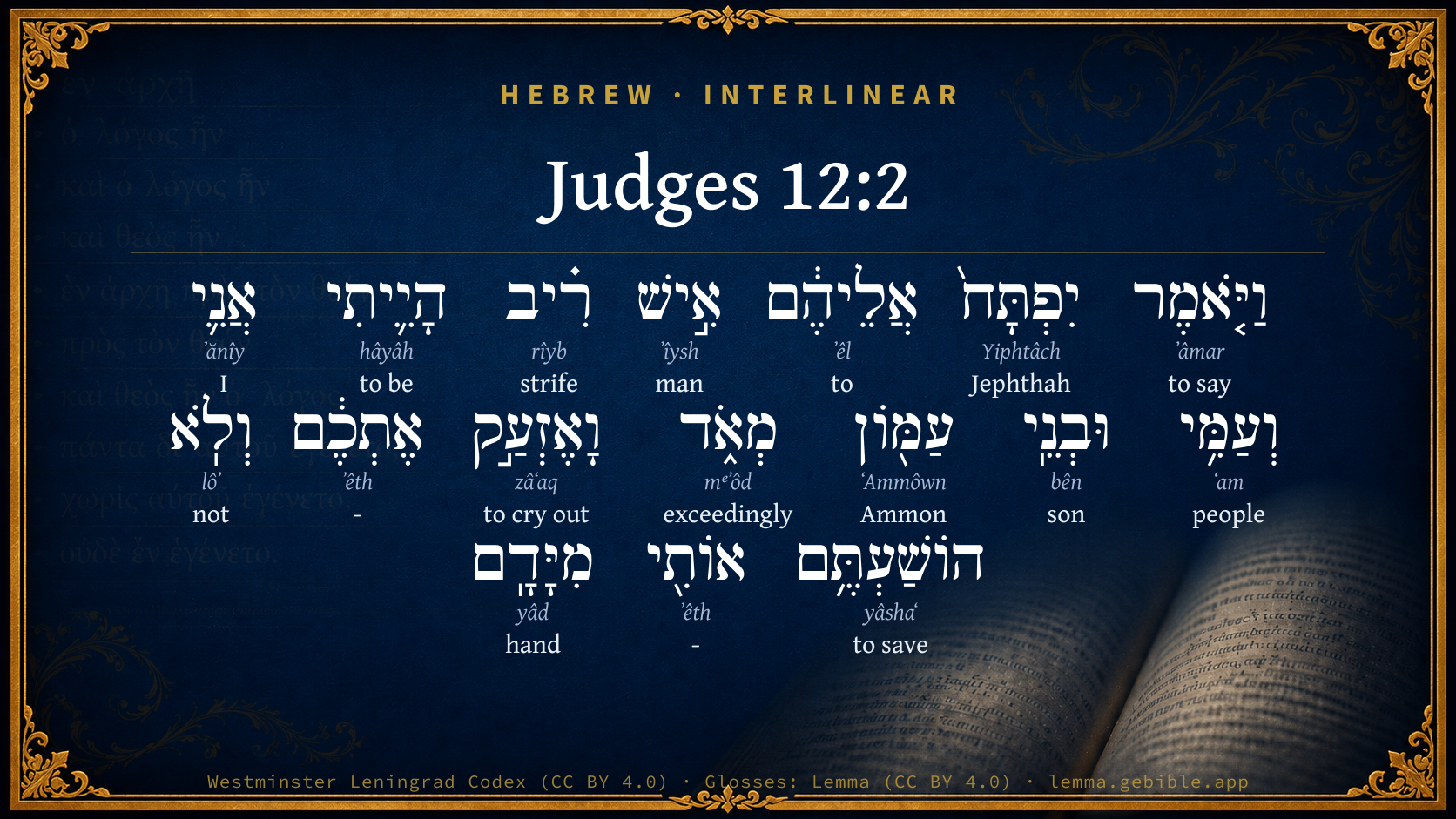
Judges 12:2

Hebrew (Westminster Leningrad Codex) Judges 12:2 appears in the Hebrew Old Testament. The text above is from the Westminster Leningrad Codex. Each word links to its Strong’s number, a concise gloss, and parsing drawn from the Open Scriptures Hebrew Bible morphology. Click any word for its full Brown-Driver-Briggs (BDB) entry.
Download image
Cite this verse

Judges 12:2 (World English Bible). Public Domain. Lemma interlinear Bible study tool, https://lemma.gebible.app/v/judges/12/2.

Show BibTeX & RIS
BibTeX
RIS
English Translation
Jephthah said to them, I and my people were at great strife with the children of Ammon; and when I called you, you didn't save me out of their hand.
World English Bible · Public Domain
Download a study sheet

One document with this verse’s original text, its word-by-word gloss line, the meaning frame, cross-references with their text, attributed commentary, and full source and license credits — printable, and it pastes into notes with its structure intact.

This verse Autodidact and up

Study sheet (.html) Plain text (.txt)

A passage Seminary Student

Up to 50 verses in one chapter. A passage sheet keeps up to 6 commentary sources and 12 cross-references per verse, in the order this page ranks them, and says so on the sheet whenever that leaves anything out. Ask for a single verse and you get the Autodidact verse sheet above.

Everything on this page stays free to read, with no account — the sheet is a download of what is already on screen, not access to it.

Want to remove ads? Support Godless Engineer
Compare translations 3

The same verse in 3 English versions, stacked beneath the original-language interlinear above. Click any original word for its lexicon entry.

Each is an independent rendering of the whole verse — the interlinear is not word-aligned to these translations.

Highlighted words mark where these versions differ — a whole-verse word diff, not a word-by-word alignment.

  • World English Bible Public Domain
    Jephthah said to them, I and my people were at great strife with the children of Ammon; and when I called you, you didn't save me out of their hand.
  • King James Version Public Domain
    And Jephthah said unto them, I and my people were at great strife with the children of Ammon; and when I called you, ye delivered me not out of their hands.
  • unfoldingWord Literal Text CC BY-SA 4.0
    And Jephthah said to them, “I was a man of strife, I and my people and the sons of Ammon, exceedingly. And I summoned you, but you did not save me from their hand.

unfoldingWord Literal Text — © unfoldingWord, licensed CC BY-SA 4.0. Word-aligned USFM3 via Door43 (git.door43.org/unfoldingWord/en_ult).

Versions to compare (up to 4)

3 of 4 selected

Show all 18 translations

Every available English version of this verse, each an independent rendering of the whole verse.

  • World English Bible Public Domain
    Jephthah said to them, I and my people were at great strife with the children of Ammon; and when I called you, you didn't save me out of their hand.
  • Berean Standard Bible Public Domain
    But Jephthah replied, “My people and I had a serious conflict with the Ammonites, and when I called, you did not save me out of their hands.
  • Majority Standard Bible Public Domain
    But Jephthah replied, “My people and I had a serious conflict with the Ammonites, and when I called, you did not save me out of their hands.
  • King James Version Public Domain
    And Jephthah said unto them, I and my people were at great strife with the children of Ammon; and when I called you, ye delivered me not out of their hands.
  • American Standard Version (1901) Public Domain
    And Jephthah said unto them, I and my people were at great strife with the children of Ammon; and when I called you, ye saved me not out of their hand.
  • Revised Version (1885) Public Domain
    And Jephthah said unto them, I and my people were at great strife with the children of Ammon; and when I called you, ye saved me not out of their hand.
  • Geneva Bible (1599) Public Domain
    And Iphtah said vnto them, I and my people were at great strife with the children of Ammon, and when I called you, ye deliuered me not out of their handes.
  • Douay-Rheims (1899) Public Domain
    And he answered them: I and my people were at great strife with the children of Ammon: and I called you to assist me, and you would not do it.
  • Young's Literal Translation Public Domain
    And Jephthah saith unto them, `A man of great strife I have been (I and my people) with the Bene-Ammon, and I call you, and ye have not saved me out of their hand,
  • Literal Standard Version CC BY-SA 4.0
    And Jephthah says to them, “I have been a man of great strife (I and my people) with the sons of Ammon, and I call you, and you have not saved me out of their hand,
  • Unlocked Literal Bible CC BY-SA 4.0
    Jephthah said to them, “I and my people were in a great conflict with the people of Ammon. When I called you, you did not rescue me from them.
  • unfoldingWord Literal Text CC BY-SA 4.0
    And Jephthah said to them, “I was a man of strife, I and my people and the sons of Ammon, exceedingly. And I summoned you, but you did not save me from their hand.
  • Darby Bible Public Domain
    And Jephthah said to them, "I and my people had a great feud with the Ammonites; and when I called you, you did not deliver me from their hand.
  • World Messianic Bible Public Domain
    Jephthah said to them, “I and my people were at great strife with the children of Ammon; and when I called you, you didn’t save me out of their hand.
  • Webster's Bible Public Domain
    And Jephthah said to them, I and my people were at great strife with the children of Ammon; and when I called you, ye delivered me not out of their hands.
  • Free Bible Version CC BY-SA 4.0
    “I was a man with a great fight on my hands,” Jephthah replied. “I and my people were fighting the Ammonites. When I called on you for help, you didn't come and help save me from them.
  • Bible in Basic English Public Domain
    And Jephthah said to them, I and my people were in danger, and the children of Ammon were very cruel to us, and when I sent for you, you gave me no help against them.
  • JPS Tanakh (1917) Public Domain
    And Jephthah said unto them: 'I and my people were at great strife with the children of Ammon; and when I called you, ye saved me not out of their hand.

Literal Standard Version (2020), Covenant Press — licensed CC BY-SA 4.0. Text via the HelloAO Bible API (eBible.org). Unlocked Literal Bible (unfoldingWord) — licensed CC BY-SA 4.0. Text via the HelloAO Bible API (eBible.org). unfoldingWord Literal Text — © unfoldingWord, licensed CC BY-SA 4.0. Word-aligned USFM3 via Door43 (git.door43.org/unfoldingWord/en_ult). Free Bible Version, Dr. Jonathan Gallagher — licensed CC BY-SA 4.0. Text via the HelloAO Bible API (eBible.org).

Word by word

More ways to search: Search by grammar → Find every occurrence → Compare this word →

Practice this passage: Drill this verse → Learn its vocabulary →

יִפְתָּח֙
Yiphtâch
H3316
“Jephthah”
Noun, Proper
Part of Speech
Noun
Type
Proper
Full BDB Definition

Origin: from H6605

TWOT: None

Jephthah or Jiphtah = "he opens" - a son of Gilead and a concubine and the judge who defeated the Ammonites; after the victory because of a vow taken before the battle he sacrificed his daughter as a burnt offering (noun proper masculine) - a city in Judah (noun proper locative)
  1. וַיֹּ֤אמֶר ʼâmar H559 “and · to say” Conjunction + Verb, Qal, Sequential Imperfect, 3rd Person, Masculine, Singular
  2. אֲלֵיהֶ֔ם ʼêl H413 “to · them” Preposition + Suffix, Personal, 3rd Person, Masculine, Plural
  3. אִ֣ישׁ ʼîysh H376 “man of” Noun, Common, Masculine, Singular, Construct
  4. רִ֗יב rîyb H7379 “strife” Noun, Common, Both, Singular, Absolute
  5. הָיִ֛יתִי hâyâh H1961 “to be” Verb, Qal, Perfect, 1st Person, Common, Singular
  6. אֲנִ֛י ʼănîy H589 “I” Pronoun, Personal, 1st Person, Common, Singular
  7. וְעַמִּ֥י ʻam H5971 “and · people · my” Conjunction + Noun, Common, Masculine, Singular, Construct + Suffix, Personal, 1st Person, Common, Singular
  8. וּבְנֵֽי bên H1121 “and · sons of” Conjunction + Noun, Common, Masculine, Plural, Construct
  9. עַמּ֖וֹן ʻAmmôwn H5983 “Ammon” Noun, Proper
  10. מְאֹ֑ד mᵉʼôd H3966 “exceedingly” Adverb
  11. וָאֶזְעַ֣ק zâʻaq H2199 “and · to cry out” Conjunction + Verb, Qal, Sequential Imperfect, 1st Person, Common, Singular
  12. אֶתְכֶ֔ם ʼêth H853 “- · you” Particle, Direct Object + Suffix, Personal, 2nd Person, Masculine, Plural
  13. וְלֹֽא lôʼ H3808 “and · not” Conjunction + Particle, Negative
  14. הוֹשַׁעְתֶּ֥ם yâshaʻ H3467 “to save” Verb, Hiphil, Perfect, 2nd Person, Masculine, Plural
  15. אוֹתִ֖י ʼêth H853 “- · me” Particle, Direct Object + Suffix, Personal, 1st Person, Common, Singular
  16. מִיָּדָֽם yâd H3027 “from · hand · their” Preposition + Noun, Common, Both, Singular, Construct + Suffix, Personal, 3rd Person, Masculine, Plural

About this verse

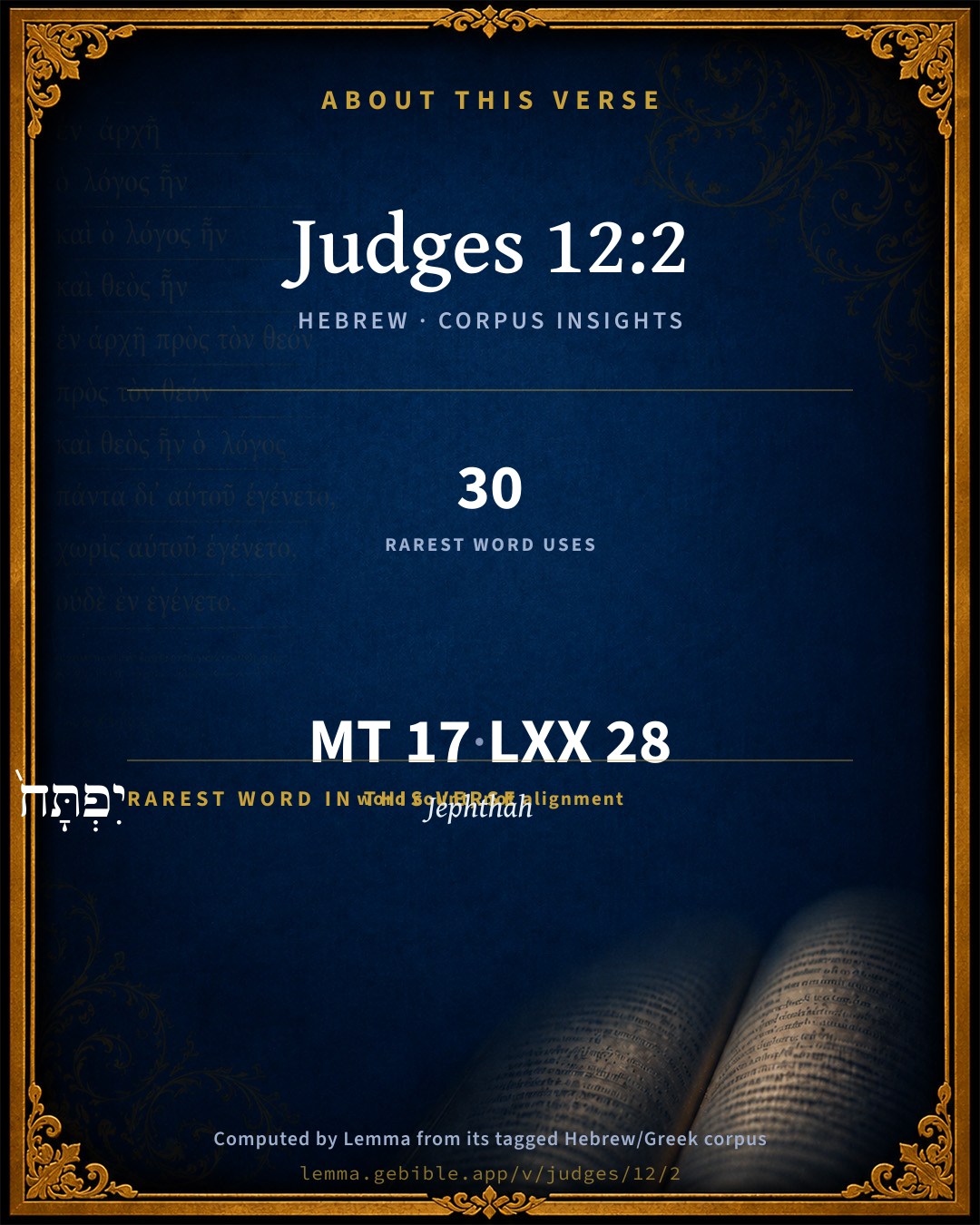
These counts appear in no published source. They are computed here, from the morphology-tagged text and Lemma’s own curated glosses. What Lemma adds →

17
words
16
distinct lemmas
Historical
section

Shared distinctive vocabulary

יִפְתָּח֙ Jephthah H3316 occurs in 26 verses of the Hebrew Bible. Also found in:

Grammatical profile

  • 4 verbs
  • 7 nouns
  • 1 pronoun
  • 1 preposition
  • 1 adverb
  • 3 particles

Verb forms

  • וַיֹּ֤אמֶר Qal · Sequential Imperfect
  • הָיִ֛יתִי Qal · Perfect
  • וָאֶזְעַ֣ק Qal · Sequential Imperfect
  • הוֹשַׁעְתֶּ֥ם Hiphil · Perfect

Hebrew & Septuagint length

In English translation the verse runs 30 words from the Hebrew and 35 from the Septuagint (LXX English) — closely comparable.

A rough comparison of the two English renderings, which tokenize alike — not a word-level alignment.

Word counts can differ between the Hebrew and the Greek without any difference in meaning — e.g. the Hebrew direct-object marker אֵת has no separate Greek word, and Greek often adds the article ὁ.

In the original languages it is 17 Hebrew tokens and 28 Greek tokens — but the two are counted differently (Hebrew bundles its prefixes and suffixes into one token; the Greek is in lemma form), so that isn’t a like-for-like length.

Cross-references

1

Topical passages linked to Judges 12:2 in the Treasury of Scripture Knowledge — connected by theme and wording, ordered by reader-vote popularity; previews shown in the World English Bible.

  • Judges 11:12–33 Jephthah sent messengers to the king of the children of Ammon, saying, What have you to do with me, that you are come to me to fight against my land?

Cross-references courtesy of OpenBible.info (CC BY 4.0).

Hebrew and Greek witnesses Masoretic Hebrew ↔ Greek Septuagint

The same verse in the two great witnesses to the Old Testament, shown verse-for-verse.

These are two independent witnesses, not word-aligned to each other, and the Septuagint is shown in lemma (dictionary) form.

Hebrew Judges 12:2 Masoretic · Westminster Leningrad Codex

וַיֹּ֤אמֶר יִפְתָּח֙ אֲלֵיהֶ֔ם אִ֣ישׁ רִ֗יב הָיִ֛יתִי אֲנִ֛י וְעַמִּ֥י וּבְנֵֽי עַמּ֖וֹן מְאֹ֑ד וָאֶזְעַ֣ק אֶתְכֶ֔ם וְלֹֽא הוֹשַׁעְתֶּ֥ם אוֹתִ֖י מִיָּדָֽם

Jephthah said to them, I and my people were at great strife with the children of Ammon; and when I called you, you didn't save me out of their hand.

World English Bible · Public Domain

Greek LXX Judges 12:2 Septuagint · lemma form

καί εἶπον ιεφθαε πρός αὐτός ἀνήρ μαχητής ἐμός ἐγώ καί ὁ λαός ἐγώ καί ὁ υἱός αμμων σφόδρα καί βοάω σύ καί οὐ σώζω ἐγώ ἐκ χείρ αὐτός

And Jephthae said to them, I and my people and the children of Ammon were very much engaged in war; and I called for you, and you⌃ did not save me out of their hand.

LXX2012 (modern English Septuagint) · Public Domain

On this verse, The Cambridge Bible for Schools and Colleges discusses the Septuagint’s reading. Read the note in Commentary ↓

Hebrew: Westminster Leningrad Codex (CC BY 4.0). Greek: Septuagint (public domain); English from LXX2012 (modern English Septuagint) (Public Domain). How the Septuagint differs from the Hebrew →

Targum (Aramaic paraphrase)

1

The Targum is the ancient Jewish Aramaic paraphrase of the Hebrew Scriptures — an interpretive translation, not the Hebrew text itself. Onkelos (literal) and Pseudo-Jonathan (expansive) render the Torah, and Jonathan the Prophets. Coverage is partial: where no permissively-licensed English translation exists for a verse, only the Aramaic is shown. This is verse-level text, not a word-by-word alignment to the Hebrew.

  1. Targum Jonathan Prophets (Joshua–Malachi)
    וַאֲמַר יִפְתָּח לְהוֹן אֱנַשׁ דִין הֱוֵיתִי אֲנָא וְעַמִי וּבְנֵי עַמוֹן לַחֲדָא וּבְעֵית אֲנָא מִנְכוֹן וְלָא פְרַקְתּוּן יָתִי מִיֶדְהוֹן:

    (no public-domain English translation for this verse)

    Targum Jonathan — Aramaic: “Mikraot Gedolot” (public domain). English: “Sefaria Community Translation” (CC0 1.0 (public-domain dedication)); “London "Chaldee Paraphrase," 1871” (public domain). Text via Sefaria.

Commentary

Notes on Judges 12:2 from classic Christian and Jewish commentators (each source and its license shown beneath its notes). The classic Christian expositions comment on the surrounding passage and are grouped to its opening verse, so a note may address several verses; the Jewish commentaries on the Tanakh (Rashi and others) are per-verse, so they appear only where the commentator wrote on this verse.

Lemma curates 59 commentaries, every one of them public domain or Creative Commons licensed, each selected and text-cleaned for this edition rather than reprinted as found. About our sources →

Trapp's Complete Commentary

John Trapp

Jdg 12:2 And Jephthah said unto them, I and my people were at great strife with the children of Ammon; and when I called you, ye delivered me not out of their hands.

Ver. 2. And Jephthah said unto them.] Apologies are lawful, and in stone cases needful: the primitive Christians, as Tertullian, Athenagoras, and others, offered their apologies to the Roman emperors to very good purpose.

And when I called you.] Which yet they denied. {Jdg 12:1} Proud and spiteful people make little of a lie. See Jdg 11:13.

John Trapp, A Commentary or Exposition upon All the Books of the Old and New Testament (1647–1656) — public domain. Text from a community e-Sword module.

Joseph Benson's Commentary

Jdg 12:2-3. When I called you, ye delivered me not — He answers them with great mildness, but denies their charge. He affirms that he had begged their assistance, but they had refused to grant it. When I saw that ye delivered me not — When I became sensible that there was no hope of your assistance to preserve us from ruin; I put my life in my hand — That is, I exposed myself to the utmost danger; as a man that carries a brittle and precious thing in his hand, which may easily either fall to the ground or be snatched from him. He had but a small part of the people of Israel with him, to encounter their powerful oppressors. And passed over against the children of Ammon — With such forces only as I could raise on the east of Jordan, Jdg 11:29-30. Wherefore are ye come up? — Why do ye thus requite my kindness in running such hazards to defend and preserve you and yours? Jephthah here manifests an excellent spirit and great wisdom. He would have prevented the civil war had it been possible.

Joseph Benson's Commentary on the Old and New Testaments (1811–1818) — public domain. Text from a community e-Sword module.

Jamieson, Fausset & Brown

Robert Jamieson, A. R. Fausset & David Brown

when I called you, ye delivered me not out of their hands--The straightforward answer of Jephthah shows that their charge was false; their complaint of not being treated as confederates and allies entirely without foundation; and their boast of a ready contribution of their services came with an ill grace from people who had purposely delayed appearing till the crisis was past.

Jamieson, Fausset & Brown — Commentary Critical and Explanatory on the Whole Bible (1871) — public domain (CC PDM 1.0). Text via the HelloAO Bible API.

Ellicott's Commentary for English Readers

(2) I and my people were at great strife with the children of Ammon.—Literally, I was a man of strife, I and my people, and the children of Ammon exceedingly. We have a similar phrase in Jer_15:10. Jephthah adopts the tone of a recognised chief, as he had done to the Ammonites.

And when I called you, ye delivered me not.—Ephraim was not immediately affected by the Ammonite oppression, any more than it had been by the Midianite. The effect of those raids was felt chiefly by Manasseh and by the Eastern tribes. Hence the Ephraimites held themselves selfishly aloof. That we are not told of this previous appeal of the Gileadites to Ephraim illustrates the compression of the narrative. We cannot tell whether it took place before or after the summons of the Gileadites to Jephthah.

A Bible Commentary for English Readers, edited by Charles John Ellicott (1878–1897) — public domain. Text from a community e-Sword module.

The Cambridge Bible for Schools and Colleges

gen. ed. J. J. S. Perowne

2. were at great strife with the children of Ammon] lit. ‘I was at strife, I and my people, and the children of A. exceedingly.’ Supply afflicted me in the last clause, with LXX. cod. A, Luc. etc., Syro-Hex. The verb (‘innûni) was accidentally omitted, probably owing to its resemblance to ‘Ammon. Jephthah identifies himself with his people, as in Jdg_11:12.

when I called you] The summons is not mentioned in ch. 11, but it may be implied in Jdg_11:29; see note.

The Cambridge Bible for Schools and Colleges (gen. ed. J. J. S. Perowne; Cambridge University Press, 1878–1918) — public domain. Text from a community e-Sword module.

John Gill's Exposition

And Jephthah said unto them, I and my people were at a great strife with the children of Ammon,.... As to the cause of the war, or the reason of his going over to fight the children of Ammon, it was a strife or contention between the Gileadites and them, concerning their country; which the children of Ammon claimed as theirs, and the Gileadites insisted on it they had a just right to it; by which it appeared that this was not a personal contention between Jephthah and them; and therefore the Ephraimites had no reason to fall so furiously upon him particularly; and it was a contention which chiefly concerned the two tribes and a half, and not the rest; and so could not be blamed for defending themselves alone if they could, without interesting others in the quarrel: but this is not all he has to say, he adds:

and when I called you, ye delivered me not out of their hands; it seems he had called them to assist in driving the enemy out of their boarders when there, and they refused to help him; though it is not elsewhere said, and it is not denied by them, so that it was false what they alleged; or however, since they declined giving him any assistance, when the children of Ammon were in his country, he could not expect they would join him in an expedition into theirs.

John Gill's Exposition of the Whole Bible (1746–1763) — public domain (CC PDM 1.0). Text via the HelloAO Bible API.

Albert Barnes' Notes on the Bible

When I called you ... - This circumstance is not related in the main narrative. It is likely to have occurred when Jephthah was first chosen leader by the Gileadites, and when Ephraim would probably ignore his pretensions.

Albert Barnes' Notes on the Bible (1834–1885) — public domain. Text from a community e-Sword/MySword module.

Haydock's Catholic Bible Commentary

Strife, to defend our property. --- I called. Drusius doubts whether he sent an express invitation to Ephraim, otherwise how durst they assert that they had not been summoned? (Calmet) --- But we may rather give credit to Jephte. The condition of the nation was a sufficient invitation, as they knew that the greatest preparations were making for war on both sides, and it was their duty to come forward. (Haydock)

George Leo Haydock (1774–1849), Haydock's Catholic Family Bible and Commentary, 1859 edition — public domain. Excludes Psalms (Douay-Rheims chapter numbering differs from Protestant) and Deuterocanonical books (Catholic canon only).

Matthew Poole's English Annotations

Hence it appears that he craved their assistance, which they denied, though that be not elsewhere expressed.

Matthew Poole's English Annotations on the Holy Bible (1683–1685) — public domain. Text from a community e-Sword/MySword module.

Whedon's Commentary on the Bible

Daniel D. Whedon

2. When I called you — Jephthah speaks in the name and as representative of the eastern tribes. These tribes were the ones specially afflicted by Ammon, and when they could no longer endure the oppression they resolved on fight. See Jdg_10:17-18. Then they looked for a leader; and then it doubtless was they appealed to the western tribes, and especially to Ephraim, to come and save them from their bitter foes. Jephthah himself, too, when collecting his forces to go against the Ammonites, probably called on them to come and help in the war. Keil thinks the Ephraimites probably refused their co-operation because the eastern tribes had appointed Jephthah as commander without consulting them. The designed brevity of the history led to the necessary omission of many minor facts and details.

Daniel D. Whedon (gen. ed.), Commentary on the Old and New Testaments (1874–1909) — public domain. Text from a community e-Sword module.

The Pulpit Commentary

When I called you. This incident is not mentioned in the previous narrative. Probably Jephthah asked the help of Ephraim when he was first made chief of the Gileadites, and they refused partly because they thought the attempt desperate, and partly because they were offended at Jephthah"s leadership.

The Pulpit Commentary (1880–1919), ed. H.D.M. Spence-Jones & Joseph S. Exell — public domain. Text from a community e-Sword module.

John Wesley's Explanatory Notes

When I called - Hence it appears, that he had craved their assistance, which they had denied; though that be not elsewhere expressed.

John Wesley, Explanatory Notes Upon the Whole Bible (1754–1765) — public domain. Text via the GEBible commentary corpus.

Lesson kit

Teaching starters — assembled from the data on this page, not authored interpretation. Every prompt links to the verse data it draws on. Edit before teaching.

Judges, in the Historical, opens this verse with 17 words (16 distinct Hebrew lemmas). Its most distinctive word is Yiphtâch (“Jephthah”). A historical commentator’s framing appears above. Read the whole chapter for the surrounding context.

Discussion questions

  1. The word Yiphtâch carries the sense “Jephthah.” How does it shape the verse?
  2. How does Joshua 15:43, which shares the word «Jephthah», read alongside this verse?
  3. These translations render this verse differently. What is at stake in choosing one wording over another?
  4. «וַיֹּ֤אמֶר» is a Qal Sequential Imperfect verb. How does that grammatical form shape the action described?
  5. Compare how Trapp's Complete Commentary and Joseph Benson's Commentary read this verse. Where do they agree or differ?

Things to notice

Reading settings

Reading text

Shown beneath each verse's original-language words.

Old Testament
Old Testament edition

Read the OT as the Masoretic Hebrew (MT) or the Greek Septuagint (LXX).

English shown for the Greek Septuagint (in the Hebrew ↔ Greek comparison).

Comparing translations? Open the Compare panel on any verse page to stack up to four side by side.