Leviticus 20:23

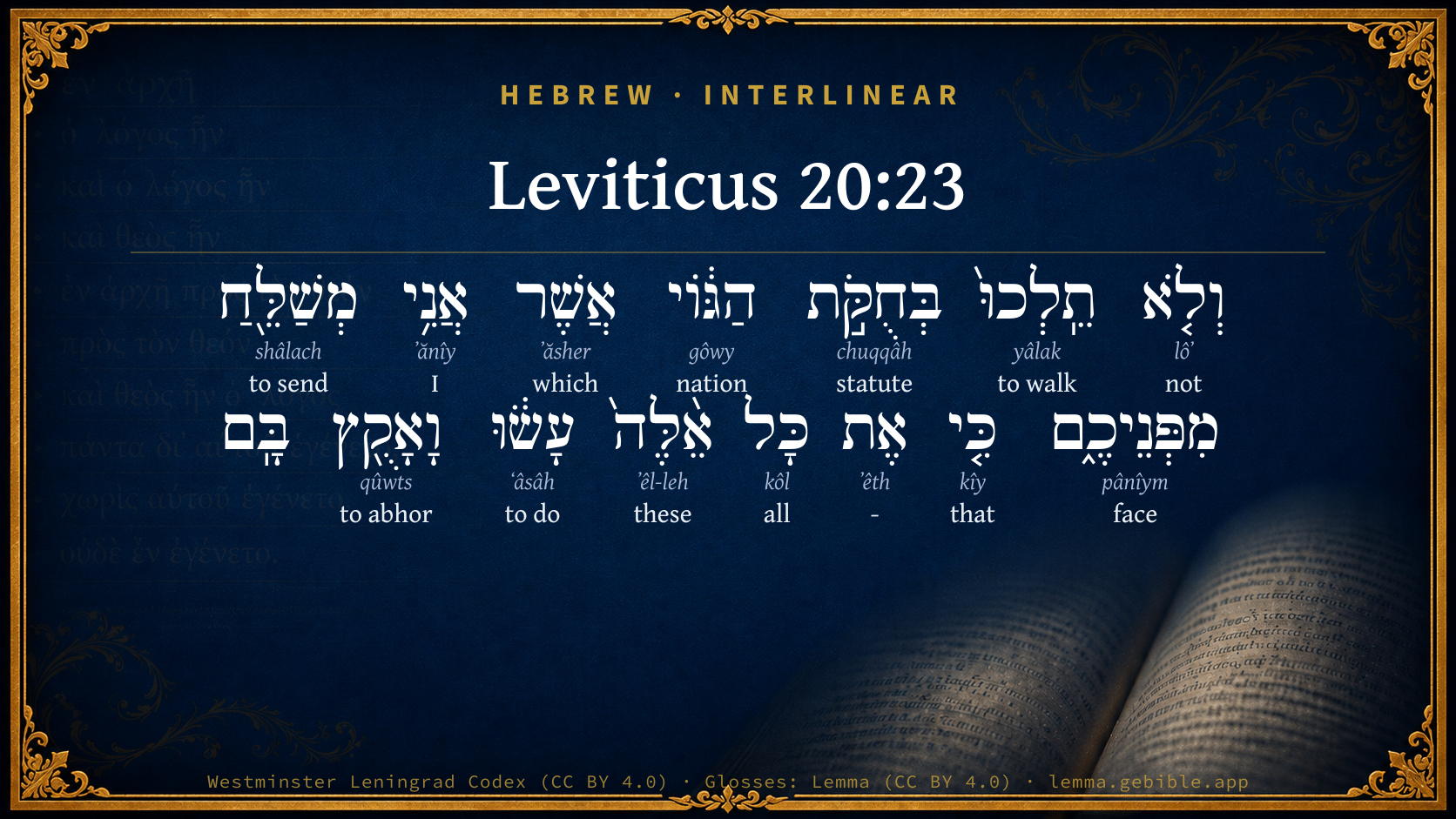
Hebrew (Westminster Leningrad Codex) Leviticus 20:23 appears in the Hebrew Old Testament. The text above is from the Westminster Leningrad Codex. Each word links to its Strong’s number, a concise gloss, and parsing drawn from the Open Scriptures Hebrew Bible morphology. Click any word for its full Brown-Driver-Briggs (BDB) entry.
Download image
Cite this verse

Leviticus 20:23 (World English Bible). Public Domain. Lemma interlinear Bible study tool, https://lemma.gebible.app/v/leviticus/20/23.

Show BibTeX & RIS
BibTeX
RIS
English Translation
You shall not walk in the customs of the nation, which I am casting out before you: for they did all these things, and therefore I abhorred them.
World English Bible · Public Domain
Download a study sheet

One document with this verse’s original text, its word-by-word gloss line, the meaning frame, cross-references with their text, attributed commentary, and full source and license credits — printable, and it pastes into notes with its structure intact.

This verse Autodidact and up

Study sheet (.html) Plain text (.txt)

A passage Seminary Student

Up to 50 verses in one chapter. A passage sheet keeps up to 6 commentary sources and 12 cross-references per verse, in the order this page ranks them, and says so on the sheet whenever that leaves anything out. Ask for a single verse and you get the Autodidact verse sheet above.

Everything on this page stays free to read, with no account — the sheet is a download of what is already on screen, not access to it.

Want to remove ads? Support Godless Engineer
Compare translations 3

The same verse in 3 English versions, stacked beneath the original-language interlinear above. Click any original word for its lexicon entry.

Each is an independent rendering of the whole verse — the interlinear is not word-aligned to these translations.

Highlighted words mark where these versions differ — a whole-verse word diff, not a word-by-word alignment.

  • World English Bible Public Domain
    You shall not walk in the customs of the nation, which I am casting out before you: for they did all these things, and therefore I abhorred them.
  • King James Version Public Domain
    And ye shall not walk in the manners of the nation, which I cast out before you: for they committed all these things, and therefore I abhorred them.
  • unfoldingWord Literal Text CC BY-SA 4.0
    And you shall not walk in the statutes of the nation that I am sending out from before your face, for they do all these things, and I loathe them.’

unfoldingWord Literal Text — © unfoldingWord, licensed CC BY-SA 4.0. Word-aligned USFM3 via Door43 (git.door43.org/unfoldingWord/en_ult).

Versions to compare (up to 4)

3 of 4 selected

Show all 18 translations

Every available English version of this verse, each an independent rendering of the whole verse.

  • World English Bible Public Domain
    You shall not walk in the customs of the nation, which I am casting out before you: for they did all these things, and therefore I abhorred them.
  • Berean Standard Bible Public Domain
    You must not follow the statutes of the nations I am driving out before you. Because they did all these things, I abhorred them.
  • Majority Standard Bible Public Domain
    You must not follow the statutes of the nations I am driving out before you. Because they did all these things, I abhorred them.
  • King James Version Public Domain
    And ye shall not walk in the manners of the nation, which I cast out before you: for they committed all these things, and therefore I abhorred them.
  • American Standard Version (1901) Public Domain
    And ye shall not walk in the customs of the nation, which I cast out before you: for they did all these things, and therefore I abhorred them.
  • Revised Version (1885) Public Domain
    And ye shall not walk in the customs of the nation, which I cast out before you: for they did all these things, and therefore I abhorred them.
  • Geneva Bible (1599) Public Domain
    Wherefore ye shall not walke in the maners of this nation which I cast out before you: for they haue committed all these things, therefore I abhorred them.
  • Douay-Rheims (1899) Public Domain
    Walk not after the laws of the nations, which I will cast out before you. For they have done all these things, and therefore I abhorred them.
  • Young's Literal Translation Public Domain
    and ye walk not in the statutes of the nation which I am sending away from before you, for all these they have done, and I am wearied with them;
  • Literal Standard Version CC BY-SA 4.0
    and you do not walk in the statutes of the nation which I am sending away from before you, for they have done all these, and I am wearied with them.
  • Unlocked Literal Bible CC BY-SA 4.0
    You must not walk in the customs of the nations that I will drive out before you, for they have done all these things, and I detest them.
  • unfoldingWord Literal Text CC BY-SA 4.0
    And you shall not walk in the statutes of the nation that I am sending out from before your face, for they do all these things, and I loathe them.’
  • Darby Bible Public Domain
    And ye shall not walk in the customs of the nation which I am casting out before you; for all these things have they done, and they became an abomination to me.
  • World Messianic Bible Public Domain
    You shall not walk in the customs of the nation which I am casting out before you; for they did all these things, and therefore I abhorred them.
  • Webster's Bible Public Domain
    And ye shall not walk in the manners of the nations which I cast out before you: for they committed all these things, and therefore I abhorred them.
  • Free Bible Version CC BY-SA 4.0
    Don't follow the practices of the nations I'm expelling for you. I detested them because they did all these evil things.
  • Bible in Basic English Public Domain
    And do not keep the rules of the nations which I am driving out before you; for they did all these things, and for that reason my soul was turned against them.
  • JPS Tanakh (1917) Public Domain
    And ye shall not walk in the customs of the nation, which I am casting out before you; for they did all these things, and therefore I abhorred them.

Literal Standard Version (2020), Covenant Press — licensed CC BY-SA 4.0. Text via the HelloAO Bible API (eBible.org). Unlocked Literal Bible (unfoldingWord) — licensed CC BY-SA 4.0. Text via the HelloAO Bible API (eBible.org). unfoldingWord Literal Text — © unfoldingWord, licensed CC BY-SA 4.0. Word-aligned USFM3 via Door43 (git.door43.org/unfoldingWord/en_ult). Free Bible Version, Dr. Jonathan Gallagher — licensed CC BY-SA 4.0. Text via the HelloAO Bible API (eBible.org).

Word by word

More ways to search: Search by grammar → Find every occurrence → Compare this word →

Practice this passage: Drill this verse → Learn its vocabulary →

וָאָקֻ֖ץ
qûwts
H6973
“and · to abhor”
Conjunction + Verb, Qal, Sequential Imperfect, 1st Person, Common, Singular
Part of Speech
Conjunction + Verb
Stem
Qal
Form
Sequential Imperfect
Person
1st Person
Gender
Common
Number
Singular
Full BDB Definition

Origin: a primitive root [identical with H6972 through the idea of severing oneself from (compare H6962 )]

TWOT: 2002

to be grieved, loathe, abhor, feel a loathing or abhorrence or sickening dread - (Qal) - to feel a loathing at, abhor - to feel a sickening dread - (Hiphil) - to cause sickening dread - to cause loathing
  1. וְלֹ֤א lôʼ H3808 “and · not” Conjunction + Particle, Negative
  2. תֵֽלְכוּ֙ yâlak H3212 “to walk” Verb, Qal, Imperfect, 2nd Person, Masculine, Plural
  3. בְּחֻקֹּ֣ת chuqqâh H2708 “in/at · statutes of” Preposition + Noun, Common, Both, Plural, Construct
  4. הַגּ֔וֹי gôwy H1471 “the · nation” Particle, Definite Article + Noun, Common, Masculine, Singular, Absolute
  5. אֲשֶׁר ʼăsher H834 “which” Particle, Relative
  6. אֲנִ֥י ʼănîy H589 “I” Pronoun, Personal, 1st Person, Common, Singular
  7. מְשַׁלֵּ֖חַ shâlach H7971 “sending” Verb, Piel, Participle Active, Masculine, Singular, Absolute
  8. מִפְּנֵיכֶ֑ם pânîym H6440 “from · face(s) · your” Preposition + Noun, Common, Both, Plural, Construct + Suffix, Personal, 2nd Person, Masculine, Plural
  9. כִּ֤י kîy H3588 “that” Conjunction
  10. אֶת ʼêth H853 “-” Particle, Direct Object
  11. כָּל kôl H3605 “all of” Noun, Common, Masculine, Singular, Construct
  12. אֵ֨לֶּה֙ ʼêl-leh H428 “these” Pronoun, Demonstrative, Common, Plural
  13. עָשׂ֔וּ ʻâsâh H6213 “to do” Verb, Qal, Perfect, 3rd Person, Common, Plural

About this verse

These counts appear in no published source. They are computed here, from the morphology-tagged text and Lemma’s own curated glosses. What Lemma adds →

15
words
14
distinct lemmas
Pentateuch
section

Notable vocabulary

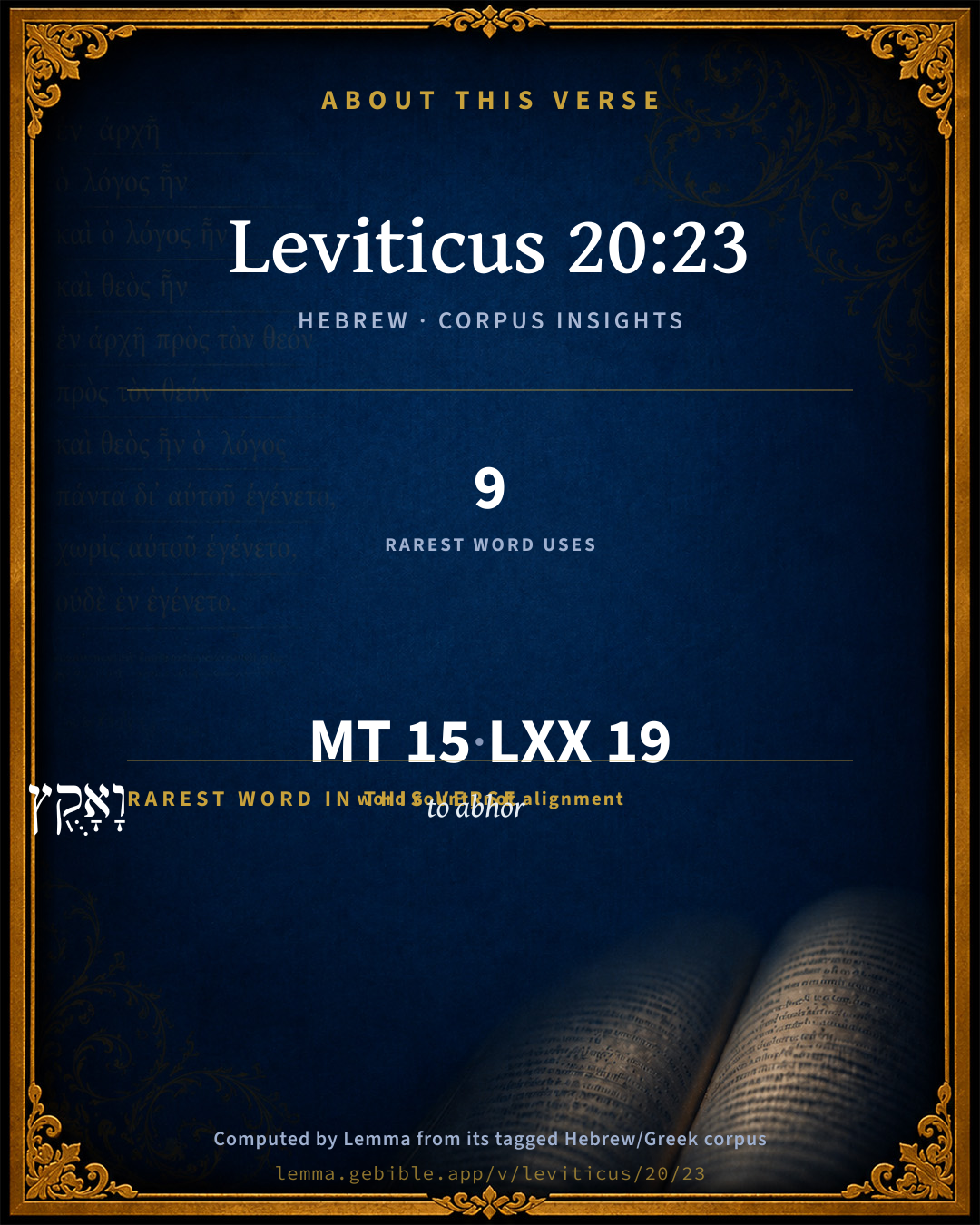
The rarest word here is וָאָקֻ֖ץ to abhor H6973 — appearing just 9 times in the whole Hebrew Bible.

Shared distinctive vocabulary

וָאָקֻ֖ץ to abhor H6973 occurs in 9 verses of the Hebrew Bible. Also found in:

Grammatical profile

  • 4 verbs
  • 4 nouns
  • 2 pronouns
  • 1 preposition
  • 1 conjunction
  • 3 particles

Verb forms

  • תֵֽלְכוּ֙ Qal · Imperfect
  • מְשַׁלֵּ֖חַ Piel · Participle Active
  • עָשׂ֔וּ Qal · Perfect
  • וָאָקֻ֖ץ Qal · Sequential Imperfect

Hebrew & Septuagint length

In English translation the verse runs 28 words from the Hebrew and 29 from the Septuagint (LXX English) — closely comparable.

A rough comparison of the two English renderings, which tokenize alike — not a word-level alignment.

Word counts can differ between the Hebrew and the Greek without any difference in meaning — e.g. the Hebrew direct-object marker אֵת has no separate Greek word, and Greek often adds the article ὁ.

In the original languages it is 15 Hebrew tokens and 19 Greek tokens — but the two are counted differently (Hebrew bundles its prefixes and suffixes into one token; the Greek is in lemma form), so that isn’t a like-for-like length.

Cross-references

9

Topical passages linked to Leviticus 20:23 in the Treasury of Scripture Knowledge — connected by theme and wording, ordered by reader-vote popularity; previews shown in the World English Bible.

  • Leviticus 18:24 "'Don't defile yourselves in any of these things: for in all these the nations which I am casting out before you were defiled.
  • Deuteronomy 9:5 Not for your righteousness, or for the uprightness of your heart, do you go in to possess their land; but for the wickedness of these nations Yahweh your God does drive them out from before you, and that he may establish the word which Yahweh swore to your fathers, to Abraham, to Isaac, and to Jacob.
  • Leviticus 18:3 You shall not do as they do in the land of Egypt, where you lived: and you shall not do as they do in the land of Canaan, where I am bringing you; neither shall you walk in their statutes.
  • Leviticus 18:30 Therefore you shall keep my charge, that you do not practice any of these abominable customs, which were practiced before you, and that you do not defile yourselves with them: I am Yahweh your God.'"
  • Leviticus 18:27 (for all these abominations have the men of the land done, that were before you, and the land became defiled);
  • Deuteronomy 12:30–31 take heed to yourself that you not be ensnared to follow them, after that they are destroyed from before you; and that you not inquire after their gods, saying, How do these nations serve their gods? even so will I do likewise.
  • Psalms 78:59 When God heard this, he was angry, And greatly abhorred Israel;
  • Jeremiah 10:1–2 Hear the word which Yahweh speaks to you, house of Israel!
  • Zechariah 11:8 I cut off the three shepherds in one month; for my soul was weary of them, and their soul also loathed me.

Cross-references courtesy of OpenBible.info (CC BY 4.0).

Hebrew and Greek witnesses Masoretic Hebrew ↔ Greek Septuagint

The same verse in the two great witnesses to the Old Testament, shown verse-for-verse.

These are two independent witnesses, not word-aligned to each other, and the Septuagint is shown in lemma (dictionary) form.

Hebrew Leviticus 20:23 Masoretic · Westminster Leningrad Codex

וְלֹ֤א תֵֽלְכוּ֙ בְּחֻקֹּ֣ת הַגּ֔וֹי אֲשֶׁר אֲנִ֥י מְשַׁלֵּ֖חַ מִפְּנֵיכֶ֑ם כִּ֤י אֶת כָּל אֵ֨לֶּה֙ עָשׂ֔וּ וָאָקֻ֖ץ בָּֽם

You shall not walk in the customs of the nation, which I am casting out before you: for they did all these things, and therefore I abhorred them.

World English Bible · Public Domain

Greek LXX Leviticus 20:23 Septuagint · lemma form

καί οὐ πορεύομαι ὁ νόμιμος ὁ ἔθνος ὅς ἐκ ἀποστέλλω ἀπό σύ ὅτι οὗτος πᾶς ποιέω καί βδελύσσω αὐτός

And walk you⌃ not in the customs of the nations which I drive out from before you; for they have done all these things, and I have abhorred them:

LXX2012 (modern English Septuagint) · Public Domain

Hebrew: Westminster Leningrad Codex (CC BY 4.0). Greek: Septuagint (public domain); English from LXX2012 (modern English Septuagint) (Public Domain). How the Septuagint differs from the Hebrew →

Targum (Aramaic paraphrase)

2

The Targum is the ancient Jewish Aramaic paraphrase of the Hebrew Scriptures — an interpretive translation, not the Hebrew text itself. Onkelos (literal) and Pseudo-Jonathan (expansive) render the Torah, and Jonathan the Prophets. Coverage is partial: where no permissively-licensed English translation exists for a verse, only the Aramaic is shown. This is verse-level text, not a word-by-word alignment to the Hebrew.

  1. Targum Onkelos Torah (Genesis–Deuteronomy)
    וְלָא תְהָכוּן בְּנִימוֹסֵי עַמְמַיָא דִי אֲנָא מַגְלֵי מִן קֳדָמֵיכוֹן אֲרֵי יָת כָּל אִלֵין עֲבָדוּ וְרָחִיק מֵימְרִי יָתְהוֹן

    (no public-domain English translation for this verse)

    Targum Onkelos — Aramaic: “Onkelos Genesis” (public domain); “Onkelos Exodus” (public domain); “Onkelos Leviticus” (public domain); “Onkelos Numbers” (public domain); “Onkelos Deuteronomy” (public domain). English: “Sefaria Community Translation” (CC0 1.0 (public-domain dedication)); “J.W. Etheridge. The Targums of Onkelos and Jonathan Ben Uzziel on the Pentateuch. London: Longmans, Green, 1862” (public domain). Text via Sefaria.

  2. Targum Pseudo-Jonathan Torah (Genesis–Deuteronomy)
    וְלָא תְהָכוּן בְּנִימוּסֵי עַמְמַיָא דַאֲנָא מַגְלֵי מִן קֳדָמֵיכוֹן אֲרוּם יַת כָּל מְרַחֲקַיָיא הָאִילֵין עָבָדוּ וְרָחִיק מֵימְרִי יַתְהוֹן

    and walk not after the laws of the peoples whom I drive away from before you; for they have committed all these abhorrent things, and My Word hath abhorred them.

    Targum Pseudo-Jonathan — Aramaic: “Targum Jonathan on Genesis” (public domain); “Targum Jonathan on Exodus” (public domain); “Targum Jonathan on Leviticus” (public domain); “Targum Jonathan on Numbers” (public domain); “Targum Jonathan on Deuteronomy” (public domain). English: “The Targum of Jonathan ben Uzziel, trans. J. W. Etheridge, London, 1862” (public domain). Text via Sefaria.

Commentary

Notes on Leviticus 20:23 from classic Christian and Jewish commentators (each source and its license shown beneath its notes). The classic Christian expositions comment on the surrounding passage and are grouped to its opening verse, so a note may address several verses; the Jewish commentaries on the Tanakh (Rashi and others) are per-verse, so they appear only where the commentator wrote on this verse.

Lemma curates 59 commentaries, every one of them public domain or Creative Commons licensed, each selected and text-cleaned for this edition rather than reprinted as found. About our sources →

Trapp's Complete Commentary

John Trapp

Lev 20:23 And ye shall not walk in the manners of the nation, which I cast out before you: for they committed all these things, and therefore I abhorred them.

Ver. 23. See on Lev 18:1-30

John Trapp, A Commentary or Exposition upon All the Books of the Old and New Testament (1647–1656) — public domain. Text from a community e-Sword module.

John Gill's Exposition

And ye shall not walk in the manners of the nation which I cast out before you,.... Nation seems to be put for nations, for there were seven nations cast out for them; though the Canaanites may be intended, being a general name for the whole: some think the Amorites are meant, who were a principal nation, and notorious for their wickedness: hence we often meet with this phrase in Jewish writings, "the way of the Amorites", as being exceeding bad, and so to be avoided, and by no means to be walked in, Gen 15:16,

for they committed all these things; were guilty of all the idolatries, incests, and uncleannesses before mentioned, and forbid under severe penalties:

and therefore I abhorred them; the sins committed by them, being so abominable and detestable: their persons, though the creatures of God, were had in abhorrence by him, and this he showed by casting them out of the land; and hereby it is suggested, that, should they, the Israelites, be guilty of the like, they also would be rejected and abhorred by him: the Targums of Onkelos and Jonathan are,"my Word abhorred them,''Christ, the eternal Word, Psa 45:7.

John Gill's Exposition of the Whole Bible (1746–1763) — public domain (CC PDM 1.0). Text via the HelloAO Bible API.

Whedon's Commentary on the Bible

Daniel D. Whedon

23. Therefore I abhorred them — The word kootz signifies to be weary of, to loathe, to be distressed, to abhor; and it heightens the hatefulness of the sins of the Canaanites. How intensely repugnant to the divine mind must those actions be which awaken the emotion of abhorrence! We have no sympathy with the semi-deistic notion that God is a bare and cold intelligence, utterly devoid of sensibilities. To limit him to mere knowledge and volition is to represent him as inferior to man. If man is made in the image of God it must be that the divine prototype is possessed of the capacity of emotion.

Daniel D. Whedon (gen. ed.), Commentary on the Old and New Testaments (1874–1909) — public domain. Text from a community e-Sword module.

The Pulpit Commentary

God"s displeasure with ourselves.

"They committed all these things, and therefore I abhorred them." This expression arrests us by

I ITS SOMEWHAT STARTLING STRENGTH. "I abhorred them." Does God positively abhor man? the Creator his creature? the Father his child? Are we to understand that the Lord, who is "gracious and full of compassion, slow to anger, and plenteous in mercy," feels an actual abhorrence of those beings to whom he is so nearly and intimately related, those human spirits he formed for himself, to reflect his own image and to enjoy his own immortal blessedness? The word startles us; it may well alarm us; it suggests the question, Is it possible that we also may become such that our God may be compelled to look on us with a displeasure which amounts to abhorrence? We look at

II THE SAD AND SOLID TRUTH WHICH IT CONTAINS. "God hates the sin and loves the sinner," we say, and truly. Yet this sentence does not cover the whole truth of the case. God does pity the sinner, and seeks to save him. But he is displeased with him also. Of anything like malignity or ill will we rejoice to know that the holy and gracious One is absolutely incapable; but we are bound to believe that he feels a sacred and holy resentment against those who violate the laws of righteousness.

1. Scripture plainly affirms that he does. "Therefore I abhorred them;" "God is angry with the wicked every day"; (Psa_7:11) "the Lord hath been sore displeased with your fathers"; (Zec_1:2) "they vexed his Holy Spirit"; (Isa_63:10) "he looked on them with anger"; (Mar_3:5) to "them that obey unrighteousness" God will render "indignation and wrath". (Rom_2:8)

2. It is impossible wholly to separate the act from the agent. An act has nomoral qualities at all apart from the disposition and character of him who does it. If our indignation is aroused by any shameful deed, it is because some one has wrought that which is wrong, and our feeling must extend to the perpetrator as well as to the crime. In theory it must do so; in fact it does so. We cannot see our own children doing that which is guilty without being displeased with them as well as excited with indignation against the wrong they have done. Our feelings of holy anger, indignation, righteous grief, etc., may not be precisely, identical with those which are in the heart of God when he looks down on the sins of his human children, but they answer to them; they correspond with them; they enable us to understand how he, our Divine Father, feels toward us when we do those things which are offensive and grievous in his sight. Let us lay it well to heart that by

(1) our positive transgressions of his holy Law,

(2) our keeping back from him the love and the service which are his due,

(3) the continued rejection of his overtures of mercy and reconciliation in Christ Jesus, we are offending, displeasing, grieving God.

These our sins are drawing down upon our own souls the awful anger., the high displeasure, of that Almighty God in whom we live, who has ourselves and our future in his right hand of power, whom it is our chief duty, and should be our first desire, to conciliate and please. We glance at

III THE WELCOME TRUTH WITH WHICH IT IS CONSISTENT. While God bates sin and is divinely displeased with the sinner, he yet pities the sinner and seeks to save him. He condemns, but he invites. "Is Ephraim my dear son?... since I spake against him, I do earnestly remember him still". (Jer_31:20) As a human father over his lost son or erring daughter, only with immeasurably deeper love, he yearns over his wayward children, and goes out to welcome them home, when, returning to themselves, they return unto him. C. (Luk_15:11-24)

The Pulpit Commentary (1880–1919), ed. H.D.M. Spence-Jones & Joseph S. Exell — public domain. Text from a community e-Sword module.

Rashi

Rabbi Shlomo Yitzchaki (Rashi)

קוץ — ואקץ signifies loathsomeness. Similar is: (Genesis 27:46) "I am sick (קצתי) of my life”, like a man who is disgusted with his food (Sifra, Kedoshim, Chapter 12 16).

Rashi on the Tanakh — English translations: “The Judaica Press complete Tanach with Rashi, translated by A. J. Rosenberg” (CC BY 4.0); “Pentateuch with Rashi's commentary by M. Rosenbaum and A.M. Silbermann, 1929-1934” (public domain); “The Metsudah Tanach series, Lakewood, N.J” (CC BY 4.0); and “The Book of Joshua, Metsudah Publications, 1997” (CC BY 4.0). Text via Sefaria.

Lesson kit

Teaching starters — assembled from the data on this page, not authored interpretation. Every prompt links to the verse data it draws on. Edit before teaching.

Leviticus, in the Pentateuch, opens this verse with 15 words (14 distinct Hebrew lemmas). Its most distinctive word is qûwts (“to abhor”). A historical commentator’s framing appears above. Read the whole chapter for the surrounding context.

Discussion questions

  1. How does “to abhor” (qûwts) shape what this verse is saying?
  2. How does Genesis 27:46, which shares the word «to abhor», read alongside this verse?
  3. These translations render this verse differently; the difference is in the English rendering, not the original. What questions does that raise?
  4. «תֵֽלְכוּ֙» is a Qal Imperfect verb. How does that grammatical form shape the action described?
  5. Compare how Trapp's Complete Commentary and John Gill's Exposition read this verse. Where do they agree or differ?

Things to notice

Reading settings

Reading text

Shown beneath each verse's original-language words.

Old Testament
Old Testament edition

Read the OT as the Masoretic Hebrew (MT) or the Greek Septuagint (LXX).

English shown for the Greek Septuagint (in the Hebrew ↔ Greek comparison).

Comparing translations? Open the Compare panel on any verse page to stack up to four side by side.