
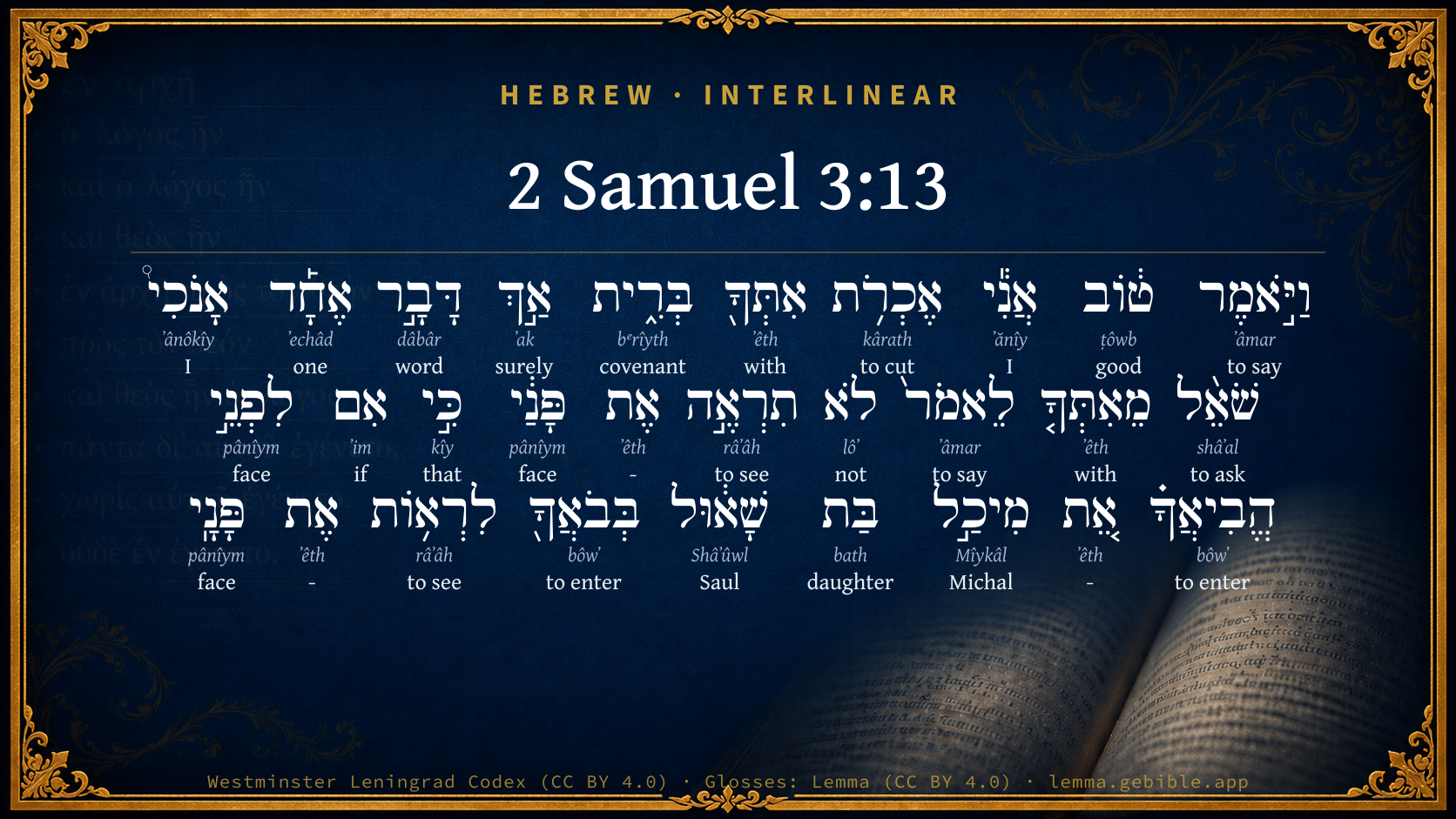
2 Samuel 3:13

Hebrew (Westminster Leningrad Codex) 2 Samuel 3:13 appears in the Hebrew Old Testament. The text above is from the Westminster Leningrad Codex. Each word links to its Strong’s number, a concise gloss, and parsing drawn from the Open Scriptures Hebrew Bible morphology. Click any word for its full Brown-Driver-Briggs (BDB) entry.
Download image
Cite this verse

2 Samuel 3:13 (World English Bible). Public Domain. Lemma interlinear Bible study tool, https://lemma.gebible.app/v/2-samuel/3/13.

Show BibTeX & RIS
BibTeX
RIS
English Translation
He said, Well; I will make a league with you; but one thing I require of you: that is, you shall not see my face, except you first bring Michal, Saul's daughter, when you come to see my face.
World English Bible · Public Domain
Download a study sheet

One document with this verse’s original text, its word-by-word gloss line, the meaning frame, cross-references with their text, attributed commentary, and full source and license credits — printable, and it pastes into notes with its structure intact.

This verse Autodidact and up

Study sheet (.html) Plain text (.txt)

A passage Seminary Student

Up to 50 verses in one chapter. A passage sheet keeps up to 6 commentary sources and 12 cross-references per verse, in the order this page ranks them, and says so on the sheet whenever that leaves anything out. Ask for a single verse and you get the Autodidact verse sheet above.

Everything on this page stays free to read, with no account — the sheet is a download of what is already on screen, not access to it.

Want to remove ads? Support Godless Engineer
Compare translations 3

The same verse in 3 English versions, stacked beneath the original-language interlinear above. Click any original word for its lexicon entry.

Each is an independent rendering of the whole verse — the interlinear is not word-aligned to these translations.

Highlighted words mark where these versions differ — a whole-verse word diff, not a word-by-word alignment.

  • World English Bible Public Domain
    He said, Well; I will make a league with you; but one thing I require of you: that is, you shall not see my face, except you first bring Michal, Saul's daughter, when you come to see my face.
  • King James Version Public Domain
    And he said, Well; I will make a league with thee: but one thing I require of thee, that is, Thou shalt not see my face, except thou first bring Michal Saul's daughter, when thou comest to see my face.
  • unfoldingWord Literal Text CC BY-SA 4.0
    And he said, “Good, I, I will cut a covenant with you. Only one thing I am asking from you, saying, ‘You shall not see my face unless you bring Michal, the daughter of Saul, to my face when you come to see my face.’”

unfoldingWord Literal Text — © unfoldingWord, licensed CC BY-SA 4.0. Word-aligned USFM3 via Door43 (git.door43.org/unfoldingWord/en_ult).

Versions to compare (up to 4)

3 of 4 selected

Show all 18 translations

Every available English version of this verse, each an independent rendering of the whole verse.

  • World English Bible Public Domain
    He said, Well; I will make a league with you; but one thing I require of you: that is, you shall not see my face, except you first bring Michal, Saul's daughter, when you come to see my face.
  • Berean Standard Bible Public Domain
    “Good,” replied David, “I will make a covenant with you. But there is one thing I require of you: Do not appear before me unless you bring Saul’s daughter Michal when you come to see me.”
  • Majority Standard Bible Public Domain
    “Good,” replied David, “I will make a covenant with you. But there is one thing I require of you: Do not appear before me unless you bring Saul’s daughter Michal when you come to see me.”
  • King James Version Public Domain
    And he said, Well; I will make a league with thee: but one thing I require of thee, that is, Thou shalt not see my face, except thou first bring Michal Saul's daughter, when thou comest to see my face.
  • American Standard Version (1901) Public Domain
    And he said, Well; I will make a league with thee; but one thing I require of thee: that is, thou shalt not see my face, except thou first bring Michal, Saul's daughter, when thou comest to see my face.
  • Revised Version (1885) Public Domain
    And he said, Well; I will make a league with thee: but one thing I require of thee, that is, thou shalt not see my face, except thou first bring Michal Saul’s daughter, when thou comest to see my face.
  • Geneva Bible (1599) Public Domain
    Who saide, Well, I will make a couenant with thee: but one thing I require of thee, that is, that thou see not my face except thou bring Michal Sauls daughter when thou commest to see me.
  • Douay-Rheims (1899) Public Domain
    And he said: Very well: I will make a league with thee: but one thing I require of thee, saying: Thou shalt not see my face before thou bring Michol the daughter of Saul: and so thou shalt come, and see me.
  • Young's Literal Translation Public Domain
    And he saith, `Good -- I make with thee a covenant; only, one thing I am asking of thee, that is, Thou dost not see my face, except thou dost first bring in Michal, daughter of Saul in thy coming into see my face.'
  • Literal Standard Version CC BY-SA 4.0
    And [David] says, “Good—I make a covenant with you; only, one thing I am asking of you, that is, you do not see my face, except [that] you first bring in Michal daughter of Saul in your coming in to see my face.”
  • Unlocked Literal Bible CC BY-SA 4.0
    David answered, “Good, I will make a covenant with you. But one thing I require from you is that you cannot see my face unless you first bring Michal, Saul's daughter, when you come to see me.”
  • unfoldingWord Literal Text CC BY-SA 4.0
    And he said, “Good, I, I will cut a covenant with you. Only one thing I am asking from you, saying, ‘You shall not see my face unless you bring Michal, the daughter of Saul, to my face when you come to see my face.’”
  • Darby Bible Public Domain
    And he said, Well, I will make a covenant with thee; only I require one thing of thee, that is, Thou shalt not see my face, except thou first bring Michal Saul's daughter, when thou comest to see my face.
  • World Messianic Bible Public Domain
    David said, “Good. I will make a treaty with you, but one thing I require of you. That is, you will not see my face unless you first bring Michal, Saul’s daughter, when you come to see my face.”
  • Webster's Bible Public Domain
    And he said, Well; I will make a league with thee: but one thing I require of thee, that is, Thou shalt not see my face, except thou shalt first bring Michal, Saul's daughter, when thou comest to see my face.
  • Free Bible Version CC BY-SA 4.0
    “Fine,” David replied, “I'll make an agreement with you. But I have one condition: I won't see you unless you bring Saul's daughter Michal when you come.”
  • Bible in Basic English Public Domain
    And he said, It is well; I will make an agreement with you, but on one condition, which is, that when you come before me, Saul's daughter Michal is to come with you; till she comes you will not see my face.
  • JPS Tanakh (1917) Public Domain
    And he said: 'Well; I will make a league with thee; but one thing I require of thee, that is, thou shalt not see my face, except thou first bring Michal Saul's daughter, when thou comest to see my face.'

Literal Standard Version (2020), Covenant Press — licensed CC BY-SA 4.0. Text via the HelloAO Bible API (eBible.org). Unlocked Literal Bible (unfoldingWord) — licensed CC BY-SA 4.0. Text via the HelloAO Bible API (eBible.org). unfoldingWord Literal Text — © unfoldingWord, licensed CC BY-SA 4.0. Word-aligned USFM3 via Door43 (git.door43.org/unfoldingWord/en_ult). Free Bible Version, Dr. Jonathan Gallagher — licensed CC BY-SA 4.0. Text via the HelloAO Bible API (eBible.org).

Word by word

More ways to search: Search by grammar → Find every occurrence → Compare this word →

Practice this passage: Drill this verse → Learn its vocabulary →

מִיכַ֣ל
Mîykâl
H4324
“Michal”
Noun, Proper
Part of Speech
Noun
Type
Proper
Full BDB Definition

Origin: apparently the same as H4323

TWOT: None

Michal = "who is like God" - daughter of king Saul, sister of Jonathan, wife of king David, and mother of five; given to David as wife for the bride price of 100 Philistine foreskins; while still married to David, her father gave her in marriage to another, Phaltiel; at the death of Saul, David forced her to return
  1. וַיֹּ֣אמֶר ʼâmar H559 “and · to say” Conjunction + Verb, Qal, Sequential Imperfect, 3rd Person, Masculine, Singular
  2. ט֔וֹב ṭôwb H2896 “good” Adjective, Adjective, Masculine, Singular, Absolute
  3. אֲנִ֕י ʼănîy H589 “I” Pronoun, Personal, 1st Person, Common, Singular
  4. אֶכְרֹ֥ת kârath H3772 “to cut” Verb, Qal, Imperfect, 1st Person, Common, Singular
  5. אִתְּךָ֖ ʼêth H854 “with · you” Preposition + Suffix, Personal, 2nd Person, Masculine, Singular
  6. בְּרִ֑ית bᵉrîyth H1285 “covenant” Noun, Common, Feminine, Singular, Absolute
  7. אַ֣ךְ ʼak H389 “surely” Particle, Accusative
  8. דָּבָ֣ר dâbâr H1697 “word” Noun, Common, Masculine, Singular, Absolute
  9. אֶחָ֡ד ʼechâd H259 “one” Adjective, Cardinal number, Masculine, Singular, Absolute
  10. אָנֹכִי֩ ʼânôkîy H595 “I” Pronoun, Personal, 1st Person, Common, Singular
  11. שֹׁאֵ֨ל shâʼal H7592 “asking” Verb, Qal, Participle Active, Masculine, Singular, Absolute
  12. מֵאִתְּךָ֤ ʼêth H854 “from · with · you” Preposition + Preposition + Suffix, Personal, 2nd Person, Masculine, Singular
  13. לֵאמֹר֙ ʼâmar H559 “to say” Preposition + Verb, Qal, Infinitive Construct
  14. לֹא lôʼ H3808 “not” Particle, Negative
  15. תִרְאֶ֣ה râʼâh H7200 “to see” Verb, Qal, Imperfect, 2nd Person, Masculine, Singular
  16. אֶת ʼêth H853 “-” Particle, Direct Object
  17. פָּנַ֔י pânîym H6440 “face(s) · my” Noun, Common, Both, Plural, Construct + Suffix, Personal, 1st Person, Common, Singular
  18. כִּ֣י kîy H3588 “that” Conjunction
  19. אִם ʼim H518 “if” Conjunction
  20. לִפְנֵ֣י pânîym H6440 “to/for · face(s) of” Preposition + Noun, Common, Both, Plural, Construct
  21. הֱבִיאֲךָ֗ bôwʼ H935 “to enter · you” Verb, Hiphil, Perfect, 3rd Person, Masculine, Singular + Suffix, Personal, 2nd Person, Masculine, Singular
  22. אֵ֚ת ʼêth H853 “-” Particle, Direct Object
  23. בַּת bath H1323 “daughter of” Noun, Common, Feminine, Singular, Construct
  24. שָׁא֔וּל Shâʼûwl H7586 “Saul” Noun, Proper
  25. בְּבֹאֲךָ֖ bôwʼ H935 “in/at · to enter · you” Preposition + Verb, Qal, Infinitive Construct + Suffix, Personal, 2nd Person, Masculine, Singular
  26. לִרְא֥וֹת râʼâh H7200 “to see” Preposition + Verb, Qal, Infinitive Construct
  27. אֶת ʼêth H853 “-” Particle, Direct Object
  28. פָּנָֽי pânîym H6440 “face(s) · my” Noun, Common, Both, Plural, Construct + Suffix, Personal, 1st Person, Common, Singular

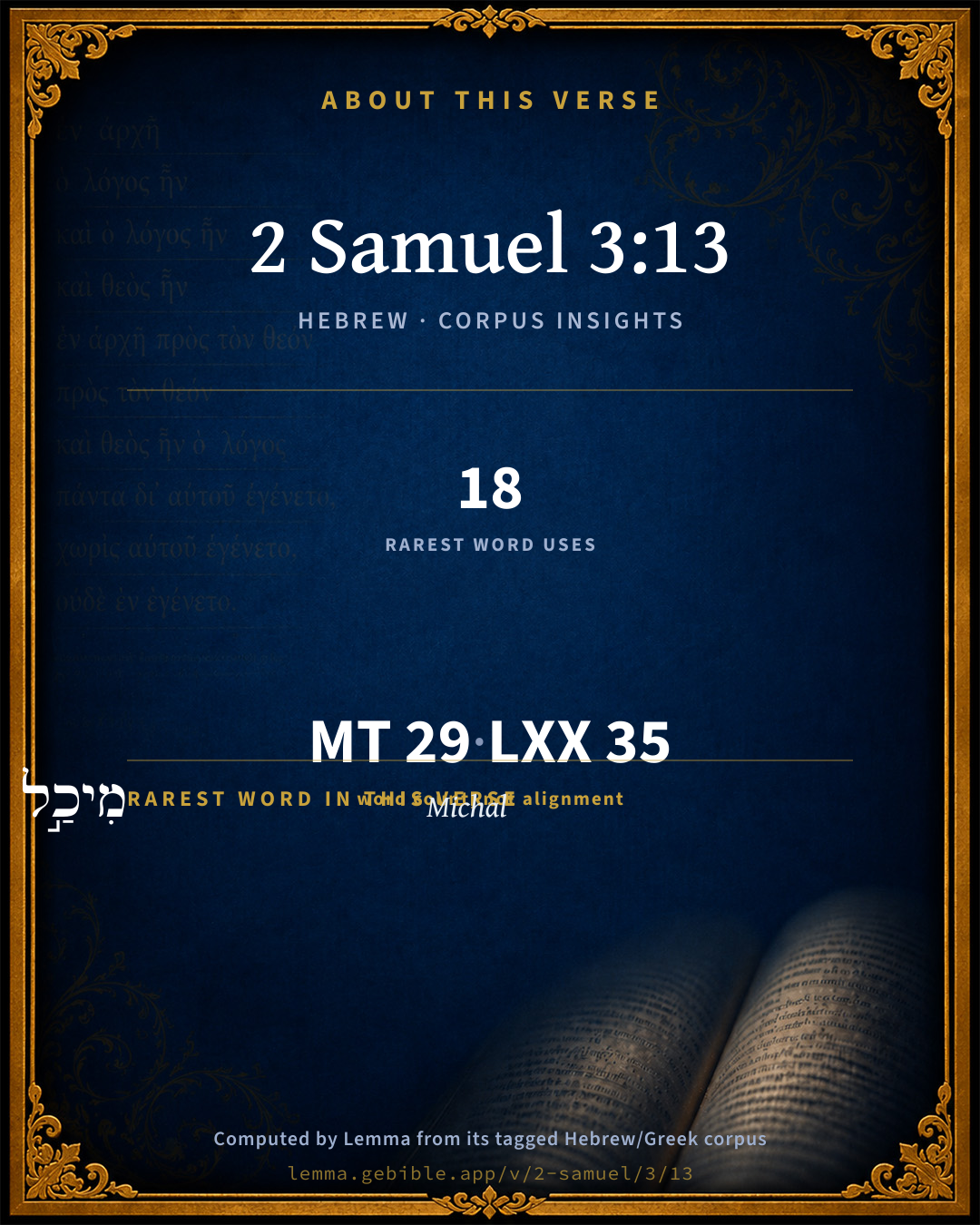
About this verse

These counts appear in no published source. They are computed here, from the morphology-tagged text and Lemma’s own curated glosses. What Lemma adds →

29
words
21
distinct lemmas
Historical
section

Notable vocabulary

The rarest word here is מִיכַ֣ל Michal H4324 — appearing just 18 times in the whole Hebrew Bible.

Shared distinctive vocabulary

מִיכַ֣ל Michal H4324 occurs in 17 verses of the Hebrew Bible. Also found in:

Grammatical profile

  • 8 verbs
  • 8 nouns
  • 2 adjectives
  • 2 pronouns
  • 2 prepositions
  • 2 conjunctions
  • 5 particles

Verb forms

  • וַיֹּ֣אמֶר Qal · Sequential Imperfect
  • אֶכְרֹ֥ת Qal · Imperfect
  • שֹׁאֵ֨ל Qal · Participle Active
  • לֵאמֹר֙ Qal · Infinitive Construct
  • תִרְאֶ֣ה Qal · Imperfect
  • הֱבִיאֲךָ֗ Hiphil · Perfect
  • בְּבֹאֲךָ֖ Qal · Infinitive Construct
  • לִרְא֥וֹת Qal · Infinitive Construct

Repetition

Words recur within this verse — often emphatic in Hebrew:

  • פָּנַ֔י face H6440 ×3
  • וַיֹּ֣אמֶר to say H559 ×2
  • תִרְאֶ֣ה to see H7200 ×2
  • הֱבִיאֲךָ֗ to enter H935 ×2
  • אִתְּךָ֖ with H854 ×2

Hebrew & Septuagint length

In English translation the verse runs 39 words from the Hebrew and 43 from the Septuagint (LXX English) — closely comparable.

A rough comparison of the two English renderings, which tokenize alike — not a word-level alignment.

Word counts can differ between the Hebrew and the Greek without any difference in meaning — e.g. the Hebrew direct-object marker אֵת has no separate Greek word, and Greek often adds the article ὁ.

In the original languages it is 29 Hebrew tokens and 35 Greek tokens — but the two are counted differently (Hebrew bundles its prefixes and suffixes into one token; the Greek is in lemma form), so that isn’t a like-for-like length.

Cross-references

7

Topical passages linked to 2 Samuel 3:13 in the Treasury of Scripture Knowledge — connected by theme and wording, ordered by reader-vote popularity; previews shown in the World English Bible.

  • Genesis 43:3 Judah spoke to him, saying, "The man solemnly warned us, saying, 'You shall not see my face, unless your brother is with you.'
  • Genesis 44:23 You said to your servants, 'Unless your youngest brother comes down with you, you will see my face no more.'
  • Genesis 44:26 We said, 'We can't go down. If our youngest brother is with us, then will we go down: for we may not see the man's face, unless our youngest brother is with us.'
  • 1 Samuel 18:20–28 Michal, Saul's daughter, loved David: and they told Saul, and the thing pleased him.
  • 1 Samuel 19:11–17 Saul sent messengers to David's house, to watch him, and to kill him in the morning: and Michal, David's wife, told him, saying, If you don't save your life tonight, tomorrow you will be slain.
  • 2 Samuel 3:20–23 So Abner came to David to Hebron, and twenty men with him. David made Abner and the men who were with him a feast.
  • 1 Chronicles 15:29 It happened, as the ark of the covenant of Yahweh came to the city of David, that Michal the daughter of Saul looked out at the window, and saw king David dancing and playing; and she despised him in her heart.

Cross-references courtesy of OpenBible.info (CC BY 4.0).

Hebrew and Greek witnesses Masoretic Hebrew ↔ Greek Septuagint

The same verse in the two great witnesses to the Old Testament, shown verse-for-verse.

These are two independent witnesses, not word-aligned to each other, and the Septuagint is shown in lemma (dictionary) form.

Hebrew 2 Samuel 3:13 Masoretic · Westminster Leningrad Codex

וַיֹּ֣אמֶר ט֔וֹב אֲנִ֕י אֶכְרֹ֥ת אִתְּךָ֖ בְּרִ֑ית אַ֣ךְ דָּבָ֣ר אֶחָ֡ד אָנֹכִי֩ שֹׁאֵ֨ל מֵאִתְּךָ֤ לֵאמֹר֙ לֹא תִרְאֶ֣ה אֶת פָּנַ֔י כִּ֣י אִם לִפְנֵ֣י הֱבִיאֲךָ֗ אֵ֚ת מִיכַ֣ל בַּת שָׁא֔וּל בְּבֹאֲךָ֖ לִרְא֥וֹת אֶת פָּנָֽי

He said, Well; I will make a league with you; but one thing I require of you: that is, you shall not see my face, except you first bring Michal, Saul's daughter, when you come to see my face.

World English Bible · Public Domain

Greek LXX 2 Samuel 3:13 Septuagint · lemma form

καί εἶπον δαυίδ ἐγώ καλῶς διατίθημι πρός σύ διαθήκη πλήν λόγος εἷς ἐγώ αἰτέω παρά σύ λέγω οὐ ὁράω ὁ πρόσωπον ἐγώ ἐάν μή ἄγω ὁ μελχολ θυγάτηρ σαούλ παραγίγνομαι σύ ὁράω ὁ πρόσωπον ἐγώ

And David said, With a good will I will make with you a covenant: only I demand one condition of you, saying, You shall not see my face, unless you bring Melchol the daughter of Saul, when you come to see my face.

LXX2012 (modern English Septuagint) · Public Domain

On this verse, The Cambridge Bible for Schools and Colleges discusses the Septuagint’s reading. Read the note in Commentary ↓

Hebrew: Westminster Leningrad Codex (CC BY 4.0). Greek: Septuagint (public domain); English from LXX2012 (modern English Septuagint) (Public Domain). How the Septuagint differs from the Hebrew →

Targum (Aramaic paraphrase)

1

The Targum is the ancient Jewish Aramaic paraphrase of the Hebrew Scriptures — an interpretive translation, not the Hebrew text itself. Onkelos (literal) and Pseudo-Jonathan (expansive) render the Torah, and Jonathan the Prophets. Coverage is partial: where no permissively-licensed English translation exists for a verse, only the Aramaic is shown. This is verse-level text, not a word-by-word alignment to the Hebrew.

  1. Targum Jonathan Prophets (Joshua–Malachi)
    וַאֲמַר טַב אֲנָא אֶגְזַר עִמָךְ קְיָם בְּרַם פִּתְגָמָא חָד אֲנָא שָׁאֵיל מֵעִמָךְ לְמֵימָר לָא תֶחֱזֵי יַת אַפֵּי אֱלָהֵין קֳדָם מֵתָיוּתָךְ יַת מִיכַל בַּת שָׁאוּל בְּמֵיתָךְ לְאִתְחֲזָאָה קֳדָמַי:

    (no public-domain English translation for this verse)

    Targum Jonathan — Aramaic: “Mikraot Gedolot” (public domain). English: “Sefaria Community Translation” (CC0 1.0 (public-domain dedication)); “London "Chaldee Paraphrase," 1871” (public domain). Text via Sefaria.

Commentary

Notes on 2 Samuel 3:13 from classic Christian and Jewish commentators (each source and its license shown beneath its notes). The classic Christian expositions comment on the surrounding passage and are grouped to its opening verse, so a note may address several verses; the Jewish commentaries on the Tanakh (Rashi and others) are per-verse, so they appear only where the commentator wrote on this verse.

Lemma curates 59 commentaries, every one of them public domain or Creative Commons licensed, each selected and text-cleaned for this edition rather than reprinted as found. About our sources →

Trapp's Complete Commentary

John Trapp

2Sa 3:13 And he said, Well; I will make a league with thee: but one thing I require of thee, that is, Thou shalt not see my face, except thou first bring Michal Saul’s daughter, when thou comest to see my face.

Ver. 13. Except thou first bring Michal.] David’s first love, and rightful wife; though wrongfully she had been detained from him, against her will haply, by the authority and importunity of her father. God seemeth to say the same to us concerning our hearts, so long held from him by the devil.

John Trapp, A Commentary or Exposition upon All the Books of the Old and New Testament (1647–1656) — public domain. Text from a community e-Sword module.

Joseph Benson's Commentary

2Sa 3:13. And he said, Well; I will make a league with thee — David agreed to enter into a treaty with him, but upon condition that he procured the restitution of Michal his wife. Hereby David both showed the sincerity of his conjugal affection to his first and most rightful wife, from whom neither her nor his marrying another had alienated it, and also testified his respect to the house of Saul. “David did right in making this stipulation; for, whatever may be said of his other wives, he had certainly a claim to this, as she was his first wife, and a king’s daughter. And there was something of true generosity in this, both to her and to Saul, in that he received her after she had been another man’s, remembering how once she loved him, and knowing, probably, that she was, without her consent, separated from him; and to show that he did not carry his resentment of Saul’s cruel and unjust persecutions of him to any of his family; whereas many princes, for much less provocation of a wife’s father, would have turned off their consorts, in revenge of them, and even put them to death for having been married to another.” — Chandler.

Joseph Benson's Commentary on the Old and New Testaments (1811–1818) — public domain. Text from a community e-Sword module.

Tyndale Open Study Notes

Tyndale Open Resources

3:13 Saul had given his daughter Michal to David as his wife (1 Sam 18:20-27). However, when Michal saved David’s life from her father (1 Sam 19:11-17), Saul terminated the marriage and gave Michal to another man, Palti (1 Sam 25:44). For David to get her back now would further cement his claim to Saul’s kingdom (cp. 1 Kgs 2:13-25).

Tyndale Open Study Notes — © Tyndale Open Resources, licensed CC BY-SA 4.0. Text via the HelloAO Bible API.

Adam Clarke's Commentary

Verse 13. Except thou first bring Michal] David had already six wives at Hebron; and none of them could have such pretensions to legitimacy as Michal, who had been taken away from him and married to Phaltiel. However distressing it was to take her from a husband who loved her most tenderly, (see 2Sa 3:16), yet prudence and policy required that he should strengthen his own interest in the kingdom as much as possible; and that he should not leave a princess in the possession of a man who might, in her right, have made pretensions to the throne. Besides, she was his own lawful wife, and he had a right to demand her when he pleased.

Adam Clarke's Commentary on the Bible (1810–1826) — public domain. Text from a community e-Sword/MySword module.

Ellicott's Commentary for English Readers

(13) Except thou first bring Michal.—David consents to negotiate with Abner only on condition of the previous restoration of his lawful wife. Besides the justice of this demand (Michal having been wrongfully taken from him by Saul), and besides all question of affection towards one who had loved him and saved his life (1Sa_18:20; 1Sa_19:11-17), there were political reasons of importance for the demand. The demand itself showed to all Israel that he bore no malice against the house of Saul, and the restoration would again constitute him Saul’s son-in-law, and thus further his claims to the throne; while it also showed publicly that he was in a condition to enforce his rights as against the house of Saul.

A Bible Commentary for English Readers, edited by Charles John Ellicott (1878–1897) — public domain. Text from a community e-Sword module.

The Cambridge Bible for Schools and Colleges

gen. ed. J. J. S. Perowne

13. except thou first bring] As the text stands it can only be rendered except on condition of thy bringing. But it looks like a combination of two readings, except thou bring (so the LXX.) and before thou bring (Vulg.).

David’s reasons for demanding the restoration of Michal were probably (a) genuine affection for the wife of his youth who had saved his life (1Sa_18:20; 1Sa_19:11 ff.); (b) a desire to efface the slight put upon him by the deprivation; (c) a wish to conciliate the good will of the northern tribes by an alliance with Saul’s family.

The Cambridge Bible for Schools and Colleges (gen. ed. J. J. S. Perowne; Cambridge University Press, 1878–1918) — public domain. Text from a community e-Sword module.

John Gill's Exposition

And he said, well, I will make a league with thee,.... He accepted of the offer, he was ready and willing to enter into a covenant of friendship with him, and forgive all past offences:

but one thing I require of thee; as the condition of this covenant:

that is, thou shall not see my face; be admitted into my presence, or have any mark of my favour and respect:

except thou first bring Michal, Saul's daughter, when thou comest to see my face; he insisted on it that Michal, Saul's daughter, and his wife, should be brought along with him, and presented to him; this was the preliminary to the league and covenant; if this was not complied with, the proposal would not be attended to. This shows the great affection David retained for his first wife, though he had had six since, see Sa2 3:2, and though she had lived with another man, Sa1 25:44; as also his great regard to the honour of Saul's family, that one of them might share with him in the grandeur of the kingdom; though this also might be a piece of policy in him, to gain the friends of Saul's family to him.

John Gill's Exposition of the Whole Bible (1746–1763) — public domain (CC PDM 1.0). Text via the HelloAO Bible API.

Albert Barnes' Notes on the Bible

David’s motive in requiring the restitution of Michal was partly his affection for her, and his memory of her love for him; partly the wish to wipe out the affront put upon him in taking away his wife, by obtaining her return; and partly, also, a politic consideration of the effect on Saul’s partisans of a daughter of Saul being David’s queen.

Albert Barnes' Notes on the Bible (1834–1885) — public domain. Text from a community e-Sword/MySword module.

Haydock's Catholic Bible Commentary

Thee. Could David thus authorize treachery? It is answered, that Abner knew that the throne belonged to him, and he was already responsible for all the evils of the civil war. David does not approve of his conduct, but only makes use of him to obtain his right. --- Michol. He might justly think that the people would have less repugnance to acknowledge him for their sovereign, when they saw that he had married the daughter of Saul. she had never been repudiated by him. (Calmet)

George Leo Haydock (1774–1849), Haydock's Catholic Family Bible and Commentary, 1859 edition — public domain. Excludes Psalms (Douay-Rheims chapter numbering differs from Protestant) and Deuterocanonical books (Catholic canon only).

Matthew Poole's English Annotations

I will make a league with thee, to wit, upon thy terms; which, all circumstances considered, seems to be lawful, to prevent the great effusion of Israelitish blood, which otherwise would certainly have been split. And although the principle of this action of Abner’s was base and wicked, yet the action itself was lawful and commendable, and no more than his duty to God and David obliged him to; and therefore David might well persuade and induce him to it.

Matthew Poole's English Annotations on the Holy Bible (1683–1685) — public domain. Text from a community e-Sword/MySword module.

Whedon's Commentary on the Bible

Daniel D. Whedon

13. First bring Michal — She was his own proper wife, and he had a right to demand her. With her restored to him he would stand before the nation as the son in law of Saul. “No doubt it was of great importance to David, on every account, to maintain this matrimonial connexion with the house of Saul as long as possible, in order to preserve the sort of claim to the succession which his alliance gave him; but an additional motive, which urged him to demand her restoration, was the prudential desire of possessing in her a pledge against possible treachery on Abner’s side.” — Ewald.

Daniel D. Whedon (gen. ed.), Commentary on the Old and New Testaments (1874–1909) — public domain. Text from a community e-Sword module.

The Pulpit Commentary

Except thou first bring Michal. Besides David"s affection for Michal, there were political reasons for demanding her restoration. Saul"s despotic act in giving her in marriage to another man (1Sa_25:44) had been a public disavowal of David as the son-in-law of the royal house, and equivalent to a proclamation of outlawry. David"s rights were all declared null by such an act. But now Ishbosheth must with equal publicity reverse his father"s deed, and restore to David his lost position. It must have been a most painful humiliation to him to be driven thus to cancel his father"s decree, and declare thereby to all Israel that he was unable to refuse hie assent to whatever his rival demanded. And for this reason David sent his messengers directly to Ishbosheth, because the importance of Michal"s surrender to him lay in its being a public act of the state. For Michal, in. (2Sa_21:8, we ought to read Merab (see note there)

The Pulpit Commentary (1880–1919), ed. H.D.M. Spence-Jones & Joseph S. Exell — public domain. Text from a community e-Sword module.

Rashi

Rabbi Shlomo Yitzchaki (Rashi)

You first bring. Before you see my face, bring me Michal.

Rashi on the Tanakh — English translations: “The Judaica Press complete Tanach with Rashi, translated by A. J. Rosenberg” (CC BY 4.0); “Pentateuch with Rashi's commentary by M. Rosenbaum and A.M. Silbermann, 1929-1934” (public domain); “The Metsudah Tanach series, Lakewood, N.J” (CC BY 4.0); and “The Book of Joshua, Metsudah Publications, 1997” (CC BY 4.0). Text via Sefaria.

Lesson kit

Teaching starters — assembled from the data on this page, not authored interpretation. Every prompt links to the verse data it draws on. Edit before teaching.

2 Samuel, in the Historical, opens this verse with 29 words (21 distinct Hebrew lemmas). Its most distinctive word is Mîykâl (“Michal”). A historical commentator’s framing appears above. Read the whole chapter for the surrounding context.

Discussion questions

  1. The word Mîykâl carries the sense “Michal.” How does it shape the verse?
  2. 1 Samuel 14:49 shares the word «Michal» with this verse. How do the two illuminate each other?
  3. “face” occurs 3× in this one verse. What is the effect of the repetition?
  4. These translations render this verse differently; the difference is in the English rendering, not the original. What questions does that raise?
  5. The verb «וַיֹּ֣אמֶר» is Qal Sequential Imperfect. How does its form color the action?
  6. Reading how Trapp's Complete Commentary and Joseph Benson's Commentary read this verse, where do the two commentators agree and where do they part?

Things to notice

Reading settings

Reading text

Shown beneath each verse's original-language words.

Old Testament
Old Testament edition

Read the OT as the Masoretic Hebrew (MT) or the Greek Septuagint (LXX).

English shown for the Greek Septuagint (in the Hebrew ↔ Greek comparison).

Comparing translations? Open the Compare panel on any verse page to stack up to four side by side.