Genesis 45:4

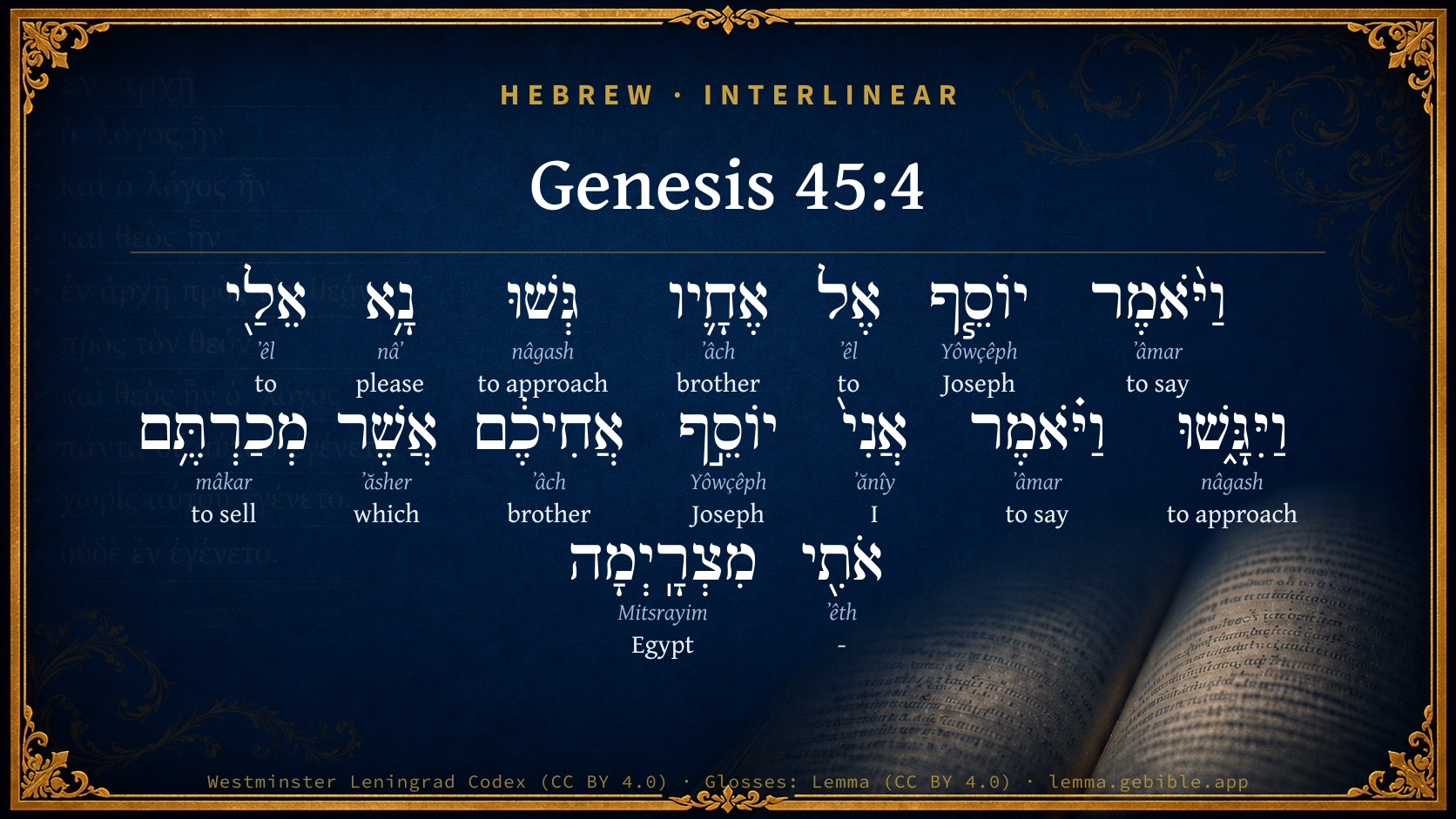
Hebrew (Westminster Leningrad Codex) Genesis 45:4 appears in the Hebrew Old Testament. The text above is from the Westminster Leningrad Codex. Each word links to its Strong’s number, a concise gloss, and parsing drawn from the Open Scriptures Hebrew Bible morphology. Click any word for its full Brown-Driver-Briggs (BDB) entry.
Download image
Cite this verse

Genesis 45:4 (World English Bible). Public Domain. Lemma interlinear Bible study tool, https://lemma.gebible.app/v/genesis/45/4.

Show BibTeX & RIS
BibTeX
RIS
English Translation
Joseph said to his brothers, "Come near to me, please." They came near. "He said, I am Joseph, your brother, whom you sold into Egypt.
World English Bible · Public Domain
Download a study sheet

One document with this verse’s original text, its word-by-word gloss line, the meaning frame, cross-references with their text, attributed commentary, and full source and license credits — printable, and it pastes into notes with its structure intact.

This verse Autodidact and up

Study sheet (.html) Plain text (.txt)

A passage Seminary Student

Up to 50 verses in one chapter. A passage sheet keeps up to 6 commentary sources and 12 cross-references per verse, in the order this page ranks them, and says so on the sheet whenever that leaves anything out. Ask for a single verse and you get the Autodidact verse sheet above.

Everything on this page stays free to read, with no account — the sheet is a download of what is already on screen, not access to it.

Want to remove ads? Support Godless Engineer
Compare translations 3

The same verse in 3 English versions, stacked beneath the original-language interlinear above. Click any original word for its lexicon entry.

Each is an independent rendering of the whole verse — the interlinear is not word-aligned to these translations.

Highlighted words mark where these versions differ — a whole-verse word diff, not a word-by-word alignment.

  • World English Bible Public Domain
    Joseph said to his brothers, "Come near to me, please." They came near. "He said, I am Joseph, your brother, whom you sold into Egypt.
  • King James Version Public Domain
    And Joseph said unto his brethren, Come near to me, I pray you. And they came near. And he said, I am Joseph your brother, whom ye sold into Egypt.
  • unfoldingWord Literal Text CC BY-SA 4.0
    Then Joseph said to his brothers, “Please come close to me.” So they came close, and he said, “I Joseph your brother, whom you sold into Egypt.

unfoldingWord Literal Text — © unfoldingWord, licensed CC BY-SA 4.0. Word-aligned USFM3 via Door43 (git.door43.org/unfoldingWord/en_ult).

Versions to compare (up to 4)

3 of 4 selected

Show all 18 translations

Every available English version of this verse, each an independent rendering of the whole verse.

  • World English Bible Public Domain
    Joseph said to his brothers, "Come near to me, please." They came near. "He said, I am Joseph, your brother, whom you sold into Egypt.
  • Berean Standard Bible Public Domain
    Then Joseph said to his brothers, “Please come near me.” And they did so. “I am Joseph, your brother,” he said, “the one you sold into Egypt!
  • Majority Standard Bible Public Domain
    Then Joseph said to his brothers, “Please come near me.” And they did so. “I am Joseph, your brother,” he said, “the one you sold into Egypt!
  • King James Version Public Domain
    And Joseph said unto his brethren, Come near to me, I pray you. And they came near. And he said, I am Joseph your brother, whom ye sold into Egypt.
  • American Standard Version (1901) Public Domain
    And Joseph said unto his brethren, Come near to me, I pray you. And they came near. And he said, I am Joseph your brother, whom ye sold into Egypt.
  • Revised Version (1885) Public Domain
    And Joseph said unto his brethren, Come near to me, I pray you. And they came near. And he said, I am Joseph your brother, whom ye sold into Egypt.
  • Geneva Bible (1599) Public Domain
    Againe, Ioseph sayde to his brethren, Come neere, I pray you, to mee. And they came neere. And he sayde, I am Ioseph your brother, whom ye sold into Egypt.
  • Douay-Rheims (1899) Public Domain
    And he said mildly to them: Come nearer to me. And when they were come near him, he said: I am Joseph, your brother, whom you sold into Egypt.
  • Young's Literal Translation Public Domain
    And Joseph saith unto his brethren, `Come nigh unto me, I pray you,' and they come nigh; and he saith, `I `am' Joseph, your brother, whom ye sold into Egypt;
  • Literal Standard Version CC BY-SA 4.0
    And Joseph says to his brothers, “Please come near to me,” and they come near; and he says, “I [am] your brother Joseph, whom you sold into Egypt;
  • Unlocked Literal Bible CC BY-SA 4.0
    Then Joseph said to his brothers, “Come near to me, please.” They came near. He said, “I am Joseph your brother, whom you sold into Egypt.
  • unfoldingWord Literal Text CC BY-SA 4.0
    Then Joseph said to his brothers, “Please come close to me.” So they came close, and he said, “I Joseph your brother, whom you sold into Egypt.
  • Darby Bible Public Domain
    And Joseph said to his brethren, Come near to me, I pray you. And they came near. And he said, I am Joseph your brother, whom ye sold into Egypt.
  • World Messianic Bible Public Domain
    Joseph said to his brothers, “Come near to me, please.” They came near. He said, “I am Joseph, your brother, whom you sold into Egypt.
  • Webster's Bible Public Domain
    And Joseph said to his brethren, Come near to me, I pray you: and they came near. And he said, I am Joseph your brother, whom ye sold into Egypt.
  • Free Bible Version CC BY-SA 4.0
    “Please come closer to me,” he told his brothers. They came over to him. “I'm your brother Joseph who you sold into slavery in Egypt.
  • Bible in Basic English Public Domain
    Then Joseph said to his brothers, Come near to me. And they came near, And he said, I am Joseph your brother, whom you sent into Egypt.
  • JPS Tanakh (1917) Public Domain
    And Joseph said unto his brethren: 'Come near to me, I pray you.' And they came near. And he said: 'I am Joseph your brother, whom ye sold into Egypt.

Literal Standard Version (2020), Covenant Press — licensed CC BY-SA 4.0. Text via the HelloAO Bible API (eBible.org). Unlocked Literal Bible (unfoldingWord) — licensed CC BY-SA 4.0. Text via the HelloAO Bible API (eBible.org). unfoldingWord Literal Text — © unfoldingWord, licensed CC BY-SA 4.0. Word-aligned USFM3 via Door43 (git.door43.org/unfoldingWord/en_ult). Free Bible Version, Dr. Jonathan Gallagher — licensed CC BY-SA 4.0. Text via the HelloAO Bible API (eBible.org).

Word by word

More ways to search: Search by grammar → Find every occurrence → Compare this word →

Practice this passage: Drill this verse → Learn its vocabulary →

מְכַרְתֶּ֥ם
mâkar
H4376
“to sell”
Verb, Qal, Perfect, 2nd Person, Masculine, Plural
Part of Speech
Verb
Stem
Qal
Form
Perfect
Person
2nd Person
Gender
Masculine
Number
Plural
Full BDB Definition

Origin: a primitive root

TWOT: 1194

to sell - (Qal) - to sell - seller (participle) - (Niphal) - to be sold - to sell oneself - to be given over to death - (Hithpael) to sell oneself
  1. וַיֹּ֨אמֶר ʼâmar H559 “and · to say” Conjunction + Verb, Qal, Sequential Imperfect, 3rd Person, Masculine, Singular
  2. יוֹסֵ֧ף Yôwçêph H3130 “Joseph” Noun, Proper
  3. אֶל ʼêl H413 “to” Preposition
  4. אֶחָ֛יו ʼâch H251 “brothers · his” Noun, Common, Masculine, Plural, Construct + Suffix, Personal, 3rd Person, Masculine, Singular
  5. גְּשׁוּ nâgash H5066 “approach” Verb, Qal, Imperative, 2nd Person, Masculine, Plural
  6. נָ֥א nâʼ H4994 “please” Particle, Exhortation
  7. אֵלַ֖י ʼêl H413 “to · me” Preposition + Suffix, Personal, 1st Person, Common, Singular
  8. וַיִּגָּ֑שׁוּ nâgash H5066 “and · to approach” Conjunction + Verb, Qal, Sequential Imperfect, 3rd Person, Masculine, Plural
  9. וַיֹּ֗אמֶר ʼâmar H559 “and · to say” Conjunction + Verb, Qal, Sequential Imperfect, 3rd Person, Masculine, Singular
  10. אֲנִי֙ ʼănîy H589 “I” Pronoun, Personal, 1st Person, Common, Singular
  11. יוֹסֵ֣ף Yôwçêph H3130 “Joseph” Noun, Proper
  12. אֲחִיכֶ֔ם ʼâch H251 “brother · your” Noun, Common, Masculine, Singular, Construct + Suffix, Personal, 2nd Person, Masculine, Plural
  13. אֲשֶׁר ʼăsher H834 “which” Particle, Relative
  14. אֹתִ֖י ʼêth H853 “- · me” Particle, Direct Object + Suffix, Personal, 1st Person, Common, Singular
  15. מִצְרָֽיְמָה Mitsrayim H4714 “Egypt · toward” Noun, Proper + Suffix, Demonstrative

About this verse

These counts appear in no published source. They are computed here, from the morphology-tagged text and Lemma’s own curated glosses. What Lemma adds →

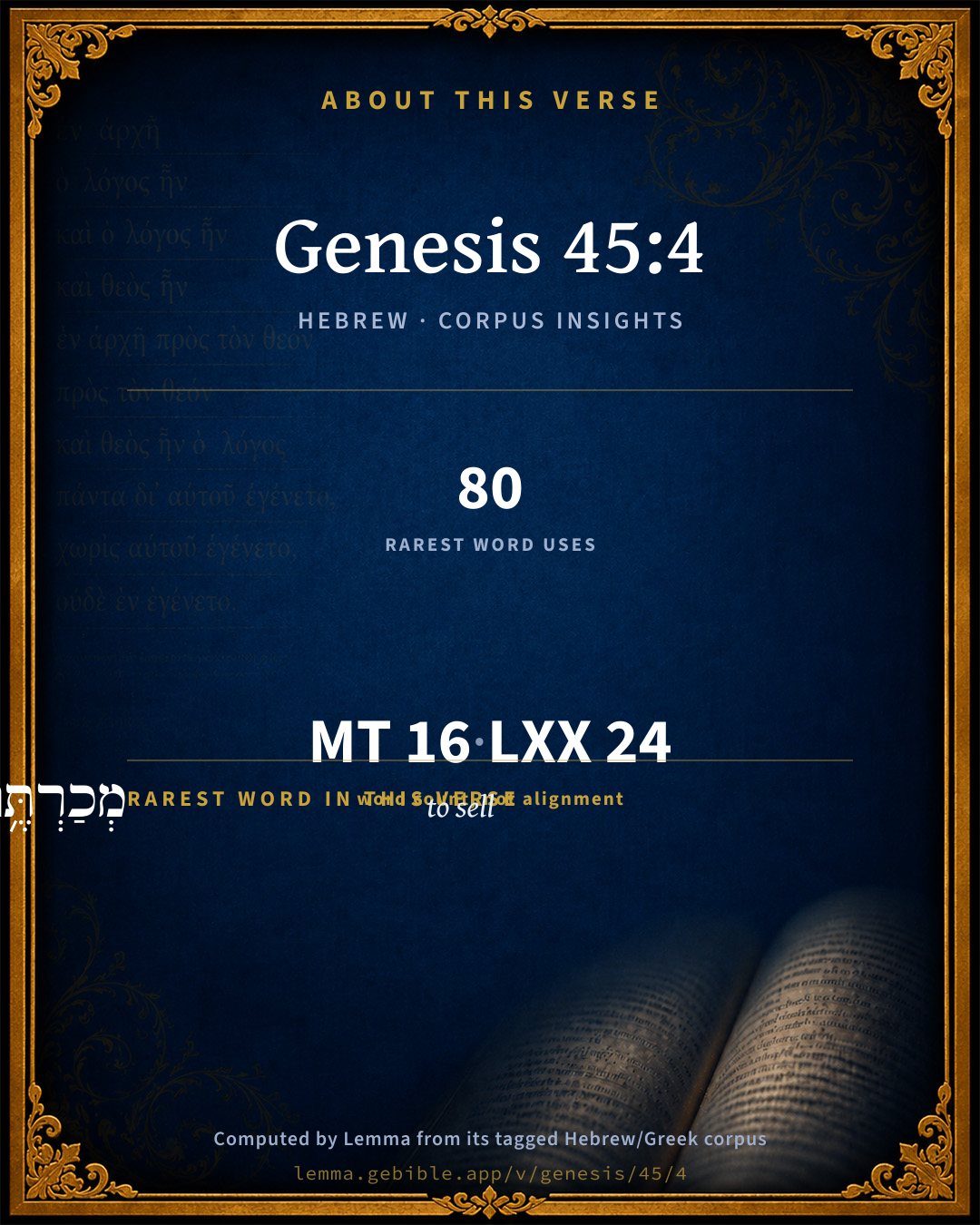
16
words
11
distinct lemmas
Pentateuch
section

Grammatical profile

  • 5 verbs
  • 5 nouns
  • 1 pronoun
  • 2 prepositions
  • 3 particles

Verb forms

  • וַיֹּ֨אמֶר Qal · Sequential Imperfect
  • גְּשׁוּ Qal · Imperative
  • וַיִּגָּ֑שׁוּ Qal · Sequential Imperfect
  • וַיֹּ֗אמֶר Qal · Sequential Imperfect
  • מְכַרְתֶּ֥ם Qal · Perfect

Repetition

Words recur within this verse — often emphatic in Hebrew:

  • וַיֹּ֨אמֶר to say H559 ×2
  • יוֹסֵ֧ף Joseph H3130 ×2
  • אֶחָ֛יו brother H251 ×2
  • גְּשׁוּ to approach H5066 ×2
  • אֶל to H413 ×2

Hebrew & Septuagint length

In English translation the verse runs 25 words from the Hebrew and 27 from the Septuagint (LXX English) — closely comparable.

A rough comparison of the two English renderings, which tokenize alike — not a word-level alignment.

Word counts can differ between the Hebrew and the Greek without any difference in meaning — e.g. the Hebrew direct-object marker אֵת has no separate Greek word, and Greek often adds the article ὁ.

In the original languages it is 16 Hebrew tokens and 24 Greek tokens — but the two are counted differently (Hebrew bundles its prefixes and suffixes into one token; the Greek is in lemma form), so that isn’t a like-for-like length.

Cross-references

4

Topical passages linked to Genesis 45:4 in the Treasury of Scripture Knowledge — connected by theme and wording, ordered by reader-vote popularity; previews shown in the World English Bible.

  • Genesis 37:28 Midianites who were merchants passed by, and they drew and lifted up Joseph out of the pit, and sold Joseph to the Ishmaelites for twenty pieces of silver. They brought Joseph into Egypt.
  • Genesis 50:18 His brothers also went and fell down before his face; and they said, "Behold, we are your servants."
  • Matthew 14:27 But immediately Jesus spoke to them, saying "Cheer up! I AM! Don't be afraid."
  • Acts 9:5 He said, "Who are you, Lord?" The Lord said, "I am Jesus, whom you are persecuting.

Cross-references courtesy of OpenBible.info (CC BY 4.0).

Hebrew and Greek witnesses Masoretic Hebrew ↔ Greek Septuagint

The same verse in the two great witnesses to the Old Testament, shown verse-for-verse.

These are two independent witnesses, not word-aligned to each other, and the Septuagint is shown in lemma (dictionary) form.

Hebrew Genesis 45:4 Masoretic · Westminster Leningrad Codex

וַיֹּ֨אמֶר יוֹסֵ֧ף אֶל אֶחָ֛יו גְּשׁוּ נָ֥א אֵלַ֖י וַיִּגָּ֑שׁוּ וַיֹּ֗אמֶר אֲנִי֙ יוֹסֵ֣ף אֲחִיכֶ֔ם אֲשֶׁר מְכַרְתֶּ֥ם אֹתִ֖י מִצְרָֽיְמָה

Joseph said to his brothers, "Come near to me, please." They came near. "He said, I am Joseph, your brother, whom you sold into Egypt.

World English Bible · Public Domain

Greek LXX Genesis 45:4 Septuagint · lemma form

εἶπον δέ ιωσηφ πρός ὁ ἀδελφός αὐτός ἐγγίζω πρός ἐγώ καί ἐγγίζω καί εἶπον ἐγώ εἰμί ιωσηφ ὁ ἀδελφός σύ ὅς ἀποδίδωμι εἰς αἴγυπτος

And Joseph said to his brethren, Draw near to me; and they drew near; and he said, I am your brother Joseph, whom you⌃ sold into Egypt.

LXX2012 (modern English Septuagint) · Public Domain

On this verse, The Pulpit Commentary discusses the Septuagint’s reading. Read the note in Commentary ↓

Hebrew: Westminster Leningrad Codex (CC BY 4.0). Greek: Septuagint (public domain); English from LXX2012 (modern English Septuagint) (Public Domain). How the Septuagint differs from the Hebrew →

Targum (Aramaic paraphrase)

2

The Targum is the ancient Jewish Aramaic paraphrase of the Hebrew Scriptures — an interpretive translation, not the Hebrew text itself. Onkelos (literal) and Pseudo-Jonathan (expansive) render the Torah, and Jonathan the Prophets. Coverage is partial: where no permissively-licensed English translation exists for a verse, only the Aramaic is shown. This is verse-level text, not a word-by-word alignment to the Hebrew.

  1. Targum Onkelos Torah (Genesis–Deuteronomy)
    וַאֲמַר יוֹסֵף לַאֲחוֹהִי קְרִיבוּ כְעַן לְוָתִי וּקְרִיבוּ וַאֲמַר אֲנָא יוֹסֵף אֲחוּכוֹן דִּי זַבִּנְתּוּן יָתִי לְמִצְרָיִם

    (no public-domain English translation for this verse)

    Targum Onkelos — Aramaic: “Onkelos Genesis” (public domain); “Onkelos Exodus” (public domain); “Onkelos Leviticus” (public domain); “Onkelos Numbers” (public domain); “Onkelos Deuteronomy” (public domain). English: “Sefaria Community Translation” (CC0 1.0 (public-domain dedication)); “J.W. Etheridge. The Targums of Onkelos and Jonathan Ben Uzziel on the Pentateuch. London: Longmans, Green, 1862” (public domain). Text via Sefaria.

  2. Targum Pseudo-Jonathan Torah (Genesis–Deuteronomy)
    וַאֲמַר יוֹסֵף לְאָחוֹי קְרִיבוּ בְּבָעוּ לְוָתִי וְחָמוּן גְזֵירַת מְהוּלְתִּי וּקְרִיבוּ וַאֲמַר אֲנָא יוֹסֵף אֲחוּכוֹן דִי זַבִּינְתּוּן יָתִי לְמִצְרָיִם

    And Joseph said to his brothers, Come near, I pray, and examine me. And they came near. And he said to them, I am Joseph your brother, whom you sold into Mizraim.

    Targum Pseudo-Jonathan — Aramaic: “Targum Jonathan on Genesis” (public domain); “Targum Jonathan on Exodus” (public domain); “Targum Jonathan on Leviticus” (public domain); “Targum Jonathan on Numbers” (public domain); “Targum Jonathan on Deuteronomy” (public domain). English: “The Targum of Jonathan ben Uzziel, trans. J. W. Etheridge, London, 1862” (public domain). Text via Sefaria.

Commentary

Notes on Genesis 45:4 from classic Christian and Jewish commentators (each source and its license shown beneath its notes). The classic Christian expositions comment on the surrounding passage and are grouped to its opening verse, so a note may address several verses; the Jewish commentaries on the Tanakh (Rashi and others) are per-verse, so they appear only where the commentator wrote on this verse.

Lemma curates 59 commentaries, every one of them public domain or Creative Commons licensed, each selected and text-cleaned for this edition rather than reprinted as found. About our sources →

Trapp's Complete Commentary

John Trapp

Gen 45:4 And Joseph said unto his brethren, Come near to me, I pray you. And they came near. And he said, I [am] Joseph your brother, whom ye sold into Egypt.

Ver. 4. I am Joseph your brother.] Therefore you are to expect no hard sentence from a brother’s mouth. Christ "is not ashamed," nor will be at the last day, "to call us brethren," He that was willingly judged for me, said that good woman, {a} will surely give no hard sentence against me. We may say boldly to him, as Ruth did to Boaz, "Spread thy skirt over me, for thou art a near kinsman" {Rth 3:9}

{a} Pattern of Piety.

John Trapp, A Commentary or Exposition upon All the Books of the Old and New Testament (1647–1656) — public domain. Text from a community e-Sword module.

The Biblical Illustrator

Joseph S. Exell

Gen_45:4

Joseph said unto his brethren, Come near to me, I pray you

Separation ending in union

It was by a strange and seemingly circuitous route that these brethren of Joseph were brought near to him.

Between Joseph and his brethren there was an immeasurable distance--all the difference between a nature given over to God and one abandoned to the force of evil passion. We may see in this narrative a type of the ways and means God still employs for bringing the wandering brothers of Josephs great Antitype near to Him.

I. In order that the brothers may be really drawn near to Joseph, they have first to be separated from him by their own sin.

II. The next step towards bringing them near is their own want.

III. When they get into Josephs presence they are suddenly subjected to the most unlooked-for and crushing trials.

IV. They are smitten to the heart with the recollection of bygone sins; these are brought to their remembrance as sins against their brother.

V. They were alone with Joseph when he made himself known to them. (W. HayAitken, M. A.)

Josephs treatment of his brethren

I. THERE IS AN ILLUSTRATION HERE OFFERED ON THE RETRIBUTIVE POWER OF AN AWAKENED CONSCIENCE.

II. NOTICE, ALSO, THE ILLUSTRATION OFFERED OF THE SEEKING LOVE OF GOD. It is Joseph who makes all the advances here. I pray you: it is the monarch who invites, the judge who pleads. Without all contradiction the less is blessed of the better. It was always so. Adam had hardly eaten of the forbidden fruit before the voice of the Lord was heard in the garden asking for him. Our Maker takes no pleasure in the death of the wicked, but would rather that the wicked should turn unto Him and live.

III. HERE, TOO, IS AN ILLUSTRATION OF THE EXACT DESIGN OF THE GOSPEL. Men need many things: as those brethren needed food then, for themselves, their families, and their beasts. But Joseph knew that temporary relief would amount to little. What they most wanted for all the long future was simply himself in reconciliation. Come near to me is exactly what Jesus Christ has always been saying to such as labour and are heavy laden.

IV. So COMPLETE IS OUR ILLUSTRATION IN THIS STORY, THAT IT LIKEWISE EXHIBITS THE NEED OF LAW-WORK IN REDEMPTION. Much as he yearned over them, he would not even for an instant relieve them of the salutary consciousness of so grievous a sin. Hence his earliest words were: I am Joseph, your brother, whom ye sold into Egypt. No doubt he meant to bring these men into greatest perplexity, and fill them with consternation. The first revelation of the Gospel is very much like a reiteration of the law. In some respects the rays from Calvary resemble those from Sinai; just as in some respects sunshine resembles lightning; but sunshine never strikes, and lightning often clears out a poison of impurity and so makes sunshine more welcome.

V. MARK THE EXCELLENT ILLUSTRATION WE HAVE HERE OF THE REVELATION OF DIVINE GRACE. When those brothers in that awful interview stood suppliant and frightened at the feet of the ruler, there was pictured something very like the literal fulfilment of a dream they must have remembered, when Joseph told them of the eleven wheat-sheaves he had seen bowing before the one upright. I am your brother: this one disclosure covered the whole ground. Sold--but a brother; a monarch--but a brother; a judge--but a brother! I am Joseph: here he probably began to talk in their own language; they heard the familiar accents of their home-speech. Benjamin recognizes his own mothers son.

VI. THERE IS AN ILLUSTRATION IN THIS STORY OF THE COMPLETENESS OF PARDON, AND RELIEF FROM PAIN. Watch how solicitous Joseph is lest his brothers should be grieved or angry with themselves any longer over that old, acknowledged, but not forgotten sin. When our Saviour perceives that true repentance is already in the heart of a sinner; when He knows that he understands his whole responsibility for his sins; then He is prepared to administer for his comfort some of the sweet assurances he has of Gods wisdom in causing even mans wrath to praise Him. Christ seems to say then: I am the Lord of glory, whom ye with wicked hands have crucified and slain; but God has over-ruled even this crime to His own glory and your redemption; be not grieved with yourself therefore, over-much, for Divine foreknowledge sent Me before you to preserve life.

VII. SEE HERE WHAT AN ILLUSTRATION WE HAVE OF THE SINFULNESS AND FOLLY OF REJECTING THE GOSPEL. Of course, there is nothing in the story which suggests the thought; but there is room for imagination just to make the conjecture: how would it seem? Suppose Simeon, just out of prison, had turned his back upon Josephs offer! Suppose Benjamin, just delivered from accusation, had refused to have Josephs arms around his neck! Suppose Judah, his eyes still moist with pleading, had rejected Josephs kiss! And some have resisted the loving pleading and gracious tenderness of the Son of God who gave His life a ransom for us. (Charles S. Robinson, D. D.)

Joseph and his brethren

I. We think that the condition and posture of Judah and his brethren at the feet of the throne of Joseph, trembling in alarm, well describe THE CONDITION AND POSITION OF EVERY TRULY AWAKENED SINNER.

1. By different methods Joseph had at last awakened the consciences of his ten brethren. The point which seemed to have been brought out most prominently before their consciences was this: We are verily guilty concerning our brother, in that we saw the anguish of his soul, when he besought us, and we would not hear; therefore is this distress come upon us. And though, in the speech which Judah made, it was not necessary to accuse themselves of crime, yet in the confession, God hath found out the iniquity of thy servants, Joseph could see evidently enough that the recollection of the pit and of the sale to the Ishmaelites was vividly before their minds eye. Now, when the Lord the Holy Ghost arouses sinners consciences, this is the great sin which he brings to mind: Of sin because they believed not on Me. Once the careless soul thought it had very little to answer for: I have not done much amiss, said he; a speedy reformation may wipe out all that has been awry, and my faults will soon be forgotten and forgiven; but now, on a sudden, the conscience perceives that the soul is guilty of despising, rejecting, and slaughtering Christ.

2. A second thought, however, which tended to make Josephs brethren feel in a wretched plight was this: that they now discovered that they were in Josephs hands. There stood Joseph, second to none but Pharaoh in all the empire of Egypt. Legions of warriors were at his beck and command; if he should say, take these men, bind them hand and foot, or cut them in pieces, none could interpose; he was to them as a lion, and they were as his prey, which he could rend to pieces at his will. Now to the awakened sinner, this also is a part of his misery: that he is entirely in the hands of that very Christ whom he once despised; for that Christ who died has now become the judge of the quick and dead, He has power over all flesh, that He may give eternal life to as many as His Father has given Him. The Father judgeth no man, He has committed all judgment to the Son. Dost thou see this, sinner, He whom thou despised is thy Master?

3. Under a sense of all these things--note what the ten brethren did. They began to plead. Ah! nothing makes a man pray like a sense of sin.

II. We turn, however, now to remark, that THE SINGULARLY ROUGH BEHAVIOUR OF JOSEPH IS A NOTABLE REPRESENTATION OF THE WAY IN WHICH CHRIST DEALS WITH SOULS UNDER CONVICTION OF SIN. Joseph always was their brother, always loved them, had a heart full of compassion to them even when he called them spies. Kind words were often hastening to his lips, yet for their good he showed himself to be as a stranger and even as an enemy, so that he might bring them very low and prostrate before the throne. Jesus Christ often does this with truly awakened souls whom He means to save. Perhaps to some of you who are to-day conscious of guilt but not of mercy, Christ seems as a stern and angry Judge; you think of Him as one who can by no means spare the guilty; your only idea of Him is of one who would say to you, Get thee behind Me, Satan, thou savourest not the things that be of God. You went to Him in prayer; but instead of getting an answer He seemed to shut up your prayer in prison and keep it like Simeon bound before your eyes. Yea, instead of telling you that there was mercy, He said to you as with a harsh voice, It is not meet to take the childrens bread and cast it unto dogs. He appeared to shut his ear to your petitions and to hear none of your requests, and to say to you, Except ye renounce a right eye sin and a right arm pleasure, and give up your Benjamin delights, ye shall see My face no more, and you have come to think, poor soul, that Christ is hard and stern, and whereas He is ever the gentle Mediator receiving sinners and eating with them, whereas His usual voice is Come unto Me all ye that labour and are heavy laden and I will give you rest, to you He seemeth no such person, for He has put on a disguise, and ye understand not who and what He is. But you will perceive, brethren, in reading the narrative, that even when Joseph disguised himself there was still much kindness discoverable in his conduct; so to the awakened sinner, even while Jesus appears to deal hardly, there is something sweet and encouraging amid it all. Do you not remember what Joseph did for his brethren? Though he was their judge he was their host too; he invited them to a great feast; he gave to Benjamin five times as much as to any of them; and they feasted even at the kings table, So has it been with you. Christ has rebuked and chastened you, but still He has sent you messes from his royal table. Ay, and there is another thing He has done for you, He has given you corn to live upon while under bondage. You would have despaired utterly if it had not been for some little comfort that He afforded you; perhaps you would have put an end to your life--you might bare gone desperately into worse sin than before, had it not been that He filled your sack at seasons with the corn of Egypt. But mark, He has never taken any of your money yet, and He never will. He has always put your money in the sacks mouth. You have come with your resolutions and with your good deeds, but when He has given you comfort He has always taken care to show you that He did not confer it because of any good thing you had in your hands. When you went down and brought double money with you, yet the double money too was returned. He would have nothing of you; He has taught you as much as that, and you begin to feel now that if He should bless you, it must be without money and without price. Ay, poor soul, and there is one other point upon which thine eye may rest with pleasure; He has sometimes spoken to thee comfortably. Did not Joseph say to Benjamin, God be gracious unto thee, my son? And so, sometimes, under a consoling sermon, though as yet you are not saved, you have had a few drops of comfort. Oh! ye have gone sometimes out of the house of prayer as light as the birds of the air, and though you could not say He is mine and I am His, yet you had a sort of inkling that the match would come off one day. He had said--God be gracious to thee, my son. You half thought, though you could not speak it loud enough to let your heart distinctly hear it, you half thought that the day would come when your sins would be forgiven; when the prisoner should leap to lose his chains; when you should know Joseph your brother to have accepted and loved your soul. I say, then, Christ disguises himself to poor awakened sinners just as Joseph did, but even amidst the sternness of His manner for awhile, there is such a sweet mixture of love, that no troubled one need run into despair.

III. JOSEPH AFTERWARDS REVEALED HIMSELF TO HIS BRETHREN, AND SO THE LORD JESUS DOES IN DUE TIME SWEETLY REVEAL HIMSELF TO POOR CONSCIENCE-STRICKEN PENITENT SINNERS.

1. Notice that this discovery was made secretly. Christ does not show Himself to sinners in a crowd; every man must see the love of Christ for himself; we go to hell in bundles, but we go to heaven one by one. Each man must personally know in his own heart his own guilt; and privately and secretly, where no other heart can join with him, he must hear words of love from Christ. Go and sin no more. Thy sins which are many are all forgiven thee.

2. Mark, that as this was done in secret, the first thing Joseph showed them was his name. I am Joseph. Blessed is that day to the sinner when Christ says to him, I am Jesus, I am the Saviour; when the soul discerns instead of the lawgiver, the Redeemer; when it looks to the wounds which its own sin has made, and sees the ransom-price flowing in drops of gore; looks to the head its own iniquity had crowned with thorns, and sees beaming there a crown of glory provided for the sinner.

3. Having revealed his name, the next thing he did was to reveal his relationship--I am Joseph, your brother. Oh, blessed is that heart which sees Jesus to be its brother, bone of our bone, flesh of our flesh, the son of Mary as well as the Son of God.

4. And then will you please to notice, that having thus proved his affection, he gave them an invitation to approach. Come near to me, I pray you. You are getting away in the corner. You want to hide away in the chamber alone; you do not want to tell anybody ,about your sorrow. Jesus says, Come near to Me, I pray you. Do not hold your griefs away from Me. Tell Me what it is you want. Confess to Me your guilt; ask Me for pardon, if you want it. Come near to Me, do not be afraid. I could not smite with a hand that bought you; I could not spurn you with the foot that was nailed for you to the tree. Come to Me! Ah! this is the hardest work in the world, to get a sinner to come near to Christ.

5. I want you to notice again, having given the invitation, what consolation Joseph gave! He did not say, I am not angry with you; I forgive you; he said something sweeter than that--Be not angry with yourselves, as much as to say, As for me, ye need not question about that: be not grieved nor angry with yourselves. So my blessed, my adorable Master, says to a poor, cast down, dejected sinner--As for My forgiving you, that is done. My heart is made of tenderness, My bowels melt with love; forgive yourself; be not grieved nor angry with yourself: it is true you have sinned, but I have died; it is true you have destroyed yourself, but I have saved you.

6. Last of all, having thus given them the consolation, he gave a quietus for their understanding in an explanation. He says, It was not you, it was God that sent me hither. So doth Christ say to the poor soul that feels itself guilty of the Lords crucifixion. It was not you, says He, it was God that sent Me to preserve your lives with a great deliverance. Man was the second agent in Christs death, but God was the great first worker, for He was delivered by the determinate counsel and foreknowledge of God; man did it to destroy righteousness, but God did it to save even the ungodly. Man hath the crime, but God hath the triumphing; man rules, but God over-rules. (C. H. Spurgeon.)

Forgiveness of injury

A little boy being asked what forgiveness is, gave the beautiful answer: It is the odour that flowers breathe when they are trampled upon. Philip the Good, when some of his courtiers would have persuaded him to punish a prelate who had used him ill, he declined, saying, It is a fine thing to have revenge in ones power; but it is a finer thing not to use it.

The Biblical Illustrator, edited by Joseph S. Exell (c. 1880s–1900s) — public domain. Text from a community e-Sword module.

John Calvin's Commentaries

4. Come near to me, I pray you. This is more efficacious than any mere words, that he kindly invites them to his embrace. Yet he also tries to remove their care and fear by the most courteous language he can use. He so attempers his speech, indeed, that he mildly accuses, and again consoles them; nevertheless, the consolation greatly predominates, because he sees that they are on the point of desperation, unless he affords them timely relief. Moreover, in relating that he had been sold, he does not renew the memory of their guilt, with the intention of expostulating with them; but only because it is always profitable that the sense of sin should remain, provided that immoderate terror does not absorb the unhappy man, after he has acknowledged his fault. And whereas the brethren of Joseph were more than sufficiently terrified, he insists the more fully on the second part of his purpose; namely, that he may heal the wound. This is the reason why he repeats, that God had sent him for their preservation; that by the counsel of God himself he had been sent beforehand into Egypt to preserve them alive; and that, in short, he had not been sent into Egypt by them, but had been led thither by the hand of God.

John Calvin's Commentaries (1540-1563) — public domain. Text from the Calvin Translation Society English edition (1840s-50s) via the Christian Classics Ethereal Library (ccel.org). Calvin's coverage is partial (roughly two-thirds of the Bible); uncommented books and verses are honest gaps, never fabricated. The 19th-century editor's footnotes and remarks are omitted so the notes are faithfully Calvin's own voice.

Ellicott's Commentary for English Readers

(4) I am Joseph your brother.—There is much force in the assurance that he was still their brother. For they stood speechless in terrified surprise at finding that the hated dreamer, upon the anguish of whose soul they had looked unmoved, was now the ruler of a mighty empire. But with magnanimous gentleness he bids them neither to grieve nor be angry with themselves; for behind their acts there had been a watchful Providence guiding all things for good.

A Bible Commentary for English Readers, edited by Charles John Ellicott (1878–1897) — public domain. Text from a community e-Sword module.

The Cambridge Bible for Schools and Colleges

gen. ed. J. J. S. Perowne

4. whom ye sold] The narrative of J is here, as in Gen_45:5, followed, according to which Joseph was sold by his brethren.

The Cambridge Bible for Schools and Colleges (gen. ed. J. J. S. Perowne; Cambridge University Press, 1878–1918) — public domain. Text from a community e-Sword module.

John Gill's Exposition

And Joseph said unto his brethren, come near to me, I pray you,.... Very probably Joseph sat in a chair of state while they were under examination, and through reverence of him they kept at a proper distance; or being frightened at what he had said, he might observe them drawing back, as Jarchi remarks, and so encourages them in a kind and tender manner to return and come nearer to him, and the rather, that they might more privately converse together without being overheard; as also that they might, by approaching him discern and call to mind some of his features still remaining, by which they might be assured he was Joseph indeed:

and they came near, and he said, I am Joseph your brother; not only his name was Joseph, but he was that Joseph that was their brother; he claims and owns the relation between them, which must be very affecting to them, who had used him so unkindly:

whom ye sold into Egypt: which is added, not so much to put them in mind of and upbraid them with their sin, but to assure them that he was really their brother Joseph; which he could not have related had he not been he, as well as to lead on to what he had further to say to them for their comfort.

John Gill's Exposition of the Whole Bible (1746–1763) — public domain (CC PDM 1.0). Text via the HelloAO Bible API.

Haydock's Catholic Bible Commentary

Nearer; that no one might hear what he was going to say respecting their fault. (Menochius) --- It is thus we ought to treat those who have injured us. He excuses his brethren as much as possible. (Haydock) See chap. l. 20.

George Leo Haydock (1774–1849), Haydock's Catholic Family Bible and Commentary, 1859 edition — public domain. Excludes Psalms (Douay-Rheims chapter numbering differs from Protestant) and Deuterocanonical books (Catholic canon only).

Matthew Poole's English Annotations

Come near to me; be not afraid of me, but come nearer to me with cheerfulness and confidence, that you may be assured that I am he, and that we may more freely and privately discourse together, so as none others may hear. It is probable that Joseph sat in state, and that they hitherto kept a due distance from him.

Sold into Egypt, i.e. sold unto them that brought me into Egypt, and sold me there: see Gen 37:28; 39:1. So they sold him into Egypt occasionally and eventually.

Matthew Poole's English Annotations on the Holy Bible (1683–1685) — public domain. Text from a community e-Sword/MySword module.

Whedon's Commentary on the Bible

Daniel D. Whedon

4. Come near — He notices their confusion and alarm, and their shrinking from his presence, and now kindly seeks to allay their fears and strengthen their hearts.

Daniel D. Whedon (gen. ed.), Commentary on the Old and New Testaments (1874–1909) — public domain. Text from a community e-Sword module.

The Pulpit Commentary

Vers. 4-13. And Joseph said unto his brethren, Come near to me, I pray you. It is probable they had instinctively shrunk from his presence on learning the astounding fact that he was Joseph, but felt reassured by the kindly tone of Joseph"s words. And they came near. And he said, I am Joseph your brother, whom ye sold into Egypt. It was impossible to evade allusion to their early wickedness, and this Joseph does in a spirit not of angry upbraiding, but of elevated piety and tender charity. Now therefore be not grieved, nor angry with yourselves (literally, let it not burn in your eyes, as in Gen_31:35) that ye sold me hither (their self-recriminations and heart upbraidings for their former wickedness Joseph in all probability saw depicted in their faces): for God (Elohim) did send me before you to preserve life (literally, for the preservation of life). For these two years hath the famine been in the land (literally, in the midst of the land): and yet there are five years, in the which there shall neither be earning nor harvest literally, neither ploughing nor reaping, the term ploughing, or earing, charish (cf. arosiv, aratio, Anglo-Saxon, origin), being derived from a root signifying to cut. And God (Elohim, the use of which here and in Ver. 5 instead of Jehovah is sufficiently explained by remembering that Joseph simply desires to point out the overruling providence of God in his early transportation to Egypt) sent me before you to preserve you a posterity in the earth (literally, to keep for you a remnant on the earth, i.e. to preserve the family from extinction through the famine), and to save your lives by a great deliverance literally, to preserve life to you to a great deliverance, i.e. by a providential rescue (Rosenm Kalisch, Murphy, "Speaker"s Commentary"), which is better than to a great nation or posterity, hf; ylep being understood, as in 2Sa_15:14; 2Ki_19:30, 2Ki_19:31, to mean a remnant escaped from slaughter (Bohlen) an interpretation which Rosenm thinks admissible, but Kalisch disputes. So now (literally, and now) it was not you that sent me hither, but God literally, for the Elohim (sent me). Joseph"s brethren sent him to be a slave; God sent him to be a savior (Hughes). And he hath made me a father to Pharaoh, i.e. a wise and confidential friend and counselor (Keil, Kalisch, "Speaker"s Commentary;" cf. RAPC 1Ma 11:32). Murphy explains the term as signifying "a second author of life," with obvious reference to the interpretation of his dreams and the measures adopted to provide against the famineand lord of all his house, and a ruler throughout all the land Egypt (vide Gen_41:40, Gen_41:41) Haste ye, and go up to my father, and say unto him, Thus saith thy son Joseph, God (Elohim) hath made me lord of all Egypt: come down unto me, tarry not: and thou shalt dwell in the land of Goshen. Goshen, Geseav (LXX), was a region on the east of the Pelusiac branch of the Nile, extending as far as the wilderness of Arabia, a land of pastures, (Gen_46:34) exceedingly fertile, (Gen_47:6) styled also the land of Rameses, (Gen_47:11) and including the cities Pithon and Rameses, (Exo_1:11) and probably also On, or Heliopolis (Josephus, "Ant.," 2:7, 6; Hengstenberg"s "Egypt and the Books of Moses," p. 42; Gesenius, "Lexicon," p. 183). And thou shalt be near unto me, thou, and thy children, and thy children"s children, and thy flocks, and thy herds, and all that thou hast: and there will I nourish thee (the verb is the Pilpel of lwK, to hold up, hence to sustain); for yet there are five years of famine; lest thou, and thy household, and all that thou hast, come to povertyliterally, be robbed, from vry; to take possession (Keil), or fall into slavery, i.e. through poverty (Knobel, Lange). And, behold, your eyes see, and the eyes of my brother Benjamin, that it is my mouth that speaketh unto you. And ye shall tell my father of (literally, ye shall relate to my father) all my glory (cf. Gen_31:1) in Egypt, and of all (literally, ail) that ye have seen; and ye shall haste and bring down my father hither.

Calvin thinks that Joseph would not have made such liberal promises to his brethren without having previously obtained Pharaoh"s consent, nisi regis permissu; but this does not appear from the narrative.

The Pulpit Commentary (1880–1919), ed. H.D.M. Spence-Jones & Joseph S. Exell — public domain. Text from a community e-Sword module.

John Wesley's Explanatory Notes

He endeavours to sweep their grief for the injuries they had done him, by shewing them, that, whatever they designed, God meant it for good, and had brought much good out of it. See note at "ver. 1" for start of item, ie. No. 1

John Wesley, Explanatory Notes Upon the Whole Bible (1754–1765) — public domain. Text via the GEBible commentary corpus.

unfoldingWord translationNotes

Door43 World Missions Community

whom you sold into Egypt

The meaning can be stated more explicitly. AT: "whom you sold as a slave to the trader who brought me to Egypt" (See: Assumed Knowledge and Implicit Information)

Do not be grieved

"do not be upset" or "do not be distressed"

that you sold me here

The meaning can be stated more explicitly. AT: "that you sold me as a slave and sent me here to Egypt" (See: Assumed Knowledge and Implicit Information)

to preserve life

Here "life" stands for the people that Joseph saved from dying during the famine. AT: "so I could save many lives" (See: Metonymy)

there are still five years in which there will be neither plowing nor harvest

"there will be five more years without planting or harvesting." Here "neither plowing nor harvest" stands for the fact that the crops still will not grow because of the famine. AT: "and the famine will last five more years" (See: Metonymy)

translationWords

Egypt

God

year

famine

harvest

unfoldingWord translationNotes — © Distant Shores Media and the Door43 World Missions Community, licensed CC BY-SA 4.0. Source: git.door43.org/Door43/en_tn.

Rashi

Rabbi Shlomo Yitzchaki (Rashi)

גשו נא אלי STEP NEAR TO ME, I PRAY YOU — He saw that they recoiled and he said to himself “Now my brothers feel ashamed”. He therefore called to them in mild and gentle language (Genesis Rabbah 93:10).

Rashi on the Tanakh — English translations: “The Judaica Press complete Tanach with Rashi, translated by A. J. Rosenberg” (CC BY 4.0); “Pentateuch with Rashi's commentary by M. Rosenbaum and A.M. Silbermann, 1929-1934” (public domain); “The Metsudah Tanach series, Lakewood, N.J” (CC BY 4.0); and “The Book of Joshua, Metsudah Publications, 1997” (CC BY 4.0). Text via Sefaria.

Radak

Rabbi David Kimhi (Radak)

גשו נא אלי, seeing his brothers in a state of shock, Joseph called to them and encouraged them to come closer and to stop being afraid of him. According to Bereshit Rabbah 93,8 he showed them that he was circumcised in order that they should believe him when he claimed to be their brother. Everything else he told them is quite clear and does not require further explanation.

Radak on the Tanakh — English translations: “Sefaria Community Translation” (CC0 1.0 (public-domain dedication)); “Eliyahu Munk, HaChut Hameshulash” (CC BY 4.0); “Rabbi Mike Feuer, Jerusalem Anthology” (CC BY 4.0); and “R. David Kimhi on the first book of Psalms, Translated by R.G. Finch, London, 1919” (public domain). Text via Sefaria.

Lesson kit

Teaching starters — assembled from the data on this page, not authored interpretation. Every prompt links to the verse data it draws on. Edit before teaching.

Genesis, in the Pentateuch, opens this verse with 16 words (11 distinct Hebrew lemmas). Its most distinctive word is mâkar (“to sell”). A historical commentator’s framing appears above. Read the whole chapter for the surrounding context.

Discussion questions

  1. What does “to sell” (mâkar) contribute to the verse as a whole?
  2. How does Genesis 37:28, which shares this passage’s theme, read alongside this verse?
  3. What does the repetition of “to say” (2× in this one verse) do in this verse?
  4. These translations render this verse differently. What is at stake in choosing one wording over another?
  5. «וַיֹּ֨אמֶר» is a Qal Sequential Imperfect verb. How does that grammatical form shape the action described?
  6. Compare how Trapp's Complete Commentary and The Biblical Illustrator read this verse. Where do they agree or differ?

Things to notice

Reading settings

Reading text

Shown beneath each verse's original-language words.

Old Testament
Old Testament edition

Read the OT as the Masoretic Hebrew (MT) or the Greek Septuagint (LXX).

English shown for the Greek Septuagint (in the Hebrew ↔ Greek comparison).

Comparing translations? Open the Compare panel on any verse page to stack up to four side by side.