
Exodus 15:26

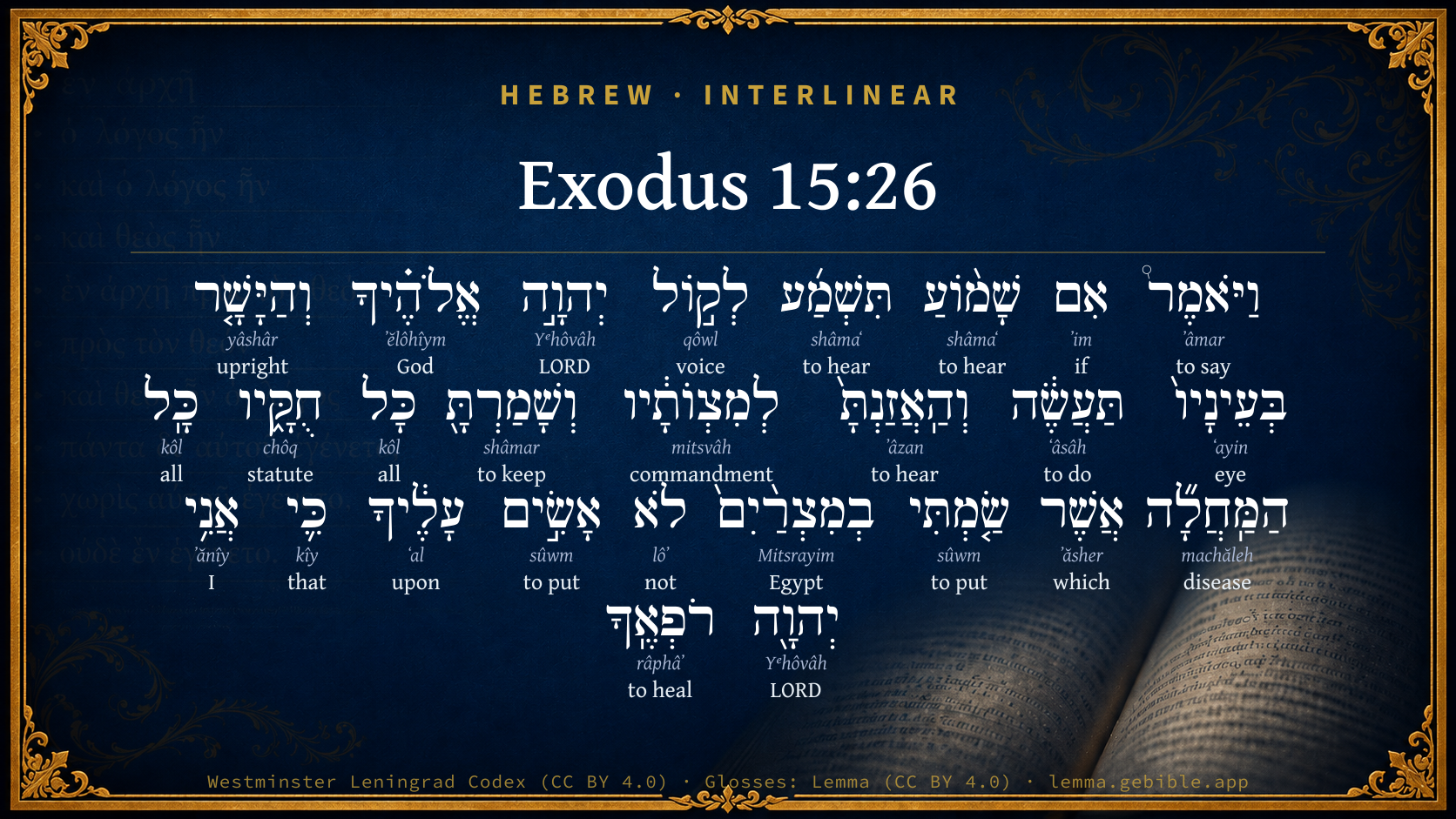
Hebrew (Westminster Leningrad Codex) Exodus 15:26 appears in the Hebrew Old Testament. The text above is from the Westminster Leningrad Codex. Each word links to its Strong’s number, a concise gloss, and parsing drawn from the Open Scriptures Hebrew Bible morphology. Click any word for its full Brown-Driver-Briggs (BDB) entry.
Download image
Cite this verse

Exodus 15:26 (World English Bible). Public Domain. Lemma interlinear Bible study tool, https://lemma.gebible.app/v/exodus/15/26.

Show BibTeX & RIS
BibTeX
RIS
English Translation
and he said, "If you will diligently listen to the voice of Yahweh your God, and will do that which is right in his eyes, and will pay attention to his commandments, and keep all his statutes, I will put none of the diseases on you, which I have put on the Egyptians; for I am Yahweh who heals you."
World English Bible · Public Domain
Highlights
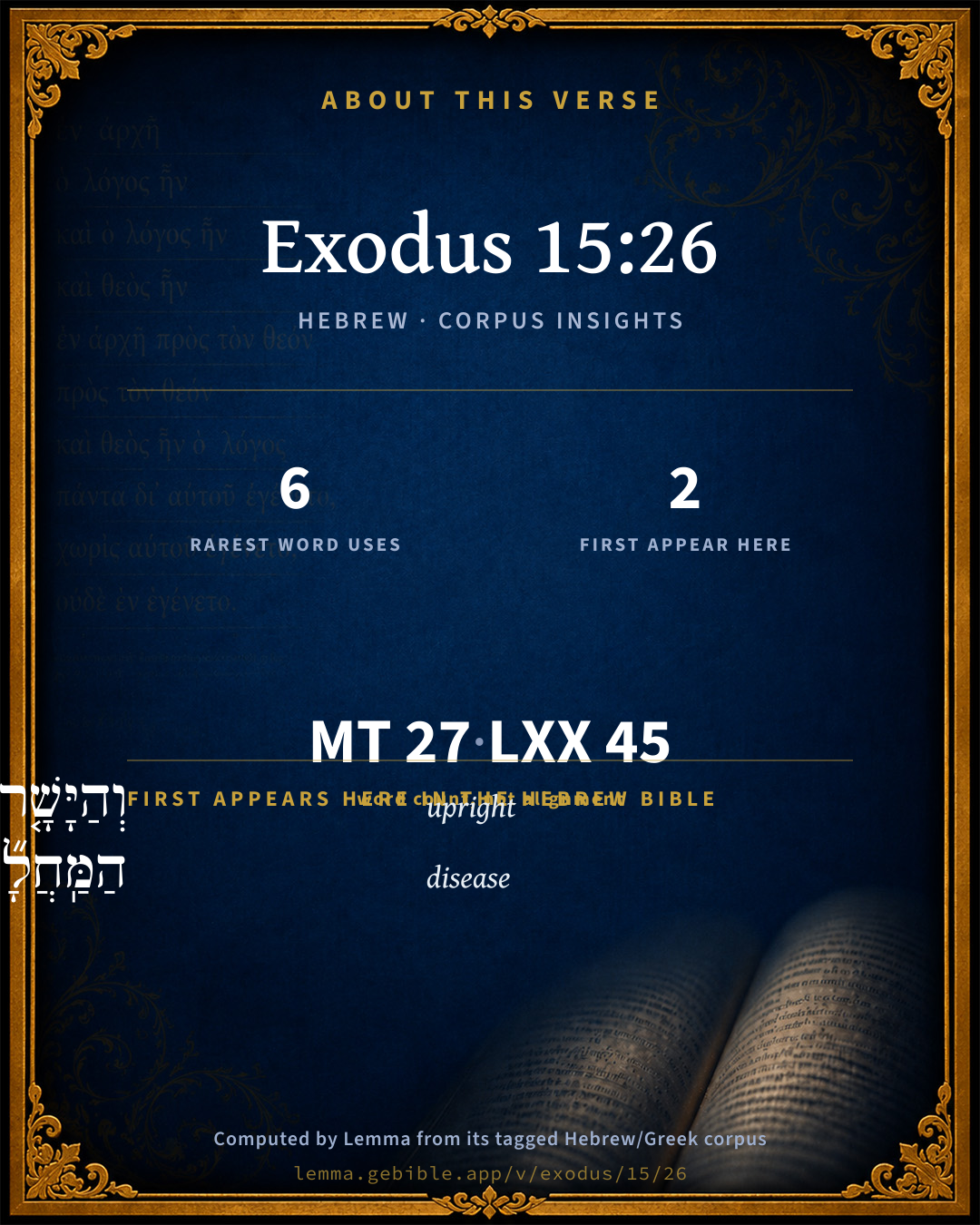
  • 2 first appearances in the Hebrew Bible
Full analysis ↓
Download a study sheet

One document with this verse’s original text, its word-by-word gloss line, the meaning frame, cross-references with their text, attributed commentary, and full source and license credits — printable, and it pastes into notes with its structure intact.

This verse Autodidact and up

Study sheet (.html) Plain text (.txt)

A passage Seminary Student

Up to 50 verses in one chapter. A passage sheet keeps up to 6 commentary sources and 12 cross-references per verse, in the order this page ranks them, and says so on the sheet whenever that leaves anything out. Ask for a single verse and you get the Autodidact verse sheet above.

Everything on this page stays free to read, with no account — the sheet is a download of what is already on screen, not access to it.

Want to remove ads? Support Godless Engineer
Compare translations 3

The same verse in 3 English versions, stacked beneath the original-language interlinear above. Click any original word for its lexicon entry.

Each is an independent rendering of the whole verse — the interlinear is not word-aligned to these translations.

Highlighted words mark where these versions differ — a whole-verse word diff, not a word-by-word alignment.

  • World English Bible Public Domain
    and he said, "If you will diligently listen to the voice of Yahweh your God, and will do that which is right in his eyes, and will pay attention to his commandments, and keep all his statutes, I will put none of the diseases on you, which I have put on the Egyptians; for I am Yahweh who heals you."
  • King James Version Public Domain
    And said, If thou wilt diligently hearken to the voice of the LORD thy God, and wilt do that which is right in his sight, and wilt give ear to his commandments, and keep all his statutes, I will put none of these diseases upon thee, which I have brought upon the Egyptians: for I am the LORD that healeth thee.
  • unfoldingWord Literal Text CC BY-SA 4.0
    And he said, “If you carefully listen to the voice of Yahweh your God, and you do what is right in his eyes, and you give ear to his commands and you keep all of his laws, all of the diseases that I put on the Egyptians I shall not put on you, for I am Yahweh your healer.”

unfoldingWord Literal Text — © unfoldingWord, licensed CC BY-SA 4.0. Word-aligned USFM3 via Door43 (git.door43.org/unfoldingWord/en_ult).

Versions to compare (up to 4)

3 of 4 selected

Show all 18 translations

Every available English version of this verse, each an independent rendering of the whole verse.

  • World English Bible Public Domain
    and he said, "If you will diligently listen to the voice of Yahweh your God, and will do that which is right in his eyes, and will pay attention to his commandments, and keep all his statutes, I will put none of the diseases on you, which I have put on the Egyptians; for I am Yahweh who heals you."
  • Berean Standard Bible Public Domain
    saying, “If you will listen carefully to the voice of the LORD your God, and do what is right in His eyes, and pay attention to His commands, and keep all His statutes, then I will not bring on you any of the diseases I inflicted on the Egyptians. For I am the LORD who heals you.”
  • Majority Standard Bible Public Domain
    saying, “If you will listen carefully to the voice of the LORD your God, and do what is right in His eyes, and pay attention to His commands, and keep all His statutes, then I will not bring on you any of the diseases I inflicted on the Egyptians. For I am the LORD who heals you.”
  • King James Version Public Domain
    And said, If thou wilt diligently hearken to the voice of the LORD thy God, and wilt do that which is right in his sight, and wilt give ear to his commandments, and keep all his statutes, I will put none of these diseases upon thee, which I have brought upon the Egyptians: for I am the LORD that healeth thee.
  • American Standard Version (1901) Public Domain
    and he said, If thou wilt diligently hearken to the voice of Jehovah thy God, and wilt do that which is right in his eyes, and wilt give ear to his commandments, and keep all his statutes, I will put none of the diseases upon thee, which I have put upon the Egyptians: for I am Jehovah that healeth thee.
  • Revised Version (1885) Public Domain
    and he said, If thou wilt diligently hearken to the voice of the LORD thy God, and wilt do that which is right in his eyes, and wilt give ear to his commandments, and keep all his statutes, I will put none of the diseases upon thee, which I have put upon the Egyptians: for I am the LORD that healeth thee.
  • Geneva Bible (1599) Public Domain
    And sayd, if thou wilt diligently hearken, O Israel, vnto the voyce of the Lord thy God, and wilt do that, which is right in his sight, and wilt giue eare vnto his commandements, and keepe all his ordinances, then will I put none of these diseases vpon thee, which I brought vpon the Egyptians: for I am the Lord that healeth thee.
  • Douay-Rheims (1899) Public Domain
    Saying: If thou wilt hear the voice of the Lord thy God, and do what is right before him, and obey his commandments, and keep all his precepts, none of the evils that I laid upon Egypt, will I bring upon thee: for I am the Lord thy healer.
  • Young's Literal Translation Public Domain
    and He saith, `If thou dost really hearken to the voice of Jehovah thy God, and dost that which is right in His eyes, and hast hearkened to His commands, and kept all His statutes: none of the sickness which I laid on the Egyptians do I lay on thee, for I, Jehovah, am healing thee.
  • Literal Standard Version CC BY-SA 4.0
    and He says, “If you really listen to the voice of your God YHWH, and do that which is right in His eyes, and have listened to His commands, and kept all His statutes, none of the sickness which I laid on the Egyptians do I lay on you, for I, YHWH, am healing you.”
  • Unlocked Literal Bible CC BY-SA 4.0
    He said, “If you carefully listen to the voice of Yahweh your God, and do what is right in his eyes, and if you give ear to his commands and obey all his laws—I will put on you none of the diseases that I put on the Egyptians, for I am Yahweh who heals you.”
  • unfoldingWord Literal Text CC BY-SA 4.0
    And he said, “If you carefully listen to the voice of Yahweh your God, and you do what is right in his eyes, and you give ear to his commands and you keep all of his laws, all of the diseases that I put on the Egyptians I shall not put on you, for I am Yahweh your healer.”
  • Darby Bible Public Domain
    And he said, If thou wilt diligently hearken to the voice of Jehovah thy God, and do what is right in his eyes, and incline thine ears to his commandments, and keep all his statutes, I will put none of the complaints upon thee that I have put upon the Egyptians; for I am Jehovah who healeth thee.
  • World Messianic Bible Public Domain
    He said, “If you will diligently listen to the LORD your God’s voice, and will do that which is right in his eyes, and will pay attention to his commandments, and keep all his statutes, I will put none of the diseases on you which I have put on the Egyptians; for I am the LORD who heals you.”
  • Webster's Bible Public Domain
    And said, If thou wilt diligently hearken to the voice of the LORD thy God, and wilt do that which is right in his sight, and wilt give ear to his commandments, and keep all his statutes; I will put none of these diseases upon thee, which I have brought upon the Egyptians; for I am the LORD that healeth thee.
  • Free Bible Version CC BY-SA 4.0
    He told them, “If you pay attention to what the Lord your God says, do what is right in his sight, obey his commands, and keep all his regulations, then I will not make you suffer from any of the diseases I gave the Egyptians because I am the Lord who heals you.”
  • Bible in Basic English Public Domain
    And he said, If with all your heart you will give attention to the voice of the Lord your God, and do what is right in his eyes, giving ear to his orders and keeping his laws, I will not put on you any of the diseases which I put on the Egyptians: for I am the Lord your life-giver.
  • JPS Tanakh (1917) Public Domain
    and He said: 'If thou wilt diligently hearken to the voice of the LORD thy God, and wilt do that which is right in His eyes, and wilt give ear to His commandments, and keep all His statutes, I will put none of the diseases upon thee, which I have put upon the Egyptians; for I am the LORD that healeth thee.'

Literal Standard Version (2020), Covenant Press — licensed CC BY-SA 4.0. Text via the HelloAO Bible API (eBible.org). Unlocked Literal Bible (unfoldingWord) — licensed CC BY-SA 4.0. Text via the HelloAO Bible API (eBible.org). unfoldingWord Literal Text — © unfoldingWord, licensed CC BY-SA 4.0. Word-aligned USFM3 via Door43 (git.door43.org/unfoldingWord/en_ult). Free Bible Version, Dr. Jonathan Gallagher — licensed CC BY-SA 4.0. Text via the HelloAO Bible API (eBible.org).

Word by word

More ways to search: Search by grammar → Find every occurrence → Compare this word →

Practice this passage: Drill this verse → Learn its vocabulary →

הַמַּֽחֲלָ֞ה
machăleh
H4245
“the · disease”
Particle, Definite Article + Noun, Common, Feminine, Singular, Absolute
Part of Speech
Particle + Noun
Type
Common
Gender
Feminine
Number
Singular
State
Absolute
Full BDB Definition

Origin: from H2470

TWOT: 655b , 655c

disease, sickness
  1. וַיֹּאמֶר֩ ʼâmar H559 “and · to say” Conjunction + Verb, Qal, Sequential Imperfect, 3rd Person, Masculine, Singular
  2. אִם ʼim H518 “if” Conjunction
  3. שָׁמ֨וֹעַ shâmaʻ H8085 “to hear” Verb, Qal, Infinitive Absolute
  4. תִּשְׁמַ֜ע shâmaʻ H8085 “to hear” Verb, Qal, Imperfect, 2nd Person, Masculine, Singular
  5. לְק֣וֹל qôwl H6963 “to/for · voice of” Preposition + Noun, Common, Masculine, Singular, Construct
  6. יְהוָ֣ה Yᵉhôvâh H3068 “LORD” Noun, Proper
  7. אֱלֹהֶ֗יךָ ʼĕlôhîym H430 “God(s) · your” Noun, Common, Masculine, Plural, Construct + Suffix, Personal, 2nd Person, Masculine, Singular
  8. וְהַיָּשָׁ֤ר yâshâr H3477 “and · the · upright” Conjunction + Particle, Definite Article + Adjective, Adjective, Masculine, Singular, Absolute
  9. בְּעֵינָיו֙ ʻayin H5869 “in/at · eyes · his” Preposition + Noun, Common, Both, Dual, Construct + Suffix, Personal, 3rd Person, Masculine, Singular
  10. תַּעֲשֶׂ֔ה ʻâsâh H6213 “to do” Verb, Qal, Imperfect, 2nd Person, Masculine, Singular
  11. וְהַֽאֲזַנְתָּ֙ ʼâzan H238 “and · to hear” Conjunction + Verb, Hiphil, Sequential Perfect, 2nd Person, Masculine, Singular
  12. לְמִצְוֺתָ֔יו mitsvâh H4687 “to/for · commandments · his” Preposition + Noun, Common, Feminine, Plural, Construct + Suffix, Personal, 3rd Person, Masculine, Singular
  13. וְשָׁמַרְתָּ֖ shâmar H8104 “and · to keep” Conjunction + Verb, Qal, Sequential Perfect, 2nd Person, Masculine, Singular
  14. כָּל kôl H3605 “all of” Noun, Common, Masculine, Singular, Construct
  15. חֻקָּ֑יו chôq H2706 “statutes · his” Noun, Common, Masculine, Plural, Construct + Suffix, Personal, 3rd Person, Masculine, Singular
  16. כָּֽל kôl H3605 “all of” Noun, Common, Masculine, Singular, Construct
  17. אֲשֶׁר ʼăsher H834 “which” Particle, Relative
  18. שַׂ֤מְתִּי sûwm H7760 “to put” Verb, Qal, Perfect, 1st Person, Common, Singular
  19. בְמִצְרַ֨יִם֙ Mitsrayim H4714 “in/at · Egypt” Preposition + Noun, Proper
  20. לֹא lôʼ H3808 “not” Particle, Negative
  21. אָשִׂ֣ים sûwm H7760 “to put” Verb, Qal, Imperfect, 1st Person, Common, Singular
  22. עָלֶ֔יךָ ʻal H5921 “upon · you” Preposition + Suffix, Personal, 2nd Person, Masculine, Singular
  23. כִּ֛י kîy H3588 “that” Conjunction
  24. אֲנִ֥י ʼănîy H589 “I” Pronoun, Personal, 1st Person, Common, Singular
  25. יְהוָ֖ה Yᵉhôvâh H3068 “LORD” Noun, Proper
  26. רֹפְאֶֽךָ râphâʼ H7495 “healing · you” Verb, Qal, Participle Active, Masculine, Singular, Construct + Suffix, Personal, 2nd Person, Masculine, Singular

About this verse

These counts appear in no published source. They are computed here, from the morphology-tagged text and Lemma’s own curated glosses. What Lemma adds →

27
words
23
distinct lemmas
Pentateuch
section

Notable vocabulary

The rarest word here is הַמַּֽחֲלָ֞ה disease H4245 — appearing just 6 times in the whole Hebrew Bible.

First appearance in Scripture

These words make their first canonical appearance in the Hebrew Bible here:

  • וְהַיָּשָׁ֤ר upright H3477
  • הַמַּֽחֲלָ֞ה disease H4245

Shared distinctive vocabulary

הַמַּֽחֲלָ֞ה disease H4245 occurs in 6 verses of the Hebrew Bible. Also found in:

Grammatical profile

  • 9 verbs
  • 11 nouns
  • 1 adjective
  • 1 pronoun
  • 1 preposition
  • 2 conjunctions
  • 2 particles

Verb forms

  • וַיֹּאמֶר֩ Qal · Sequential Imperfect
  • שָׁמ֨וֹעַ Qal · Infinitive Absolute
  • תִּשְׁמַ֜ע Qal · Imperfect
  • תַּעֲשֶׂ֔ה Qal · Imperfect
  • וְהַֽאֲזַנְתָּ֙ Hiphil · Sequential Perfect
  • וְשָׁמַרְתָּ֖ Qal · Sequential Perfect
  • שַׂ֤מְתִּי Qal · Perfect
  • אָשִׂ֣ים Qal · Imperfect
  • רֹפְאֶֽךָ Qal · Participle Active

Repetition

Words recur within this verse — often emphatic in Hebrew:

  • שָׁמ֨וֹעַ to hear H8085 ×2
  • יְהוָ֣ה LORD H3068 ×2
  • כָּל all H3605 ×2
  • שַׂ֤מְתִּי to put H7760 ×2

Hebrew & Septuagint length

In English translation the verse runs 60 words from the Hebrew and 55 from the Septuagint (LXX English) — closely comparable.

A rough comparison of the two English renderings, which tokenize alike — not a word-level alignment.

Word counts can differ between the Hebrew and the Greek without any difference in meaning — e.g. the Hebrew direct-object marker אֵת has no separate Greek word, and Greek often adds the article ὁ.

In the original languages it is 27 Hebrew tokens and 45 Greek tokens — but the two are counted differently (Hebrew bundles its prefixes and suffixes into one token; the Greek is in lemma form), so that isn’t a like-for-like length.

Cross-references

27

Topical passages linked to Exodus 15:26 in the Treasury of Scripture Knowledge — connected by theme and wording, ordered by reader-vote popularity; previews shown in the World English Bible.

  • Psalms 103:3 Who forgives all your sins; Who heals all your diseases;
  • Deuteronomy 7:15 Yahweh will take away from you all sickness; and none of the evil diseases of Egypt, which you know, will he put on you, but will lay them on all those who hate you.
  • Exodus 23:25 You shall serve Yahweh your God, and he will bless your bread and your water, and I will take sickness away from your midst.
  • Psalms 41:3–4 Yahweh will sustain him on his sickbed, And restore him from his bed of illness.
  • Psalms 147:3 He heals the broken in heart, And binds up their wounds.
  • Jeremiah 33:6 Behold, I will bring it health and cure, and I will cure them; and I will reveal to them abundance of peace and truth.
  • Deuteronomy 28:1–15 It shall happen, if you shall listen diligently to the voice of Yahweh your God, to observe to do all his commandments which I command you this day, who Yahweh your God will set you on high above all the nations of the earth:
  • Hosea 6:1 "Come, and let us return to Yahweh; For he has torn us to pieces, And he will heal us; He has injured us, And he will bind up our wounds.
  • Leviticus 26:13 I am Yahweh your God, who brought you forth out of the land of Egypt, that you should not be their slaves; and I have broken the bars of your yoke, and made you go upright.
  • Job 5:18 For he wounds, and binds up; He injures, and his hands make whole.
  • James 5:11–16 Behold, we call them blessed who endured. You have heard of the patience of Job, and have seen the Lord in the outcome, and how the Lord is full of compassion and mercy.
  • Deuteronomy 12:28 Observe and hear all these words which I command you, that it may go well with you, and with your children after you forever, when you do that which is good and right in the eyes of Yahweh your God.
  • Deuteronomy 28:60 He will bring on you again all the diseases of Egypt, which you were afraid of; and they shall cleave to you.
  • Deuteronomy 13:18 when you shall listen to the voice of Yahweh your God, to keep all his commandments which I command you this day, to do that which is right in the eyes of Yahweh your God.
  • Deuteronomy 28:27 Yahweh will strike you with the boil of Egypt, and with the tumors, and with the scurvy, and with the itch, of which you can not be healed.
  • 1 Kings 11:33 because that they have forsaken me, and have worshiped Ashtoreth the goddess of the Sidonians, Chemosh the god of Moab, and Milcom the god of the children of Ammon; and they have not walked in my ways, to do that which is right in my eyes, and [to keep] my statutes and my ordinances, as did David his father.
  • Deuteronomy 7:12–13 It shall happen, because you listen to these ordinances, and keep and do them, that Yahweh your God will keep with you the covenant and the loving kindness which he swore to your fathers:
  • Isaiah 57:18 I have seen his ways, and will heal him: I will lead him also, and restore comforts to him and to his mourners.
  • Ezekiel 18:5 But if a man is just, and does that which is lawful and right,
  • 2 Kings 20:5 Turn back, and tell Hezekiah the prince of my people, Thus says Yahweh, the God of David your father, I have heard your prayer, I have seen your tears: behold, I will heal you; on the third day you shall go up to the house of Yahweh.
  • 2 Kings 22:2 He did that which was right in the eyes of Yahweh, and walked in all the way of David his father, and didn't turn aside to the right hand or to the left.
  • Jeremiah 8:22 Is there no balm in Gilead? is there no physician there? why then isn't the health of the daughter of my people recovered?
  • Leviticus 26:3 "'If you walk in my statutes, and keep my commandments, and do them;
  • 1 Kings 11:38 It shall be, if you will listen to all that I command you, and will walk in my ways, and do that which is right in my eyes, to keep my statutes and my commandments, as David my servant did; that I will be with you, and will build you a sure house, as I built for David, and will give Israel to you.
  • Deuteronomy 28:58 If you will not observe to do all the words of this law that are written in this book, that you may fear this glorious and fearful name, YAHWEH YOUR GOD;
  • Exodus 12:29 It happened at midnight, that Yahweh struck all the firstborn in the land of Egypt, from the firstborn of Pharaoh who sat on his throne to the firstborn of the captive who was in the dungeon; and all the firstborn of cattle.
  • Exodus 9:10–11 They took ashes of the furnace, and stood before Pharaoh; and Moses sprinkled it up toward the sky; and it became a boil breaking forth with boils on man and on animal.

Cross-references courtesy of OpenBible.info (CC BY 4.0).

Hebrew and Greek witnesses Masoretic Hebrew ↔ Greek Septuagint

The same verse in the two great witnesses to the Old Testament, shown verse-for-verse.

These are two independent witnesses, not word-aligned to each other, and the Septuagint is shown in lemma (dictionary) form.

Hebrew Exodus 15:26 Masoretic · Westminster Leningrad Codex

וַיֹּאמֶר֩ אִם שָׁמ֨וֹעַ תִּשְׁמַ֜ע לְק֣וֹל יְהוָ֣ה אֱלֹהֶ֗יךָ וְהַיָּשָׁ֤ר בְּעֵינָיו֙ תַּעֲשֶׂ֔ה וְהַֽאֲזַנְתָּ֙ לְמִצְוֺתָ֔יו וְשָׁמַרְתָּ֖ כָּל חֻקָּ֑יו כָּֽל הַמַּֽחֲלָ֞ה אֲשֶׁר שַׂ֤מְתִּי בְמִצְרַ֨יִם֙ לֹא אָשִׂ֣ים עָלֶ֔יךָ כִּ֛י אֲנִ֥י יְהוָ֖ה רֹפְאֶֽךָ

and he said, "If you will diligently listen to the voice of Yahweh your God, and will do that which is right in his eyes, and will pay attention to his commandments, and keep all his statutes, I will put none of the diseases on you, which I have put on the Egyptians; for I am Yahweh who heals you."

World English Bible · Public Domain

Greek LXX Exodus 15:26 Septuagint · lemma form

καί εἶπον ἐάν ἀκοή ἀκούω ὁ φωνή κύριος ὁ θεός σύ καί ὁ ἀρεστός ἐναντίον αὐτός ποιέω καί ἐνὠτίζομαι ὁ ἐντολή αὐτός καί φυλάσσω πᾶς ὁ δικαίωμα αὐτός πᾶς νόσος ὅς ἐπιἄγω ὁ αἰγύπτιος οὐ ἐπιἄγω ἐπί σύ ἐγώ γάρ εἰμί κύριος ὁ ἰάομαι σύ

and said, If you will indeed hear the voice of the Lord your God, and do things pleasing before him, and will listen to his commands, and keep all his ordinances, no disease which I have brought upon the Egyptians will I bring upon you, for I am the Lord your God that heals you.

LXX2012 (modern English Septuagint) · Public Domain

Hebrew: Westminster Leningrad Codex (CC BY 4.0). Greek: Septuagint (public domain); English from LXX2012 (modern English Septuagint) (Public Domain). How the Septuagint differs from the Hebrew →

Targum (Aramaic paraphrase)

2

The Targum is the ancient Jewish Aramaic paraphrase of the Hebrew Scriptures — an interpretive translation, not the Hebrew text itself. Onkelos (literal) and Pseudo-Jonathan (expansive) render the Torah, and Jonathan the Prophets. Coverage is partial: where no permissively-licensed English translation exists for a verse, only the Aramaic is shown. This is verse-level text, not a word-by-word alignment to the Hebrew.

  1. Targum Onkelos Torah (Genesis–Deuteronomy)
    וַאֲמַר אִם קַבָּלָא תְקַבֵּל לְמֵימְרָא דַיְיָ אֱלָהָךְ וּדְכָשַׁר קֳדָמוֹהִי תַעְבֵּד וְתַצֵית לִפִקוּדוֹהִי וְתִטַר כָּל קְיָמוֹהִי כָּל מַרְעִין דִי שַׁוֵיתִי בְמִצְרַיִם לָא אֲשַׁוִנוּן עֲלָךְ אֲרֵי אֲנָא יְיָ אַסָךְ:

    (no public-domain English translation for this verse)

    Targum Onkelos — Aramaic: “Onkelos Genesis” (public domain); “Onkelos Exodus” (public domain); “Onkelos Leviticus” (public domain); “Onkelos Numbers” (public domain); “Onkelos Deuteronomy” (public domain). English: “Sefaria Community Translation” (CC0 1.0 (public-domain dedication)); “J.W. Etheridge. The Targums of Onkelos and Jonathan Ben Uzziel on the Pentateuch. London: Longmans, Green, 1862” (public domain). Text via Sefaria.

  2. Targum Pseudo-Jonathan Torah (Genesis–Deuteronomy)
    וַאֲמַר אִין קַבָּלָא תְקַבֵּל לְמֵימְרָא דַיְיָ אֱלָהָךְ וּדְכָשַׁר קֳדָמוֹי תַּעֲבֵיד וְתַצֵּית לְפִקוּדוֹי וְתִנְטוֹר כָּל קְיָימוֹי כָּל מַרְעִין בִּישִׁין דְּשַׁוִּיתִי עַל מִצְרָאֵי לָא אַשְׁוִינוּן עֲלָךְ וְאִם תַּעַבְרוּן עַל פִּתְגָּמֵי אוֹרַיְיתָא וּמִשְׁתַּלְחִין עֲלָךְ אִין תְּתִיבוּן אַעֲדִינוּן מִנָךְ אֲרוּם אֲנָא הוּא יְיָ אַסְאָךְ

    and said, If you will truly hearken to the Word of the Lord your God, and do that which is right before Him, and will listen to His precepts and keep all His statutes, all those evil things that I laid upon the Mizraee I will not lay upon thee: but if thou wilt transgress against the word of the law, upon thee shall they be sent. If thou convert, I will remove them from thee; for I am the Lord thy Healer.

    Targum Pseudo-Jonathan — Aramaic: “Targum Jonathan on Genesis” (public domain); “Targum Jonathan on Exodus” (public domain); “Targum Jonathan on Leviticus” (public domain); “Targum Jonathan on Numbers” (public domain); “Targum Jonathan on Deuteronomy” (public domain). English: “The Targum of Jonathan ben Uzziel, trans. J. W. Etheridge, London, 1862” (public domain). Text via Sefaria.

Commentary

Notes on Exodus 15:26 from classic Christian and Jewish commentators (each source and its license shown beneath its notes). The classic Christian expositions comment on the surrounding passage and are grouped to its opening verse, so a note may address several verses; the Jewish commentaries on the Tanakh (Rashi and others) are per-verse, so they appear only where the commentator wrote on this verse.

Lemma curates 59 commentaries, every one of them public domain or Creative Commons licensed, each selected and text-cleaned for this edition rather than reprinted as found. About our sources →

Trapp's Complete Commentary

John Trapp

Exo 15:26 And said, If thou wilt diligently hearken to the voice of the LORD thy God, and wilt do that which is right in his sight, and wilt give ear to his commandments, and keep all his statutes, I will put none of these diseases upon thee, which I have brought upon the Egyptians: for I [am] the LORD that healeth thee.

Ver. 26. And said, If thou, &c.] This God premiseth as a preface to the law, to be shortly after given in Sinai.

I am the Lord that healeth thee.] Both on the inside, by "forgiving all thine iniquities," and on the outside, by "healing all thy diseases." {Psa 103:3} I am Jehovah the physician. And Omnipotenti medico nullus insanabilis occurrit morbus. {a} To an almighty physician no disease is incurable.

{a} Isidor.

John Trapp, A Commentary or Exposition upon All the Books of the Old and New Testament (1647–1656) — public domain. Text from a community e-Sword module.

Joseph Benson's Commentary

Exo 15:26. If thou wilt diligently hearken to the voice of the Lord thy God, &c. — He here states the substance of what he required of them. For as yet he did not load them with that grievous yoke of ceremonies, which he thought fit afterward to lay upon them, for the hardness of their hearts, or because they showed themselves incapable of a more liberal and ingenuous service. And to this the words of the Lord by Jeremiah seem to refer, Jer 7:22-23, “I spake not to your fathers in the day I brought them out of the land of Egypt, concerning burnt-offerings, or sacrifices,” &c. I will put none of these diseases upon thee — Either such preternatural plagues as God had inflicted on the Egyptians, or the diseases which were peculiar to Egypt, and most frequent in that country, such as the leprosy and other cutaneous diseases. This intimates that if they were disobedient, the plagues which they had seen inflicted on their enemies should be brought on them. The threatening is implied only, but the promise is expressed. I am the Lord that healeth thee — That preserves thee in health, as well as heals thy diseases.

Joseph Benson's Commentary on the Old and New Testaments (1811–1818) — public domain. Text from a community e-Sword module.

Tyndale Open Study Notes

Tyndale Open Resources

15:26 The connection between obedience to God’s commands and health is not arbitrary. God made the body, and our bodies will last longer if we follow the Creator’s guidelines. Since this statement was made in the context of a need for water, it might indicate that the Egyptians had been drinking polluted water.

Tyndale Open Study Notes — © Tyndale Open Resources, licensed CC BY-SA 4.0. Text via the HelloAO Bible API.

Geneva Bible (1599)

Geneva Bible translators

Which is, to do that only that God commanded.

Geneva Bible (1599) marginal notes — public domain. Text via Bolls.life.

Adam Clarke's Commentary

Verse 26. If thou wilt diligently hearken] What is contained in this verse appears to be what is intended by the statute and ordinance mentioned in the preceding: If thou wilt diligently hearken unto the voice of the Lord thy God, and wilt do that which is right in his sight, and wilt give ear to his commandments, and keep all his statutes, I will put none of these diseases upon thee, c. This statute and ordinance implied the three following particulars:

1. That they should acknowledge Jehovah for their God, and thus avoid all idolatry.

2. That they should receive his word and testimony as a Divine revelation, binding on their hearts and lives, and thus be saved from profligacy of every kind, and from acknowledging the maxims or adopting the customs of the neighbouring nations.

3. That they should continue to do so, and adorn their profession with a holy life.

These things being attended to, then the promise of God was, that they should have none of the diseases of the Egyptians put on them that they should be kept in a state of health of body and peace of mind; and if at any time they should be afflicted, on application to God the evil should be removed, because he was their healer or physician - I am the Lord that healeth thee. That the Israelites had in general a very good state of health, their history warrants us to believe; and when they were afflicted, as in the case of the fiery serpents, on application to God they were all healed. The Targum of Jonathan ben Uzziel states that the statutes which Moses received at this time were commandments concerning the observance of the Sabbath, duty to parents, the ordinances concerning wounds and bruises, and the penalties which sinners should incur by transgressing them. But it appears that the general ordinances already mentioned are those which are intended here, and this seems to be proved beyond dispute by Jer 7:22-23: "For I spake not unto your fathers, nor commanded them in the day that I brought them out of the land of Egypt, concerning burnt-offerings or sacrifices: but this thing commanded I them, saying, Obey my voice, and I will be your God, and ye shall be my people; walk ye in all the ways that I have commanded you, that it may be well unto you."

Adam Clarke's Commentary on the Bible (1810–1826) — public domain. Text from a community e-Sword/MySword module.

The Cambridge Bible for Schools and Colleges

gen. ed. J. J. S. Perowne

26. Encouragement to Israel, to obey the commandments laid upon them. The verse approximates in style and tone to Deuteronomy, and is probably one of the parenetic additions of the compiler of JE (see on Exo_13:3-16); notice Hearken to the voice, as Deu_15:5; Deu_28:1 al. (but with ב, not ל, as here); Jehovah thy Goa, as Deu_1:21; Deu_1:31, and constantly; that which is right &c., as Deu_6:18, Deu_12:25; Deu_12:28 al.; give ear, as Deu_1:45 (elsewhere nearly always poet.); commandments … and statutes, as Deu_4:40, Deu_6:17, Deu_10:13, &c.; keep, as Deu_4:40, Deu_26:17.

I will put, &c.] Deu_7:15 is based upon this passage (in spite of the Heb. word for ‘diseases’ being different).

diseases] alluding to the plagues.

that healeth thee] Cf. Psa_103:3; also ch. Exo_23:25. The thought seems to be suggested by the incident of v. 25a: unwholesome or bitter water that has been made sweet is sometimes spoken of as ‘healed’ (2Ki_2:21-22, Eze_47:8).

The Cambridge Bible for Schools and Colleges (gen. ed. J. J. S. Perowne; Cambridge University Press, 1878–1918) — public domain. Text from a community e-Sword module.

John Gill's Exposition

And they came to Elim,.... On the twenty fifth of Nisan; for, according to Aben Ezra, they stayed but one day at Marah. Elim, as a late traveller (r) says, was upon the northern skirts of the desert of Sin, two leagues from Tor, and near thirty from Corondel; according to Bunting (s) it was eight miles from Marah:

where were twelve wells of water, and seventy palm trees; and so a very convenient, commodious, and comfortable place to abide at for a time, since here was plenty of water for themselves and cattle, and shady trees to sit under by turns; for as for the fruit of them, that was not ripe at this time of the year, as Aben Ezra observes. Thevenot (t) seems to confound the waters here with the waters of Marah; for he says, the garden of the monks of Tor is the place which in holy Scripture is called Elim, where were sventy palm trees and twelve wells of bitter water; these wells, adds he, are still in being, being near one another, and most of them within the precinct of the garden, the rest are pretty near; they are all hot, and are returned again to their first bitterness; for I tasted says he, of one of them, where people bathe themselves, which by the Arabs is called Hammam Mouse, i.e. the "bath of Moses"; it is in a little dark cave: there is nothing in that garden but abundance of palm trees, which yield some rent to the monks, but the seventy old palm trees are not there now. This does not agree with an observation of the afore mentioned Jewish writer, that palm trees will not flourish in the ground where the waters are bitter; though they delight in watery places, as Pliny (u) says; and yet Leo Africanus (w) asserts, that in Numidia the dates (the fruit of palm trees) are best in a time of drought. A later traveller (x) tells us, he saw no more than nine of the twelve wells that are mentioned by Moses, the other three being filled up by those drifts of sand which are common in Arabia; yet this loss is amply made up by the great increase in the palm trees, the seventy having propagated themselves into more than 2000; under the shade of these trees is the Hammam Mouse, or "bath of Moses", particularly so called, which the inhabitants of Tor have in great veneration, acquainting us that it was here where the household of Moses was encamped. Dr. Pocock takes Elim to be the same with Corondel; about four hours or ten miles south of Marah, he says, is the winter torrent of Corondel in a very narrow valley, full of tamarisk trees, where there is tolerable water about half a mile west of the road; beyond this, he says, about half an hour, or little more than a mile, is a winter torrent called Dieh-Salmeh; and about an hour or two further, i.e. about three or four miles, is the valley or torrent of Wousset, where there are several springs of water that are a little salt; and he thinks that one of them, but rather Corondel, is Elim, because it is said afterwards:

they removed from Elim, and encamped at the Red sea; and the way to Corondel, to go to the valley of Baharum, is part of it near the sea, where he was informed there was good water, and so probably the Israelites encamped there; and Dr. Clayton (y) is of the same mind, induced by the argument he uses: a certain traveller (z), in the beginning of the sixteenth century, tells us, that indeed the wells remain unto this day, but that there is not one palm tree, only some few low shrubs; but he could never have been at the right place, or must say a falsehood, since later travellers, who are to be depended upon, say the reverse, as the above quotations show. As to the mystical application of this passage, the Targums of Jonathan and Jerusalem make the twelve fountains answerable to the twelve tribes of Israel, and seventy palm trees to the seventy elders of the sanhedrim; and so Jarchi: and more evangelically the twelve fountains of water may denote the abundance of grace in Christ, in whom are the wells of salvation, and the sufficiency of it for all his people; and which the doctrine of the Gospel, delivered by his twelve apostles, discovers and reveals, and leads and directs souls unto; and the seventy palm trees may lead us to think of the seventy disciples sent out by Christ, and all other ministers of the word, who for their uprightness, fruitfulness, and usefulness, may be compared to palm trees, as good men in Scripture are, see Psa 92:12,

and they encamped there by the waters; where they stayed, as Aben Ezra thinks, twenty days, since, in the first verse of the following chapter, they are said to come to the wilderness of Sin on the fifteenth day of the second month; here being everything agreeable to them for the refreshment of themselves and cattle, they pitched their tents and abode a while; as it is right in a spiritual sense for the people of God to abide by his word and ordinances.

(r) Shaw, ut supra. (Travels, p. 314.) (s) Travels, p. 82. (t) Travels into the Levant, B. 2. ch. 26. p. 166. (u) Nat. Hist. l. 13. c. 4. (w) Descriptio Africae, l. 1. p. 82. (x) Dr. Shaw, ut supra. (r)) (y) Chronolgy of the Hebrew Bible, p. 296, 297. (z) Baumgarten. Peregrinatio, l. 1. c. 21. p. 44.

Next: Exodus Chapter 16

John Gill's Exposition of the Whole Bible (1746–1763) — public domain (CC PDM 1.0). Text via the HelloAO Bible API.

Haydock's Catholic Bible Commentary

Healer. God delivered his people from every infirmity, which might prevent any one from joining the rest of their tribes on the night of the exit, Psalm civ. 37.

George Leo Haydock (1774–1849), Haydock's Catholic Family Bible and Commentary, 1859 edition — public domain. Excludes Psalms (Douay-Rheims chapter numbering differs from Protestant) and Deuterocanonical books (Catholic canon only).

Matthew Poole's English Annotations

None of these diseases upon thee, nor other evils or plagues; but, on the contrary, I will bless thee with all manner of blessings. Under one branch or part of the blessings of God’s covenant, he includes all the rest by a very common synecdoche.

That healeth thee; or, thy physician, for all thy maladies both of soul and body.

Matthew Poole's English Annotations on the Holy Bible (1683–1685) — public domain. Text from a community e-Sword/MySword module.

Whedon's Commentary on the Bible

Daniel D. Whedon

26. For I am the Lord that healeth thee — For I, JEHOVAH, am thy Healer, Physician. This first trial and miracle of the desert is made the occasion of great spiritual lessons, such as may ever come from great trials. They had seen Egypt’s blessings turned to curses because of the sins of the Egyptians, and the same God would not only save them from these dreadful judgments, but would turn all life’s bitterness to sweetness if they would but keep his law. Jehovah the Physician can heal all the Marahs of life if man but obeys and submits, whether he comprehends God’s dealings or not. Here, also, they were clearly taught that continued obedience was essential to their continued election as God’s covenant people. They were not to be presumptuous because of the wonderful manifestations in Egypt and at the Red Sea. If they sinned like the Egyptians they would also be punished like the Egyptians. But the great lesson here emphatically impressed is, that it is not ritual or outward obedience of any kind — not the offering of sacrifices or of bodily services merely — but the doing that which is right in his sight — the sacrifice of the heart, the offering of the self, that Jehovah demands. Jeremiah, centuries afterwards, refers to this transaction and this solemn spiritual lesson thus: “For I spake not unto your fathers, nor commanded them in the day that I brought them out of the land of Egypt, concerning burnt offerings or sacrifices: but this thing commanded I them, saying, Obey my voice, and I will be your God, and ye shall be my people: and walk ye in all the ways that I have commanded you, that it may be well unto you.” Jer_7:22-23. This “statute and ordinance” coming just before the Levitical economy — just before the first altar was reared in the wilderness — is most valuable as setting forth the real nature and spirit of the Levitical ordinances.

Daniel D. Whedon (gen. ed.), Commentary on the Old and New Testaments (1874–1909) — public domain. Text from a community e-Sword module.

Rashi

Rabbi Shlomo Yitzchaki (Rashi)

אם שמע תשמע IF THOU WILL DILIGENTLY HEARKEN — this implies acceptance — that they should take upon themselves the duty of performing God’s commands.

תעשה AND IF THOU WILT DO — this implies the performance of the commands.

והאזנת means THOU WILT INCLINE THE EAR to be punctilious in the practice of the details.

כל חקיו ALL HIS STATUTES — Matters which are only the decrees of the King (decrees of God imposed by Him, as King, upon us, His subjects) and which appear to have no reason, and at which the evil inclination cavils saying, “What sense is there in prohibiting these? Why should they be prohibited?” — For instance: the prohibition of wearing a mixture of wool and linen, and of eating swine’s flesh, and the law regarding the red heifer, and similar matters (cf. Yoma 67b).

לא אשים עליך I WILL NOT PLACE ON THEE — and if I do place them on thee because thou refusest to hearken to My voice, it will be as though they had not been placed on thee, for if thou repentest of thy disobedience I will remove them immediately, כי אני ה׳ רפאך BECAUSE I AM THE LORD THAT HEALETH THEE. This is its Midrashic explanation (Mekhilta). But according to its literal sense the meaning is: For I am the Lord who healeth thee and teacheth thee the Law and Commandments in order that thou mayst be saved from them (these diseases) — like a physician who says to a man: Do not eat this thing lest it will bring you into danger from this disease. So, too, it states, (Proverbs 3:8) “It (obedience to God) will be wholesome to thy body” (implying that disease will not fall upon thee) (Mekhilta).

Rashi on the Tanakh — English translations: “The Judaica Press complete Tanach with Rashi, translated by A. J. Rosenberg” (CC BY 4.0); “Pentateuch with Rashi's commentary by M. Rosenbaum and A.M. Silbermann, 1929-1934” (public domain); “The Metsudah Tanach series, Lakewood, N.J” (CC BY 4.0); and “The Book of Joshua, Metsudah Publications, 1997” (CC BY 4.0). Text via Sefaria.

Ramban (Nachmanides)

Rabbi Moshe ben Nachman (Ramban / Nachmanides)

IF ‘SHAMO’A TISHMA’ TO THE VOICE OF THE ETERNAL THY G-D. Rabbi Abraham ibn Ezra explained that “[shamo’a tishma here] means ‘to understand’ would mean “surely listen” or “diligently hearken,” but wherever this expression is followed by the letter lamed — as in this case, [shamo’a tishma l’kol] — or a beth, it means ‘understanding.’ This is why Ibn Ezra explained it here to mean “if you will have a full understanding of His commandments.” the purport of that which He has commanded you to do. And thou wilt do that which is right in His eyes — this implies the positive commandments — and wilt give ear to His commandments — this implies the negative commandments.” [Thus the language of Ibn Ezra.] And in the Mechilta, the Rabbis have said: “And thou wilt do that which is right in His eyes, this means in business dealings. This teaches us that if a person is honest in his business dealings, and the spirit of his fellow creatures finds pleasure in him, it is accounted to him as though he had fulfilled the entire Torah.”. The sense thereof is thus: “If you will do that which is right in G-d’s eyes, meaning if you will be honest in your business dealings, it will be accounted to you as though you had given ear, etc.” I will further explain this when I come to the verse ‘And thou shalt do that which is upright and good,’ if the good G-d will show me goodness.

I WILL PUT NONE OF THE DISEASES UPON THEE, WHICH I HAVE PUT UPON THE EGYPTIANS; FOR I AM THE ETERNAL THAT HEALETH THEE. Rashi wrote: “I will put none of the diseases upon thee, and if I do place them [because you will not hearken to My voice], they will be as though they had not been placed, for I am the Eternal that healeth thee. This is the homiletic exposition. But according to the plain meaning of Scripture, the verse is to be understood in the sense of a person who says, ‘I am the physician who warns you not to eat certain things which might bring a man back to his state of disease.’” Thus far the language of Rashi.But according to the plain meaning of Scripture, rophecha is not an adjective, [or more precisely, a noun-adjective, as Rashi would have it, meaning “Thy physician Who teaches thee how disease should not befall thee.” Instead, the meaning of the verse is “that I am the One Who heals thee.”] Besides, it is not customary that a master should assure his servants that “if you will do all my will and desire, I will not slay you with sore diseases.” None of the Divine assurances of the Torah are expressed in that way! Rather, the verse here constitutes an admonition by which He warned them not to be among those that rebel against Him as the Egyptians had been. By hearkening to His voice, they will be saved from all sickness, since that sickness deservedly comes upon all those who rebel against His will, even as it befell the Egyptians when they did not hearken to Him. This is similar to that which He said that He will put upon thee all the diseases of Egypt which thou wast in dread of, and they shall cleave unto thee. And He further said, For I am the Eternal that healeth thee. This constitutes a promise “that I will remove from you sickness that comes in the natural course of events, even as I healed the waters [at Marah].”Rabbi Abraham ibn Ezra commented that this sign, [i.e., making the bitter waters sweet], which was the first one done for them in the wilderness, was in contrast to the first plague that came upon the Egyptians. The waters of the [Nile] river were sweet and He changed them to be of evil effect, while these waters of Marah were bitter and He healed them. Thus it was shown that G-d does things which are contrary to each other, and therefore you should fear Him and not rebel against Him so that He should not afflict you as He did [afflict] them. You should love Him for He will bestow goodness upon you, even as He healed the waters for you. [Thus far Ibn Ezra’s comment.]Now on the matter of Scripture making use here of two expressions, saying, “His commandments, His statutes,” and concluding, I will put none of the diseases upon thee, for I am the Eternal, [thus using the third-person and first-person pronouns in the same verse], I have already written you three times on the explanation thereof. [Here] it can be understood from the word ‘l’kol’ (to the voice) and the word ‘ani’ (I), which convey the thought that if we shall listen to the voice of our G-d to keep G-d’s commandments and His statutes, the Glorious Name will be our healer. It is on the basis [of the verse] that the Sages instituted [the formula of] benedictions [which contain two different pronouns, thus: “Blessed art Thou O Eternal, our G-d, King of the universe,] Who hast sanctified us with His commandments and hast commanded us.” The benedictions contain an expression of acknowledgment of G-d’s Sovereignty, [saying as we do, “our G-d, King of the universe”], and the commandments have been given to us from everlasting even to everlasting. The student learned [in the mystic lore of the Cabala] will understand.And I will enlighten you [on this matter]. All benedictions which contain an expression of His Sovereignty are so formulated that they show respect to the Sovereign of the universe, Who has sanctified us [by His commandments] and Who has done [a certain deed] for us. But where a benediction follows another one, in which case the Sovereignty of G-d is not mentioned, the Sovereignty of G-d thus being acknowledged in the second person, i.e., as the One directly addressed. But the benediction concludes with a reference to that Sovereign in the third person, thus concluding, “Who has sanctified us by His commandments.” The following benedictions do not open with a reference to G-d’s Sovereignty, but instead continue throughout in the second person. For example, in the Grace after the meal, the first benediction begins: “Blessed art Thou, O Eternal our G-d, King of the universe, Who sustains the whole world with His goodness… He giveth food to all flesh….” The second benediction begins: “We thank Thee, O Eternal our G-d, for the goodly and ample land of our desire which Thou gavest….” It should be noted that this rule applies only where a number of benedictions relate to one unit of prayer, such as the Grace after the Meal, or the Morning Sh’ma, the Evening Sh’ma, etc. Where the benedictions consist of short unrelated statements, such as the blessings of thanksgiving with which the Morning Service begins, each benediction contains an expression of G-d as the Sovereign of the universe. it is formulated in the second-person, such as [the benedictions beginning]: “Thou art Mighty,” “Thou art Holy,” [literally: the “Eighteen” Blessings — the central prayer around which the regular daily services are built]. They do not begin with a reference to G-d’s Sovereignty, and therefore are formulated in the second person: “Thou art Mighty;” “Thou art Holy.” It should be noted that in the first benediction of the Sh’moneh Esreh, although there is no reference to G-d as the Sovereign of the universe, the expression “G-d of Abraham” is deemed equivalent to “King of the universe,” since Abraham was the first to acknowledge His Sovereignty over the whole universe. See my Hebrew commentary, p. 361. and so all the others. The prayer of Aleinu l’shabei’ach [“It is for us to praise the Lord of all things,” a prayer which begins the three special sections of the New Year Additional Service], was designated in the third-person [even though it is not preceded by a benediction in which G-d’s Sovereignty is mentioned], because we mention therein, “And we bend the knee and bow low and offer thanks before the Supreme King of kings.” prayer is designated in the third person. (Ricanti). See my Hebrew commentary, p. 361. Understand this.

Ramban (Nachmanides) on the Tanakh — English translation: “Commentary on the Torah by Ramban (Nachmanides). Translated and annotated by Charles B. Chavel. New York, Shilo Pub. House, 1971-1976” (CC BY 4.0). Text via Sefaria.

Lesson kit

Teaching starters — assembled from the data on this page, not authored interpretation. Every prompt links to the verse data it draws on. Edit before teaching.

Exodus, in the Pentateuch, opens this verse with 27 words (23 distinct Hebrew lemmas). Its most distinctive word is machăleh (“disease”). A historical commentator’s framing appears above. Read the whole chapter for the surrounding context.

Discussion questions

  1. What does “disease” (machăleh) contribute to the verse as a whole?
  2. 2 words here appear for the first time in Scripture. What is being introduced at this debut?
  3. Exodus 23:25 shares the word «disease» with this verse. How do the two illuminate each other?
  4. “to hear” occurs 2× in this one verse. What is the effect of the repetition?
  5. These translations render this verse differently. What is at stake in choosing one wording over another?
  6. The verb «וַיֹּאמֶר֩» is Qal Sequential Imperfect. How does its form color the action?
  7. Reading how Trapp's Complete Commentary and Joseph Benson's Commentary read this verse, where do the two commentators agree and where do they part?

Things to notice

Reading settings

Reading text

Shown beneath each verse's original-language words.

Old Testament
Old Testament edition

Read the OT as the Masoretic Hebrew (MT) or the Greek Septuagint (LXX).

English shown for the Greek Septuagint (in the Hebrew ↔ Greek comparison).

Comparing translations? Open the Compare panel on any verse page to stack up to four side by side.