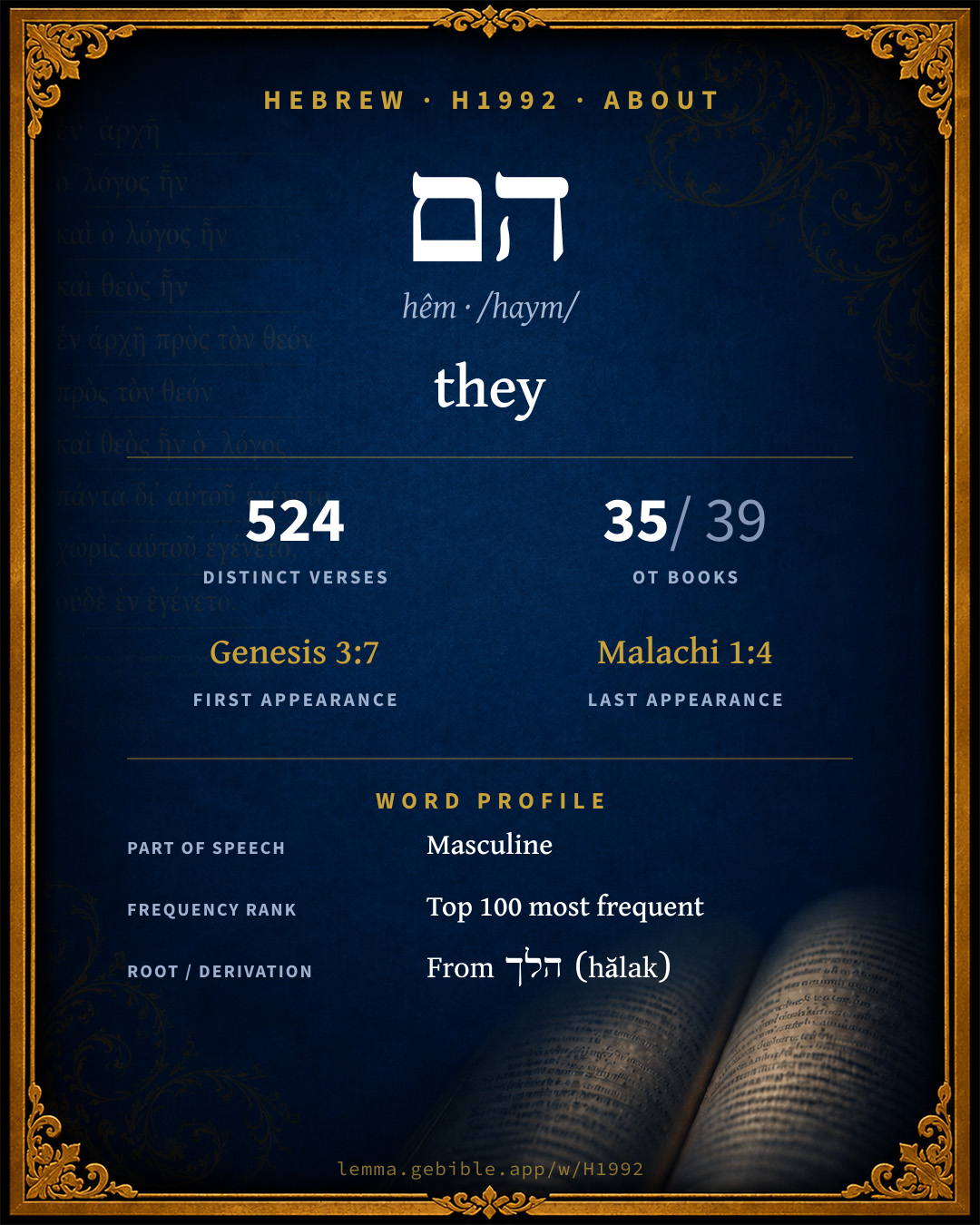
הֵ֫מָּה
they
Full lexicon entry — Brown-Driver-Briggs (BDB)
From Brown-Driver-Briggs (BDB)
Where this word appears
Grammar key — what these labels mean
Part of speech
- Pronoun
- A word standing in for a noun (“he,” “this,” “who”).
- Preposition
- A relational word (e.g. “in,” “to,” “from”) governing a noun.
- Particle
- A short function word — article, negation, interrogative, the sign of the direct object, and the like.
Person
- 3rd Person
- The one spoken about (“he / she / it / they”).
Gender
- Masculine
- Grammatically masculine.
Number
- Plural
- More than one (in Hebrew, generally three or more).
Grammatical forms
- Pronoun, Personal, 3rd Person, Masculine, Plural 561 times (99%)
- Pronoun, Demonstrative, Masculine, Plural 3 times (1%)
- Preposition 1 time (0%)
- Particle, Relative 1 time (0%)
Parsed forms decoded from the imported morphology (morphhb / Westminster Leningrad Codex — WLC text public domain, morphhb tagging CC BY 4.0), counted across 566 parsed occurrences — not distinct verses.
Page 1 of 3 — showing verses 1–200 of 524 distinct verses where H1992 appears, across 35 books. Click any verse to open its interlinear word-by-word view. Verse text shown in the World English Bible for context — . Each verse’s Hebrew form is shown with its reference; the English is not keyword-highlighted, since the data carries no word-level English alignment. Use “Compare translations” on any verse to read it across multiple English versions. This concordance covers the Hebrew Bible; Septuagint (Greek Old Testament) occurrences are not indexed here.
Genesis 20 verses
- Genesis 3:7 הֵ֑ם pron pers 3mp Both of their eyes were opened, and they knew that they were naked. They sewed fig leaves together, and made themselves aprons.
- Genesis 6:4 הָ/הֵם֒ הֵ֧מָּה ptcl def.art + pron pers 3mp pron pers 3mp The Nephilim were in the earth in those days, and also after that, when God's sons came to men's daughters. They bore children to them: the same were the mighty men who were of old, men of renown.
- Genesis 7:14 הֵ֜מָּה pron pers 3mp they, and every animal after its kind, all the cattle after their kind, every creeping thing that creeps on the earth after its kind, and every bird after its kind, every bird of every sort.
- Genesis 14:13 וְ/הֵ֖ם conj + pron pers 3mp One who had escaped came and told Abram, the Hebrew. Now he lived by the oaks of Mamre, the Amorite, brother of Eshcol, and brother of Aner; and these were allies of Abram.
- Genesis 14:24 הֵ֖ם pron pers 3mp Except only that which the young men have eaten, and the portion of the men who went with me, Aner, Eshcol, and Mamre: let them take their portion."
- Genesis 25:16 הֵ֞ם pron pers 3mp These are the sons of Ishmael, and these are their names, by their villages, and by their encampments: twelve princes, according to their nations.
- Genesis 34:21 הֵ֣ם pron pers 3mp "These men are peaceful with us. Therefore let them live in the land and trade in it. For, behold, the land is large enough for them. Let us take their daughters to us for wives, and let us give them our daughters.
- Genesis 34:22 הֵ֥ם pron pers 3mp Only on this condition will the men consent to us to dwell with us, to become one people, if every male among us be circumcised, as they are circumcised.
- Genesis 34:23 הֵ֑ם pron pers 3mp Won't their cattle and their substance and all their animals be ours? Only let us give our consent to them, and they will dwell with us."
- Genesis 37:16 הֵ֥ם pron pers 3mp He said, "I am looking for my brothers. Tell me, please, where they are feeding the flock."
- Genesis 40:12 הֵֽם pron pers 3mp Joseph said to him, "This is the interpretation of it: the three branches are three days.
- Genesis 40:18 הֵֽם pron pers 3mp Joseph answered, "This is the interpretation of it. The three baskets are three days.
- Genesis 42:8 וְ/הֵ֖ם conj + pron pers 3mp Joseph recognized his brothers, but they didn't recognize him.
- Genesis 42:23 וְ/הֵם֙ conj + pron pers 3mp They didn't know that Joseph understood them; for there was an interpreter between them.
- Genesis 42:35 הֵ֚ם הֵ֥מָּה pron pers 3mp pron pers 3mp It happened as they emptied their sacks, that behold, every man's bundle of money was in his sack. When they and their father saw their bundles of money, they were afraid.
- Genesis 44:3 הֵ֖מָּה pron pers 3mp As soon as the morning was light, the men were sent away, they and their donkeys.
- Genesis 44:4 הֵ֠ם pron pers 3mp When they had gone out of the city, and were not yet far off, Joseph said to his steward, "Up, follow after the men. When you overtake them, ask them, 'Why have you rewarded evil for good?
- Genesis 47:14 הֵ֣ם pron pers 3mp Joseph gathered up all the money that was found in the land of Egypt, and in the land of Canaan, for the grain which they bought: and Joseph brought the money into Pharaoh's house.
- Genesis 48:5 הֵ֑ם pron pers 3mp Now your two sons, who were born to you in the land of Egypt before I came to you into Egypt, are mine; Ephraim and Manasseh, even as Reuben and Simeon, will be mine.
- Genesis 48:9 הֵ֔ם pron pers 3mp Joseph said to his father, "They are my sons, whom God has given me here." He said, "Please bring them to me, and I will bless them."
Exodus 22 verses
- Exodus 2:11 הָ/הֵ֗ם ptcl def.art + pron pers 3mp It happened in those days, when Moses had grown up, that he went out to his brothers, and looked at their burdens. He saw an Egyptian striking a Hebrew, one of his brothers.
- Exodus 2:23 הָ/הֵ֗ם ptcl def.art + pron pers 3mp It happened in the course of those many days, that the king of Egypt died, and the children of Israel sighed because of the bondage, and they cried, and their cry came up to God because of the bondage.
- Exodus 5:7 הֵ֚ם pron pers 3mp "You shall no longer give the people straw to make brick, as before. Let them go and gather straw for themselves.
- Exodus 5:8 הֵם֩ הֵ֔ם הֵ֤ם pron pers 3mp pron pers 3mp pron pers 3mp The number of the bricks, which they made before, you require from them. You shall not diminish anything of it, for they are idle; therefore they cry, saying, 'Let us go and sacrifice to our God.'
- Exodus 6:27 הֵ֗ם pron pers 3mp These are those who spoke to Pharaoh king of Egypt, to bring out the children of Israel from Egypt. These are that Moses and Aaron.
- Exodus 7:11 הֵ֜ם pron pers 3mp Then Pharaoh also called for the wise men and the sorcerers. They also, the magicians of Egypt, did in like manner with their enchantments.
- Exodus 8:21 הֵ֥ם pron pers 3mp Else, if you will not let my people go, behold, I will send swarms of flies on you, and on your servants, and on your people, and into your houses: and the houses of the Egyptians shall be full of swarms of flies, and also the ground whereon they are.
- Exodus 14:3 הֵ֖ם pron pers 3mp Pharaoh will say of the children of Israel, 'They are entangled in the land. The wilderness has shut them in.'
- Exodus 15:23 הֵ֑ם pron pers 3mp When they came to Marah, they couldn't drink from the waters of Marah, for they were bitter. Therefore the name of it was called Marah.
- Exodus 18:22 הֵ֑ם pron pers 3mp Let them judge the people at all times. It shall be that every great matter they shall bring to you, but every small matter they shall judge themselves. So shall it be easier for you, and they shall share the load with you.
- Exodus 18:26 הֵֽם pron pers 3mp They judged the people at all times. They brought the hard causes to Moses, but every small matter they judged themselves.
- Exodus 19:13 הֵ֖מָּה pron pers 3mp No hand shall touch him, but he shall surely be stoned or shot through; whether it is animal or man, he shall not live.' When the trumpet sounds long, they shall come up to the mountain."
- Exodus 24:2 וְ/הֵ֖ם conj + pron pers 3mp Moses alone shall come near to Yahweh, but they shall not come near, neither shall the people go up with him."
- Exodus 28:5 וְ/הֵם֙ conj + pron pers 3mp They shall take the gold, and the blue, and the purple, and the scarlet, and the fine linen.
- Exodus 29:33 הֵֽם pron pers 3mp They shall eat those things with which atonement was made, to consecrate and sanctify them: but a stranger shall not eat of it, because they are holy.
- Exodus 30:4 בָּ/הֵֽמָּה prep + pron pers 3mp You shall make two golden rings for it under its molding; on its two ribs, on its two sides you shall make them; and they shall be for places for poles with which to bear it.
- Exodus 32:15 הֵ֥ם pron pers 3mp Moses turned, and went down from the mountain, with the two tablets of the testimony in his hand; tablets that were written on both their sides; on the one side and on the other they were written.
- Exodus 32:16 הֵ֑מָּה pron pers 3mp The tablets were the work of God, and the writing was the writing of God, engraved on the tables.
- Exodus 36:1 בָּ/הֵ֔מָּה prep + pron pers 3mp "Bezalel and Oholiab shall work with every wise-hearted man, in whom Yahweh has put wisdom and understanding to know how to work all the work for the service of the sanctuary, according to all that Yahweh has commanded."
- Exodus 36:3 וְ֠/הֵם conj + pron pers 3mp and they received from Moses all the offering which the children of Israel had brought for the work of the service of the sanctuary, with which to make it. They brought yet to him freewill-offerings every morning.
- Exodus 36:4 הֵ֥מָּה pron pers 3mp All the wise men, who performed all the work of the sanctuary, each came from his work which they did.
- Exodus 38:17 וְ/הֵם֙ conj + pron pers 3mp The sockets for the pillars were of brass. The hooks of the pillars and their fillets were of silver; and the overlaying of their capitals, of silver; and all the pillars of the court were filleted with silver.
Leviticus 19 verses
- Leviticus 8:28 הֵם֙ pron pers 3mp Moses took them from their hands, and burned them on the altar on the burnt offering. They were a consecration for a sweet savor. It was an offering made by fire to Yahweh.
- Leviticus 11:8 הֵ֖ם pron pers 3mp Of their flesh you shall not eat, and their carcasses you shall not touch; they are unclean to you.
- Leviticus 11:10 הֵ֖ם pron pers 3mp All that don't have fins and scales in the seas, and in the rivers, of all that move in the waters, and of all the living creatures that are in the waters, they are an abomination to you,
- Leviticus 11:13 הֵ֑ם pron pers 3mp "'These you shall detest among the birds; they shall not be eaten, they are an abomination: the eagle, and the vulture, and the black vulture,
- Leviticus 11:26 הֵ֖ם pron pers 3mp "'Every animal which parts the hoof, and is not cloven-footed, nor chews the cud, is unclean to you. Everyone who touches them shall be unclean.
- Leviticus 11:27 הֵ֖ם pron pers 3mp Whatever goes on its paws, among all animals that go on all fours, they are unclean to you. Whoever touches their carcass shall be unclean until the evening.
- Leviticus 11:28 הֵ֖מָּה pron pers 3mp He who carries their carcass shall wash his clothes, and be unclean until the evening. They are unclean to you.
- Leviticus 11:35 הֵ֑ם pron pers 3mp Everything whereupon part of their carcass falls shall be unclean; whether oven, or range for pots, it shall be broken in pieces: they are unclean, and shall be unclean to you.
- Leviticus 11:42 הֵֽם pron pers 3mp Whatever goes on its belly, and whatever goes on all fours, or whatever has many feet, even all creeping things that creep on the earth, them you shall not eat; for they are an abomination.
- Leviticus 16:4 הֵ֔ם pron pers 3mp He shall put on the holy linen coat, and he shall have the linen breeches on his body, and shall put on the linen sash, and he shall be dressed with the linen turban. They are the holy garments. He shall bathe his body in water, and put them on.
- Leviticus 17:5 הֵ֣ם pron pers 3mp This is to the end that the children of Israel may bring their sacrifices, which they sacrifice in the open field, that they may bring them to Yahweh, to the door of the Tent of Meeting, to the priest, and sacrifice them for sacrifices of peace offerings to Yahweh.
- Leviticus 17:7 הֵ֥ם pron pers 3mp They shall no more sacrifice their sacrifices to the goat idols, after which they play the prostitute. This shall be a statute forever to them throughout their generations.'
- Leviticus 21:6 הֵ֥ם pron pers 3mp They shall be holy to their God, and not profane the name of their God; for they offer the offerings of Yahweh made by fire, the bread of their God; therefore they shall be holy.
- Leviticus 22:2 הֵ֧ם pron pers 3mp "Tell Aaron and his sons to separate themselves from the holy things of the children of Israel, which they make holy to me, and that they not profane my holy name. I am Yahweh.
- Leviticus 22:11 הֵ֖ם pron pers 3mp But if a priest buys a slave, purchased by his money, he shall eat of it; and such as are born in his house, they shall eat of his bread.
- Leviticus 23:2 הֵ֖ם pron pers 3mp "Speak to the children of Israel, and tell them, 'The set feasts of Yahweh, which you shall proclaim to be holy convocations, even these are my set feasts.
- Leviticus 25:42 הֵ֔ם pron pers 3mp For they are my servants, whom I brought forth out of the land of Egypt. They shall not be sold as slaves.
- Leviticus 25:55 הֵ֔ם pron pers 3mp For to me the children of Israel are servants; they are my servants whom I brought forth out of the land of Egypt. I am Yahweh your God.
- Leviticus 26:43 וְ/הֵ֖ם conj + pron pers 3mp The land also will be left by them, and will enjoy its sabbaths while it lies desolate without them: and they will accept the punishment of their iniquity; because, even because they rejected my ordinances, and their soul abhorred my statutes.
Numbers 30 verses
- Numbers 1:16 הֵֽם pron pers 3mp These are those who were called of the congregation, the princes of the tribes of their fathers; they were the heads of the thousands of Israel.
- Numbers 1:50 הֵ֜מָּה וְ/הֵ֖ם pron pers 3mp conj + pron pers 3mp but appoint the Levites over the Tabernacle of the Testimony, and over all its furnishings, and over all that belongs to it. They shall carry the tabernacle, and all its furnishings; and they shall take care of it, and shall encamp around it.
- Numbers 3:9 הֵ֨מָּה֙ pron pers 3mp You shall give the Levites to Aaron and to his sons. They are wholly given to him on the behalf of the children of Israel.
- Numbers 3:20 הֵ֛ם pron pers 3mp The sons of Merari by their families: Mahli and Mushi. These are the families of the Levites according to their fathers' houses.
- Numbers 3:21 הֵ֔ם pron pers 3mp Of Gershon was the family of the Libnites, and the family of the Shimeites: these are the families of the Gershonites.
- Numbers 3:27 הֵ֖ם pron pers 3mp Of Kohath was the family of the Amramites, and the family of the Izharites, and the family of the Hebronites, and the family of the Uzzielites: these are the families of the Kohathites.
- Numbers 3:33 הֵ֖ם pron pers 3mp Of Merari was the family of the Mahlites, and the family of the Mushites. These are the families of Merari.
- Numbers 4:22 הֵ֑ם pron pers 3mp "Take a census of the sons of Gershon also, by their fathers' houses, by their families;
- Numbers 7:2 הֵ֚ם הֵ֥ם pron pers 3mp pron pers 3mp that the princes of Israel, the heads of their fathers' houses, offered. These were the princes of the tribes. These are they who were over those who were numbered:
- Numbers 8:16 הֵ֨מָּה֙ pron pers 3mp For they are wholly given to me from among the children of Israel; instead of all who open the womb, even the firstborn of all the children of Israel, I have taken them to me.
- Numbers 9:7 הָ/הֵ֨מָּה֙ ptcl def.art + pron pers 3mp Those men said to him, "We are unclean because of the dead body of a man. Why are we kept back, that we may not offer the offering of Yahweh in its appointed season among the children of Israel?"
- Numbers 11:16 הֵ֛ם pron pers 3mp Yahweh said to Moses, Gather to me seventy men of the elders of Israel, whom you know to be the elders of the people, and officers over them; and bring them to the tent of meeting, that they may stand there with you.
- Numbers 11:26 וְ/הֵ֨מָּה֙ conj + pron pers 3mp But there remained two men in the camp, the name of the one was Eldad, and the name of the other Medad: and the Spirit rested on them; and they were of those who were written, but had not gone out to the Tent; and they prophesied in the camp.
- Numbers 13:3 הֵֽמָּה pron pers 3mp Moses sent them from the wilderness of Paran according to the commandment of Yahweh: all of them men who were heads of the children of Israel.
- Numbers 14:9 הֵ֑ם pron pers 3mp Only don't rebel against Yahweh, neither fear the people of the land; for they are bread for us: their defense is removed from over them, and Yahweh is with us: don't fear them.
- Numbers 14:27 הֵ֥מָּה הֵ֧מָּה pron pers 3mp pron pers 3mp How long [shall I bear] with this evil congregation, that murmur against me? I have heard the murmurings of the children of Israel, which they murmur against me.
- Numbers 14:38 הָ/הֵ֔ם ptcl def.art + pron pers 3mp But Joshua the son of Nun, and Caleb the son of Jephunneh, remained alive of those men who went to spy out the land.
- Numbers 15:25 וְ/הֵם֩ conj + pron pers 3mp The priest shall make atonement for all the congregation of the children of Israel, and they shall be forgiven; for it was an error, and they have brought their offering, an offering made by fire to Yahweh, and their sin-offering before Yahweh, for their error:
- Numbers 16:14 הָ/הֵ֛ם ptcl def.art + pron pers 3mp Moreover you haven't brought us into a land flowing with milk and honey, nor given us inheritance of fields and vineyards: will you put out the eyes of these men? we won't come up.
- Numbers 16:16 וָ/הֵ֛ם conj + pron pers 3mp Moses said to Korah, You and all your company go before Yahweh, you, and they, and Aaron, tomorrow:
- Numbers 16:33 הֵ֣ם pron pers 3mp So they, and all that appertained to them, went down alive into Sheol: and the earth closed on them, and they perished from among the assembly.
- Numbers 17:5 הֵ֥ם pron pers 3mp It shall happen, that the rod of the man whom I shall choose shall bud: and I will make to cease from me the murmurings of the children of Israel, which they murmur against you.
- Numbers 18:3 הֵ֖ם pron pers 3mp They shall keep your charge, and the charge of all the Tent: only they shall not come near to the vessels of the sanctuary and to the altar, that they not die, neither they, nor you.
- Numbers 18:17 הֵ֑ם pron pers 3mp But the firstborn of a cow, or the firstborn of a sheep, or the firstborn of a goat, you shall not redeem; they are holy: you shall sprinkle their blood on the altar, and shall burn their fat for an offering made by fire, for a sweet savor to Yahweh.
- Numbers 18:21 הֵ֣ם pron pers 3mp To the children of Levi, behold, I have given all the tithe in Israel for an inheritance, in return for their service which they serve, even the service of the tent of meeting.
- Numbers 18:23 וְ/הֵ֖ם conj + pron pers 3mp But the Levites shall do the service of the tent of meeting, and they shall bear their iniquity: it shall be a statute forever throughout your generations; and among the children of Israel they shall have no inheritance.
- Numbers 20:13 הֵ֚מָּה pron pers 3mp These are the waters of Meribah; because the children of Israel strove with Yahweh, and he was sanctified in them.
- Numbers 25:6 וְ/הֵ֣מָּה conj + pron pers 3mp Behold, one of the children of Israel came and brought to his brothers a Midianite woman in the sight of Moses, and in the sight of all the congregation of the children of Israel, while they were weeping at the door of the tent of meeting.
- Numbers 25:18 הֵם֙ pron pers 3mp for they vex you with their wiles, with which they have deceived you in the matter of Peor, and in the matter of Cozbi, the daughter of the prince of Midian, their sister, who was slain on the day of the plague in the matter of Peor.
- Numbers 27:14 הֵ֛ם pron pers 3mp because you rebelled against my word in the wilderness of Zin, in the strife of the congregation, to sanctify me at the waters before their eyes. (These are the waters of Meribah of Kadesh in the wilderness of Zin.)
Deuteronomy 19 verses
- Deuteronomy 1:39 הֵ֖מָּה וְ/הֵ֖ם pron pers 3mp conj + pron pers 3mp Moreover your little ones, whom you said should be a prey, and your children, who this day have no knowledge of good or evil, they shall go in there, and to them will I give it, and they shall possess it.
- Deuteronomy 2:11 הֵ֖ם pron pers 3mp these also are accounted Rephaim, as the Anakim; but the Moabites call them Emim.
- Deuteronomy 3:20 הֵ֔ם pron pers 3mp until Yahweh give rest to your brothers, as to you, and they also possess the land which Yahweh your God gives them beyond the Jordan: then shall you return every man to his possession, which I have given you.
- Deuteronomy 4:10 הֵ֤ם pron pers 3mp the day that you stood before Yahweh your God in Horeb, when Yahweh said to me, Assemble me the people, and I will make them hear my words, that they may learn to fear me all the days that they live on the earth, and that they may teach their children.
- Deuteronomy 9:29 וְ/הֵ֥ם conj + pron pers 3mp Yet they are your people and your inheritance, which you brought out by your great power and by your outstretched arm.
- Deuteronomy 11:30 הֵ֜מָּה pron pers 3mp Aren't they beyond the Jordan, behind the way of the going down of the sun, in the land of the Canaanites who dwell in the Arabah, over against Gilgal, beside the oaks of Moreh?
- Deuteronomy 14:7 הֵ֗מָּה הֵ֖ם pron pers 3mp pron pers 3mp Nevertheless these you shall not eat of them that chew the cud, or of those who have the hoof cloven: the camel, and the hare, and the rabbit; because they chew the cud but don't part the hoof, they are unclean to you.
- Deuteronomy 17:9 הָ/הֵ֑ם ptcl def.art + pron pers 3mp and you shall come to the priests the Levites, and to the judge who shall be in those days: and you shall inquire; and they shall show you the sentence of judgment.
- Deuteronomy 18:9 הָ/הֵֽם ptcl def.art + pron pers 3mp When you are come into the land which Yahweh your God gives you, you shall not learn to do after the abominations of those nations.
- Deuteronomy 19:17 הָ/הֵֽם ptcl def.art + pron pers 3mp then both the men, between whom the controversy is, shall stand before Yahweh, before the priests and the judges who shall be in those days;
- Deuteronomy 26:3 הָ/הֵ֑ם ptcl def.art + pron pers 3mp You shall come to the priest who shall be in those days, and tell him, I profess this day to Yahweh your God, that I am come to the land which Yahweh swore to our fathers to give us.
- Deuteronomy 28:65 הָ/הֵם֙ ptcl def.art + pron pers 3mp Among these nations shall you find no ease, and there shall be no rest for the sole of your foot: but Yahweh will give you there a trembling heart, and failing of eyes, and pining of soul;
- Deuteronomy 29:3 הָ/הֵֽם ptcl def.art + pron pers 3mp the great trials which your eyes saw, the signs, and those great wonders:
- Deuteronomy 29:18 הָ/הֵ֑ם ptcl def.art + pron pers 3mp lest there should be among you man, or woman, or family, or tribe, whose heart turns away this day from Yahweh our God, to go to serve the gods of those nations; lest there should be among you a root that bears gall and wormwood;
- Deuteronomy 32:20 הֵ֔מָּה pron pers 3mp He said, I will hide my face from them, I will see what their end shall be: For they are a very perverse generation, Children in whom is no faithfulness.
- Deuteronomy 32:21 הֵ֚ם pron pers 3mp They have moved me to jealousy with that which is not God; They have provoked me to anger with their vanities: I will move them to jealousy with those who are not a people; I will provoke them to anger with a foolish nation.
- Deuteronomy 32:28 הֵ֑מָּה pron pers 3mp For they are a nation void of counsel, There is no understanding in them.
- Deuteronomy 33:3 וְ/הֵם֙ conj + pron pers 3mp Yes, he loves the people; All his saints are in your hand: They sat down at your feet; [Everyone] shall receive of your words.
- Deuteronomy 33:17 וְ/הֵם֙ וְ/הֵ֖ם conj + pron pers 3mp conj + pron pers 3mp The firstborn of his herd, majesty is his; His horns are the horns of the wild-ox: With them he shall push the peoples all of them, [even] the ends of the earth: They are the ten thousands of Ephraim, They are the thousands of Manasseh.
Joshua 12 verses
- Joshua 1:15 הֵ֔מָּה pron pers 3mp until Yahweh have given your brothers rest, as [he has given] you, and they also have possessed the land which Yahweh your God gives them: then you shall return to the land of your possession, and possess it, which Moses the servant of Yahweh gave you beyond the Jordan toward the sunrise.
- Joshua 2:4 הֵֽמָּה pron pers 3mp The woman took the two men, and hid them; and she said, Yes, the men came to me, but I didn't know whence they were:
- Joshua 2:8 וְ/הֵ֖מָּה conj + pron pers 3mp Before they were laid down, she came up to them on the roof;
- Joshua 7:3 הֵֽמָּה pron pers 3mp They returned to Joshua, and said to him, Don't let all the people go up; but let about two or three thousand men go up and strike Ai; don't make all the people to toil there; for they are but few.
- Joshua 9:4 הֵ֨מָּה֙ pron pers 3mp they also resorted to a ruse, and went and made as if they had been ambassadors, and took old sacks on their donkeys, and wine-skins, old and torn and bound up,
- Joshua 9:16 הֵם֙ הֵ֥ם pron pers 3mp pron pers 3mp It happened at the end of three days after they had made a covenant with them, that they heard that they were their neighbors, and that they lived among them.
- Joshua 10:5 הֵ֖ם pron pers 3mp Therefore the five kings of the Amorites, the king of Jerusalem, the king of Hebron, the king of Jarmuth, the king of Lachish, the king of Eglon, gathered themselves together, and went up, they and all their hosts, and encamped against Gibeon, and made war against it.
- Joshua 10:11 הֵ֞ם pron pers 3mp It happened, as they fled from before Israel, while they were at the descent of Beth Horon, that Yahweh cast down great stones from the sky on them to Azekah, and they died: they were more who died with the hailstones than they whom the children of Israel killed with the sword.
- Joshua 11:4 הֵ֗ם pron pers 3mp They went out, they and all their hosts with them, much people, even as the sand that is on the sea-shore in multitude, with horses and chariots very many.
- Joshua 20:6 הָ/הֵ֑ם ptcl def.art + pron pers 3mp He shall dwell in that city, until he stand before the congregation for judgment, until the death of the high priest that shall be in those days: then shall the manslayer return, and come to his own city, and to his own house, to the city from whence he fled.
- Joshua 22:14 הֵ֖מָּה pron pers 3mp and with him ten princes, one prince of a fathers' house for each of the tribes of Israel; and they were everyone of them head of their fathers' houses among the thousands of Israel.
- Joshua 23:12 וְ/הֵ֥ם conj + pron pers 3mp Else if you do at all go back, and cleave to the remnant of these nations, even these who remain among you, and make marriages with them, and go in to them, and they to you;
Judges 22 verses
- Judges 1:22 הֵ֖ם pron pers 3mp The house of Joseph, they also went up against Bethel; and Yahweh was with them.
- Judges 2:22 הֵם֩ pron pers 3mp that by them I may prove Israel, whether they will keep the way of Yahweh to walk therein, as their fathers did keep it, or not.
- Judges 6:5 הֵם֩ pron pers 3mp For they came up with their cattle and their tents; they came in as locusts for multitude; both they and their camels were without number: and they came into the land to destroy it.
- Judges 8:5 הֵ֔ם pron pers 3mp He said to the men of Succoth, Please give loaves of bread to the people who follow me; for they are faint, and I am pursuing after Zebah and Zalmunna, the kings of Midian.
- Judges 8:19 הֵ֑ם pron pers 3mp He said, They were my brothers, the sons of my mother: as Yahweh lives, if you had saved them alive, I would not kill you.
- Judges 8:24 הֵֽם pron pers 3mp Gideon said to them, I would make a request of you, that you would give me every man the ear-rings of his spoil. (For they had golden ear-rings, because they were Ishmaelites.)
- Judges 10:14 הֵ֛מָּה pron pers 3mp Go and cry to the gods which you have chosen; let them save you in the time of your distress.
- Judges 17:6 הָ/הֵ֔ם ptcl def.art + pron pers 3mp In those days there was no king in Israel: every man did that which was right in his own eyes.
- Judges 18:1 הָ/הֵ֔ם הָ/הֵ֗ם ptcl def.art + pron pers 3mp ptcl def.art + pron pers 3mp In those days there was no king in Israel: and in those days the tribe of the Danites sought them an inheritance to dwell in; for to that day [their] inheritance had not fallen to them among the tribes of Israel.
- Judges 18:3 הֵ֚מָּה וְ/הֵ֣מָּה pron pers 3mp conj + pron pers 3mp When they were by the house of Micah, they knew the voice of the young man the Levite; and they turned aside there, and said to him, Who brought you here? and what do you in this place? and what have you here?
- Judges 18:7 הֵ֨מָּה֙ pron pers 3mp Then the five men departed, and came to Laish, and saw the people who were therein, how they lived in security, after the manner of the Sidonians, quiet and secure; for there was none in the land, possessing authority, that might put [them] to shame in anything, and they were far from the Sidonians, and had no dealings with any man.
- Judges 18:22 הֵ֥מָּה pron pers 3mp When they were a good way from the house of Micah, the men who were in the houses near to Micah's house were gathered together, and overtook the children of Dan.
- Judges 18:26 הֵ֨מָּה֙ pron pers 3mp The children of Dan went their way: and when Micah saw that they were too strong for him, he turned and went back to his house.
- Judges 18:27 וְ/הֵ֨מָּה conj + pron pers 3mp They took that which Micah had made, and the priest whom he had, and came to Laish, to a people quiet and secure, and struck them with the edge of the sword; and they burnt the city with fire.
- Judges 19:1 הָ/הֵ֔ם ptcl def.art + pron pers 3mp It happened in those days, when there was no king in Israel, that there was a certain Levite sojourning on the farther side of the hill-country of Ephraim, who took to him a concubine out of Bethlehem Judah.
- Judges 19:11 הֵ֣ם pron pers 3mp When they were by Jebus, the day was far spent; and the servant said to his master, Please come and let us turn aside into this city of the Jebusites, and lodge in it.
- Judges 19:22 הֵמָּה֮ pron pers 3mp As they were making their hearts merry, behold, the men of the city, certain base fellows, beset the house round about, beating at the door; and they spoke to the master of the house, the old man, saying, Bring forth the man who came into your house, that we may know him.
- Judges 20:27 הָ/הֵֽם ptcl def.art + pron pers 3mp The children of Israel asked of Yahweh (for the ark of the covenant of God was there in those days,
- Judges 20:28 הָ/הֵם֮ ptcl def.art + pron pers 3mp and Phinehas, the son of Eleazar, the son of Aaron, stood before it in those days), saying, Shall I yet again go out to battle against the children of Benjamin my brother, or shall I cease? Yahweh said, Go up; for tomorrow I will deliver him into your hand.
- Judges 20:32 הֵ֛ם pron pers 3mp The children of Benjamin said, They are struck down before us, as at the first. But the children of Israel said, Let us flee, and draw them away from the city to the highways.
- Judges 20:34 וְ/הֵם֙ conj + pron pers 3mp There came over against Gibeah ten thousand chosen men out of all Israel, and the battle was sore; but they didn't know that evil was close on them.
- Judges 21:25 הָ/הֵ֔ם ptcl def.art + pron pers 3mp In those days there was no king in Israel: every man did that which was right in his own eyes.
Ruth 1 verse
1 Samuel 21 verses
- 1 Samuel 3:1 הָ/הֵ֔ם ptcl def.art + pron pers 3mp The child Samuel ministered to Yahweh before Eli. The word of Yahweh was precious in those days; there was no frequent vision.
- 1 Samuel 4:8 הֵ֣ם pron pers 3mp Woe to us! who shall deliver us out of the hand of these mighty gods? these are the gods that struck the Egyptians with all manner of plagues in the wilderness.
- 1 Samuel 8:8 הֵ֥מָּה pron pers 3mp According to all the works which they have done since the day that I brought them up out of Egypt even to this day, in that they have forsaken me, and served other gods, so do they also to you.
- 1 Samuel 9:5 הֵ֗מָּה pron pers 3mp When they had come to the land of Zuph, Saul said to his servant who was with him, Come, and let us return, lest my father leave off caring for the donkeys, and be anxious for us.
- 1 Samuel 9:11 הֵ֗מָּה וְ/הֵ֨מָּה֙ pron pers 3mp conj + pron pers 3mp As they went up the ascent to the city, they found young maidens going out to draw water, and said to them, Is the seer here?
- 1 Samuel 9:14 הֵ֗מָּה pron pers 3mp They went up to the city; [and] as they came within the city, behold, Samuel came out toward them, to go up to the high place.
- 1 Samuel 9:22 וְ/הֵ֖מָּה conj + pron pers 3mp Samuel took Saul and his servant, and brought them into the guest-chamber, and made them sit in the best place among those who were invited, who were about thirty persons.
- 1 Samuel 9:27 הֵ֗מָּה pron pers 3mp As they were going down at the end of the city, Samuel said to Saul, Bid the servant pass on before us (and he passed on), but stand you still first, that I may cause you to hear the word of God.
- 1 Samuel 10:5 וְ/הֵ֖מָּה conj + pron pers 3mp After that you shall come to the hill of God, where is the garrison of the Philistines: and it shall happen, when you are come there to the city, that you shall meet a band of prophets coming down from the high place with a psaltery, and a tambourine, and a pipe, and a harp, before them; and they will be prophesying:
- 1 Samuel 12:21 הֵֽמָּה pron pers 3mp and don't turn aside; for [then would you go] after vain things which can't profit nor deliver, for they are vain.
- 1 Samuel 14:15 הֵ֑מָּה pron pers 3mp There was a trembling in the camp, in the field, and among all the people; the garrison, and the spoilers, they also trembled; and the earth quaked: so there was an exceeding great trembling.
- 1 Samuel 14:21 הֵ֗מָּה pron pers 3mp Now the Hebrews who were with the Philistines as before, and who went up with them into the camp, [from the country] round about, even they also [turned] to be with the Israelites who were with Saul and Jonathan.
- 1 Samuel 14:22 הֵ֛מָּה pron pers 3mp Likewise all the men of Israel who had hid themselves in the hill-country of Ephraim, when they heard that the Philistines fled, even they also followed hard after them in the battle.
- 1 Samuel 17:19 וְ/הֵ֨מָּה֙ conj + pron pers 3mp Now Saul, and they, and all the men of Israel, were in the valley of Elah, fighting with the Philistines.
- 1 Samuel 19:20 הֵֽמָּה pron pers 3mp Saul sent messengers to take David: and when they saw the company of the prophets prophesying, and Samuel standing as head over them, the Spirit of God came on the messengers of Saul, and they also prophesied.
- 1 Samuel 19:21 הֵ֑מָּה הֵֽמָּה pron pers 3mp pron pers 3mp When it was told Saul, he sent other messengers, and they also prophesied. Saul sent messengers again the third time, and they also prophesied.
- 1 Samuel 23:1 וְ/הֵ֖מָּה conj + pron pers 3mp They told David, saying, Behold, the Philistines are fighting against Keilah, and are robbing the threshing floors.
- 1 Samuel 25:11 הֵֽמָּה pron pers 3mp Shall I then take my bread, and my water, and my meat that I have killed for my shearers, and give it to men who I don't know where they come from?
- 1 Samuel 26:19 הֵם֙ pron pers 3mp Now therefore, please let my lord the king hear the words of his servant. If it be Yahweh that has stirred you up against me, let him accept an offering: but if it be the children of men, cursed be they before Yahweh: for they have driven me out this day that I shouldn't cling to Yahweh's inheritance, saying, Go, serve other gods.
- 1 Samuel 28:1 הָ/הֵ֔ם ptcl def.art + pron pers 3mp It happened in those days, that the Philistines gathered their hosts together for warfare, to fight with Israel. Achish said to David, Know you assuredly, that you shall go out with me in the host, you and your men.
- 1 Samuel 29:4 הָ/הֵֽם ptcl def.art + pron pers 3mp But the princes of the Philistines were angry with him; and the princes of the Philistines said to him, Make the man return, that he may go back to his place where you have appointed him, and let him not go down with us to battle, lest in the battle he become an adversary to us: for with what should this [fellow] reconcile himself to his lord? should it not be with the heads of these men?
2 Samuel 9 verses
- 2 Samuel 2:24 וְ/הֵ֗מָּה conj + pron pers 3mp But Joab and Abishai pursued after Abner: and the sun went down when they were come to the hill of Ammah, that lies before Giah by the way of the wilderness of Gibeon.
- 2 Samuel 13:30 הֵ֣מָּה pron pers 3mp It happened, while they were in the way, that the news came to David, saying, Absalom has slain all the king's sons, and there is not one of them left.
- 2 Samuel 16:23 הָ/הֵ֔ם ptcl def.art + pron pers 3mp The counsel of Ahithophel, which he gave in those days, was as if a man inquired at the oracle of God: so was all the counsel of Ahithophel both with David and with Absalom.
- 2 Samuel 17:8 הֵ֗מָּה הֵ֔מָּה pron pers 3mp pron pers 3mp Hushai said moreover, You know your father and his men, that they are mighty men, and they are fierce in their minds, as a bear robbed of her cubs in the field; and your father is a man of war, and will not lodge with the people.
- 2 Samuel 17:17 וְ/הֵם֙ conj + pron pers 3mp Now Jonathan and Ahimaaz were staying by En Rogel; and a maid-servant used to go and tell them; and they went and told king David: for they might not be seen to come into the city.
- 2 Samuel 20:8 הֵ֗ם pron pers 3mp When they were at the great stone which is in Gibeon, Amasa came to meet them. Joab was girded with his apparel of war that he had put on, and thereon was a sash with a sword fastened on his loins in the sheath of it; and as he went forth it fell out.
- 2 Samuel 21:2 הֵ֗מָּה pron pers 3mp The king called the Gibeonites, and said to them (now the Gibeonites were not of the children of Israel, but of the remnant of the Amorites; and the children of Israel had sworn to them: and Saul sought to kill them in his zeal for the children of Israel and Judah);
- 2 Samuel 21:9 ו/הם וְ/הֵ֨מָּה conj + pron pers 3mp conj + pron pers 3mp He delivered them into the hands of the Gibeonites, and they hanged them in the mountain before Yahweh, and they fell [all] seven together. They were put to death in the days of harvest, in the first days, at the beginning of barley harvest.
- 2 Samuel 24:3 כָּ/הֵ֤ם וְ/כָ/הֵם֙ prep + pron pers 3mp conj + prep + pron pers 3mp Joab said to the king, Now Yahweh your God add to the people, however many they may be, one hundred times; and may the eyes of my lord the king see it: but why does my lord the king delight in this thing?
1 Kings 24 verses
- 1 Kings 1:41 וְ/הֵ֖ם conj + pron pers 3mp Adonijah and all the guests who were with him heard it as they had made an end of eating. When Joab heard the sound of the trumpet, he said, Why is this noise of the city being in an uproar?
- 1 Kings 3:2 הָ/הֵֽם ptcl def.art + pron pers 3mp Only the people sacrificed in the high places, because there was no house built for the name of Yahweh until those days.
- 1 Kings 8:40 הֵ֥ם pron pers 3mp that they may fear you all the days that they live in the land which you gave to our fathers.
- 1 Kings 8:51 הֵ֑ם pron pers 3mp (for they are your people, and your inheritance, which you brought forth out of Egypt, from the midst of the furnace of iron);
- 1 Kings 9:20 הֵֽמָּה pron pers 3mp As for all the people who were left of the Amorites, the Hittites, the Perizzites, the Hivites, and the Jebusites, who were not of the children of Israel;
- 1 Kings 9:22 הֵ֞ם pron pers 3mp But of the children of Israel did Solomon make no bondservants; but they were the men of war, and his servants, and his princes, and his captains, and rulers of his chariots and of his horsemen.
- 1 Kings 10:25 וְ/הֵ֣מָּה conj + pron pers 3mp They brought every man his tribute, vessels of silver, and vessels of gold, and clothing, and armor, and spices, horses, and mules, a rate year by year.
- 1 Kings 11:2 וְ/הֵם֙ conj + pron pers 3mp of the nations concerning which Yahweh said to the children of Israel, You shall not go among them, neither shall they come among you; for surely they will turn away your heart after their gods: Solomon joined to these in love.
- 1 Kings 11:41 הֵ֣ם pron pers 3mp Now the rest of the acts of Solomon, and all that he did, and his wisdom, aren't they written in the book of the acts of Solomon?
- 1 Kings 13:20 הֵ֥ם pron pers 3mp It happened, as they sat at the table, that the word of Yahweh came to the prophet who brought him back;
- 1 Kings 14:23 הֵ֧מָּה pron pers 3mp For they also built them high places, and pillars, and Asherim, on every high hill, and under every green tree;
- 1 Kings 14:29 הֵ֣מָּה pron pers 3mp Now the rest of the acts of Rehoboam, and all that he did, aren't they written in the book of the chronicles of the kings of Judah?
- 1 Kings 15:7 הֵ֣ם pron pers 3mp The rest of the acts of Abijam, and all that he did, aren't they written in the book of the chronicles of the kings of Judah? There was war between Abijam and Jeroboam.
- 1 Kings 15:23 הֵ֣מָּה pron pers 3mp Now the rest of all the acts of Asa, and all his might, and all that he did, and the cities which he built, aren't they written in the book of the chronicles of the kings of Judah? But in the time of his old age he was diseased in his feet.
- 1 Kings 15:31 הֵ֣ם pron pers 3mp Now the rest of the acts of Nadab, and all that he did, aren't they written in the book of the chronicles of the kings of Israel?
- 1 Kings 16:5 הֵ֣ם pron pers 3mp Now the rest of the acts of Baasha, and what he did, and his might, aren't they written in the book of the chronicles of the kings of Israel?
- 1 Kings 16:14 הֵ֣ם pron pers 3mp Now the rest of the acts of Elah, and all that he did, aren't they written in the book of the chronicles of the kings of Israel?
- 1 Kings 16:20 הֵ֣ם pron pers 3mp Now the rest of the acts of Zimri, and his treason that he did, aren't they written in the book of the chronicles of the kings of Israel?
- 1 Kings 16:27 הֵ֣ם pron pers 3mp Now the rest of the acts of Omri which he did, and his might that he shown, aren't they written in the book of the chronicles of the kings of Israel?
- 1 Kings 20:3 הֵֽם pron pers 3mp Your silver and your gold is mine; your wives also and your children, even the best, are mine.
- 1 Kings 20:31 הֵ֑ם pron pers 3mp His servants said to him, See now, we have heard that the kings of the house of Israel are merciful kings: let us, we pray you, put sackcloth on our loins, and ropes on our heads, and go out to the king of Israel: peradventure he will save your life.
- 1 Kings 22:32 וְ/הֵ֤מָּה conj + pron pers 3mp It happened, when the captains of the chariots saw Jehoshaphat, that they said, Surely it is the king of Israel; and they turned aside to fight against him: and Jehoshaphat cried out.
- 1 Kings 22:39 הֵ֣ם pron pers 3mp Now the rest of the acts of Ahab, and all that he did, and the ivory house which he built, and all the cities that he built, aren't they written in the book of the chronicles of the kings of Israel?
- 1 Kings 22:45 הֵ֣ם pron pers 3mp Now the rest of the acts of Jehoshaphat, and his might that he shown, and how he warred, aren't they written in the book of the chronicles of the kings of Judah?
2 Kings 38 verses
About this entry
At a glance — auto-summarized from this page’s data, not written by a person. Every figure links to its source below. This summary describes the numbers; it doesn’t interpret them.
הם — transliterated hêm — is a Hebrew word carrying the sense “they.” Debuting at Genesis 3:7, it then recurs through the corpus. The Hebrew Bible uses it across 524 verses — among the most common. It shares a root with הלך, הוך and הלך. See the sense tree, 524-verse concordance, and the renderings breakdown below.
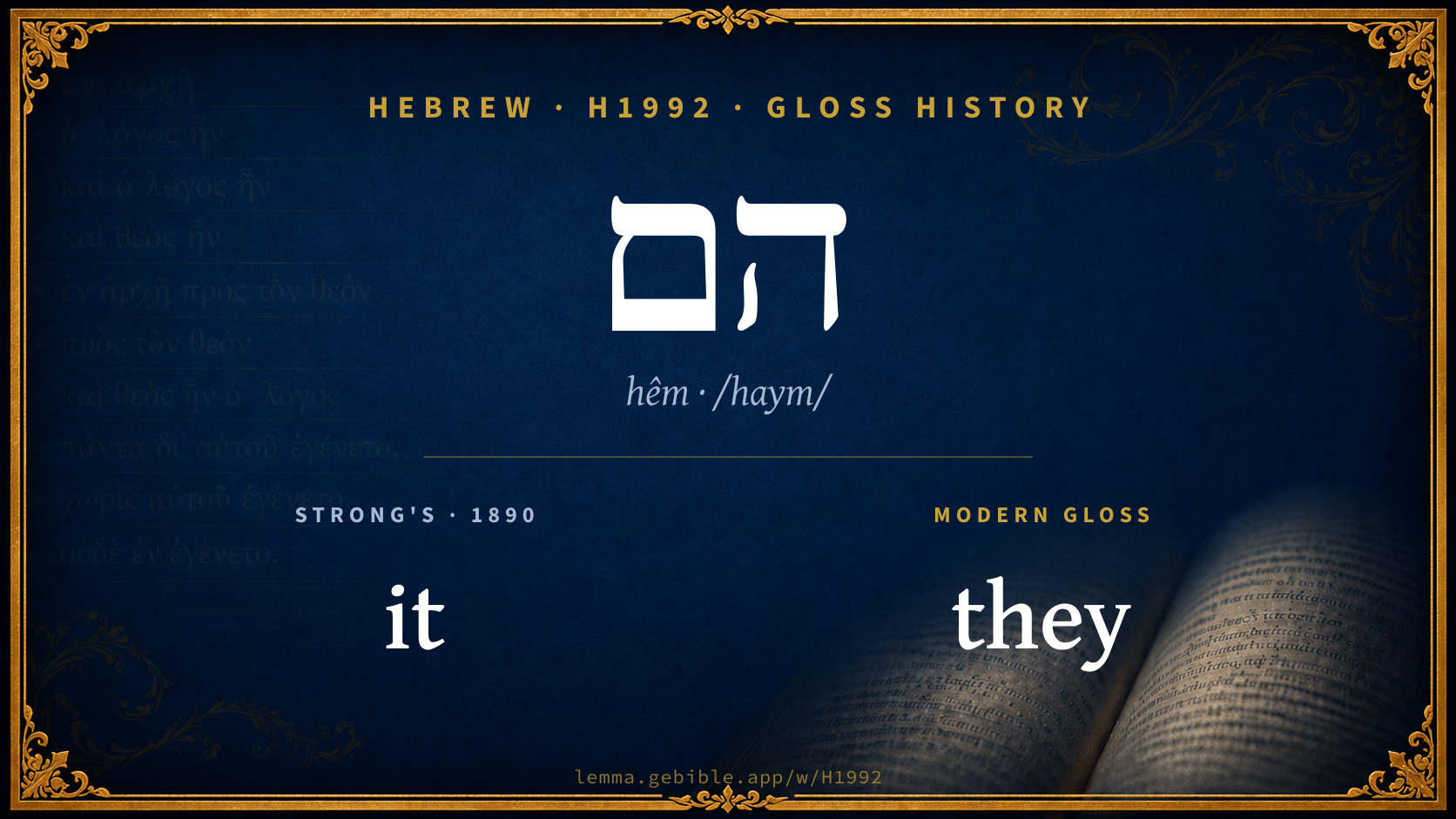
Gloss history
Strong's 1890 vs modern scholarship
About this word
Strong's H1992 catalogs a Hebrew word from the Hebrew Old Testament.
These counts are not copied from any lexicon or concordance. They are computed here, from the morphology-tagged Hebrew Old Testament. What Lemma adds →
- 524
- distinct verses
- The word appears in 524 distinct verses.
- 35 / 39
- OT books
- The word appears in 35 of 39 Old Testament books.
- #88
- by frequency
- Top 100 most frequent Hebrew words (rank 88 of 8,640 Hebrew words by occurrence).
View all 524 occurrences in the concordance →
By section of the Old Testament
By traditional corpus
Conventional, traditional groupings — biblical authorship is debated, so this is a traditional corpus grouping, not an authorship claim. Each share is this word’s portion of its verses in that division of the Hebrew canon. Each figure is a share of the word’s 524 distinct verses.
- Prophets (Nevi'im) 298 verses · 57%
- Writings (Ketuvim) 116 verses · 22%
- Torah (Pentateuch) 110 verses · 21%
How translations render this word
Counts come from each version’s own published word-to-Strong’s tagging or interlinear alignment — an approximate guide to how each version renders this word, not a word-level alignment the data otherwise carries. Because each total is that version’s own tagged count, the per-version totals vary from one another and need not match the appearance or distinct-verse counts above. These counts may also differ from a printed concordance because Lemma counts each distinctly tagged rendering and does not collapse phrase taggings into a single head-word total. This is a fixed set of word-tagged versions (KJV, ASV, BSB, ULT) and does not change with the reading translation you choose elsewhere. Each version’s license is shown beside its name below (and on Sources).
- King James Version: These 5×, They 5×, Them 4×
- American Standard Version: Them 4×, These 4×, They 4×
- Berean Standard Bible: They 256×, Those 40×, Are they 11×
- unfoldingWord Literal Text: They 387×, Those 47×, Are 27×
King James Version Public Domain
Renders H1992 across 42 tagged occurrences — most commonly:
Plus 22 renderings that appear only once — usually multi-word phrases or single function words the recovered tagging swept in, not distinct renderings. Not rendered by a distinct English word in 2 further occurrences.
American Standard Version Public Domain
Renders H1992 across 43 tagged occurrences — most commonly:
Plus 21 renderings that appear only once — usually multi-word phrases or single function words the recovered tagging swept in, not distinct renderings.
Berean Standard Bible Public Domain
Renders H1992 across 426 tagged occurrences — most commonly:
Plus other, less common renderings. Plus 44 renderings that appear only once — usually multi-word phrases or single function words the recovered tagging swept in, not distinct renderings. Not rendered by a distinct English word in 122 further occurrences.
unfoldingWord Literal Text CC BY-SA 4.0
Renders H1992 across 586 tagged occurrences — most commonly:
Plus other, less common renderings. Plus 21 renderings that appear only once — usually multi-word phrases or single function words the recovered tagging swept in, not distinct renderings.
21 senses and sub-senses in the full BDB
What do BDB’s symbols mean?
BDB uses these scholarly abbreviations:
| Symbol | Meaning |
|---|---|
| 𝔊 | the Septuagint (the ancient Greek translation, LXX) |
| 𝔙 | the Vulgate (the Latin translation) |
| 𝔖 | the Syriac version (the Peshitta) |
| 𝔗 | the Targum (the Aramaic translation) |
| ψ | the Psalms |
| √ | root (the underlying root or stem) |
| ‖ | parallel passage (a synonymous or contrasted parallel) |
| † | the dagger: every passage where the word occurs is cited |
The 21 senses and sub-senses the full Brown-Driver-Briggs lexicon distinguishes for this word, in lexicon order (not ranked by frequency), with BDB’s own verbatim wording and sub-sense lettering. Shown in Hebrew script with BDB’s own scholarly abbreviations. The condensed entry is in the Lexicon Entry tab. See also the Forms in the corpus table below.
- 1.
- a. Gn 6:4; Ex 5:7 הֵם יֵֽלְכוּ let them (emph.) go and gather straw, Nu 31:16; Is 24:14; Ho 4:14; 7:3 etc.; after כִּי Je 5:5; 34:7. (For the use in circumst. clauses v. Dr§ 160, 169.) e.g. Genesis 6:4
- b. Ju 1:22 ויעלו … גַם הֵם, Dt 2:11 (אַף הֵם), 3:20; Jos 9:4; Ez 30:17. e.g. Judges 1:22
- c. Ex 18:22 every small matter יִשְׁפְּטוּ־הֵם let them judge themselves, v 26 Je 15:19; 17:18 ψ 109:28; Est 9:1. e.g. Exodus 18:22
- d. Gn 33:6; 44:3 Jud 6:5 etc. e.g. Genesis 33:6
- e. cf. Ne 10:38. e.g. Nehemiah 10:38
- 2.
- a. (Resuming the subj. with emph.) Gn 14:24 (note accents), Dt 1:39 ψ 23:4; 27:2 (accents), 37:9; 107:24; Ez 36:7; 44:15. e.g. Genesis 14:24
- b. Is 30:7; Ez 27:13, 17, 21; cf. Is 44:11. e.g. Isaiah 30:7
- c. Nu 14:27a Je 27:9; Ez 43:19 אֲשֶׁר הֵם מִזֶּרַע צָדוֹק, Ec 4:2; Ne 2:13.—הֵמָּה כִּדְוֵי לַחֻמִי Jb 6:7 read perhaps וַהֲמָה וגו׳ (or זָֽהֲמָה) it is loathesome (√ זהם). e.g. Numbers 14:27
- 3.
- a. Gn 3:7; Ex 5:8 כִּי נִרְפִּים הֵם for they are idle, 14:3; 15:23; 29:33 etc. (the opp. order rare: Nu 11:16 Is 61:9, cf. De ψ 94:11). e.g. Genesis 3:7
- b. Gn 34:21, 23; 41:26; 48:5 שׁני בניך … לִי הֵם thy two sons …, they are mine, Ex 32:16 + often: Is. 41:22 הָרִאשֹׁנוֹת מָה הֵנָּה, 49:21 אֵלֶּה אֵיפֹה הֵם these—where were they? Zp 2:12 after אַתֶּם, peculiarly (cf. Dr§ 198 Obs. 2). e.g. Genesis 34:21
- c. Dt 20:15 אֲשֶׁר לֹא־מֵעָרֵי הַגּוֹיִם הָאֵלֶּה הֵנָּה, Ju 19:12 1 K 9:20. e.g. Deuteronomy 20:15
- d. 2 K 7:10 כַּאֲשֶׁר הֵמָּה. (Pr 19:7 Kt לֹא־הֵמָּה is prob. corrupt: v. Comm.) e.g. 2 Kings 7:10
- 4.
- a. Pr 30:24 אַרְבָּעָה הֵם קְטַנֵּי־אָ֑רֶץ four things are they, the little ones of the earth, v 29 (cf. before a rel. clause v 15, 18; 6:16) Ct 6:8; Is 51:19 שְׁתַּיִם הֵנָּה קֹרְאֹתַיִךְ, 1 Ch 9:26 (v. הוא 4 a). e.g. Proverbs 30:24
- b. (β) Gn 21:29 מָה הֵנָּה שֶׁבַע … lit. What are they—these seven sheep? Zc 1:9; 4:5. (γ) אֵלֶּה … הֵם †Gn 25:16 (= 1 Ch 1:36) Lv 23:2; Nu 3:20, 21, 27, 33 1 S 4:8 1 Ch 8:6; 12:15 (v. Dr§ 201, 3). e.g. Genesis 21:29
- 6.
- a. In a neuter sense (rare), Jb 6:7 הֵמָּה כִּדְוֵי לַחְמִי they (i.e. such sufferings as mine) are as loathsomeness in my meat, Je 7:4 הֵיכַל י׳ הֵמָּה they (i.e. these buildings) are the temple of י׳; and in the fem., Lv 5:22 of all that a man doeth to sin בָּהֵנָּה therein, 1 Ch 21:10 מֵהֵנָּה (‖ 2 S 24:12 מֵהֶם); 2 S 12:8 Jb 23:14 כָּהֵנָּה things such as these. e.g. Job 6:7
- 7. With art. הָהֵם, Gn 6:4; Ex 2:11; Nu 14:38 + often; הָהֵמָּה 12 times (v. supr.); הָהֵנָּה †1 S 17:28. N.B.—Ez 8:6 Kt מָהֵם stands for מָה הֵם (so Qr), cf. מַזֶּה for מַה־זֶּה Ex 4:2; 2 K 9:18 עַד־הֵם is irreg. for עֲדֵיהֶם; 2 S 4:6 וְהֵנָּה וג׳ is textual error for וְהִנֵּה שֹׁעֶרֶת הַבַּיִת סֹקְלָה חִטִּים וג׳ v. We Dr (𝔊 & RVm). e.g. Genesis 6:4
- 8. With preps. (in lieu of the normal, and more usual, forms with suffixes בָּהֶם, לָהֶם, מֵהֶם etc. [כָּהֶם & כָּהֶן, however, each once only, כְּמוֹהֶם thrice: v. כְּ])—
- a. בָּהֵמָּה †Ex 30:4; 36:1 (both P), Hb 1:16; כָּהֵמָּה †Je 36:32; לָהֵמָּה †Je 14:16; מֵהֵמָּה †Je 10:2 Ec 12:12. e.g. Exodus 30:4
- b. כָּהֵם †2 S 24:3 Yahweh add to the people כָּהֵם וְכָהֵם מֵאָה פְעָמִים the like of themselves and the like of themselves 100 times, = 1 Ch 21:3 (but כָּהֵם here only once, cf. Dt 1:11 כָּכֶם), 2 Ch 9:11; Ec 9:12. e.g. 2 Samuel 24:3
- c. בָּהֵנָּה †Lv 5:22 (P) Nu 13:19 (JE) Je 5:17: כָּהֵנָּה †Gn 41:19 2 S 12:8 וְאֹסִפָה לְךָ כָּהֵנָּה וְכָהֵנָּה, Jb 23:14: לָהֵנָּה †Ez 1:5, 23(×2); 42:9; Zc 5:9: מֵהֵנָּה †Lv 4:2 (P) Is 34:16; Je 5:6; Ez 16:51; 42:5 ψ 34:21 1 Ch 21:10 (‖ 2 S 24:12 מֵהֶם). e.g. Leviticus 5:22
- d. בָּהֵן †Gn 19:29 (P) 30:26, 37 Ex 25:29; 37:16 (both P) Lv 10:1; 11:21; 14:40 Nu 10:3; 16:7 (all P) Dt 28:52; Jr 4:29; 48:9; 51:43(×2) (בָּהֶן thrice only, v. p. 88); כָּהֵן †Ez 18:14 (edd.; Baer כָּהֶן); לָהֵן (= therefore) †Ru 1:13(×2) (also Biblical Aramaic); מֵהֵן †Ez 16:47, 52 (edd.; Baer מֵהֶן). (With the exception of כָּהֵנָּה, these forms are found mostly in P and writers not earlier than Je.; b and d, however, depend solely on the punctuation.) e.g. Genesis 19:29
Senses from the full Brown-Driver-Briggs lexicon (Brown, Driver, Briggs; Oxford 1906 — public domain), digitized via Sefaria, supplemented by the OpenScriptures HebrewLexicon (CC BY 4.0). Full attribution on Sources.
Word origin
and הֵם (without appreciable distinction in usage, except prob. in so far as the longer or shorter form was better adapted to the rhythm of particular sentences: on the whole הֵמָּה (alone) is somewhat more freq. than הֵם, הָהֵם on the contrary is said regularly, הָהֵמָּה occurring only 12 times, viz. Nu 9:7 (P), Je 14:15 Zc 14:15, and in the phr. בַּ(הַ)יָּמִים הָהֵמָּה 2 K 18:4 Je 3:16, 18; 5:18; 50:4; Jo 3:2; 4:1; Zc 8:23; Ne 13:15, though בַּיָּמִים הָהֵם is much more common) pron. 3 pl. masc. (הֵמָּה used incorrectly for the fem. Zc 5:10; Ru 1:22; Ct 6:8), fem. הֵ֫נָּה [NH also הֵן, which occurs however in Bibl. Heb. only after a prefix: v. infr. 8], pr. 3 pl. they (Biblical Aramaic הִמּוֹ, q.v.; هُنَّ, هُمْ; Ethiopic (one form) እሙንቱ: እማንቱ: ʾemūn-tū, ʾemān-tū; cf. also for the dissyl. form, the sf. –ōmū [fem. –ōn]; perhaps also Assyrian suff. šunu, šina[ni], cf. reff. sub הוּא). In usage not different in genl. from הוּא, הִיא (which see, under the corresponding headings, for fuller explanations), thus:—
— Brown-Driver-Briggs (Oxford 1906, public domain), digitized via Sefaria, supplemented by the OpenScriptures HebrewLexicon (CC BY 4.0). See Sources.
Derived from הלך (hălak) (H1981) — to walk.
Jastrow Dictionary
A second Hebrew/Aramaic lexicon for comparison, covering Aramaic and post-biblical (Talmudic, Targumic, Midrashic) usage that the biblical-Hebrew BDB does not. Matched by lemma rather than by Strong’s number, so a lemma may carry more than one Jastrow headword (shown separately below), and the entries cover usage well beyond the Bible.
הוּא
- (b. h.) he, it; she; it is &c. Snh. III, 3 (24ᵇ) if he has no trade אלא הוא (Y. ed., Erub. 82ᵃ היא) except this (gambling &c.); יש לו אומנות שלא הוא (היא) if he has a trade besides this (v. Rabb. D. S. a. l. note 80).—הוא—הוא, היא—היא it is the same, i.e. there is no difference between the two. Y. Ber. I, 3ᵇ היא היא both are equally precious. Gen. R. s. 9, end הוא מאד הוא אדם the word מאד has the same letters as אדם. Ber. 2ᵇ דילמא ביאת אורו הוא perhaps it is (means) the arrival of his day, v. אוֹר II; a. v. fr.—[Shebi. III, 8 עושה הוא; IV, 5 מכסה הוא, Y. ed. עוֹשֵׂהוּ, מְכַסֵּהוּ; ib. X, 6 מזכה הוא; Ms. M., Gitt. 37ᵃ מְזַכֵּהוּ.]—ולא היא but it is not so (it has a different reason &c.). Ber. 57ᵃ; a. fr.—כל שהוא (כל שהיא) a) whosoever, whatsoever (is). Peah II, 4 כל ש׳ אוכל whatever is eatable &c.; a. fr.—b) whatever it may be, a minimum, v. כָּל. Shebi. X, 6 כל שהוא; Gitt. l. c. כל שֶׁהוּ; a. fr.—ספר היא the Book Hi, name of a Pentateuch scroll in the Temple in which היא occurs nine times (for the archaic הִוא), whereas in others it appears eleven times (v. Ab. d’R. N. ch. XXXIV, ed. Schechter). Sifré Deut. 356; Y. Taan. IV, 68ᵃ bot.—הַהוּא, הַהִיא, mostly in Chald. diction, v. next w.—Pl. הֵם m., הֵן c. Ber. 2ᵇ והלא כהנים … הם טובלים but do not priests bathe &c.?—Meg. 14ᵇ רהמניות הן are compassionate. Ḥull. 127ᵇ הרי הן וכ׳ they are to be treated as if &c.; a. v. fr.—הן … הן are the same. Y. Ab. Zar. II, end, 42ᵃ, v. אִסְטַגְיוֹת.—With prep. מֵהֶם, מֵהֶן, לָהֶם &c.
הֵם
- m. pl. of הוּא.
A Dictionary of the Targumim, the Talmud Babli and Yerushalmi, and the Midrashic Literature (Marcus Jastrow; London, Luzac, 1903) — Public Domain. Digitized via Sefaria. Digitized via Sefaria. Full attribution on Sources.
Forms in the corpus
The 95 distinct written forms H1992 takes in the Hebrew Bible, most frequent first — each parse links to that state’s occurrences in the concordance. Hebrew forms include their vowel points and cantillation, so a single lemma takes many written forms.
| Form | Parsing | Example | Uses |
|---|---|---|---|
| הֵ֣ם | Pronoun, Personal, 3rd Person, Masculine, Plural | Esther 10:2 | 43 |
| הֵ֖מָּה | Pronoun, Personal, 3rd Person, Masculine, Plural | Deuteronomy 1:39 | 31 |
| הֵֽמָּה | Pronoun, Personal, 3rd Person, Masculine, Plural | Ezekiel 2:6 | 28 |
| הֵ֣מָּה | Pronoun, Personal, 3rd Person, Masculine, Plural | Ezekiel 10:22 | 27 |
| הֵ֥ם | Pronoun, Personal, 3rd Person, Masculine, Plural | Ecclesiastes 1:7 | 26 |
| הֵ֖ם | Pronoun, Personal, 3rd Person, Masculine, Plural | Deuteronomy 2:11 | 23 |
| הֵ֥מָּה | Pronoun, Personal, 3rd Person, Masculine, Plural | Ecclesiastes 4:2 | 22 |
| הָ/הֵ֔ם | Pronoun, Personal, 3rd Person, Masculine, Plural | Daniel 11:14 | 18 |
| הֵ֑ם | Pronoun, Personal, 3rd Person, Masculine, Plural | Exodus 15:23 | 16 |
| הֵ֗מָּה | Pronoun, Personal, 3rd Person, Masculine, Plural | Deuteronomy 14:7 | 15 |
| הֵ֨מָּה֙ | Pronoun, Personal, 3rd Person, Masculine, Plural | Ezekiel 44:19 | 15 |
| הֵ֚מָּה | Pronoun, Personal, 3rd Person, Masculine, Plural | Ezekiel 20:49 | 12 |
| הֵ֤מָּה | Pronoun, Personal, 3rd Person, Masculine, Plural | Ezekiel 2:3 | 12 |
| הֵֽם | Pronoun, Personal, 3rd Person, Masculine, Plural | Exodus 18:26 | 12 |
| וְ/הֵ֖ם | Pronoun, Personal, 3rd Person, Masculine, Plural | Deuteronomy 1:39 | 12 |
| וְ/הֵ֖מָּה | Pronoun, Personal, 3rd Person, Masculine, Plural | Ezekiel 25:4 | 12 |
| הֵ֑מָּה | Pronoun, Personal, 3rd Person, Masculine, Plural | Deuteronomy 32:28 | 11 |
| הֵ֔ם | Pronoun, Personal, 3rd Person, Masculine, Plural | Deuteronomy 3:20 | 10 |
| הֵ֔מָּה | Pronoun, Personal, 3rd Person, Masculine, Plural | Deuteronomy 32:20 | 10 |
| הֵ֜מָּה | Pronoun, Personal, 3rd Person, Masculine, Plural | Deuteronomy 11:30 | 9 |
| וְ/הֵם֙ | Pronoun, Personal, 3rd Person, Masculine, Plural | Deuteronomy 33:3 | 9 |
| הֵ֗ם | Pronoun, Personal, 3rd Person, Masculine, Plural | Exodus 6:27 | 8 |
| הֵ֛מָּה | Pronoun, Personal, 3rd Person, Masculine, Plural | Ezekiel 32:29 | 8 |
| הָ/הֵ֑ם | Pronoun, Personal, 3rd Person, Masculine, Plural | Daniel 10:2 | 8 |
| וְ/הֵ֣מָּה | Pronoun, Personal, 3rd Person, Masculine, Plural | 1 Kings 10:25 | 8 |
| וְ/הֵ֨מָּה֙ | Pronoun, Personal, 3rd Person, Masculine, Plural | Ezekiel 2:5 | 8 |
| הֵ֛ם | Pronoun, Personal, 3rd Person, Masculine, Plural | 2 Kings 4:5 | 7 |
| וְ/הֵ֥ם | Pronoun, Personal, 3rd Person, Masculine, Plural | Deuteronomy 9:29 | 7 |
| הָ/הֵֽם | Pronoun, Personal, 3rd Person, Masculine, Plural | Deuteronomy 18:9 | 6 |
| וְ/הֵ֗מָּה | Pronoun, Personal, 3rd Person, Masculine, Plural | Ezekiel 34:30 | 6 |
| הֵ֚ם | Pronoun, Personal, 3rd Person, Masculine, Plural | Deuteronomy 32:21 | 5 |
| הֵ֞ם | Pronoun, Personal, 3rd Person, Masculine, Plural | Genesis 25:16 | 5 |
| הֵ֭מָּה | Pronoun, Personal, 3rd Person, Masculine, Plural | Proverbs 30:18 | 5 |
| הֵם֙ | Pronoun, Personal, 3rd Person, Masculine, Plural | Hosea 4:14 | 5 |
| הָ/הֵ֗ם | Pronoun, Personal, 3rd Person, Masculine, Plural | Exodus 2:11 | 5 |
| וְ/הֵ֥מָּה | Pronoun, Personal, 3rd Person, Masculine, Plural | Ecclesiastes 7:29 | 5 |
| הֵ֧מָּה | Pronoun, Personal, 3rd Person, Masculine, Plural | Genesis 6:4 | 4 |
| הֵם֩ | Pronoun, Personal, 3rd Person, Masculine, Plural | Exodus 5:8 | 4 |
| הָ/הֵם֙ | Pronoun, Personal, 3rd Person, Masculine, Plural | Deuteronomy 28:65 | 4 |
| וְ/הֵ֛מָּה | Pronoun, Personal, 3rd Person, Masculine, Plural | Ezekiel 8:16 | 4 |
| הָ/הֵ֔מָּה | Pronoun, Personal, 3rd Person, Masculine, Plural | Jeremiah 3:18 | 3 |
| הֵ֝֗מָּה | Pronoun, Personal, 3rd Person, Masculine, Plural | Job 6:7 | 3 |
| הֵ֤ם | Pronoun, Personal, 3rd Person, Masculine, Plural | Deuteronomy 4:10 | 3 |
| הֵמָּה֮ | Pronoun, Personal, 3rd Person, Masculine, Plural | Ezekiel 23:10 | 3 |
| הָ/הֵ֨מָּה֙ | Pronoun, Personal, 3rd Person, Masculine, Plural | 2 Kings 18:4 | 3 |
| וְ/הֵ֛ם | Pronoun, Personal, 3rd Person, Masculine, Plural | 2 Chronicles 3:13 | 3 |
| וְ/הֵ֣ם | Pronoun, Personal, 3rd Person, Masculine, Plural | 2 Chronicles 9:24 | 3 |
| וְ/הֵ֨מָּה | Pronoun, Personal, 3rd Person, Masculine, Plural | 2 Samuel 21:9 | 3 |
| וְ֝/הֵ֗ם | Pronoun, Personal, 3rd Person, Masculine, Plural | Proverbs 18:8 | 3 |
| הָ/הֵ֖מָּה | Pronoun, Demonstrative, Masculine, Plural | Joel 3:1 | 2 |
| הֵ֠מָּה | Pronoun, Personal, 3rd Person, Masculine, Plural | Ezekiel 37:25 | 2 |
| הֵ֨ם | Pronoun, Personal, 3rd Person, Masculine, Plural | 1 Chronicles 24:31 | 2 |
| הֵ֭ם | Pronoun, Personal, 3rd Person, Masculine, Plural | Proverbs 4:22 | 2 |
| וְ/הֵ֕מָּה | Pronoun, Personal, 3rd Person, Masculine, Plural | Hosea 6:7 | 2 |
| וְ/הֵ֗ם | Pronoun, Personal, 3rd Person, Masculine, Plural | Hosea 3:1 | 2 |
| וְ/הֵ֤מָּה | Pronoun, Personal, 3rd Person, Masculine, Plural | 1 Kings 22:32 | 2 |
| וְ֝/הֵ֗מָּה | Pronoun, Personal, 3rd Person, Masculine, Plural | Proverbs 30:24 | 2 |
| בָ/הֵ֨מָּה֙ | Pronoun, Personal, 3rd Person, Masculine, Plural | Habakkuk 1:16 | 1 |
| בָּ/הֵ֔מָּה | Pronoun, Personal, 3rd Person, Masculine, Plural | Exodus 36:1 | 1 |
| בָּ/הֵֽמָּה | Pronoun, Personal, 3rd Person, Masculine, Plural | Exodus 30:4 | 1 |
The 60 most common forms are shown; 35 rarer forms follow in the full concordance.
Same root — word family
Other BDB entries built from the same root as H1992, grouped by Strong’s listed origin. These share a root / origin per the lexicon — not necessarily a shared meaning. Each links to that word’s own entry.
Derives from
Shares the same root
Derived from this word
Compare all same-root words → Showing 4 of 6 — not the complete family. They share a root, not necessarily a meaning.
Septuagint verse parallels
This word appears in 483 verses that also exist in the Greek Old Testament (Septuagint), out of the 524 Hebrew verses it occurs in. You can read those verses in Greek by switching the Old Testament edition to the Septuagint.
Read these verses in the Septuagint
- Genesis 3:7
- Exodus 2:11
- Leviticus 8:28
- Numbers 1:16
- Deuteronomy 1:39
- Joshua 1:15
- Judges 1:22
- Ruth 1:22
- 1 Samuel 3:1
- 2 Samuel 2:24
- 1 Kings 1:41
- 2 Kings 1:18
This is a verse-level parallel only — the same verses exist in both the Hebrew and Greek Old Testaments. No word-level Hebrew↔Greek correspondence is claimed: the data carries no such alignment, so no Greek word is shown as this Hebrew word’s translation. Coverage is not total — the Septuagint omits the deuterocanon and renumbers the Psalms, so some Hebrew verses have no direct Greek parallel.