
2 Kings 7:10

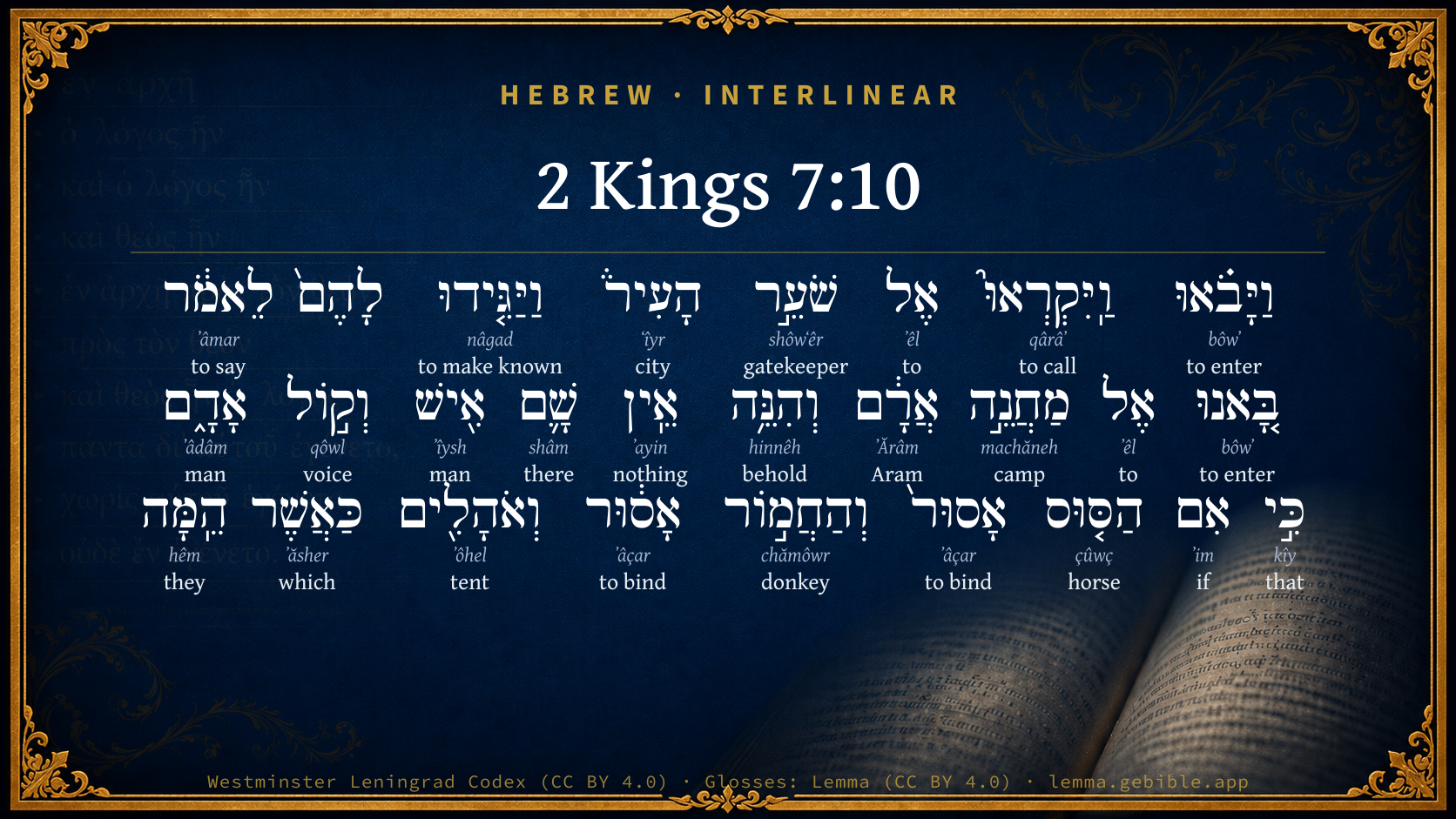
Hebrew (Westminster Leningrad Codex) 2 Kings 7:10 appears in the Hebrew Old Testament. The text above is from the Westminster Leningrad Codex. Each word links to its Strong’s number, a concise gloss, and parsing drawn from the Open Scriptures Hebrew Bible morphology. Click any word for its full Brown-Driver-Briggs (BDB) entry.
Download image
Cite this verse

2 Kings 7:10 (World English Bible). Public Domain. Lemma interlinear Bible study tool, https://lemma.gebible.app/v/2-kings/7/10.

Show BibTeX & RIS
BibTeX
RIS
English Translation
So they came and called to the porter of the city; and they told them, saying, We came to the camp of the Syrians, and, behold, there was no man there, neither voice of man, but the horses tied, and the donkeys tied, and the tents as they were.
World English Bible · Public Domain
Download a study sheet

One document with this verse’s original text, its word-by-word gloss line, the meaning frame, cross-references with their text, attributed commentary, and full source and license credits — printable, and it pastes into notes with its structure intact.

This verse Autodidact and up

Study sheet (.html) Plain text (.txt)

A passage Seminary Student

Up to 50 verses in one chapter. A passage sheet keeps up to 6 commentary sources and 12 cross-references per verse, in the order this page ranks them, and says so on the sheet whenever that leaves anything out. Ask for a single verse and you get the Autodidact verse sheet above.

Everything on this page stays free to read, with no account — the sheet is a download of what is already on screen, not access to it.

Want to remove ads? Support Godless Engineer
Compare translations 3

The same verse in 3 English versions, stacked beneath the original-language interlinear above. Click any original word for its lexicon entry.

Each is an independent rendering of the whole verse — the interlinear is not word-aligned to these translations.

Highlighted words mark where these versions differ — a whole-verse word diff, not a word-by-word alignment.

  • World English Bible Public Domain
    So they came and called to the porter of the city; and they told them, saying, We came to the camp of the Syrians, and, behold, there was no man there, neither voice of man, but the horses tied, and the donkeys tied, and the tents as they were.
  • King James Version Public Domain
    So they came and called unto the porter of the city: and they told them, saying, We came to the camp of the Syrians, and, behold, there was no man there, neither voice of man, but horses tied, and asses tied, and the tents as they were.
  • unfoldingWord Literal Text CC BY-SA 4.0
    And they came and called to the gatekeeper of the city. And they declared to them, saying, “We came to the camp of Aram, and behold, there was not a man there or the sound of a man, but the horse was tied, and the donkey was tied, and the tents just as they.”

unfoldingWord Literal Text — © unfoldingWord, licensed CC BY-SA 4.0. Word-aligned USFM3 via Door43 (git.door43.org/unfoldingWord/en_ult).

Versions to compare (up to 4)

3 of 4 selected

Show all 18 translations

Every available English version of this verse, each an independent rendering of the whole verse.

  • World English Bible Public Domain
    So they came and called to the porter of the city; and they told them, saying, We came to the camp of the Syrians, and, behold, there was no man there, neither voice of man, but the horses tied, and the donkeys tied, and the tents as they were.
  • Berean Standard Bible Public Domain
    So they went and called out to the gatekeepers of the city, saying, “We went to the Aramean camp and no one was there—not a trace—only tethered horses and donkeys, and the tents were intact.”
  • Majority Standard Bible Public Domain
    So they went and called out to the gatekeepers of the city, saying, “We went to the Aramean camp and no one was there—not a trace—only tethered horses and donkeys, and the tents were intact.”
  • King James Version Public Domain
    So they came and called unto the porter of the city: and they told them, saying, We came to the camp of the Syrians, and, behold, there was no man there, neither voice of man, but horses tied, and asses tied, and the tents as they were.
  • American Standard Version (1901) Public Domain
    So they came and called unto the porter of the city; and they told them, saying, We came to the camp of the Syrians, and, behold, there was no man there, neither voice of man, but the horses tied, and the asses tied, and the tents as they were.
  • Revised Version (1885) Public Domain
    So they came and called unto the porter of the city: and they told them, saying, We came to the camp of the Syrians, and, behold, there was no man there, neither voice of man, but the horses tied, and the asses tied, and the tents as they were.
  • Geneva Bible (1599) Public Domain
    So they came, and called vnto the porters of the citie, and tolde them, saying, We came to the campe of the Aramites, and loe, there was no man there, neither voyce of man, but horses tyed and asses tyed: and the tents are as they were.
  • Douay-Rheims (1899) Public Domain
    So they came to the gate of the city, and told them, saying: We went to the camp of the Syrians, and we found no man there, but horses, and asses tied, and the tents standing.
  • Young's Literal Translation Public Domain
    And they come in, and call unto the gatekeeper of the city, and declare for themselves, saying, `We have come in unto the camp of Aram, and lo, there is not there a man, or sound of man, but the bound horse, and the bound ass, and tents as they `are'.'
  • Literal Standard Version CC BY-SA 4.0
    And they come in, and call to the gatekeeper of the city, and declare for themselves, saying, “We have come to the camp of Aram, and behold, there is no man or sound of man there, but the bound horse, and the bound donkey, and tents as they [are].”
  • Unlocked Literal Bible CC BY-SA 4.0
    So they went and called the gatekeepers of the city. They told them, saying, “We went to the camp of the Arameans, but there was no one there, not the sound of anyone, but there were the horses tied, and the donkeys tied, and the tents as they were.”
  • unfoldingWord Literal Text CC BY-SA 4.0
    And they came and called to the gatekeeper of the city. And they declared to them, saying, “We came to the camp of Aram, and behold, there was not a man there or the sound of a man, but the horse was tied, and the donkey was tied, and the tents just as they.”
  • Darby Bible Public Domain
    And they came and called to the porters of the city, and told them saying, We came to the camp of the Syrians, and behold, there was no one there, no sound of man, but the horses tied, and the asses tied, and the tents as they were.
  • World Messianic Bible Public Domain
    So they came and called to the city gatekeepers; and they told them, “We came to the camp of the Syrians, and, behold, there was no man there, not even a man’s voice, but the horses tied, and the donkeys tied, and the tents as they were.”
  • Webster's Bible Public Domain
    So they came and called to the porter of the city: and they told him, saying, We came to the camp of the Syrians, and behold, there was no man there, neither voice of man, but horses tied, and asses tied, and the tents as they were.
  • Free Bible Version CC BY-SA 4.0
    They went and called to the gatekeepers of the city, “We went over to the Aramean camp and no one was there, not a sound of anybody! There were just horses and donkeys tied up, and the tents just as they were.”
  • Bible in Basic English Public Domain
    So they came in, and, crying out to the door-keepers of the town, they gave them the news, saying, We came to the tents of the Aramaeans, and there was no one there and no voice of man, only the horses and the asses in their places, and the tents as they were.
  • JPS Tanakh (1917) Public Domain
    So they came and called unto the porters of the city; and they told them, saying. 'We came to the camp of the Arameans, and, behold, there was no man there, neither voice of man, but the horses tied, and the asses tied, and the tents as they were.'

Literal Standard Version (2020), Covenant Press — licensed CC BY-SA 4.0. Text via the HelloAO Bible API (eBible.org). Unlocked Literal Bible (unfoldingWord) — licensed CC BY-SA 4.0. Text via the HelloAO Bible API (eBible.org). unfoldingWord Literal Text — © unfoldingWord, licensed CC BY-SA 4.0. Word-aligned USFM3 via Door43 (git.door43.org/unfoldingWord/en_ult). Free Bible Version, Dr. Jonathan Gallagher — licensed CC BY-SA 4.0. Text via the HelloAO Bible API (eBible.org).

Word by word

More ways to search: Search by grammar → Find every occurrence → Compare this word →

Practice this passage: Drill this verse → Learn its vocabulary →

שֹׁעֵ֣ר
shôwʻêr
H7778
“gatekeeper of”
Noun, Common, Masculine, Singular, Construct
Part of Speech
Noun
Type
Common
Gender
Masculine
Number
Singular
State
Construct
Full BDB Definition

Origin: from H8179

TWOT: 2437b

gatekeeper, porter
  1. וַיָּבֹ֗אוּ bôwʼ H935 “and · to enter” Conjunction + Verb, Qal, Sequential Imperfect, 3rd Person, Masculine, Plural
  2. וַֽיִּקְרְאוּ֮ qârâʼ H7121 “and · to call” Conjunction + Verb, Qal, Sequential Imperfect, 3rd Person, Masculine, Plural
  3. אֶל ʼêl H413 “to” Preposition
  4. הָעִיר֒ ʻîyr H5892 “the · city” Particle, Definite Article + Noun, Common, Feminine, Singular, Absolute
  5. וַיַּגִּ֤ידוּ nâgad H5046 “and · to make known” Conjunction + Verb, Hiphil, Sequential Imperfect, 3rd Person, Masculine, Plural
  6. לֵאמֹ֔ר ʼâmar H559 “to say” Preposition + Verb, Qal, Infinitive Construct
  7. בָּ֚אנוּ bôwʼ H935 “to enter” Verb, Qal, Perfect, 1st Person, Common, Plural
  8. אֶל ʼêl H413 “to” Preposition
  9. מַחֲנֵ֣ה machăneh H4264 “camp of” Noun, Common, Both, Singular, Construct
  10. אֲרָ֔ם ʼĂrâm H758 “Aram” Noun, Proper
  11. וְהִנֵּ֥ה hinnêh H2009 “and · behold” Conjunction + Particle, Demonstrative
  12. אֵֽין ʼayin H369 “nothing” Particle, Negative
  13. שָׁ֛ם shâm H8033 “there” Adverb
  14. אִ֖ישׁ ʼîysh H376 “man” Noun, Common, Masculine, Singular, Absolute
  15. וְק֣וֹל qôwl H6963 “and · voice of” Conjunction + Noun, Common, Masculine, Singular, Construct
  16. אָדָ֑ם ʼâdâm H120 “man” Noun, Common, Masculine, Singular, Absolute
  17. כִּ֣י kîy H3588 “that” Conjunction
  18. אִם ʼim H518 “if” Conjunction
  19. הַסּ֤וּס çûwç H5483 “the · horse” Particle, Definite Article + Noun, Common, Masculine, Singular, Absolute
  20. אָסוּר֙ ʼâçar H631 “bound” Verb, Qal, Participle Passive, Masculine, Singular, Absolute
  21. וְהַחֲמ֣וֹר chămôwr H2543 “and · the · donkey” Conjunction + Particle, Definite Article + Noun, Common, Both, Singular, Absolute
  22. אָס֔וּר ʼâçar H631 “bound” Verb, Qal, Participle Passive, Masculine, Singular, Absolute
  23. וְאֹהָלִ֖ים ʼôhel H168 “and · tents” Conjunction + Noun, Common, Masculine, Plural, Absolute
  24. כַּאֲשֶׁר ʼăsher H834 “like/as · which” Preposition + Particle, Relative
  25. הֵֽמָּה hêm H1992 “they” Pronoun, Personal, 3rd Person, Masculine, Plural

About this verse

These counts appear in no published source. They are computed here, from the morphology-tagged text and Lemma’s own curated glosses. What Lemma adds →

27
words
23
distinct lemmas
Historical
section

Shared distinctive vocabulary

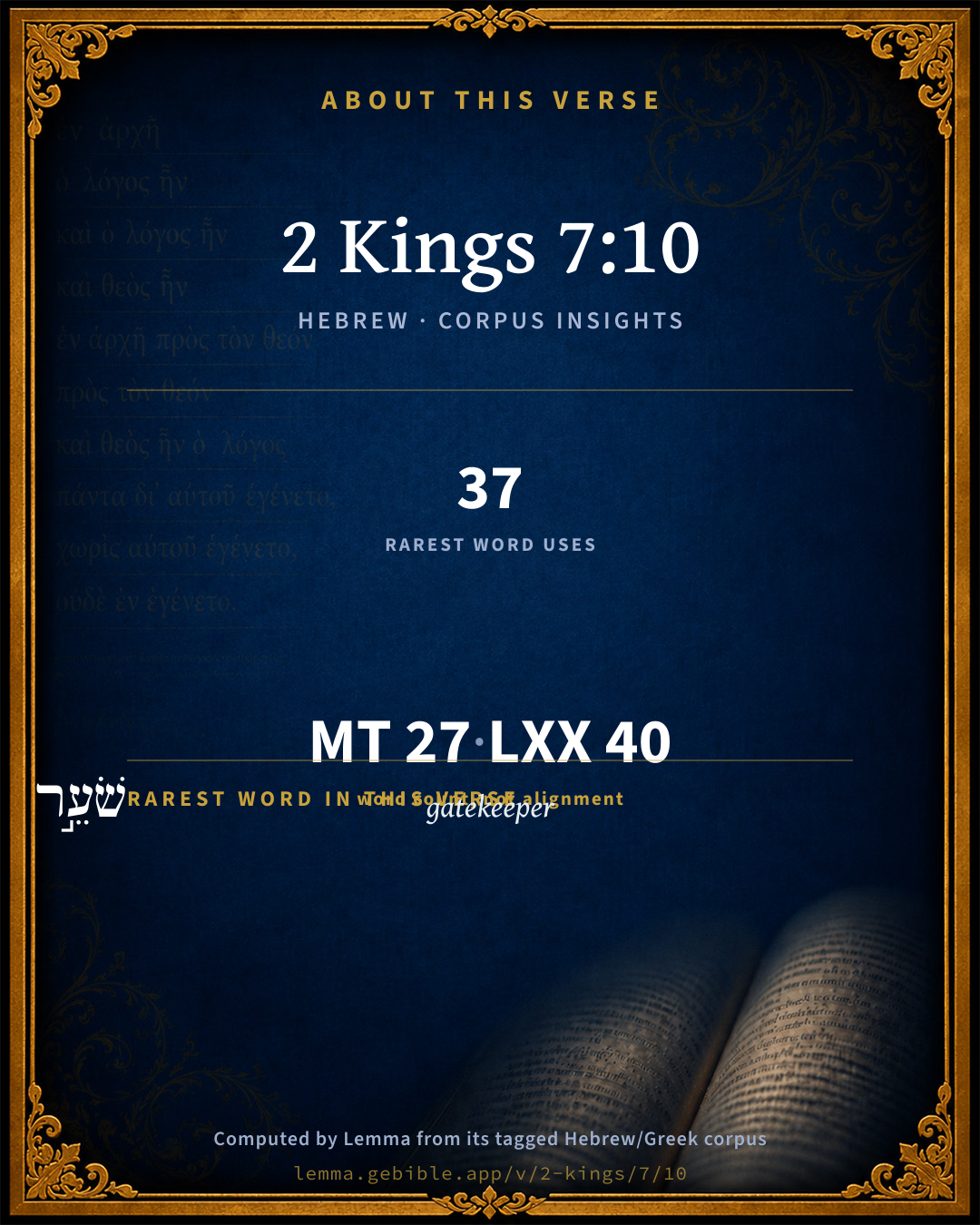
שֹׁעֵ֣ר gatekeeper H7778 occurs in 37 verses of the Hebrew Bible. Also found in:

Grammatical profile

  • 7 verbs
  • 10 nouns
  • 1 pronoun
  • 3 prepositions
  • 2 conjunctions
  • 1 adverb
  • 3 particles

Verb forms

  • וַיָּבֹ֗אוּ Qal · Sequential Imperfect
  • וַֽיִּקְרְאוּ֮ Qal · Sequential Imperfect
  • וַיַּגִּ֤ידוּ Hiphil · Sequential Imperfect
  • לֵאמֹ֔ר Qal · Infinitive Construct
  • בָּ֚אנוּ Qal · Perfect
  • אָסוּר֙ Qal · Participle Passive
  • אָס֔וּר Qal · Participle Passive

Repetition

Words recur within this verse — often emphatic in Hebrew:

  • וַיָּבֹ֗אוּ to enter H935 ×2
  • אָסוּר֙ to bind H631 ×2
  • אֶל to H413 ×2

Hebrew & Septuagint length

In English translation the verse runs 49 words from the Hebrew and 46 from the Septuagint (LXX English) — closely comparable.

A rough comparison of the two English renderings, which tokenize alike — not a word-level alignment.

Word counts can differ between the Hebrew and the Greek without any difference in meaning — e.g. the Hebrew direct-object marker אֵת has no separate Greek word, and Greek often adds the article ὁ.

In the original languages it is 27 Hebrew tokens and 40 Greek tokens — but the two are counted differently (Hebrew bundles its prefixes and suffixes into one token; the Greek is in lemma form), so that isn’t a like-for-like length.

Cross-references

5

Topical passages linked to 2 Kings 7:10 in the Treasury of Scripture Knowledge — connected by theme and wording, ordered by reader-vote popularity; previews shown in the World English Bible.

  • 2 Samuel 18:26 The watchman saw another man running; and the watchman called to the porter, and said, Behold, [another] man running alone. The king said, He also brings news.
  • 2 Kings 7:6–7 For the Lord had made the host of the Syrians to hear a noise of chariots, and a noise of horses, even the noise of a great host: and they said one to another, Behold, the king of Israel has hired against us the kings of the Hittites, and the kings of the Egyptians, to come on us.
  • 2 Kings 7:11 He called the porters; and they told it to the king's household within.
  • Psalms 127:1 Unless Yahweh builds the house, They labor in vain who build it. Unless Yahweh watches over the city, The watchman guards it in vain.
  • Mark 13:34–35 "It is like a man, traveling to another country, having left his house, and given authority to his servants, and to each one his work, and also commanded the doorkeeper to keep watch.

Cross-references courtesy of OpenBible.info (CC BY 4.0).

Hebrew and Greek witnesses Masoretic Hebrew ↔ Greek Septuagint

The same verse in the two great witnesses to the Old Testament, shown verse-for-verse.

These are two independent witnesses, not word-aligned to each other, and the Septuagint is shown in lemma (dictionary) form.

Hebrew 2 Kings 7:10 Masoretic · Westminster Leningrad Codex

וַיָּבֹ֗אוּ וַֽיִּקְרְאוּ֮ אֶל שֹׁעֵ֣ר הָעִיר֒ וַיַּגִּ֤ידוּ לָהֶם֙ לֵאמֹ֔ר בָּ֚אנוּ אֶל מַחֲנֵ֣ה אֲרָ֔ם וְהִנֵּ֥ה אֵֽין שָׁ֛ם אִ֖ישׁ וְק֣וֹל אָדָ֑ם כִּ֣י אִם הַסּ֤וּס אָסוּר֙ וְהַחֲמ֣וֹר אָס֔וּר וְאֹהָלִ֖ים כַּאֲשֶׁר הֵֽמָּה

So they came and called to the porter of the city; and they told them, saying, We came to the camp of the Syrians, and, behold, there was no man there, neither voice of man, but the horses tied, and the donkeys tied, and the tents as they were.

World English Bible · Public Domain

Greek LXX 2 Kings 7:10 Septuagint · lemma form

καί εἰςἔρχομαι καί βοάω πρός ὁ πύλη ὁ πόλις καί ἀναἀγγέλλω αὐτός λέγω εἰςἔρχομαι εἰς ὁ παρεμβολή συρία καί ἰδού οὐ εἰμί ἐκεῖ ἀνήρ καί φωνή ἄνθρωπος ὅτι εἰ μή ἵππος δέω καί ὄνος καί ὁ σκηνή αὐτός ὡς εἰμί

So they went and cried toward the gate of the city, and reported to them, saying, We went into the camp of Syria, and, behold, there is not there a man, nor voice of man, only horses tied and asses, and their tents as they were.

LXX2012 (modern English Septuagint) · Public Domain

On this verse, Ellicott's Commentary for English Readers discusses the Septuagint’s reading. Read the note in Commentary ↓

Hebrew: Westminster Leningrad Codex (CC BY 4.0). Greek: Septuagint (public domain); English from LXX2012 (modern English Septuagint) (Public Domain). How the Septuagint differs from the Hebrew →

Targum (Aramaic paraphrase)

1

The Targum is the ancient Jewish Aramaic paraphrase of the Hebrew Scriptures — an interpretive translation, not the Hebrew text itself. Onkelos (literal) and Pseudo-Jonathan (expansive) render the Torah, and Jonathan the Prophets. Coverage is partial: where no permissively-licensed English translation exists for a verse, only the Aramaic is shown. This is verse-level text, not a word-by-word alignment to the Hebrew.

  1. Targum Jonathan Prophets (Joshua–Malachi)
    וַאֲתוֹ וּקְרוֹ לְנַטְרֵי תְרַע קַרְתָּא וְחַוִיאוּ לְהוֹן לְמֵימַר אָתִינָא לְמַשִׁרְיַת אֲרָם וְהָא לֵית תַּמָן גְבַר וְקַל אֱנַשׁ אֱלָהֵין סוּסְוָן אֲסִירִין וַחֲמָרִין אֲסִירִין וּמַשְׁכְּנִין כְּמָא דְאִינוּן:

    (no public-domain English translation for this verse)

    Targum Jonathan — Aramaic: “Mikraot Gedolot” (public domain). English: “Sefaria Community Translation” (CC0 1.0 (public-domain dedication)); “London "Chaldee Paraphrase," 1871” (public domain). Text via Sefaria.

Commentary

Notes on 2 Kings 7:10 from classic Christian and Jewish commentators (each source and its license shown beneath its notes). The classic Christian expositions comment on the surrounding passage and are grouped to its opening verse, so a note may address several verses; the Jewish commentaries on the Tanakh (Rashi and others) are per-verse, so they appear only where the commentator wrote on this verse.

Lemma curates 59 commentaries, every one of them public domain or Creative Commons licensed, each selected and text-cleaned for this edition rather than reprinted as found. About our sources →

Trapp's Complete Commentary

John Trapp

2Ki 7:10 So they came and called unto the porter of the city: and they told them, saying, We came to the camp of the Syrians, and, behold, [there was] no man there, neither voice of man, but horses tied, and asses tied, and the tents as they [were].

Ver. 10. And, behold, there was no man there.] God had made an utter riddance of them for the good of his people; neither had they any mind to return to their tents again, God continuing the sound which at first he had sent amongst them. So the Germans were frightened and sent home with a flea in their ear in bello Hussitico, in the war they made upon God’s people in Bohemia.

John Trapp, A Commentary or Exposition upon All the Books of the Old and New Testament (1647–1656) — public domain. Text from a community e-Sword module.

Tyndale Open Study Notes

Tyndale Open Resources

7:10-12 Joram suspected that the Arameans had set a trap, perhaps attempting to lure the Israelites into an ambush. Joshua had used a similar battle tactic in taking the city of Ai (Josh 8:3-23).

Tyndale Open Study Notes — © Tyndale Open Resources, licensed CC BY-SA 4.0. Text via the HelloAO Bible API.

Jamieson, Fausset & Brown

Robert Jamieson, A. R. Fausset & David Brown

horses tied, and asses tied, and the tents as they were--The uniform arrangement of encampments in the East is to place the tents in the center, while the cattle are picketed all around, as an outer wall of defense; and hence the lepers describe the cattle as the first objects they saw.

Jamieson, Fausset & Brown — Commentary Critical and Explanatory on the Whole Bible (1871) — public domain (CC PDM 1.0). Text via the HelloAO Bible API.

Ellicott's Commentary for English Readers

(10) The porter.—The Oriental versions may be right in reading “porters,” i.e., warders. The plural is implied by “they told them,” which immediately follows, and actually occurs in 2Ki_7:11. But the reading of the LXX. and Vulg., “gate,” implies the same consonants differently pointed, as those of the word “porter.” This attests the antiquity of the reading. Probably, therefore, the word “porter” is here used collectively.

No man . . . voice of man.—The first word (’îsh) denotes an individual man, the second word (’âdâm) denotes the species, and so includes women and children.

Horses.—The horses. Similarly, the asses. Both words are singular (collectives) in the Hebrew.

Tied—i.e., tethered and feeding.

The tents.—Omit the.

A Bible Commentary for English Readers, edited by Charles John Ellicott (1878–1897) — public domain. Text from a community e-Sword module.

The Cambridge Bible for Schools and Colleges

gen. ed. J. J. S. Perowne

10. called unto the porter] i.e. from the outside of the wall, whither alone they were allowed to come. The singular noun is clearly taken in a collective sense, and some of the versions give ‘porters’. The plural pronoun immediately following shews that this is intended. Hence R.V. gives the plural on the margin.

but horses [R.V. the horses] tied, and asses [R.V. the asses] tied] The articles are expressed in the original, and the strict rendering gives a truer idea of all things being left without distinction. The baggage cattle, and the beasts for riding stood tethered in their places, fear having permitted no attempt to unloose them. In the camp it was necessary to keep the animals tied up, and most likely one part of the encampment was set apart for this purpose, and the terrified soldiers fled without a thought of going first to get their horses.

the tents as they were] The italic word is really implied, and so is printed in Roman type in R.V. Everything had been forsaken just as it stood. The alarm had proved so sudden and so terrible that the one thought had been to get away.

The Cambridge Bible for Schools and Colleges (gen. ed. J. J. S. Perowne; Cambridge University Press, 1878–1918) — public domain. Text from a community e-Sword module.

John Gill's Exposition

So they came and called to the porter of the city,.... The chief of those that had the care of the gate of it; for there were more than one, as follows:

and they told them; the porter, and the watchmen with him:

we came to the camp of the Syrians, and, behold, there was no man there, neither voice of man; not one to be seen or heard:

but horses tied, and asses tied; to their mangers; the latter, as well as the former, were used for war, not only to carry burdens, but to fight upon, as Aelianus (a) relates of some people; and especially when there was a want of horses, as Strabo (b); and both observe that this creature was sacrificed to Mars:

and the tents as they were; none of them struck, nor anything taken out of them.

(a) De Animal. l. 12. c. 34. (b) Geograph. l. 15. p. 500.

John Gill's Exposition of the Whole Bible (1746–1763) — public domain (CC PDM 1.0). Text via the HelloAO Bible API.

Albert Barnes' Notes on the Bible

They called unto the porter ... and told them - The word “porter” is used like our “guard” and the meaning here is, not that the lepers called to any particular individual, but that they roused the body of men who were keeping guard at one of the gates.

Albert Barnes' Notes on the Bible (1834–1885) — public domain. Text from a community e-Sword/MySword module.

Haydock's Catholic Bible Commentary

Tied to the mangers, or rather by the hind-legs, as it is still the custom in the East. (Xenophon. Anab. iii. Martyr legat. Babyl.)

George Leo Haydock (1774–1849), Haydock's Catholic Family Bible and Commentary, 1859 edition — public domain. Excludes Psalms (Douay-Rheims chapter numbering differs from Protestant) and Deuterocanonical books (Catholic canon only).

Matthew Poole's English Annotations

They told them, to wit, the porter and his companies.

Matthew Poole's English Annotations on the Holy Bible (1683–1685) — public domain. Text from a community e-Sword/MySword module.

The Pulpit Commentary

So they came and called unto the porter of the city; i.e. to the guard of the gate nearest them. The word dcO, "porter," or "gateman," is used collectively. And they told them, saying, We came to the camp of the Syrians, and, behold, there was no man there, neither voice of man, but horses tied, and asses tied, and the tents as they were. The horses and asses within a camp were always "tied," or tethered, as we see from the monumental representations of Egyptian camps (Rawlinson, "History of Ancient Egypt," vol. 1. p. 476), and also learn from historians (Herod., 4:135). It is somewhat surprising that the horses were left behind, as they would have expedited the flight had they been saddled and mounted. But this was, perhaps, overlooked in the panic.

The Pulpit Commentary (1880–1919), ed. H.D.M. Spence-Jones & Joseph S. Exell — public domain. Text from a community e-Sword module.

MacLaren's Expositions of Holy Scripture

Alexander MacLaren

2 Kings

‘IMPOSSIBLE,-ONLY I SAW IT’

2Ki 7:1 - 2Ki 7:16.

The keynote of this incident lies in the promise in the first verse. The whole story illustrates man’s too frequent rejection of God’s promise, and God’s wonderful way of fulfilling it.

I. We note first the promise which common-sense finds incredible. It came from Elisha when all seemed desperate. The wonderfully vivid narrative in the previous chapter tells a pitiful tale of women boiling their children, of unclean food worth more than its weight in silver, of a king worked up to a pitch of frenzy and murderous designs, and renouncing his allegiance to Jehovah. Such faith as he had was strained to the breaking point, and his messenger was sent to tell the prophet that the king would not ‘wait for the Lord any longer.’ That was the moment chosen to speak the promise. It came, as God’s helps, both of promise and act, so often come, at the very nick of time, when faith is ready to fail and human aid is vain. Before we had learned our hopeless state, they would come too soon for our good; after faith had wholly parted from its moorings, they would come too late.

Note the precision and confidence of the promise. The hour of the fulfilment, and the price of flour and the cheaper barley are stated. Man’s promises are vague; God’s are specific. Mark, too, the entire silence of the promise as to the mode of its fulfilment. Probably Elisha knew as little as any one, how it was going to be accomplished. The particularity and vagueness combined are remarkable. A hint as to how the thing was to be done would have made the belief in the fact so much easier. Yes, and just because it would have smoothed the road for worthless belief, it was not given, but the apparently impossible promise was left in nakedness, for any one who needed sense to animate his faith, to scoff at. Is not that emphatic assertion of the fact, and emphatic silence as to the ‘how,’ a frequent characteristic of God’s promises? If ever we are kept in the dark as to the latter, it is for our good, and for the encouragement of our growth in utter dependence and perfect trust. It is not well for the trusting soul to ask too curiously about methods intervening between the promise in the present and its accomplishment in the future. It is better for peace and the simplicity of our trust, that we should be content to cling to the faithful word, and to ‘believe. . . that it shall be even as it was told’ us, without troubling ourselves about His way of effecting His purposes. Passengers are not admitted to the engine-room, nor allowed on the bridge. Let them leave all the working of the ship to the captain.

II. The noble who blurted out his incredulity had a great deal to say for himself from the common-sense and worldly point of view. But he need not have sneered, in the same breath, at old miracles and new. His sarcasm about ‘windows in heaven’ refers to the story of the flood; and perhaps there is a hint of allusion to the manna. He neither believed these ancient deeds, nor the promise for to-morrow. Why not? Simply because he-wise as he thought himself-could not see any way of bringing it about. There are many of us yet who have the same modest opinion of our own acuteness, and go on the supposition that what we do not see is invisible, and what we cannot do, or imagine done, is impossible. Why should not the Lord ‘make windows in heaven’ if He please? Or, how does the pert objector know that that is the only way of fulfilling the promise? He will be taught that he has not quite exhausted all the possibilities open to Omnipotence, and that something much simpler than windows in heaven can do what is wanted. Unbelief which rejects God’s plain promises because it does not see how they can be fulfilled is common enough still, and is as unreasonable as it is impertinent. Elisha was as ignorant as this nobleman was, of the means, but his faith fixed its eyes on the faithful word, and trusted, while sense, self-conceit, and worldliness, a mole pretending to have an eagle’s eye, declared that to be impossible which it could not see the way to bring about, and thereby exposed only its own blind arrogance.

III. Elisha’s answer {2Ki 7:2} sounds like Elijah. The utmost gentleness is stirred to pronounce condemnation on self-confident unbelief, and a gentler gentleness than Elisha’s, even Christ’s, shrinks not from executing the sentence. Is not the sentence on this scoffing lord the very sentence pronounced ever on unbelief? In his case, it was fulfilled by the crowd that pressed, in their ravenous hunger, through the gate, and trod him down; but in ordinary cases, in our days, the natural operation of unbelief is to shut men out from the fruition, of which faith is the necessary and only condition. It is no avenging and arbitrarily imposed exclusion, but the necessary result of self-made disqualification, which brings on the unbeliever the doom, ‘Thou shalt not eat thereof.’ The blessings of the religious life on earth, and the glories of its perfection in heaven, are only enjoyable through faith. These are not so plainly visible to the unbelieving heart as the scene at the gate was to the nobleman; but, in some measure, even those who do not possess them do, in some lucid moments, see their worth. It is one sad part of the sad lives of godless men that they have their seasons of calm weather, when, in the clearer atmosphere, they catch glimpses of their true good, but that they yet do not behold it long and close enough to be smitten with the desire to possess it; and so the sight remains inoperative, or adds to their condemnation. Not to taste is the sadder fate, because there has been sight. To have eyes opened at last to our own folly, and to see the rich provision of God’s table, when it is too late, will be a chief pang of future retribution,-as it sometimes is of present god-lessness.

IV. Passing over for the present the account of the discovery by the four lepers, we may next note God’s way of fulfilling His promise. A panic would spread fast in an undisciplined army, and history supplies examples of the swift change into a mob under the influence of groundless terror. There is nothing wonderful in the helter-skelter rush for the Jordan, or in the road being littered with abandoned baggage. The divine intervention produced the impression which naturally brought the flight about, and the coincidence of the prophecy and the panic which fulfilled it stamp both as divinely originated. But if we looked on events as devoutly, and saw into their true character as deeply as the author of the Books of Kings does, we should see that many a similar coincidence, which we trace no farther than to men or circumstances, was due to the same divine cause which made the Syrians to hear ‘the noise of a great host.’ Track the river of life to its source, and you come to God.

‘The wicked fleeth when no man pursueth.’ Imaginary terrors are apt to beset those who have no trust in God. If we fear Him, we need have no other fear; but if we have not Him for our anchorage, we shall be driven by gusts of passion and terror. The unseen possibilities of attack and defeat may well terrify a man who has not the unseen God to keep him calm.

Windows in heaven, then, were not needed, and the arrogance which said ‘Impossible!’ had not measured all the resources of God. A very wise scientist here in England proved that the Atlantic could not be crossed by a steamer, and the first steamer that did cross took out copies of his book. How foolish men’s demonstrations of impossibility look beside God’s deliverances! We have not gone through all the chambers of His storehouse, and ‘His ways are far above, out of our sight.’ Let us hold fast by the faith that His arm is strong to do whatever His lips are gracious to engage, nor let our inability to see where the river gets through the mountains ever make us doubt that it will reach the sunlit ocean.

V. We may throw together the remaining parts of the incident, as showing how the fulfilled promise was received. These four lepers had heard nothing of it, when despair made them venturesome. How reckless they were, and how they harp on the one gloomy word ‘die’! The thought was familiar to them, and yet, lepers though they were, life was sweet, and a chance of prolonging it, even as slaves, was worth trying. They chose twilight, that they might be unobserved. We can see them creeping cautiously, with beating hearts, towards the camp, expecting every moment to be challenged, and possibly slain. How their caution would diminish and their wonder grow, as they passed from end to end, and found no one! There stood the horses and asses, left behind lest their footfalls should betray the flight, and every tent empty of men and full of spoil. The lepers seem to have gone right through the camp before they ventured to begin plundering; for the ‘uttermost part’ in 2Ki 7:5 and that in 2Ki 7:8 are naturally understood of its opposite extremities. Then, secure against surprise, they eat and drink as ravenously as men who had been starving so long would do. Twilight had deepened into darkness before hunger and greed were satisfied. Not till then did they awake to their duty; and even when they bethink themselves, it is fear of punishment, not care for a city full of hungry men, that moves them. But their tardy awaking to duty is couched in words which carry a great truth, especially to all who have tasted the Bread of Life. It is ‘not well’ to ‘hold our peace’ in ‘a day of good tidings.’ If we have good news, especially the good news, its possession obliges us to impart it. If we have tasted the graciousness of the Lord, we are bound to tell of the stores we have found. ‘He that withholdeth corn, the people shall curse him.’ ‘Of how much sorer punishment. . .shall he be thought worthy,’ who keeps to himself the food of the world?

Lepers were strange messengers of good, but the message graces the bringer, and they who tell good tidings are sure of a welcome. God does not choose great men for the heralds of His mercy, but the qualification is personal experience. These four could only say, ‘We have seen and tasted,’ but that was enough. The king’s caution was very natural, and would have been quite blameless, if God’s promise had not been spoken the day before. But that made the slowness to believe a sin. Feeling one’s way over untried ice is prudent; but if we have previously been told that it will bear, it proves our distrust of him who told us. The despatch of the chariots to make a reconnaissance was needless trouble. But men are always apt to think that faith is but a shaky ground of certitude unless it be backed up by sense. When God gives us His word to trust to, we are wisest if we trust to it alone, and we may save ourselves the trouble of sending out scouts to see if it is really beginning to be fulfilled. Elisha had no need to wait the report of the charioteers before he believed in the fulfilment of the promise, which others had found incredible when spoken, and too good to be true even when fulfilled. Let us trust God, whether sense can attest the incipient accomplishment of His words or no.

Alexander MacLaren, Expositions of Holy Scripture (1904–1910) — public domain. Text from a community e-Sword module.

Rashi

Rabbi Shlomo Yitzchaki (Rashi)

As they were. As they were full at the beginning; they did not take out what was in them.

Rashi on the Tanakh — English translations: “The Judaica Press complete Tanach with Rashi, translated by A. J. Rosenberg” (CC BY 4.0); “Pentateuch with Rashi's commentary by M. Rosenbaum and A.M. Silbermann, 1929-1934” (public domain); “The Metsudah Tanach series, Lakewood, N.J” (CC BY 4.0); and “The Book of Joshua, Metsudah Publications, 1997” (CC BY 4.0). Text via Sefaria.

Lesson kit

Teaching starters — assembled from the data on this page, not authored interpretation. Every prompt links to the verse data it draws on. Edit before teaching.

2 Kings, in the Historical, opens this verse with 27 words (23 distinct Hebrew lemmas). Its most distinctive word is shôwʻêr (“gatekeeper”). A historical commentator’s framing appears above. Read the whole chapter for the surrounding context.

Discussion questions

  1. What does “gatekeeper” (shôwʻêr) contribute to the verse as a whole?
  2. 2 Samuel 18:26 shares the word «gatekeeper» with this verse. How do the two illuminate each other?
  3. “to enter” occurs 2× in this one verse. What is the effect of the repetition?
  4. The translations on this page render this verse differently — a whole-verse word diff, not a word-by-word alignment. What might account for the different wordings?
  5. The verb «וַיָּבֹ֗אוּ» is Qal Sequential Imperfect. How does its form color the action?
  6. Reading how Trapp's Complete Commentary and Tyndale Open Study Notes read this verse, where do the two commentators agree and where do they part?

Things to notice

Reading settings

Reading text

Shown beneath each verse's original-language words.

Old Testament
Old Testament edition

Read the OT as the Masoretic Hebrew (MT) or the Greek Septuagint (LXX).

English shown for the Greek Septuagint (in the Hebrew ↔ Greek comparison).

Comparing translations? Open the Compare panel on any verse page to stack up to four side by side.