
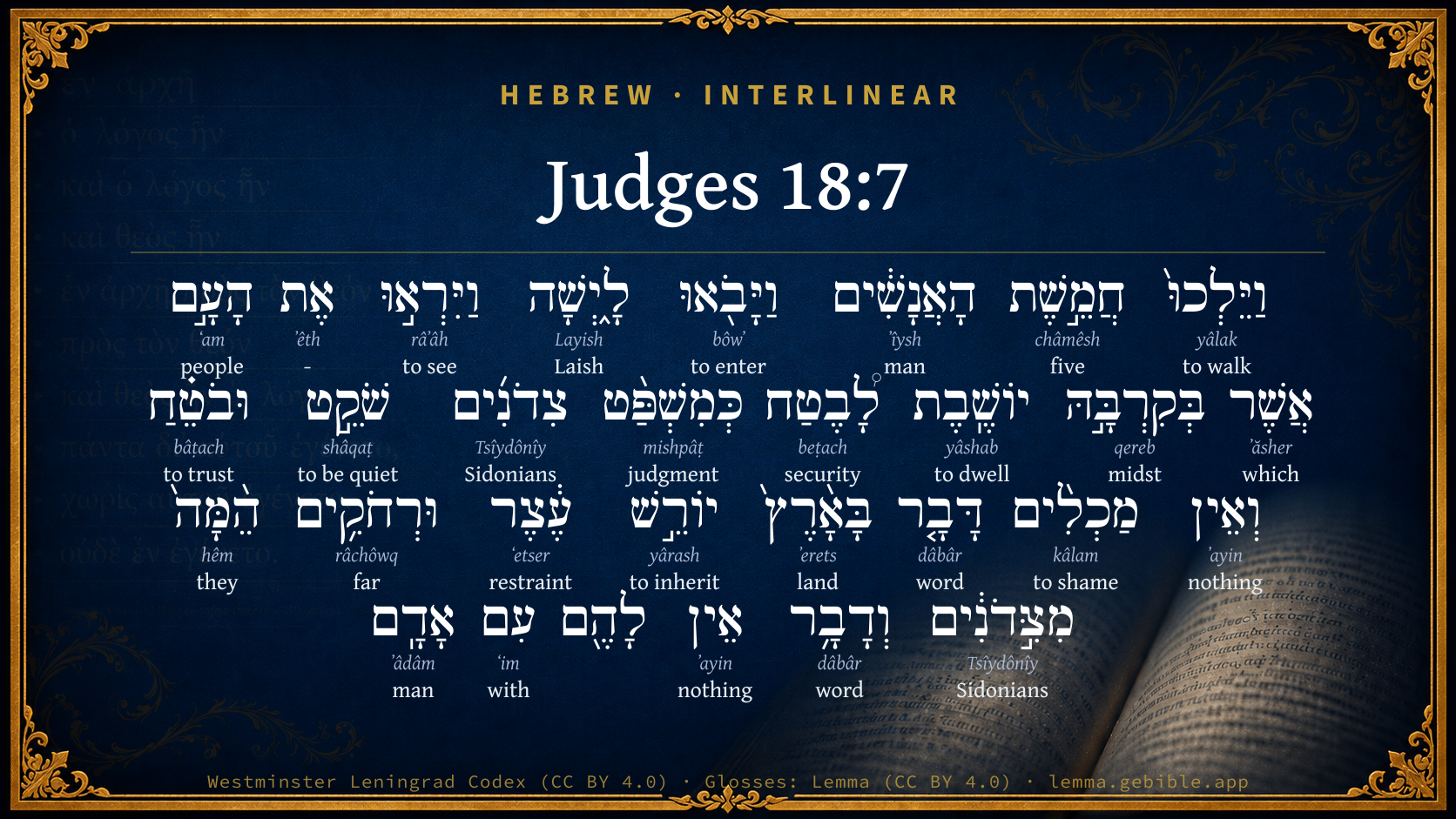
Judges 18:7

Hebrew (Westminster Leningrad Codex) Judges 18:7 appears in the Hebrew Old Testament. The text above is from the Westminster Leningrad Codex. Each word links to its Strong’s number, a concise gloss, and parsing drawn from the Open Scriptures Hebrew Bible morphology. Click any word for its full Brown-Driver-Briggs (BDB) entry.
Download image
Cite this verse

Judges 18:7 (World English Bible). Public Domain. Lemma interlinear Bible study tool, https://lemma.gebible.app/v/judges/18/7.

Show BibTeX & RIS
BibTeX
RIS
English Translation
Then the five men departed, and came to Laish, and saw the people who were therein, how they lived in security, after the manner of the Sidonians, quiet and secure; for there was none in the land, possessing authority, that might put [them] to shame in anything, and they were far from the Sidonians, and had no dealings with any man.
World English Bible · Public Domain
Highlights
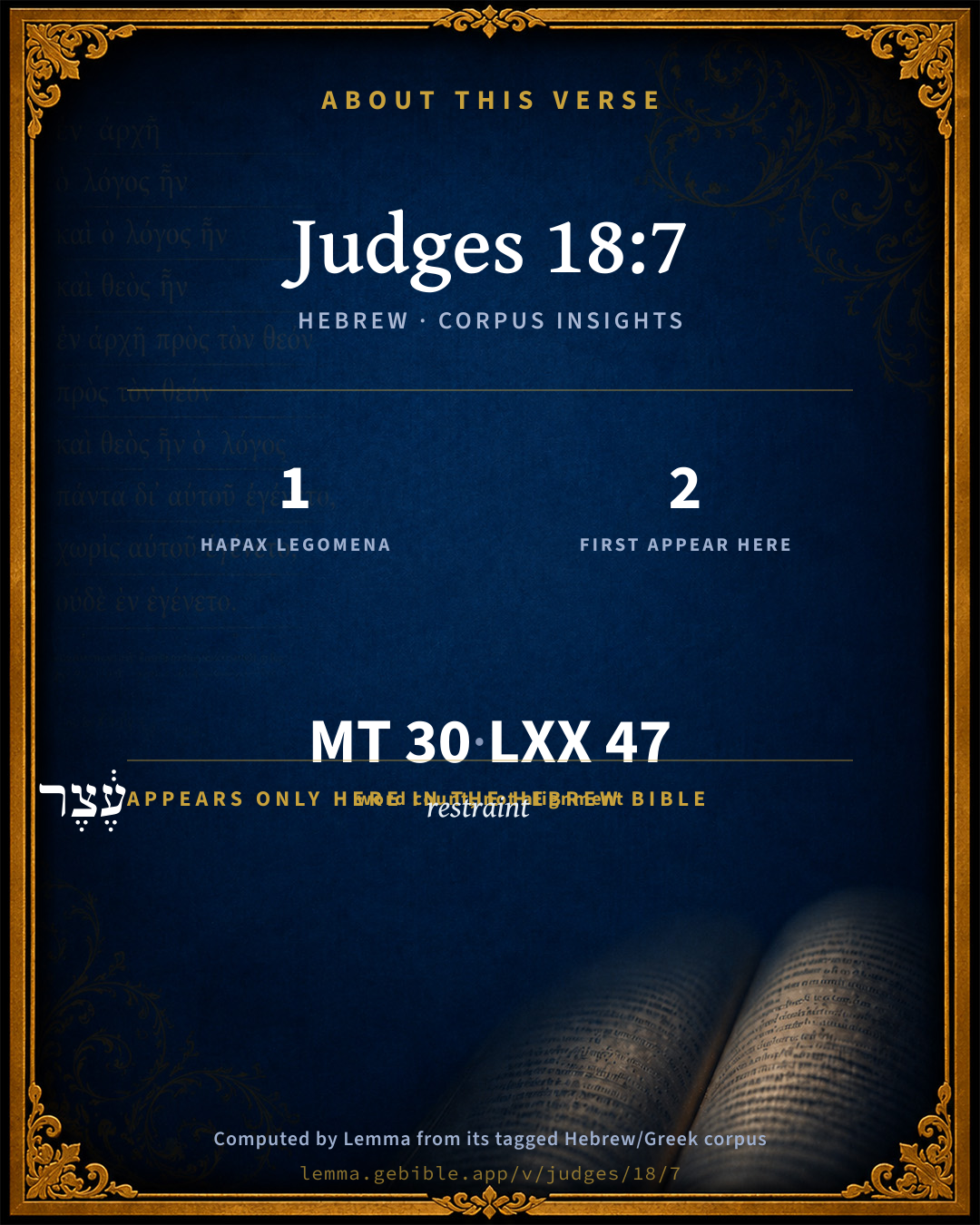
  • 1 hapax legomenon — only here in the Hebrew Bible
  • 2 first appearances in the Hebrew Bible
Full analysis ↓
Download a study sheet

One document with this verse’s original text, its word-by-word gloss line, the meaning frame, cross-references with their text, attributed commentary, and full source and license credits — printable, and it pastes into notes with its structure intact.

This verse Autodidact and up

Study sheet (.html) Plain text (.txt)

A passage Seminary Student

Up to 50 verses in one chapter. A passage sheet keeps up to 6 commentary sources and 12 cross-references per verse, in the order this page ranks them, and says so on the sheet whenever that leaves anything out. Ask for a single verse and you get the Autodidact verse sheet above.

Everything on this page stays free to read, with no account — the sheet is a download of what is already on screen, not access to it.

Want to remove ads? Support Godless Engineer
Compare translations 3

The same verse in 3 English versions, stacked beneath the original-language interlinear above. Click any original word for its lexicon entry.

Each is an independent rendering of the whole verse — the interlinear is not word-aligned to these translations.

Highlighted words mark where these versions differ — a whole-verse word diff, not a word-by-word alignment.

  • World English Bible Public Domain
    Then the five men departed, and came to Laish, and saw the people who were therein, how they lived in security, after the manner of the Sidonians, quiet and secure; for there was none in the land, possessing authority, that might put [them] to shame in anything, and they were far from the Sidonians, and had no dealings with any man.
  • King James Version Public Domain
    Then the five men departed, and came to Laish, and saw the people that were therein, how they dwelt careless, after the manner of the Zidonians, quiet and secure; and there was no magistrate in the land, that might put them to shame in any thing; and they were far from the Zidonians, and had no business with any man.
  • unfoldingWord Literal Text CC BY-SA 4.0
    So the five men went, and they came Laish. And they saw the people who in the midst of it dwelling in security, according to the manner of the Sidonians, reposing and being secure. And no one possessing restraint humiliating a thing in the land. And they far from the Sidonians, and no thing to them with man.

unfoldingWord Literal Text — © unfoldingWord, licensed CC BY-SA 4.0. Word-aligned USFM3 via Door43 (git.door43.org/unfoldingWord/en_ult).

Versions to compare (up to 4)

3 of 4 selected

Show all 18 translations

Every available English version of this verse, each an independent rendering of the whole verse.

  • World English Bible Public Domain
    Then the five men departed, and came to Laish, and saw the people who were therein, how they lived in security, after the manner of the Sidonians, quiet and secure; for there was none in the land, possessing authority, that might put [them] to shame in anything, and they were far from the Sidonians, and had no dealings with any man.
  • Berean Standard Bible Public Domain
    So the five men departed and came to Laish, where they saw that the people were living securely, like the Sidonians, tranquil and unsuspecting. There was nothing lacking in the land and no oppressive ruler. And they were far away from the Sidonians and had no alliance with anyone.
  • Majority Standard Bible Public Domain
    So the five men departed and came to Laish, where they saw that the people were living securely, like the Sidonians, quiet and unsuspecting. There was nothing lacking in the land and no oppressive ruler. And they were far away from the Sidonians and had no alliance with anyone.
  • King James Version Public Domain
    Then the five men departed, and came to Laish, and saw the people that were therein, how they dwelt careless, after the manner of the Zidonians, quiet and secure; and there was no magistrate in the land, that might put them to shame in any thing; and they were far from the Zidonians, and had no business with any man.
  • American Standard Version (1901) Public Domain
    Then the five men departed, and came to Laish, and saw the people that were therein, how they dwelt in security, after the manner of the Sidonians, quiet and secure; for there was none in the land, possessing authority, that might put `them' to shame in anything, and they were far from the Sidonians, and had no dealings with any man.
  • Revised Version (1885) Public Domain
    Then the five men departed, and came to Laish, and saw the people that were therein, how they dwelt in security, after the manner of the Zidonians, quiet and secure; for there was none in the land, possessing authority, that might put them to shame in any thing, and they were far from the Zidonians, and had no dealings with any man.
  • Geneva Bible (1599) Public Domain
    Then the fiue men departed and came to Laish, and sawe the people that were therein, which dwelt carelesse, after the maner of the Zidonians, quiet and sure, because no man made any trouble in the lande, or vsurped any dominion: also they were farre from the Zidonians, and had no businesse with other men.
  • Douay-Rheims (1899) Public Domain
    So the five men going on came to Lais: and they saw how the people dwelt therein without any fear, according to the custom of the Sidonians, secure and easy, having no man at all to oppose them, being very rich, and living separated, at a distance from Sidon and from all men.
  • Young's Literal Translation Public Domain
    And the five men go, and come in to Laish, and see the people which `is' in its midst, dwelling confidently, according to the custom of Zidonians, quiet and confident; and there is none putting to shame in the land in `any' thing, possessing restraint, and they `are' far off from the Zidonians, and have no word with `any' man.
  • Literal Standard Version CC BY-SA 4.0
    And the five men go, and come to Laish, and see the people which [is] in its midst, dwelling confidently, according to the custom of Zidonians, quiet and confident; and there is none putting to shame in the land in [any] thing, possessing restraint, and they [are] far off from the Zidonians, and have no word with [any] man.
  • Unlocked Literal Bible CC BY-SA 4.0
    Then the five men left and came to Laish, and they saw that the people were living in safety, in the same way the Sidonians lived, undisturbed and secure. There was no one who conquered them or who oppressed them in any way in the land. They lived far away from the Sidonians and had no dealings with anyone.
  • unfoldingWord Literal Text CC BY-SA 4.0
    So the five men went, and they came Laish. And they saw the people who in the midst of it dwelling in security, according to the manner of the Sidonians, reposing and being secure. And no one possessing restraint humiliating a thing in the land. And they far from the Sidonians, and no thing to them with man.
  • Darby Bible Public Domain
    Then the five men departed, and came to La'ish, and saw the people who were there, how they dwelt in security, after the manner of the Sido'nians, quiet and unsuspecting, lacking nothing that is in the earth, and possessing wealth, and how they were far from the Sido'nians and had no dealings with any one.
  • World Messianic Bible Public Domain
    Then the five men departed and came to Laish and saw the people who were there, how they lived in safety, in the way of the Sidonians, quiet and secure; for there was no one in the land possessing authority, that might put them to shame in anything, and they were far from the Sidonians, and had no dealings with anyone else.
  • Webster's Bible Public Domain
    Then the five men departed, and came to Laish, and saw the people that were in it, how they dwelt careless, after the manner of the Zidonians, quiet and secure; and there was no magistrate in the land, that might put them to shame in any thing; and they were far from the Zidonians, and had no business with any man.
  • Free Bible Version CC BY-SA 4.0
    The five men left and went to the town of Laish. They observed that the people there lived in safety, and followed the customs of the Sidonians. The people were unsuspecting and confident of their security, at home in a productive land. They didn't have a strong ruler, they lived a long way from the Sidonians, and had no other allies to help them.
  • Bible in Basic English Public Domain
    Then the five men went on their way and came to Laish and saw the people who were there, living without thought of danger, like the Zidonians, quiet and safe; for they had everything on earth for their needs, and they were far from the Zidonians and had no business with Aram.
  • JPS Tanakh (1917) Public Domain
    Then the five men departed, and came to Laish, and saw the people that were therein, how they dwelt in security, after the manner of the Zidonians, quiet and secure; for there was none in the land, possessing authority, that might put them to shame in any thing, and they were far from the Zidonians, and had no dealings with any man.

Literal Standard Version (2020), Covenant Press — licensed CC BY-SA 4.0. Text via the HelloAO Bible API (eBible.org). Unlocked Literal Bible (unfoldingWord) — licensed CC BY-SA 4.0. Text via the HelloAO Bible API (eBible.org). unfoldingWord Literal Text — © unfoldingWord, licensed CC BY-SA 4.0. Word-aligned USFM3 via Door43 (git.door43.org/unfoldingWord/en_ult). Free Bible Version, Dr. Jonathan Gallagher — licensed CC BY-SA 4.0. Text via the HelloAO Bible API (eBible.org).

Word by word

More ways to search: Search by grammar → Find every occurrence → Compare this word →

Practice this passage: Drill this verse → Learn its vocabulary →

עֶ֔צֶר
ʻetser
H6114
“restraint”
Noun, Common, Masculine, Singular, Absolute
Part of Speech
Noun
Type
Common
Gender
Masculine
Number
Singular
State
Absolute
Full BDB Definition

Origin: from H6113

TWOT: 1675a

restraint, oppression
  1. וַיֵּלְכוּ֙ yâlak H3212 “and · to walk” Conjunction + Verb, Qal, Sequential Imperfect, 3rd Person, Masculine, Plural
  2. חֲמֵ֣שֶׁת châmêsh H2568 “five” Adjective, Cardinal number, Masculine, Singular, Construct
  3. הָאֲנָשִׁ֔ים ʼîysh H376 “the · men” Particle, Definite Article + Noun, Common, Masculine, Plural, Absolute
  4. וַיָּבֹ֖אוּ bôwʼ H935 “and · to enter” Conjunction + Verb, Qal, Sequential Imperfect, 3rd Person, Masculine, Plural
  5. לָ֑יְשָׁה Layish H3919 “Laish · toward” Noun, Proper + Suffix, Demonstrative
  6. וַיִּרְא֣וּ râʼâh H7200 “and · to see” Conjunction + Verb, Qal, Sequential Imperfect, 3rd Person, Masculine, Plural
  7. אֶת ʼêth H853 “-” Particle, Direct Object
  8. הָעָ֣ם ʻam H5971 “the · people” Particle, Definite Article + Noun, Common, Masculine, Singular, Absolute
  9. אֲשֶׁר ʼăsher H834 “which” Particle, Relative
  10. בְּקִרְבָּ֣הּ qereb H7130 “in/at · midst · her” Preposition + Noun, Common, Masculine, Singular, Construct + Suffix, Personal, 3rd Person, Feminine, Singular
  11. יוֹשֶֽׁבֶת yâshab H3427 “dwelling” Verb, Qal, Participle Active, Feminine, Singular, Absolute
  12. לָ֠בֶטַח beṭach H983 “to/for · security” Preposition + Noun, Common, Masculine, Singular, Absolute
  13. כְּמִשְׁפַּ֨ט mishpâṭ H4941 “like/as · judgment of” Preposition + Noun, Common, Masculine, Singular, Construct
  14. צִדֹנִ֜ים Tsîydônîy H6722 “Sidonians” Noun, Gentilic, Masculine, Plural, Absolute
  15. שֹׁקֵ֣ט shâqaṭ H8252 “being quiet” Verb, Qal, Participle Active, Masculine, Singular, Absolute
  16. וּבֹטֵ֗חַ bâṭach H982 “and · trusting” Conjunction + Verb, Qal, Participle Active, Masculine, Singular, Absolute
  17. וְאֵין ʼayin H369 “and · nothing” Conjunction + Particle, Negative
  18. מַכְלִ֨ים kâlam H3637 “shaming” Verb, Hiphil, Participle Active, Masculine, Singular, Absolute
  19. דָּבָ֤ר dâbâr H1697 “word” Noun, Common, Masculine, Singular, Absolute
  20. בָּאָ֨רֶץ֙ ʼerets H776 “in/at the · land” Preposition, Determined + Noun, Common, Both, Singular, Absolute
  21. יוֹרֵ֣שׁ yârash H3423 “inheriting” Verb, Qal, Participle Active, Masculine, Singular, Absolute
  22. וּרְחֹקִ֥ים râchôwq H7350 “and · far” Conjunction + Adjective, Adjective, Masculine, Plural, Absolute
  23. הֵ֨מָּה֙ hêm H1992 “they” Pronoun, Personal, 3rd Person, Masculine, Plural
  24. מִצִּ֣דֹנִ֔ים Tsîydônîy H6722 “from · Sidonians” Preposition + Noun, Gentilic, Masculine, Plural, Absolute
  25. וְדָבָ֥ר dâbâr H1697 “and · word” Conjunction + Noun, Common, Masculine, Singular, Absolute
  26. אֵין ʼayin H369 “nothing” Particle, Negative
  27. עִם ʻim H5973 “with” Preposition
  28. אָדָֽם ʼâdâm H120 “man” Noun, Common, Masculine, Singular, Absolute

About this verse

These counts appear in no published source. They are computed here, from the morphology-tagged text and Lemma’s own curated glosses. What Lemma adds →

30
words
26
distinct lemmas
Historical
section

Notable vocabulary

1 hapax legomenon — a word that appears only here in the entire Hebrew Bible:

  • עֶ֔צֶר restraint H6114

First appearance in Scripture

These words make their first canonical appearance in the Hebrew Bible here:

  • לָ֑יְשָׁה Laish H3919
  • עֶ֔צֶר restraint H6114

Shared distinctive vocabulary

לָ֑יְשָׁה Laish H3919 occurs in 7 verses of the Hebrew Bible. Also found in:

Grammatical profile

  • 8 verbs
  • 13 nouns
  • 2 adjectives
  • 1 pronoun
  • 2 prepositions
  • 4 particles

Verb forms

  • וַיֵּלְכוּ֙ Qal · Sequential Imperfect
  • וַיָּבֹ֖אוּ Qal · Sequential Imperfect
  • וַיִּרְא֣וּ Qal · Sequential Imperfect
  • יוֹשֶֽׁבֶת Qal · Participle Active
  • שֹׁקֵ֣ט Qal · Participle Active
  • וּבֹטֵ֗חַ Qal · Participle Active
  • מַכְלִ֨ים Hiphil · Participle Active
  • יוֹרֵ֣שׁ Qal · Participle Active

Repetition

Words recur within this verse — often emphatic in Hebrew:

  • צִדֹנִ֜ים Sidonians H6722 ×2
  • וְאֵין nothing H369 ×2
  • דָּבָ֤ר word H1697 ×2

Hebrew & Septuagint length

In English translation the verse runs 61 words from the Hebrew and 63 from the Septuagint (LXX English) — closely comparable.

A rough comparison of the two English renderings, which tokenize alike — not a word-level alignment.

Word counts can differ between the Hebrew and the Greek without any difference in meaning — e.g. the Hebrew direct-object marker אֵת has no separate Greek word, and Greek often adds the article ὁ.

In the original languages it is 30 Hebrew tokens and 47 Greek tokens — but the two are counted differently (Hebrew bundles its prefixes and suffixes into one token; the Greek is in lemma form), so that isn’t a like-for-like length.

Cross-references

7

Topical passages linked to Judges 18:7 in the Treasury of Scripture Knowledge — connected by theme and wording, ordered by reader-vote popularity; previews shown in the World English Bible.

  • Joshua 19:47 The border of the children of Dan went out beyond them; for the children of Dan went up and fought against Leshem, and took it, and struck it with the edge of the sword, and possessed it, and lived therein, and called Leshem, Dan, after the name of Dan their father.
  • Judges 18:27–28 They took that which Micah had made, and the priest whom he had, and came to Laish, to a people quiet and secure, and struck them with the edge of the sword; and they burnt the city with fire.
  • 1 Samuel 3:13 For I have told him that I will judge his house forever, for the iniquity which he knew, because his sons did bring a curse on themselves, and he didn't restrain them.
  • 1 Kings 1:6 His father had not displeased him at any time in saying, Why have you done so? and he was also a very goodly man; and he was born after Absalom.
  • Romans 13:3 For rulers are not a terror to the good work, but to the evil. Do you desire to have no fear of the authority? Do that which is good, and you will have praise from the same,
  • 1 Peter 2:14 or to governors, as sent by him for vengeance on evil-doers and for praise to those who do well.
  • Revelation 18:7 However much she glorified herself, and grew wanton, so much give her of torment and mourning. For she says in her heart, 'I sit a queen, and am no widow, and will in no way see mourning.'

Cross-references courtesy of OpenBible.info (CC BY 4.0).

Hebrew and Greek witnesses Masoretic Hebrew ↔ Greek Septuagint

The same verse in the two great witnesses to the Old Testament, shown verse-for-verse.

These are two independent witnesses, not word-aligned to each other, and the Septuagint is shown in lemma (dictionary) form.

Hebrew Judges 18:7 Masoretic · Westminster Leningrad Codex

וַיֵּלְכוּ֙ חֲמֵ֣שֶׁת הָאֲנָשִׁ֔ים וַיָּבֹ֖אוּ לָ֑יְשָׁה וַיִּרְא֣וּ אֶת הָעָ֣ם אֲשֶׁר בְּקִרְבָּ֣הּ יוֹשֶֽׁבֶת לָ֠בֶטַח כְּמִשְׁפַּ֨ט צִדֹנִ֜ים שֹׁקֵ֣ט וּבֹטֵ֗חַ וְאֵין מַכְלִ֨ים דָּבָ֤ר בָּאָ֨רֶץ֙ יוֹרֵ֣שׁ עֶ֔צֶר וּרְחֹקִ֥ים הֵ֨מָּה֙ מִצִּ֣דֹנִ֔ים וְדָבָ֥ר אֵין לָהֶ֖ם עִם אָדָֽם

Then the five men departed, and came to Laish, and saw the people who were therein, how they lived in security, after the manner of the Sidonians, quiet and secure; for there was none in the land, possessing authority, that might put [them] to shame in anything, and they were far from the Sidonians, and had no dealings with any man.

World English Bible · Public Domain

Greek LXX Judges 18:7 Septuagint · lemma form

καί πορεύομαι ὁ πέντε ἀνήρ καί ἔρχομαι εἰς λαις καί ὁράω ὁ λαός ὁ ἐν μέσος αὐτός καταἧμαι ἐπί ἐλπίς ὡς κρίσις σιδώνιος ἡσυχάζω καί οὐ εἰμί διατρέπω ἤ κατααἰσχύνω λόγος ἐν ὁ γῆ κληρονόμος ἐκπιέζω θησαυρός καί μακράν εἰμί σιδώνιος καί λόγος οὐ ἔχω πρός ἄνθρωπος

And the five men went on, and came to Laisa; and they saw the people in the midst of it dwelling securely, at ease as is the manner of the Sidonians, and there is no one perverting or shaming a matter in the land, no heir extorting treasures; and they are far from the Sidonians, and they have no intercourse with any one.

LXX2012 (modern English Septuagint) · Public Domain

On this verse, Adam Clarke's Commentary discusses the Septuagint’s reading. Read the note in Commentary ↓

Hebrew: Westminster Leningrad Codex (CC BY 4.0). Greek: Septuagint (public domain); English from LXX2012 (modern English Septuagint) (Public Domain). How the Septuagint differs from the Hebrew →

Targum (Aramaic paraphrase)

1

The Targum is the ancient Jewish Aramaic paraphrase of the Hebrew Scriptures — an interpretive translation, not the Hebrew text itself. Onkelos (literal) and Pseudo-Jonathan (expansive) render the Torah, and Jonathan the Prophets. Coverage is partial: where no permissively-licensed English translation exists for a verse, only the Aramaic is shown. This is verse-level text, not a word-by-word alignment to the Hebrew.

  1. Targum Jonathan Prophets (Joshua–Malachi)
    וַאֲזַלוּ חַמְשָׁא גוּבְרִין וַאֲתוֹ לְלָיִשׁ וַחֲזוֹ יַת עַמָא דִי בְגַוָהּ יַתְבִין לְרוֹחֲצָן כְּהִלְכַת צִידוֹנָאֵי דְשָׁקְטִין וּשְׁרָן לְרוֹחֲצָן וְלֵית דְמַנְזַק פִּתְגָמָא בְּאַרְעָא יְרוּתִין זְעִירִין וּרְחִיקִין אִינוּן מִצִידוֹנָאֵי וּפִתְגַם לֵית לְהוֹן עִם אֱנָשׁ:

    (no public-domain English translation for this verse)

    Targum Jonathan — Aramaic: “Mikraot Gedolot” (public domain). English: “Sefaria Community Translation” (CC0 1.0 (public-domain dedication)); “London "Chaldee Paraphrase," 1871” (public domain). Text via Sefaria.

Commentary

Notes on Judges 18:7 from classic Christian and Jewish commentators (each source and its license shown beneath its notes). The classic Christian expositions comment on the surrounding passage and are grouped to its opening verse, so a note may address several verses; the Jewish commentaries on the Tanakh (Rashi and others) are per-verse, so they appear only where the commentator wrote on this verse.

Lemma curates 59 commentaries, every one of them public domain or Creative Commons licensed, each selected and text-cleaned for this edition rather than reprinted as found. About our sources →

Matthew Henry's Commentary

Here is, I. The observation which the spies made upon the city of Laish, and the posture of its inhabitants, Jdg 18:7. Never was place so ill governed and so ill guarded, which would make it a very easy prey to the invader.

1. It was ill governed, for every man might be as bad as he would, and there was no magistrate, no heir of restraint (as the word is), that might so much as put them to shame in any thing, much less put them to death, so that by the most impudent immoralities they provoked God's wrath, and by all manner of mutual mischiefs weakened and consumed one another. See here, (1.) What the office of magistrates is. They are to be heirs of restraint, that is, to preserve a constant entail of power, as heirs to an inheritance, in the places where they are, for the restraining of that which is evil. They are possessors of restraint, entrusted with their authority for this end, that they may check and suppress every thing that is vicious and be a terror to evil doers. It is only God's grace that can renew men's depraved minds and turn their hearts; but the magistrate's power may restrain their bad practices and tie their hands, so that the wickedness of the wicked may not be either so injurious or so infectious as otherwise it would be. Though the sword of justice cannot cut up the root of bitterness, it may cut off its branches and hinder its growth and spreading, that vice may not go without a check, for then it becomes daring and dangerous, and the community shares in the guilt. (2.) See what method must be used for the restraint of wickedness. Sinners must be put to shame, that those who will not be restrained by the shamefulness of the sin before God and their own consciences may be restrained by the shamefulness of the punishment before men. All ways must be tried to dash sin out of countenance and cover it with contempt, to make people ashamed of their idleness, drunkenness, cheating, lying, and other sins, by making reputation always appear on virtue's side. (3.) See how miserable, and how near to ruin, those places are that either have no magistrates or none that bear the sword to any purpose; the wicked then walk on every side, Psa 12:8. And how happy we are in good laws and a good government.

2. It was ill guarded. The people of Laish were careless, quiet, and secure, their gates left open, their walls out of repair, because under no apprehension of danger in any way, though their wickedness was so great that they had reason to fear divine vengeance every day. It was a sign that the Israelites, through their sloth and cowardice, were not now such a terror to the Canaanites as they were when they first came among them, else the city of Laish, which probably knew itself to be assigned to them, would not have been so very secure. Though they were an open and inland town, they lived secure, like the Zidonians (who were surrounded with the sea and were well fortified both by art and nature), but were far from the Zidonians, who therefore could not come in to their assistance, nor help to defend them from the danger which, by debauching their manners, they had helped to bring them into. And, lastly, they had no business with any man, which bespeaks either the idleness they affected (they followed no trade, and so grew lazy and luxurious, and utterly unable to defend themselves) or the independency they affected: they scorned to be either in subjection to or alliance with any of their neighbours, and so they had none to protect them nor bring in any aid to them. They cared for nobody and therefore nobody cared for them. Such as these were the men of Laish.

II. The encouragement which they consequently gave to their countrymen that sent them to prosecute their design upon this city, Jdg 18:8-10. Probably the Danites had formed notions of the insuperable difficulties of the enterprise, thought it impossible ever to make themselves masters of Laish, and therefore had kept themselves so long out of the possession of it, perhaps suggesting likewise to one another, in their unbelief, that it was not a country worth going so far and running such a risk for, which jealousies the spies (and they were not, in this, evil spies) had an eye to in their report. 1. They represent the place as desirable: "If you will trust our judgments, we have seen the land, and we are agreed in our verdict upon the view, that, behold, it is very good (Jdg 18:9), better than this mountainous country into which we are here crowded by the Philistines. You need not doubt of living comfortably in it, for it is a place where there is no want of any thing," Jdg 18:10. See what a good land Canaan was, that this city which lay furthest of all northward, in the utmost corner of the country, stood on such a fruitful spot. 2. They represent it as attainable. They do not at all question but, with God's blessing, they may soon get possession of it; for the people are secure, Jdg 18:10. And the more secure always the less safe. "God has given it into your hands, and you may have it for the taking." They stir them up to the undertaking: "Arise, that we may go up against them, let us go about it speedily and resolutely." They expostulate with them for their delays, and chide them out of their sluggishness: Are you still? Be not slothful to go. Men need to be thus stirred up to mind even their interest. Heaven is a very good land, where there is no want of any thing; our God has, by the promise, given it into our hands; let us not then be slothful in making it sure, and laying hold on eternal life, but strive to enter.

III. The Danites' expedition against Laish. This particular family of them, to whose lot that city fell, now at length make towards it, Jdg 18:11-13. The military men were but 600 in all, not a hundredth part of that tribe, for when they entered Canaan the Danites were above 64,000, Num 26:43. It was strange that none of their brethren of their own tribe, much less of any other, came in to their assistance; but it was long after Israel came to Canaan before there appeared among them any thing of a public spirit, or concern for a common interest, which was the reason why they seldom united in a common head, and this kept them low and inconsiderable. It appears (by Jdg 18:21) that these 600 were the whole number that went to settle there, for they had their families and effects with them, their little ones and cattle, so confident were they of success. The other tribes gave them a free passage through their country. Their first day's march brought them to Kirjath-jearim (Jdg 18:12), and such rare things had military encampments now become in Israel that the place where they rested that night was thence called Mahaneh-dan, the camp of Dan, and probably the place whence they began their march between Zorah and Eshtaol was called by the same name, and is meant, Jdg 13:25. The second day's march brought them to Mount Ephraim, near Micah's house (Jdg 18:13), and there we must pause awhile.

Matthew Henry's Commentary on the Whole Bible (1708–1710) — public domain (CC PDM 1.0). Text via the HelloAO Bible API.

Trapp's Complete Commentary

John Trapp

Jdg 18:7 Then the five men departed, and came to Laish, and saw the people that [were] therein, how they dwelt careless, after the manner of the Zidonians, quiet and secure; and [there was] no magistrate in the land, that might put [them] to shame in [any] thing; and they [were] far from the Zidonians, and had no business with [any] man.

Ver. 7. Careless, … quiet and secure.] And so, ripe for ruin. See Jer 49:31. They lived in all pleasure, plenty, and prosperity, like so many Sodomites or Sybarites; or as those Roman nobles at Caprea, which Augustus was wont to call Aπραγοπολις, the city of Do-noughts; or lastly, as the nobles of Naples at this day, who are said of all men to live the most idle and careless lives; having, like the tyrant Polycrates, nothing to trouble them, but that they are troubled with nothing. {a}

And there was no magistrate in the land.] Heb., No heir of restraint to repress wickedness, to turn the wheel over the enormous: no officer, but such as they could make and unmake at pleasure.

That might put them to shame in anything.] Shame is instanced, because many stand more upon shame, than upon either sin or smart.

And they were far from the Zidonians.] Who should have been their protectors, but could not save them from a sudden surprise, because far remote.

{a} Erasm., Apophtheg. Mr Clark’s Mirr., 549.

John Trapp, A Commentary or Exposition upon All the Books of the Old and New Testament (1647–1656) — public domain. Text from a community e-Sword module.

Joseph Benson's Commentary

Jdg 18:7. After the manner of the Zidonians — Who, dwelling in a very strong place, and abounding in wealth, lived securely in peace and luxury, and were imitated therein by the people of Laish, who were grown secure and careless, because they perceived that the Israelites never attempted any thing against them. There was no magistrate that might put them to shame — That is, rebuke or punish them for any thing they did. Putting to shame seems to be used for inflicting civil punishment, because shame is generally the effect of it. They were far from the Zidonians — Who otherwise could have succoured them, and would have been ready to do it. Had no business with any man — No commercial connection, or any alliance with the neighbouring nations, nor much intercourse or converse with other cities, the place being in a pleasant and plentiful soil, between the two rivulets of Jor and Dan; not needing supplies from others, and therefore minding only their own ease and pleasure.

Joseph Benson's Commentary on the Old and New Testaments (1811–1818) — public domain. Text from a community e-Sword module.

Geneva Bible (1599)

Geneva Bible translators

Hebrew, made them ashamed.

Geneva Bible (1599) marginal notes — public domain. Text via Bolls.life.

Jamieson, Fausset & Brown

Robert Jamieson, A. R. Fausset & David Brown

the five men departed, and came to Laish--or, "Leshem" (Jos 19:47), supposed to have been peopled by a colony of Zidonians. The place was very secluded--the soil rich in the abundance and variety of its produce, and the inhabitants, following the peaceful pursuits of agriculture, lived in their fertile and sequestered valley, according to the Zidonian style of ease and security, happy among themselves, and maintaining little or no communication with the rest of the world. The discovery of this northern paradise seemed, to the delight of the Danite spies, an accomplishment of the priest's prediction. They hastened back to inform their brethren in the south both of the value of their prize, and how easily it could be made their prey.

Jamieson, Fausset & Brown — Commentary Critical and Explanatory on the Whole Bible (1871) — public domain (CC PDM 1.0). Text via the HelloAO Bible API.

Adam Clarke's Commentary

Verse 7. After the manner of the Zidonians] Probably the people of Laish or Leshem were originally a colony of the Sidonians, who, it appears, were an opulent people; and, being in possession of a strong city, lived in a state of security, not being afraid of their neighbours. In this the Leshemites imitated them, though the sequel proves they had not the same reason for their confidence.

They were far from the Zidonians] Being, as above supposed, a Sidonian colony, they might naturally expect help from their countrymen; but, as they dwelt a considerable distance from Sidon, the Danites saw that they could strike the blow before the news of invasion could reach Sidon; and, consequently, before the people of Laish could receive any succours from that city.

And had no business with any man.] In the most correct copies of the Septuagint, this clause is thus translated: Και λογος ουκ ην αυτοις μετα Συριας; and they had no transactions with SYRIA. Now it is most evident that, instead of אדם adam, MAN, they read ארם aram, SYRIA; words which are so nearly similar that the difference which exists is only between the ר resh and ד daleth, and this, both in MSS. and printed books, is often indiscernible. This reading is found in the Codex Alexandrinus, in the Complutensian Polyglot, in the Spanish Polyglot, and in the edition of the Septuagint published by Aldus. It may be proper to observe, that Laish was on the frontiers of Syria; but as they had no intercourse with the Syrians, from whom they might have received the promptest assistance, this was an additional reason why the Danites might expect success.

Adam Clarke's Commentary on the Bible (1810–1826) — public domain. Text from a community e-Sword/MySword module.

Ellicott's Commentary for English Readers

(7) Laish.—It is called Leshem in Jos_19:47, and is now called Tel el-Kadi, “the mound of the judge,” possibly (though not probably) with some reference to the name of Dan (Gen_49:16). It is four miles from Paneas and Cæsarea Philippi, and was the northernmost city of Palestine (Jdg_20:1). As such, its name recurs in Isa_10:30, if our version is there correct. It is sometimes called el-Leddan, because it is at the source of the Leddan, the chief stream of the Jordan. The position of the town, on a round hill girt with trees, is very striking, and fully bears out the description of this chapter (Robinson, Bible Res. 3:392). The name “Dan” in Gen_14:14 may have been altered from Laish at a later date (Ewald, Gesch. 1:73).

After the manner of the Zidonians—i.e., in luxurious commercial ease. There can be little doubt that they were a colony from Zidon.

Quiet and secure . . . There are three peculiarities in this clause:—(1) Although the word for “people” (am) is masculine, yet the word for “dwelling” (yoshebeth) is feminine, perhaps because the writer had the word “city” in his mind, just as αὺτὴν is feminine in Act_27:14, though the word for “ship” has been neuter, because the writer has ναῦς in his mind. (2) The word for “careless” and the word for “secure” are from the same root, and are tautological. (3) The clause “no magistrate,” &c., is curiously expressed. It is difficult not to suppose that the text is in some way corrupt.

There was no magistrate . . . This difficult clause seems to mean, “no one possessing wealth” (LXX., “heir of treasure”) “among them doing harm in the land in any matter.” The various versions differ widely from each other, and the text is almost certainly corrupt.

They were far from the Zidonians.—As Josephus says, the town is a day’s journey distant from Zidon.

No business with any man.—The reading of some MSS. of the LXX., “They had no business with Syria,” rises from reading Aram for Adam.

A Bible Commentary for English Readers, edited by Charles John Ellicott (1878–1897) — public domain. Text from a community e-Sword module.

The Cambridge Bible for Schools and Colleges

gen. ed. J. J. S. Perowne

7. Laish] In Jos_19:47 Leshem. After the place was occupied by the Danites and re-named, it became the most northerly of Israelite settlements; cf. 2Sa_24:6, Jer_4:15, and the expression ‘from Dan to Beer-sheba’ Jdg_20:1, 1Sa_3:20 etc. Josephus defines the situation of Laish-Dan as ‘near the springs of the lesser Jordan’ (Ant. viii. 8, 4, cf. i. 10, 1; Jdg_18:3; Jdg_18:1). Does this mean the source at Tell el-Ḳâḍi, or the other source 3½ m. to the S.E., at Bânias (the Caesarea Philippi of the Gospels1[62])? Most authorities adopt the identification with Tell el-Ḳâḍi, where the Jordan, at this point called by the Arabs Nahr Leddan, gushes in powerful volume out of the western side of the Tell. G. A. Smith, however, prefers the other site (Hist. Geogr., pp. 473, 480 f.). In the background of the district rises the imposing snow-capped mountain of Hermon; cf. Psa_42:6. The modern names Tell el-Ḳâḍi (Ḳâḍi = Dan = judge) and Nahr Leddan may preserve a reminiscence of ancient associations, but we cannot be sure.

[62] The reference in Eusebius, Onomasticon 275, 33 and 249, 32 is not decisive.

the people … how they dwelt in security] So LXX, correcting the text; how they dwelt is fem. and cannot agree with the people (mas.). Either, then, read the verb as mas., or suppose that the text originally ran ‘and they found the city inhabited (lit. sitting, cf. Isa_47:8, Zep_2:15) in security, and the people that were therein … quiet and secure.’

after the manner of the Zidonians] of Zidonians; the civilization was Phoenician in character. Apparently Laish was a dependency of Zidon (cf. Jdg_18:28). Though remote from the suzerain city, the inhabitants felt secure enough, and never suspected attack from outside.

for there was … in any thing] The text is overloaded and partially corrupt. Read perhaps … quiet and secure, and there was no want of any thing that is in the earth (as in Jdg_18:10), in possession of wealth (?). The phrase possessing authority, lit. restraint (?) cannot be right. The LXX took the word rendered restraint (?), i.e. ‘eṣer, to mean treasure, i.e. ’ôṣar; altering one letter we might read ‘osher = wealth, but the corruption may well be deeper.

with any man] The LXX., cod. A and Luc., reads with Syria, i.e. Aram for adam. The change is not necessary but it gives more force to the expression. The people of Laish were not only far from the friendly power of Phoenicia, but they had not allied themselves with their Syrian neighbours (cf. 2Sa_10:6); this explains more distinctly why they fell such an easy prey to the Danites.

The Cambridge Bible for Schools and Colleges (gen. ed. J. J. S. Perowne; Cambridge University Press, 1878–1918) — public domain. Text from a community e-Sword module.

John Gill's Exposition

And the five men departed,.... From Mount Ephraim, and Micah's house there:

and came to Laish; which, according to Bunting (s), was one hundred and four miles from Mount Ephraim, and so many he makes it to be from Jerusalem; it lay at the furthest northern border of the land of Canaan, at the foot of Mount Lebanon, near the fountain of Jordan; it was four miles from Paneas, as Jerom says (t), as you go to Tyre; it is the Caesarea Philippi of the New Testament, and the same that is called Leshem; see Gill on Jos 19:47,

and saw the people that were therein; went into the city, and made their observations on the inhabitants of it, their number, strength, and manner of living:

how they dwelt careless, after the manner of the Zidonians, quiet and secure; the inhabitants of Zidon, whose customs they might imitate, whose laws they might use, and might be under their government, since they are said to have no magistrate within themselves; and their carelessness and confidence might arise from their strong fortresses; or rather because they thought their city, and the land adjacent to it, did not belong to the land of Israel, and did not know that the Israelites made any pretensions to it, and therefore were quite easy, and in no fear of them; had no watchmen to guard their city, and did not take care to furnish themselves with weapons of war for their defence, even as the Zidonians; who, besides their city being a strong and fortified one, were in no fear of the Israelites, because their city was not in the land of Canaan, only the border of it reached to it:

and there was no magistrate in the land that might put them to shame in anything; to restrain them from vice, and punish them for it, or even to reprove and correct them, and so put them to shame; or put any mark of infamy and disgrace upon them in a public manner, that might shame them; hence they lived in a disorderly and dissolute manner, whereby they became the more easy prey to others: or the sense is, there was no king, nor an heir of the kingdom, as Kimchi interprets it, so that there were none to contest his right to the government of the place, or to accuse another, and put him to shame for taking it away from him. Jarchi takes the sense to be, that none needed to turn back his neighbour empty, when he asked anything of him for his relief, since there was no want of anything in the land, as after observed; but the first sense seems best:

and they were far from the Zidonians; who were the only people that could help them, being in friendship with them; and it may be they were under their government, as before observed; they are said (u) to be about eleven miles from them; Josephus (w) says, a day's journey:

and had no business with any man; no trade or commerce, but lived independent of others, and within themselves, their land affording them everything sufficient for them. Some understand it of their not being in any league or alliance with any other people, and so had none to call in to their assistance in case of any attack upon them.

(s) Ut supra. (Travels of the Patriarchs, &c. p. 112.) (t) De loc. Heb. fol. 90. H. (u) Adrichom. Theatrum Terrae Sanct. p. 105. (w) Antiqu. l. 5. c. 3. sect. 1.

John Gill's Exposition of the Whole Bible (1746–1763) — public domain (CC PDM 1.0). Text via the HelloAO Bible API.

Albert Barnes' Notes on the Bible

Laish - Afterward called “Dan” Jdg 18:29. The exact site has not been identified, but it was the northern extremity of Israel, near the sources of the Jordan, and about four miles from Panium, or Caesarea-Philippi. It is thought to have stood where the village Tell-el-Kadi now stands.

After the manner of the Zidonians - The genius of the Zidonians being mechanical and commercial, not military, their colonists were apt to neglect fortifications and similar warlike precautions. In Solomon’s time the Zidonians were especially skillful in hewing timber 1Ki 5:6; 1Ch 22:4, and it is highly probable, from their proximity to Lebanon, that such was the occupation of the men of Laish.

Quiet and secure ... - This is a very obscure and difficult passage. Translate thus: “Quiet and secure, and none of them doing any injury in the land, possessing wealth,” or “dominion.”

Albert Barnes' Notes on the Bible (1834–1885) — public domain. Text from a community e-Sword/MySword module.

Haydock's Catholic Bible Commentary

Lais, four miles from Paneas, towards Tyre. It is called Lesem Dan; (Josue xix 47.) both the ancient and the new name being joined together. --- Rich, Hebrew has almost as many different meanings as interpreters. De Dieu, "There was no one to put them to shame, no chief magistrate." (Calmet) --- Protestants, "and there was no magistrate in the land that might put them to shame in any thing." (Haydock) --- The citizens of Lais were perhaps a colony, and followed the manners and religion of Sidon, but were at a day’s journey from their territory; (Josephus) so that the latter could not come to their assistance at a very short warning. The Danites were therefore encouraged to make the attack, (Calmet) particularly as this city was confident in its own strength and riches, and made no alliance with any other. (Haydock) --- Septuagint (Alexandrian, &c.), read, Aram instead of Adam. "They had no commerce with Syria." But the Roman edition (Calmet) has, "they are far off from the Sidonians, and have no (word or) commerce with man." The edition of Grabe repeats a great part of this verse again; ver. 9, with an obelus.

George Leo Haydock (1774–1849), Haydock's Catholic Family Bible and Commentary, 1859 edition — public domain. Excludes Psalms (Douay-Rheims chapter numbering differs from Protestant) and Deuterocanonical books (Catholic canon only).

Matthew Poole's English Annotations

Laish, called also Leshem, Jos 19:47.

After the manner of the Zidonians, who living in a very strong place, and abounding in wealth, and understanding that they were not a part of that land which God gave to his people, and perceiving that the Israelites never attempted any thing against them, were grown secure and careless.

That might put them to shame in any thing, or, that might rebuke or punish any thing, i.e. any crime; Heb. that might put any thing to shame, or, make any thing shameful. Putting to shame seems to be used metonymically for inflicting civil punishment, because shame is generally the adjunct or effect of it.

They were far from the Zidonians, who otherwise could have succoured them, and would have been ready to do it.

Had no business with any man; no league of confederacy, nor much converse with other cities, it being in a pleasant and plentiful soil, between the two rivulets of Jor and Dan, not needing supplies from others, and therefore minding only their own ease and pleasure.

Matthew Poole's English Annotations on the Holy Bible (1683–1685) — public domain. Text from a community e-Sword/MySword module.

Whedon's Commentary on the Bible

Daniel D. Whedon

7. Laish — Called Leshem in Jos_19:47, and afterwards Dan. Jdg_18:29, where see note.

Manner of the Zidonians — That is, as explained in the immediate context, careless, quiet, and secure. The inhabitants of Zidon lived by commerce, and took no interest in war and conquest. They consequently took no thought of danger from armed forces; and in their more peaceful pursuits enriched themselves, while other nations weakened and impoverished themselves by constant wars. It is commonly supposed that these people of Laish were originally a colony of the Zidonians, and hence the resemblance named.

No magistrate in the land, that might put them to shame in any thing — A very difficult passage, finding little agreement among critics as to its meaning. The versions all vary, and give little help. Bertheau, as usual, supposes an error in the text, and suggests that possibly the reading מכלים originated in overlooking the letters חסור, which, being restored, give, by dropping the ending ים, the reading in Jdg_18:10, no want of any thing. Furst proposes to amend מכלים דבר by joining the מ to the following word, מכליא, a hinderance. He also gives עצר a cognate sense with מחסור, want, of Jdg_18:10, and, repeating אין from the preceding clause, would read, There was no hinderance to any thing in the land; no one had need: (literally, no possessor of want.) But such emendations are not to be followed, except as a last resort. Keil renders it, No one who seized the government to himself did any harm to them in the land; Cassel, No hereditary ruler was in the land, who in any way oppressed. The main difficulty attaches to the word עצר, which occurs here only. Furst, as we have seen, renders it need; Gesenius renders it wealth, riches, after the Septuagint. But the verbal root, עצר, often means to be able, to have strength or power, and hence we incline to substantially the meaning which our common version, and Keil and Cassel, put upon the noun, עצר, namely, power, dominion, rule. The Hebrew text, without any alteration, would then literally read, No one harming a thing in the land — a possessor of power; and the meaning, as we take it, is, No possessor of power — that is, no neighbouring king, prince, or ruler of any kind, for a ruler or magistrate may aptly be called a possessor of power — disturbed or injured any thing in the country belonging to Laish. They acknowledged no allegiance and paid no tribute to any government, nor did any government meddle with any thing in their land. The statements which immediately follow confirm this view of the passage. They were far from the Zidonians, the only people who might lawfully claim allegiance and tribute from them; and because of this their remoteness from Zidon, whence they had originally emigrated as a colony, they were, on the one hand, quietly ignored by the ruling powers of the home government, and could, on the other, expect no help from them in case of danger. Compare Jdg_18:28.

Had no business with any man — Not only were they thus separated from the Zidonians, but they formed no alliances with any other people. Hence it was, as stated above, that no possessor of power meddled with them to the injury of a thing in their land.

Daniel D. Whedon (gen. ed.), Commentary on the Old and New Testaments (1874–1909) — public domain. Text from a community e-Sword module.

The Pulpit Commentary

To Laish. Called in Jos_19:47 Leshem, which is perhaps a corruption caused by the statement that they called it after the name (Keshem) of Dan, or it may be only another form. The name is strangely corrupted in the Septuagint of ver. 29 of this chapter into Oulamais, and in Jos_19:47 into Lesem-dan. St. Jerome, misled by the Septuagint, has Lesem Dan. Laish was situated four Roman miles from Bahias, on the road to. Tyre, on one of the sources of the Jordan. Robinson identifies it unhesitatingly with Tell-el-Kady, "the mount of the judge" (where Kady has the same meaning as Dan), close to the great fountain, "one of the largest fountains in the world," called el-Leddan, which is the source of the lesser Jordan (Josephus), and which may very possibly be the ultimate form of ed-Dan, corrupted into Eddan, el-Eddan, Led-dan, el-Leddan, by successive incorporations of the article el into the word itself, of which there are other examples. The remainder of this verse is exceedingly obscure; a probable translation is as follows: "And they saw the people that was in the midst of it dwelling in security after the manner of the Zidonians, quiet and secure, and none doing any injury to any one in the land, possessing wealth;" and they were far from the Zidonians, and had no business with any man." The words in italics are probably a poetical quotation, descriptive of the people of Laish, which would account for the peculiar diction and the grammatical changes; for whereas the word dwelling is in the feminine gender, agreeing with people, the words quiet and secure and possessing are in the masculine, which can be readily accounted for if they are a quotation. This would also account for the tautology, "dwelling in security," "quiet and secure," and for the poetical character of the phrase possessing wealth," and for the unusual form of the word here rendered wealth (etzer with an ain, instead of the usual otzar with an aleph), in accordance with the Septuagint and Vulgate and Gesenius, who derive the meaning of wealth from collecting, from which the common word atzereth derives its meaning of a collection or congregation of people.

The Pulpit Commentary (1880–1919), ed. H.D.M. Spence-Jones & Joseph S. Exell — public domain. Text from a community e-Sword module.

John Wesley's Explanatory Notes

Manner of the Zidonians - Who living in a very strong place, and abounding in wealth, and perceiving that the Israelites never attempted anything against them, were grown secure and careless. Put to shame - Or, that might rebuke or punish any thing, that is, any crime. Putting to shame seems to be used for inflicting civil punishment, because shame is generally the effect of it. Zidonians - Who otherwise could have succored them, and would have been ready to do it. No business-No league or confederacy, nor much converse with other cities, it being in a pleasant and plentiful soil, between the two rivulets of Jor and Daniel, not needing supplies from others, and therefore minding only their own ease and pleasure.

John Wesley, Explanatory Notes Upon the Whole Bible (1754–1765) — public domain. Text via the GEBible commentary corpus.

Keil & Delitzsch

C. F. Keil & F. Delitzsch

Thus the five men proceeded to Laish, which is called Leshem in Jos 19:47, and was named Dan after the conquest by the Danites-a place on the central source of the Jordan, the present Tell el Kadi (see at Jos 19:47)-and saw the people of the town dwelling securely after the manner of the Sidonians, who lived by trade and commerce, and did not go out to war. יושׁבת is the predicate to את־העם, and the feminine is to be explained from the fact that the writer had the population before his mind (see Ewald, 174, b.); and the use of the masculine in the following words וּבטח שׁקט, which are in apposition, is not at variance with this. The connection of יושׁבת with בּקרבּהּ, which Bertheau revives from the earlier commentators, is opposed to the genius of the Hebrew language. וּבטח שׁקט, "living quietly and safely there." וגו ואין־מכלים, "and no one who seized the government to himself did any harm to them in the land." הכלים, to shame, then to do an injury (Sa1 25:7). דּבר מכלים, shaming with regard to a thing, i.e., doing any kind of injury. עצר, dominion, namely tyrannical rule, from עצר, imperio coercere. The rendering "riches" (θησαυρός, lxx), which some give to this word, is founded simply upon a confounding of עצר with אוצר. ירשׁ does not mean "to possess," but "to take possession of," and that by force (as in Kg1 21:18). "And they were far from the Sidonians," so that in the event of a hostile invasion they could not obtain any assistance from this powerful city. Grotius draws the very probable conclusion from these words, that Laish may have been a colony of the Sidonians. "And they had nothing to do with (other) men," i.e., they did not live in any close association with the inhabitants of other towns, so as to be able to obtain assistance from any other quarter.

Keil & Delitzsch — Biblical Commentary on the Old Testament (1861–1891) — public domain (CC PDM 1.0). Text via the HelloAO Bible API. (Old Testament only.)

Scofield Reference Notes

C. I. Scofield

Laish

called Leshem. Jos 19:47.

The Scofield Reference Bible (1917 edition), notes by C. I. Scofield — public domain. Text from a community e-Sword module.

unfoldingWord translationNotes

Door43 World Missions Community

Laish

This is the name of a city. (See: How to Translate Names)

There was no one who conquered

"There were no enemies living in their land who had conquered them"

had no dealings with anyone

"had no contact with any outsiders." This means they lived far enough away from any other city that they lived secluded from other people.

Zorah

Translate the name of this city the same as you did in Judges 13:2.

Eshtaol

Translate the name of this city the same as you did in Judges 13:25.

translationWords

people group

Sidon

trouble

report

unfoldingWord translationNotes — © Distant Shores Media and the Door43 World Missions Community, licensed CC BY-SA 4.0. Source: git.door43.org/Door43/en_tn.

Rashi

Rabbi Shlomo Yitzchaki (Rashi)

With nothing to put them to shame. No one ever needed anothers' help, who might have rebuffed him empty handedly, thus humiliating him, as stated below, "Nothing is lacking." So I have heard.

There is a dearth of heirs. There are few heirs, so that if they should be killed, no other claimants will wage war against those who occupy the territory.

They were distant. From the support of the Tzidonians.

And they were not allied with anyone. They had not entered into any treaty requiring others to come to their assistance in times of need.

Rashi on the Tanakh — English translations: “The Judaica Press complete Tanach with Rashi, translated by A. J. Rosenberg” (CC BY 4.0); “Pentateuch with Rashi's commentary by M. Rosenbaum and A.M. Silbermann, 1929-1934” (public domain); “The Metsudah Tanach series, Lakewood, N.J” (CC BY 4.0); and “The Book of Joshua, Metsudah Publications, 1997” (CC BY 4.0). Text via Sefaria.

Lesson kit

Teaching starters — assembled from the data on this page, not authored interpretation. Every prompt links to the verse data it draws on. Edit before teaching.

Judges, in the Historical, opens this verse with 30 words (26 distinct Hebrew lemmas). Its most distinctive word is ʻetser (“restraint”). A historical commentator’s framing appears above. Read the whole chapter for the surrounding context.

Discussion questions

  1. What does “restraint” (ʻetser) contribute to the verse as a whole?
  2. This verse holds 1 word here found nowhere else in the Hebrew Bible. What might the rare word draw attention to?
  3. 2 words here appear for the first time in Scripture. What is being introduced at this debut?
  4. Judges 18:14 shares the word «Laish» with this verse. How do the two illuminate each other?
  5. “Sidonians” occurs 2× in this one verse. What is the effect of the repetition?
  6. The translations on this page render this verse differently — a whole-verse word diff, not a word-by-word alignment. What might account for the different wordings?
  7. The verb «וַיֵּלְכוּ֙» is Qal Sequential Imperfect. How does its form color the action?
  8. Reading how Matthew Henry's Commentary and Trapp's Complete Commentary read this verse, where do the two commentators agree and where do they part?

Things to notice

  • 1 word in this verse appears nowhere else in the Hebrew Bible.
  • 2 words make their first canonical appearance in Scripture here.
  • This verse counts 30 Hebrew ↔ 47 Greek words.
  • These translations choose different wording for 35 words in this verse.
  • “Sidonians” occurs 2× in this single verse.

Reading settings

Reading text

Shown beneath each verse's original-language words.

Old Testament
Old Testament edition

Read the OT as the Masoretic Hebrew (MT) or the Greek Septuagint (LXX).

English shown for the Greek Septuagint (in the Hebrew ↔ Greek comparison).

Comparing translations? Open the Compare panel on any verse page to stack up to four side by side.