
Leviticus 8:28

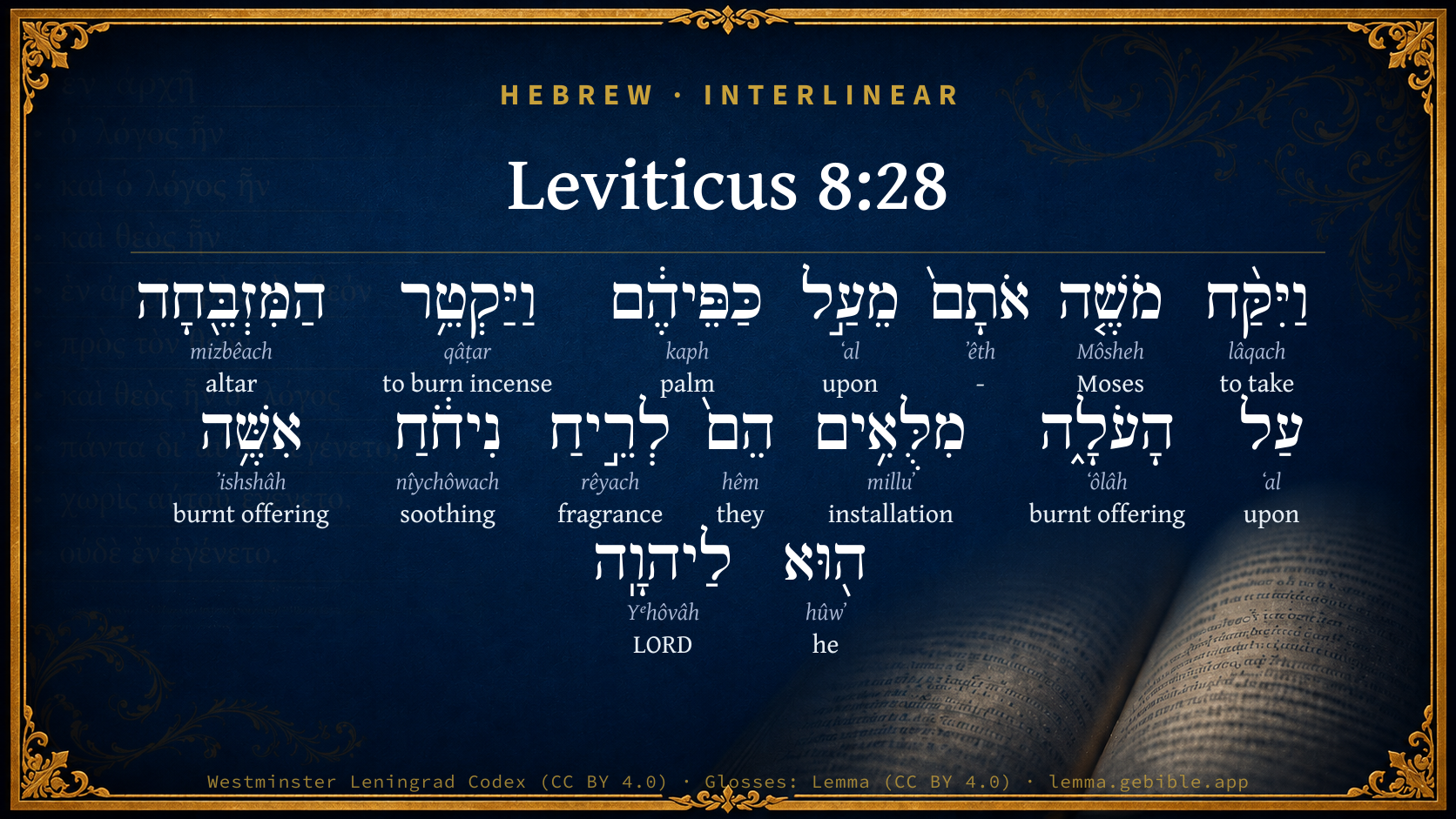
Hebrew (Westminster Leningrad Codex) Leviticus 8:28 appears in the Hebrew Old Testament. The text above is from the Westminster Leningrad Codex. Each word links to its Strong’s number, a concise gloss, and parsing drawn from the Open Scriptures Hebrew Bible morphology. Click any word for its full Brown-Driver-Briggs (BDB) entry.
Download image
Cite this verse

Leviticus 8:28 (World English Bible). Public Domain. Lemma interlinear Bible study tool, https://lemma.gebible.app/v/leviticus/8/28.

Show BibTeX & RIS
BibTeX
RIS
English Translation
Moses took them from their hands, and burned them on the altar on the burnt offering. They were a consecration for a sweet savor. It was an offering made by fire to Yahweh.
World English Bible · Public Domain
Download a study sheet

One document with this verse’s original text, its word-by-word gloss line, the meaning frame, cross-references with their text, attributed commentary, and full source and license credits — printable, and it pastes into notes with its structure intact.

This verse Autodidact and up

Study sheet (.html) Plain text (.txt)

A passage Seminary Student

Up to 50 verses in one chapter. A passage sheet keeps up to 6 commentary sources and 12 cross-references per verse, in the order this page ranks them, and says so on the sheet whenever that leaves anything out. Ask for a single verse and you get the Autodidact verse sheet above.

Everything on this page stays free to read, with no account — the sheet is a download of what is already on screen, not access to it.

Want to remove ads? Support Godless Engineer
Compare translations 3

The same verse in 3 English versions, stacked beneath the original-language interlinear above. Click any original word for its lexicon entry.

Each is an independent rendering of the whole verse — the interlinear is not word-aligned to these translations.

Highlighted words mark where these versions differ — a whole-verse word diff, not a word-by-word alignment.

  • World English Bible Public Domain
    Moses took them from their hands, and burned them on the altar on the burnt offering. They were a consecration for a sweet savor. It was an offering made by fire to Yahweh.
  • King James Version Public Domain
    And Moses took them from off their hands, and burnt them on the altar upon the burnt offering: they were consecrations for a sweet savor: it is an offering made by fire unto the LORD.
  • unfoldingWord Literal Text CC BY-SA 4.0
    And Moses took them from on their hands, and he caused to become smoke on the altar, on the burnt offering. They an ordination offering for a scent of pleasing. It a gift to Yahweh.

unfoldingWord Literal Text — © unfoldingWord, licensed CC BY-SA 4.0. Word-aligned USFM3 via Door43 (git.door43.org/unfoldingWord/en_ult).

Versions to compare (up to 4)

3 of 4 selected

Show all 18 translations

Every available English version of this verse, each an independent rendering of the whole verse.

  • World English Bible Public Domain
    Moses took them from their hands, and burned them on the altar on the burnt offering. They were a consecration for a sweet savor. It was an offering made by fire to Yahweh.
  • Berean Standard Bible Public Domain
    Then Moses took these from their hands and burned them on the altar with the burnt offering. This was an ordination offering, a pleasing aroma, an offering made by fire to the LORD.
  • Majority Standard Bible Public Domain
    Then Moses took these from their hands and burned them on the altar with the burnt offering. This was an ordination offering, a pleasing aroma, a food offering to the LORD.
  • King James Version Public Domain
    And Moses took them from off their hands, and burnt them on the altar upon the burnt offering: they were consecrations for a sweet savor: it is an offering made by fire unto the LORD.
  • American Standard Version (1901) Public Domain
    And Moses took them from off their hands, and burnt them on the altar upon the burnt-offering: they were a consecration for a sweet savor: it was an offering made by fire unto Jehovah.
  • Revised Version (1885) Public Domain
    And Moses took them from off their hands, and burnt them on the altar upon the burnt offering: they were a consecration for a sweet savour: it was an offering made by fire unto the LORD.
  • Geneva Bible (1599) Public Domain
    After, Moses tooke the out of their hands, and burnt them vpon the altar for a burnt offring: for these were consecrations for a sweete sauour which were made by fire vnto the Lord.
  • Douay-Rheims (1899) Public Domain
    He took them again from their hands, and burnt them upon the altar of holocaust, because it was the oblation of consecration, for a sweet odour of sacrifice to the Lord.
  • Young's Literal Translation Public Domain
    And Moses taketh them from off their hands, and maketh perfume on the altar, on the burnt-offering, they `are' consecrations for sweet fragrance; it `is' a fire-offering to Jehovah;
  • Literal Standard Version CC BY-SA 4.0
    And Moses takes them from off their hands, and makes incense on the altar, on the burnt-offering—they [are] consecrations for refreshing fragrance; it [is] a fire-offering to YHWH;
  • Unlocked Literal Bible CC BY-SA 4.0
    Then Moses took them from off their hands and burned them on the altar for the burnt offering. They were a consecration offering and produced a sweet aroma. It was an offering made by fire to Yahweh.
  • unfoldingWord Literal Text CC BY-SA 4.0
    And Moses took them from on their hands, and he caused to become smoke on the altar, on the burnt offering. They an ordination offering for a scent of pleasing. It a gift to Yahweh.
  • Darby Bible Public Domain
    And Moses took them from off their hands, and burned [them] on the altar, over the burnt-offering: they were a consecration-offering for a sweet odour: it was an offering by fire to Jehovah.
  • World Messianic Bible Public Domain
    Moses took them from their hands, and burned them on the altar on the burnt offering. They were a consecration offering for a pleasant aroma. It was an offering made by fire to the LORD.
  • Webster's Bible Public Domain
    And Moses took them from off their hands, and burnt them on the altar upon the burnt-offering: they were consecrations for a sweet savor: it is an offering made by fire to the LORD.
  • Free Bible Version CC BY-SA 4.0
    After this Moses took them back and burned them on the altar with the burnt offering. This was an ordination offering, a food offering to be accepted by the Lord.
  • Bible in Basic English Public Domain
    And Moses took them from their hands, and they were burned on the altar on the burned offering, as a priest's offering for a sweet smell, an offering made by fire to the Lord.
  • JPS Tanakh (1917) Public Domain
    And Moses took them from off their hands, and made them smoke on the altar upon the burnt-offering; they were a consecration-offering for a sweet savour; it was an offering made by fire unto the LORD.

Literal Standard Version (2020), Covenant Press — licensed CC BY-SA 4.0. Text via the HelloAO Bible API (eBible.org). Unlocked Literal Bible (unfoldingWord) — licensed CC BY-SA 4.0. Text via the HelloAO Bible API (eBible.org). unfoldingWord Literal Text — © unfoldingWord, licensed CC BY-SA 4.0. Word-aligned USFM3 via Door43 (git.door43.org/unfoldingWord/en_ult). Free Bible Version, Dr. Jonathan Gallagher — licensed CC BY-SA 4.0. Text via the HelloAO Bible API (eBible.org).

Word by word

More ways to search: Search by grammar → Find every occurrence → Compare this word →

Practice this passage: Drill this verse → Learn its vocabulary →

מִלֻּאִ֥ים
milluʼ
H4394
“installations”
Noun, Common, Masculine, Plural, Absolute
Part of Speech
Noun
Type
Common
Gender
Masculine
Number
Plural
State
Absolute
Full BDB Definition

Origin: from H4390

TWOT: 1195e

setting, installation - setting, stones for setting - installation (of priests)
  1. וַיִּקַּ֨ח lâqach H3947 “and · to take” Conjunction + Verb, Qal, Sequential Imperfect, 3rd Person, Masculine, Singular
  2. מֹשֶׁ֤ה Môsheh H4872 “Moses” Noun, Proper
  3. אֹתָם֙ ʼêth H853 “- · them” Particle, Direct Object + Suffix, Personal, 3rd Person, Masculine, Plural
  4. מֵעַ֣ל ʻal H5921 “from · upon” Preposition + Preposition
  5. כַּפֵּיהֶ֔ם kaph H3709 “palms · their” Noun, Common, Feminine, Dual, Construct + Suffix, Personal, 3rd Person, Masculine, Plural
  6. וַיַּקְטֵ֥ר qâṭar H6999 “and · to burn incense” Conjunction + Verb, Hiphil, Sequential Imperfect, 3rd Person, Masculine, Singular
  7. הַמִּזְבֵּ֖חָה mizbêach H4196 “the · altar · toward” Particle, Definite Article + Noun, Common, Masculine, Singular, Absolute + Suffix, Demonstrative
  8. עַל ʻal H5921 “upon” Preposition
  9. הָעֹלָ֑ה ʻôlâh H5930 “the · burnt offering” Particle, Definite Article + Noun, Common, Feminine, Singular, Absolute
  10. הֵם֙ hêm H1992 “they” Pronoun, Personal, 3rd Person, Masculine, Plural
  11. לְרֵ֣יחַ rêyach H7381 “to/for · fragrance of” Preposition + Noun, Common, Masculine, Singular, Construct
  12. נִיחֹ֔חַ nîychôwach H5207 “soothing” Noun, Common, Masculine, Singular, Absolute
  13. אִשֶּׁ֥ה ʼishshâh H801 “burnt offering” Noun, Common, Masculine, Singular, Absolute
  14. ה֖וּא hûwʼ H1931 “he” Pronoun, Personal, 3rd Person, Masculine, Singular
  15. לַיהוָֽה Yᵉhôvâh H3068 “to/for · LORD” Preposition + Noun, Proper

About this verse

These counts appear in no published source. They are computed here, from the morphology-tagged text and Lemma’s own curated glosses. What Lemma adds →

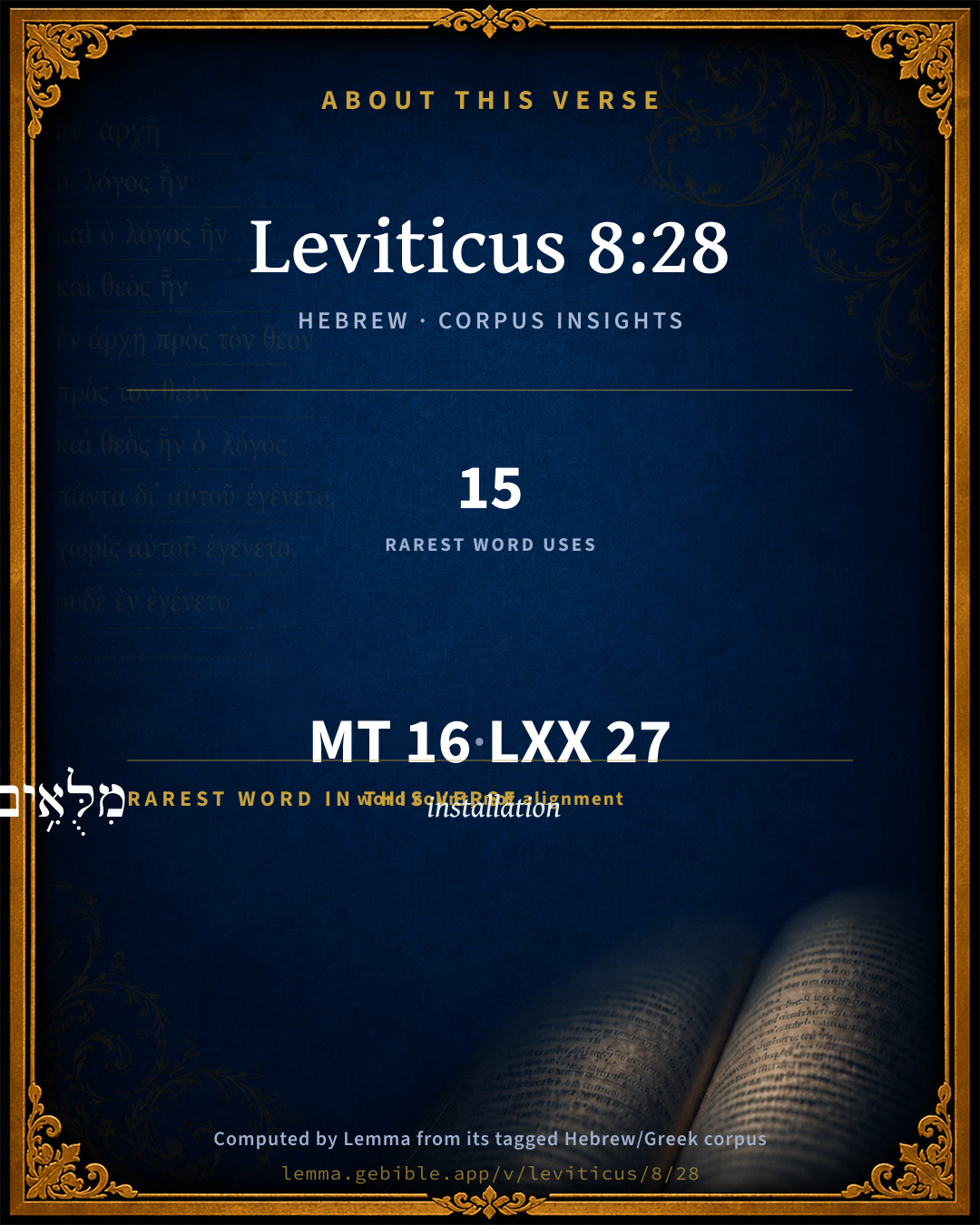
16
words
15
distinct lemmas
Pentateuch
section

Notable vocabulary

The rarest word here is מִלֻּאִ֥ים installation H4394 — appearing just 15 times in the whole Hebrew Bible.

Shared distinctive vocabulary

מִלֻּאִ֥ים installation H4394 occurs in 15 verses of the Hebrew Bible. Also found in:

Grammatical profile

  • 2 verbs
  • 9 nouns
  • 2 pronouns
  • 2 prepositions
  • 1 particle

Verb forms

  • וַיִּקַּ֨ח Qal · Sequential Imperfect
  • וַיַּקְטֵ֥ר Hiphil · Sequential Imperfect

Repetition

A word recurs within this verse — often emphatic in Hebrew:

  • מֵעַ֣ל upon H5921 ×2

Hebrew & Septuagint length

In English translation the verse runs 33 words from the Hebrew and 29 from the Septuagint (LXX English) — closely comparable.

A rough comparison of the two English renderings, which tokenize alike — not a word-level alignment.

Word counts can differ between the Hebrew and the Greek without any difference in meaning — e.g. the Hebrew direct-object marker אֵת has no separate Greek word, and Greek often adds the article ὁ.

In the original languages it is 16 Hebrew tokens and 27 Greek tokens — but the two are counted differently (Hebrew bundles its prefixes and suffixes into one token; the Greek is in lemma form), so that isn’t a like-for-like length.

Cross-references

4

Topical passages linked to Leviticus 8:28 in the Treasury of Scripture Knowledge — connected by theme and wording, ordered by reader-vote popularity; previews shown in the World English Bible.

  • Exodus 29:25 You shall take them from their hands, and burn them on the altar on the burnt offering, for a sweet savor before Yahweh: it is an offering made by fire to Yahweh.
  • Psalms 22:13–14 They open their mouths wide against me, Lions tearing prey and roaring.
  • Zechariah 13:7 "Awake, sword, against my shepherd, And against the man who is close to me," says Yahweh of Hosts. Strike the shepherd, and the sheep will be scattered; And I will turn my hand against the little ones.
  • Hebrews 10:14–22 For by one offering he has perfected forever those who are being sanctified.

Cross-references courtesy of OpenBible.info (CC BY 4.0).

Hebrew and Greek witnesses Masoretic Hebrew ↔ Greek Septuagint

The same verse in the two great witnesses to the Old Testament, shown verse-for-verse.

These are two independent witnesses, not word-aligned to each other, and the Septuagint is shown in lemma (dictionary) form.

Hebrew Leviticus 8:28 Masoretic · Westminster Leningrad Codex

וַיִּקַּ֨ח מֹשֶׁ֤ה אֹתָם֙ מֵעַ֣ל כַּפֵּיהֶ֔ם וַיַּקְטֵ֥ר הַמִּזְבֵּ֖חָה עַל הָעֹלָ֑ה מִלֻּאִ֥ים הֵם֙ לְרֵ֣יחַ נִיחֹ֔חַ אִשֶּׁ֥ה ה֖וּא לַיהוָֽה

Moses took them from their hands, and burned them on the altar on the burnt offering. They were a consecration for a sweet savor. It was an offering made by fire to Yahweh.

World English Bible · Public Domain

Greek LXX Leviticus 8:28 Septuagint · lemma form

καί λαμβάνω μωυσῆς ἀπό ὁ χείρ αὐτός καί ἀναφέρω αὐτός μωυσῆς ἐπί ὁ θυσιαστήριον ἐπί ὁ ὁλοκαύτωμα ὁ τελείωσις ὅς εἰμί ὀσμή εὐωδία κάρπωμα εἰμί ὁ κύριος

And Moses took the breast, and separated it for a heave-offering before the Lord, from the ram of consecration; and it became Moses' portion, as the Lord commanded Moses.

LXX2012 (modern English Septuagint) · Public Domain

Hebrew: Westminster Leningrad Codex (CC BY 4.0). Greek: Septuagint (public domain); English from LXX2012 (modern English Septuagint) (Public Domain). How the Septuagint differs from the Hebrew →

Targum (Aramaic paraphrase)

2

The Targum is the ancient Jewish Aramaic paraphrase of the Hebrew Scriptures — an interpretive translation, not the Hebrew text itself. Onkelos (literal) and Pseudo-Jonathan (expansive) render the Torah, and Jonathan the Prophets. Coverage is partial: where no permissively-licensed English translation exists for a verse, only the Aramaic is shown. This is verse-level text, not a word-by-word alignment to the Hebrew.

  1. Targum Onkelos Torah (Genesis–Deuteronomy)
    וּנְסִיב מֹשֶׁה יָתְהוֹן מֵעַל יְדֵיהוֹן וְאַסֵק לְמַדְבְּחָא עַל עֲלָתָא קוּרְבָּנַיָא אִנוּן לְאִתְקַבָּלָא בְרַעֲוָא קוּרְבָּנָא הוּא קֳדָם יְיָ

    (no public-domain English translation for this verse)

    Targum Onkelos — Aramaic: “Onkelos Genesis” (public domain); “Onkelos Exodus” (public domain); “Onkelos Leviticus” (public domain); “Onkelos Numbers” (public domain); “Onkelos Deuteronomy” (public domain). English: “Sefaria Community Translation” (CC0 1.0 (public-domain dedication)); “J.W. Etheridge. The Targums of Onkelos and Jonathan Ben Uzziel on the Pentateuch. London: Longmans, Green, 1862” (public domain). Text via Sefaria.

  2. Targum Pseudo-Jonathan Torah (Genesis–Deuteronomy)
    וּנְסֵיב משֶׁה יַתְהוֹן מֵעַל יְדֵיהוֹן וְאַסֵיק עַל מַדְבְּחָא עַל עֲלָתָא קָרְבָּן אַשְׁלָמוּתָא הִינוּן דִשְׁלִימוּן בְּכוֹלָא מְטוּל לְאִתְקַבְּלָא בְּרַעֲוָא קֳדָם יְיָ

    And Mosheh took them from off their hands, and burned (them) upon the altar with the burnt sacrifice; a completing offering were they to complete all, to be received with acceptance before the Lord.

    Targum Pseudo-Jonathan — Aramaic: “Targum Jonathan on Genesis” (public domain); “Targum Jonathan on Exodus” (public domain); “Targum Jonathan on Leviticus” (public domain); “Targum Jonathan on Numbers” (public domain); “Targum Jonathan on Deuteronomy” (public domain). English: “The Targum of Jonathan ben Uzziel, trans. J. W. Etheridge, London, 1862” (public domain). Text via Sefaria.

Commentary

Notes on Leviticus 8:28 from classic Christian and Jewish commentators (each source and its license shown beneath its notes). The classic Christian expositions comment on the surrounding passage and are grouped to its opening verse, so a note may address several verses; the Jewish commentaries on the Tanakh (Rashi and others) are per-verse, so they appear only where the commentator wrote on this verse.

Lemma curates 59 commentaries, every one of them public domain or Creative Commons licensed, each selected and text-cleaned for this edition rather than reprinted as found. About our sources →

John Gill's Exposition

And Moses took them from off their hands,.... After they had been waved before the Lord:

and burnt them upon the altar, upon the burnt offering; of the other ram; or after that burnt offering, as Jarchi, who observes, that we do not find that the shoulder of peace offerings was offered in any place but this, it belonged to the priest; but this being at the consecration of the priests, it was offered to the Lord by Moses, to whom it seems to have belonged, as the breast also, but that was not burnt, but eaten: and the same writer affirms, that Moses ministered all the seven days of the consecration in a white shirt, or surplice; and that he might wear a linen coat, as priests did, is not improbable, since he now officiated as one:

they were consecrated for a sweet savour; acceptable to the Lord, and so the priests, Aaron and his sons likewise, on whose account they were made:

it is an offering made by fire unto the Lord; the fat, the shoulder, and the cakes.

John Gill's Exposition of the Whole Bible (1746–1763) — public domain (CC PDM 1.0). Text via the HelloAO Bible API.

unfoldingWord translationNotes

Door43 World Missions Community

Moses took them

Here "them" refers to the fat, thigh, and all of the bread.

from off their hands

Here "hands" represents the whole person. AT: "from Aaron and his sons" (See: Synecdoche)

They were a consecration offering

"They were an offering for setting Aaron and his sons apart for service to Yahweh"

an offering made by fire to Yahweh

This can be translated in active form. AT: "a burnt offering to Yahweh" (See: Active or Passive)

produced a sweet aroma

Yahweh being pleased with the sincere worshiper who offered the sacrifice is spoken of as if God were pleased with the aroma of the burning sacrifice. See how you translated a similar phrase in Leviticus 1:9. (See: Metaphor)

breast

the front part of the animal's body below the neck

ordination

an official ceremony that makes someone a priest

translationWords

Moses

altar

burnt offering

consecrate

fire

Yahweh

ewe

priest

command

unfoldingWord translationNotes — © Distant Shores Media and the Door43 World Missions Community, licensed CC BY-SA 4.0. Source: git.door43.org/Door43/en_tn.

Rashi

Rabbi Shlomo Yitzchaki (Rashi)

ויקטר המזבחה [AND MOSES TOOK THEM FROM OFF THEIR HANDS] AND CAUSED THEM TO ASCEND IN FUMES AT THE ALTAR — Moses (though a non-priest) was officiating during the seven days of installation [in a white garment] (Avodah Zarah 34a).

על העלה [AND MOSES … CAUSED THEM TO ASCEND IN FUMES] על העלה — after the burnt offering (על is taken in the sense of besides, in addition to the burnt offering. Hence he burnt it after the burnt offering). We do not find in any passage, that the shoulder of peace-offerings was burnt except in the case of this alone (cf. Rashi on Exodus 29:22).

Rashi on the Tanakh — English translations: “The Judaica Press complete Tanach with Rashi, translated by A. J. Rosenberg” (CC BY 4.0); “Pentateuch with Rashi's commentary by M. Rosenbaum and A.M. Silbermann, 1929-1934” (public domain); “The Metsudah Tanach series, Lakewood, N.J” (CC BY 4.0); and “The Book of Joshua, Metsudah Publications, 1997” (CC BY 4.0). Text via Sefaria.

Lesson kit

Teaching starters — assembled from the data on this page, not authored interpretation. Every prompt links to the verse data it draws on. Edit before teaching.

Leviticus, in the Pentateuch, opens this verse with 16 words (15 distinct Hebrew lemmas). Its most distinctive word is milluʼ (“installation”). A historical commentator’s framing appears above. Read the whole chapter for the surrounding context.

Discussion questions

  1. How does “installation” (milluʼ) shape what this verse is saying?
  2. Exodus 25:7 shares the word «installation» with this verse. How do the two illuminate each other?
  3. “upon” occurs 2× in this one verse. What is the effect of the repetition?
  4. These translations render this verse differently; the difference is in the English rendering, not the original. What questions does that raise?
  5. The verb «וַיִּקַּ֨ח» is Qal Sequential Imperfect. How does its form color the action?
  6. Reading how John Gill's Exposition and unfoldingWord translationNotes read this verse, where do the two commentators agree and where do they part?

Things to notice

Reading settings

Reading text

Shown beneath each verse's original-language words.

Old Testament
Old Testament edition

Read the OT as the Masoretic Hebrew (MT) or the Greek Septuagint (LXX).

English shown for the Greek Septuagint (in the Hebrew ↔ Greek comparison).

Comparing translations? Open the Compare panel on any verse page to stack up to four side by side.