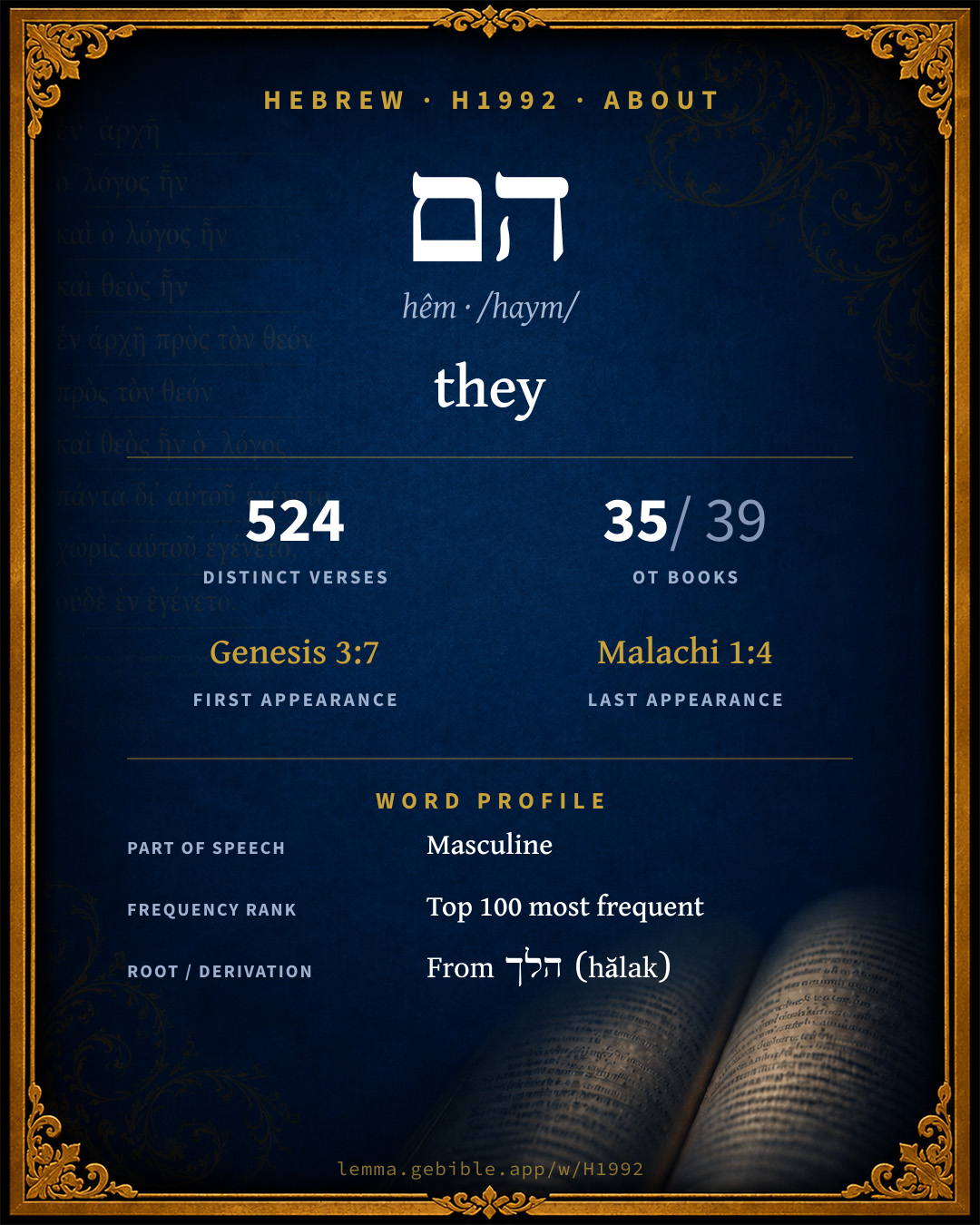
הֵ֫מָּה
they
Full lexicon entry — Brown-Driver-Briggs (BDB)
From Brown-Driver-Briggs (BDB)
Where this word appears
Grammar key — what these labels mean
Part of speech
- Pronoun
- A word standing in for a noun (“he,” “this,” “who”).
- Preposition
- A relational word (e.g. “in,” “to,” “from”) governing a noun.
- Particle
- A short function word — article, negation, interrogative, the sign of the direct object, and the like.
Person
- 3rd Person
- The one spoken about (“he / she / it / they”).
Gender
- Masculine
- Grammatically masculine.
Number
- Plural
- More than one (in Hebrew, generally three or more).
Every verse where H1992 appears in the Book of 1 Chronicles — 22 distinct verses. Click any verse to open its interlinear word-by-word view. Verse text shown in the World English Bible for context — . Each verse’s Hebrew form is shown with its reference; the English is not keyword-highlighted, since the data carries no word-level English alignment. Use “Compare translations” on any verse to read it across multiple English versions. This concordance covers the Hebrew Bible; Septuagint (Greek Old Testament) occurrences are not indexed here.
1 Chronicles
- 1 Chronicles 1:31 הֵ֖ם pron pers 3mp Jetur, Naphish, and Kedemah. These are the sons of Ishmael.
- 1 Chronicles 2:55 הֵ֚מָּה pron pers 3mp The families of scribes who lived at Jabez: the Tirathites, the Shimeathites, the Sucathites. These are the Kenites who came of Hammath, the father of the house of Rechab.
- 1 Chronicles 4:23 הֵ֚מָּה pron pers 3mp These were the potters, and the inhabitants of Netaim and Gederah: there they lived with the king for his work.
- 1 Chronicles 5:23 הֵ֥מָּה pron pers 3mp The children of the half-tribe of Manasseh lived in the land: they increased from Bashan to Baal Hermon and Senir and Mount Hermon.
- 1 Chronicles 8:6 הֵ֞ם pron pers 3mp These are the sons of Ehud: these are the heads of fathers' [houses] of the inhabitants of Geba, and they carried them captive to Manahath:
- 1 Chronicles 8:13 הֵ֚מָּה הֵ֥מָּה pron pers 3mp pron pers 3mp and Beriah, and Shema, who were heads of fathers' [houses] of the inhabitants of Aijalon, who put to flight the inhabitants of Gath;
- 1 Chronicles 8:32 הֵ֗מָּה pron pers 3mp Mikloth became the father of Shimeah. They also lived with their brothers in Jerusalem, over against their brothers.
- 1 Chronicles 9:18 הֵ֚מָּה pron pers 3mp who hitherto [waited] in the king's gate eastward: they were the porters for the camp of the children of Levi.
- 1 Chronicles 9:22 הֵ֤מָּה הֵ֣מָּה pron pers 3mp pron pers 3mp All these who were chosen to be porters in the thresholds were two hundred and twelve. These were reckoned by genealogy in their villages, whom David and Samuel the seer did ordain in their office of trust.
- 1 Chronicles 9:23 וְ/הֵ֨ם conj + pron pers 3mp So they and their children had the oversight of the gates of the house of Yahweh, even the house of the tent, by wards.
- 1 Chronicles 9:26 הֵ֗מָּה הֵ֖ם pron pers 3mp pron pers 3mp for the four chief porters, who were Levites, were in an office of trust, and were over the chambers and over the treasuries in the house of God.
- 1 Chronicles 9:27 וְ/הֵ֥ם conj + pron pers 3mp They lodged round about the house of God, because the charge [of it] was on them; and to them pertained the opening of it morning by morning.
- 1 Chronicles 9:38 הֵ֗ם pron pers 3mp Mikloth became the father of Shimeam. They also lived with their brothers in Jerusalem, over against their brothers.
- 1 Chronicles 12:1 וְ/הֵ֨מָּה֙ conj + pron pers 3mp Now these are those who came to David to Ziklag, while he yet kept himself close because of Saul the son of Kish; and they were among the mighty men, his helpers in war.
- 1 Chronicles 12:15 הֵ֗ם pron pers 3mp These are those who went over the Jordan in the first month, when it had overflowed all its banks; and they put to flight all them of the valleys, both toward the east, and toward the west.
- 1 Chronicles 12:21 וְ/הֵ֗מָּה conj + pron pers 3mp They helped David against the band of rovers: for they were all mighty men of valor, and were captains in the host.
- 1 Chronicles 19:15 הֵ֗ם pron pers 3mp When the children of Ammon saw that the Syrians were fled, they likewise fled before Abishai his brother, and entered into the city. Then Joab came to Jerusalem.
- 1 Chronicles 21:3 כָּ/הֵם֙ prep + pron pers 3mp Joab said, Yahweh make his people a hundred times as many as they are: but, my lord the king, aren't they all my lord's servants? why does my lord require this thing? why will he be a cause of guilt to Israel?
- 1 Chronicles 23:27 הֵ֖מָּה pron pers 3mp For by the last words of David the sons of Levi were numbered, from twenty years old and upward.
- 1 Chronicles 24:31 הֵ֨ם pron pers 3mp These likewise cast lots even as their brothers the sons of Aaron in the presence of David the king, and Zadok, and Ahimelech, and the heads of the fathers' [houses] of the priests and of the Levites; the fathers' [houses] of the chief even as those of his younger brother.
- 1 Chronicles 26:6 הֵֽמָּה pron pers 3mp Also to Shemaiah his son were sons born, who ruled over the house of their father; for they were mighty men of valor.
- 1 Chronicles 26:8 הֵ֤מָּה pron pers 3mp All these were of the sons of Obed-edom: they and their sons and their brothers, able men in strength for the service; sixty-two of Obed-edom.
About this entry
At a glance — auto-summarized from this page’s data, not written by a person. Every figure links to its source below. This summary describes the numbers; it doesn’t interpret them.
הם — transliterated hêm — is a Hebrew word carrying the sense “they.” Debuting at Genesis 3:7, it then recurs through the corpus. The Hebrew Bible uses it across 524 verses — among the most common. It shares a root with הלך, הוך and הלך. See the sense tree, 524-verse concordance, and the renderings breakdown below.
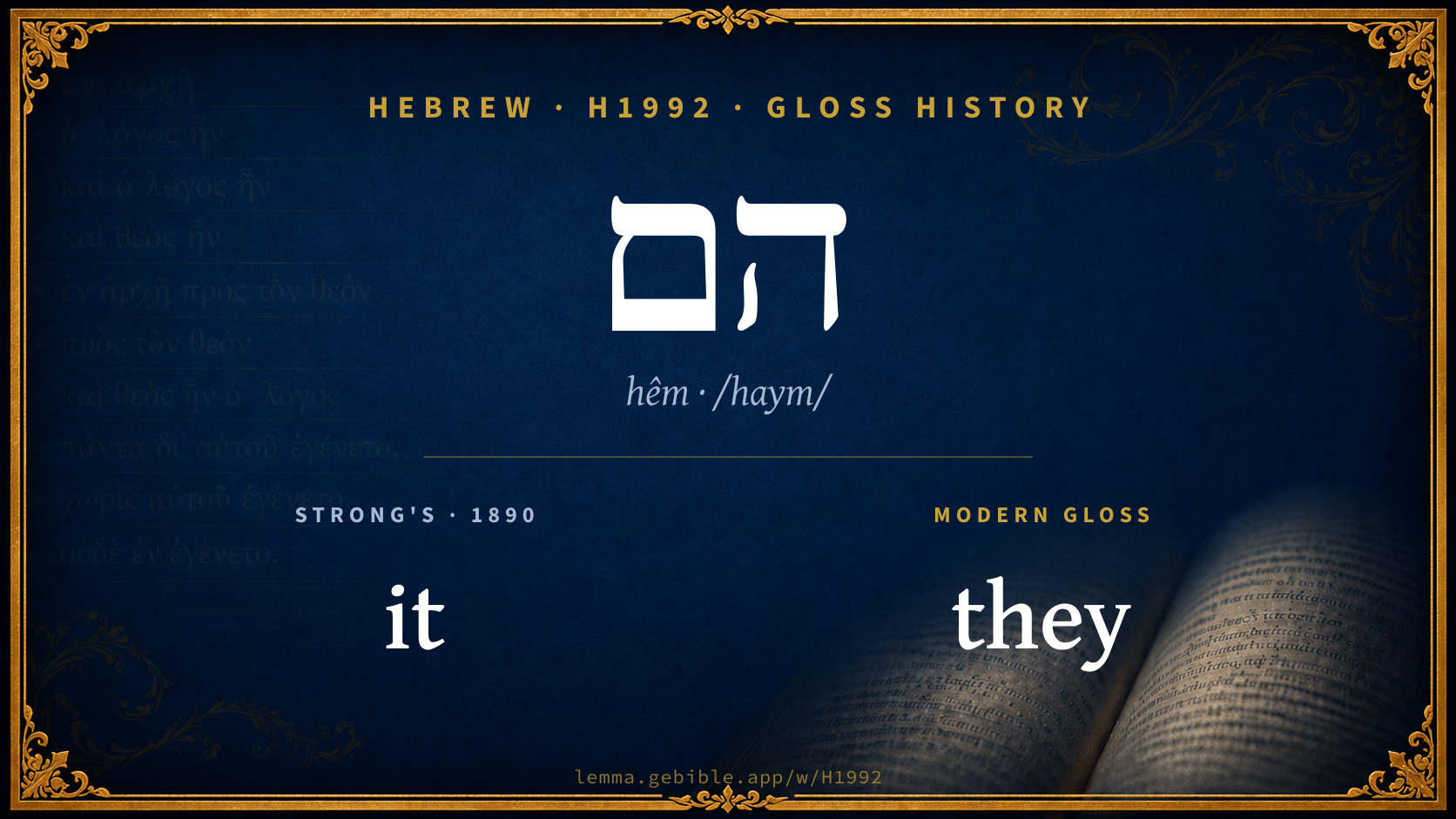
Gloss history
Strong's 1890 vs modern scholarship
About this word
Strong's H1992 catalogs a Hebrew word from the Hebrew Old Testament.
These counts are not copied from any lexicon or concordance. They are computed here, from the morphology-tagged Hebrew Old Testament. What Lemma adds →
- 524
- distinct verses
- The word appears in 524 distinct verses.
- 35 / 39
- OT books
- The word appears in 35 of 39 Old Testament books.
- #88
- by frequency
- Top 100 most frequent Hebrew words (rank 88 of 8,640 Hebrew words by occurrence).
View all 524 occurrences in the concordance →
By section of the Old Testament
By traditional corpus
Conventional, traditional groupings — biblical authorship is debated, so this is a traditional corpus grouping, not an authorship claim. Each share is this word’s portion of its verses in that division of the Hebrew canon. Each figure is a share of the word’s 524 distinct verses.
- Prophets (Nevi'im) 298 verses · 57%
- Writings (Ketuvim) 116 verses · 22%
- Torah (Pentateuch) 110 verses · 21%
How translations render this word
Counts come from each version’s own published word-to-Strong’s tagging or interlinear alignment — an approximate guide to how each version renders this word, not a word-level alignment the data otherwise carries. Because each total is that version’s own tagged count, the per-version totals vary from one another and need not match the appearance or distinct-verse counts above. These counts may also differ from a printed concordance because Lemma counts each distinctly tagged rendering and does not collapse phrase taggings into a single head-word total. This is a fixed set of word-tagged versions (KJV, ASV, BSB, ULT) and does not change with the reading translation you choose elsewhere. Each version’s license is shown beside its name below (and on Sources).
- King James Version: These 5×, They 5×, Them 4×
- American Standard Version: Them 4×, These 4×, They 4×
- Berean Standard Bible: They 256×, Those 40×, Are they 11×
- unfoldingWord Literal Text: They 387×, Those 47×, Are 27×
King James Version Public Domain
Renders H1992 across 42 tagged occurrences — most commonly:
Plus 22 renderings that appear only once — usually multi-word phrases or single function words the recovered tagging swept in, not distinct renderings. Not rendered by a distinct English word in 2 further occurrences.
American Standard Version Public Domain
Renders H1992 across 43 tagged occurrences — most commonly:
Plus 21 renderings that appear only once — usually multi-word phrases or single function words the recovered tagging swept in, not distinct renderings.
Berean Standard Bible Public Domain
Renders H1992 across 426 tagged occurrences — most commonly:
Plus other, less common renderings. Plus 44 renderings that appear only once — usually multi-word phrases or single function words the recovered tagging swept in, not distinct renderings. Not rendered by a distinct English word in 122 further occurrences.
unfoldingWord Literal Text CC BY-SA 4.0
Renders H1992 across 586 tagged occurrences — most commonly:
Plus other, less common renderings. Plus 21 renderings that appear only once — usually multi-word phrases or single function words the recovered tagging swept in, not distinct renderings.
21 senses and sub-senses in the full BDB
What do BDB’s symbols mean?
BDB uses these scholarly abbreviations:
| Symbol | Meaning |
|---|---|
| 𝔊 | the Septuagint (the ancient Greek translation, LXX) |
| 𝔙 | the Vulgate (the Latin translation) |
| 𝔖 | the Syriac version (the Peshitta) |
| 𝔗 | the Targum (the Aramaic translation) |
| ψ | the Psalms |
| √ | root (the underlying root or stem) |
| ‖ | parallel passage (a synonymous or contrasted parallel) |
| † | the dagger: every passage where the word occurs is cited |
The 21 senses and sub-senses the full Brown-Driver-Briggs lexicon distinguishes for this word, in lexicon order (not ranked by frequency), with BDB’s own verbatim wording and sub-sense lettering. Shown in Hebrew script with BDB’s own scholarly abbreviations. The condensed entry is in the Lexicon Entry tab. See also the Forms in the corpus table below.
- 1.
- a. Gn 6:4; Ex 5:7 הֵם יֵֽלְכוּ let them (emph.) go and gather straw, Nu 31:16; Is 24:14; Ho 4:14; 7:3 etc.; after כִּי Je 5:5; 34:7. (For the use in circumst. clauses v. Dr§ 160, 169.) e.g. Genesis 6:4
- b. Ju 1:22 ויעלו … גַם הֵם, Dt 2:11 (אַף הֵם), 3:20; Jos 9:4; Ez 30:17. e.g. Judges 1:22
- c. Ex 18:22 every small matter יִשְׁפְּטוּ־הֵם let them judge themselves, v 26 Je 15:19; 17:18 ψ 109:28; Est 9:1. e.g. Exodus 18:22
- d. Gn 33:6; 44:3 Jud 6:5 etc. e.g. Genesis 33:6
- e. cf. Ne 10:38. e.g. Nehemiah 10:38
- 2.
- a. (Resuming the subj. with emph.) Gn 14:24 (note accents), Dt 1:39 ψ 23:4; 27:2 (accents), 37:9; 107:24; Ez 36:7; 44:15. e.g. Genesis 14:24
- b. Is 30:7; Ez 27:13, 17, 21; cf. Is 44:11. e.g. Isaiah 30:7
- c. Nu 14:27a Je 27:9; Ez 43:19 אֲשֶׁר הֵם מִזֶּרַע צָדוֹק, Ec 4:2; Ne 2:13.—הֵמָּה כִּדְוֵי לַחֻמִי Jb 6:7 read perhaps וַהֲמָה וגו׳ (or זָֽהֲמָה) it is loathesome (√ זהם). e.g. Numbers 14:27
- 3.
- a. Gn 3:7; Ex 5:8 כִּי נִרְפִּים הֵם for they are idle, 14:3; 15:23; 29:33 etc. (the opp. order rare: Nu 11:16 Is 61:9, cf. De ψ 94:11). e.g. Genesis 3:7
- b. Gn 34:21, 23; 41:26; 48:5 שׁני בניך … לִי הֵם thy two sons …, they are mine, Ex 32:16 + often: Is. 41:22 הָרִאשֹׁנוֹת מָה הֵנָּה, 49:21 אֵלֶּה אֵיפֹה הֵם these—where were they? Zp 2:12 after אַתֶּם, peculiarly (cf. Dr§ 198 Obs. 2). e.g. Genesis 34:21
- c. Dt 20:15 אֲשֶׁר לֹא־מֵעָרֵי הַגּוֹיִם הָאֵלֶּה הֵנָּה, Ju 19:12 1 K 9:20. e.g. Deuteronomy 20:15
- d. 2 K 7:10 כַּאֲשֶׁר הֵמָּה. (Pr 19:7 Kt לֹא־הֵמָּה is prob. corrupt: v. Comm.) e.g. 2 Kings 7:10
- 4.
- a. Pr 30:24 אַרְבָּעָה הֵם קְטַנֵּי־אָ֑רֶץ four things are they, the little ones of the earth, v 29 (cf. before a rel. clause v 15, 18; 6:16) Ct 6:8; Is 51:19 שְׁתַּיִם הֵנָּה קֹרְאֹתַיִךְ, 1 Ch 9:26 (v. הוא 4 a). e.g. Proverbs 30:24
- b. (β) Gn 21:29 מָה הֵנָּה שֶׁבַע … lit. What are they—these seven sheep? Zc 1:9; 4:5. (γ) אֵלֶּה … הֵם †Gn 25:16 (= 1 Ch 1:36) Lv 23:2; Nu 3:20, 21, 27, 33 1 S 4:8 1 Ch 8:6; 12:15 (v. Dr§ 201, 3). e.g. Genesis 21:29
- 6.
- a. In a neuter sense (rare), Jb 6:7 הֵמָּה כִּדְוֵי לַחְמִי they (i.e. such sufferings as mine) are as loathsomeness in my meat, Je 7:4 הֵיכַל י׳ הֵמָּה they (i.e. these buildings) are the temple of י׳; and in the fem., Lv 5:22 of all that a man doeth to sin בָּהֵנָּה therein, 1 Ch 21:10 מֵהֵנָּה (‖ 2 S 24:12 מֵהֶם); 2 S 12:8 Jb 23:14 כָּהֵנָּה things such as these. e.g. Job 6:7
- 7. With art. הָהֵם, Gn 6:4; Ex 2:11; Nu 14:38 + often; הָהֵמָּה 12 times (v. supr.); הָהֵנָּה †1 S 17:28. N.B.—Ez 8:6 Kt מָהֵם stands for מָה הֵם (so Qr), cf. מַזֶּה for מַה־זֶּה Ex 4:2; 2 K 9:18 עַד־הֵם is irreg. for עֲדֵיהֶם; 2 S 4:6 וְהֵנָּה וג׳ is textual error for וְהִנֵּה שֹׁעֶרֶת הַבַּיִת סֹקְלָה חִטִּים וג׳ v. We Dr (𝔊 & RVm). e.g. Genesis 6:4
- 8. With preps. (in lieu of the normal, and more usual, forms with suffixes בָּהֶם, לָהֶם, מֵהֶם etc. [כָּהֶם & כָּהֶן, however, each once only, כְּמוֹהֶם thrice: v. כְּ])—
- a. בָּהֵמָּה †Ex 30:4; 36:1 (both P), Hb 1:16; כָּהֵמָּה †Je 36:32; לָהֵמָּה †Je 14:16; מֵהֵמָּה †Je 10:2 Ec 12:12. e.g. Exodus 30:4
- b. כָּהֵם †2 S 24:3 Yahweh add to the people כָּהֵם וְכָהֵם מֵאָה פְעָמִים the like of themselves and the like of themselves 100 times, = 1 Ch 21:3 (but כָּהֵם here only once, cf. Dt 1:11 כָּכֶם), 2 Ch 9:11; Ec 9:12. e.g. 2 Samuel 24:3
- c. בָּהֵנָּה †Lv 5:22 (P) Nu 13:19 (JE) Je 5:17: כָּהֵנָּה †Gn 41:19 2 S 12:8 וְאֹסִפָה לְךָ כָּהֵנָּה וְכָהֵנָּה, Jb 23:14: לָהֵנָּה †Ez 1:5, 23(×2); 42:9; Zc 5:9: מֵהֵנָּה †Lv 4:2 (P) Is 34:16; Je 5:6; Ez 16:51; 42:5 ψ 34:21 1 Ch 21:10 (‖ 2 S 24:12 מֵהֶם). e.g. Leviticus 5:22
- d. בָּהֵן †Gn 19:29 (P) 30:26, 37 Ex 25:29; 37:16 (both P) Lv 10:1; 11:21; 14:40 Nu 10:3; 16:7 (all P) Dt 28:52; Jr 4:29; 48:9; 51:43(×2) (בָּהֶן thrice only, v. p. 88); כָּהֵן †Ez 18:14 (edd.; Baer כָּהֶן); לָהֵן (= therefore) †Ru 1:13(×2) (also Biblical Aramaic); מֵהֵן †Ez 16:47, 52 (edd.; Baer מֵהֶן). (With the exception of כָּהֵנָּה, these forms are found mostly in P and writers not earlier than Je.; b and d, however, depend solely on the punctuation.) e.g. Genesis 19:29
Senses from the full Brown-Driver-Briggs lexicon (Brown, Driver, Briggs; Oxford 1906 — public domain), digitized via Sefaria, supplemented by the OpenScriptures HebrewLexicon (CC BY 4.0). Full attribution on Sources.
Word origin
and הֵם (without appreciable distinction in usage, except prob. in so far as the longer or shorter form was better adapted to the rhythm of particular sentences: on the whole הֵמָּה (alone) is somewhat more freq. than הֵם, הָהֵם on the contrary is said regularly, הָהֵמָּה occurring only 12 times, viz. Nu 9:7 (P), Je 14:15 Zc 14:15, and in the phr. בַּ(הַ)יָּמִים הָהֵמָּה 2 K 18:4 Je 3:16, 18; 5:18; 50:4; Jo 3:2; 4:1; Zc 8:23; Ne 13:15, though בַּיָּמִים הָהֵם is much more common) pron. 3 pl. masc. (הֵמָּה used incorrectly for the fem. Zc 5:10; Ru 1:22; Ct 6:8), fem. הֵ֫נָּה [NH also הֵן, which occurs however in Bibl. Heb. only after a prefix: v. infr. 8], pr. 3 pl. they (Biblical Aramaic הִמּוֹ, q.v.; هُنَّ, هُمْ; Ethiopic (one form) እሙንቱ: እማንቱ: ʾemūn-tū, ʾemān-tū; cf. also for the dissyl. form, the sf. –ōmū [fem. –ōn]; perhaps also Assyrian suff. šunu, šina[ni], cf. reff. sub הוּא). In usage not different in genl. from הוּא, הִיא (which see, under the corresponding headings, for fuller explanations), thus:—
— Brown-Driver-Briggs (Oxford 1906, public domain), digitized via Sefaria, supplemented by the OpenScriptures HebrewLexicon (CC BY 4.0). See Sources.
Derived from הלך (hălak) (H1981) — to walk.
Jastrow Dictionary
A second Hebrew/Aramaic lexicon for comparison, covering Aramaic and post-biblical (Talmudic, Targumic, Midrashic) usage that the biblical-Hebrew BDB does not. Matched by lemma rather than by Strong’s number, so a lemma may carry more than one Jastrow headword (shown separately below), and the entries cover usage well beyond the Bible.
הוּא
- (b. h.) he, it; she; it is &c. Snh. III, 3 (24ᵇ) if he has no trade אלא הוא (Y. ed., Erub. 82ᵃ היא) except this (gambling &c.); יש לו אומנות שלא הוא (היא) if he has a trade besides this (v. Rabb. D. S. a. l. note 80).—הוא—הוא, היא—היא it is the same, i.e. there is no difference between the two. Y. Ber. I, 3ᵇ היא היא both are equally precious. Gen. R. s. 9, end הוא מאד הוא אדם the word מאד has the same letters as אדם. Ber. 2ᵇ דילמא ביאת אורו הוא perhaps it is (means) the arrival of his day, v. אוֹר II; a. v. fr.—[Shebi. III, 8 עושה הוא; IV, 5 מכסה הוא, Y. ed. עוֹשֵׂהוּ, מְכַסֵּהוּ; ib. X, 6 מזכה הוא; Ms. M., Gitt. 37ᵃ מְזַכֵּהוּ.]—ולא היא but it is not so (it has a different reason &c.). Ber. 57ᵃ; a. fr.—כל שהוא (כל שהיא) a) whosoever, whatsoever (is). Peah II, 4 כל ש׳ אוכל whatever is eatable &c.; a. fr.—b) whatever it may be, a minimum, v. כָּל. Shebi. X, 6 כל שהוא; Gitt. l. c. כל שֶׁהוּ; a. fr.—ספר היא the Book Hi, name of a Pentateuch scroll in the Temple in which היא occurs nine times (for the archaic הִוא), whereas in others it appears eleven times (v. Ab. d’R. N. ch. XXXIV, ed. Schechter). Sifré Deut. 356; Y. Taan. IV, 68ᵃ bot.—הַהוּא, הַהִיא, mostly in Chald. diction, v. next w.—Pl. הֵם m., הֵן c. Ber. 2ᵇ והלא כהנים … הם טובלים but do not priests bathe &c.?—Meg. 14ᵇ רהמניות הן are compassionate. Ḥull. 127ᵇ הרי הן וכ׳ they are to be treated as if &c.; a. v. fr.—הן … הן are the same. Y. Ab. Zar. II, end, 42ᵃ, v. אִסְטַגְיוֹת.—With prep. מֵהֶם, מֵהֶן, לָהֶם &c.
הֵם
- m. pl. of הוּא.
A Dictionary of the Targumim, the Talmud Babli and Yerushalmi, and the Midrashic Literature (Marcus Jastrow; London, Luzac, 1903) — Public Domain. Digitized via Sefaria. Digitized via Sefaria. Full attribution on Sources.
Forms in the corpus
The 95 distinct written forms H1992 takes in the Hebrew Bible, most frequent first — each parse links to that state’s occurrences in the concordance. Hebrew forms include their vowel points and cantillation, so a single lemma takes many written forms.
| Form | Parsing | Example | Uses |
|---|---|---|---|
| הֵ֣ם | Pronoun, Personal, 3rd Person, Masculine, Plural | Esther 10:2 | 43 |
| הֵ֖מָּה | Pronoun, Personal, 3rd Person, Masculine, Plural | Deuteronomy 1:39 | 31 |
| הֵֽמָּה | Pronoun, Personal, 3rd Person, Masculine, Plural | Ezekiel 2:6 | 28 |
| הֵ֣מָּה | Pronoun, Personal, 3rd Person, Masculine, Plural | Ezekiel 10:22 | 27 |
| הֵ֥ם | Pronoun, Personal, 3rd Person, Masculine, Plural | Ecclesiastes 1:7 | 26 |
| הֵ֖ם | Pronoun, Personal, 3rd Person, Masculine, Plural | Deuteronomy 2:11 | 23 |
| הֵ֥מָּה | Pronoun, Personal, 3rd Person, Masculine, Plural | Ecclesiastes 4:2 | 22 |
| הָ/הֵ֔ם | Pronoun, Personal, 3rd Person, Masculine, Plural | Daniel 11:14 | 18 |
| הֵ֑ם | Pronoun, Personal, 3rd Person, Masculine, Plural | Exodus 15:23 | 16 |
| הֵ֗מָּה | Pronoun, Personal, 3rd Person, Masculine, Plural | Deuteronomy 14:7 | 15 |
| הֵ֨מָּה֙ | Pronoun, Personal, 3rd Person, Masculine, Plural | Ezekiel 44:19 | 15 |
| הֵ֚מָּה | Pronoun, Personal, 3rd Person, Masculine, Plural | Ezekiel 20:49 | 12 |
| הֵ֤מָּה | Pronoun, Personal, 3rd Person, Masculine, Plural | Ezekiel 2:3 | 12 |
| הֵֽם | Pronoun, Personal, 3rd Person, Masculine, Plural | Exodus 18:26 | 12 |
| וְ/הֵ֖ם | Pronoun, Personal, 3rd Person, Masculine, Plural | Deuteronomy 1:39 | 12 |
| וְ/הֵ֖מָּה | Pronoun, Personal, 3rd Person, Masculine, Plural | Ezekiel 25:4 | 12 |
| הֵ֑מָּה | Pronoun, Personal, 3rd Person, Masculine, Plural | Deuteronomy 32:28 | 11 |
| הֵ֔ם | Pronoun, Personal, 3rd Person, Masculine, Plural | Deuteronomy 3:20 | 10 |
| הֵ֔מָּה | Pronoun, Personal, 3rd Person, Masculine, Plural | Deuteronomy 32:20 | 10 |
| הֵ֜מָּה | Pronoun, Personal, 3rd Person, Masculine, Plural | Deuteronomy 11:30 | 9 |
| וְ/הֵם֙ | Pronoun, Personal, 3rd Person, Masculine, Plural | Deuteronomy 33:3 | 9 |
| הֵ֗ם | Pronoun, Personal, 3rd Person, Masculine, Plural | Exodus 6:27 | 8 |
| הֵ֛מָּה | Pronoun, Personal, 3rd Person, Masculine, Plural | Ezekiel 32:29 | 8 |
| הָ/הֵ֑ם | Pronoun, Personal, 3rd Person, Masculine, Plural | Daniel 10:2 | 8 |
| וְ/הֵ֣מָּה | Pronoun, Personal, 3rd Person, Masculine, Plural | 1 Kings 10:25 | 8 |
| וְ/הֵ֨מָּה֙ | Pronoun, Personal, 3rd Person, Masculine, Plural | Ezekiel 2:5 | 8 |
| הֵ֛ם | Pronoun, Personal, 3rd Person, Masculine, Plural | 2 Kings 4:5 | 7 |
| וְ/הֵ֥ם | Pronoun, Personal, 3rd Person, Masculine, Plural | Deuteronomy 9:29 | 7 |
| הָ/הֵֽם | Pronoun, Personal, 3rd Person, Masculine, Plural | Deuteronomy 18:9 | 6 |
| וְ/הֵ֗מָּה | Pronoun, Personal, 3rd Person, Masculine, Plural | Ezekiel 34:30 | 6 |
| הֵ֚ם | Pronoun, Personal, 3rd Person, Masculine, Plural | Deuteronomy 32:21 | 5 |
| הֵ֞ם | Pronoun, Personal, 3rd Person, Masculine, Plural | Genesis 25:16 | 5 |
| הֵ֭מָּה | Pronoun, Personal, 3rd Person, Masculine, Plural | Proverbs 30:18 | 5 |
| הֵם֙ | Pronoun, Personal, 3rd Person, Masculine, Plural | Hosea 4:14 | 5 |
| הָ/הֵ֗ם | Pronoun, Personal, 3rd Person, Masculine, Plural | Exodus 2:11 | 5 |
| וְ/הֵ֥מָּה | Pronoun, Personal, 3rd Person, Masculine, Plural | Ecclesiastes 7:29 | 5 |
| הֵ֧מָּה | Pronoun, Personal, 3rd Person, Masculine, Plural | Genesis 6:4 | 4 |
| הֵם֩ | Pronoun, Personal, 3rd Person, Masculine, Plural | Exodus 5:8 | 4 |
| הָ/הֵם֙ | Pronoun, Personal, 3rd Person, Masculine, Plural | Deuteronomy 28:65 | 4 |
| וְ/הֵ֛מָּה | Pronoun, Personal, 3rd Person, Masculine, Plural | Ezekiel 8:16 | 4 |
| הָ/הֵ֔מָּה | Pronoun, Personal, 3rd Person, Masculine, Plural | Jeremiah 3:18 | 3 |
| הֵ֝֗מָּה | Pronoun, Personal, 3rd Person, Masculine, Plural | Job 6:7 | 3 |
| הֵ֤ם | Pronoun, Personal, 3rd Person, Masculine, Plural | Deuteronomy 4:10 | 3 |
| הֵמָּה֮ | Pronoun, Personal, 3rd Person, Masculine, Plural | Ezekiel 23:10 | 3 |
| הָ/הֵ֨מָּה֙ | Pronoun, Personal, 3rd Person, Masculine, Plural | 2 Kings 18:4 | 3 |
| וְ/הֵ֛ם | Pronoun, Personal, 3rd Person, Masculine, Plural | 2 Chronicles 3:13 | 3 |
| וְ/הֵ֣ם | Pronoun, Personal, 3rd Person, Masculine, Plural | 2 Chronicles 9:24 | 3 |
| וְ/הֵ֨מָּה | Pronoun, Personal, 3rd Person, Masculine, Plural | 2 Samuel 21:9 | 3 |
| וְ֝/הֵ֗ם | Pronoun, Personal, 3rd Person, Masculine, Plural | Proverbs 18:8 | 3 |
| הָ/הֵ֖מָּה | Pronoun, Demonstrative, Masculine, Plural | Joel 3:1 | 2 |
| הֵ֠מָּה | Pronoun, Personal, 3rd Person, Masculine, Plural | Ezekiel 37:25 | 2 |
| הֵ֨ם | Pronoun, Personal, 3rd Person, Masculine, Plural | 1 Chronicles 24:31 | 2 |
| הֵ֭ם | Pronoun, Personal, 3rd Person, Masculine, Plural | Proverbs 4:22 | 2 |
| וְ/הֵ֕מָּה | Pronoun, Personal, 3rd Person, Masculine, Plural | Hosea 6:7 | 2 |
| וְ/הֵ֗ם | Pronoun, Personal, 3rd Person, Masculine, Plural | Hosea 3:1 | 2 |
| וְ/הֵ֤מָּה | Pronoun, Personal, 3rd Person, Masculine, Plural | 1 Kings 22:32 | 2 |
| וְ֝/הֵ֗מָּה | Pronoun, Personal, 3rd Person, Masculine, Plural | Proverbs 30:24 | 2 |
| בָ/הֵ֨מָּה֙ | Pronoun, Personal, 3rd Person, Masculine, Plural | Habakkuk 1:16 | 1 |
| בָּ/הֵ֔מָּה | Pronoun, Personal, 3rd Person, Masculine, Plural | Exodus 36:1 | 1 |
| בָּ/הֵֽמָּה | Pronoun, Personal, 3rd Person, Masculine, Plural | Exodus 30:4 | 1 |
The 60 most common forms are shown; 35 rarer forms follow in the full concordance.
Same root — word family
Other BDB entries built from the same root as H1992, grouped by Strong’s listed origin. These share a root / origin per the lexicon — not necessarily a shared meaning. Each links to that word’s own entry.
Derives from
Shares the same root
Derived from this word
Compare all same-root words → Showing 4 of 6 — not the complete family. They share a root, not necessarily a meaning.
Septuagint verse parallels
This word appears in 483 verses that also exist in the Greek Old Testament (Septuagint), out of the 524 Hebrew verses it occurs in. You can read those verses in Greek by switching the Old Testament edition to the Septuagint.
Read these verses in the Septuagint
- Genesis 3:7
- Exodus 2:11
- Leviticus 8:28
- Numbers 1:16
- Deuteronomy 1:39
- Joshua 1:15
- Judges 1:22
- Ruth 1:22
- 1 Samuel 3:1
- 2 Samuel 2:24
- 1 Kings 1:41
- 2 Kings 1:18
This is a verse-level parallel only — the same verses exist in both the Hebrew and Greek Old Testaments. No word-level Hebrew↔Greek correspondence is claimed: the data carries no such alignment, so no Greek word is shown as this Hebrew word’s translation. Coverage is not total — the Septuagint omits the deuterocanon and renumbers the Psalms, so some Hebrew verses have no direct Greek parallel.