

Proverbs 18:8

Hebrew (Westminster Leningrad Codex) Proverbs 18:8 appears in the Hebrew Old Testament. The text above is from the Westminster Leningrad Codex. Each word links to its Strong’s number, a concise gloss, and parsing drawn from the Open Scriptures Hebrew Bible morphology. Click any word for its full Brown-Driver-Briggs (BDB) entry.
Download image
Cite this verse

Proverbs 18:8 (World English Bible). Public Domain. Lemma interlinear Bible study tool, https://lemma.gebible.app/v/proverbs/18/8.

Show BibTeX & RIS
BibTeX
RIS
English Translation
The words of a gossip are like dainty morsels: They go down into a person's innermost parts.
World English Bible · Public Domain
Highlights
  • 1 first appearance in the Hebrew Bible
Full analysis ↓
Download a study sheet

One document with this verse’s original text, its word-by-word gloss line, the meaning frame, cross-references with their text, attributed commentary, and full source and license credits — printable, and it pastes into notes with its structure intact.

This verse Autodidact and up

Study sheet (.html) Plain text (.txt)

A passage Seminary Student

Up to 50 verses in one chapter. A passage sheet keeps up to 6 commentary sources and 12 cross-references per verse, in the order this page ranks them, and says so on the sheet whenever that leaves anything out. Ask for a single verse and you get the Autodidact verse sheet above.

Everything on this page stays free to read, with no account — the sheet is a download of what is already on screen, not access to it.

Want to remove ads? Support Godless Engineer
Compare translations 3

The same verse in 3 English versions, stacked beneath the original-language interlinear above. Click any original word for its lexicon entry.

Each is an independent rendering of the whole verse — the interlinear is not word-aligned to these translations.

Highlighted words mark where these versions differ — a whole-verse word diff, not a word-by-word alignment.

  • World English Bible Public Domain
    The words of a gossip are like dainty morsels: They go down into a person's innermost parts.
  • King James Version Public Domain
    The words of a talebearer are as wounds, and they go down into the innermost parts of the belly.
  • unfoldingWord Literal Text CC BY-SA 4.0
    The words of a murmurer like things swallowed greedily, and they themselves go down into the rooms of the belly.

unfoldingWord Literal Text — © unfoldingWord, licensed CC BY-SA 4.0. Word-aligned USFM3 via Door43 (git.door43.org/unfoldingWord/en_ult).

Versions to compare (up to 4)

3 of 4 selected

Show all 18 translations

Every available English version of this verse, each an independent rendering of the whole verse.

  • World English Bible Public Domain
    The words of a gossip are like dainty morsels: They go down into a person's innermost parts.
  • Berean Standard Bible Public Domain
    The words of a gossip are like choice morsels that go down into the inmost being.
  • Majority Standard Bible Public Domain
    The words of a gossip are like choice morsels that go down into the inmost being.
  • King James Version Public Domain
    The words of a talebearer are as wounds, and they go down into the innermost parts of the belly.
  • American Standard Version (1901) Public Domain
    The words of a whisperer are as dainty morsels, And they go down into the innermost parts.
  • Revised Version (1885) Public Domain
    The words of a whisperer are as dainty, morsels, and they go down into the innermost parts of the belly.
  • Geneva Bible (1599) Public Domain
    The wordes of a tale bearer are as flatterings, and they goe downe into the bowels of the belly.
  • Douay-Rheims (1899) Public Domain
    The words of the double tongued are as if they were harmless: and they reach even to the inner parts of the bowels. Fear casteth down the slothful: and the souls of the effeminate shall be hungry.
  • Young's Literal Translation Public Domain
    The words of a tale-bearer `are' as self-inflicted wounds, And they have gone down `to' the inner parts of the heart.
  • Literal Standard Version CC BY-SA 4.0
    The words of a tale-bearer [are] as self-inflicted wounds, || And they have gone down [to] the inner parts of the heart.
  • Unlocked Literal Bible CC BY-SA 4.0
    The words of a gossip are like delicious morsels and they go down into the inner parts of the body.
  • unfoldingWord Literal Text CC BY-SA 4.0
    The words of a murmurer like things swallowed greedily, and they themselves go down into the rooms of the belly.
  • Darby Bible Public Domain
    The words of a talebearer are as dainty morsels, and they go down into the innermost parts of the belly.
  • World Messianic Bible Public Domain
    The words of a gossip are like dainty morsels: they go down into a person’s innermost parts.
  • Webster's Bible Public Domain
    The words of a tale-bearer are as wounds, and they go down into the innermost parts of the belly.
  • Free Bible Version CC BY-SA 4.0
    Listening to gossip is like gulping down bites of your favorite food—they go deep down inside you.
  • Bible in Basic English Public Domain
    The words of one who says evil of his neighbour secretly are like sweet food, and go down into the inner parts of the stomach.
  • JPS Tanakh (1917) Public Domain
    The words of a whisperer are as dainty morsels, and they go down into the innermost parts of the belly.

Literal Standard Version (2020), Covenant Press — licensed CC BY-SA 4.0. Text via the HelloAO Bible API (eBible.org). Unlocked Literal Bible (unfoldingWord) — licensed CC BY-SA 4.0. Text via the HelloAO Bible API (eBible.org). unfoldingWord Literal Text — © unfoldingWord, licensed CC BY-SA 4.0. Word-aligned USFM3 via Door43 (git.door43.org/unfoldingWord/en_ult). Free Bible Version, Dr. Jonathan Gallagher — licensed CC BY-SA 4.0. Text via the HelloAO Bible API (eBible.org).

Word by word

More ways to search: Search by grammar → Find every occurrence → Compare this word →

Practice this passage: Drill this verse → Learn its vocabulary →

About this verse

These counts appear in no published source. They are computed here, from the morphology-tagged text and Lemma’s own curated glosses. What Lemma adds →

7
words
7
distinct lemmas
Wisdom
section

Notable vocabulary

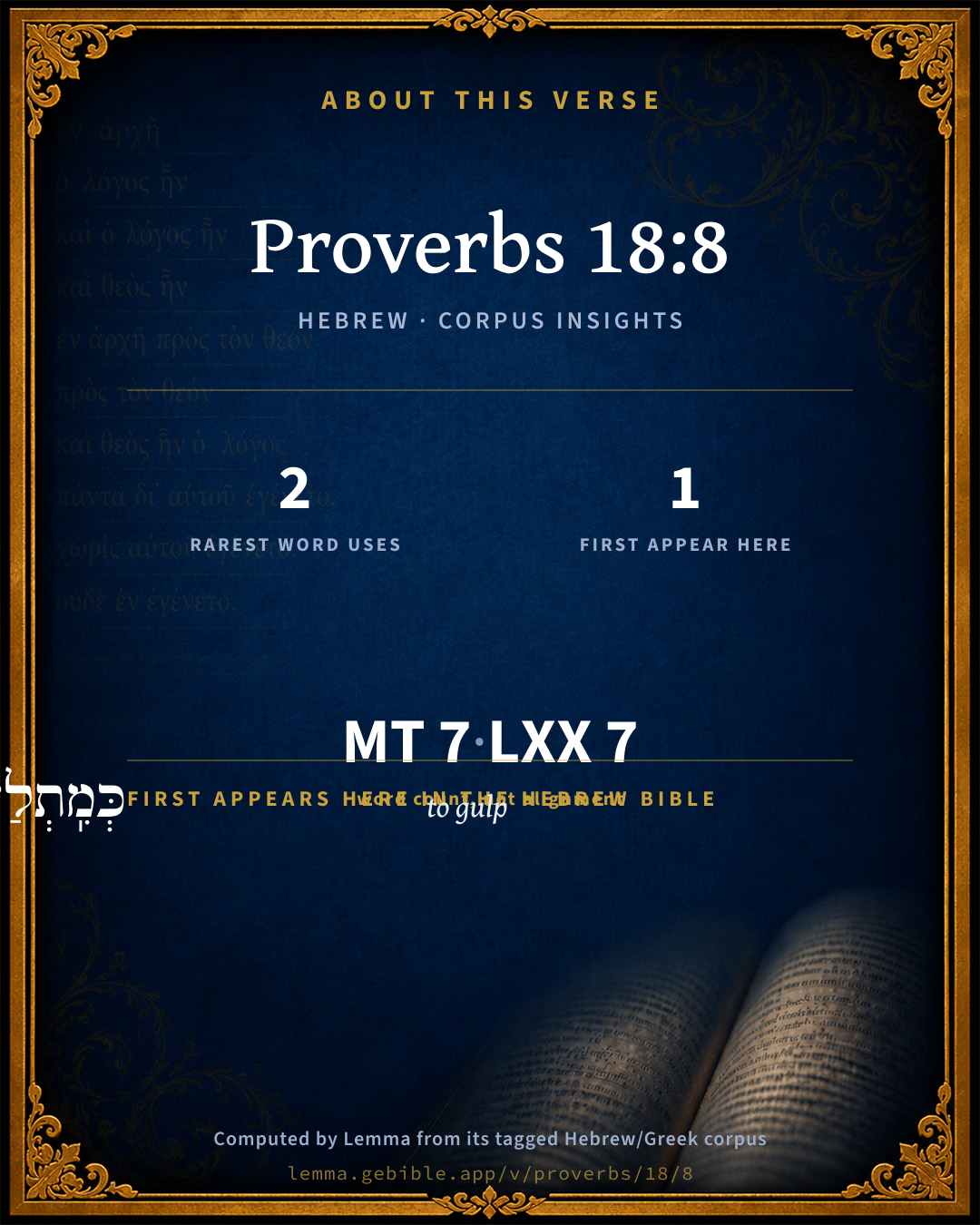
The rarest word here is כְּמִֽתְלַהֲמִ֑ים to gulp H3859 — appearing just 2 times in the whole Hebrew Bible.

First appearance in Scripture

This word makes its first canonical appearance in the Hebrew Bible here:

  • כְּמִֽתְלַהֲמִ֑ים to gulp H3859

Shared distinctive vocabulary

כְּמִֽתְלַהֲמִ֑ים to gulp H3859 occurs in 2 verses of the Hebrew Bible. Also found in:

Grammatical profile

  • 3 verbs
  • 3 nouns
  • 1 pronoun

Verb forms

  • נִ֭רְגָּן Niphal · Participle Active
  • כְּמִֽתְלַהֲמִ֑ים Hithpael · Participle Active
  • יָרְד֥וּ Qal · Perfect

Hebrew & Septuagint length

In English translation the verse runs 17 words from the Hebrew and 13 from the Septuagint (LXX English) — closely comparable.

A rough comparison of the two English renderings, which tokenize alike — not a word-level alignment.

Word counts can differ between the Hebrew and the Greek without any difference in meaning — e.g. the Hebrew direct-object marker אֵת has no separate Greek word, and Greek often adds the article ὁ.

In the original languages it is 7 Hebrew tokens and 7 Greek tokens — but the two are counted differently (Hebrew bundles its prefixes and suffixes into one token; the Greek is in lemma form), so that isn’t a like-for-like length.

Cross-references

6

Topical passages linked to Proverbs 18:8 in the Treasury of Scripture Knowledge — connected by theme and wording, ordered by reader-vote popularity; previews shown in the World English Bible.

  • Leviticus 19:16 "'You shall not go up and down as a slanderer among your people; neither shall you stand against the life of your neighbor. I am Yahweh.
  • Proverbs 12:18 There is one who speaks rashly like the piercing of a sword, But the tongue of the wise heals.
  • Proverbs 16:28 A perverse man stirs up strife. A whisperer separates close friends.
  • Proverbs 26:20–22 For lack of wood a fire goes out; Without gossip, a quarrel dies down.
  • Psalms 52:2 Your tongue plots destruction, Like a sharp razor, working deceitfully.
  • Psalms 64:3–4 Who sharpen their tongue like a sword, And aim their arrows, deadly words,

Cross-references courtesy of OpenBible.info (CC BY 4.0).

Hebrew and Greek witnesses Masoretic Hebrew ↔ Greek Septuagint

The same verse in the two great witnesses to the Old Testament, shown verse-for-verse.

These are two independent witnesses, not word-aligned to each other, and the Septuagint is shown in lemma (dictionary) form.

Hebrew Proverbs 18:8 Masoretic · Westminster Leningrad Codex

דִּבְרֵ֣י נִ֭רְגָּן כְּמִֽתְלַהֲמִ֑ים וְ֝הֵ֗ם יָרְד֥וּ חַדְרֵי בָֽטֶן

The words of a gossip are like dainty morsels: They go down into a person's innermost parts.

World English Bible · Public Domain

Greek LXX Proverbs 18:8 Septuagint · lemma form

ὀκνηρός καταβάλλω φόβος ψυχή δέ ἀνδρόγυνος πεινάω

Fear casts down the slothful; and the souls of the effeminate shall hunger.

LXX2012 (modern English Septuagint) · Public Domain

On this verse, Haydock's Catholic Bible Commentary discusses the Septuagint’s reading. Read the note in Commentary ↓

Hebrew: Westminster Leningrad Codex (CC BY 4.0). Greek: Septuagint (public domain); English from LXX2012 (modern English Septuagint) (Public Domain). How the Septuagint differs from the Hebrew →

Commentary

Notes on Proverbs 18:8 from classic Christian and Jewish commentators (each source and its license shown beneath its notes). The classic Christian expositions comment on the surrounding passage and are grouped to its opening verse, so a note may address several verses; the Jewish commentaries on the Tanakh (Rashi and others) are per-verse, so they appear only where the commentator wrote on this verse.

Lemma curates 59 commentaries, every one of them public domain or Creative Commons licensed, each selected and text-cleaned for this edition rather than reprinted as found. About our sources →

Trapp's Complete Commentary

John Trapp

Pro 18:8 The words of a talebearer [are] as wounds, and they go down into the innermost parts of the belly.

Ver. 8. The words of a talebearer are as wounds.] {See Trapp on "Pro 12:18"} He that takes away a man’s good name kills him alive, and ruins him and his posterity; being herein worse than Cain, for he, in killing his brother, made him live for ever, and eternalised his name. Some read, "Are as the words of the wounded": they seem to speak out of wounded, troubled hearts, and then their words go down into the belly - they go glib down, pass without the least questioning.

John Trapp, A Commentary or Exposition upon All the Books of the Old and New Testament (1647–1656) — public domain. Text from a community e-Sword module.

Joseph Benson's Commentary

Pro 18:8-9. The words of a tale-bearer — Who privily slanders his neighbour; are as wounds — Deeply wound the reputation, and afterward the heart, of the slandered person. They go down, &c. — They wound mortally, piercing to the heart, which is often meant by the belly. He also that is slothful is brother, &c. — They are alike: though they take different paths, yet both come to one end, even to extreme want and poverty.

Joseph Benson's Commentary on the Old and New Testaments (1811–1818) — public domain. Text from a community e-Sword module.

Tyndale Open Study Notes

Tyndale Open Resources

18:8 // 26:22 Rumors may be delicious to hear and repeat, but they are deadly.

Tyndale Open Study Notes — © Tyndale Open Resources, licensed CC BY-SA 4.0. Text via the HelloAO Bible API.

Geneva Bible (1599)

Geneva Bible translators

They are soon believed, and enter most deeply.

Geneva Bible (1599) marginal notes — public domain. Text via Bolls.life.

Matthew Henry's Commentary

Tale-bearers are those who secretly carry stories from house to house, which perhaps have some truth in them, but are secrets not fit to be told, or are basely misrepresented, and false colours put upon them, and are all told with design to blast men's reputation, to break their friendship, to make mischief between relations and neighbours, and set them at variance. Now the words of such are here said to be, 1. Like as when men are wounded (so the margin reads it); they pretend to be very much affected with the miscarriages of such and such, and to be in pain for them, and pretend that it is with the greatest grief and reluctance imaginable that they speak of them. They look as if they themselves were wounded by it, whereas really they rejoice in iniquity, are fond of the story, and tell it with pride and pleasure. Thus their words seem; but they go down as poison into the innermost parts of the belly, the pill being thus gilded, thus sugared. 2. As wounds (so the text reads it), as deep wounds, deadly wounds, wounds in the innermost parts of the belly; the venter medius vel infimus - the middle or lower belly, the thorax or the abdomen, in either of which wounds are mortal. The words of the tale-bearer wound him of whom they are spoken, his credit and interest, and him to whom they are spoken, his love and charity. They occasion sin to him, which is a wound to the conscience. Perhaps he seems to slight them, but they would insensibly, by alienating his affections from one he ought to love.

Matthew Henry's Commentary on the Whole Bible (1708–1710) — public domain (CC PDM 1.0). Text via the HelloAO Bible API.

Jamieson, Fausset & Brown

Robert Jamieson, A. R. Fausset & David Brown

(Compare Pro 16:28).

as wounds--not sustained by the Hebrew; better, as "sweet morsels," which men gladly swallow.

innermost . . . belly--the mind, or heart (compare Pro 20:27-30; Psa 22:14).

Jamieson, Fausset & Brown — Commentary Critical and Explanatory on the Whole Bible (1871) — public domain (CC PDM 1.0). Text via the HelloAO Bible API.

Adam Clarke's Commentary

Verse 8. The words of a tale-bearer] דברי נרגן dibrey nirgan, "the words of the whisperer," the busy-body, the busy, meddling croaker. Verba bilinguis, "the words of the double-tongued." - Vulgate. The wordes of the twisel tunge. - Old MS. Bible. "The words of a slanderer." - Coverdale.

The words of a deceiver, the fair-spoken, deeply-malicious man, though they appear soft and gracious, are wounds deeply injurious.

The original word is כמתלהמים kemithlahamim; they are as soft or simple, or undesigning. But Schultens gives another meaning. He observes that [Arabic] lahamah in Arabic signifies to "swallow down quickly or greedily." Such words are like dainties, eagerly swallowed, because inviting to the taste; like gingerbread, apparently gilded over, though with Dutch leaf, which is a preparation of copper; or sweetmeats powdered over with red candied seeds, which are thus formed by red lead; both deeply ruinous to the tender bowels of the poor little innocents, but, because of their sweetness and inviting colour, greedily swallowed down. This makes a good reading, and agrees with the latter clause of the verse, "they go down into the innermost parts of the belly."

Adam Clarke's Commentary on the Bible (1810–1826) — public domain. Text from a community e-Sword/MySword module.

Ellicott's Commentary for English Readers

(8) The words of a talebearer are as wounds.—Or, more probably, “as dainty morsels” that are eagerly swallowed, and “go down into the innermost parts of the belly,” i.e., are treasured up in the deepest recesses of the heart, to be remembered and brought out again when an opportunity for employing them occurs.

A Bible Commentary for English Readers, edited by Charles John Ellicott (1878–1897) — public domain. Text from a community e-Sword module.

The Cambridge Bible for Schools and Colleges

gen. ed. J. J. S. Perowne

8. talebearer] Rather, whisperer, R.V., secret calumniator, as in Pro_16:28; bilinguis, Vulg.

wounds] Rather, dainty morsels, R.V.; so greedily do men swallow down and retain them. This proverb occurs again, Pro_26:22.

The Cambridge Bible for Schools and Colleges (gen. ed. J. J. S. Perowne; Cambridge University Press, 1878–1918) — public domain. Text from a community e-Sword module.

John Gill's Exposition

The words of a talebearer are as wounds,.... Or rather they are wounds; they wound the credit and reputation of the person of whom the tale is told; they wound the person to whom it is told, and destroy his love and affection to his friend; and in the issue they wound, hurt, and ruin the talebearer himself. Or, they are "as of those that are wounded" (m); they pretend to be affected with the case they tell, and to be grieved for the failings and infirmities of those they are secretly exposing, when at the same time they rejoice at them: or, they are "secret" hidden ones, as Aben Ezra interprets it; they are spoken secretly, and wound secretly, in a backbiting way: or, they are "smooth" or flattering (n), as Kimchi; they are smoother than oil, and glide easily into the minds of others: rather, "are greedily swallowed down" (o), as the word in the Arabic language signifies; as Schultens has shown, and so renders it. Hence it follows:

and they go down into the innermost parts of the belly; go down pleasantly, and sink deep into the hearts of those to whom they are told; where they have a place and remain, both to the injury of the persons that receive them, and of them of whom they are told; and, though pleasing at first, they are as wounds in the inner parts, which are mortal.

(m) "similia sunt verbis eorum, qui saepenumero contusi sunt", Junius & Tremellius; "ut contusorum", Cocceius. (n) "Ut lenientia", Montanus; "velut blanda", Vatablus, Mercerus, Gejerus; "quasi blandientia", Schmidt, so Ben Melech. (o) "Tanquam avide deglutita crustula", Schultens.

John Gill's Exposition of the Whole Bible (1746–1763) — public domain (CC PDM 1.0). Text via the HelloAO Bible API.

Haydock's Catholic Bible Commentary

Tongued. Hebrew, "caluminator." He pretends to wish well to those of whom he speaks, or else to guard the company against deceit. (Calmet) --- "If the devil be upon the detractor’s tongue, he is in the ears of those who pay attention to him." (St. Francis de Sales) --- Fear, &c., is in the Septuagint, above. The Vulgate retains both this and the new version of St. Jerome.

George Leo Haydock (1774–1849), Haydock's Catholic Family Bible and Commentary, 1859 edition — public domain. Excludes Psalms (Douay-Rheims chapter numbering differs from Protestant) and Deuterocanonical books (Catholic canon only).

Matthew Poole's English Annotations

The words of a tale-bearer, who privily slandereth his neighbour,

are as wounds; deeply wound the reputation, and afterwards the heart, of the slandered person. Compare Pro 12:18. Or, as others render the word, are

as smooth or flattering, i.e. they really are so; the particle as being oft used to express the truth of the thing, as hath been noted before. See also Joh 1:14. They are softer than oil, as is said, Psa 55:21. For slanderers use to cover and usher in their calumnies with pretences or kindness and compassion to them whom they traduce.

They go down into the innermost parts of the belly; they wound mortally, piercing to the heart, which is oft meant by the belly; as Job 15:35; 32:19, &c.

Matthew Poole's English Annotations on the Holy Bible (1683–1685) — public domain. Text from a community e-Sword/MySword module.

Whedon's Commentary on the Bible

Daniel D. Whedon

8. Words of a talebearer — Of a whisperer, slanderer, Pro_16:28.

Are as wounds — כמתלהמים, (kimithlahamim,) dainties, sweetmeats. So Gesenius, Conant, etc. Some read, are “sportive ones.” There are various other readings. The word occurs only here and in Pro_26:22. The sense dainties is probably to be taken. The going down into the innermost parts is to be applied to the person who listens. He swallows the tales greedily, like sweetmeats. The expression may refer to that relish with which many listen to tales of scandal. Comp. Pro_20:27.

Daniel D. Whedon (gen. ed.), Commentary on the Old and New Testaments (1874–1909) — public domain. Text from a community e-Sword module.

The Pulpit Commentary

The words of a tale bearer are as wounds. Nergan, "tale bearer," is better rendered "whisperer". (see on Pro_16:28) The Authorized Version reminds one of the mediaeval jingle"Lingua susurronis Est pejor felle draconis.

The verse recurs in Pro_26:22; but the word rendered "wounds" (mitlahamim) is to be differently explained. It is probably the hithp. participle of laham," to swallow," and seems to mean "dainty morsels," such as one eagerly swallows. Thus Gesenius, Schultens, Delitzsch, Nowack, and others. So the clause means, "A whisperer"s words are received with avidity; calumny, slander, and evil stories find eager listeners." The same metaphor is found in Pro_19:28 Job_34:7. There may, at the same time, be involved the idea that these dainty morsels are of poisonous character. Vulgate, Verba bilinguis, quasi simplicia, "The words of a man of double tongue seem to be simple," which contains another truth. They go down into the innermost parts of the belly. (Pro_20:27, Pro_20:30) The hearers take in the slanders and treasure them up in memory, to be used as occasion shall offer. The LXX omits this verse, and in its place introduces a paragraph founded partly on the next verse and partly on Pro_19:15. The Vulgate also inserts the interpolation, "Fear overthrows the sluggish; and the souls of the effeminate (androgunwn ) shall hunger.

See homily on Pro_17:9. C.

The Pulpit Commentary (1880–1919), ed. H.D.M. Spence-Jones & Joseph S. Exell — public domain. Text from a community e-Sword module.

John Wesley's Explanatory Notes

They go - They wound mortally.

John Wesley, Explanatory Notes Upon the Whole Bible (1754–1765) — public domain. Text via the GEBible commentary corpus.

Keil & Delitzsch

C. F. Keil & F. Delitzsch

A pair of proverbs regarding the flatterer and the slothful:

8 The words of the flatter are as dainty morsels,

And they glide down into the innermost parts.

An "analogy, with an epexegesis in the second member" (Fl.), which is repeated in Pro 26:22. Ewald, Bertheau, Hitzig, and others, are constrained to interpret המו as introducing a contrast, and in this sense they give to מתלהמים all kinds of unwarrantable meanings. Ewald translates: a burning (להם, cogn. להב), and offers next: as whispering (להם, cogn. רעם, נהם); Ch. B. Michaelis, Bertheau, and others: as sporting (להם, cogn. להה); Hitzig: like soft airs (להם, cogn. Arab. hillam, flaccus, laxus). All these interpretations are without support. The word להם has none of all these significations; it means, as the Arab. lahima warrants, deglutire. But Bttcher's explanation also: "as swallowed down, because spoken with reserve," proceeds, like those others, from the supposed syntactically fine yet false supposition, that 8b is an antithetic "dennoch" [tamen]. In that case the poet would have written והם ירדים (cf. והוא, as the beginning of a conditional clause, Pro 3:29; Pro 23:3). But והוא, והם, with the finite following, introduces neither here nor at Deu 33:3; Jdg 20:34; Psa 95:10, cf. Gen 43:23, a conditional clause. Thus 8b continues the clause 8a by one standing on the same line; and thus we do not need to invent a meaning for כמתלהמים, which forms a contrast to the penetrating into the innermost parts. The relation of the parts of the proverb is rightly given by Luther:

The words of the slanderer are stripes,

And they go through the heart of one.

He interprets להם as transposed from הלם (Rashi and others); but stripes cannot be called מתלהמים - they are called, 6b, מהלמות. This interpretation of the word has always more support than that of Symmachus: ὡς ἀκέραιοι; Jerome: quasi simplicia; Aquila, xxvi. 22: γοητικοί; which last, as also that of Capellus, Clericus, and Schultens: quasi numine quodam afflata, seems to support itself on the Arab. âhm iv. inspirare. But in reality âhm does not mean afflare; it means deglutire, and nothing else. The Jewish lexicographers offer nothing worth considering; Kimchi's חלקים, according to which the Venet. translates μαλθακιζόμενοι, is fanciful; for the Talm. הלם, striking = hitting, suitable, standing well, furnishes no transition to "smooth" and "soft." Immanuel compares âhm = בלע; and Schultens, who is followed by Gesenius and others, has already, with perfect correctness, explained: tanquam quae avidissime inglutiantur. Thus also Fleischer: things which offer themselves to be eagerly gulped down, or which let themselves be thus swallowed. But in this way can one be truly just to the Hithpa.? The Arab. âlthm (stronger form, âltkm, according to which van Dyk translates mthl uḳam ḥlwt, like sweet morsels) means to swallow into oneself, which is not here appropriate. The Hithpa. will thus have here a passive signification: things which are greedily swallowed. Regarding נרגּן from רגן, vid., at Pro 16:28. המו refers to the words of the flatterer, and is emphatic, equivalent to aeque illa, etiam illa, or illa ipsa. ירד is here connected with the obj. accus. (cf. Pro 1:12) instead of with אל, Pro 7:27. חדרי, penetralia, we had already at Pro 7:27; the root-word is (Arab.) khdr, to seclude, to conceal, different from ḥdr, demittere, and ḥkhr (cogn. חזר), to finish, circumire. בּטן is the inner part of the body with reference to the organs lying there, which mediate not only the life of the body, but also that of the mind - in general, the internal part of the personality. The lxx does not translate this proverb, but has in its stead Pro 19:15, in a different version, however, from that it gives there; the Syr. and the Targ. have thereby been drawn away from the Hebr. text.

Keil & Delitzsch — Biblical Commentary on the Old Testament (1861–1891) — public domain (CC PDM 1.0). Text via the HelloAO Bible API. (Old Testament only.)

Bridges on Proverbs

Charles Bridges

Do men deny, question, or soften down the depravity of our nature? Mark again how the virulent poison of only one member destroys practical godliness, social order, and mutual friendship. The talebearer was expressly forbidden by the law (Lev 19:16 ), and not less is he opposed to the spirit of the Gospel. (1Co 13:6 .) No Character indeed is more despicable; no influence more detestable. It is right indeed, that we should exercise interference with each other, and mutual inspection. It is a hard selfishness only, that asks the question — "Am I my brother’s keeper?" (Gen 4:9 .) The rule is clear — "Look not every one on his own, but every man also on the things of others." (Php 2:4 .) The rule is at once illustrated and enforced by an example magnificent and constraining. It is "the mind that was in Christ Jesus himself." Had the Son of God "looked at his own things," and not "at the things of others," would he have emptied himself of his divine glory? Would he have humbled himself to the accursed cross? (Php 2:5-8 .)

Again — the bond of the interference will be determined by the principle of the love of our neighbour. It is right therefore to "bring an evil report,"†1 for the prevention of sin. Eli was thus enabled, though without effect, to remonstrate with his sons.†2 The life of an Apostle was by this means preserved.†3 Serious evils in the Church were restrained or corrected.†4 But no good results can arise from the spirit of the talebearer, because with him it is pure selfishness,†5 without a principle beyond the love of sin for its own sake. He lives upon the scandal of the place, and makes it his hateful business to carry about tales, or slanders of his neighbour’s faults.†6 Such reports are eagerly devoured, and the mischief-maker feeds with greedy appetite upon the fruit of his cruel indulgence. To him this may appear harmless play. But if it draws no blood, and no outward hurt is shewn, an internal, and often incurable, wound is inflicted. (Pro 26:22 .) We may seem to make light of the tale brought to our ears, and wholly to despise it. But the subtle poison has worked. ’Suppose it should be true. Perhaps, though it may be exaggerated, there may be some ground for it.’ The thought indulged only for a moment brings suspicion, distrust, coldness; and often it ends in the separation of chief friends.†7 So dangerous a member in the frame is the tongue without stern determined control!

The tale of an unguarded moment may be a tremendous irreparable injury. The evil humour may meet with a welcome audience in good society, where but for the food which scandal supplies, conversation would drag heavy. But no favor can alter its real character, as an abomination both with God and man. Ah! what but the power of holy love, opening freely the channels of kindness and forbearance, can overcome this mischievous propensity? And what will bring this spirit of love, but a true interest in Christian privileges, and a corresponding sense of Christian obligations? (Col 3:12-14 .)

Footnotes:

†1 Pro 24:11-12. Gen 37:2 . Lev 5:1 .

†2 1Sa 2:23-24 .

†3 Act 23:13. Contrast Jer 40:13-16 ; Jer 41:1-2.

†4 1Co 1:11 ; 1Co 11:18 .

†5 Jer 20:10.

†6 The word properly signifies a pedlar, who buys goods (stolen ones it may be) at one place, and sells them at another, taking care to make his own market of them. ’So a talebearer makes his own visits, to pick up at one place, and utter at another, that which he thinks will lessen his neighbour’s reputation, that he may build his own upon it.’ — M. Henry’s Sermon on Friendly Visits. Compare Pro 11:13 ; Pro 20:19.

†7 Pro 16:28; Pro 17:9 . 1Sa 24:9 ; 1Sa 26:19 . 2Sa 16:1-4 .

Charles Bridges, An Exposition of the Book of Proverbs (1846) — public domain. Text from a community e-Sword module.

Kretzmann's Popular Commentary

Paul E. Kretzmann

v. 8. The words of a talebearer are as wounds, rather, as sweet morsels, or, as pastime, eagerly grasped and swallowed by those who listen to slander, and they go down into the innermost parts of the belly, gladly accepted and remembered.

Paul E. Kretzmann, Popular Commentary of the Bible (1921–1924) — public domain. Text from a community e-Sword module.

Rashi

Rabbi Shlomo Yitzchaki (Rashi)

The words of a grumbler are like blows Heb. כמתלהמים.

Rashi on the Tanakh — English translations: “The Judaica Press complete Tanach with Rashi, translated by A. J. Rosenberg” (CC BY 4.0); “Pentateuch with Rashi's commentary by M. Rosenbaum and A.M. Silbermann, 1929-1934” (public domain); “The Metsudah Tanach series, Lakewood, N.J” (CC BY 4.0); and “The Book of Joshua, Metsudah Publications, 1997” (CC BY 4.0). Text via Sefaria.

Lesson kit

Teaching starters — assembled from the data on this page, not authored interpretation. Every prompt links to the verse data it draws on. Edit before teaching.

Proverbs, in the Wisdom, opens this verse with 7 words (7 distinct Hebrew lemmas). Its most distinctive word is lâham (“to gulp”). A historical commentator’s framing appears above. Read the whole chapter for the surrounding context.

Discussion questions

  1. How does “to gulp” (lâham) shape what this verse is saying?
  2. The word “to gulp” first appears here in Scripture. What is being introduced at this debut?
  3. Proverbs 26:22 shares the word «to gulp» with this verse. How do the two illuminate each other?
  4. These translations render this verse differently; the difference is in the English rendering, not the original. What questions does that raise?
  5. The verb «נִ֭רְגָּן» is Niphal Participle Active. How does its form color the action?
  6. Reading how Trapp's Complete Commentary and Joseph Benson's Commentary read this verse, where do the two commentators agree and where do they part?

Things to notice

Reading settings

Reading text

Shown beneath each verse's original-language words.

Old Testament
Old Testament edition

Read the OT as the Masoretic Hebrew (MT) or the Greek Septuagint (LXX).

English shown for the Greek Septuagint (in the Hebrew ↔ Greek comparison).

Comparing translations? Open the Compare panel on any verse page to stack up to four side by side.