
Joshua 20:6

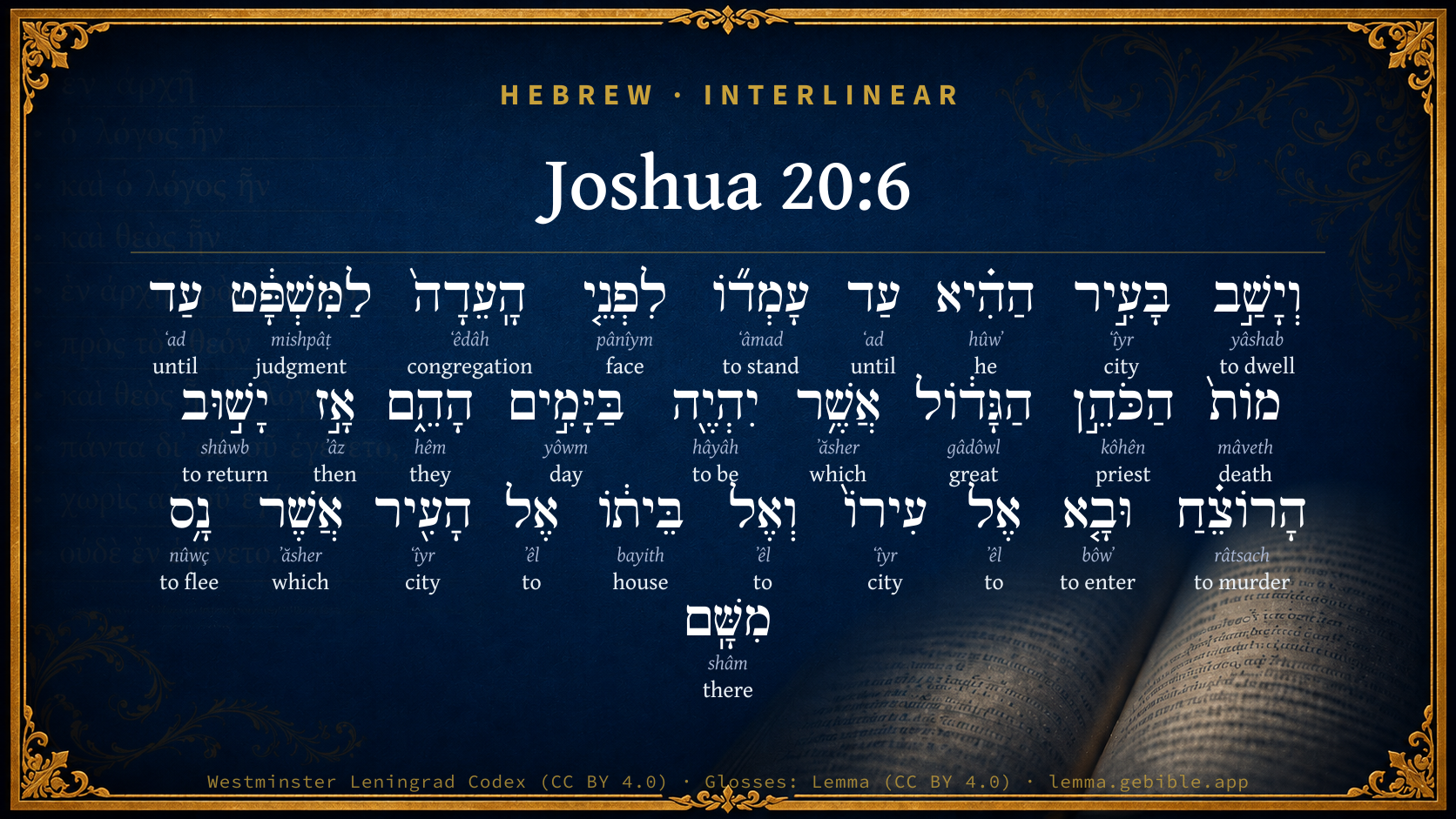
Hebrew (Westminster Leningrad Codex) Joshua 20:6 appears in the Hebrew Old Testament. The text above is from the Westminster Leningrad Codex. Each word links to its Strong’s number, a concise gloss, and parsing drawn from the Open Scriptures Hebrew Bible morphology. Click any word for its full Brown-Driver-Briggs (BDB) entry.
Download image
Cite this verse

Joshua 20:6 (World English Bible). Public Domain. Lemma interlinear Bible study tool, https://lemma.gebible.app/v/joshua/20/6.

Show BibTeX & RIS
BibTeX
RIS
English Translation
He shall dwell in that city, until he stand before the congregation for judgment, until the death of the high priest that shall be in those days: then shall the manslayer return, and come to his own city, and to his own house, to the city from whence he fled.
World English Bible · Public Domain
Download a study sheet

One document with this verse’s original text, its word-by-word gloss line, the meaning frame, cross-references with their text, attributed commentary, and full source and license credits — printable, and it pastes into notes with its structure intact.

This verse Autodidact and up

Study sheet (.html) Plain text (.txt)

A passage Seminary Student

Up to 50 verses in one chapter. A passage sheet keeps up to 6 commentary sources and 12 cross-references per verse, in the order this page ranks them, and says so on the sheet whenever that leaves anything out. Ask for a single verse and you get the Autodidact verse sheet above.

Everything on this page stays free to read, with no account — the sheet is a download of what is already on screen, not access to it.

Want to remove ads? Support Godless Engineer
Compare translations 3

The same verse in 3 English versions, stacked beneath the original-language interlinear above. Click any original word for its lexicon entry.

Each is an independent rendering of the whole verse — the interlinear is not word-aligned to these translations.

Highlighted words mark where these versions differ — a whole-verse word diff, not a word-by-word alignment.

  • World English Bible Public Domain
    He shall dwell in that city, until he stand before the congregation for judgment, until the death of the high priest that shall be in those days: then shall the manslayer return, and come to his own city, and to his own house, to the city from whence he fled.
  • King James Version Public Domain
    And he shall dwell in that city, until he stand before the congregation for judgment, and until the death of the high priest that shall be in those days: then shall the slayer return, and come unto his own city, and unto his own house, unto the city from whence he fled.
  • unfoldingWord Literal Text CC BY-SA 4.0
    And he shall dwell in that city until his standing to the face of the congregation for judgment, until the death of the great priest who is in those days. Then the one having killed may return and enter into his city and into his house, into the city that he fled from there.’”

unfoldingWord Literal Text — © unfoldingWord, licensed CC BY-SA 4.0. Word-aligned USFM3 via Door43 (git.door43.org/unfoldingWord/en_ult).

Versions to compare (up to 4)

3 of 4 selected

Show all 18 translations

Every available English version of this verse, each an independent rendering of the whole verse.

  • World English Bible Public Domain
    He shall dwell in that city, until he stand before the congregation for judgment, until the death of the high priest that shall be in those days: then shall the manslayer return, and come to his own city, and to his own house, to the city from whence he fled.
  • Berean Standard Bible Public Domain
    He is to stay in that city until he stands trial before the assembly and until the death of the high priest serving at that time. Then the manslayer may return to his own home in the city from which he fled.”
  • Majority Standard Bible Public Domain
    He is to stay in that city until he stands trial before the assembly and until the death of the high priest serving at that time. Then the manslayer may return to his own home in the city from which he fled.”
  • King James Version Public Domain
    And he shall dwell in that city, until he stand before the congregation for judgment, and until the death of the high priest that shall be in those days: then shall the slayer return, and come unto his own city, and unto his own house, unto the city from whence he fled.
  • American Standard Version (1901) Public Domain
    And he shall dwell in that city, until he stand before the congregation for judgment, until the death of the high priest that shall be in those days: then shall the manslayer return, and come unto his own city, and unto his own house, unto the city from whence he fled.
  • Revised Version (1885) Public Domain
    And he shall dwell in that city, until he stand before the congregation for judgment, until the death of the high priest that shall be in those days: then shall the manslayer return, and come unto his own city, and unto his own house, unto the city from whence he fled.
  • Geneva Bible (1599) Public Domain
    But hee shall dwell in that citie vntill hee stande before the Congregation in iudgement, or vntill the death of the hie Priest that shall be in those daies: then shall the slaier returne, and come vnto his owne citie, and vnto his owne house, euen vnto the citie from whence he fled.
  • Douay-Rheims (1899) Public Domain
    And he shall dwell in that city, till he stand before judgment to give an account of his fact, and till the death of the high priest, who shall be at that time: then shall the manslayer return, and go into his own city and house from whence he fled.
  • Young's Literal Translation Public Domain
    and he hath dwelt in that city till his standing before the company for judgment, till the death of the chief priest who is in those days -- then doth the man-slayer turn back and hath come unto his city, and unto his house, unto the city whence he fled.'
  • Literal Standard Version CC BY-SA 4.0
    and he has dwelt in that city until his standing before the congregation for judgment, until the death of the chief priest who is in those days—then the manslayer turns back and has come to his city, and to his house, to the city from where he fled.”
  • Unlocked Literal Bible CC BY-SA 4.0
    He must stay in that city until he has stood before the assembly for judgment, until the death of the one who was serving as high priest in those days. Then the one who had accidentally killed the person may return to his own town and his own home, to the town from which he fled.'”
  • unfoldingWord Literal Text CC BY-SA 4.0
    And he shall dwell in that city until his standing to the face of the congregation for judgment, until the death of the great priest who is in those days. Then the one having killed may return and enter into his city and into his house, into the city that he fled from there.’”
  • Darby Bible Public Domain
    And he shall dwell in that city, until he have stood before the assembly in judgment, until the death of the high-priest that shall be in those days; then shall the slayer return, and come unto his own city, and unto his own house, unto the city from whence he fled.
  • World Messianic Bible Public Domain
    He shall dwell in that city until he stands before the congregation for judgment, until the death of the high priest that shall be in those days. Then the man slayer shall return, and come to his own city, and to his own house, to the city he fled from.’”
  • Webster's Bible Public Domain
    And he shall dwell in that city, until he shall stand before the congregation for judgment, and until the death of the high-priest that shall be in those days: then shall the slayer return, and come to his own city, and to his own house, to the city from whence he fled.
  • Free Bible Version CC BY-SA 4.0
    He shall remain in that town until he has received a public trial and a verdict has been given, and until the death of the high priest of the time. Then he is free to return to his home, back to the town from where he ran away.’”
  • Bible in Basic English Public Domain
    And he is to go on living in that town till he has to come before the meeting of the people to be judged; (till the death of him who is high priest at that time:) then the taker of life may come back to his town and to his house, to the town from which he had gone in flight.
  • JPS Tanakh (1917) Public Domain
    And he shall dwell in that city, until he stand before the congregation for judgment, until the death of the high priest that shall be in those days; then may the manslayer return, and come unto his own city, and unto his own house, unto the city from whence he fled.'

Literal Standard Version (2020), Covenant Press — licensed CC BY-SA 4.0. Text via the HelloAO Bible API (eBible.org). Unlocked Literal Bible (unfoldingWord) — licensed CC BY-SA 4.0. Text via the HelloAO Bible API (eBible.org). unfoldingWord Literal Text — © unfoldingWord, licensed CC BY-SA 4.0. Word-aligned USFM3 via Door43 (git.door43.org/unfoldingWord/en_ult). Free Bible Version, Dr. Jonathan Gallagher — licensed CC BY-SA 4.0. Text via the HelloAO Bible API (eBible.org).

Word by word

More ways to search: Search by grammar → Find every occurrence → Compare this word →

Practice this passage: Drill this verse → Learn its vocabulary →

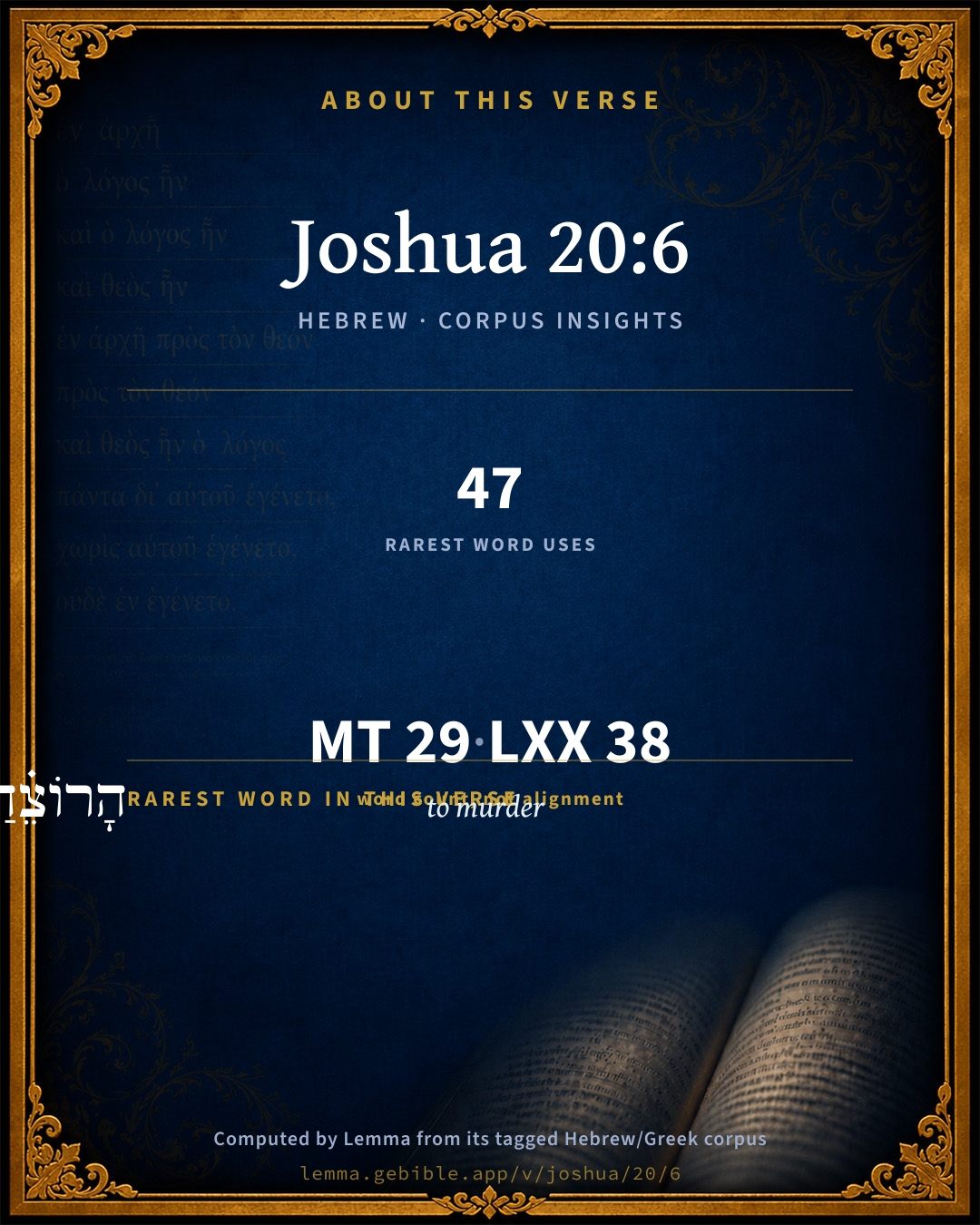
הָרוֹצֵ֗חַ
râtsach
H7523
“the · murdering”
Particle, Definite Article + Verb, Qal, Participle Active, Masculine, Singular, Absolute
Part of Speech
Particle + Verb
Stem
Qal
Form
Participle Active
Gender
Masculine
Number
Singular
State
Absolute
Full BDB Definition

Origin: a primitive root

TWOT: 2208

to murder, slay, kill - (Qal) to murder, slay - premeditated - accidental - as avenger - slayer (intentional) (participle) - (Niphal) to be slain - (Piel) - to murder, assassinate - murderer, assassin (participle) (substantive) - (Pual) to be killed
  1. וְיָשַׁ֣ב yâshab H3427 “and · to dwell” Conjunction + Verb, Qal, Sequential Perfect, 3rd Person, Masculine, Singular
  2. בָּעִ֣יר ʻîyr H5892 “in/at the · city” Preposition, Determined + Noun, Common, Feminine, Singular, Absolute
  3. הַהִ֗יא hûwʼ H1931 “the · he” Particle, Definite Article + Pronoun, Personal, 3rd Person, Feminine, Singular
  4. עַד ʻad H5704 “until” Preposition
  5. עָמְד֞וֹ ʻâmad H5975 “to stand · him” Verb, Qal, Infinitive Construct + Suffix, Personal, 3rd Person, Masculine, Singular
  6. לִפְנֵ֤י pânîym H6440 “to/for · face(s) of” Preposition + Noun, Common, Both, Plural, Construct
  7. הָֽעֵדָה֙ ʻêdâh H5712 “the · congregation” Particle, Definite Article + Noun, Common, Feminine, Singular, Absolute
  8. לַמִּשְׁפָּ֔ט mishpâṭ H4941 “to/for the · judgment” Preposition, Determined + Noun, Common, Masculine, Singular, Absolute
  9. עַד ʻad H5704 “until” Preposition
  10. מוֹת֙ mâveth H4194 “death of” Noun, Common, Masculine, Singular, Construct
  11. הַכֹּהֵ֣ן kôhên H3548 “the · priest” Particle, Definite Article + Noun, Common, Masculine, Singular, Absolute
  12. הַגָּד֔וֹל gâdôwl H1419 “the · great” Particle, Definite Article + Adjective, Adjective, Masculine, Singular, Absolute
  13. אֲשֶׁ֥ר ʼăsher H834 “which” Particle, Relative
  14. יִהְיֶ֖ה hâyâh H1961 “to be” Verb, Qal, Imperfect, 3rd Person, Masculine, Singular
  15. בַּיָּמִ֣ים yôwm H3117 “in/at the · days” Preposition, Determined + Noun, Common, Masculine, Plural, Absolute
  16. הָהֵ֑ם hêm H1992 “the · they” Particle, Definite Article + Pronoun, Personal, 3rd Person, Masculine, Plural
  17. אָ֣ז ʼâz H227 “then” Adverb
  18. יָשׁ֣וּב shûwb H7725 “to return” Verb, Qal, Imperfect, 3rd Person, Masculine, Singular
  19. וּבָ֤א bôwʼ H935 “and · to enter” Conjunction + Verb, Qal, Perfect, 3rd Person, Masculine, Singular
  20. אֶל ʼêl H413 “to” Preposition
  21. עִירוֹ֙ ʻîyr H5892 “city · his” Noun, Common, Feminine, Singular, Construct + Suffix, Personal, 3rd Person, Masculine, Singular
  22. וְאֶל ʼêl H413 “and · to” Conjunction + Preposition
  23. בֵּית֔וֹ bayith H1004 “house · his” Noun, Common, Masculine, Singular, Construct + Suffix, Personal, 3rd Person, Masculine, Singular
  24. אֶל ʼêl H413 “to” Preposition
  25. הָעִ֖יר ʻîyr H5892 “the · city” Particle, Definite Article + Noun, Common, Feminine, Singular, Absolute
  26. אֲשֶׁר ʼăsher H834 “which” Particle, Relative
  27. נָ֥ס nûwç H5127 “to flee” Verb, Qal, Perfect, 3rd Person, Masculine, Singular
  28. מִשָּֽׁם shâm H8033 “from · there” Preposition + Adverb

About this verse

These counts appear in no published source. They are computed here, from the morphology-tagged text and Lemma’s own curated glosses. What Lemma adds →

29
words
23
distinct lemmas
Historical
section

Shared distinctive vocabulary

הָרוֹצֵ֗חַ to murder H7523 occurs in 40 verses of the Hebrew Bible. Also found in:

Grammatical profile

  • 7 verbs
  • 10 nouns
  • 1 adjective
  • 2 pronouns
  • 5 prepositions
  • 2 adverbs
  • 2 particles

Verb forms

  • וְיָשַׁ֣ב Qal · Sequential Perfect
  • עָמְד֞וֹ Qal · Infinitive Construct
  • יִהְיֶ֖ה Qal · Imperfect
  • יָשׁ֣וּב Qal · Imperfect
  • הָרוֹצֵ֗חַ Qal · Participle Active
  • וּבָ֤א Qal · Perfect
  • נָ֥ס Qal · Perfect

Repetition

Words recur within this verse — often emphatic in Hebrew:

  • בָּעִ֣יר city H5892 ×3
  • עַד until H5704 ×2
  • אֶל to H413 ×3
  • אֲשֶׁ֥ר which H834 ×2

Hebrew & Septuagint length

In English translation the verse runs 50 words from the Hebrew and 50 from the Septuagint (LXX English) — the same length.

A rough comparison of the two English renderings, which tokenize alike — not a word-level alignment.

Word counts can differ between the Hebrew and the Greek without any difference in meaning — e.g. the Hebrew direct-object marker אֵת has no separate Greek word, and Greek often adds the article ὁ.

In the original languages it is 29 Hebrew tokens and 38 Greek tokens — but the two are counted differently (Hebrew bundles its prefixes and suffixes into one token; the Greek is in lemma form), so that isn’t a like-for-like length.

Cross-references

3

Topical passages linked to Joshua 20:6 in the Treasury of Scripture Knowledge — connected by theme and wording, ordered by reader-vote popularity; previews shown in the World English Bible.

  • Numbers 35:12 The cities shall be to you for refuge from the avenger, that the manslayer not die, until he stands before the congregation for judgment.
  • Hebrews 9:26 or else he must have suffered often since the foundation of the world. But now once at the end of the ages, he has been revealed to put away sin by the sacrifice of himself.
  • Numbers 35:24–25 then the congregation shall judge between the striker and the avenger of blood according to these ordinances;

Cross-references courtesy of OpenBible.info (CC BY 4.0).

Hebrew and Greek witnesses Masoretic Hebrew ↔ Greek Septuagint

The same verse in the two great witnesses to the Old Testament, shown verse-for-verse.

These are two independent witnesses, not word-aligned to each other, and the Septuagint is shown in lemma (dictionary) form.

Hebrew Joshua 20:6 Masoretic · Westminster Leningrad Codex

וְיָשַׁ֣ב בָּעִ֣יר הַהִ֗יא עַד עָמְד֞וֹ לִפְנֵ֤י הָֽעֵדָה֙ לַמִּשְׁפָּ֔ט עַד מוֹת֙ הַכֹּהֵ֣ן הַגָּד֔וֹל אֲשֶׁ֥ר יִהְיֶ֖ה בַּיָּמִ֣ים הָהֵ֑ם אָ֣ז יָשׁ֣וּב הָרוֹצֵ֗חַ וּבָ֤א אֶל עִירוֹ֙ וְאֶל בֵּית֔וֹ אֶל הָעִ֖יר אֲשֶׁר נָ֥ס מִשָּֽׁם

He shall dwell in that city, until he stand before the congregation for judgment, until the death of the high priest that shall be in those days: then shall the manslayer return, and come to his own city, and to his own house, to the city from whence he fled.

World English Bible · Public Domain

Greek LXX Joshua 20:6 Septuagint · lemma form

οὗτος ὁ πόλις ὁ ἐπίκλητος ὁ υἱός ἰσραήλ καί ὁ προσήλυτος ὁ προςκεῖμαι ἐν αὐτός καταφεύγω ἐκεῖ πᾶς παίω ψυχή ἀκουσίως ἵνα μή ἀποθνήσκω ἐν χείρ ὁ ἀγχιστεύω ὁ αἷμα ἕως ἄν καταἵστημι ἔναντι ὁ συναγωγή εἰς κρίσις

These were the cities selected for the sons of Israel, and for the stranger dwelling among them, that every one who smites a soul unintentionally should flee there, that he should not die by the hand of the avenger of blood, until he should stand before the congregation for judgment.

LXX2012 (modern English Septuagint) · Public Domain

On this verse, Haydock's Catholic Bible Commentary discusses the Septuagint’s reading. Read the note in Commentary ↓

Hebrew: Westminster Leningrad Codex (CC BY 4.0). Greek: Septuagint (public domain); English from LXX2012 (modern English Septuagint) (Public Domain). How the Septuagint differs from the Hebrew →

Targum (Aramaic paraphrase)

1

The Targum is the ancient Jewish Aramaic paraphrase of the Hebrew Scriptures — an interpretive translation, not the Hebrew text itself. Onkelos (literal) and Pseudo-Jonathan (expansive) render the Torah, and Jonathan the Prophets. Coverage is partial: where no permissively-licensed English translation exists for a verse, only the Aramaic is shown. This is verse-level text, not a word-by-word alignment to the Hebrew.

  1. Targum Jonathan Prophets (Joshua–Malachi)
    וִיתֵיב בְּקַרְתָּא הַהִיא עַד דִיקוּם קֳדָם כְנִשְׁתָּא לְדִינָא עַד דִימוּת כַּהֲנָא רַבָּא דִי יְהֵי בְיוֹמַיָא הָאִינוּן בְּכֵן יְתוּב קְטוֹלָא וְיֵיעוֹל לְקַרְתֵּיהּ וּלְבֵיתֵיהּ לְקַרְתָּא דִי עֲרַק מִתַּמָן:

    (no public-domain English translation for this verse)

    Targum Jonathan — Aramaic: “Mikraot Gedolot” (public domain). English: “Sefaria Community Translation” (CC0 1.0 (public-domain dedication)); “London "Chaldee Paraphrase," 1871” (public domain). Text via Sefaria.

Commentary

Notes on Joshua 20:6 from classic Christian and Jewish commentators (each source and its license shown beneath its notes). The classic Christian expositions comment on the surrounding passage and are grouped to its opening verse, so a note may address several verses; the Jewish commentaries on the Tanakh (Rashi and others) are per-verse, so they appear only where the commentator wrote on this verse.

Lemma curates 59 commentaries, every one of them public domain or Creative Commons licensed, each selected and text-cleaned for this edition rather than reprinted as found. About our sources →

Trapp's Complete Commentary

John Trapp

Jos 20:6 And he shall dwell in that city, until he stand before the congregation for judgment, [and] until the death of the high priest that shall be in those days: then shall the slayer return, and come unto his own city, and unto his own house, unto the city from whence he fled.

Ver. 6. Until he stand before the congregation for judgment.] Until his cause be tried, and the truth bolted out, that he may be cleared or doomed by the judges, with the assent of the people, whose voice should be Currat lex, fiat iustitia, ruat orbis.

Until the death of the high priest.] So long he shall live; in exile howsoever, because he should have looked better to it, there having been some heedlessness in the business. Besides, the high priest was amongst men the chief god upon earth, and so the offence did chiefly strike against him: lest, therefore, such an offender should happen to come into his presence, he might not be at liberty till the high priest’s death. Philo saith that the high priest was not to behold at any time any mournful object. Similarly among the Romans, Tiberius, counterfeiting grief for the death of Drusus, had a veil laid betwixt the dead and him at the funeral, that he might not see the body; because, forsooth, the high priest is a sacred thing, and the devil loveth to be God’s ape. See on Num 35:25.

John Trapp, A Commentary or Exposition upon All the Books of the Old and New Testament (1647–1656) — public domain. Text from a community e-Sword module.

Joseph Benson's Commentary

Jos 20:6. Stand — Which was the posture of the accused and accusers. The congregation — The council appointed to judge of these matters, not the council of the city of refuge, for they had examined him before, (Jos 20:4,) but of the city to which he belonged, or in or nigh which the fact was committed, as appears from Num 35:25.

Joseph Benson's Commentary on the Old and New Testaments (1811–1818) — public domain. Text from a community e-Sword module.

Geneva Bible (1599)

Geneva Bible translators

Till his cause were proved.

Geneva Bible (1599) marginal notes — public domain. Text via Bolls.life.

Jamieson, Fausset & Brown

Robert Jamieson, A. R. Fausset & David Brown

until the death of the high priest--His death secured the complete deliverance of the manslayer from his sin, only because he had been anointed with the holy oil (Num 35:25), the symbol of the Holy Ghost; and thus the death of the earthly high priest became a type of that of the heavenly one (Heb 9:14-15).

Jamieson, Fausset & Brown — Commentary Critical and Explanatory on the Whole Bible (1871) — public domain (CC PDM 1.0). Text via the HelloAO Bible API.

The Cambridge Bible for Schools and Colleges

gen. ed. J. J. S. Perowne

6. until the death of the high priest] “To the tyme that the great priest dye,” Wyclif. The protection granted was provisional, until the manslayer and the pursuer could be duly heard by the assembly of the elders of the city where the occurrence took place, and the guilt or innocence of the former established. In the latter case the homicide was safely lodged in the City of Refuge until the death of the anointed High priest (Num_35:25).

then shall the slayer return] The death of the ruling High priest, “the head of the theocracy and representative of the whole people,” was regarded as of such importance that any other death was, so to speak, forgotten in consequence, and an amnesty ensued during which the manslayer was at liberty to return to his home. Thus as on the one hand by disallowing compensation by money in the case of wilful murder, the Jewish Law shewed a just regard for human life, and put the poor on the same footing as the rich, so on the other “the asylum afforded by Moses displayed the same benign regard for human life in respect of the homicide himself. Had no obstacle been put in the way of the Goel, instant death would have awaited any one who had the misfortune to occasion the death of another. By his wise arrangements, however, Moses interposed a seasonable delay, and enabled the manslayer to appeal to the laws and justice of his country. Momentary wrath could hardly execute its fell purposes, and a suitable refuge was provided for the guiltless and unfortunate.” Kitto’s Biblical Cyclopædia, i. p. 527.

The Cambridge Bible for Schools and Colleges (gen. ed. J. J. S. Perowne; Cambridge University Press, 1878–1918) — public domain. Text from a community e-Sword module.

John Gill's Exposition

And he shall dwell in that city until he shall stand before the congregation for judgment,.... That is, until his cause was heard in the court of judicature in his own city, or in any other to which the avenger of blood should appeal: see Num 35:24; who if they found him guilty of death, they put him to death; but if only guilty of accidental manslaughter, then they delivered him up to his city of refuge for safety, where he was to abide

until the death of the high priest that shall be in those days; see Num 35:25,

then shall the slayer return, and come unto his own city, and unto his own house, unto the city from whence he fled; and live with his family in the enjoyment of his possessions and estates, honours, and privileges belonging to him, as before; see Num 35:28.

John Gill's Exposition of the Whole Bible (1746–1763) — public domain (CC PDM 1.0). Text via the HelloAO Bible API.

Haydock's Catholic Bible Commentary

Fact. Septuagint, "before the synagogue for judgment." (Haydock) --- Whether this took place in the same city, or where the murder was committed, (see Numbers xxxv. 12, 25.) the reasons are given why the manslayer was released at the death of the high priest. (Calmet) --- By the death of Christ, the greatest criminals are redeemed. (Menochius)

George Leo Haydock (1774–1849), Haydock's Catholic Family Bible and Commentary, 1859 edition — public domain. Excludes Psalms (Douay-Rheims chapter numbering differs from Protestant) and Deuterocanonical books (Catholic canon only).

Matthew Poole's English Annotations

Standing was the posture of the accused and accusers, Exo 18:13; Isa 1:8; Zec 3:1.

Before the congregation, or, company, or assembly, to wit, the council appointed to judge of these matters: not the council of the city of refuge, for they had examined him before, Jos 20:4; but of the city to which he belonged, or in or nigh which the fact was committed, as appears from Num 35:25.

Until the death of the high priest; of which see Poole "Num 35:25".

Matthew Poole's English Annotations on the Holy Bible (1683–1685) — public domain. Text from a community e-Sword/MySword module.

Whedon's Commentary on the Bible

Daniel D. Whedon

6. Until he stand before the congregation — The local authorities shall summon him and the Goel to appear before them for a judicial inquest and verdict. The congregation or jury was to hear both sides, and to decide whether the deed proceeded from malice or was accidental. If he was condemned he was to be executed; but if he was acquitted he was not set at liberty, but was sent back to live in the refuge till the death of the High Priest. Here we see the superiority of this system of protection over the pagan asylum of the altar, in the temple of some god, which shielded the guilty and the innocent alike.

Until the death of the high priest — This does not mean that the death of the High Priest takes place at the same time with the summons to trial. The only occasions on which an innocent manslayer may leave the refuge are, 1st, temporarily, for a trial where the manslaying occurred; and 2d, permanently, at the death of the High Priest.

Why should he be released when the High Priest dies? Probably because he was anointed as the representative and mediator of the people, who alone was able to offer annual expiation for the whole people. His death, therefore, may be regarded as an atonement prefiguring the death of our heavenly High Priest, who through the eternal Spirit offered himself without spot unto God. Heb_9:14-15.

Daniel D. Whedon (gen. ed.), Commentary on the Old and New Testaments (1874–1909) — public domain. Text from a community e-Sword module.

The Pulpit Commentary

Until he stand before the congregation. That is, until he had had a fair trial. It was no object of the Jewish law to make a man a victim to passion. Until the death of the high priest. The further to protect the unwitting homicide from the consequences of an unjust revenge, he was, if innocent, to return to the city of refuge, and to dwell there until there was reasonable ground to suppose that the anger of the relatives of the slain man should have abated. This is clear from Num_35:24, Num_35:25. Why the period of the death of the high priest should have been fixed upon is not easy to explain. Keil thinks it is because the death of the high priest was typical of the death of Christ, and refers to Heb_9:14, Heb_9:15. But the reference is not to the point. The high priest"s death was in no sense typical of the death of Christ. His yearly entrance into the holy place once a year, on the Day of Atonement, was so typical. It might have been supposed that this yearly atonement would have been regarded as a propitiation for all the sins committed during the year. Certainly the fact that the high priest died the common death of all men, and the inauguration of his successor to fill his place could in no way be regarded as an atonement for sin. There is more force in Bahr"s suggestion in his "Symbolik" (2:52). The high priest, on this view, is the head of the theocracy, the representative of the covenant. He concentrates in his person (so Bahr puts it in another place see vol. 2:13) the whole people of Israel in their religious aspect. His death, therefore, stands in a connection with the life of Israel which that of no other man could do. "It is," says Maimonides ("Moreh Nevochim," 3.40), "the death of the most honoured and beloved man in all Israel. His death plunges the whole community into such distress that private sorrow is lost in the general affliction." Thus the covenant in a way recommences with the inauguration of the new high priest. Bahr complains that Philo has carried this view to an extravagant and fanciful extent. Hengstenberg ("Geschichte des Reiches Gottes," vol. 2, sec. 3, p. 258) takes the same view as Maimonides, that the high priest"s death was "a great calamity," affecting the whole nation.

The Pulpit Commentary (1880–1919), ed. H.D.M. Spence-Jones & Joseph S. Exell — public domain. Text from a community e-Sword module.

John Wesley's Explanatory Notes

Stand - Which was the posture of the accused and accusers. The congregation - The council appointed to judge of these matters, not the council of the city of refuge, for they had examined him before, ver. 4, but of the city to which he belonged, or in or nigh which the fact was committed, as appears from Num. xxxv, 25.

John Wesley, Explanatory Notes Upon the Whole Bible (1754–1765) — public domain. Text via the GEBible commentary corpus.

Rashi

Rabbi Shlomo Yitzchaki (Rashi)

Until he stands, etc. for judgement. If he is acquited from exile, he is discharged. If he is sentanced to exile, he is returned to the city of his refuge, and he must reside there until the death of the Kohein-godol.

Rashi on the Tanakh — English translations: “The Judaica Press complete Tanach with Rashi, translated by A. J. Rosenberg” (CC BY 4.0); “Pentateuch with Rashi's commentary by M. Rosenbaum and A.M. Silbermann, 1929-1934” (public domain); “The Metsudah Tanach series, Lakewood, N.J” (CC BY 4.0); and “The Book of Joshua, Metsudah Publications, 1997” (CC BY 4.0). Text via Sefaria.

Lesson kit

Teaching starters — assembled from the data on this page, not authored interpretation. Every prompt links to the verse data it draws on. Edit before teaching.

Joshua, in the Historical, opens this verse with 29 words (23 distinct Hebrew lemmas). Its most distinctive word is râtsach (“to murder”). A historical commentator’s framing appears above. Read the whole chapter for the surrounding context.

Discussion questions

  1. How does “to murder” (râtsach) shape what this verse is saying?
  2. Exodus 20:13 shares the word «to murder» with this verse. How do the two illuminate each other?
  3. “city” occurs 3× in this one verse. What is the effect of the repetition?
  4. These translations render this verse differently; the difference is in the English rendering, not the original. What questions does that raise?
  5. The verb «וְיָשַׁ֣ב» is Qal Sequential Perfect. How does its form color the action?
  6. Reading how Trapp's Complete Commentary and Joseph Benson's Commentary read this verse, where do the two commentators agree and where do they part?

Things to notice

Reading settings

Reading text

Shown beneath each verse's original-language words.

Old Testament
Old Testament edition

Read the OT as the Masoretic Hebrew (MT) or the Greek Septuagint (LXX).

English shown for the Greek Septuagint (in the Hebrew ↔ Greek comparison).

Comparing translations? Open the Compare panel on any verse page to stack up to four side by side.