
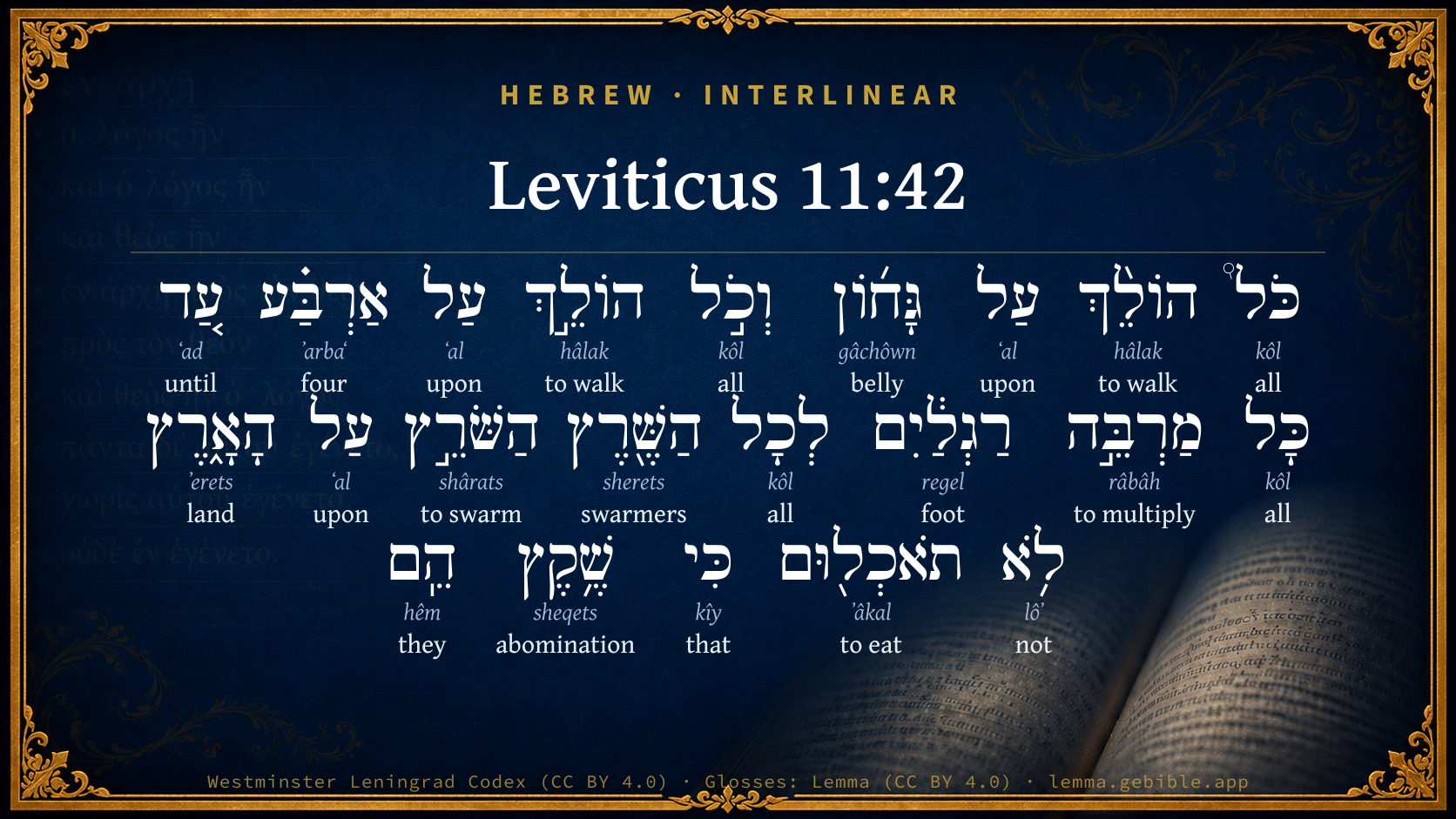
Leviticus 11:42

Hebrew (Westminster Leningrad Codex) Leviticus 11:42 appears in the Hebrew Old Testament. The text above is from the Westminster Leningrad Codex. Each word links to its Strong’s number, a concise gloss, and parsing drawn from the Open Scriptures Hebrew Bible morphology. Click any word for its full Brown-Driver-Briggs (BDB) entry.
Download image
Cite this verse

Leviticus 11:42 (World English Bible). Public Domain. Lemma interlinear Bible study tool, https://lemma.gebible.app/v/leviticus/11/42.

Show BibTeX & RIS
BibTeX
RIS
English Translation
Whatever goes on its belly, and whatever goes on all fours, or whatever has many feet, even all creeping things that creep on the earth, them you shall not eat; for they are an abomination.
World English Bible · Public Domain
Download a study sheet

One document with this verse’s original text, its word-by-word gloss line, the meaning frame, cross-references with their text, attributed commentary, and full source and license credits — printable, and it pastes into notes with its structure intact.

This verse Autodidact and up

Study sheet (.html) Plain text (.txt)

A passage Seminary Student

Up to 50 verses in one chapter. A passage sheet keeps up to 6 commentary sources and 12 cross-references per verse, in the order this page ranks them, and says so on the sheet whenever that leaves anything out. Ask for a single verse and you get the Autodidact verse sheet above.

Everything on this page stays free to read, with no account — the sheet is a download of what is already on screen, not access to it.

Want to remove ads? Support Godless Engineer
Compare translations 3

The same verse in 3 English versions, stacked beneath the original-language interlinear above. Click any original word for its lexicon entry.

Each is an independent rendering of the whole verse — the interlinear is not word-aligned to these translations.

Highlighted words mark where these versions differ — a whole-verse word diff, not a word-by-word alignment.

  • World English Bible Public Domain
    Whatever goes on its belly, and whatever goes on all fours, or whatever has many feet, even all creeping things that creep on the earth, them you shall not eat; for they are an abomination.
  • King James Version Public Domain
    Whatsoever goeth upon the belly, and whatsoever goeth upon all four, or whatsoever hath more feet among all creeping things that creep upon the earth, them ye shall not eat; for they are an abomination.
  • unfoldingWord Literal Text CC BY-SA 4.0
    Everything going on a belly and anything walking on four up to anything multiplying feet, of any swarming thing, the one swarming on the earth, you shall not eat them, because they a detestable thing.

unfoldingWord Literal Text — © unfoldingWord, licensed CC BY-SA 4.0. Word-aligned USFM3 via Door43 (git.door43.org/unfoldingWord/en_ult).

Versions to compare (up to 4)

3 of 4 selected

Show all 18 translations

Every available English version of this verse, each an independent rendering of the whole verse.

  • World English Bible Public Domain
    Whatever goes on its belly, and whatever goes on all fours, or whatever has many feet, even all creeping things that creep on the earth, them you shall not eat; for they are an abomination.
  • Berean Standard Bible Public Domain
    Do not eat any creature that moves along the ground, whether it crawls on its belly or walks on four or more feet; for such creatures are detestable.
  • Majority Standard Bible Public Domain
    Do not eat any creature that moves along the ground, whether it crawls on its belly or walks on four or more feet; for such creatures are detestable.
  • King James Version Public Domain
    Whatsoever goeth upon the belly, and whatsoever goeth upon all four, or whatsoever hath more feet among all creeping things that creep upon the earth, them ye shall not eat; for they are an abomination.
  • American Standard Version (1901) Public Domain
    Whatsoever goeth upon the belly, and whatsoever goeth upon all fours, or whatsoever hath many feet, even all creeping things that creep upon the earth, them ye shall not eat; for they are an abomination.
  • Revised Version (1885) Public Domain
    Whatsoever goeth upon the belly, and whatsoever goeth upon all four, or whatsoever hath many feet, even all creeping things that creep upon the earth, them ye shall not eat; for they are an abomination.
  • Geneva Bible (1599) Public Domain
    Whatsoeuer goeth vpon the breast, and whatsoeuer goeth vpon al foure, or that hath many feete among all creeping thinges that creepe vpon the earth, ye shall not eate of them, for they shalbe abomination.
  • Douay-Rheims (1899) Public Domain
    Whatsoever goeth upon the breast on four feet, or hath many feet, or traileth on the earth, you shall not eat, because it is abominable.
  • Young's Literal Translation Public Domain
    any thing going on the belly, and any going on four, unto every multiplier of feet, to every teeming thing which is teeming on the earth -- ye do not eat them, for they `are' an abomination;
  • Literal Standard Version CC BY-SA 4.0
    anything going on the belly, and any going on four, to every multiplier of feet, to every teeming thing which is teeming on the earth—you do not eat them, for they [are] an abomination;
  • Unlocked Literal Bible CC BY-SA 4.0
    Whatever crawls on its belly, and whatever walks on all four legs, or whatever has many feet—all the animals that creep on the ground, these you must not eat, for they are to be detested.
  • unfoldingWord Literal Text CC BY-SA 4.0
    Everything going on a belly and anything walking on four up to anything multiplying feet, of any swarming thing, the one swarming on the earth, you shall not eat them, because they a detestable thing.
  • Darby Bible Public Domain
    Whatever goeth on the belly, and whatever goeth on all four, and all that have a great many feet, of every manner of crawling thing which crawleth on the earth -- these ye shall not eat; for they are an abomination.
  • World Messianic Bible Public Domain
    Whatever goes on its belly, and whatever goes on all fours, or whatever has many feet, even all creeping things that creep on the earth, them you shall not eat; for they are an abomination.
  • Webster's Bible Public Domain
    Whatever goeth upon the belly, and whatever goeth upon all four, or whatever hath more feet among all creeping animals that creep upon the earth, them ye shall not eat; for they are an abomination.
  • Free Bible Version CC BY-SA 4.0
    Don't eat any animal that crawls along the ground, whether it moves on its belly or walks on four feet or many feet. All such animals are repulsive.
  • Bible in Basic English Public Domain
    Whatever goes on its stomach or on four feet or has a great number of feet, even all those going flat on the earth, may not be used for food, for they are disgusting.
  • JPS Tanakh (1917) Public Domain
    Whatsoever goeth upon the belly, and whatsoever goeth upon all fours, or whatsoever hath many feet, even all swarming things that swarm upon the earth, them ye shall not eat; for they are a detestable thing.

Literal Standard Version (2020), Covenant Press — licensed CC BY-SA 4.0. Text via the HelloAO Bible API (eBible.org). Unlocked Literal Bible (unfoldingWord) — licensed CC BY-SA 4.0. Text via the HelloAO Bible API (eBible.org). unfoldingWord Literal Text — © unfoldingWord, licensed CC BY-SA 4.0. Word-aligned USFM3 via Door43 (git.door43.org/unfoldingWord/en_ult). Free Bible Version, Dr. Jonathan Gallagher — licensed CC BY-SA 4.0. Text via the HelloAO Bible API (eBible.org).

Word by word

More ways to search: Search by grammar → Find every occurrence → Compare this word →

Practice this passage: Drill this verse → Learn its vocabulary →

גָּח֜וֹן
gâchôwn
H1512
“belly”
Noun, Common, Masculine, Singular, Absolute
Part of Speech
Noun
Type
Common
Gender
Masculine
Number
Singular
State
Absolute
Full BDB Definition

Origin: probably from H1518

TWOT: 342a

belly (of reptiles)
  1. כֹּל֩ kôl H3605 “all” Noun, Common, Masculine, Singular, Absolute
  2. הוֹלֵ֨ךְ hâlak H1980 “walking” Verb, Qal, Participle Active, Masculine, Singular, Absolute
  3. עַל ʻal H5921 “upon” Preposition
  4. וְכֹ֣ל kôl H3605 “and · all” Conjunction + Noun, Common, Masculine, Singular, Absolute
  5. הוֹלֵ֣ךְ hâlak H1980 “walking” Verb, Qal, Participle Active, Masculine, Singular, Absolute
  6. עַל ʻal H5921 “upon” Preposition
  7. אַרְבַּ֗ע ʼarbaʻ H702 “four” Adjective, Cardinal number, Feminine, Singular, Absolute
  8. עַ֚ד ʻad H5704 “until” Preposition
  9. כָּל kôl H3605 “all of” Noun, Common, Masculine, Singular, Construct
  10. מַרְבֵּ֣ה râbâh H7235 “multiplying” Verb, Hiphil, Participle Active, Masculine, Singular, Construct
  11. רַגְלַ֔יִם regel H7272 “feet” Noun, Common, Feminine, Dual, Absolute
  12. לְכָל kôl H3605 “to/for · all of” Preposition + Noun, Common, Masculine, Singular, Construct
  13. הַשֶּׁ֖רֶץ sherets H8318 “the · swarmers” Particle, Definite Article + Noun, Common, Masculine, Singular, Absolute
  14. הַשֹּׁרֵ֣ץ shârats H8317 “the · swarming” Particle, Definite Article + Verb, Qal, Participle Active, Masculine, Singular, Absolute
  15. עַל ʻal H5921 “upon” Preposition
  16. הָאָ֑רֶץ ʼerets H776 “the · land” Particle, Definite Article + Noun, Common, Both, Singular, Absolute
  17. לֹ֥א lôʼ H3808 “not” Particle, Negative
  18. תֹאכְל֖וּם ʼâkal H398 “to eat · them” Verb, Qal, Imperfect, 2nd Person, Masculine, Plural + Suffix, Personal, 3rd Person, Masculine, Plural
  19. כִּי kîy H3588 “that” Conjunction
  20. שֶׁ֥קֶץ sheqets H8263 “abomination” Noun, Common, Masculine, Singular, Absolute
  21. הֵֽם hêm H1992 “they” Pronoun, Personal, 3rd Person, Masculine, Plural

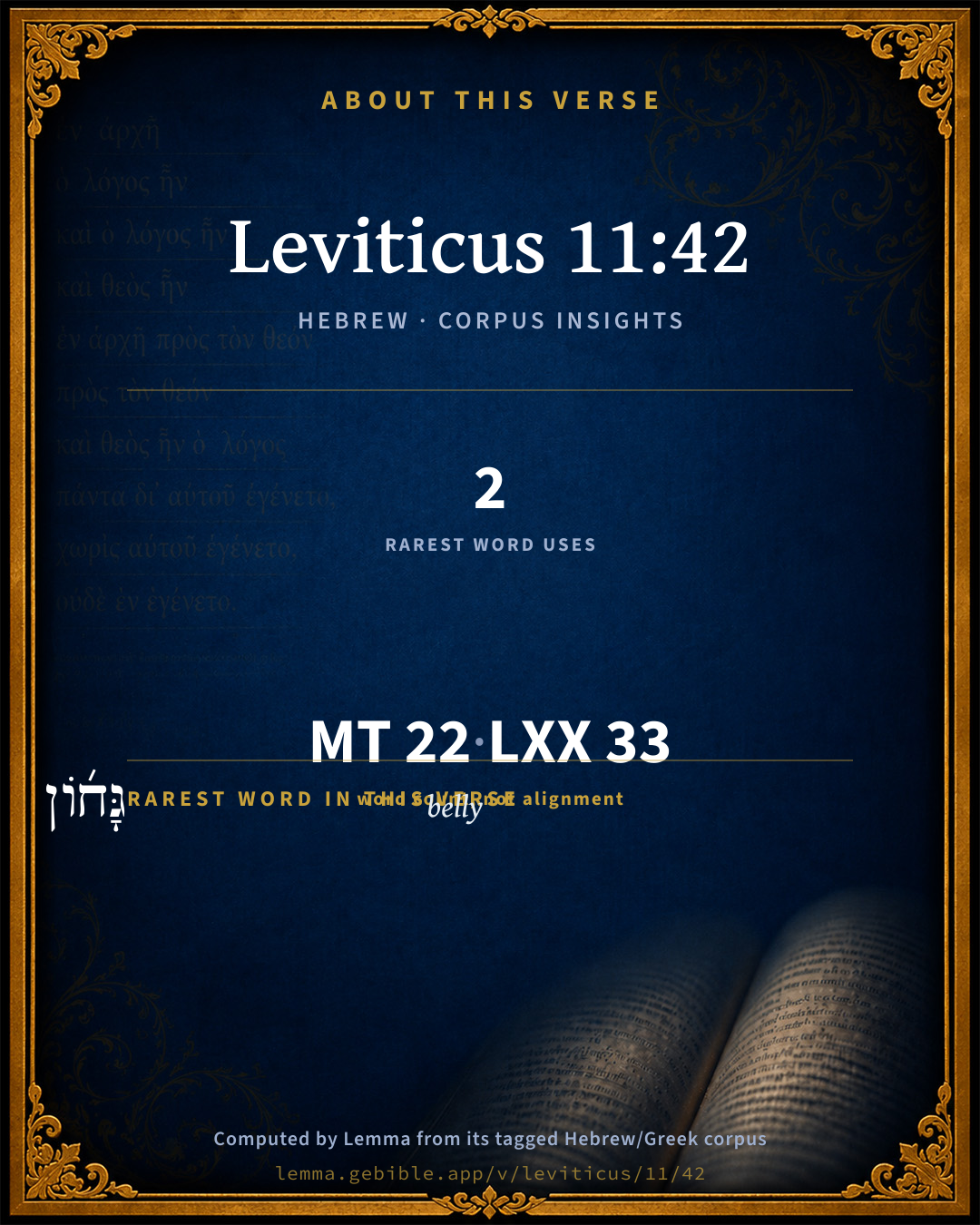
About this verse

These counts appear in no published source. They are computed here, from the morphology-tagged text and Lemma’s own curated glosses. What Lemma adds →

22
words
16
distinct lemmas
Pentateuch
section

Notable vocabulary

The rarest word here is גָּח֜וֹן belly H1512 — appearing just 2 times in the whole Hebrew Bible.

Shared distinctive vocabulary

גָּח֜וֹן belly H1512 occurs in 2 verses of the Hebrew Bible. Also found in:

Grammatical profile

  • 5 verbs
  • 9 nouns
  • 1 adjective
  • 1 pronoun
  • 4 prepositions
  • 1 conjunction
  • 1 particle

Verb forms

  • הוֹלֵ֨ךְ Qal · Participle Active
  • הוֹלֵ֣ךְ Qal · Participle Active
  • מַרְבֵּ֣ה Hiphil · Participle Active
  • הַשֹּׁרֵ֣ץ Qal · Participle Active
  • תֹאכְל֖וּם Qal · Imperfect

Repetition

Words recur within this verse — often emphatic in Hebrew:

  • כֹּל֩ all H3605 ×4
  • עַל upon H5921 ×3
  • הוֹלֵ֨ךְ to walk H1980 ×2

Hebrew & Septuagint length

In English translation the verse runs 35 words from the Hebrew and 40 from the Septuagint (LXX English) — closely comparable.

A rough comparison of the two English renderings, which tokenize alike — not a word-level alignment.

Word counts can differ between the Hebrew and the Greek without any difference in meaning — e.g. the Hebrew direct-object marker אֵת has no separate Greek word, and Greek often adds the article ὁ.

In the original languages it is 22 Hebrew tokens and 33 Greek tokens — but the two are counted differently (Hebrew bundles its prefixes and suffixes into one token; the Greek is in lemma form), so that isn’t a like-for-like length.

Cross-references

9

Topical passages linked to Leviticus 11:42 in the Treasury of Scripture Knowledge — connected by theme and wording, ordered by reader-vote popularity; previews shown in the World English Bible.

  • Genesis 3:14–15 Yahweh God said to the serpent, "Because you have done this, cursed are you above all cattle, and above every animal of the field. On your belly shall you go, and you shall eat dust all the days of your life.
  • Isaiah 65:25 The wolf and the lamb shall feed together, and the lion shall eat straw like the ox; and dust shall be the serpent's food. They shall not hurt nor destroy in all my holy mountain, says Yahweh.
  • Micah 7:17 They will lick the dust like a serpent. Like crawling things of the earth they shall come trembling out of their dens. They will come with fear to Yahweh our God, And will be afraid because of you.
  • Matthew 3:7 But when he saw many of the Pharisees and Sadducees coming for his baptism, he said to them, "You offspring of vipers, who warned you to flee from the wrath to come?
  • Matthew 23:23 "Woe to you, scribes and Pharisees, hypocrites! For you tithe mint, dill, and cumin, and have left undone the weightier matters of the law: justice, mercy, and faith. But you ought to have done these, and not to have left the other undone.
  • John 8:44 You are of your Father, the devil, and you want to do the desires of your father. He was a murderer from the beginning, and doesn't stand in the truth, because there is no truth in him. When he speaks a lie, he speaks on his own; for he is a liar, and the father of it.
  • 2 Corinthians 11:3 But I am afraid that somehow, as the serpent deceived Eve in his craftiness, so your minds might be corrupted from the simplicity that is in Christ.
  • 2 Corinthians 11:13 For such men are false apostles, deceitful workers, masquerading as Christ's apostles.
  • Titus 1:12 One of them, a prophet of their own, said, "Cretans are always liars, evil beasts, and idle gluttons."

Cross-references courtesy of OpenBible.info (CC BY 4.0).

Hebrew and Greek witnesses Masoretic Hebrew ↔ Greek Septuagint

The same verse in the two great witnesses to the Old Testament, shown verse-for-verse.

These are two independent witnesses, not word-aligned to each other, and the Septuagint is shown in lemma (dictionary) form.

Hebrew Leviticus 11:42 Masoretic · Westminster Leningrad Codex

כֹּל֩ הוֹלֵ֨ךְ עַל גָּח֜וֹן וְכֹ֣ל הוֹלֵ֣ךְ עַל אַרְבַּ֗ע עַ֚ד כָּל מַרְבֵּ֣ה רַגְלַ֔יִם לְכָל הַשֶּׁ֖רֶץ הַשֹּׁרֵ֣ץ עַל הָאָ֑רֶץ לֹ֥א תֹאכְל֖וּם כִּי שֶׁ֥קֶץ הֵֽם

Whatever goes on its belly, and whatever goes on all fours, or whatever has many feet, even all creeping things that creep on the earth, them you shall not eat; for they are an abomination.

World English Bible · Public Domain

Greek LXX Leviticus 11:42 Septuagint · lemma form

καί πᾶς ὁ πορεύομαι ἐπί κοιλία καί πᾶς ὁ πορεύομαι ἐπί τέσσαρες διά πᾶς ὅς πολυπληθέω πούς ἐν πᾶς ὁ ἑρπετόν ὁ ἕρπω ἐπί ὁ γῆ οὐ ἐσθίω αὐτός ὅτι βδέλυγμα σύ εἰμί

And every animal that creeps on its belly, and every one that goes on four feet continually, which abounds with feet among all the reptiles creeping upon the earth—you⌃ shall not eat it, for it is an abomination to you.

LXX2012 (modern English Septuagint) · Public Domain

Hebrew: Westminster Leningrad Codex (CC BY 4.0). Greek: Septuagint (public domain); English from LXX2012 (modern English Septuagint) (Public Domain). How the Septuagint differs from the Hebrew →

Targum (Aramaic paraphrase)

2

The Targum is the ancient Jewish Aramaic paraphrase of the Hebrew Scriptures — an interpretive translation, not the Hebrew text itself. Onkelos (literal) and Pseudo-Jonathan (expansive) render the Torah, and Jonathan the Prophets. Coverage is partial: where no permissively-licensed English translation exists for a verse, only the Aramaic is shown. This is verse-level text, not a word-by-word alignment to the Hebrew.

  1. Targum Onkelos Torah (Genesis–Deuteronomy)
    כֹּל דִמְהַלֵךְ עַל מְעוֹהִי וְכֹל דִמְהַלֵךְ עַל אַרְבַּע עַד כָּל סְגִיאוּת רַגְלָאִין לְכָל רִחֲשָׁא דְרָחֵשׁ עַל אַרְעָא לָא תֵיכְלֻנוּן אֲרֵי שִׁקְצָא אִנוּן

    (no public-domain English translation for this verse)

    Targum Onkelos — Aramaic: “Onkelos Genesis” (public domain); “Onkelos Exodus” (public domain); “Onkelos Leviticus” (public domain); “Onkelos Numbers” (public domain); “Onkelos Deuteronomy” (public domain). English: “Sefaria Community Translation” (CC0 1.0 (public-domain dedication)); “J.W. Etheridge. The Targums of Onkelos and Jonathan Ben Uzziel on the Pentateuch. London: Longmans, Green, 1862” (public domain). Text via Sefaria.

  2. Targum Pseudo-Jonathan Torah (Genesis–Deuteronomy)
    כָּל דִמְהַלֵךְ עַל מָעוֹי וְכָל דִמְהַלֵךְ עַל אַרְבַּע מִן חִיוְיָא וְעַד נַדַל דְמַסְגֵי רִיגְלִין בְּכָל רִיחֲשָׁא דִרְחֵישׁ עַל אַרְעָא לָא תֵיכְלוּנוּן אֲרוּם שִׁיקְצָא הִינוּן

    And whatever goeth upon its belly, and whatever animal crawleth upon four, from the serpent unto the caterpillar which hath many feet, of any reptile that creepeth upon the ground you may not eat, for they are an abomination.

    Targum Pseudo-Jonathan — Aramaic: “Targum Jonathan on Genesis” (public domain); “Targum Jonathan on Exodus” (public domain); “Targum Jonathan on Leviticus” (public domain); “Targum Jonathan on Numbers” (public domain); “Targum Jonathan on Deuteronomy” (public domain). English: “The Targum of Jonathan ben Uzziel, trans. J. W. Etheridge, London, 1862” (public domain). Text via Sefaria.

Commentary

Notes on Leviticus 11:42 from classic Christian and Jewish commentators (each source and its license shown beneath its notes). The classic Christian expositions comment on the surrounding passage and are grouped to its opening verse, so a note may address several verses; the Jewish commentaries on the Tanakh (Rashi and others) are per-verse, so they appear only where the commentator wrote on this verse.

Lemma curates 59 commentaries, every one of them public domain or Creative Commons licensed, each selected and text-cleaned for this edition rather than reprinted as found. About our sources →

Trapp's Complete Commentary

John Trapp

Lev 11:42 Whatsoever goeth upon the belly, and whatsoever goeth upon [all] four, or whatsoever hath more feet among all creeping things that creep upon the earth, them ye shall not eat; for they [are] an abomination.

Ver. 42. {See Trapp on "Lev 11:41"}

John Trapp, A Commentary or Exposition upon All the Books of the Old and New Testament (1647–1656) — public domain. Text from a community e-Sword module.

Adam Clarke's Commentary

Verse 42. Whatsoever goeth upon the belly] In the word גהון gahon, the vau holem, in most Hebrew Bibles, is much larger than the other letters; and a Masoretic note is added in the margin, which states that this is the middle letter of the law; and consequently this verse is the middle verse of the Pentateuch.

Whatsoever hath more feet] Than four; that is, all many-footed reptiles, as well as those which go upon the belly having no feet, such as serpents; besides the four-footed smaller animals mentioned above.

Adam Clarke's Commentary on the Bible (1810–1826) — public domain. Text from a community e-Sword/MySword module.

Ellicott's Commentary for English Readers

(42) Whatsoever goeth upon the belly.—In explanation of the general statement made in the preceding verse, three classes of creeping things are here adduced. (1) Those which move by the aid of the under part of the stomach, here described as “going upon the belly,” as serpents (see Gen_3:14) and serpentine worms.

And whatsoever goeth upon all four.—Those (2) which have four legs and yet move like reptiles, as scorpions, beetles, &c.

Or whatsoever hath more feet.—Better, whatsoever hath many feet, that is (3), those which have a number of such short feet that they cannot easily be discerned by the naked eye, and appear to crawl about upon their stomachs, as caterpillars, centipedes, millipedes, &c.

A Bible Commentary for English Readers, edited by Charles John Ellicott (1878–1897) — public domain. Text from a community e-Sword module.

John Gill's Exposition

Whatsoever goeth upon the belly,.... Jarchi's paraphrase is, "whatsoever goeth", as worms and beetles, and the like to them, "upon the belly", this is the serpent; and to go upon the belly is the curse denounced upon it, Gen 3:14 this and every such creature are forbidden to be eaten; as there are others who either have no feet, or what they have so short, that they seem to go upon their belly; and yet, as horrible and detestable as the serpent is, it has been the food of some, and accounted very delicious, as by a people mentioned by the Arabic geographer (e). Mela (f) speaks of a people, who, from their eating serpents, were called Ophiophagi, serpent eaters; and Pliny (g) says of the Troglodytes, that the flesh of serpents was their food. The Spaniards, when they first found out the West Indies, going ashore on the isle of Cuba, found certain spits of wood lying at the fire, having fish on them, about one hundred pound weight, and two serpents of eight feet long, differing nothing from the crocodiles in Egypt, but not so big; there is nothing, says my author (h), among the delicate dishes (of the natives of that place), they esteem so much as these serpents, insomuch that it is no more lawful for the common people to eat of them, than of peacocks and pheasants among us; the Spaniards at first durst not venture to taste of them, because of their horrible deformity and loathsomeness; but the brother of Columbus being allured by a sister of one of the kings of the country to taste of them, found them very delicious, on which he and his men fell to, and ate freely of them, affirming them to be of more pleasant taste than either our pheasants or partridges; and that there is no meat to be compared with the eggs of these serpents (i). Diodorus Siculus (k) speaks of serpents in the island of Taprobane of great size, harmless to men, and whose flesh is eaten, and of a sweet savour:

and whatsoever goeth upon all four; that is, whatsoever creeping thing; for otherwise there are beasts that go upon all four that are clean and fit to eat; but this is observed to distinguish this sort of creeping things from those that go upon their belly, and from those that have more feet, as in the next clause; Jarchi particularly instances in the scorpion:

or whatsoever hath mere feet among all creeping things that creep upon the earth; such as caterpillars, and particularly the Scolopendra, which the eastern people call Nedal; so Jarchi says, this is Nedal, a reptile which hath feet from its head to its tail, called Centipeda; and the Targum of Jonathan is, "from the serpent, to the Nedal or Scolopendra, which has many feet.'' Some of then, have seventy two, thirty six on a side, and others eighty four; some fewer, but all have many:

them ye shall not eat, for they are an abomination; abominable for food, and to be had in the utmost aversion. (e) Clim. 1. par. 6. (f) De Situ Orbis, l. 3. c. 8. (g) Nat. Hist. l. 5. c. 8. (h) Peter Martyr de Angleria, Decad. 1. l. 3. (i) Ib. l. 5. (k) Bibliothec. l. 3. p. 141.

John Gill's Exposition of the Whole Bible (1746–1763) — public domain (CC PDM 1.0). Text via the HelloAO Bible API.

Albert Barnes' Notes on the Bible

Whatsoever goeth upon the belly - i. e. all footless reptiles, and mollusks, snakes of all kinds, snails, slugs, and worms. “Whatsoever goeth upon all four;” i. e. “creeping things,” or vermin; such as the weasel, the mouse or the lizard. Whatsoever hath more feet; i. e. all insects, except the locust family (Lev 11:22 note), myriapods, spiders, and caterpillars.

Albert Barnes' Notes on the Bible (1834–1885) — public domain. Text from a community e-Sword/MySword module.

Haydock's Catholic Bible Commentary

Abominable. Serpents, worms, and reptiles are proscribed. (Menochius)

George Leo Haydock (1774–1849), Haydock's Catholic Family Bible and Commentary, 1859 edition — public domain. Excludes Psalms (Douay-Rheims chapter numbering differs from Protestant) and Deuterocanonical books (Catholic canon only).

Matthew Poole's English Annotations

Upon the belly, as worms and snakes.

Upon all four as toads and divers serpents.

More feet, to wit, more than four, as caterpillars, &c.

Matthew Poole's English Annotations on the Holy Bible (1683–1685) — public domain. Text from a community e-Sword/MySword module.

John Wesley's Explanatory Notes

Upon the belly - As worms and snakes, Upon all four - As toads and divers serpents.

John Wesley, Explanatory Notes Upon the Whole Bible (1754–1765) — public domain. Text via the GEBible commentary corpus.

Rashi

Rabbi Shlomo Yitzchaki (Rashi)

‎גחון‎ הולך על THAT GOETH ON THE BELLY — This is the serpent (Sifra, Shemini, Chapter 12 2; Chullin 67b), and the expression גחון denotes bending low, so that the phrase means: that which walks bent down and fallen upon its belly.

כל הולך EVERYTHING THAT GOETH — The word “everything” is employed to include worms and whatever is similar to anything similar to it (Sifra, Shemini, Chapter 12 2).

הולך על ארבע THAT GOETH UPON ALL FOUR — This is the scorpion (Sifra, Shemini, Chapter 12 2).

כל EVERYTHING [THAT GOETH UPON ALL FOUR] — The word “everything” is intended to include the beetle, — escarbot in O. F. — and whatever is similar to anything similar to it (Sifra, Shemini, Chapter 12 2).

מרבה רגלים [AND] WHAT HATH MANY FEET — This is the centipede (Sifra, Shemini, Chapter 12 2) — an insect which has feet from its head to its tail on both sides of its body, and it is called centpies in old French

Rashi on the Tanakh — English translations: “The Judaica Press complete Tanach with Rashi, translated by A. J. Rosenberg” (CC BY 4.0); “Pentateuch with Rashi's commentary by M. Rosenbaum and A.M. Silbermann, 1929-1934” (public domain); “The Metsudah Tanach series, Lakewood, N.J” (CC BY 4.0); and “The Book of Joshua, Metsudah Publications, 1997” (CC BY 4.0). Text via Sefaria.

Lesson kit

Teaching starters — assembled from the data on this page, not authored interpretation. Every prompt links to the verse data it draws on. Edit before teaching.

Leviticus, in the Pentateuch, opens this verse with 22 words (16 distinct Hebrew lemmas). Its most distinctive word is gâchôwn (“belly”). A historical commentator’s framing appears above. Read the whole chapter for the surrounding context.

Discussion questions

  1. How does “belly” (gâchôwn) shape what this verse is saying?
  2. Genesis 3:14 shares the word «belly» with this verse. How do the two illuminate each other?
  3. “all” occurs 4× in this one verse. What is the effect of the repetition?
  4. These translations render this verse differently. What is at stake in choosing one wording over another?
  5. The verb «הוֹלֵ֨ךְ» is Qal Participle Active. How does its form color the action?
  6. Reading how Trapp's Complete Commentary and Adam Clarke's Commentary read this verse, where do the two commentators agree and where do they part?

Things to notice

Reading settings

Reading text

Shown beneath each verse's original-language words.

Old Testament
Old Testament edition

Read the OT as the Masoretic Hebrew (MT) or the Greek Septuagint (LXX).

English shown for the Greek Septuagint (in the Hebrew ↔ Greek comparison).

Comparing translations? Open the Compare panel on any verse page to stack up to four side by side.